Archive | January 2021

Weizmann scientists date Santorini eruption with modern olive branch

Weizmann scientists date Santorini eruption with modern olive branch

HANNAH BROWN


The annual growth of the olive tree is not a simple story.
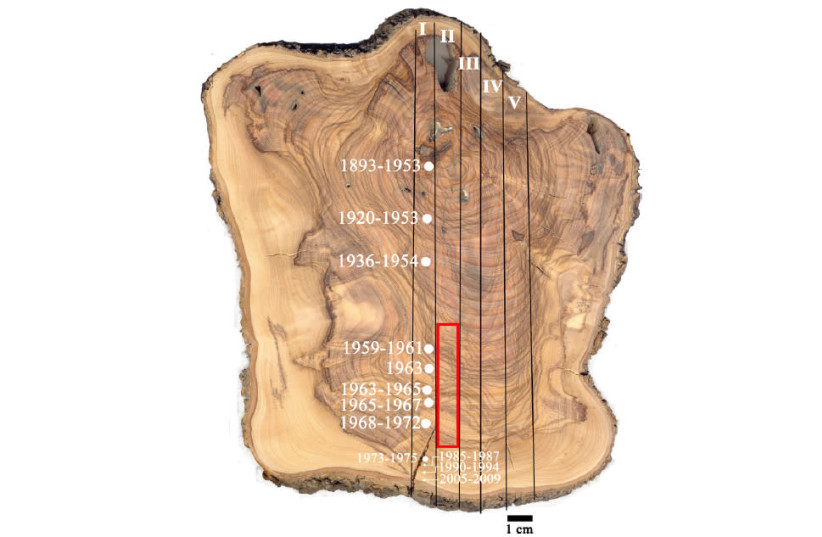
A cross section of a model olive-tree branch used to help date the Santorini volcanic eruption.  /  (photo credit: Courtesy)

When the volcano on the Mediterranean island of Santorini erupted over three thousand years ago – give or take a few hundred — it spewed lava, rocks and ash over a huge region. The ash from that eruption is so prevalent in the archaeological record of the region that it is used to date the strata above and below. But few agree on the chronological date of the eruption itself. That is why a single olive branch discovered in the ashes on Santorini has become the center of a recent controversy between archaeologists and chronologists.

Whereas some archaeologists place that date in the second part of the 16th century BCE, a study using radiocarbon dating and an analysis of the olive branch’s growth rings placed this volcanic eruption around 1630-1620 BCE, nearly a 100 years’ difference. Researchers in the lab of Prof. Elisabetta Boaretto, of the Weizmann Institute of Science in Rehovot’s Scientific Archaeology Department, have now shown how different methods could produce dates that agree, after all.

The Weizmann scientists focused on the fact that the annual growth of the olive tree is not a simple story. Although a cross section of olive wood does show somewhat concentric rings, the light and dark circles visible to the naked eye do not represent single years of growth. The darker rings may be a sort of staining, rather than signs of annual cycles. To get around this, the archaeological team studying the Santorini branch made use of micro computer tomography (microCT), finding slight variations in density that logically seemed to represent yearly growth. But Weizmann’s Prof. Boaretto, Dr. Yael Ehrlich and Dr. Lior Regev decided to go back to basics and ask: Do the variations noted in the microCT studies truly represent yearly growth rings, and, if so, would the last ring (and thus, its date) in the Santorini branch reveal the true date of the eruption?
Their answer was a resounding: sort of.

The team took a modern branch from an olive tree that was about 70 years old and dated its wood using several independent methods to study and date the growth of the rings. They applied microCT and high-resolution radiocarbon dating on various segments of a cross section. The researchers were looking to identify the “bomb peak” – a doubling of radiocarbon concentration in the atmosphere that occurred in the 1960s due to the atmospheric nuclear weapons testing of those years. With the Dangoor research accelerator in her lab, Boaretto and her team conducted100 radiocarbon determinations in segments of 20 mg of wood along the growth radius of the branch. With these high-resolution measurements, the Weizmann researchers mapped the inclusion in the wood of the nuclear-testing radiocarbon to the level of single month in Israel, and they compared it with the global radiocarbon distribution from that period. On the same material, the team measured two other isotopes of carbon (12C and 13C), and these revealed seasonal changes in growth.

The highlight of the experiment, says Boaretto, was that their method was so precise, they could even identify parts of the year when the trees add their new mass – that is, olive trees do undergo seasonal growth through the spring and into the summer, a process that tends to contribute to the forming of rings that are deposited annually. Moreover, they found that the boundaries between years can generally be observed with microCT. Even when the wood was charred (which is how wood material is usually found in archaeology), the dividing lines could be made out.

In a second highlight of the group’s high-resolution method, however, they found that in the outermost layers, just beneath the bark, the growth that comprised something like the last 30 years in their samples had run together a bit in a single band. That could call ring-counting methods into question, as the ring boundaries telling them exactly how many years it had grown in that period were missing. On top of that, they found that olive trees, as they get older, can stop adding wood to some or parts of their branches even as they continue to add new growth elsewhere. The boundaries between the still-active and the dead parts are invisible to the eye, but the radiocarbon method revealed a difference of 40 years in the apparent age between two different samples, both taken around the circumference of the branch. In other words, a sample taken from the outermost area of a cross-section of a branch, which might be thought to represent the age of the tree at the time of sampling, could actually appear to be 40 or more years younger than the tree’s true age. This insight suggested to Boaretto and her team a new interpretation for the absolute date given for the “last” ring in the Santorini branch.

The Weizmann team suggested that, while the original microCT study of the Santorini branch may have been counting real growth rings, there is a distinct possibility that the radiocarbon date obtained from the branch does not represent the date of the eruption, but rather an older date. The area the sample was taken from may have stopped growing decades before the eruption. Modeling different possible scenarios, such as non-ring-forming growth and supposing a premature end to growth in the branch, the team showed that the resulting new date ranges overlap with that of the archaeological evidence.

Determining the date of the eruption is important to archaeological research: Whether it occurred before or after 1570 BCE would have seruiys implications for other studies. This date is indeed related to the beginning of the so-called “New Kingdom” of Egypt – the period of extensive colonization and large pyramid building – and another significant signpost in the archaeological record. The original archaeological dating of the Santorini olive branch had put the eruption within the New Kingdom era; this chronological connection, or lack of connection, has significance for dating other findings in the Mediterranean region from this period.

“This is not the last word on the Santorini dating,” says Boaretto. “But it has highlighted, among other things, how we can use modern artifacts to check our dating methods, and why we need to continually return to the most basic questions. After setting the biological clock of an olive tree with radiocarbon, it is possible to better interpret a study in which the data comes from counting ancient olive tree rings.”

Boaretto’s research is supported by the head of the Helen and Martin Kimmel Center for Archaeological Science; the Dangoor Research Accelerator Mass Spectrometry Laboratory; the Instituto Serrapilheira; and Dana and Yossie Hollander. Boaretto is the incumbent of the Dangoor Chair of Archaeological Sciences.


Zawartość publikowanych artykułów i materiałów nie reprezentuje poglądów ani opinii Reunion’68,
ani też webmastera Blogu Reunion’68, chyba ze jest to wyraźnie zaznaczone.
Twoje uwagi, linki, własne artykuły lub wiadomości prześlij na adres:
webmaster@reunion68.com


Israeli air purifiers fight Covid in 400 UK, Irish buses

Israeli air purifiers fight Covid in 400 UK, Irish buses

Abigail Klein Leichman


Aura Air devices placed in tour coaches that are transporting essential workers to and from their jobs.

A bus equipped with an Aura Air air purification system. Photo courtesy of Aura Air

Four hundred touring coaches, repurposed to transport essential workers in the United Kingdom and Ireland, have been outfitted with air filtration and disinfection devices from Israeli startup Aura Air.

The device has a pre-filter to catch large particles of dust, pollen, insects and animal hair. A patented three-layer HEPA filter catches particles as small as 0.3 microns, absorbs volatile organic compounds and bad odors, and neutralizes viruses, bacteria, fungi and mold.

It also includes an ultraviolet LED-based component, the Sterionizer, which generates positive and negative ions to purify and freshen air.

The system’s sensors and algorithms constantly monitor and analyze particles in the air as well as temperature, humidity and carbon dioxide. Passengers can view results via an app, and alerts are sent to the driver if any levels go above a certain threshold indicating a possible hazard.

In pilots of the technology at a hotel and other locations in the United States, and at Sheba Medical Center in Israel, Aura Air neutralized various viruses, including the novel coronavirus SARS-CoV-2, at a rate of 99.9%.

Aura Air devices are sold to corporate customers such as schools, train stations and offices in Israel, Europe, the United States and the Far East, as well as to individual customers through the company’s website.

Aura Air was founded by brothers Aviad and Eldar Shnaiderman and and has 14 employees. The devices are manufactured in Israel in collaboration with Beit El Industries.


Zawartość publikowanych artykułów i materiałów nie reprezentuje poglądów ani opinii Reunion’68,
ani też webmastera Blogu Reunion’68, chyba ze jest to wyraźnie zaznaczone.
Twoje uwagi, linki, własne artykuły lub wiadomości prześlij na adres:
webmaster@reunion68.com


O chłopakach i dziewczynach z Kickiego. Tacy byliśmy w Marcu ’68


O chłopakach i dziewczynach z Kickiego. Tacy byliśmy w Marcu ’68

Antoni Sułek


Przy flaszce wódki w akademiku z zazdrością słuchaliśmy opowieści czeskich kolegów o manifestacjach w Pradze. Zapamiętałem jeden transparent: “Niech żyje Związek Radziecki – za swoje!”. To też wpłynęło na to, co mieliśmy w głowach w marcu 1968 r.

Antoni Sułek – profesor w Instytucie Socjologii Uniwersytetu Warszawskiego

Opiszę tamten czas na podstawie obserwacji uczestniczącej, bo w latach 1963-68 studiowałem socjologię na Wydziale Filozoficznym Uniwersytetu Warszawskiego i mieszkałem w nie mniej wówczas sławnym akademiku przy ul. Kickiego, na odległym od śródmieścia Grochowie.

Lata 60., czas „małej stabilizacji”, to okres, gdy nic wyrazistego się w Polsce nie działo. Jałowy bezruch sprawiał jednak, że nawet tak słabe bodźce jak wspomnienia wydarzeń sprzed lat i docierające do Polski echa idei z Zachodu były żywo odbierane i „mąciły w głowach”. Na studiach, choć nie na zajęciach, ale na otwartych dyskusjach organizowanych przez Związek Młodzieży Socjalistycznej, można było usłyszeć o koncepcjach politycznych partii komunistycznych w Europie Zachodniej. Zdaje się, że terminu „eurokomunizm” jeszcze wtedy nie było, ale na jednym z takich spotkań Karol Modzelewski mówił o „policentryzmie” Palmiro Togliattiego i przedstawiał go jako alternatywę ustrojową wobec „kierowniczej roli” partii komunistycznej w Polsce.

Ściana wielkich hieroglifów

W latach 60. rozwijał się konflikt radziecko-chiński i trwała „rewolucja kulturalna”. O jej obecności w wyobraźni studentów świadczy to, że mur na dziedzińcu UW, potocznie nazywany „ścianą płaczu” (tych, co nie znajdowali swych nazwisk na listach przyjętych na studia), zmienił w marcu 1968 r. nazwę na „ścianę wielkich hieroglifów”, a młodzi aktywiści gorliwie zwalczający ruch marcowy byli nazywani „hunwejbinami”. W akademiku przy Kickiego Piotr Żebruń, aktywny potem w marcu student filozofii, chodził do ambasady chińskiej i przynosił stamtąd „czerwone książeczki” z myślami Mao Zedonga. A sławny w marcu student Józef Dajczgewand mówił o „tysiącu kwiatów na 1000-lecie”, co było oczywistą aluzją do hasła Mao „Niech rozkwita sto kwiatów, a sto szkół myśli nich się ze sobą spiera”.

W dalekiej Azji toczyła się krwawa wojna w Wietnamie, kontestowana na amerykańskich kampusach. Gdy w marcu 1965 r. pierwsi marines wylądowali na plażach Da Nang, na UW odbył się wielki wiec protestacyjny, zdaje się, że zorganizowany z inspiracji studentów z krajów tzw. Trzeciego Świata. Nieoczekiwanie rozwinął się w dużą demonstrację uliczną, która doszła aż do ambasady wietnamskiej, skandując: „USA, żandarm świata”. Jej uczestnicy mogli poczuć słodycz udziału w kroczącym Nowym Światem proteście zbiorowym, a ci, co chcieli – także smak rozdawanych przez pracowników ambasady „papierosów wolności”.

Innym studentom okazji do uniesień kolektywnych dostarczały kościelne obchody milenijne. Ja sam, przeczytawszy „Psychologię tłumu” Le Bona, szukałem okazji do sprawdzenia, jak to jest. Poszedłem przed katedrę św. Jana witać wracającego z Rzymu kardynała Wyszyńskiego, wysłuchałem nawet kazania, ale moja własna dusza nie zdołała się stopić z „duszą zbiorową” zgromadzenia wiernych.

Bliżej niż Chiny i Wietnam była Czechosłowacja. Jesienią 1967 r. w Pradze doszło do manifestacji studenckich, a skończyło się na wyborze nowego I sekretarza KPCz, który nazywał się Dubczek. Jeszcze nim nastała Praska Wiosna i zaczęto mówić, że „Polska czeka na Dubczeka”, z Fakultetu Filozoficznego Uniwersytetu Karola przyjechali na Wydział Filozoficzny UW dwaj aktywiści. Przy flaszce wódki na Kickiego z zazdrością słuchaliśmy ich opowieści o manifestacjach w Pradze. Zapamiętałem jeden transparent: „Niech żyje Związek Radziecki – za swoje!”.

Papierosy Leszka Kołakowskiego

W 1966 r. mijało dziesięć lat od Polskiego Października, ale Gomułka nie obchodził jubileuszu postalinowskiej odwilży. W zbiorowej pamięci bardziej aktywnej części studentów zachowało się „Po prostu”, Klub Krzywego Koła i niespełnione nadzieje. W październiku 1966 r. duża sala w Instytucie Historycznym UW nie mogła pomieścić wszystkich chętnych, by posłuchać, co Leszek Kołakowski i Krzysztof Pomian myślą o ostatniej dekadzie. To, co studenci usłyszeli, miało na nich duży wpływ. Także dlatego, że Kołakowski był dla nich autorytetem, młodym profesorem o zniewalającej wiedzy, inteligencji i elokwencji. Studentki filozofii jak on nosiły swetry i paliły mocne papierosy, a ja sam wykułem na pamięć różne jego myśli. Z czasem je też zrozumiałem.

Rok 1966 był też rokiem dziesięciolecia powstania węgierskiego. Starsi studenci pamiętali z 1956 r. zbiórki pieniędzy „na Węgrów”, ale nawet oni o samym powstaniu niewiele wiedzieli, jeśli nie poszli do Biblioteki Uniwersyteckiej, by poczytać ówczesne roczniki „Po prostu”. W Kickim Radiu, akademikowym radiowęźle, Ryszard Polowczyk, student socjologii, w marcu 1968 r. wyrzucony ze studiów, zrobił wtedy tak świetną audycję o rewolucji węgierskiej, że do tej pory ją pamiętam, a Kickie Radio władza partyjna wzięła później pod but. Zawsze znajdowali się studenci chętni do pomocy partii w sprawowaniu „kierowniczej roli”.

Uniwersytet był wtedy silną „agendą socjalizującą”. Jak ktoś się znalazł na wydziale filozoficznym, to, chciał nie chciał, stawał się filozofem. Prawidłowość tę złamało dopiero w 1967 r. pojawienie się na filozofii nauk politycznych – garnęli się tam maturzyści z nadzieją karier politycznych w ówczesnym systemie (wiem, bo zbadałem ankietowo tych studentów). Jeszcze silniej socjalizował studentów akademik. Domy studenckie były miejscem uwspólniania doświadczenia studentów z różnych środowisk społecznych, miejscowości i kierunków studiów. Akademik na Kickiego był szczególny, bo pod jednym dachem gromadził studentów filozofii, socjologii, ekonomii politycznej i historii, wydziałów najbardziej niepokornych.

Ci młodzi ludzie znaleźli się na studiach w wyniku szczególnie ostrej selekcji, a było wśród nich wiele osób bystrych, ambitnych i ciekawych świata. W akademiku rośli jak na drożdżach i rozwijali swoje światopoglądy. Józef Dajczgewand demaskował narastający ruch moczarowski i założył niezależne od ZMS „Nowe Formy”, a w tamtejszym klubie U Bab na dyskusji o patriotyzmie studenci mogli usłyszeć od Stefana Kisielewskiego, w obecności płk. Zbigniewa Załuskiego, autora „Siedmiu polskich grzechów głównych”, że patriotyzm to w Polsce taka pała, którą władza wali w głowy przeciwników politycznych.

Umyślnie wymieniłem tu parę nazwisk studentów z Kickiego, znalazłem je na listach skreślonych ze studiów w 1968 r. W kolejne rocznice marca wspominamy z żalem tych, którzy wyjechali wtedy z Polski i bywa, że zrobili w świecie kariery – są wśród nich wybitni profesorowie i inni ludzie sukcesu. Czytamy w gazetach, ile wtedy „Polska straciła”. To prawda, ale ja myślę też o chłopakach i dziewczynach z Kickiego, którzy nigdzie nie wyjechali. Polska ich nie straciła, ale oni sami ponieśli wielką stratę. Przerwane, opóźnione i nigdy nieukończone studia nie pozwoliły im zostać tym, kim mogli i kim chcieli. Tę stratę trzeba nam wyraźniej dopisywać do smutnego bilansu marca sprzed 50 lat.


Zawartość publikowanych artykułów i materiałów nie reprezentuje poglądów ani opinii Reunion’68,
ani też webmastera Blogu Reunion’68, chyba ze jest to wyraźnie zaznaczone.
Twoje uwagi, linki, własne artykuły lub wiadomości prześlij na adres:
webmaster@reunion68.com


Antisemitism Requires Each of Us to Stand Up and Fight

Antisemitism Requires Each of Us to Stand Up and Fight

Sarah Victor


Memorial to Jewish children murdered by the Nazis, at Yad Vashem in Jerusalem, April 11, 2011. Photo: Avishai Teicher via Wikimedia Commons

Jewish people are the target of more religious bias hate crimes in the United States than people of all other religions combined. FBI hate crime statistics show that this has been true every year, dating back over the approximately 25 years that the FBI has been collecting this data. FBI statistics reveal that although Jewish people comprise 1.8% of the population in the United States, some 60.3% of crimes motivated by religious bias in 2019 took place against Jews. That year also saw a 56% spike in assaults against Jewish people — including lethal assaults — marking the highest number of incidents since the Anti-Defamation League began tracking this data in 1979.

These are more than mere numbers. They represent lives impacted. Seeing how these statistics play out in real life, I am struck by the different worlds my Jewish and non-Jewish friends inhabit amid these emerging realities. The deep visceral feeling of loss — not only in terms of physical safety but of indifference toward antisemitism — I encounter from my Jewish friends stands in stark contrast to the blasé ignorance I often hear from my non-Jewish colleagues in response.

A recent American Jewish Committee poll highlights this dichotomy: While 84% of Jewish people in the United States felt antisemitism has risen over the last five years, only 43% of those who are not Jewish felt the same.

Antisemitism doesn’t emanate from one ideology. It isn’t prepackaged in a box delivered by those with any singular viewpoint. Antisemitism is a hydra-headed monster that has found a foothold in premises ranging from religious fundamentalism to racial supremacy and far-left principles. As I have tried to better understand the root causes of antisemitism, I am consistently horrified by its ability to permeate new forums without ever changing form.

Modern-day conspiracies targeting Jews have been consistently preceded by ancient iterations of the same. We are seeing repeats of blood libels, accusations of dual loyalty, and the ever-reliable “Jews control the government and financial systems.” Yet, as societies, we continue to fall prey to them.

The phrase “never again” has been used in reference to Jewish history and, in particular, the Holocaust. But for this phrase to carry impact, it requires a willingness to continually enter into the suffering that has occurred: something we must do when we encounter antisemitism in the present as well. We must work to understand the pain that has been endemic to the Jewish experience.

Antisemitism has plagued every continent and political system imaginable throughout history. And perhaps we too, have unknowingly become imprisoned in the insidious imagination of the stereotypes and misinformation that continually haunt societal representations of Jewish people. If we truly care about our Jewish neighbors, it means caring enough to recognize the dark threads connecting the ideologues we distance ourselves from with the ideology that we are willing to allow ourselves the space to indulge in — the foundation that lies may provide to our personal prejudice.

But changing our mindset has to transcend our thoughts — and influence our personhood — to be truly effective.

Taking on a role in addressing antisemitism inevitably requires a willingness to embrace discomfort. It can be incredibly uncomfortable to recognize one’s own prejudice. It can also be incredibly uncomfortable to respond to those around us. But hate is given credence when we minimize its impact on our consciousness. We are shaken for a moment when we see its potency but then default to the comfortable routines of life. The wronged then become the accused: they are overreacting, after all.

At a basic level, the way we respond to antisemitism reflects whether or not we will treat someone the way we would like to be treated. To love our neighbor means to care enough about their life and dignity to put our own lives on the line. If a Jewish person is scared to identify as or even be Jewish because of the physical violence or insults that accompany this, will we be willing to be there? Will we associate ourselves with, and speak up on behalf of, those who are so targeted? As Elie Wiesel said, “The opposite of love is not hate, it’s indifference.” We cannot be indifferent.

Speaking up is important because we cannot afford to allow antisemitism to be framed as atomized incidents of happenstance, instead of the serious systemic issue that it is. I have found that many people I speak to are simply unaware of the prevalence of antisemitism, yet are receptive to learning more about its realities.

But you can be part of such change only if you recognize that it is up to you and take on the challenge. I hope that at this moment in history, you will choose to care about antisemitism. That you diligently seek to understand the pain and the past of antisemitism. That you will, in humility, take the scary step of choosing to use your voice in your communities. That you will care enough to step beyond your comfort zone when you engage.

Never again means we have to be willing to rise up again and again — not just when it’s convenient or glamorous or when the answers are readily apparent. To quote Holocaust historian Professor Yehuda Bauer, “Antisemitism is not a Jewish illness, but a non-Jewish one.” Shouldn’t we be trying to cure it?


Sarah Victor is a publishing Adjunct at The MirYam Institute. She is a graduate of Cornell University’s School of Industrial and Labor Relations and Temple University Beasley School of Law. She spent additional semesters at Tsinghua University in Beijing, China and Tel Aviv University.

The MirYam Institute is the leading international forum for Israel-focused discussion, dialogue, and debate; focused on campus presentations, engagement with international legislators, and gold-standard trips to the State of Israel. Follow their work at www.MirYamInstitute.org.


Zawartość publikowanych artykułów i materiałów nie reprezentuje poglądów ani opinii Reunion’68,
ani też webmastera Blogu Reunion’68, chyba ze jest to wyraźnie zaznaczone.
Twoje uwagi, linki, własne artykuły lub wiadomości prześlij na adres:
webmaster@reunion68.com


The Spielberg Jewish Film Archive – Jerusalem of Light

The Spielberg Jewish Film Archive – Jerusalem of Light

   Hebrew University of Jerusalem


Abstract: A compilation of clips, marking the 40th anniversary of Jerusalem’s reunification, depicting Jerusalem from 1911 to the 1970s.

The Spielberg Jewish Film Archive –
The 400 films, selected for the virtual cinema, reflect the vast scope of documentary material collected in the Spielberg Archive. The films range from 1911 to the present and include home movies, short films and full length features.

שם: ירושלים של אור
שנה: 2007
אורך: 01:10:00
שפה: עברית

תקציר: אוסף קטעי ארכיון לציון ארבעים שנה לאיחודה של ירושלים, המשרטט את דיוקנה של העיר משנת 1911 ועד לתחילת שנות התשעים.

ארכיון הסרטים היהודיים על שם סטיבן שפילברג –
חמש מאות הסרטים שנבחרו עבור הקולנוע הווירטואלי משקפים את ההיקף הנרחב של החומר התיעודי בארכיון שפילברג. באתר ישנם סרטים משנת 1911 ועד ימינו אלה ביתיים, קצרים ובאורך מלא.

כל הזכויות שמורות לארכיון הסרטים היהודיים על שם סטיבן שפילברג ולאוניברסיטה העברית בירושלים 2010; דף הבית; www.spielbergfilmarchive.org.il
http://multimedia.huji.ac.il/


Zawartość publikowanych artykułów i materiałów nie reprezentuje poglądów ani opinii Reunion’68,
ani też webmastera Blogu Reunion’68, chyba ze jest to wyraźnie zaznaczone.
Twoje uwagi, linki, własne artykuły lub wiadomości prześlij na adres:
webmaster@reunion68.com