Archive | January 2022

Israel’s mines had ‘Start-Up Nation managers, engineers’ 3,000 years ago

Israel’s mines had ‘Start-Up Nation managers, engineers’ 3,000 years ago

ROSSELLA TERCATIN


New TAU research suggests it was their ability to work the Arava mines, rather than connections to the Egyptian empire, that succeeded.

Slaves’ Hill in the center of the Timna Valley. / (photo credit: Erez Ben-Yosef and the Central Timna Valley Project.)

Some 3,000 years ago, the copper industry in the Arava Valley – located between modern southern Israel and Jordan – thrived thanks to the ability of its managers, rather than because of technologies imported from the Egyptian empire, new research by Tel Aviv University has suggested.

“It appears that the secret of the success of the ancient copper industry in the Arava lies in the skills and abilities of efficient managers, who were assisted at every stage of their decision-making by talented technological experts,” said TAU’s David Luria, who conducted the study published in the academic journal PLOS ONE.

Luria considered the two main mining areas in the region, Timna, which is north of Eilat, and Faynan in Jordan.

The mines at Timna were traditionally associated with King Solomon and the Kingdom of Israel – until an excavation at the end of the 1960s revealed a small Egyptian temple that was understood as evidence the mining activity was related to Egypt and dated back to the 13th century BCE, some 200 years before King David.

However, after TAU archaeologists began to excavate again in 2013, radiocarbon dating of organic material proved that the most intense activity of the site happened around 1,000 BCE, the time of David and Solomon, when Egypt was no longer powerful.
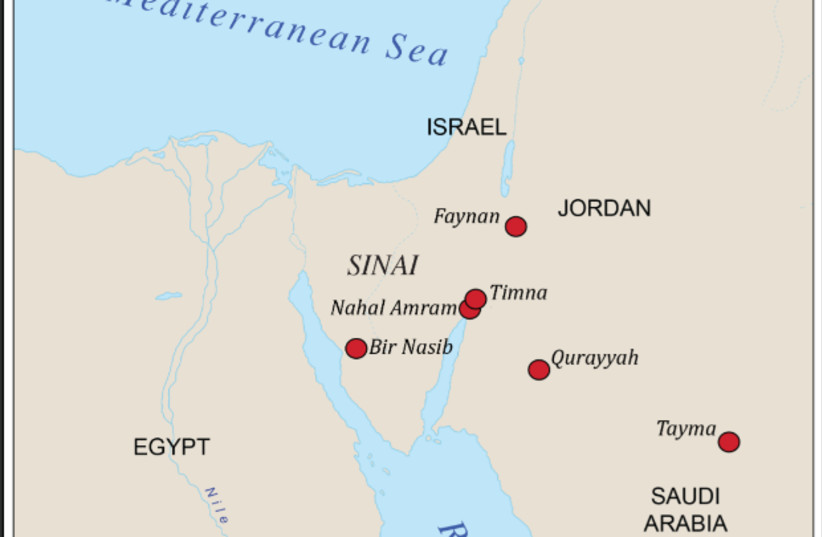
Map of the Arava Valley copper industry (credit: TEL AVIV UNIVERSITY)

Between 1200 BCE and 850 BCE, when the operations abruptly stopped, the quantity of slag produced increased from 1,600 tons to 23,000 tons.

However, many scholars suggested that the high technological level displayed at the mines still originated from Egypt, specifically from a trip to the region by Egyptian Pharoah Shishak in 925 BCE. In 2014, a scarab bearing the figure of Shishak was discovered in Faynan. The king is also mentioned in the Bible.

“In the fifth year of King Rehoboam, King Shishak of Egypt marched against Jerusalem and carried off the treasures of the House of the Lord and the treasures of the royal palace. He carried off everything; he even carried off all the golden shields that Solomon had made,” reads a passage in the Book of Kings.

However, according to Luria, the goal of Pharoah Shishak’s incursion was of a different nature.

“Shishak’s expedition was not intended to physically take over the copper mines in the Arava, but rather to formulate a long-term agreement with the Arava people in order to bolster local production and thus increase copper exports to Egypt, which was suffering from local production difficulties at the time,” he said.

Luria suggested that the ancient workers at the mine relied on two systems to advance the industry, known today as “trial and error” and “scaling up.” The first implied slowly working to improve the techniques employed; the second was increasing the dimensions of production using materials and processes widely available.

“Obviously these terms were not in use in ancient times, but the application of their practical principles was made possible due to a basic understanding of engineering and common sense, which were seen in other places in the ancient world as well,” he said.

While it is impossible to know who these creative managers were, it has been possible to clearly track their work through deposits left in the mining sites, Luria said.

“These findings are the residues of copper production that have accumulated as heaps of waste that can be dated and whose size allows us to assess the volume of production at any given time,” he said. “Moreover, by conducting a chemical analysis of the copper content remaining in the waste, we can determine the quality of the production; when the amount of copper in the waste diminishes, we can conclude that the process had become more efficient.”

Luria was also able to determine that waste from an earlier period started to be reused to extract the large quantities of copper still present, which also showed a high level of technological skills and the ability to check the amount of copper present in the material.

“The important lesson to take away from this technological success is that the hi-tech savvy of individuals – educated and energetic people who lived here in the first millennium BCE – succeeded, just like it does today, in bringing about a huge revolution in the local economy,” Luria concluded. “As they say, there is nothing new under the sun.”


Zawartość publikowanych artykułów i materiałów nie reprezentuje poglądów ani opinii Reunion’68,
ani też webmastera Blogu Reunion’68, chyba ze jest to wyraźnie zaznaczone.
Twoje uwagi, linki, własne artykuły lub wiadomości prześlij na adres:
webmaster@reunion68.com


News From Israel- January 17, 2022

News From Israel- January 17, 2022

ILTV Israel News


Two IDF officers were killed by friendly fire overnight in the Jordan Valley

Israeli security services un-covers an Iranian attempt to recruit Israeli spies

The daily number of coronavirus cases reaches an all time high, a quarter of a million people already infected since the beginning of the new year


Zawartość publikowanych artykułów i materiałów nie reprezentuje poglądów ani opinii Reunion’68,
ani też webmastera Blogu Reunion’68, chyba ze jest to wyraźnie zaznaczone.
Twoje uwagi, linki, własne artykuły lub wiadomości prześlij na adres:
webmaster@reunion68.com


Licytacja w niemieckiej prasie na liczbę ofiar “żydowskich” i “nieżydowskich”

Licytacja w niemieckiej prasie na liczbę ofiar “żydowskich” i “nieżydowskich”

Jan Grabowski
[ 2 maja 2021 ]


Hanna Radziejowska – kierowniczka oddziału Instytutu Pileckiego w Berlinie (Fot. Franciszek Mazur / Agencja Gazeta)

Magiczną liczbę “trzy miliony zabitych Polaków” stworzył na użytek partyjnej propagandy Jakub Berman w 1945 r. Jak widać po lekturze wywiadu z Hanną Radziejowską, dla polskich urzędników od historii ustalenia Bermana najwyraźniej są już niewystarczające.

.

Na łamach prestiżowego niemieckiego tygodnika „Der Spiegel” ukazał się wywiad Jana Puhla z Hanną Radziejowską, szefową filii Instytutu Pileckiego (tłumaczenie na stronie IP) w Berlinie. Dla mniej obeznanych z tematem czytelników śpieszę wyjaśnić, że IP to taki IPN light, kolejna instytucja rzucona przez władze na front walki ideologicznej prowadzonej na polach historii w ramach Polskiej Polityki Historycznej (PPH).

Wywiad nosi tytuł „Niemcy nie wiedzą prawie nic” („Die Deutschen wissen fast nichts”), co – w kontekście wcześniejszych wypowiedzi p. Radziejowskiej – jest zabiegiem dość ryzykownym. Tak się bowiem składa, że kilka miesięcy temu szefowa filii IP w Berlinie oznajmiła tryumfalnie w mediach (polskich i niemieckich), że wraz z pracownikami swej placówki odkryła nieznane dotąd historykom źródła, które rzucają światło na wcześniej nieznany wymiar pomocy niesionej Żydom przez Polaków podczas wojny.

W rzeczywistości źródła te (świetnie znane od wielu lat badaczom Zagłady) przekazywały polskie władze komunistyczne władzom RFN w latach 60. i 70. ubiegłego wieku. W sposób konsekwentny polska strona usuwała z nich wówczas jakiekolwiek wzmianki o udziale Polaków w zbrodniach na Żydach. Gdyby ktoś dziś chciał na podstawie tych akt zrozumieć, co tak naprawdę wydarzyło się w Jedwabnem, to doszedłby do wniosku, że mordu dopuścili się Niemcy bez jakiegokolwiek udziału Polaków. Co było oczywiście zgodne z linią partyjną za czasów Moczara – i co niestety nadal jest zgodne z linią partyjną dzisiaj, w 2021 r.

„Przebicie” liczby wymordowanych polskich Żydów

Mając w pamięci niedawny popis niewiedzy p. Radziejowskiej, z tym większym zainteresowaniem oddałem się lekturze wywiadu ze „Spiegla”. Szefowej IP w Berlinie nie podoba się to, że mało kto w Niemczech zdaje sobie sprawę, że „wśród sześciu milionów ofiar Holokaustu, trzy miliony były polskimi obywatelami”. Z kolejnego zdania dowiadujemy się, że Niemcy nie wiedzą, że podczas wojny zginęło „ponad trzy miliony nieżydowskich Polaków”.

Niemiecki dziennikarz mógłby w tym miejscu zauważyć, że po pierwsze, polscy Żydzi nie dlatego ginęli, że mieli polskie obywatelstwo, lecz dlatego że byli Żydami.

A po drugie nikt poważny nie twierdzi, że podczas wojny zginęły „ponad trzy miliony nieżydowskich Polaków”. To już jest czysty wymysł, którego jedynym celem jest „przebicie” liczby wymordowanych polskich Żydów.

Magiczną liczbę „trzy miliony zabitych Polaków” stworzył na użytek partyjnej propagandy Jakub Berman w 1945 r. Jak widać, w 2021 r. dla polskich urzędników od historii ustalenia Bermana najwyraźniej są już niewystarczające.

„Nasze” ofiary to „księża i intelektualiści”

Wywiad jest dość przypadkową zbitką nieskładnych komentarzy, które niejednokrotnie stoją w sprzeczności same do siebie. Pomimo licytacji na liczbę „żydowskich” i „nieżydowskich” ofiar Radziejowska zapewnia w chwilę później, że Polacy nie są zainteresowani konkurowaniem na liczbę ofiar. Naprawdę?

Urzędniczka IP postuluje też, aby pamięci o Annie Frank towarzyszyła pamięć o „doświadczeniach Żydów ze wschodnich sztetli”. To ładnie, ale już w następnym zdaniu Radziejowska sama sobie przeczy, ubolewając nad tym, że Niemcy z podejrzliwością traktują kategorię „narodu”, chętniej mówiąc o tragedii Żydów, Romów czy homoseksualistów. I przypomina, że „nasze ofiary miały narodowość – polską”. „Nasze” ofiary w pojęciu szefowej berlińskiej filii IP to „księża i intelektualiści”, ofiary terroru okupanta skierowanego przeciwko polskim elitom. To ciekawe, jak szybko okazuje się, że w oczach polskich propagandystów spod znaku PPH „nasze” ofiary definiowane są w sposób etniczny, na gruncie pochodzenia i krwi.

Hanna Radziejowska i polska polityka historyczna

Na trafne pytanie dziennikarza o to, że IP jest po prostu narzędziem polityki historycznej polskich prawicowych i populistycznych władz, Radziejowska odpowiada, że przecież powołanie IP odbyło się za zgodą wszystkich partii, również opozycyjnych.

Niestety, to prawda – PPH cieszy się poparciem wychodzącym poza granice ław poselskich zajmowanych przez polskich nacjonalistów

Nie tak w końcu dawno opozycja głosowała ramię w ramię z rządem w sprawie oddania honoru żołnierzom Brygady Świętokrzyskiej NSZ, przypominając wszystkim, że wiara w historyczne mity stanowi jeden z ostatnich obszarów, gdzie Polacy wszystkich zapatrywań schodzą się jak jedna rodzina. Sursum corda!

Na sam już koniec p. Radziejowska w odpowiedzi na pytanie o procesy wytaczane dziś w Polsce historykom śmiało odparła, że pozew cywilny wytoczony mnie i prof. Barbarze Engelking to zwykła sprawa, jakich wiele (choćby i w Niemczech), i że chodzi po prostu o obronę czci pewnego wujka i jego bratanicy. Czyżby szefowa IP w Berlinie nie słyszała o atakach na niezależnych historyków prowadzonych od dawna przez IPN, MSZ, ministra Ziobrę czy też przez jej własną instytucję? Czyżby nie słyszała o tym, że w procesie nie chodzi o „godność wuja”, lecz o przyszłość badań historycznych w Polsce?

Jako że nie bardzo wypada mi się odnosić do własnej sprawy, pozostawię to bez dalszego komentarza, ale chciałbym, żeby pozostał na papierze ślad tych przemyśleń. Rolą historyka jest również dokumentowanie słów i czynów ludzi biorących udział w ataku na polską historię. A poza tym, jak już przyjdzie czas likwidowania instytucji takich jak IPN czy IP, to wypowiedzi ich urzędników będą miały wagę dowodową.


Prof. Jan Grabowski – historyk, badacz Holocaustu; pracuje na University of Ottawa


Zawartość publikowanych artykułów i materiałów nie reprezentuje poglądów ani opinii Reunion’68,
ani też webmastera Blogu Reunion’68, chyba ze jest to wyraźnie zaznaczone.
Twoje uwagi, linki, własne artykuły lub wiadomości prześlij na adres:
webmaster@reunion68.com


Ancient underwater treasure found in Caesarea with Christian gold ring

Ancient underwater treasure found in Caesarea with Christian gold ring

ROSSELLA TERCATIN


Maritime archaeologists found several precious artifacts, hundreds of silver coins from two shipwrecks dating over a millennium apart in the ancient harbor.

.
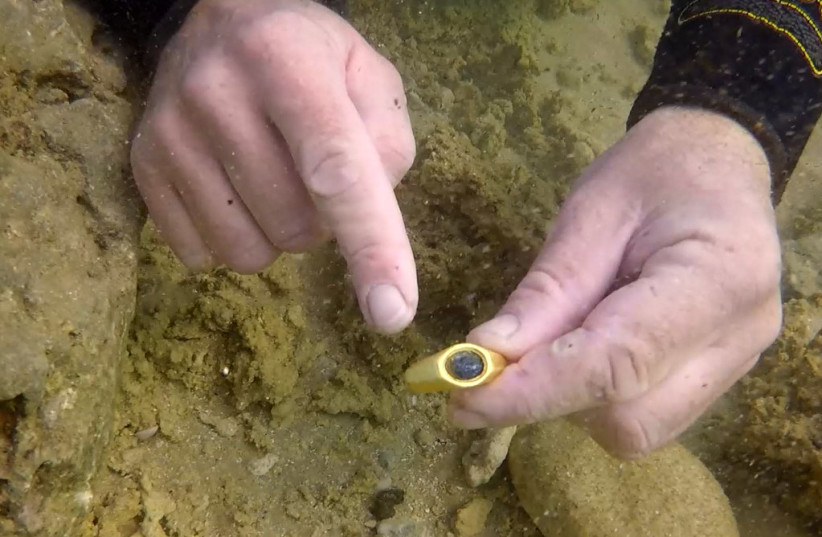
The underwater discovery of the gold ring. / (photo credit: ISRAEL ANTIQUITIES AUTHORITY MARINE ARCHAEOLOGY UNIT)

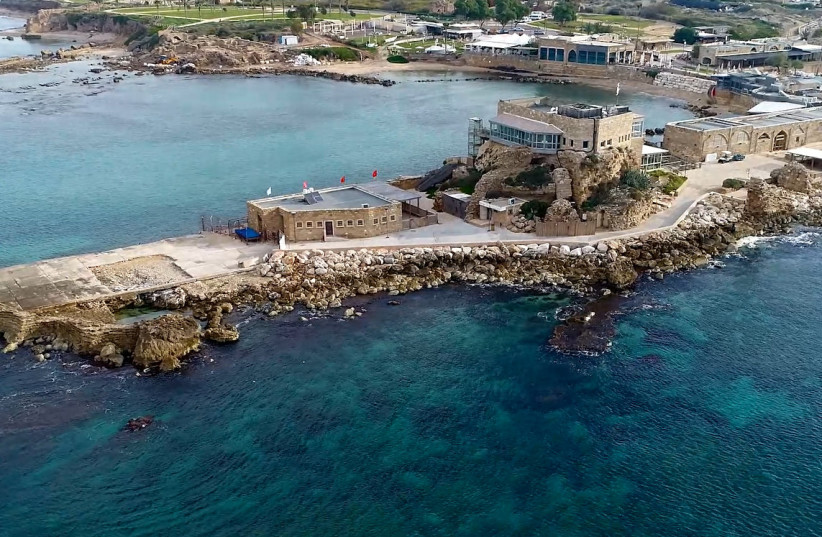
Some time ago, a team of divers from the Antiquities Authority’s (IAA) Marine Archaeology Unit was surveying an area just outside the harbor of Caesarea, as they routinely do off the entire coast of Israel.

“We spotted a broken metal anchor and decided to see if there was more in the area,” said archaeologist Jacob Sharvit. “We soon started to find many other artifacts.”

That diving led to the discovery of an incredible underwater treasure, from two ancient ships dating back to the third and 14th centuries CE that wrecked in the same spot just meters off the coast – over 1,000 years apart, as the IAA revealed Wednesday. The treasures included hundreds of coins and some unique jewelry.

First established in the fourth century BCE, in the first century, Caesarea was selected by Herod to build a port city. The city remained an important center throughout the Roman and Byzantine times.

The artifacts from the Roman period included silver and bronze coins – which allowed the expert to date the findings – a precious gemstone with a lyre carved on the surface, bronze bells, an eagle figurine, symbol of the Roman rule, another figurine shaped like a dancer wearing a comic mask, and pottery vessels.

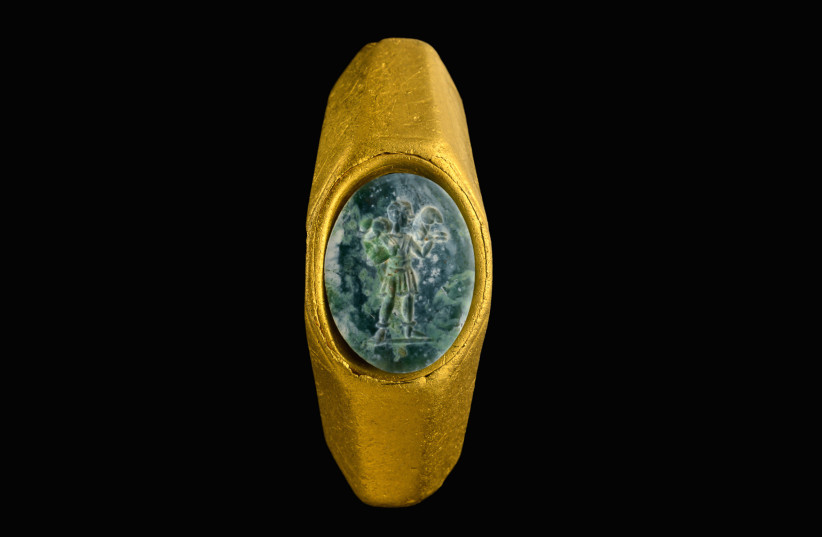
Gold ring with gemma engraved with the figure of the Good Shepherd. (credit: DAFNA GAZIT/ISRAEL ANTIQUITIES AUTHORITY)

“We were surprised by the quantity of bells we uncovered,” said Sharvit. “It is possible that the sailors used them to fish with fish nets during the night, or maybe they were part of the cargo and were goods to sell.”

Perhaps the most extraordinary find, however, was the gold ring. Thick and shaped as an octagon, the ring carried a green stone with the figure of a young shepherd wrapped in a tunic and carrying a lamb on his shoulders engraved on it. The “good shepherd” is one of the earliest expressions to refer to Jesus, used multiple times in the Gospels.

“I am the good shepherd,” reads a verse in John. “The good shepherd lays down his life for the sheep.”

“We know that similar images were found in the Christian catacombs in Rome,” said Helena Sokolov, a curator at the IAA Coin Department.
Caesarea was home to an important early Christian community and it is mentioned several times in the New Testament.

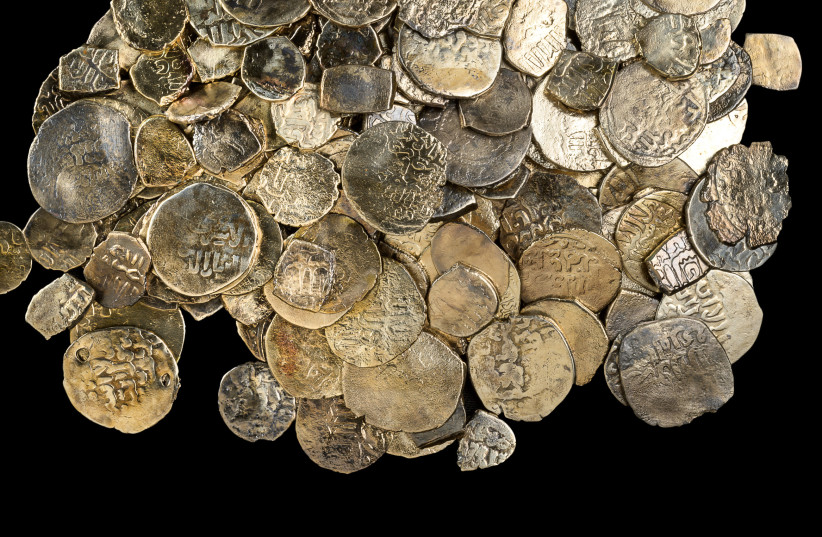
Hoard of coins from the Mamluk period including cut coins. (credit: DAFNA GAZIT/ISRAEL ANTIQUITIES AUTHORITY)

Among others, the Roman centurion Cornelius is said to have been baptized here by the apostle Peter (Acts 10:10).

“This was the first instance of a non-Jew being accepted into the Christian community,” said Sharvit. “From here, the Christian religion began to be disseminated across the world.”

The more modern ship was carrying a hoard of about 560 silver coins from the Mamluk period.

Caesarea port, aerial view. (credit: YAAKOV SHMIDOV/ISRAEL ANTIQUITIES AUTHORITY)

The expert said it is not possible to determine to whom the ship belonged.
The best time to go explore maritime sites is after storms, he noted, when the currents shift sands and new remains emerge.

“We are planning to go back to the site as soon as this storm passes,” he said, referring to the Carmel storm that has been battering Israel for days.


Zawartość publikowanych artykułów i materiałów nie reprezentuje poglądów ani opinii Reunion’68,
ani też webmastera Blogu Reunion’68, chyba ze jest to wyraźnie zaznaczone.
Twoje uwagi, linki, własne artykuły lub wiadomości prześlij na adres:
webmaster@reunion68.com


What do Israelis think of Poland? Street interview in Tel-Aviv, Israel

What do Israelis think of Poland? Street interview in Tel-Aviv, Israel

UBA


Hello! Today I’d like to present you a special video on my channel – we filmed a street interview in Tel-Aviv. We were asking people of Tel-Aviv what comes to their mind when they think about Poland.
A lot of Polish people are wondering and would like to know what Israelis think about Poland. We all know that politicians and mass media are not helping with this relation – everything is always extreme, there is a lot of conflict and bad blood. Of course, the history is very hard, but it connected the people of Poland and the people of Israel forever. This is why we recorded this street interview – to show what the normal citizens of Israel think about Poland.
A lot of people said that they associate Poland with Holocaust, which is absolutely valid – the history is still alive and painful. There were also people who mentioned other things such as: culture, Chopin, food, vodka, pierogi and Jan Błachowicz, the MMA fighter. Surprisingly, nobody mentioned Robert Lewandowski or John Paul II 🙂
I was nicely surprised to meet 2 Polish speakers and a lot of people with Polish origins. Poles are everywhere!
Please, let me know if you liked this street interview in Israel. Also – what do you think that Polish people would say about Israel if we did the same interview in Warsaw?


Zawartość publikowanych artykułów i materiałów nie reprezentuje poglądów ani opinii Reunion’68,
ani też webmastera Blogu Reunion’68, chyba ze jest to wyraźnie zaznaczone.
Twoje uwagi, linki, własne artykuły lub wiadomości prześlij na adres:
webmaster@reunion68.com