
Archive | December 2022

Jewish Life Is Cheap

Jewish Life Is Cheap

ASHLEY RINDSBERG


Just look at how it’s treated in the media.
.
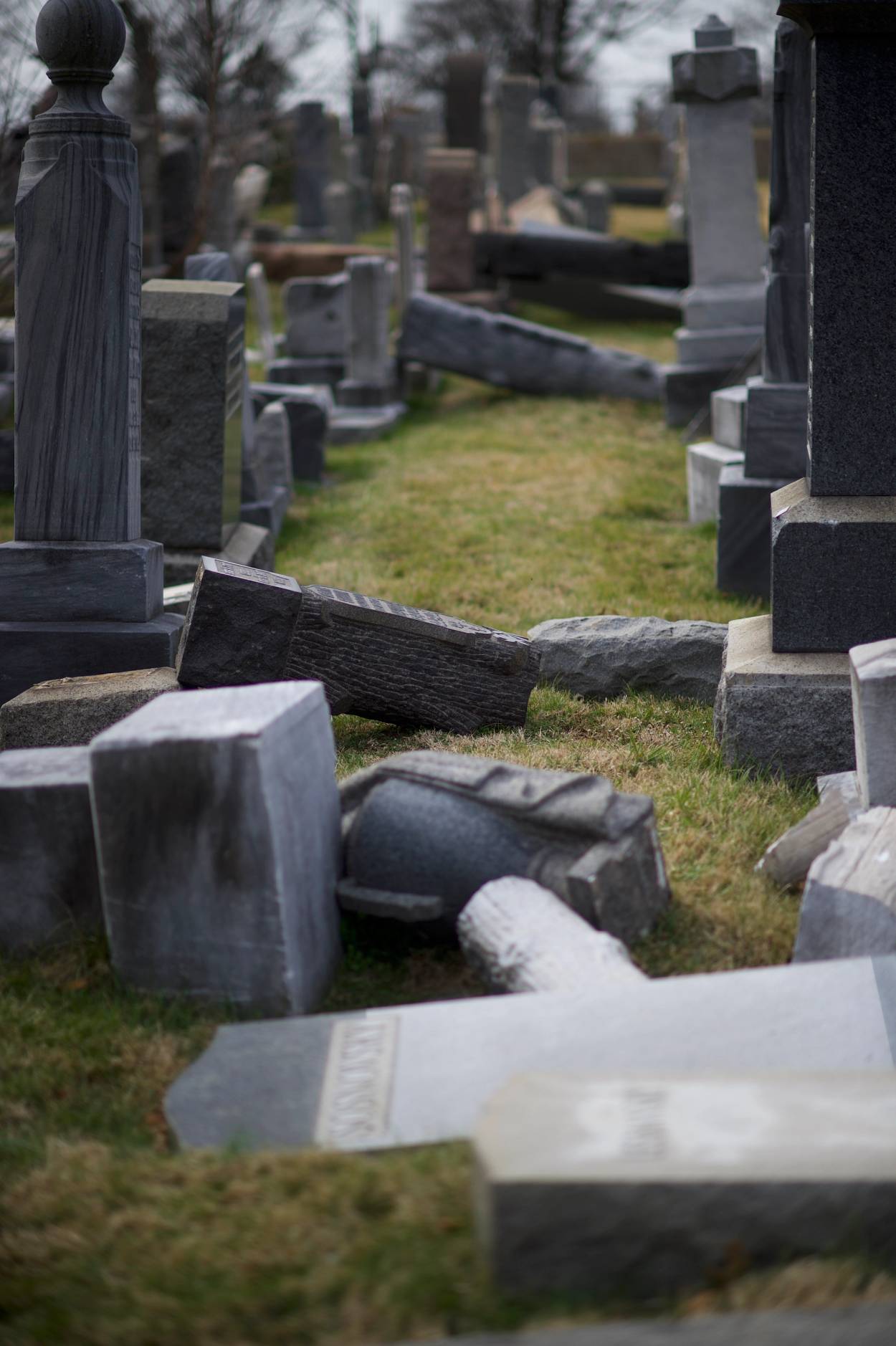
Jewish tombstones lay vandalized at Mount Carmel Cemetery in Philadelphia, Feb. 27, 2017MARK MAKELA/GETTY IMAGES

Ever since Ye declared he’d be going “death con 3 on Jewish people,” the media and advocacy groups like the Anti-Defamation League have sought to portray the issue as a battle between free speech and censorship. When Ye fawned over Hitler alongside an open Holocaust denier on a talk show hosted by a man successfully sued for calling a school massacre a hoax, it seemed to prove the larger point: Unregulated internet forums (like the ones where Alex Jones made his name) are dangerous, and the best safeguard against antisemitism lies in actively policing them.

Free speech of the kind being advocated by people like Twitter’s new owner, Elon Musk, the argument goes on, is a direct threat to Jews. Following Musk’s acquisition of the social media platform, The New York Times wrote breathlessly that “Hate Speech’s Rise on Twitter Is Unprecedented, Researchers Find.” Only two groups are named as sources for the research, one is the ADL and the other is British-based, dark-money-funded Center for Countering Digital Hate (CCDH), perhaps best known for providing the White House with data that was then used to pressure Facebook to remove content deemed objectionable. The ADL, meanwhile, has increasingly defined its mission to defend the Jewish people as being synonymous with the Democratic Party’s efforts to eliminate “hate” from the internet, while turning a blind eye to it elsewhere. The head of the ADL, Jonathan Greenblatt, has repeatedly framed the fight against antisemitism in recent weeks as hinging on the actions of Elon Musk.

But this tells only half the story. After all, Ye’s narrative of sinister Jewish control did not emerge fully formed from his personal study of historical and theological matters. Rather it’s been building for decades in the same media ecosystem that now proclaims itself guardian against all things racist and the protector of the Jews.

Ye’s narrative of sinister Jewish control emerged from the same media ecosystem that now proclaims itself protector of the Jews.

For the past five years, the dominant media narrative about race—perhaps the dominant media narrative, period—has built up a hierarchy of racial justice. At the top are the perennially marginalized “BIPOCs,” victim to the lash of the ever-present colonial whip. At the bottom lurks the “white male,” inherently and ineluctably racist, even when (or perhaps especially when) they’re trying hard not to be.

In a manner true to our history, Jews have been sucked into this Manichean whirlpool, cast by radical academics and their media acolytes as an essential, almost distilled element of the global system of racial oppression. We are not just white; we are the plotters and financiers of the entire sysyetm of white supremacy.

Worse still, if Jews are white then they are not, well, Jews. The largely successful effort to assign Jews to the white race means Jews do not have the moral privilege of determining our own identity. The perverse result of dispossessing Jews of their own history is that it grants the mantle of Jewishness to our enemies. Thus Ye, in the same Twitter thread where he threatened to go “death con 3” on Jews, also claimed: “I actually can’t be antisemitic because Black people are actually Jew also.”

When Whoopi Goldberg asserted on The View that the “Holocaust was not about race,” she was advancing a version of the same arguments made by virulent Black Hebrew Israelite hate preachers, professors who insist on the indelible whiteness of Jews, and anti-Zionists who deny the legitimacy of Jewish historical identity. It’s true that only the last two groups tend to have their ideas promoted by the media, but all three share the idea that “Jew” is not a meaningful or legitimate category. Palestinians can be Jews—thus the Democratic political activist and Louis Farrakhan fan Linda Sarsour is invited to participate as an expert in a prominent panel on antisemitism. And by the same logic, Black Hebrews can be Jews. Ye can be a Jew. Only Jews are not allowed to be Jews.

Over and over, Jews have watched this trend play out, and largely we’ve been silent.

In a key scene in the 2014 Oscar-nominated Selma, Dr. Martin Luther King Jr. leads a group of activists and protesters across a bridge alongside Black civil rights leaders. Not pictured in the scene was a man who walked in that front line of protesters, fighting for civil rights: the great American Jewish rabbi and leader Abraham Joshua Heschel.

Why would Ava Duvernay, the film’s director, compromise the film’s historical integrity to erase one of America’s most prominent Jewish spiritual figures out of the image? The answer is that over the past decade, the anti-racist movement that has been the media’s single most championed social cause has turned a syllogism into a truism: Whites are by definition white supremacists; Jews are the whitest of whites because they falsely hide behind their fake ethnicity; Jews, therefore, are at the top of the white supremacy totem.

The media has actively spread these ideas by turning woke racialism into the defining moral cause of our time, while at the same time ignoring the consequences of this campaign. While Ye was “canceled” for making open threats and affirming his love for Hitler, little more than a week earlier hundreds of Black Hebrew Israelites marched through central Brooklyn, uniformed and in formation, chanting “we are the real Jews.” Save for some coverage in the New York Post and in Tablet’s daily newsletter, The Scroll, the rest of the media was virtually silent. The media is still talking about the alt-right’s 2017 hate march in Charlottesville, treating it as one of the defining events of the modern era, but when hundreds of virulent antisemites march in Brooklyn—the mecca of America’s media establishment—it was crickets. The silence was appalling but also unsurprising given that the same media has largely ignored the routine violent attacks against religious Jews in New York.

The media has turned woke racialism into the defining moral cause of our time while ignoring the consequences of this campaign.

When Ilhan Omar tweeted in 2019 that Jewish money swayed Congress to support Israeli policies—only weeks before claiming American Jews harbor dual allegiance—the media response was hedged. Ilhan Omar “was widely accused of antisemitism,” NPR wrote, working hard not to claim Omar’s comments were in fact antisemitic. CBS News noted that it was not the first time Omar “has been attacked,” positioning Omar, incredibly, as victim rather than aggressor.

The New York Times worked this idea of dual Jewish allegiance into a 2021 news article by Catie Edmonson that claimed—without any source to substantiate it—that unnamed “rabbis” had influenced Congress’ decision to fund Iron Dome, a missile-defense system that has saved countless lives in Israel. The media appeared to further boost the narrative that Iron Dome is a tool of Israeli injustice when it ran dozens of headlines about AOC openly weeping after the vote.

In a profile of Alice Walker last spring, the Times offered sympathetic treatment to The Color Purple author despite the fact that she has spread vile antisemitic tropes, including writing a poem that asks “Are Goyim (us) meant to be slaves of Jews, and not only / That, but to enjoy it?” The Times, which previously ran a conversation between Walker and Cheryl Strayed that made no mention of Walker’s Jew hatred, characterized this noted antisemite as “complex.”

By far, the most effective tool in the demonization of Jews has been the use of Israel and Zionism as a means to hide what would otherwise be recognized as pure ethnic bigotry under the cloak of social justice. Casting Israel as the world’s last settler colonial state allows antisemites to call Jews colonialists. And casting Jews as colonialists has allowed them to call Israel a colonial movement. It has also underlined the idea that Jews are the most villainous sect on the hierarchy of white supremacy.

But by this tail-swallowing logic, the mere existence of Israel constitutes a crime. If Jews are not a real category with a legitimate identity, then why would they ever have a state, given that other people are there, too? And if the state is mired in the original sin of apartheid, how can any Jews support it without upholding white supremacy?

As a PLO political cartoon so neatly illustrates, the Palestinian national movement has not been slow to capitalize on the opportunity to conflate Jews with whites and Palestinians with American Blacks: An American police officer kneeling on the neck of an African American man is joined by an Israeli soldier kneeling on the neck of a Palestinian.

This paradox is resolved by a narrative of control. “Three hundred Zionists” (by Ye’s reckoning) run Hollywood, media, and finance to keep the gentiles in thrall. And through its silence, its endless attacks on Israel, its complicity in demonizing Israel and treating the word “Zionism” as an epithet, the media not only accepts but advances this heinous narrative.

Blaming the normalization of antisemitism on Elon Musk or on the internet’s “dangerous” tolerance of unregulated speech shifts attention from the way many Jews are regularly treated by the media, their neighbors, their college classmates, and law enforcement. As calls now come from the ADL and establishment figures that Jews should trust them to censor the problem away—that our very lives depend on it!—Jews understand that the real problem has been censored all along.


Zawartość publikowanych artykułów i materiałów nie reprezentuje poglądów ani opinii Reunion’68,
ani też webmastera Blogu Reunion’68, chyba ze jest to wyraźnie zaznaczone.
Twoje uwagi, linki, własne artykuły lub wiadomości prześlij na adres:
webmaster@reunion68.com


Al Jazeera Files Suit at International Criminal Court Over Journalist’s Killing

Al Jazeera Files Suit at International Criminal Court Over Journalist’s Killing

Reuters and Algemeiner Staff


People light candles during a vigil in memory of Al Jazeera journalist Shireen Abu Akleh, who was killed during an Israeli raid, outside the Church of the Nativity in Bethlehem, in the Israeli-occupied West Bank, May 16, 2022. REUTERS/Mussa Qawasma

Al Jazeera on Tuesday said it has filed a lawsuit at the International Criminal Court against Israeli forces over the killing of Palestinian-American journalist Shireen Abu Akleh, who was shot during an Israeli raid in the West Bank in May.

The lawsuit following an investigation by the television news network’s legal team, Al Jazeera said on Twitter.

The ICC must identify the individuals who were directly involved Abu Akleh’s killing, Al Jazeera lawyer Rodney Dixon KC told a news conference in The Hague on Tuesday.

“The rulings of the International Criminal Court stipulate that those responsible be investigated and held accountable. Otherwise, they bear the same responsibility as if they were the ones who opened fire,” Dixon said.

The circumstances of Abu Akleh’s killing are disputed.

Israeli Prime Minister Yair Lapid said on Tuesday that no one would question Israeli soldiers.

“No one will interrogate IDF soldiers and no one will preach to us about morals of combat, certainly not the Al Jazeera network,” Lapid said.


Zawartość publikowanych artykułów i materiałów nie reprezentuje poglądów ani opinii Reunion’68,
ani też webmastera Blogu Reunion’68, chyba ze jest to wyraźnie zaznaczone.
Twoje uwagi, linki, własne artykuły lub wiadomości prześlij na adres:
webmaster@reunion68.com


Hell’s Angels Gang Leader Accused of Coordinating Attacks on Jewish Targets in Germany on Behalf of Iranian Regime

Hell’s Angels Gang Leader Accused of Coordinating Attacks on Jewish Targets in Germany on Behalf of Iranian Regime

Ben Cohen


The Instagram page of Ramin Yektaparast, a former Hell’s Angels leader alleged to be coordinating Iranian regime attacks on Jewish targets in Germany. Photo: Screenshot

Police in Germany believe that the Iranian regime’s Islamic Revolutionary Guards Corps (IRGC) was behind a series of attacks on Jewish targets during November under the direction of a former leader of the Hell’s Angels biker gang.

Shots were fired at the Old Synagogue in Essen, an attempted arson attack was recorded at a synagogue in Dortmund and a Molotov cocktail was hurled at a Jewish school in Bochum. All three cities are located in the state of North-Rhine Westphalia.

Earlier this month, police arrested a 35-year-old German-Iranian man who was allegedly responsible for the attack in Bochum and who attempted to recruit another individual for the attack in Dortmund. According to the ARD broadcaster’s Kontraste program on Thursday night, local police suspect that the man is connected to Ramin Yektaparast, the founder of the Hell’s Angels chapter in the city of Mönchengladbach. Yektaparast is understood to have fled to Iran last year to escape trial for the brutal murder and dismemberment of another member of the gang in 2014, according to German media reports. Six other men went on trial for the killing during the summer.

German investigators believe that Yektaparast, whose dormant Instagram page features both the Iranian and German flags, is affiliated with the IRGC’s operations in Germany. As well as the attacks on Jewish institutions, investigators reportedly discovered a credible plot to target Josef Schuster, the president of the Central Council of German Jews.

“We’re talking about state terrorism here,” one investigator told ARD.

Over the last year, concern has increased globally regarding Iranian-directed terrorist operations abroad. In August, the US Justice Department charged a member of the IRGC with plotting to murder John Bolton, a national security adviser to former President Donald Trump, while in the same month, a man alleged to be an Iranian operative was arrested with a loaded AK-47 rifle outside the home of Masih Alinejad, a prominent critic of the Iranian regime, in Brooklyn, New York.

News of the German discovery coincided with intensified anti-regime protests in Iran itself, where human rights activists said a man, named as Mehran Samak, was shot dead by security forces in the town of Bandar Anzali on Tuesday night amid celebrations of the Iranian national soccer team’s 1-0 loss to the USA at the World Cup in Qatar. Celebrations were also reported in several other Iranian cities; many Iranians are hoping for their own team’s defeat as a protest against the Islamic Republic’s continued rule.


Zawartość publikowanych artykułów i materiałów nie reprezentuje poglądów ani opinii Reunion’68,
ani też webmastera Blogu Reunion’68, chyba ze jest to wyraźnie zaznaczone.
Twoje uwagi, linki, własne artykuły lub wiadomości prześlij na adres:
webmaster@reunion68.com


Istotą komunistycznej utopii nie jest marksizm czy wiara w przemoc

Lew Trocki (1879-1940) czyta książkę w swojej willi w Coyoacán w mieście Meksyk, gdzie w 1940 r. zamordował go sowiecki agent Ramón Mercader (Keystone/Zuma / Bridgeman Images/East News)


Istotą komunistycznej utopii nie jest marksizm czy wiara w przemoc

Paweł Smoleński


Ramon Mercader przeszedł szkolenie w osiedlu szpiegów pod Moskwą, gdzie zarżnął z zimną krwią podstawionego mu włóczęgę. Szkolono go w językach, walce wręcz, strzelaniu, bezwzględnym posłuszeństwie, nienawiści i wierze w sowiecki komunizm.

Paskudne miejsce, w którym się urodził, jeszcze za jego życia zmieniało się w jeszcze gorsze. A parszywy czas, w którym żył, z każdym dniem parszywiał jeszcze bardziej. Lecz Ivan Cárdenas Maturell – bohater książki „Człowiek, który kochał psy” Kubańczyka Leonarda Padury – był pełen zapału, ufności, wiary i dobrej woli. Studiował, wiecował, wykrzykiwał słuszne hasła. Co mu wmawiano – przyjmował bez dyskusji. I trudno się dziwić, bo były to piękne obietnice składane pięknymi słowami, zapowiedzi świata najlepszego z możliwych. Napisał książkę, a ta okazała się perłą jakiegoś konkursu dla debiutantów. Uchwycił w niej właściwy rytm rewolucji, dobrze rozeznał problemy, posłużył się konstruktywną krytyką i myślami właściwych autorytetów. W swoim mniemaniu Ivan napisał prawdę, również dlatego, że nie miał pojęcia, jak wygląda świat poza Kubą, nic nie wiedział o muzyce salsa i o Beatlesach, o Praskiej Wiośnie i młodzieżowej rewolcie na Zachodzie. Nie miał pojęcia o rozstrzelaniu setek lewicowych studentów na placu Tlatelolco w stolicy Meksyku. A mimo to w pewnym momencie dostrzegł, iż w jego opowiadaniu nie ma nic.

***

Los dał mu dość wrażliwości, by uznał, iż może być albo kubańskim pisarzem, albo człowiekiem. Zaniósł do wydawnictwa opowiadanie: pewien bojownik zostaje ze strachu donosicielem i popełnia samobójstwo („Jak śmiesz dawać nam coś takiego!”). Życiorys Ivana zaczął wędrować po zupełnie nowej drodze.

Po studiach zesłano go na prowincję. Pracował w lokalnej radiostacji, odkrył namiętność do rumu, skutkującą chorobą alkoholową, oraz do seksu, zazwyczaj skutkującą tryprem. Nie nosił etykiety wroga ludu, lecz blisko mu było do tego. Gdy skończył zsyłkę, został korektorem w magazynie kynologicznym. Ivan kochał psy. Skutki tej miłości przypadkiem okażą się dla niego zbawienne. Wygra wojnę z własnym strachem.

Brat dołożył swoje do komplikacji biografii Ivana. Był homoseksualistą nieukrywającym związku z profesorem akademii medycznej.

Głośno krzyczał, że za gejostwo nie wolno go szykanować i zwolnić z uczelni. Ale na tym etapie rozwoju kubańskiej rewolucji Fidel Castro zlikwidował różnorodność seksualnych orientacji.

Brat z kochankiem podczas ucieczki z wyspy utonęli gdzieś w oceanie między Kubą a Florydą. Gdyby poczekali dwa miesiące, załapaliby się na wielki exodus Kubańczyków do USA (komunistyczne władze zmuszały homoseksualistów do ucieczki) i żyli do dzisiaj w Tampie lub w Miami.

Pierwszą żonę Ivana wściekała jego życiowa niezaradność, druga zmarła na raka w czasie głodu na Kubie po rozpadzie sowieckiego protektora i żywiciela. Od zawsze lubił czytać książki na plaży Santa Maria del Mar.

***

Pewnego dnia dostrzegł starszego, schorowanego mężczyznę – cudzoziemca spacerującego z dwoma chartami rosyjskimi, borzojami. Snuł się za nim chudy, bardzo czarny ochroniarz, przysiadający w nadmorskich zaroślach. Mężczyzna bawił się z Ixem i Daxem, a jego lewa dłoń była zawsze obandażowana.

Rozmowa o chartach stała się preludium do późniejszej spowiedzi nieznajomego, która przyniosła Ivanowi strach niemożliwy do wyobrażenia, ale też wyzwolenie. Ivan jest alter ego Leonarda Padury, którego pisarska maestria wspaniale opowiedziała nam tę historię.

Na kubańskich plażach mężczyzna z borzojami nosił nazwisko Jaime Lopez. Wcześniej miał kilka innych tożsamości. Najwcześniejsza to Ramon Mercader del Rio, Katalończyk urodzony w burżujsko-szlacheckiej rodzinie milionerów wzbogaconych na wyzyskiwaniu maluczkich w Hiszpanii i na Kubie. Od wczesnej młodości był komunistą, wprowadzony do ruchu przez matkę Caridad, która postawiła radykalną ideę, barcelońskie szynki dla ludu i cuchnące noclegownie ponad upokorzenia fundowane przez męża despotę. Dzieciństwo spędził we Francji. Walczył po republikańskiej stronie w hiszpańskiej wojnie domowej. Kochał się w Afryce, pannie akurat zakochanej w Józefie Stalinie. Pewnie zginąłby nad Ebro lub w obronie Madrytu, gdyby nie nieoczekiwana wizyta znienawidzonej matki, która spytała, czy dla komunizmu jest w stanie zrobić więcej, niż umrzeć za republikę. Zgodził się, choć matka na jego oczach zastrzeliła Pączka, kundelka błąkającego się przy republikańskich oddziałach, przyjaciela Ramona, największego przyjaciela psów.

Ramon był ćwiczony już w Hiszpanii, poznał się z sowieckimi nadzorcami komunistycznej – choć nie tylko – frakcji republikanów. Przeszedł szkolenie w osiedlu szpiegów pod Moskwą, gdzie zarżnął z zimną krwią podstawionego mu włóczęgę. Szkolono go w językach, walce wręcz, strzelaniu, bezwzględnym posłuszeństwie, nienawiści i wierze w sowiecki komunizm. W sąsiednim domku mieszkała piękna Afryka, ale już wiemy, że od Ramona wolała namiętną, choć platoniczną, miłość do Stalina. Zresztą przyszłym szpiegom nie wolno było kontaktować się ze sobą.

***

Pod Moskwą Ramon stał się Jakiem Mornardem, belgijskim bon vivantem, playboyem, złotym młodzieńcem z bezdennym kontem, szykowanym do największego zadania, jakie umyślił sobie Stalin. Później był też przez chwilę Frankiem Jacsonem, Kanadyjczykiem uciekającym z Europy przed wojną z Hitlerem. Mornard/Jacson już wie, jakie zadanie powierzyli mu Sowieci. Ma zabić Lwa Dawidowicza Trockiego.

Napędza go śmiertelna nienawiść do bolszewickiego renegata. Wyhodował ją jeszcze jako Ramon Mercader. Wszystkie chwyty dozwolone i zalecane, łajdactwa i kłamstwa. W tym uwiedzenie Sylwii Ageloff, kobiety brzydkiej i zakochanej w Ramonie, która nieświadomie wprowadzi go do ufortyfikowanej kryjówki Trockiego, gdzieś pod miastem Meksykiem. Po zabójstwie zostanie schwytany. Odsiedzi 20 lat w meksykańskim więzieniu, chroniony przez tajne służby imperium Stalina. Zamieszka w Moskwie. Odznaczą go najwyższymi orderami, które – przypięte do lichego garnituru – pozwalały na bezkolejkowe zakupy. Mimo apanaży, lepszego mieszkania i oficjalnego nimbu bohatera jego status był niejasny; dowie się, że miał zginąć po wykonaniu zadania, jako że Sowiety nie potrzebują świadków zbrodni.

Sowiecki agent Ramón Mercader (1914-78), który zamordował Lwa Trockiego, tuż po aresztowaniuSowiecki agent Ramón Mercader (1914-78), który zamordował Lwa Trockiego, tuż po aresztowaniu  Fot. Abner Bucireli / AP Photo

Wyjeżdża na socjalistyczną Kubę, już chory; być może złoty zegarek, którym go obdarowano, był wcześniej – to już czas grubo po Stalinie – wykąpany w radioaktywnym polonie. Umarł w potwornych bólach, świadom, że umiera. Zaś bandaż na dłoni wziął się z potwornego samopoparzenia. Mercader wypalił sobie rozżarzonym żelazem inną ranę, ból odczuwał do ostatnich dni. Gdy rozłupał głowę Trockiego alpinistycznym czekanem (uznał, że to najlepsze narzędzie mordu, również z symbolicznego punktu widzenia), Lew Dawidowicz ugryzł go w rękę, pozostawiając księżycowatą bliznę. Ramon nie mógł na nią patrzeć. Wystarczyła mu inna pamiątka po Trockim: ciągle słyszał przerażający krzyk mordowanego, bezsłowne rzężenie i zwierzęcy bełkot.

Z tego wszystkiego Mercader zwierzył się Ivanowi w osobistych rozmowach i w sążnistym liście, który dotarł do kubańskiego pisarza wiele lat po śmierci mordercy Trockiego.

***

Trzecim mężczyzną jest w tej opowieści właśnie Lew Dawidowicz. Też kochał psy, osobliwie charty – borzoje, ulubieńców rosyjskiej arystokracji. Szczególnie sukę Maję, mądrą, opiekuńczą i wierną. Spotykamy się z nim w Ałma Acie, gdzie – wyrzucony z partii bolszewickiej – przebywał na zesłaniu. Właśnie pakuje kufry, by udać się na emigrację, początkowo do Turcji, potem do Francji i do Norwegii, by osiąść w Meksyku. Bano się Trockiego, za którym ciągnęła się niesława wiecowego demagoga, twórcy sowieckiej armii, zbrodniarza i kata zbuntowanych marynarzy Kronsztadu.

Ale też – przynajmniej na początku – przyjmowano go z respektem należnym politycznemu uchodźcy, póki w zakulisowych działaniach nie wtrącała się sowiecka Rosja. Nawet demokratyczne kraje Europy ulegały tej presji, bo Stalin budził trwogę. Światowe gazety drukowały z wiarą brednie produkowane przez Kreml na temat Trockiego (np. traktowaną z najwyższą powagą wieść, iż w przypadku ataku Hitlera na Związek Sowiecki Trocki zostanie namiestnikiem nazistów, choć był antyfaszystą i Żydem). Po ulicach przewalały się demonstracje komunistów i zainfekowanych stalinizmem związków zawodowych, żądające przegnania największego wroga sowieckiej Rosji. Podczas tajemnych spotkań z sowiecką dyplomacją, w obliczu gróźb i szantażu, odwracali się od Trockiego niedawni przyjaciele.

Wszędzie był niechcianym gościem, choć Francją, Norwegią i Meksykiem rządziła wtedy lewica. Pilnowała go, prócz sowieckiej bezpieki, tajna policja krajów osiedlenia. Mieszkał – jak we Francji i w Norwegii – na najbardziej odległych zadupiach. Zajmował się pisaniem książek, artykułów i manifestów piętnujących Stalina – złodzieja rewolucji – oraz tworzeniem Czwartej Międzynarodówki. Miała obalić stalinizm, ocalić przed biurokracją sowiecką Rosję oraz rozpalić światową rewolucję.

Trocki był wybitnie inteligentnym analitykiem, dobrym biografistą i przekonywającym agitatorem. Nie stosował marksowskich wygibasów objaśniających na przykładzie surduta – na surdutach znali się wszak krawcy, a nie Marks – krwiożerczość kapitalizmu. Ze znawstwem objaśniał istotę moskiewskich procesów, w których Stalin wytracił elitę bolszewików i Armii Czerwonej. Pisał z wściekłością o wielkim terrorze i o zamkniętych na prawdę o Sowietach oczach zachodniej lewicy. Przewidział zdradę Moskwy wobec hiszpańskich republikanów oddanych na pastwę faszystów podczas wojny domowej (gdy skończyło się ukradzione Hiszpanom złoto, Moskwa zaprzestała jakiejkolwiek pomocy).

Nie dziwił się paktowi Ribbentrop-Mołotow i nagłej, wzajemnej miłości Stalina do Hitlera. Mógłby być sumieniem zdradzonej rewolucji, gdyby nie mały defekt: sam sobie dawał przyzwolenie na mordowanie i usprawiedliwiał własne zbrodnie, wynikające podobno z dziejowej konieczności. Gdy Stalin głodził Ukrainę i gubił do spodu bolszewicką arystokrację, dla Trockiego był zbrodniarzem. Lecz rozstrzelanie tysięcy jeńców – zbuntowanych marynarzy Kronsztadu, krwawe dekrety pierwszych lat po bolszewickim przewrocie w 1917 r. (Trocki to wówczas druga po Leninie postać rewolucji), pochód Armii Czerwonej znaczony bestialstwem były wedle Lwa Dawidowicza obiektywnie usprawiedliwione, taktycznie nieuchronne, konieczne, prawe i sprawiedliwe. Czym innym było bowiem sądowe morderstwo na Bucharinie czy Zinowjewie, a czym innych rozwałka jakichś niewinnych matrosów.

Moskwa, 23 sierpnia 1939 r., podpisanie układu o nieagresji pomiędzy ZSRR i III Rzeszą. Z lewej Joachim von Ribbentrop, minister spraw zagranicznych Niemiec, z prawej - szef sowieckiej dyplomacji Wiaczesław Mołotow, w środku Józef Stalin, a na prawo od niego Gustav Hilger, tłumacz niemieckiej ambasadyMoskwa, 23 sierpnia 1939 r., podpisanie układu o nieagresji pomiędzy ZSRR i III Rzeszą. Z lewej Joachim von Ribbentrop, minister spraw zagranicznych Niemiec, z prawej – szef sowieckiej dyplomacji Wiaczesław Mołotow, w środku Józef Stalin, a na prawo od niego Gustav Hilger, tłumacz niemieckiej ambasady  Fot. domena publiczna

***

Obok trzech głównych bohaterów mamy fantastyczną galerię drugiego planu. To matka Mercadera, Caridad, zdeprawowana fanatyczka, kochanka niejakiego Kotowa, jednego z pierwszych nadzorców Sowietów nad hiszpańskimi republikanami (nosił zresztą wiele innych nazwisk). Kotow naprawdę nazywał się Naum Eitingon. Z domu wyszedł goły jak święty turecki, więc przystąpił do bezpieki, bo tylko tam mógł liczyć na przydział butów. Znał wiele języków, był mistrzem intryg i genialnym cynikiem, smakoszem najlepszych potraw i win. Wiedział, że on – świadomy Żyd – wysługuje się bolszewickim antysemitom i szkoli ludzi w podłości. Spędził kilkanaście lat w chruszczowowskim, a potem breżniewowskim więzieniu, bito go i torturowano. Na wolności żył w biedzie. Umarł na raka.

Jest w końcu Sylwia Ageloff, brzydula i miłośniczka Trockiego. Nie umie zrozumieć, czemu w 1939 r. Lew Dawidowicz uparcie broni Sowietów, mimo iż zawarli traktat z Hitlerem. Są w końcu psy, borzoje i pospolite kundle, dzieląc trudny los swoich właścicieli, ale kochane, prawdziwi członkowie rodzin. Aż dziw bierze, że tak staliniści, jak trockiści nie mieli takiej miłości do ludzi, którym obiecywali raj na ziemi.

Są pośród bohaterów drugiego planu fanatycy-herosi, ludzie kryształowo uczciwi, uwiedzeni perspektywą szczęścia całej ludzkości. Są łajdacy i kolaboranci, wataha agenciarstwa i bezinteresownych głupców. Trocki jawi się jako człowiek zaszczuty, świadom skazującego go na śmierć wyroku Moskwy. Można by mu współczuć, gdyby nie świadomość, że tylko utrata władzy zrobiła z niego upokorzonego wygnańca. Możemy współczuć Mercaderowi, śrubce w machinie stalinowskiego terroru, który w końcu przegląda się w swoich czynach. Fanatyczce Caridad, brzyduli Ageloff (Ramon zamykał oczy, gdy zaczynała się rozbierać przed seksem), a nawet Kotowowi, choć wiemy, że to cwana gnida i sprzedawczyk, choć wytrawny szpieg.

Tylko Ivanowi nie możemy współczuć, mimo marnego życia, doskonałej poniewierki. On jeden wygrał, a koszt zwycięstwa jest mimo wszystko łagodny w swojej straszliwości.

***

Po co Padurze tak zróżnicowane biografie, na dodatek prawdziwe? Po nic więcej jak do wiwisekcji bolszewizmu; niech będzie to część republikańskiej Hiszpanii, breżniewowski Związek Sowiecki albo Kuba Fidela Castro. Pisarz drąży i wychodzi mu, że istotą krwawej komunistycznej utopii nie jest marksizm czy wiara w przemoc, która podobno ma prowadzić do szczęścia całej ludzkości. Wszystko sprowadza się do nienawiści, nawet władza, bo tylko dzierżąc władzę, można nienawidzić doskonale.

Trocki z nienawiści kazał mordować robotników Kronsztadu. Mercader zamordował Trockiego, bo wyćwiczono w nim nienawiść do wszystkiego, co kwestionuje nieomylność i wszechwładzę Stalina. Stalin nienawidził zamordowanego i mordercy, jako że z nienawiści wynikała jego moc. Nic innego nie miało znaczenia.

***

Trocki zlekceważył nienawiść Stalina i to początek jego końca. Powinien wiedzieć, że skoro tak długo żyje, widać jest Stalinowi do czegoś przydatny. Stalin niszczy Trockiego z precyzją i przebiegłością. Mógł go zabić w dowolnym momencie, kiedy tylko uzyskał przewagę. Ale nie – upodlony Trocki jest mu bardziej potrzebny. Bowiem Trockim można usprawiedliwić wielką czystkę i terror lat 30. Trocki jest potrzebny, by objaśnić wyssaną z palca zdradę najbardziej zasłużonych bolszewików i przyjaciół Lenina.

Trocki w styczniu 1924 r.

Trocki w styczniu 1924 r.  domena publiczna

Nienawiść każe Stalinowi sprawić, by wrogów bolało. Naiwność aż kapie z ostatniego listu, który Bucharin wysłał do Stalina w noc przed swoją egzekucją (dyktator przechowywał go ze starannością, jakby był najważniejszym państwowym dokumentem): „Kobe, po co ci moja śmierć”. Jak to po co? Znienawidzony musi umrzeć, a z nim jego rodzina, choćby obiecano im życie.

Stalin z nienawiści odbiera Trockiemu dzieci, przyjaciół, współpracowników, a nawet Maję, wierną borzojkę. Rewolucja, wojny, intrygi to tylko narzędzia zemsty i mgła kryjąca potrzebę zemsty. Gdyby górą był Lew Dawidowicz, najpewniej zrobiłby to samo. Stalin nienawidził Trockiego nie z powodu ideologicznych niesnasek. To nie spór o wartości był przyczyną, że Trocki nienawidził Stalina. Wiedzą o sobie dużo za dużo, za bardzo się rozumieją, zbyt długo sobie świadkowali, a wiadomo, że świadek i współuczestnik przestępstwa to najwdzięczniejszy obiekt nienawiści.

PS Jakim cudem Leonardo Padura, poddany familii Castrów, jeszcze nie siedzi?


Człowiek, który kochał psy
Leonardo Padura
Tłumaczenie Dorota i Adam Elbanowscy
Wydawnictwo Noir sur Blanc

Leonardo Padura, 'Człowiek, który kochał psy', tłumaczenie Dorota i Adam Elbanowscy

Leonardo Padura, ‘Człowiek, który kochał psy’, tłumaczenie Dorota i Adam Elbanowscy  Wydawnictwo Noir sur Blanc


Zawartość publikowanych artykułów i materiałów nie reprezentuje poglądów ani opinii Reunion’68,
ani też webmastera Blogu Reunion’68, chyba ze jest to wyraźnie zaznaczone.
Twoje uwagi, linki, własne artykuły lub wiadomości prześlij na adres:
webmaster@reunion68.com


A New Strategic Landscape in the Middle East

A New Strategic Landscape in the Middle East

DAN SCHUEFTAN


Is Israel prepared for its role as a senior regional power?
.

AMIR LEVY/GETTY IMAGES

Despite what most Western readers have long been conditioned to assume, the Middle East and Arab-Israeli relations are a source of good news these days. The region is still violent and unstable; the conflict between the Jewish state and its radical enemies, Palestinians and others, is far from over; the threat of the Iranian revolutionary regime may be greater than ever. However, a new strategic alignment that has lately been emerging promises a better chance than ever before in modern history for regional states to isolate and stand up to the radicals who continue to threaten the existing order. The old structure of the Arab-Israel conflict that defined the Middle East for generations—during and shortly after the Cold War—is now being replaced by a strengthening Arab-Israeli coalition against Iran and its radical Arab proxies.

Since the 1930s, Arab radicals—the likes of the Mufti of Jerusalem Haj Amin al-Husseini, Gamal Abdel Nasser, Moammar Gadhafi, Saddam Hussein, Hafez al-Assad, and Yasser Arafat—managed to intimidate other Arab regimes and mobilize them, often against their own national interests, in a fruitless and destructive struggle for the “liberation” of Palestine from the Jews. Cooperation with Israel was condemned as treachery, and evasion of confrontation with her was considered cowardice. This imposed pan-Arab solidarity stifled regional development and repeatedly drew the region into wide-scale wars which occasionally pushed the Soviet and American superpowers to the brink of nuclear confrontation.

For Israel, pan-Arab solidarity could have presented a clear existential threat. A small, vulnerable and isolated state could hardly survive in the long run against a radical and aggressive Arab leadership that can mobilize the enormous resources of the entire Middle East—oil, gas, money, markets, international clout, control of essential waterways and impact on Muslim communities the world over.

The erosion, restriction, and ultimately the abolition of aggressive regional solidarity targeting the Jewish state was the supreme objective of Israel’s regional strategy since its inception. While the goals of regional peace and cooperation sound much more noble and appealing, every clear-sighted realist knew that this romantic dream is unattainable in this historically violent and unstable region. Besides, breaking up attempts at regional solidarity was an indispensable precondition to any progress toward peace or its lesser cousins: Arab states would consider accepting Israel only following a painful recognition of the failure of the attempt to erase it at an acceptable cost.

Israel’s grand strategy of breaking up aggressive Arab solidarity scored a crucial success in its 1947-49 War of Independence. A preemptive alliance with King Abdallah I of Transjordan broke up the joint Arab invasion on the day the Jewish state was established, thereby partitioning Mandatory Palestine between Israel and the Hashemite kingdom. Without this alliance, Israel may not have survived the coordinated Arab assault in the early part of the war, it would not have withstood the pressure to internationalize its capital city in Jerusalem, and it could not have concentrated all its forces in the south to confront the Egyptian expeditionary army. The resounding Egyptian defeat that followed forced that pivotal Arab state to betray all other Arab invaders in February 1949, by signing a separate agreement with Israel, practically enabling her to dictate the terms of the armistice and the strategic outcome of that formative war.

Only five years after having successfully shattered Arab solidarity in the late 1940’s, Israel faced her most formidable challenge when a messianic Arab leader unprecedentedly captured the imagination of Arabs “From the [Atlantic] Ocean, to the [Arabian] Gulf.” Gamal Abdel Nasser’s movement was not essentially about the struggle against Israel. It was about uniting the Arabs under Egyptian leadership to restore their historic glory, to retrieve their trodden dignity and to catapult their international bargaining position.

Yet the mobilizing commitment to “liberate” Palestine could not have been left out of Nasser’s wish list, even though Nasser himself had consistently insisted since the early 1960s that the Arabs were ill prepared to deal Israel a decisive blow and repeatedly warned that a premature war could end up in disaster, as it had in 1948. Ironically, his own political instruments—the radical rhetoric and the political mechanisms of all-Arab solidarity—were turned against him and enabled his even more radical rivals in the Arab arena to manipulate him into initiating the 1967 war.

Traumatized by the all-Arab mobilization against it in the late 1960s and early 1970s, Israel placed at the top of its regional security strategy the objective of undermining and finally shattering aggressive Arab solidarity against the Jewish state by forcefully removing its Egyptian keystone. Israel, as well as its Arab neighbors, were well aware that the eviction of Egypt from this pivotal position meant not only the collapse of the all-Arab struggle against Israel. It also inevitably meant terminating the Arab hopes for a major role in world affairs that fueled Nasser’s messianic movement. This was a zero-sum game: Israel could not be safe without it; Egypt and Arab radicals could not abide by it.

The ultimate expression of Israel’s strategic victory in this crucial round was Egypt’s 1979 separate peace agreement with Israel. The essence of Israel’s success was Egyptian acquiescence with whatever consequences Israel chose to inflict on other Arabs who continued to challenge it violently. Thus, Israel could get away, for instance, with the occupation of an Arab capital city (Beirut, 1982), the destruction of nuclear projects (Iraq, 1981; Syria 2007) and with wide-scale repression of Palestinian violence (2002-04, in response to the Second Intifada). The 1979 separate peace with Egypt was “the end of the beginning” of the “all-Arab-Israeli conflict.” When the Soviet Union collapsed a decade later, the chances of a major coordinated assault against Israel declined even further.

The next major step that changed the core of Arab-Israeli relations and the regional balance of power was not the failed “peace process” with the Palestinians or the 1994 peace agreement between Israel and Jordan. It came more than three decades after the regional turning point in 1979, following the “Arab Spring” and Arab awareness of the far-reaching significance of its failure.

The exhilarating hopes for a speedy restoration of Arab greatness that Nasser inspired in the 1950s and 1960s were shattered with the 1967 defeat and obliterated by the turn of the century. The much more modest hope that prevailed in the region and among Middle Eastern scholars was that Arab societies might extract themselves from their lingering predicament by rising against their autocratic and corrupt leaders and replace their failing realities with more pluralistic modern political and social structures. The Arab upheaval in the second decade clearly proved that the failure to meet the challenges of the 21st century was deeply rooted in these Arab societies, far beyond the tyranny and deficiencies of their leadership. Never before in their modern history were Arab regimes and their politically aware elites more cognizant of their weakness and less hopeful about an effective response to their predicament in the foreseeable future.

The profound change in the strategic landscape of the Middle East in the recent decade started with this recognition, but it materialized only when it was accompanied by three more realizations among important regional players. A somewhat exaggerated and oversimplified definition may be helpful in order to characterize its four pillars: the magnitude of the Iranian regional threat, the inability of Arab states to stand up to that threat by themselves, the questionable steadfastness of American support, and the proven capacity and dependability of Israel.

Unlike most European and American political leaders, officials, and observers, Arabs fully realize the magnitude of the Iranian determination to hegemonize the Middle East at their expense and the effectiveness of Iranian brutality and sophistication in the pursuit of that objective. Watching the impact of the Iranian takeovers in Lebanon, Syria, Iraq, and Yemen and its subversion in their own countries, they know they are in desperate need of external assistance to survive.

In this time of supreme Arab anxiety and distress, the Obama administration demonstrated a frightening combination of surrealistic misreading of basic regional realities and sweeping strategic incompetence. Some of the most important regional allies of the United States perceived Obama’s policies as an attempt to replace their own historic alliance with the U.S. by an American strategic deal with the Iranian Revolution. These suspicions, which culminated with the JCPOA, were only partially alleviated during the one-term Trump administration; they resurfaced with renewed vigor when Biden was elected. This deep mutual mistrust was manifested when even a conciliatory presidential visit in July 2022 failed to convince Saudi Arabia to help Biden to bring down the price of oil.

With the need for external support against the Iranian threat at a desperate peak, and trust in the American guarantor at its lowest ebb, the most vulnerable Arab states turned to the only power that fully appreciates the magnitude of that threat and is capable and determined to provide a forceful response. Israel is not only cognizant of the catastrophic consequences of Iranian regional hegemony but has also been engaged for more than half a decade in a wide-scale preventive war in Syria and western Iraq to thwart the Iranian takeover where it threatens Israel most acutely.

Israel is, of course, infinitely less powerful than the U.S. But to the beleaguered Arabs it is, at this stage, also immeasurably more trustworthy as an ally against their worst and most immediate enemy, which poses an ongoing existential threat.

Using an outdated vocabulary of Middle Eastern affairs, recent relations between Israel and most Arab states are often discussed in terms of peace and normalization. What is happening recently is far more significant than the willingness to live together and overshadow old grievances and animosities. It is about strategic interdependence with a senior Israeli partner. The historic all-Arab coalition against Israel has been replaced by a de facto Arab-Israeli coalition against the radical forces that threaten them both. Iran is the immediate and outstanding among those radicals, but Erdogan’s Turkey in the eastern Mediterranean, Syria—and, in a different way, its allies in the Muslim Brotherhood—are not very far behind.

For Israel, the result of these new alignments is a transformational change in its regional standing, as well as a major upgrade of its position on the global stage. In the Middle East, Israel can, for the first time, act as a full-fledged regional power. In recent decades, Israel established its position as a formidable military, economic, and technological power, but it could not openly and freely maneuver politically or partake in regional strategic alliances. Its position is dramatically enhanced when Arab parties compete over its attention and cooperation.

On the international scene, global powers and other states no longer have to weigh the advantages of cooperation with Israel against its prohibitive costs in “the Arab World.” While a large part of Arab public opinion remains hostile to Israel, European and other states can pay lip service by criticizing Israel in international forums and through symbolic diplomatic protests while deepening bilateral cooperation, with no real cost vis-à-vis Arab regimes.

By far the most significant effect of this transformation is on the American strategic calculus of its relations with Israel. Washington no longer needs to choose between support of Israel on the one hand, and Arab oil, gas, money, markets, and alliance with the United States, on the other. Most of America’s allies in the region need a strong Israel for their strategic welfare or even survival, and they share with Israel a disappointment in the degree of trustworthy support that Washington offers to its regional allies. The U.S. is already engaged in coordinating an American-sponsored regional air defense system against Iran that reflects this new and revolutionary reality. Crucially important Arab states want more of that, not less.

In some important ways, then, the “New Middle East” has arrived. Not, of course, in the surreal Shimon Peres vision of regional democracy, peace, and prosperity, but in terms of a balance of power and hard strategic realities that can guardrail a somewhat less unstable and dangerous region, where the radicals are isolated and the others cooperate to keep them at bay.


Dan Schueftan is the Director of the National Security Studies Center at the University of Haifa.


Zawartość publikowanych artykułów i materiałów nie reprezentuje poglądów ani opinii Reunion’68,
ani też webmastera Blogu Reunion’68, chyba ze jest to wyraźnie zaznaczone.
Twoje uwagi, linki, własne artykuły lub wiadomości prześlij na adres:
webmaster@reunion68.com