Archives

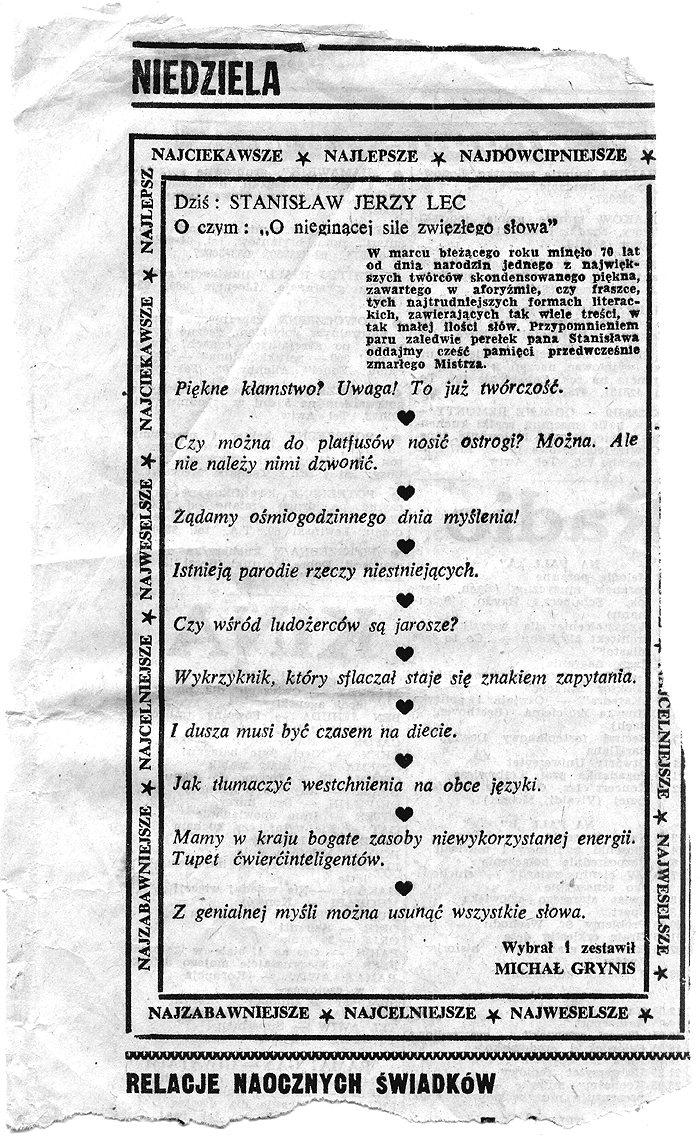
“Nowiny-Kurier” 1979

“Nowiny-Kurier” 1979


Dla czytelnikow ktorzy nie wiedza czym byly Nowiny-Kurier:

Rekordzista “Nowiny-Kurier”

Najdłużej, bo ponad 30 lat, utrzymał się dziennik “Nowiny-Kurier”, który od stycznia 1992 roku przekształcony został w tygodnik czy też, jak uporczywie twierdzi jego wydawca, w “dziennik ukazujący się tylko raz w tygodniu”. “NK” — jak dziennik nazywano w skrócie – pojawił się w kioskach w połowie września 1958 roku i powstał z połączenia dwóch polskich dzienników: istniejących od połowy lat pięćdziesiątych wspomnianych już “Nowin Izraelskich” i ukazującego się od początku 1958 roku “Kuriera”.
“Nowiny Izraelskie” zarówno szatą graficzną, jak i sposobem redagowania przypominały polskojęzyczną prasę żydowską, ukazującą się w Polsce w dwudziestoleciu międzywojennym. Gazetę tę założyła grupa pochodzących z Polski dziennikarzy, przybyłych do Izraela zaraz po proklamowaniu niepodległości tego państwa w roku 1948. „Nowiny” w pełni zaspokajały potrzeby czytelników, przywykłych do takiego charakteru dziennika.

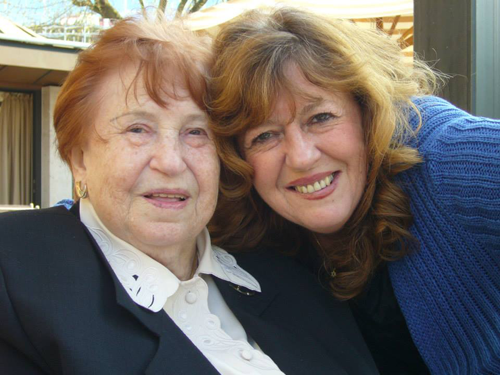
Wycinek “Nowiny-Kurier” pochodzi ze zbiorow mamy Fridy Schatz – Lizy Stern.

W latach 1956 — 1957, wraz z napływem dużej fali imigracji z Polski, zwanej “gomułkowską”, składającej się w dużym stopniu z inteligencji, znacznie wzrosło zapotrzebowanie na polski dziennik. Zapotrzebowaniu temu nie były jednak w stanie sprostać istniejące “Nowiny Izraelskie”, które dla wielu nowych czytelników „trąciły myszką” Wtedy właśnie grupa przybyłych dziennikarzy zainicjowała wydawanie dziennika bardziej nowoczesnego i dostosowanego do czytelniczych nawyków nowej imigracji. Patronką tej grupy stała się znana izraelska poetka rodem z Polski, Anda Pinkerfeld-Amir

[Fragment przygotowanej do druku książki „Polonica w Ziemi Świętej” Aleksandra Klugmana. Tytuł i śródtytuły pochodzą od redakcji. Tekst opublikowany w dodatku do dziennika „Rzeczpospolita” z 29-30 stycznia 1994 r., nr 24 (3673), s. 11-13.]


twoje uwagi, linki, wlasne artykuly, lub wiadomosci przeslij do: webmaster@reunion68.com


Wieloletni aktywisci palestynscy czlonkami nowego rzadu szwedzkiego.

Swedish ministers have history of pro-Palestinian activism

Wieloletni aktywisci palestynscy czlonkami nowego rzadu szwedzkiego.


Swedish MP Mehmet Kaplan (photo credit: Youtube screenshot)

Swedish MP Mehmet Kaplan (photo credit: Youtube screenshot)

W artykule zapomniano o pani Romson, obecny i minister i v-ce premier. Czesty mowca na propalestynskich wiecach i demonstracjach.

Min spraw wewnetrznych, Anders Ygeman. odpowiedzialny m in za policje i sluzby bezpieczenstwa, podpisal w 2012 r rezolucje w parlamencie,nawolujaca do uznania Izraela oraz do dialogu z Hamasem.Rezolucje ta podpisalo 5 socjaldemokratycznych poslow, znanych ze swojej jednostronnej propalestynskiej postawy.
Rzad przeprowadzil blyskawicznie zmiany w pracy min spraw wewnetrznych, ale ich znaczenie jest trudne do odcyfrowaania w chwili obecnej.
(patrz zalacznik 2)

Min do spraw cywilnych Ardalan Shekarabi jest byl iranskim uciekinierem z Iranu, ktory wraz z matka szukal tu azylu w 1989r,dziwnym szczegolem jego zyciorysu jest fakt,iz urodzony byl w Manchester,United Kingdom ,potem przeniosl sie do Iranu. Z tego powodu nie dostal tu azylu z matka,co spowodowalo,iz “zeszli oni pod ziemie” i przez dwa lata zyli nielegalnie w Szwecji.Shekarabi zrobil dziwna i blyskawiczna kariere po zmianie decyzji wladz emigracyjnych.W krotkim czasie przeistoczyl sie z ukrywajacego sie uciekiniera w przewodniczacego socjaldemokratycznego zwiazu mlodziezowe SSU.(sosjaldemokratyczna mlodzierz)

Zostal jednak stamtad usuniety za naduzycia finansowe, manipulacje majace na celu ekonomiczne dobra oraz klamstwa,falszywe oswiadczenia i klamliwe swiadectwa. W zdumiewiajacy spsob pojawil sie w centrum wladzy partii socjaldemokratycznej i stal sie szybko czlonkiem komisji do spraw badania przyczyn socjaldemokratycznej kleski wyborczej 2010.Stamtad wybrany zostal czlonkiem najwazniejszego ciala
kierujacego partia ( wydzial wykonawczy)

Jego pozycja jako min spraw cywilnych otwiera niezwykla wladze nad wszystkim co dotyczy funkcjonowania kraju (komuny i wojewodztwa) poprzez jednoczesna pozycje w departamencie finansow. (jest to blyskawiczna reforma min spraw cywilnych jaka juz przeprowadzil obecny rzad
w ciagu doslownie paru dni przy wladzy) (patrz szwedzki tekst) Ekonomiczny oszust, obsesyjny aktywista palestynski,czlowiek ktory nienawidzi Izrael
(jak i wielu nowych ministrow) dostal w swoje rece wladze nad funkcjonowaniem kraju poprzez m in wladze nad srodkami ekonomicznymi.

zalacznik 1
Regeringen Reinfeldt återinförde efter riksdagsvalet 2010 civilministerposten, som tilldelades Stefan Attefall (KD), , nu placerad på Socialdepartementet. Ansvarsområden är de frågor om kommuner och landsting som tidigare låg under Finansdepartementet. I den nya regeringen som bildades efter riksdagsvalet 2014, ledd av Stefan Löfven, innehar Ardalan Shekarabi posten som civilminister, nu åter placerad i Finansdepartementet.

zalacznik 2
Inrikesminister är det statsråd i Sveriges regering som ansvarar för frågor som rör polisväsendet och civil krishantering. Posten har tidvis varit avskaffad, men återinfördes 2014 i regeringen Löfven. Inrikesministern är placerad vid Justitiedepartementet och är formellt sett underställd justitieministern. Inrikesministern ingår därmed i den grupp av statsråd som inte är departementschefer, vilka tidigare benämndes konsultativa statsråd. Nuvarande inrikemsinister är Anders Ygeman.


Swedish ministers have history of pro-Palestinian activism

The new Swedish prime minister’s surprise announcement on Friday of his intention to recognize a Palestinian state, which has drawn harsh criticism from Israel, comes after some of its highest-ranking politicians have engaged in pro-Palestinian activism in past years.

Stockholm’s new housing minister was aboard the 2010 Gaza flotilla; education minister was held in Israel for protesting security barrier
Housing Minister Mehmet Kaplan, of Sweden’s Green Party, was arrested in 2010 by Israeli forces after participating in the Mavi Marmara flotilla, which was headed to the Gaza Strip. The Turkish-born MP was later deported from Israel over his involvement.

In that incident, Israeli commandos stormed the ship and were attacked by those on board, with several soldiers seriously injured. Nine Turks were killed in the ensuing melee and a tenth died in hospital this year after four years in a coma.

During this summer’s Operation Protective Edge in Gaza, Kaplan called for the “liberation of Jerusalem” at a pro-Palestinian rally.

He also downplayed the evils of the Islamic State in a July address, saying that Swedes joining their ranks in Iraq and Syria were similar to those who went to Finland during World War II to combat the Soviet Union. His comparison was lambasted by many Swedes, who consider the soldiers who volunteered to fight the Soviets on behalf of Finland freedom fighters.

In addition, Sweden’s Education Minister Gustav Fridolin was detained by Israeli forces in 2004 for protesting the security barrier near Ramallah. Fridolin left the country shortly after he was released.

During his inaugural speech Friday, Swedish Prime Minister Stefan Lofven said that “the conflict between Israel and Palestine can only be solved with a two-state solution, negotiated in accordance with international law.

“The two-state solution requires mutual recognition and a will to coexist peacefully. Sweden will therefore recognize the state of Palestine.”

A Foreign Ministry official reprimanded the Swedish ambassador to Israel on Monday for Lofven’s pledge to recognize a future Palestinian state. The Foreign Ministry representative argued that the move encourages the Palestinians to pursue unilateral steps toward statehood, rather than seeking to restart direct talks with Israel.

Prior to the meeting, envoy Carl Magnus Nesser said that he planned to clarify Sweden’s position on recognizing a Palestinian state and its desire to maintain strong ties with Israel.

“Israel and Sweden have a strong relationship, and the new government has made it clear that it wants this to continue,” Nesser told Army Radio on Monday morning.

He added, however, that in deciding to recognize a Palestinian state, Sweden was making a statement to support the resumption of peace negotiations.

“The situation is clear, peace talks have been suspended for a while, and I think the conflict in Gaza made it clear that the status quo needs to be changed,” Nesser said. “The purpose of such a statement of this forthcoming recognition is, of course, to support negotiations leading to a two-state solution.”

Times of Israel staff and AFP contributed to this report.

twoje uwagi, linki, wlasne artykuly, lub wiadomosci przeslij do: webmaster@reunion68.com


Russia commanded spy operation against Israeli forces and Syria rebels, footage shows

Russia commanded spy operation against Israeli forces and Syria rebels, footage shows


by: Anshel Pfeffer


Russia commanded spy operation against Israeli forces and Syria rebels, footage shows

Recent footage uploaded by fighters from the Free Syrian Army after their capture of a Golan Heights base indicates deep Russian involvement in the espionage operations of President Bashar Assad’s regime.

Recent footage apparently taken of an intelligence base in the Syrian Golan Heights, uploaded by fighters from the Free Syrian Army (FSA) after their capture of the base, indicates deep Russian involvement in the espionage operations of President Bashar Assad’s regime.

The base in Tel Al-Hara, south of the Quneitra border crossing with Israel, was seized over the weekend by the FSA, after pitched battles that included a number of rebel groups, including the al-Qaida-aligned Nusra Front.

The footage shows that the base, used to carry out electronic surveillance of both rebels and of Israeli military forces, had been under Russian command.

The video posted by the FSA seems to be have been filmed in the office building of the base. It shows what appears to be a Syrian officer conducting a tour of the facility for the rebels, pointing at photographs, maps and captions on the walls, in Russian and Arabic. The symbols of Syrian intelligence and the 6th Directorate of Russian military intelligence (GRU) which deals with signal intelligence (SIGINT) are shown there side by side.

In the photographs, Russian and Syrian officers can be seen collecting and analyzing intelligence together. Further photographs captured Russian defense officials visiting the base, along with a list of current and previous commanders of the base, Russian officers with the rank of colonel.

The officers are directed, according to standing orders on the wall, to listen in to communications of the rebel groups. Also on the wall, is a map detailing locations of Israel Defense Forces positions in the north of Israel.

One question that arises from viewing the video is why the footage was taken only from the office building. A different video shows what the rebels claim to be an air-defense system, but the radio dishes inside the building look more like listening devices.

The Russian and Syrian officers that evacuated the base most likely took with them most of the sensitive hardware and intelligence material, but it is highly likely that valuable material remained behind, in addition to the photographs and maps on the office building walls.

The FSA has close ties to the CIA, and the Americans are certainly interested in analyzing whatever has been left behind at the base before it is seen in public.

New details of the ties between the FSA and Israel have also recently emerged, in an article written by Channel 2’s Arab affairs commentator, Ehud Yaari, published Monday by the Washington Institute of which he is a research fellow.

Details of this relationship include coordination meetings in Israel, the operation of an Israeli field hospital on the Golan Heights for wounded Syrians, and a limited amount of weapons supplies, mostly rocket-propelled grenade launchers.

Israel naturally has a huge interest in the spy base which operates on its border, especially as any intelligence gathered would have been shared by Syria with Assad’s allies, Iran and Hezbollah.

Jerusalem has a deeply sensitive relationship with the Kremlin and there have been extremely few public recriminations over the military and intelligence support Russia extends to Syria and Iran.

There have been no official comments so far from America or Israel regarding the footage, and probably will not be in the near future.

A swift American response has emerged though, from Senator John McCain, the former Republican presidential candidate, who tweeted that the “Shocking revelation of (the) secret Russian base in Syria shows how much Putin is helping Assad’s war machine.”


twoje uwagi, linki, wlasne artykuly, lub wiadomosci przeslij do: webmaster@reunion68.com


“Hamas? Nie negocjuje się z kimś, kto chce zetrzeć cię z powierzchni ziemi”

“Hamas? Nie negocjuje się z kimś, kto chce zetrzeć cię z powierzchni ziemi”


Benjamin Netanjahu (fot. Bernard Patrick / newspix.pl)

Benjamin Netanjahu (fot. Bernard Patrick / newspix.pl)

Premier Benjamin Netanjahu powiedział na antenie CNN, że dopuszcza rozmowy z pokojowo nastawionymi Palestyńczykami, ale wyklucza negocjacje z Hamasem. – Wróg, który zdeterminowany jest, by cię zniszczyć, nieustannie zmierza do tego, by zetrzeć twój kraj z powierzchni ziemi, nie jest partnerem do negocjacji – podkreślił szef izraelskiego gabinetu.

Premier Izraela stwierdził niedawno, że radykalny Hamas jest taką samą organizacją, jak Państwo Islamskie.

– Możemy rozmawiać z Palestyńczykami, którzy chcą żyć z nami w pokoju. Mogą nam się trafiać nieporozumienia, np. w sprawie granic, ale zasadniczo rzecz biorąc, chcemy razem kształtować wspólną przyszłość. Hamas wzywa do zniszczenia nas. Nie ma podstaw do negocjacji – dodał premier.

Wyjaśnił też, że wiele krajów arabskich rozumie, iż “Hamas prowadzi wojnę, która zagraża również im i dlatego nie popierają go”. Netanjahu ptwierdził, że Egipt i Arabia Saudyjska połączyła się z Izraelem “wspólnotą interesów”, jakiej “nie widział nigdy w swym życiu”.

Wszystkie państwa arabskie uważają za największe zagrożenie Iran posiadający broń nuklearną oraz radykalnych sunnitów wdzierających się do krajów sunnickich – powiedział Netanjahu.

– Islamscy ekstremiści chcą dopaść wielkiego szatana, a po drodze zniszczyć małego szatana. My jesteśmy tylko małym szatanem. Wielki szatan do Stany Zjednoczone. A wszyscy ci ekstremiści mają szalone ideologie, więc łączą nas (z państwami arabskimi) wspólne interesy – dodał izraelski premier.

CNN “Global Public Square”


twoje uwagi, linki, wlasne artykuly, lub wiadomosci przeslij do: webmaster@reunion68.com


The Yom Kippur War 1973 – Documentary

The Yom Kippur War 1973 – Documentary


The Yom Kippur War, Ramadan War, or October War (Hebrew: מלחמת יום הכיפורים‎ Milẖemet Yom HaKipurim or מלחמת יום כיפור Milẖemet Yom Kipur; Arabic: حرب أكتوبر‎ ḥarb ʾUktōbar, or حرب تشرين ḥarb Tišrīn), also known as the 1973 Arab–Israeli War, was a war fought by the coalition of Arab states led by Egypt and Syria against Israel from October 6 to 25, 1973.
The war began when the Arab coalition launched a joint surprise attack on Israeli positions in the Israeli-occupied territories on Yom Kippur, the holiest day in Judaism, which occurred that year during the Muslim holy month of Ramadan. Egyptian and Syrian forces crossed ceasefire lines to enter the Sinai Peninsula and Golan Heights respectively, which had been captured by Israel in the 1967 Six-Day War. Both the United States and the Soviet Union initiated massive resupply efforts to their respective allies during the war, and this led to a near-confrontation between the two nuclear superpowers.
The war began with a massive and successful Egyptian crossing of the Suez Canal. After crossing the cease-fire lines, Egyptian forces advanced virtually unopposed into the Sinai Peninsula. After three days, Israel had mobilized most of its forces and managed to halt the Egyptian offensive, settling into a stalemate. The Syrians coordinated their attack on the Golan Heights to coincide with the Egyptian offensive and initially made threatening gains into Israeli-held territory. Within three days, however, Israeli forces had managed to push the Syrians back to the pre-war ceasefire lines. They then launched a four-day counter-offensive deep into Syria. Within a week, Israeli artillery began to shell the outskirts of Damascus. As Egyptian president Anwar Sadat began to worry about the integrity of his major ally, he believed that capturing two strategic passes located deeper in the Sinai would make his position stronger during the negotiations. He therefore ordered the Egyptians to go back on the offensive, but the attack was quickly repulsed. The Israelis then counterattacked at the seam between the two Egyptian armies, crossed the Suez Canal into Egypt, and began slowly advancing southward and westward towards Cairo in over a week of heavy fighting that inflicted heavy casualties on both sides.
On October 22 a United Nations-brokered ceasefire quickly unraveled, with each side blaming the other for the breach. By October 24, the Israelis had improved their positions considerably and completed their encirclement of Egypt’s Third Army and the city of Suez. This development led to tensions between the United States and the Soviet Union. As a result, a second ceasefire was imposed cooperatively on October 25 to end the war.
The war had far-reaching implications. The Arab World, which had been humiliated by the lopsided rout of the Egyptian–Syrian–Jordanian alliance in the Six-Day War, felt psychologically vindicated by early successes in the conflict. In Israel, despite impressive operational and tactical achievements on the battlefield, the war led to recognition that there was no guarantee it would always dominate the Arab states militarily. These changes paved the way for the subsequent peace process. The 1978 Camp David Accords that followed led to the return of the Sinai to Egypt and normalized relations—the first peaceful recognition of Israel by an Arab country. Egypt continued its drift away from the Soviet Union and left the Soviet sphere of influence entirely.

Publicerades den 20 feb 2014

Website http://goo.gl/spr4Fo
Facebook http://goo.gl/opWvzF
Twitter http://goo.gl/Ia3o0Q
Google+ http://goo.gl/9slaZO
Subscribe http://goo.gl/AIywYc


twoje uwagi, linki, wlasne artykuly, lub wiadomosci przeslij do: webmaster@reunion68.com