Archive | May 2019

Activists call for boycott of Eurovision Song Contest in Israel

Activists call for boycott of Eurovision Song Contest in Israel | DW News

  DW News


Israel is hosting this year’s Eurovision Song Contest finale. The country was granted the opportunity thanks to Israeli singer Netta Barzilai, who won in Lisbon last year.
Now the competition is becoming overshadowed by politics. Activists have urged artists and visitors to boycott Eurovision in solidarity with the Palestinian cause.


Zawartość publikowanych artykułów i materiałów nie reprezentuje poglądów ani opinii Reunion’68,
ani też webmastera Blogu Reunion’68, chyba ze jest to wyraźnie zaznaczone.
Twoje uwagi, linki, własne artykuły lub wiadomości prześlij na adres:
webmaster@reunion68.com


Napad na ambasadora Magierowskiego.

Napad na ambasadora Magierowskiego. Sprawca przeprasza

Paweł Wroński


Marek Magierowski (Fot. Adam Stępień / Agencja Gazeta)

Marek Magierowski, polski ambasador w Izraelu, został zaatakowany przed gmachem ambasady w Tel Awiwie. Izraelskie media łączą incydent z ostatnimi napięciami dyplomatycznymi na linii Polska-Izrael. Premier Mateusz Morawiecki potępił “rasistowski i ksenofobiczny” atak. Dziś sprawca przeprosił za swój czyn.

Do ataku doszło we wtorek. Dziś poinformowały o nim izraelskie media. Miał on mieć charakter „werbalny i fizyczny”, nieoficjalnie wiadomo, że napastnik zaatakował ambasadora, gdy ten siedział w samochodzie – opluł go i zaatakował słownie. Sam ambasador zrozumiał głównie słowa „Polska” i „polski”.

Magierowski sfotografował napastnika i jego samochód. 65-letniego sprawcę policja ujęła po 1,5 godziny. Ambasadorowi nic się nie stało.

Rzecznik izraelskiego MSZ Emmanuel Nahshon bezpośrednio po zdarzeniu napisał na Twitterze: „Izrael wyraża współczucie wobec polskiego ambasadora. Jesteśmy zszokowani atakiem”. Zapowiedział, że polski MSZ będzie informowany na bieżąco o wynikach śledztwa.

Sprawcą okazał się 65-letni Arik Lederman, który twierdzi, że spotkał się z “lekceważącą postawą” ochroniarza, który nie chciał go wpuścić na teren polskiej placówki. Dodatkowo ochroniarz miał go nazwać “żydkiem”. Gdy Lederman wracał po nieudanej próbie wejścia do polskiej ambasady, miał go zdenerwować trąbiący samochód. – Nie znałem tożsamości pasażera pojazdu, nie wiedziałem o jego pracy i na pewno nie wiedziałem, że w samochodzie jest ambasador Polski w Izraelu – powiedział Lederman.

– Chciałbym przeprosić za wczorajsze wydarzenie. Moja rodzina doświadczyła Holocaustu w Polsce. Zaapelowałem do ambasady o zwrot mienia – powiedział.

MSZ odmówił przyjęcia izraelskiej delegacji

“Jerusalem Post” połączyło atak z ostatnimi napięciami na linii Jerozolima–Warszawa. We wtorek polski MSZ odmówił przyjęcia delegacji izraelskiej na czele z Avi Cohenem-Scalą, dyrektorem generalnym Ministerstwa Równości Społecznej. – W związku z dokonaną w ostatniej chwili przez stronę izraelską zmianą składu delegacji, która mogła sugerować, że rozmowy miałyby koncentrować się na kwestiach restytucji mienia, strona polska podjęła decyzję o odwołaniu wizyty izraelskich urzędników” – napisał w komunikacie MSZ.

Ma to związek z amerykańską ustawę 447 (JUST act) dotyczącą zwrotu mienia ofiar Holocaustu. W 2018 r. podpisał ją prezydent Donald Trump i od tego czasu rząd Stanów Zjednoczonych ma dbać o zadośćuczynienie dla ofiar Holocaustu; sprawozdanie w tej sprawie ma być przedstawione w listopadzie. Według izraelskich mediów komentujących wizytę Polska ma być jedynym krajem, który nie rozwiązał tego problemu.

Napięcie między Polską a Izraelem jest kolejnym z serii zapoczątkowanej przyjętą w ubiegłym roku nowelizacją ustawy o IPN, która w Izraelu została odebrana jako akt prawny, który grozi sankcjami karnymi za dyskusję na temat współudziału Polaków w Holocauście. Rząd PiS pod naciskiem Stanów Zjednoczonych z ustawy się wycofał i zorganizował razem z USA na początku roku Konferencję Bliskowschodnią, ale niezręczne wypowiedzi premiera Beniamina Netanjahu w Warszawie oraz stwierdzenie p.o. izraelskiego szefa MSZ Israela Katza, że „Polacy wyssali antysemityzm z mlekiem matki”, dodatkowo zaogniły relacje.

Sejm nie zajmie się ustawą anty-447

Michał Dworczyk, szef kancelarii premiera, oświadczył, że Polska oczekuje ukarania sprawcy ataku na polskiego ambasadora w Izraelu. Premier Mateusz Morawiecki określił atak jako „rasistowski i ksenofobiczny”. Na Twitterze napisał, że „nie ma naszej zgody na jakiekolwiek akty ksenofobii, zarówno wobec dyplomatów, jak i innych obywateli”.

Równocześnie jednak Prawo i Sprawiedliwość, aby nie zaogniać sytuacji, zdjęło z porządku obrad Sejmu projekt ustawy przygotowanej przez posła Kukiz’15 Tomasza Rzymkowskiego (miała zablokować działanie ustawy 447). Poinformował o tym sam Rzymkowski, dodając, że „Polska leży plackiem przed przedsiębiorstwem Holocaust”.


Zawartość publikowanych artykułów i materiałów nie reprezentuje poglądów ani opinii Reunion’68,
ani też webmastera Blogu Reunion’68, chyba ze jest to wyraźnie zaznaczone.
Twoje uwagi, linki, własne artykuły lub wiadomości prześlij na adres:
webmaster@reunion68.com


Polish photographer casts Hasidim visiting lost world in new light

Polish photographer casts Hasidim visiting lost world in new light

ERIC BERGER


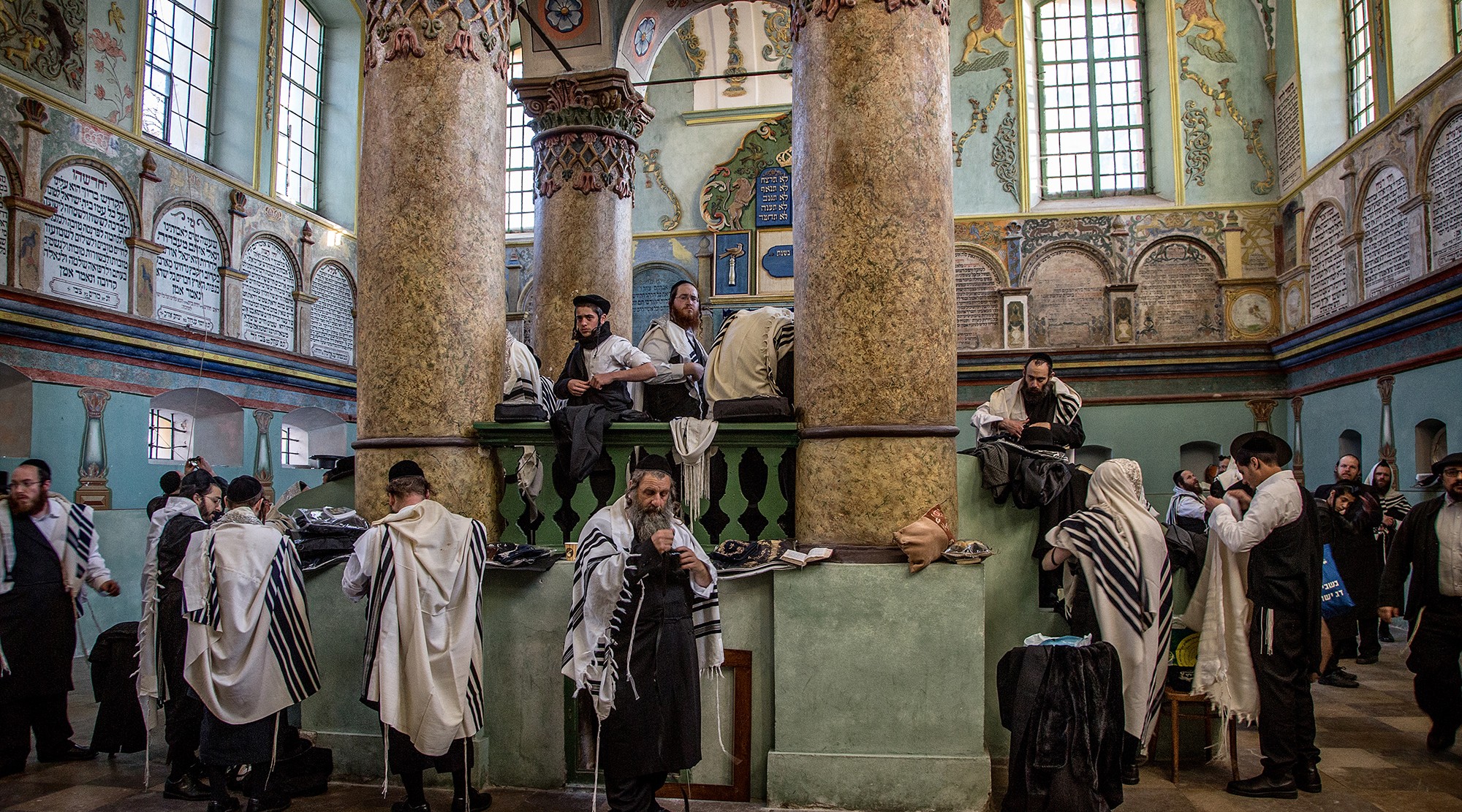
Hasidim gather for morning prayers at an old synagogue in Lancut, Poland. (Agnieszka Traczewska

When New York natives Duvid and Naomi Singer went to Poland about a decade ago and spent some time visiting the gravesite of a revered Hasidic rebbe, they spotted something unusual beyond the 30 or so Jews reciting Psalms in the Bobowa cemetery.

“We were a little surprised to see this woman with a camera,” said Duvid Singer, who leads tours of Poland primarily for American Hasidic Jews, including Bobovers like himself. “We were kind of staring at her, and she came over to us and started asking questions.”

Naomi asked her if she was Jewish. She wasn’t.

The woman turned out to be Agnieszka Traczewska, a Polish photographer and film producer working on a project to photograph Hasidic Jews visiting historic sites in Poland. The idea was to pay homage to the history of Jews in Poland – something most Poles today overlook, she said.

“My education left me with unbelievable gaps, and one of the most significant gaps was the story of the Jewish nation, which lived with the Polish nation side by side for a thousand years and vanished in the Holocaust,” Traczewska said.

The result of her decade-long effort is a collection of photos, titled “Returns,” that Traczewska turned into a 208-page book. The collection is being exhibited as well at sites ranging from European cultural festivals to the U.N. headquarters in New York. The book focuses on the thousands of Orthodox Jews who make pilgrimages to Jewish sites in Poland each year.

We see men lighting yahrzeit candles and praying in former synagogues and outside in the rain. Everyday scenes show men smoking cigarettes and chatting at the edge of a cemetery.

The goal was to “visualize their spiritual connection to” the Jewish sites, Traczewska said.

Even though the men in the photos often live in insular communities and typically are cautious toward contact with women outside their immediate family, they not only spoke with Traczewska but also flocked to her photo exhibits and asked her to autograph their copies of her book.
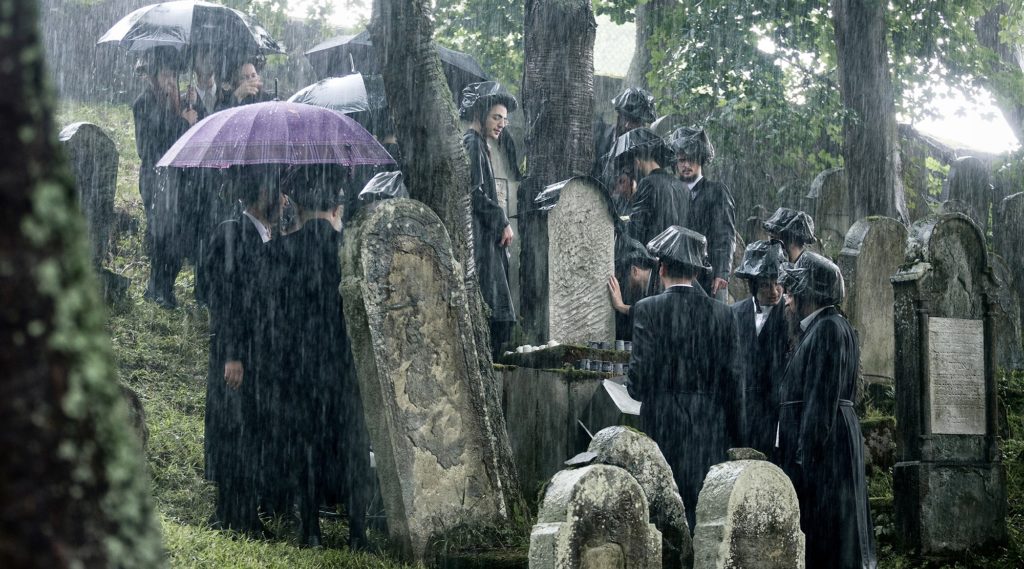
Hasidim withstand a downpour during a visit to a Jewish cemetery in the Polish town of Krynica Gorska. (Agnieszka Traczewska)

Traczewska’s work has been featured at synagogues and the Polin Museum of the History of Polish Jews in Warsaw. The photographs in an exhibit titled “Bracha-A Blessing: Back to the Polish Shtetls” have been presented all over the world. In January, they were on display at the United Nations in New York at a show organized by the Consulate General of Poland there in cooperation with Poland’s U.N. mission.

The opening included a stirring performance by a cantor that seemed to leave both Jews and non-Jewish Poles in the audience deeply moved.

“She’s extremely charismatic and found this niche that no one else has covered, that no one else was interested in,” said Naomi Singer, who runs Heritage and Discovery Eastern European Trips with her husband. “Perhaps people were interested in the cemeteries, but those were the dead, whereas she was interested in those who were returning.”

Traczewska first connected with Hasidic Jews about 11 years ago, when she traveled to the small Polish town of Leżajsk while Jews were there for the yahrzeit — the anniversary of the death — of Elimelech Weisblum, a famous Hasidic leader who died in 1786. Thousands of Jews travel to Poland each year for the occasion. A Jewish friend had told Traczewska that she might find the gathering interesting.

But her friend also warned her: “For a woman with a camera, it’s not the easiest.”

But Traczewska was deliberate, taking care to dress modestly and approach her camera-shy subjects gently to win their trust.

Traczewska eventually earned access and made friends. Naomi Singer introduced her to other Hasidim on trips, and more often than not they acquiesced to being photographed.

The photographs in Traczewska’s collection are not limited to Poland. She won second place in the 2014 National Geographic Traveler Photo Contest for her image of two 18-year-olds in Jerusalem following a wedding ceremony for their arranged marriage.

Yaakov Lemmer, a Hasidic cantor from Brooklyn, connected with Traczewska after seeing her photos on Facebook. She took photos of Lemmer using a branch in an effort to clean off some illegible letters on two tombstones at a gravesite near where his grandparents lived. He thought one of his ancestors might be buried there.
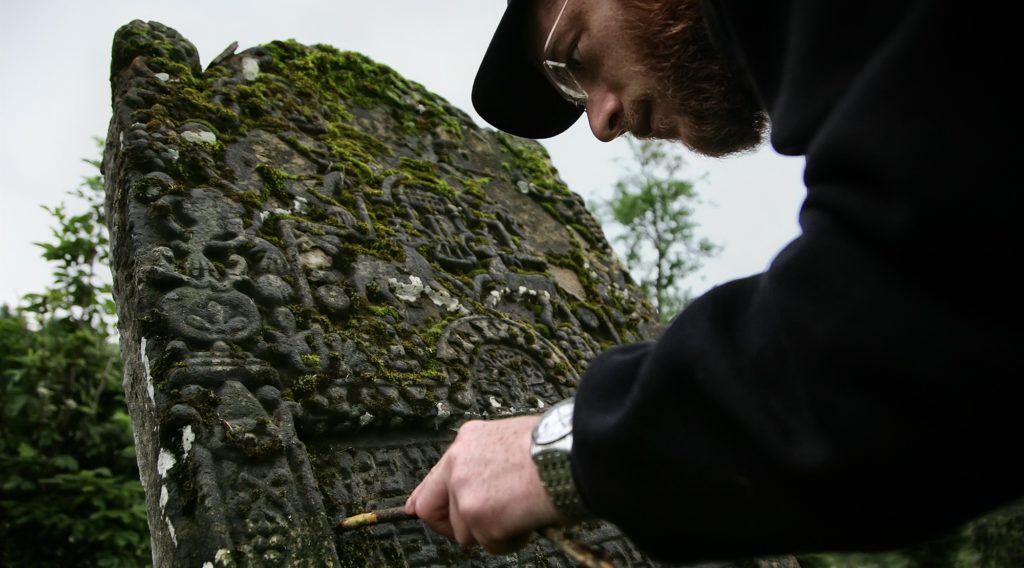
Yaakov Lemmer, a Hasidic cantor from Brooklyn, cleans off a tombstone at a cemetery in Jasliska, Poland. (Agnieszka Traczewska)

Lemmer said he was particularly moved by a Traczewska photo of a puddle reflecting a family standing outside the gates of the Auschwitz extermination camp. He said the reflection illustrates the memory of the Holocaust.

In the book, Traczewska used photos of Duvid Singer looking out the window of a Jewish center in Katowice, Poland, and his written reflection on how he and his father, a native of Poland who fled before World War II, traveled back to the country.

“My father, after reciting the Kaddish not heard in these parts for nearly 60 years, turned to me and with tears in his eyes, asked me not to allow their memory to be erased,” wrote Singer, who in 1996 started leading about four trips each year to Poland.

Traczewska has developed close friendships with the Singers as well as other Hasidim. Her speech is now peppered with Yiddish terms, as she describes how she “schlepped” on countless trips from her Krakow home to take photos in towns like Bobowa, Lelov and Radomsko – all once the homes of eponymous Hasidic dynasties.

Ultimately, Traczewska said, it was curiosity that really compelled her to acquaint herself with this community that once was such an integral part of Poland. Despite their much different life circumstances, hailing from two different worlds that coexisted long ago, the photographer and the Hasidim were able to find common ground. Traczewska was even allowed to photograph intimate moments of prayer.

She said the process that led to the exhibition was beautiful, and the connections she forged with her subjects opens a door for hope.

“Eleven years ago, if someone had told me this would be possible, I wouldn’t have believed it,” Traczewska said. “I felt like I had an obligation to my people to educate them, and toward Hasidim who shared with me so much trust and the obligation not to fail this trust.”

[ Brava Agnieszka! Let me just mention that being a multi-faceted artist she also produced numerous documentaries and among them “Dworzec Gdański” (2006) based on interviews conducted by Teresa Torańska during the gathering of Reunion ’68 crowd in Ashqelon, Israel and directed by Maria Zmarz-Koczanowicz. Way to go, Agnieszka! Leon Rozenbaum ]

This article was sponsored by and produced in partnership with the  Polish Cultural Institute New York, a diplomatic mission of Poland’s Foreign Affairs Ministry that promotes comprehensive knowledge of Poland, Polish history and national heritage. This story was produced by JTA’s native content team.


Zawartość publikowanych artykułów i materiałów nie reprezentuje poglądów ani opinii Reunion’68,
ani też webmastera Blogu Reunion’68, chyba ze jest to wyraźnie zaznaczone.
Twoje uwagi, linki, własne artykuły lub wiadomości prześlij na adres:
webmaster@reunion68.com


Former Miss Iraq Dismisses Anti-Israel Tirade by Roger Waters

Former Miss Iraq Dismisses Anti-Israel Tirade by Roger Waters: ‘Use Your Power for Good, Bring People Together’

Shiryn Ghermezian


Former Miss Iraq Sarah Idan, right, speaking alongside former Miss Israel Adar Gendelsman at the AJC Global Forum in June 2018. Photo: Screenshot / YouTube.

Former Miss Iraq Sarah Idan on Friday shot down an anti-Israel rant by ex-Pink Floyd frontman Roger Waters in which he urged the boycott of the Eurovision song contest being held next week in Tel Aviv.

“An artist has power to inspire. Make sure you use your power for good and to bring people together,” Idan, 29, said in a series of Twitter posts. “I never understood artists who boycott an entire country, you’re singing for people not for governments.”

The former beauty queen’s comments were in response to an article, posted on Twitter by the blog Israelycool, about the latest anti-Israel video uploaded onto Facebook by Waters, who is an avid supporter of the boycott, divestment and sanctions (BDS) movement.

Idan, the founding CEO of the organization Forward Humanity, was attacked on social media in 2017 and received death threats for taking a selfie with Miss Israel Adar Gendelsman at the Miss Universe pageant in Las Vegas. At the time, she refused to delete the photo despite pressure from her Iraqi sponsors, including the director of the Miss Iraq Organization, and out of fear, Idan and her family fled Iraq. She now lives in New York.

Idan said last year that she was still being targeted with death threats, some from the terrorist group Hamas.

Iraq does not recognize Israel and the two countries do not have any formal diplomatic relations. Israel does have warm relations, however, with Iraq’s Kurdish community, which the Jewish state backed for independence from Iraq in 2017.


Zawartość publikowanych artykułów i materiałów nie reprezentuje poglądów ani opinii Reunion’68,
ani też webmastera Blogu Reunion’68, chyba ze jest to wyraźnie zaznaczone.
Twoje uwagi, linki, własne artykuły lub wiadomości prześlij na adres:
webmaster@reunion68.com


THE GOLDEN GATE IN HISTORY

THE GOLDEN GATE IN HISTORY

MOSHE DANN


Turning historical and holy sites of other religions into mosques does not erase history; it only confirms Muslim bigotry and intolerance.

Britain’s Labour Party leader Jeremy Corbyn with Seumas Milne.. (photo credit: HANNAH MCKAY/ REUTERS)

Although Muslims claim the Golden/Mercy Gate as a Muslim shrine, the gate was built during the Second Temple period. Known as the Golden, Mercy and Shushan Gate, it is the most important gate of the Temple Mount because through it, the High Priest on Yom Kippur led the red heifer to be sacrificed on the Mount of Olives and the goat of Azazel was led into the wilderness of the Judean Desert.

The reason a bridge over the Kidron Valley to the Mount of Olives was necessary is because the Mount was (and still is) a Jewish cemetery, into which kohanim (Jewish priests) are forbidden by halacha (Jewish law). Ashes of the red heifer were part of a purification process required for Jews who ascended the Temple Mount.

According to Mishna Parah III, 6 and Middot I, 3:

“The elders of the Sanhedrin… and the Kohen Gadol [take the red heifer] via a bridge, arch upon arch… to the Mount of Olives.” This detailed ritual is read in many synagogues on Parshat Parah, a few weeks before Passover.

The ornate double arches on the outside of the gate indicate that it is from the Second Temple period; the surrounding wall has typical Herodian-style cut stones. The area outside the gate was explored by Charles Warren and other archaeologists in the mid-19th century – and several decades ago, Israel Antiquities Authority archeologists found the Herodian period foundations.

Interestingly, ancient maps of “Jerusalem at the time of the Second Temple” drawn by Christian European artists hundreds of years ago include a bridge on the eastern side of the Temple Mount – not because they could have seen one, or even the remains of one, but because they were familiar with the Mishna.

A large, modern rendition of one of these maps drawn by the 16th century Dutch humanist Christian van Adrichem includes the bridge; it can be seen in the dining room of the King David Hotel. The original map and many others are in the map collection at the Hebrew University’s Givat Ram campus.

Historical claims are not a game of how many places one can conquer, but about authenticity. Turning historical and holy sites of other religions into mosques does not erase history; it only confirms Muslim bigotry and intolerance.


The writer is a PhD historian, writer and journalist in Israel


Zawartość publikowanych artykułów i materiałów nie reprezentuje poglądów ani opinii Reunion’68,
ani też webmastera Blogu Reunion’68, chyba ze jest to wyraźnie zaznaczone.
Twoje uwagi, linki, własne artykuły lub wiadomości prześlij na adres:
webmaster@reunion68.com