Archive | April 2022

Dybuki współczesnej Ukrainy

Dybuki współczesnej Ukrainy

MICHAŁ BOJANOWSKI [ 2017 ]


Zdjęcia powstały na planie filmu “Dybuk. Rzecz o wędrówce dusz” w reżyserii Krzysztofa Kopczyńskiego / Fot. Witold Krassowski

NAWET DO CZTERDZIESTU TYSIĘCY BRACŁAWSKICH CHASYDÓW ODWIEDZA Z OKAZJI ROSZ HA-SZANA GRÓB CADYKA NACHMANA, POCHOWANEGO NA CMENTARZU OFIAR RZEZI W HUMANIU, GDZIE Z RĄK UKRAIŃCÓW W 1768 ROKU ZGINĘŁO TYSIĄCE ŻYDÓW I POLAKÓW. TO OSIEMNASTOWIECZNE „ANTYFEUDALNE POWSTANIE” JEST W „PRAWICOWEJ” UKRAIŃSKIEJ NARRACJI JEDNYM Z FILARÓW TWORZĄCEJ SIĘ NARODOWEJ POLITYKI HISTORYCZNEJ.

MIESZKAŃCY HUMANIA ZARZUCAJĄ PRZYJEZDNYM, ŻE ZAMIAST PŁACIĆ PODATKI, DAJĄ ŁAPÓWKI KILKU NAJWAŻNIEJSZYM URZĘDNIKOM. ZAWIĄZUJĄ ORGANIZACJĘ, KTÓREJ CELEM Z JEDNEJ STRONY JEST ZMUSZENIE CHASYDÓW DO PRZESTRZEGANIA PRAWA, Z DRUGIEJ ZAŚ POSTAWIENIE POMNIKA „NARODOWYM BOHATEROM”, ODPOWIEDZIALNYM ZA WYMORDOWANIE ŻYDÓW W 1768 ROKU. KONFLIKT ZAOSTRZA SIĘ, GDY PEWNEGO DNIA W MIEJSCU, W KTÓRYM CHASYDZI WITAJĄ NOWY ROK, POJAWIA SIĘ KRZYŻ Z FIGURĄ JEZUSA.

SYTUACJI W HUMANIU PRZYGLĄDAŁ SIĘ PRZEZ SIEDEM LAT KRZYSZTOF KOPCZYŃSKI. DOKUMENT „DYBUK. RZECZ O WĘDRÓWCE DUSZ”, WRAZ Z NAPISANĄ WSPÓLNIE Z ANNĄ SAJEWICZ KSIĄŻKĄ, UKAZUJĄCĄ KULISY JEGO POWSTAWANIA, TRAFIŁ 17 MAJA DO KSIĘGARŃ. I CHOĆ NA PIERWSZY PLAN WYSUWA SIĘ KONFLIKT CHASYDÓW Z MIESZKAŃCAMI HUMANIA, FILM OBRAZUJE RÓWNIEŻ KONDYCJĘ UKRAIŃSKIEGO SPOŁECZEŃSTWA W PRZEDEDNIU MAJDANU, DOPEŁNIONY PRZEZ KSIĄŻKĘ O TRAGICZNE WYDARZENIA WOJNY Z ROSJĄ.

Michał Bojanowski: Czy mieszkańcy Humania rzeczywiście nienawidzą chasydów?

Krzysztof Kopczyński: Większość w ogóle się nimi nie interesuje. To jest dosyć rozległe miasto, a chasydzi zawsze skupiali się w okolicach synagogi grobu Nachmana, wierząc, że blisko cadyka jest najlepsza aura. Nie zapuszczali się dalej. Rzadko nawet jeździli do jaru, w którym hitlerowcy wymordowali kilkanaście tysięcy Żydów. Część z nich nawet nie wiedziała o jego istnieniu.

Wielu mieszkańców żyje z pielgrzymek i nawet jeśli w głębi duszy są nastawieni do nich nieprzychylnie, to względy ekonomiczne wymuszają tolerancję. Natomiast ci, którzy mieszkają w okolicy grobu i mają styczność z chasydami przez cały rok, co jakiś czas manifestują swoją niechęć.

Zdjęcia powstały na planie filmu „Dybuk. Rzecz o wędrówce dusz” w reżyserii Krzysztofa Kopczyńskiego / Fot. Witold Krassowski

Choć w filmie sporo uwagi poświęcono budowie pomnika „prawdziwym” bohaterom Ukrainy, to jest Iwanowi Goncie i Maksymowi Żeleźniakowi, którzy w czasie koliszczyzny, antyfeudalnego powstania w 1768 roku, wymordowali tysiące Żydów i Polaków, to – szczególnie w książce – na pierwszy plan wysuwa się problem korupcji. Mieszkańcy Humania twierdzą, że chasydzi zamiast wspomagać kasę miejską, zasilają kilka prywatnych kieszeni. Miasto się nie bogaci, a przeciętny mieszkaniec poza hałasem i nerwami, niczego nie zyskuje z obecności żydowskich pielgrzymów. Czy to prawda?

Jeden z chasydów mówi o tym wprost, opisując historię kiosku. Mieszkańcy protestowali, że znajduje się on częściowo na chodniku, co jest niezgodne z ukraińskim prawem. Nic nie wpłynęło z tej okazji do kasy miejskiej, a właściciel nie miał nawet pozwolenia na budowę. Chasyd musiał zapłacić siedem tysięcy dolarów łapówki, żeby, zamiast likwidacji, pozwolono mu przestawić kiosk o parę metrów.

To poważne oskarżenie ukraińskich urzędów.

Ukraina jest krajem skorumpowanym i to jest jeden z najważniejszych problemów, z jakimi się boryka. W Humaniu czasem, żeby zdać do następnej klasy, daje się łapówkę. Aby dostać pracę w sektorze publicznym, płaci się tysiąc dolarów. Tyle tylko, że jak Ukrainiec daje łapówkę Ukraińcowi, jest to czymś zupełnie innym, niż gdy robi to Żyd. Wtedy uruchamiają się inne emocje.

Zarówno w filmie, jak i w książce prezentuje pan osoby, które mają bardzo wyraźne i kontrowersyjne poglądy na konflikt ukraińsko-chasydzki.

W filmie konieczna jest konfrontacja. Dokument nie pretenduje do tego, żeby opisywać świat w sposób obiektywny. Zawsze jest jakaś wizja – a w mojej nie mieściło się pokazanie całej tej masy obojętnych ludzi.

Zdjęcia powstały na planie filmu „Dybuk. Rzecz o wędrówce dusz” w reżyserii Krzysztofa Kopczyńskiego / Fot. Witold Krassowski

czytaj dalej tu: Dybuki współczesnej Ukrainy


twoje uwagi, linki, wlasne artykuly, lub wiadomosci przeslij do: webmaster@reunion68.com


Michael Steinhardt’s looted antiquities coming back to Israel

Michael Steinhardt’s looted antiquities coming back to Israel

JUDITH SUDILOVSKY


Repatriated antiquities valued at $5 million date back to 7000 BCE, include gold masks, carved ivory head and death Masks.

Michael Steinhardt speaks at the Champions of Jewish Values International Awards Gala in New York City, May 21, 2017. / (photo credit: MICHAEL BROCHSTEIN/SOPA IMAGES/LIGHTROCKET VIA GETTY IMAGES/JTA)

Some 39 stolen antiquities valued at more than $5 million are to be repatriated to Israel following a multi-national criminal investigation into the purchase of antiquities by Jewish philanthropist and ancient art collector Michael Steinhardt.

In a March 22 press release Manhattan District Attorney Alvin L. Bragg Jr. said 28 of the objects, some of which were looted from the West Bank, were turned over to Israeli authorities, and three objects have already been transferred to Israel, but eight objects had not been located yet. He said they will be returned as soon as they are found.

Two of the missing objects, including a cosmetic spoon dating back to 800-700 BCE valued at approximately $6,500 and a red carnelian sunfish amulet, dating to approximately 600 B.C.E. and valued at approximately $7,000, will be returned to the Palestinian Authorities once located.

The antiquities seized from Steinhardt’s collection were officially repatriated to Israel during a ceremony attended by Dr. Eitan Klein, Deputy Director of the Theft Prevention Unit within the Israel Antiquities Authority (IAA) and US Homeland Security Investigations (“HSI”) Acting Deputy Special Agent-in-Charge Mike Alfonso.

“These antiquities are priceless for the State of Israel and its people. They Symbolize our rich and vast cultural heritage. Now, they are being returned to their rightful owners,” said Klein, thanking the US officials for their efforts.

“Illicit trafficking and looting of cultural property can be prevented through coordination at the international level. We believe that cooperation between the State of Israel and the United States of America will yield more fruitful results in the coming period.”

The objects repatriated to Israel were among the total 180 stolen antiquities valued at $70 million seized from Steinhardt in the multi-year investigation which concluded in December 2021.

One of the world’s largest ancient art collectors, Steinhardt received an unprecedented life-time ban on acquiring antiquities in an agreement with the district attorney’s office.

A lawyer for Steinhardt, an important donor to Israeli cultural institutions and the founder of the Birthright free travel program to Israel for young diaspora Jews, has said many of the dealers from whom Steinhardt bought the artifacts had misrepresented their alleged provenance and legal status.  

Steinhardt is also a patron of educational institutions in New York and has invested in baseball teams. In the 1990s he purchased two islands in the Falkland Islands at Argentina’s southernmost tip and donated then to the Wildlife Conservation Society.

He has also faced sexual harassment accusations.

As a strong supporter of Israel, his defenders in Israel have said that his contributions to Israel outweigh any wrongs he may have done.

The D.A.’s office press release describes how Steinhardt purchased 28 of the items from Israeli antiquities dealer Gil Chaya, who bought illegal antiquities with his then-wife directly from looters, and two items from illegal antiquities dealer Rafi Brown.

Among those antiquities Steinhardt purchased from Chaya which will be repatriated are the Carved Ivory Head, which dates back to 1300-1200 B.C.E, and a set of three Death Masks, dating back to 6000 to 7000 B.C.E., now valued at $650,000. Two Gold Masks dating back even earlier to 5000 BCE which Steinhardt purchased from Brown will also be returned.

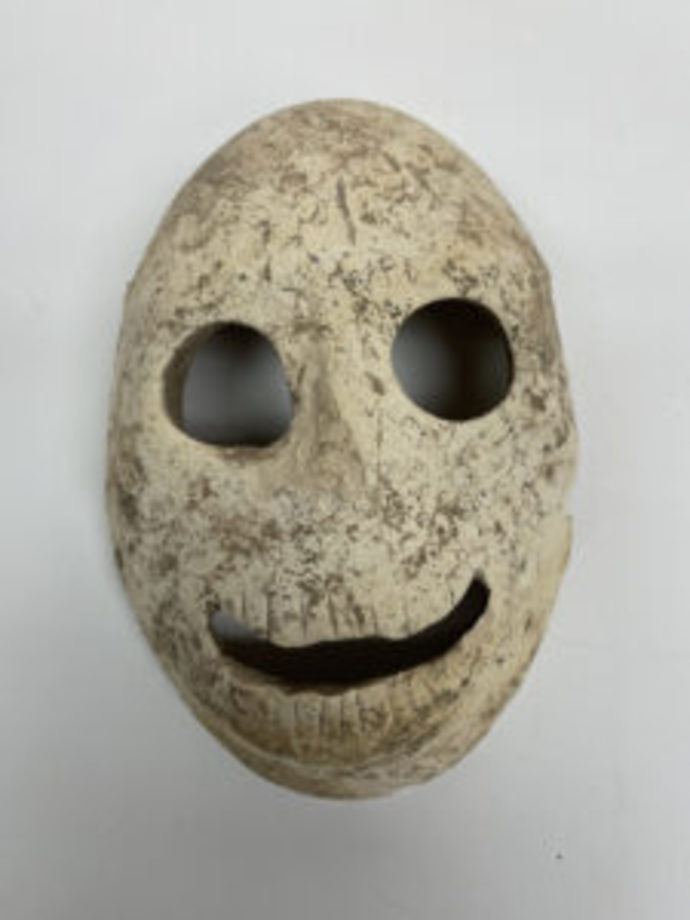
In addition, Neolithic masks depicting stylized human heads dating to around 7000 BCE valued at three million dollars and an incense burner with ducks, goats, and gazelle dating back to 1700 BCE valued at $70,000 will also be coming back to Israel.

Also among the antiquities seized in location are the Heliodorus Stele and two Neolithic masks which Steinhardt had loaned to the Israel Museum.

In the January press release the Manhattan District Attorney’s office outlined the process of the investigation into Steinhardt’s purchases of illegal antiquities. Many of the antiquities seized from Steinhardt were trafficked following civil unrest or looting, they said.

The criminal investigation into Steinhardt began in February 2017 when the D.A.’s office began investigating the purchase of the multi-million-dollar Bull’s Head statue, which was stolen from Lebanon during the Lebanese Civil War, and which Steinhardt had loaned to the Metropolitan Museum of Art.

That statue and another second multi-million-dollar marble statue seized from Steinhardt, the Calf Bearer, were repatriated to Lebanon in December 2017.

In the process of uncovering the Lebanese statues, the D.A.’s Office learned that Steinhardt had additional looted antiquities at his apartment and office, and initiated a grand jury criminal investigation into his acquisition, possession, and sale of more than 1,000 antiquities since at least 1987.

During their investigation the D.A.’s Office issued 17 search warrants and conducted joint investigations with law-enforcement authorities in Bulgaria, Egypt, Greece, Iraq, Israel, Italy, Jordan, Lebanon, Libya, Syria, and Turkey. 

On the January 12, 2022 Bragg’s office announced the repatriation of the first of the 180 objects seized from Steinhardt, the “Veiled Head of a Female,” a marble bust antiquity dating back to 350 BCE valued at $1.2 million, which was returned to Libya.

In the January press release the Manhattan District Attorney’s office outlined the process of the investigation into Steinhardt’s purchases of illegal antiquities. Many of the antiquities they seized from Steinhardt were trafficked following civil unrest or looting, they said.

According to filed documents, said the D.A.’s office, Steinhardt purchased the Veiled Head of a Female, which originated from a tomb at the ancient city of Cyrene—modern day Shahhat, Libya—in November 2000.

A year earlier, scientific excavations in that area had been forced to shut down due to growing unrest and governmental instability, the press release noted.

Antiquities thieves took advantage of the situation and began extensive looting for tombs in Cyrene. The Veiled Head of a Female first appeared on the market immediately after reports of these lootings.

“These rare and beautiful artifacts, which are thousands of years old, have been kept from the public because of illegal looting and trafficking,” said Bragg. “My office is proud to once again return historic antiquities to where they rightfully belong.”


Zawartość publikowanych artykułów i materiałów nie reprezentuje poglądów ani opinii Reunion’68,
ani też webmastera Blogu Reunion’68, chyba ze jest to wyraźnie zaznaczone.
Twoje uwagi, linki, własne artykuły lub wiadomości prześlij na adres:
webmaster@reunion68.com


Advocating for increase in ownership of personal weapons – Orin Julie

Advocating for increase in ownership of personal weapons – Orin Julie

ILTV Israel News


Now, in the wake of the recent terror attacks – Prime Minister Bennett calling on all armed citizens to start carrying their weapons. but my next guest has been advocating the same for years.


Zawartość publikowanych artykułów i materiałów nie reprezentuje poglądów ani opinii Reunion’68,
ani też webmastera Blogu Reunion’68, chyba ze jest to wyraźnie zaznaczone.
Twoje uwagi, linki, własne artykuły lub wiadomości prześlij na adres:
webmaster@reunion68.com


The US Must Reestablish Deterrence

The US Must Reestablish Deterrence

Judith Bergman


  • The complacency with which the Biden administration has come to view military threats, such as Russia’s invasion of Ukraine, as a thing of the past has led to a misguided prioritization of issues such as climate change as the biggest threat facing the US. This misguided focus has come at the expense of a realistic definition of what the US’s vital national interests are and should be in the face of actual national security threats.
  • Over the past two decades, US leadership has waned, especially as it has retreated from the Middle East and Europe — where its military presence has been reduced from 400,000 troops in the 1950s to just around 60,000 troops today. US credibility has been compromised, as its reputation for adhering to US commitments — failing to prevent the crossing of red lines in Syria and the Afghanistan debacle, to mention just two examples — has been wrecked.
  • Rebuilding deterrence will require a massive political and military recommitment to vital national interests. Those will require a policy reorientation that acknowledges that the US is the primary Western force in a world with global military threats from a variety of bad actors — China, Russia, Iran and North Korea primary among them.
  • “How many times do you have to make this point that if you don’t have more resources, you get political leadership that makes the case to the American people that we face threats on multiple fronts and if we want to defend our way of life as we know it and our interests around the world, protect our allies, not as acts of charity but because it benefits us, then you do it. And if you can’t do it, you can’t be a world power anymore…” — Former National Security Advisor, Ambassador John R. Bolton, Ronald Reagan Institute, February 24, 2022.
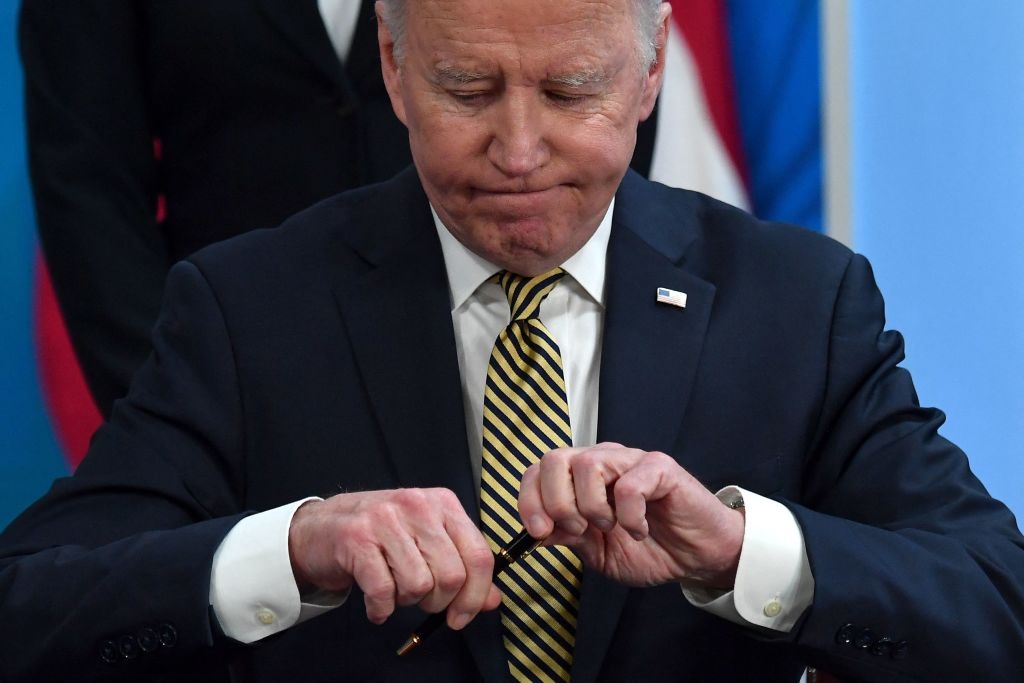
The complacency with which the Biden administration has come to view military threats, such as Russia’s invasion of Ukraine, as a thing of the past has led to a misguided prioritization of issues such as climate change as the biggest threat facing the US. (Photo by Nicholas Kamm/AFP via Getty Images)

Russia’s invasion of Ukraine has proven, sadly, that US deterrence lies in tatters.

While Russia’s invasion represents an absolute low point thus far, US deterrence has been eroding for years. The cause is failed policies and ill-defined national interests, which bad actors such as Russia, China and Iran have clearly been noting.

They saw, in 2013, President Barack Obama demonstrating that a “red line” by the US in Syria meant nothing, and that Syrian President Bashar al-Assad could get away with killing 1,400 civilians with chemical weapons. They saw that Russia could invade Georgia and annex Crimea, while China could seize Hong Kong — and the US let them, with no negative consequences, not even a side effect.

They also saw, in August 2021, that US President Joe Biden was willing to surrender Afghanistan to terrorists in sandals, abandon a US ally and give its citizens and people, who had loyally worked with the US for 20 years, over to murderous chaos.

It is this constant erosion of US deterrence — the impression that the US is all talk and no action and can no longer be trusted as a global force — which arguably led Russian President Vladimir Putin to calculate that he would be able to invade Ukraine without paying much of a price.

The task ahead for the US is how to prevent the Putins, Xi Jinpings and Khameneis of the world to become even further emboldened to try their hand at advancing their territorial ambitions on the Baltics, the countries of Northern Europe, Eastern Europe, Taiwan, the South China Sea and the Middle East. The US needs to reestablish the necessary deterrence in the face of military threats that the US — and the West in general — has come complacently to believe to be outdated and irrelevant, mere relics from the Cold War.

There are two things, primarily, that the US needs to do to deter bad actors and reassure allies that it is a force with which one can and must reckon: Focus on vital US national interests and massively recommit to the national security of the US and its allies. At the moment, as the historian Bernard Lewis often said, “America is harmless as an enemy but treacherous as a friend.”

Vital national interests

The complacency with which the Biden administration has come to view military threats, such as Russia’s invasion of Ukraine, as a thing of the past has led to a misguided prioritization of issues such as climate change as the biggest threat facing the US. This misguided focus has come at the expense of a realistic definition of what the US’s vital national interests are and should be in the face of actual national security threats.

More than two decades ago, in July 2000, the Commission on America’s National Interests, with Harvard’s Belfer Center for Science and International Affairs, the Nixon Center, and RAND, produced a report, “What are America’s National Interests?” (also known as the Belfer Report), which listed US national interests as “conditions that are strictly necessary to safeguard and enhance Americans’ survival and well-being in a free and secure nation”.

The Belfer Report listed five areas, primary among them the prevention, deterrence and reduction of the threat of attacks on the US or its military forces abroad, and ensuring the survival of US allies and their active cooperation with the US in shaping an international system in which we can thrive. More than 20 years later, as China and Russia seek to extend their spheres of influence, these two paramount interests are not being properly upheld by the US, which has been retreating from vital regions and deterrent military expenditures.

Focusing all US efforts in the Indo-Pacific to safeguard against China’s territorial designs on the South China Sea ignores the fact that China’s growing influence and power is global. In the Middle East, for instance, in the growing absence of the US, which, under Biden, has deprioritized the region while increasingly accommodating Iran, China is now the ascending power, investing heavily in and making agreements with practically all Middle Eastern countries, including close US allies such as Israel and the United Arab Emirates. The Chinese Communist Party has been filling in the growing vacuum that the US is leaving behind and propping up Iran, with a 25-year strategic agreement.

The Belfer report concluded:

“Instrumentally, these vital interests will be enhanced and protected by promoting singular US leadership, military and intelligence capabilities, credibility (including a reputation for adherence to clear US commitments and even-handedness in dealing with other states), and strengthening critical international institutions– particularly the US alliance system around the world.”

Meanwhile, the exact opposite has occurred: Over the past two decades, US leadership has waned, especially as it has retreated from the Middle East and Europe — where its military presence has been reduced from 400,000 troops in the 1950s to just around 60,000 troops today. US credibility has been compromised, as its reputation for adhering to US commitments — failing to prevent the crossing of red lines in Syria and the Afghanistan debacle, to mention just two examples — has been wrecked.

A massive recommitment to international security and US allies

Rebuilding deterrence will require a massive political and military recommitment to vital national interests. Those will require a policy reorientation that acknowledges that the US is the primary Western force in a world with global military threats from a variety of bad actors — China, Russia, Iran and North Korea primary among them. Safeguarding a world with an international system in which the US can thrive, therefore, requires that the US reengage globally, instead of pursuing a policy according to which threats can be isolated, as with China, to the Indo-Pacific, and entire regions such as Africa and South America, be ignored as irrelevant to US national security.

The Biden administration, or whatever administration follows it, would do well to acknowledge that China threatens the entire planet and that it cannot be contained by simply concentrating efforts in the Far East. Russia’s threat to Ukraine is also not isolated, but could extend to Moldova, the Baltic statesFinland, Sweden and beyond. Iran’s threat to the Middle East — nuclear and through its terrorist proxies — and its quest for hegemony cannot be solved through Biden’s habitual accommodation and restraint, but on the contrary, requires robust deterrence.

There are a multitude of security challenges in the world that impinge on the national security of the US and its allies. The US, if it is to remain a global force, will have to recommit its efforts to confronting those challenges. These new threats means doubling down on strengthening US military and intelligence capabilities — especially in the face of a technologically ascendant China that is extremely focused on its military modernization and in unseating the US as the primary global power. America will also have to prioritize regions that the US, under Biden, mistakenly assumes that it can leave behind, such as the Middle East.

“The argument that because we are pressed by China, which I have described as the existential threat to the West in the 21st century, we have to give up focus elsewhere, is simply wrong,” Former National Security Advisor, Ambassador John R. Bolton, recently said at the Reagan Institute.

“And it’s not to say that at any given moment in time your resources are fixed… because that is a view that ignores history. On December 7, 1941 at the end of the day our resources were fixed and a lot lower… How many times do you have to make this point that if you don’t have more resources, you get political leadership that makes the case to the American people that we face threats on multiple fronts and if we want to defend our way of life as we know it and our interests around the world, protect our allies, not as acts of charity but because it benefits us, then you do it. And if you can’t do it, you can’t be a world power anymore… If you’re going to play on the world stage, play on the world stage.”


Judith Bergman, a columnist, lawyer and political analyst, is a Distinguished Senior Fellow at Gatestone Institute.


Zawartość publikowanych artykułów i materiałów nie reprezentuje poglądów ani opinii Reunion’68,
ani też webmastera Blogu Reunion’68, chyba ze jest to wyraźnie zaznaczone.
Twoje uwagi, linki, własne artykuły lub wiadomości prześlij na adres:
webmaster@reunion68.com


Controversy Over Nazi-Looted Items on Display at Reopened Scotland Museum

Controversy Over Nazi-Looted Items on Display at Reopened Scotland Museum

Shiryn Ghermezian


The outside of the Burrell Collection before its refurbishing. Photo: Wikimedia Commons.

An art museum in Glasgow, Scotland, reopened its doors on Tuesday for the first time in six years amid new accusations about Nazi-stolen items on display there, The Scotsman reported Monday.

The book “A Collector’s Life: William Burrell” claims that artworks in The Burrell Collection, which just completed a nearly $91 million refurbishment, were obtained through “forced sales” during Adolf Hitler’s reign in Nazi Germany, according to the outlet.

The news comes after the museum’s collection, which was created by the late Scottish shipping magnate William Burrell and his wife, made headlines after two of its artworks were reported to be stolen from Jewish owners in Germany in the 1930s. The Glasgow City Council was forced to compensate descendants of the original owners.

“Research by the current curatorial team has indicated that there are other works in Burrell’s Collection that may have been acquired as a result of forced sales,” stated the book co-authored by Martin Bellamy, the research and curatorial manager at Glasgow Museums, and Dr. Isobel MacDonald, a specialist in 19th and 20th century British collecting history. MacDonald’s PhD was on Burrell as a collector.

The book, which will be released on May 5, also revealed that in small notebooks he kept, Burrell was forthcoming about the provenance, description and price he paid for some of the items he collected. Bellamy and MacDonald wrote that “some of the practices that were employed would not be viewed as ethical today.”

Glasgow Life, which manages the Burrell Collection of almost 9,000 items on behalf of the Glasgow City Council, said the book’s claim about “forced sales” is correct, but would not specify what the items are. Leading Scottish historian Sir Tom Devine criticized the museum for refusing to reveal the works.

”As long as the provenance of these items is established by experts and curators, it should always be made public,” he told The Scotsman. “The question the public will ask is ‘what do they have to hide? I find the refusal rather curious. Curators of museums always want the truth to be out, and unvarnished at that.”

The museum also displayed in its reopening other looted items unrelated to World War II including a 200-year-old ritual wine vessel that was stolen during a raid of British troops on the Summer Palace in Beijing, China, in 1901, according to The Scotsman. The item dates back to the Han Dynasty.

Glasglow Life said in a statement that the looting of the palace was “officially sanctioned” and that “there is nothing to suggest Sir William Burrell was made aware works he was buying originated from forced sales.”

The Burrell Collection also has in storage an early 16th-century Swiss tapestry called “The Visitation,” which was bought by Burrell in 1938 after it was sold from the estate of a German Jewish woman named Emma Budge. Budge’s heirs laid claim to the item and Glasgow agreed to pay compensation for it, according to the Scottish Daily Express. The tapestry was not on display at the museum’s reopening but it did display a painting called “Pate de Jambon” by Jean-Baptiste-Simeon Chardin, whose Jewish owners were forced by Nazi authorities to sell.

Errol Francis, an art expert in the United Kingdom and head of the arts charity Culture&, told The Times it would be “shocking” if the museum displayed to the public Nazi-looted items in its reopening. He also called for an audit of every item in the Burrell Collection to make sure nothing else can be connected back to the Holocaust.


Zawartość publikowanych artykułów i materiałów nie reprezentuje poglądów ani opinii Reunion’68,
ani też webmastera Blogu Reunion’68, chyba ze jest to wyraźnie zaznaczone.
Twoje uwagi, linki, własne artykuły lub wiadomości prześlij na adres:
webmaster@reunion68.com