Archives

Israel Strikes Iranian Military Targets, Reports of ‘Limited’ Damage Ease Escalation Fear

Israel Strikes Iranian Military Targets, Reports of ‘Limited’ Damage Ease Escalation Fear

Reuters and Algemeiner Staff


Israeli Air Force plane, October 26, 2024. Photo: Israel Defense Forces/Handout via REUTERS

Israel bombed military sites in Iran early on Saturday, but its retaliation for an Iranian attack this month did not target the most sensitive oil and nuclear facilities and drew no immediate vows of vengeance.

The risk of a wider conflagration between heavily armed Israel and Iran has convulsed a region already on fire with warfare in Gaza and Lebanon, but Tehran’s initial response appeared muted.

Israel’s military said scores of jets completed three waves of strikes before dawn against missile factories and other sites near Tehran and in western Iran, and warned its heavily armed arch-foe not to hit back.

Iran said its air defenses had successfully countered the attack but four soldiers were killed and some locations suffered “limited damage.” A semi-official Iranian news agency said there would be a “proportional reaction” to the Israeli strikes.

Tensions between Iran and Israel have grown rapidly since the Oct. 7, 2023 attack on Israel by Iran-backed Hamas, raising fears of a wider regional conflict that could drag in global powers and imperil world energy supplies.

Fears of an escalation have increased since Oct. 1 when Iran launched about 200 ballistic missiles at Israel, killing one person in the West Bank, in response to earlier Israeli moves.

Worsening conflict in Lebanon, where Israel is waging an intense campaign against Iran’s main regional ally Hezbollah to stop it firing rockets into northern Israel, has raised the temperature still further.

The United States and other countries responded to Israel’s strikes by calling for an end to the cycle of confrontation. President Joe Biden said it appeared Israel had only struck military targets in its attack and that he hoped they were “the end.”

Iranian Foreign Minister Abbas Araqchi said his country has no limits when it comes to defending its interests, its territorial integrity and its people, according to the semi-official Tasnim news agency.

An earlier statement from the Foreign Ministry said Iran was “entitled and obligated” to defend itself, but added that it “recognizes its responsibilities towards regional peace and security,” a more conciliatory statement than after previous bouts of escalation.

Two regional officials briefed by Iran told Reuters that several high-level meetings were held in Tehran to determine the scope of Iran’s response. One official said the damage was “very minimal” but added that several Revolutionary Guards bases in and around Tehran were also hit.

Iranian news sites aired footage of passengers at Tehran’s Mehrabad Airport, seemingly meant to show there was little impact.

Israel’s military, signaling it did not expect an immediate Iranian response, said there was no change to public safety restrictions across the country.

‘MESSAGE TO IRAN’

Beni Sabti, an Iran expert at Tel Aviv’s Institute for National Security Studies, said the Israeli strike had appeared designed to give Tehran an opportunity to avoid further escalation.

“We see that Israel wants to close this event, to pass this message to Iran that it is closed and we don’t want to escalate it,” he said.

Videos carried by Iranian media showed air defenses continuously firing at apparently incoming projectiles in central Tehran, without saying which sites were coming under attack.

Israel’s military said its jets had struck missile manufacturing facilities and surface-to-air missile arrays, and safely returned home.

“If the regime in Iran were to make the mistake of beginning a new round of escalation, we will be obligated to respond,” the military said.

Israel notified the US before striking, but Washington was not involved in the operation, a US official told Reuters. Targets did not include energy infrastructure or Iran’s nuclear facilities, a US official said.

In the days after Iran’s strikes on Israel this month, Biden had warned that Washington, Israel’s main backer and supplier of arms, would not support a retaliatory strike on Tehran’s nuclear sites and had said Israel should consider alternatives to attacking Iran’s oil fields.

Arab states situated between Israel and Iran have been particularly worried that use of their airspace could prompt retaliation against them.

Jordanian television quoted a source in the country’s armed forces as saying no military planes had been allowed through its airspace. A Saudi official also said that Saudi airspace had not been used for the strike.

A regional intelligence source said Israeli jets had flown across southern Syria, emitting sonic booms near the Jordanian border, and then across Iraq.

Saudi Arabia, which has mended fences with Iran after years of regional rivalry, and had been edging towards better ties with Israel before the war in Gaza, condemned the attack as a violation of Iranian sovereignty and international law.

LEBANON CONFLICT

In Lebanon, Hezbollah said on Saturday it had launched a drone attack at Israel’s Tel Nof airbase south of Tel Aviv and targeted an intelligence base in northern Safed with rockets.

Israel said it had struck Hezbollah facilities in Beirut’s southern Dahiyeh suburb including a weapons-making site and an intelligence headquarters.

The conflict in Lebanon, which has greatly intensified in recent weeks, has also led to strikes on sites linked to Iran and Hezbollah in Syria.

Israel launched airstrikes against some military sites in central and southern Syria early on Saturday, Syrian state news agency SANA reported. Israel has not confirmed striking Syria.

Efforts to secure a ceasefire and hostage-release deal in Gaza, which could help cool the wider conflict, are expected to resume in Doha when negotiators fly there on Sunday.


Zawartość publikowanych artykułów i materiałów nie reprezentuje poglądów ani opinii Reunion’68,
ani też webmastera Blogu Reunion’68, chyba ze jest to wyraźnie zaznaczone.
Twoje uwagi, linki, własne artykuły lub wiadomości prześlij na adres:
webmaster@reunion68.com


2 Dead, Several Seriously Wounded After Hezbollah Rocket Hits Arab Israeli Town

2 Dead, Several Seriously Wounded After Hezbollah Rocket Hits Arab Israeli Town

i24 News and Algemeiner Staff


Two Arab Israelis were killed by rocket shrapnel following a barrage of rockets launched by Hezbollah on the Galilee town of Majd al-Krum.

The victims were named as Hassan Suad, 21, and Arjwan Manaa, 35.


Zawartość publikowanych artykułów i materiałów nie reprezentuje poglądów ani opinii Reunion’68,
ani też webmastera Blogu Reunion’68, chyba ze jest to wyraźnie zaznaczone.
Twoje uwagi, linki, własne artykuły lub wiadomości prześlij na adres:
webmaster@reunion68.com


Jews Retake Gaza on Sukkot to Repair the Arik Sharon Destruction

Jews Retake Gaza on Sukkot to Repair the Arik Sharon Destruction

David Israel


One of the sukkahs near Gaza’s ‘Sukkah City,” October 21, 2024.

In the Sukkahs city that arose from an idea on Sunday, Chol Hamoed Sukkot, life was a quiet and pastoral throwback to the reality of the Gush Katif settlements before Prime Minister Ariel Sharon got himself into criminal trouble and settled with the prosecution to sacrifice some 8,000 Jews to keep his hide out of jail. Of course, pastoral life was interrupted on occasion by terrorist attacks, but the Jews of Gaza were willing to take it.

Blame it on divine intervention, karma, or cosmic justice, but soon after destroying the lives of so many happy Jews in Gaza in August 2005 (one day after Tisha B’Av, just like the Spanish expulsion of 1492), Sharon suffered a stroke in January 2006 and remained in a permanent vegetative state until he died in 2014.

Since their arrival at the IDF-approved designated area, the men and women, boys and girls from all over Israel continued to erect more and more Sukkot, and the entrance to one of them, at the front of the city of temporary dwellings, a sign welcomed newcomers: “Join us in the new Gaza City,” with some details: “The re-establishment of the city of Gaza as a Hebrew city, technological, green, and unifying all parts of Israeli society. A city that will be a symbol and a flag for Zionism, the restoration of security, and the campaign’s victory.”

Like the Eiland plan to empty northern Gaza of all its residents, and the plan for south Lebanon to do the same for the residents there, the Sukkahs City planners believe that Israel cannot punish its Islamist enemies by killing them. Their entire culture is death-oriented. In fact, one of the things they despise about us Jews is how precious life is to us, while they are willing to give it all up with the push of a button on a suicide vest.

Sukkah City near northern Gaza at night, October 21, 2024 / Courtesy

Land, however, is an entirely different thing. You want to teach the Islamists a lesson they’ll never forget? Take away their land. Why the Al Qaeda leadership in 2001 was still talking about retaking Andalusia, their name for Spain and Portugal, from which the Muslims had been driven in the 1390s. Their world is divided into the parts that are governed by Muslims and those that are not, with special emphasis on areas that used to be Muslim and no longer are, such as Iberia and Eretz Israel.

Haaretz correspondent Noah Spiegel quoted Noam Twig, who now lives in Givatayim, who sat in one of the Gaza Sukkot and explained, “We are active in New Gaza. Our goal is bigger than Gush Katif – to make Gaza a part of the State of Israel, a modern, prosperous city. The Riviera of the Middle East.”

Here’s a funny thing: Twig’s vision was the Israeli left’s vision, most notably then Labor Party Chairman Shimon Peres, who predicted that once Gaza is free from the Jewish settlers, it would become the Singapore of the Middle East. Turns out you need Jews to realize these visions.

Chaya Aitgeb from Beit Shemesh, who was expelled from Gush Katif in 2005, brought her five children to the Sukkahs City. “We have been praying for this for twenty years,” she told Spiegel. “A year ago, no one thought this could happen. I think this is the solution. The Holy One, blessed be He, directs it. I don’t see the residents of the Gaza Envelope returning if there is no Jewish settlement in the Gaza Strip.”

In addition to Sukkah settlers who spent their time in the colorful compound, there were many visitors. The organizers offered a shuttle every half hour from the Be’eri junction as long as the event was going on.

The driving spirit behind the Sukkahs City venture is Daniella Weiss, 79, founder of the Nahala settlement movement and the former mayor of Kedumim. She is so successful that at her advanced age, she was sanctioned by Canada in June for violence against innocent Arab civilians. Apparently, she beats up Arabs so hard, you can hear their cries for help over in Ottawa.

Daniela Weiss signs a settlement convention in Gaza. / Courtesy of Nahala

At the preparatory conference near Kibbutz Be’eri which was attended by several hundred men and women, including Likud, Otzma, and Religious Zionism MKs, Weiss declared she wished to teach the folks “a small lesson in English,” asking if there were foreign reporters on hand.

“Our goal is clear,” she said in English, “to settle the entire Gaza Strip.” She repeated the sentence and continued, “I want to tell the world in English, the international language, that this is not only good for Israel, it is not only for the Jews, it is for the benefit of the whole world, to support good and eliminate evil, to put an end to Hamas, to Hezbollah,” and switched to Hebrew, “to the axis of evil.” She continued in English: “I want to advise the US, England, and the European Union – be with us, it will be good for you. I assure you that sticking to the good is not only good for Israel.”

‘Preparing to Settle Gaza’ near the Gaza Strip on Sukkot, October 21, 2024. / Courtesy

National Security Minister Itamar Ben Gvir attended the event near northern Gaza and said, “If we want to we can renew the settlement in Gaza. Ladies and gentlemen, we can. We can rebuild Kfar Darom, we can rebuild Netzer, Atzmona, we can return home.

“We can do one more thing – encourage Arab migration. The truth is, this is the most moral, the most correct solution. Not under duress, but we should tell them: We give you the option, to go from here to other countries. The Land of Israel belongs to us!

“I would like to extend my best wishes to Prime Minister Benjamin Netanyahu on the occasion of his birthday, wishing him a heartfelt mazal tov. Over the past two and a half months, during our participation in the limited forums alongside you, we have demonstrated that action is achievable, that care can be provided, that challenges can be overcome, and that victory is within reach!”

Couldn’t say it better myself, even seeing as my sweet Raanana has just been threatened by very scary booms, courtesy of the remaining Hezbollah terrorists. I, too, believe victory is within reach and happy days are here to come.


Zawartość publikowanych artykułów i materiałów nie reprezentuje poglądów ani opinii Reunion’68,
ani też webmastera Blogu Reunion’68, chyba ze jest to wyraźnie zaznaczone.
Twoje uwagi, linki, własne artykuły lub wiadomości prześlij na adres:
webmaster@reunion68.com


Hezbollah made ‘grave mistake’ attacking his home, Netanyahu says

Hezbollah made ‘grave mistake’ attacking his home, Netanyahu says

Israel News


“There should be no red lines on Israel’s response against the real perpetrator: Iran,” former U.S. national security advisor John Bolton said.

.
Israeli security forces at the scene where a drone fired from Lebanon caused damage in Caesarea, Oct. 19, 2024. Photo by Flash90.

A Hezbollah drone attack on his and his wife Sara Netanyahu’s home in Caesarea won’t budge the Jewish state from its mission, Israeli Prime Minister Benjamin Netanyahu stated on Saturday night.

“The attempt by Iran’s proxy Hezbollah to assassinate me and my wife today was a grave mistake. This will not deter me or the State of Israel from continuing our just war against our enemies in order to secure our future,” the Israeli prime minister stated.

“I say to Iran and its proxies in its axis of evil: Anyone who tries to harm Israel’s citizens will pay a heavy price,” Netanyahu added. “We will continue to eliminate the terrorists and those who dispatch them. We will bring our hostages home from Gaza. And we will return our citizens who live on our northern border safely to their homes.”

It was not clear if the drone actually hit the house. The prime minister and his wife weren’t there at the time, per the Associated Press.

Lloyd Austin, the U.S. defense secretary, told Israeli Defense Minister Yoav Gallant on Saturday that “he was relieved Prime Minister Netanyahu was safe after the attack that reportedly targeted his home in Caesarea this morning,” according to Maj. Gen. Pat Ryder, the Pentagon press secretary.

House Speaker Mike Johnson (R-La.) wrote that he spoke with his “friend” Netanyahu on Saturday, “and I am happy to report he is safe, in good spirits and undeterred.”

“I told him America stands strong with Israel and reiterated our ongoing commitment to help counter Iran and its terrorist proxies,” the House speaker added. “This is a crucial moment and America must deliver. It is vital that the Biden-Harris administration stop slow-walking needed weapons to Israel and implement the sanctions on Iran that Congress enacted this spring.”

“Glad to hear this,” wrote Rep. Daniel Webster (R-Fla.), sharing Johnson’s message. “Keeping Benjamin Netanyahu in my prayers.”

“In light of this attempt on Prime Minister Netanyahu’s life, there should be no red lines on Israel’s response against the real perpetrator: Iran,” stated John Bolton, a former U.S. national security advisor and former U.S. ambassador to the United Nations.


Zawartość publikowanych artykułów i materiałów nie reprezentuje poglądów ani opinii Reunion’68,
ani też webmastera Blogu Reunion’68, chyba ze jest to wyraźnie zaznaczone.
Twoje uwagi, linki, własne artykuły lub wiadomości prześlij na adres:
webmaster@reunion68.com


WATCH: Dramatic footage of Sinwar’s elimination

WATCH: Dramatic footage of Sinwar’s elimination

Israel at War


Yahya Sinwar “was hiding in an area surrounded by our forces. We didn’t know he was there. He had a [tactical] vest, a pistol and 40,000 shekels.”

.
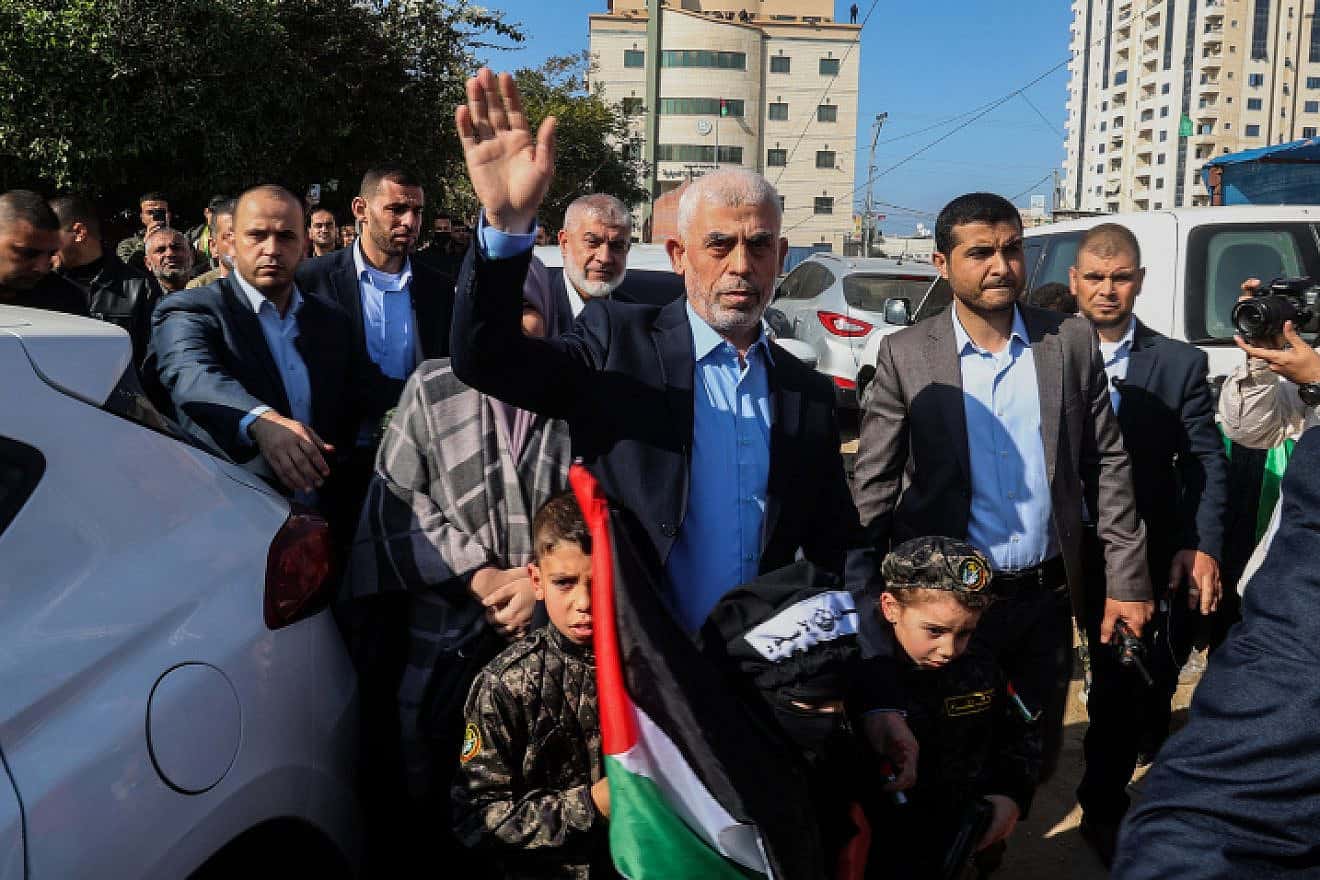
Yahya Sinwar, Hamas’s leader in the Gaza Strip, at a rally in Gaza City marking the movement’s 35th anniversary, Dec. 14, 2022. Photo by Atia Mohammed/Flash90.

The IDF spokesperson unveiled new details and footage from the death in Rafah, the southern Gaza Strip, of Yahya Sinwar, the head of Hamas and the chief architect of the Oct. 7 massacre.


In a video, captured by an Israeli drone, shows Sinwar sitting on a couch inside a destroyed building. Upon noticing the drone hovering above him, Sinwar, who had lost a hand from earlier gunfire, throws a piece of wood at the drone in an effort to knock it down.

IDF soldiers at the scene of Sinwar’s elimination. Photo: Usage in accordance with Section 27A of the Copyright Law.

In his statement, the IDF spokesperson said: “For months, IDF and Shin Bet forces have been working to gather intelligence in order to eliminate Yahya Sinwar, the leader of the Hamas terrorist organization and one of the founders of its [Al-Qassam Brigades] ‘military’ wing. Sinwar had been hiding in an area our forces surrounded for an extended period.

“We didn’t know he was there, but we continued to act with determination. The forces found Sinwar with a [tactical] vest, a pistol and 40,000 shekels [nearly $11,000] in cash. He tried to flee, and our forces eliminated him.”

Hamas chief Yahya Sinwar’s belongings when he died. Credit: IDF.

“There were no hostages with the terrorists we eliminated [Sinwar and two others, apparently his body guards],” the spokesperson clarified. “The forces are now scanning the area and are proceeding with the necessary caution.”

Regarding Sinwar’s earlier presence in the Rafah tunnel where the bodies of the six hostages, who were murdered in captivity, were discovered last month, he added: “After an investigation, we can confirm that Sinwar’s DNA was found in an underground tunnel, a few hundred meters from the tunnel where the hostages were killed.

“We had known Sinwar’s estimated location for some time despite the high level of secrecy that Hamas employed regarding his whereabouts,” military sources stated. “We knew he had been in Rafah, and we have been extracting information from underground tunnels there to understand where he was.”


Originally published by Israel Hayom.


Zawartość publikowanych artykułów i materiałów nie reprezentuje poglądów ani opinii Reunion’68,
ani też webmastera Blogu Reunion’68, chyba ze jest to wyraźnie zaznaczone.
Twoje uwagi, linki, własne artykuły lub wiadomości prześlij na adres:
webmaster@reunion68.com