JUDITH SUDILOVSKY
This is a striking new architectural concept in the city, having been excavated deep beneath the earth’s surface to adhere to height restrictions prohibiting anything taller than the Old City walls.
.
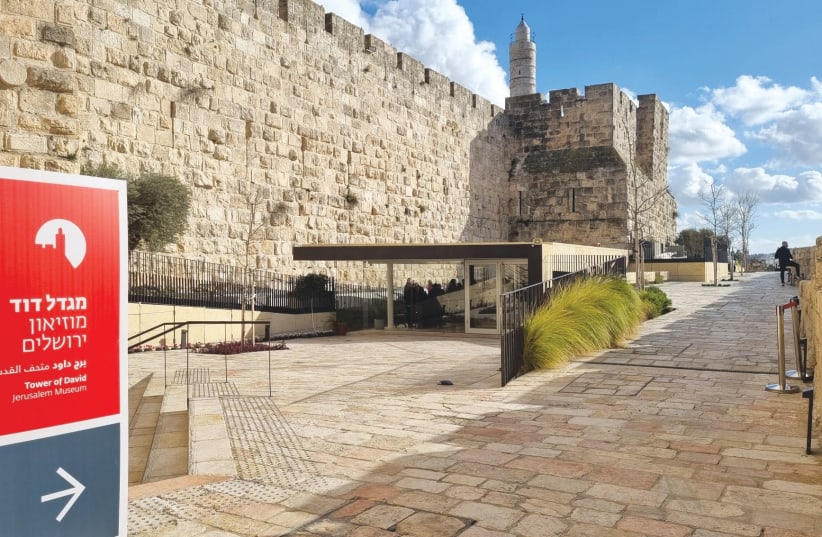 Adhering to strict height restrictions to maintain the Old City’s skyline, Kimmel Eshkolot Architects excavated 17 meters down to craft the new multi-level Tower of David Angelina Drahi Entrance Pavilion in an area between the outer Old City Ottoman-period wall and the inner wall.
(photo credit: Reut Kozak)
Nestled in an area between the Old City’s Ottoman-period outer wall and the inner wall that was once an Ottoman ramp is the new Tower of David Angelina Drahi Entrance Pavilion, which is scheduled to hold its official opening and inaugural temporary exhibition next month.
This is a striking new architectural concept in the city, having been excavated deep beneath the earth’s surface to adhere to height restrictions prohibiting anything taller than the Old City walls.
The opening of the new building was postponed from November 3, following the Hamas attack on Oct. 7, though the museum nevertheless opened its doors to visitors on the third day of the war. Since then, more than 20,000 displaced residents currently living in Jerusalem have visited. The museum restarted its English-language tours of the new permanent exhibition in February. The tours, included in the admission price, start at 10 a.m. on Mondays and Thursdays.
Adhering to the strict height restrictions to maintain the Old City’s skyline, architects from Kimmel Eshkolot Architects excavated 17 meters down to craft a multi-level pavilion that now hosts a temporary exhibition gallery, a maze of offices for the Education Department, and the museum’s ticket office. Additionally, visitors can enjoy a shaded outdoor seating area, with a new coffee shop slated to open in May.
Led by Prof. Etan Kimmel and chief architect Yotam Cohen-Sagi, the ancient citadel, initially designed as a fortress to keep people out, was converted into an accessible environment suitable for a modern museum. In the Crusader period, the area of the pavilion was used as a moat around the Old City. Later, the Ottoman ruler Suleiman the Great built defensive ramparts there to defend the city from the west from an attack by Napoleon’s French forces, which never arrived.
.
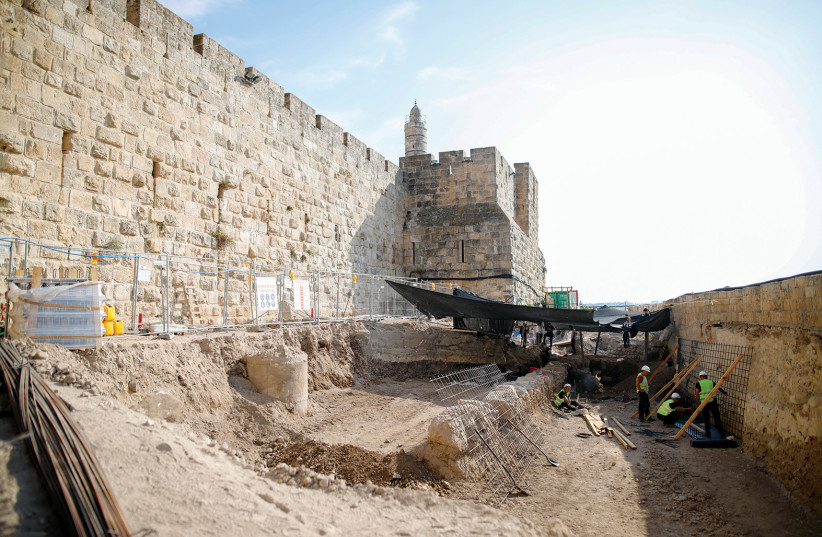 After first having to establish the museum’s ownership over the property, a salvage excavation was conducted in cooperation with the Israeli Antiquities Authority before construction began during the COVID period. (credit: RICKY RACHMAN)
“Our challenge boiled down to our ability to find solutions to preserve the ancient stones that represent Jerusalem’s past without compromising their historic value or their beauty – all the while planning new architectural structures and introducing modern infrastructure using modern materials to create an interesting meeting between the new and the old. Ever present in our planning was our respect for this ancient structure,” said Kimmel.
The $50 million endeavor to renovate and preserve the Tower of David Jerusalem Museum was spearheaded by Dame Vivien Duffield, in collaboration with the Clore Israel Foundation. Their vision received support from the Jerusalem Municipality, the Ministry of Jerusalem and Jewish Tradition, the Ministry of Heritage, and the Tourism Ministry. Contributions also came from the Patrick and Lina Drahi Foundation, Keren Hayesod, the Jerusalem Foundation, the American Friends of Museums in Israel, and the P. Austin Family Foundation.
For centuries, the Jaffa Gate, where the Tower of David Museum is located, served as the primary entry point to the Old City. Over the past two decades, the municipality has introduced modern infrastructure, including convenient access points from the light rail, and parking facilities at the Mamilla-Alrov shopping boulevard lots, changing the urban setting of the area.
“They built the Jaffa Gate Piazza, which put a different point of view of the whole citadel because it became the building that stands and overlooks this piazza,” Cohen-Sagi told journalists on a recent press tour of the pavilion, ahead of its opening.
“We understood that once we started to plan the concept for the whole renewal of the museum a few years ago, we needed to change the situation of the citadel.”
Gateway to the Holy City
Before the redesign, visitors to the museum had to walk around to the eastern entrance, which originally was the front of the citadel. The changes to the Tower of David Museum now provide a smooth gateway for visitors to explore Jerusalem: As they enter the Old City through the Jaffa Gate, they can first visit the museum and explore its new historical and archaeological permanent exhibit. Here, they can traverse the narrative of Jerusalem’s 4,000-year-old history before exploring the modern-day alleys of the Old City.
“We have the beautiful unique building of the citadel, which was never meant to be a museum. It was an army barracks,” said Eilat Lieber, the museum’s director and chief curator. “Three decades after the opening of the Tower of David Museum, we had to think about the future of the museum – not just renew the exhibits but [consider] our role within the vision of being the museum for the city.
“The [nearby] Mamilla [outdoor shopping boulevard] is a very successful bridge between the modern western part of the city and the Old City. You can find all the communities of the city in the same place. Suddenly, you see a place where people can mix. We knew this museum had to be a gateway to Jerusalem and a key to understanding the history of Jerusalem [and the connection] between people and communities.”
Challenging excavation
For many years, the area where the sleek yet minimalist modern glass and steel structure now stands was considered a no-man’s land, used as a parking lot and the rear entrance to the museum. After first establishing the museum’s ownership over the property, a salvage excavation was conducted in cooperation with the Antiquities Authority before construction began during the COVID period.
Excavation work was done with the guiding help of an archaeological diary written almost 100 years ago by British archaeologist Cedric Norman Jones. It included photographs and descriptions of the section that he had originally excavated.
“You only need to use a teaspoon to dig up antiquities in the Old City of Jerusalem, and this is even more true when you are building a 1,000 sq.m. structure underground next to a citadel thousands of years old,” said Cohen-Sagi.
“From the first moment, therefore, we used all the tools at our disposal to minimize the lack of certainty of what would be found, such as 3D imaging, core samples, exploratory archaeological excavations, and documenting the excavation that was done on-site at the beginning of the 20th century.
“We worked closely with the Antiquities Authority. Despite a number of engineering changes and adaptations requested during the actual excavation work, and finds that were discovered in the area, the building that was finally erected is almost the same building that appears on the first sketches.”
The new pavilion now redirects the flow of visitors to the historic site. Since it is located at the lowest topographical point around David’s Citadel, visitors now pass through it to enter the citadel and continue on an upward journey through the galleries and open passageways. Their visit ends at the top of the observation point, which overlooks Jerusalem from the rooftop of the Phasael Tower – 30 m. above the new entrance pavilion, 777 m. above sea level.
“It was actually a parking place. Six years ago, this was the rear entrance to the museum, kind of a service entrance to the museum. We had the challenge, for the first time in history, to make it a place for people,” Cohen-Sagi said. “So we understood that we have first of all to make a practical building.”
One of the biggest challenges in building the pavilion was discovering in February 2022 that at least a 20-m.-long section of the huge monumental wall of the citadel was not built on any foundation at all but rather on construction fill. Though a wonder of ancient engineering skill, the new construction and excavation work threatened to disrupt the delicate ancient balance.
To continue their work and preserve the wall, engineers from Schaffer and Ronen Engineering and Conservation used a series of eighty 17-m.-deep “piles” – wrought-iron tube-like metal constructions – to temporarily support the citadel wall as they built a new wall next to it.
Another challenge arose during the installation of the wall’s supportive element – ensuring minimal movement. After seeking advice from experts in Portugal and Italy, specialized digital sensors, linked to a mobile app, were installed along the wall to detect any shifts around the clock. Apart from the engineers, Lieber also had the sensor app synchronized with her mobile phone.
“I wanted the app on my cellphone so I could follow the sensors and sleep at night,” she said. “At night, I would open the app and follow the project to see that the wall was not moving at all. It was scary.”
Now that she can sleep at night, Lieber hopes the museum’s new permanent exhibition, which includes original artifacts, interactive displays, and creative programming, will help give visitors a better understanding of Jerusalem.
“Whether it is a schoolchild from Israel or a visitor from overseas, I hope that the Tower of David can give them a basis for dialogue, tolerance, and respect,” she said.■
 TV7 Israel News – Sword of Iron, Israel at War – Day 167 – UPDATE 21.03.24



