EMANUEL FABIAN
 .
.
Subterranean facility for terror group’s intelligence needs, beneath UN complex in upscale Rimal neighborhood, discovered after interrogations of Palestinian prisoners
GAZA CITY, Gaza Strip — Beneath the Gaza Strip headquarters of the controversial United Nations agency for Palestinian refugees, known commonly as UNRWA, the Hamas terror group hid one of its most significant assets, the Israeli military has revealed.
The subterranean data center — complete with an electrical room, industrial battery power banks and living quarters for Hamas terrorists operating the computer servers — was built precisely under the location where Israel would not consider looking initially, let alone target in an airstrike.
The revelation of the server farm comes amid other accusations of UNRWA collusion with the Gaza-ruling terror group and the entanglement of the UN body that provides welfare and humanitarian services for Palestinian refugees from the 1948 and 1967 wars and their descendants.
Israel last month accused 12 staff with the UN Palestinian refugee agency of taking part in the October 7 massacre by Hamas-led terrorists, who killed 1,200 people and took 253 hostages in the murderous rampage.
Since the allegations became public late last month, UNRWA has seen many of its top donor countries announce funding freezes, leading to concerns that the agency could stop operating in Gaza and elsewhere in the Middle East within weeks.
But the IDF’s recent discovery of the Hamas data center while UNRWA is under increased scrutiny appears to be merely a coincidence.
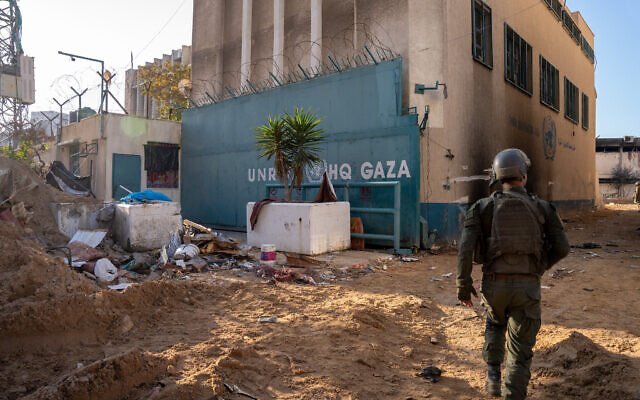 Col. Benny Aharon walks into UNRWA’s headquarters in Gaza City, February 8, 2024. (Emanuel Fabian/Times of Israel)
UNRWA’s Gaza headquarters is located in Gaza City’s upscale Rimal neighborhood, an area that the IDF had previously operated in, dismantled the local Hamas battalion and withdrawn its troops from.
At the time of the initial ground offensive in Gaza City, the military had not found or known much about the Hamas data center. But new intelligence, primarily emerging from the Shin Bet interrogations of captured terrorists, helped pinpoint where to dig.
“The IDF was here previously, the first time was to destroy the enemy, but when we were here the last time we collected a lot of intelligence documents and findings, a lot of prisoners, and thanks to this we reached here. Now we carried out a targeted operation to take this capability away,” said the commander of the 401st Armored Brigade, Col. Benny Aharon, while giving a media tour of the tunnel and UN complex on Thursday.
“We had a basis of information, but not enough to be able to dig down 20 meters and find it, we needed a bit more. There’s information we get from prisoners we capture, from computers we find, from documents, maps,” he said.
The IDF in recent weeks has returned to carry out smaller operations in the northern Gaza Strip, after largely destroying Hamas’s fighting capabilities during the early stages of the ground offensive.
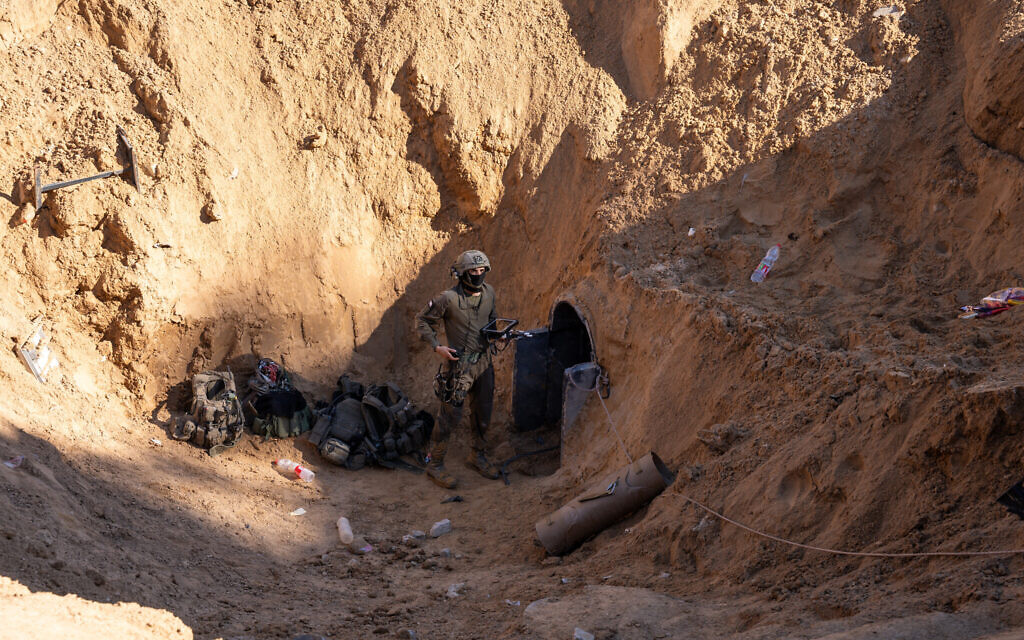 A soldier of the Yahalom unit stands outside a tunnel leading to a Hamas data center, uncovered by the IDF in Gaza City, February 8, 2024. (Emanuel Fabian/Times of Israel)
Col. Nissim Hazan, a senior officer in the 401st Brigade, said the IDF can now carry out raids with much smaller numbers of forces, for operations “that require much more research and much more time, and a lot more patience.”
There is still a risk to these raids, with Aharon noting that two soldiers under his command had been killed during their operation to reach the Hamas data center — Maj. (res.) Yitzhar Hofman, a commander in the Israeli Air Force’s elite Shaldag unit and Maj. David Shakuri, the deputy commander of the Combat Engineering Corps’ 601st Battalion — both by sniper fire.
Hazan, who is tasked with coordinating the brigade’s underground operations, said the main entrance to the tunnel was located under a UNRWA school in the area. However, it had been blocked off by Hamas by the time troops arrived. Instead, combat engineers dug down around eight meters to find the shallowest part of the underground passage.
A muddy and humid labyrinth to the data center
Journalists, accompanied by troops of the elite Yahalom combat engineering unit, the Shaldag unit and Hazan, entered the tunnel passage that had been uncovered. Due to the humidity, with all of Hamas’s air filtration systems disabled, we were advised to remove our bulletproof vests before embarking on the journey to the data center.
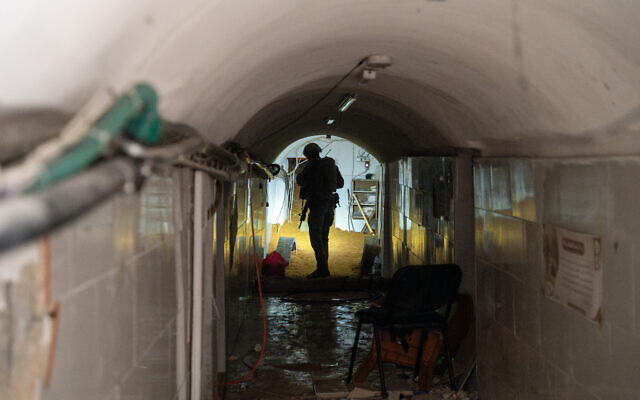 A soldier stands in a Hamas tunnel underneath a UNRWA school in Gaza City, February 8, 2024. (Emanuel Fabian/Times of Israel)
The first stretch of the 700-meter-long tunnel, a few dozen meters with Hamas’s hallmark concrete arches and a floor of sand, was relatively unremarkable, similar to hundreds of kilometers of underground passages the terror group has built across the Gaza Strip.
The passage had several other branching paths, but to keep the reporters on track and not get lost, soldiers had placed neon glowsticks on the floors.
The route we followed led to a small hole, which after climbing through, revealed a large hallway with flooring, wall tiles, air conditioning and lighting fixtures.
The hallway was plastered with posters bearing the logo of Hamas’s military wing, the Al-Qassam Brigades, some with operational security instructions for the terrorists managing the data center.
In this part of the tunnel, according to Hazan, Hamas IT and intelligence staff would supervise and manage the data center.
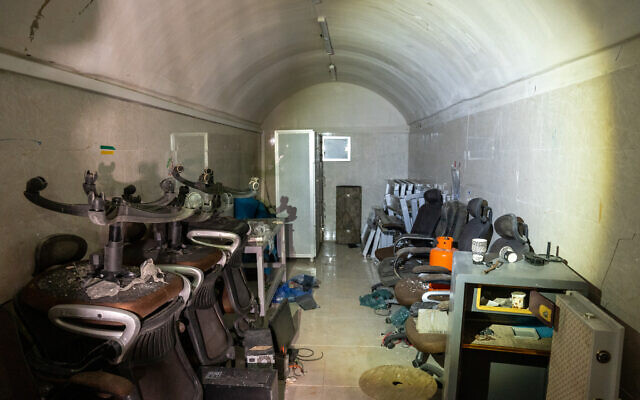 Office chairs are stored in a room in a Hamas tunnel, underneath a UNRWA school in Gaza City, February 8, 2024. (Emanuel Fabian/Times of Israel)
Along the hallway, there were several rooms, including a kitchenette, a meeting room with office chairs, two bathrooms and living quarters with several mattresses.
Also in the hallway, troops found several small mobility scooters, thought to have been used by Hamas to traverse through the tunnel’s facilities with ease.
“Above us is a UNRWA kids’ school,” Hazan said, as we explored the rooms in the main hallway. “This is years of work, with a lot of determination and resources.”
From the main hallway, a 300-meter passage led to the data center and nearby electrical room.
“We are now crossing a main road in Rimal, below several high-rise towers,” Hazan said.
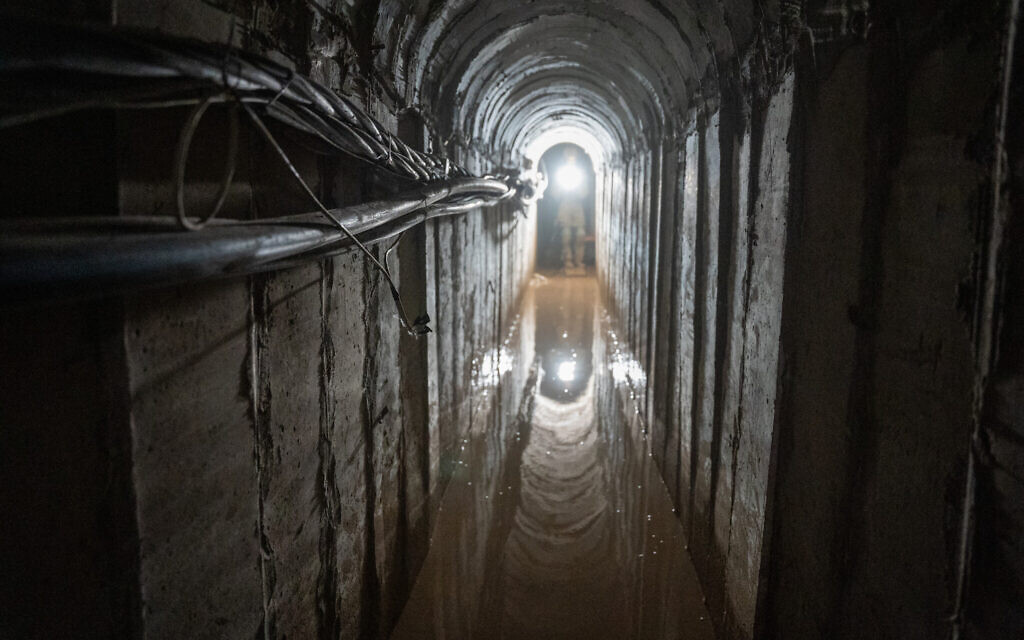 A flooded tunnel leading to a Hamas data center, uncovered by the IDF in Gaza City, February 8, 2024. (Emanuel Fabian/Times of Israel)
Parts of the tunnel, due to the combat engineers’ operations, did not have the usual concrete ceiling, exposing the fragile sand.
“Keep your head down and don’t touch the ceiling,” a Shaldag officer told us, as we crawled through the section, making sure not to cause the tunnel to collapse on our heads.
Also as a result of the combat engineers digging to reach the tunnel, rainwater had flooded in, causing knee-deep puddles in some areas, which we waded through to reach the data center.
After the flooded sections of the tunnel, a slippery incline led to the first main facility in the tunnel, the electrical room.
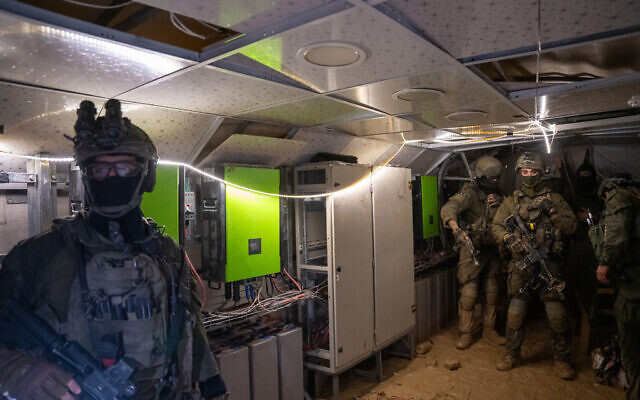 An electrical room serving an underground Hamas data center, beneath the UNRWA headquarters, uncovered by the IDF in Gaza City, February 8, 2024. (Emanuel Fabian/Times of Israel)
The room, with several electrical closets, power inverters and dozens of off-grid industrial batteries, was now covered in a thick layer of mud.
Part of the room’s dropped ceiling was falling apart, where the combat engineers had dug down 20 meters from the courtyard of the UNRWA complex, adjacent to one of the main buildings.
A few more dozen meters of tunnel from the electrical room led to the heart of the facility, Hamas’s data center.
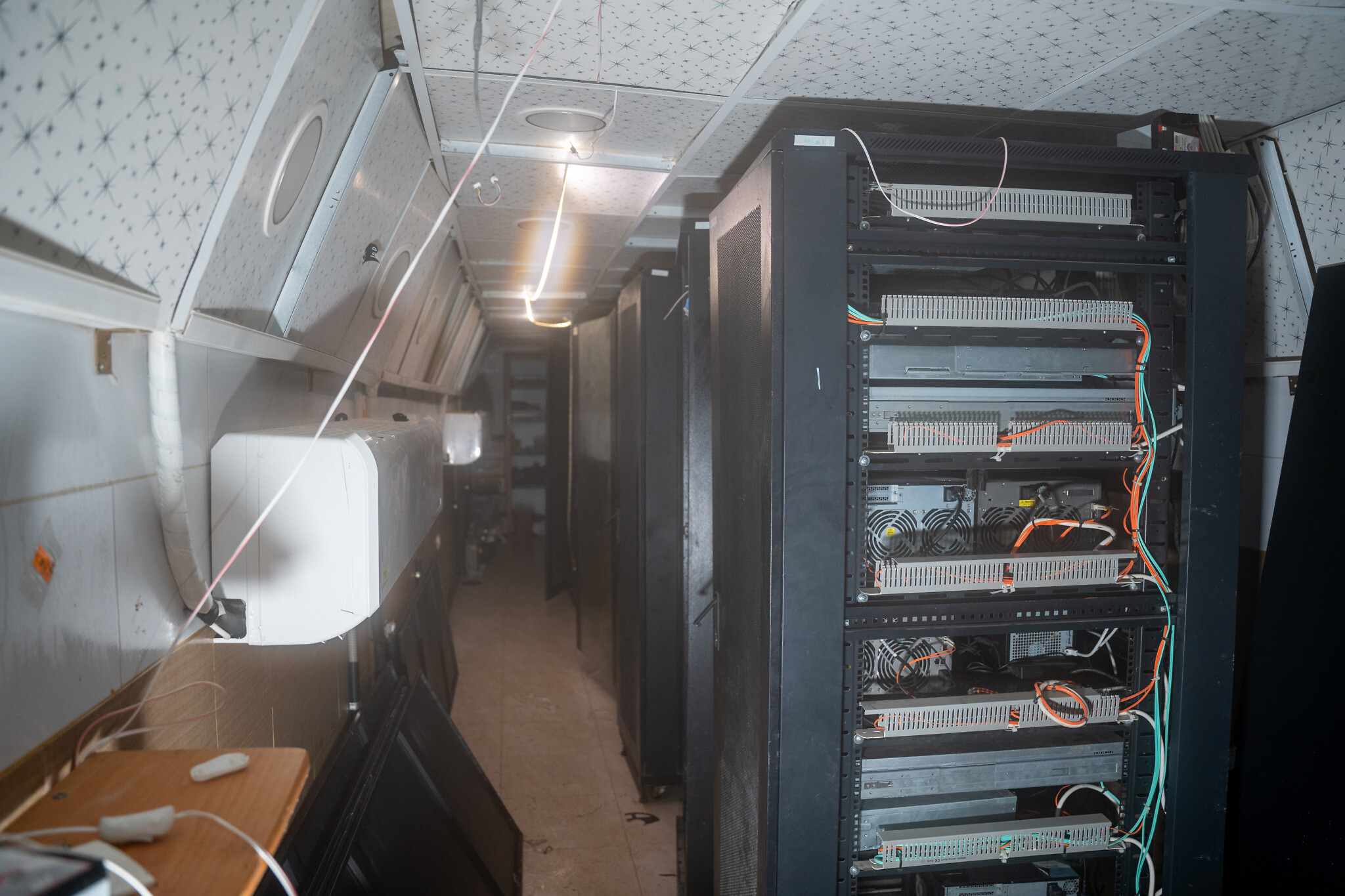
There were about half a dozen rows of server cabinets, each with racks of computers for Hamas’s operations.
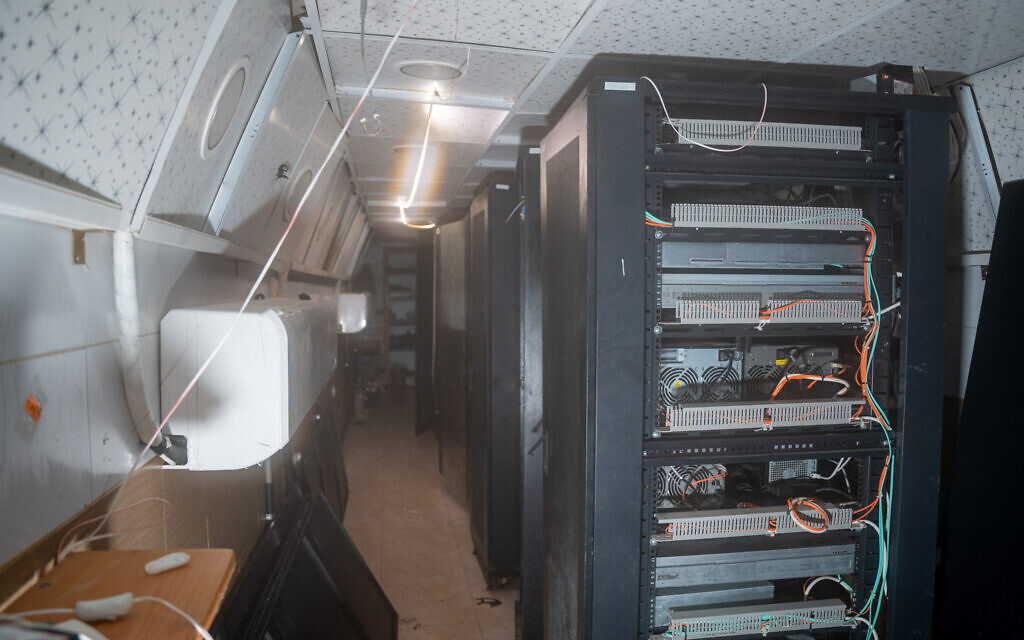 A subterranean Hamas data center underneath UNRWA’s headquarters in Gaza City, February 8, 2024. (Emanuel Fabian/Times of Israel)
“We are now at the heart of the secret… under the main UNRWA building. Here is where Hamas kept its intelligence servers,” Hazan said. He said that “to destroy it, totally, so that Hamas cannot use this intelligence supremacy again, you need boots on the ground.”
IDF officials believe Hamas used the server farm for intelligence gathering, data processing and communications. Hard drives and some of the computers were taken to Israel to be investigated by intelligence authorities before the tunnel system was demolished in a large explosion.
Hazan said the IDF knows of several more “strategic” Hamas tunnels in Gaza, that they will reach in time.
“We have time, months ahead of us in the war, and one by one we will dismantle them and take away what the enemy is trying to hide, and it hides it in a very sophisticated and cynical way,” he said.
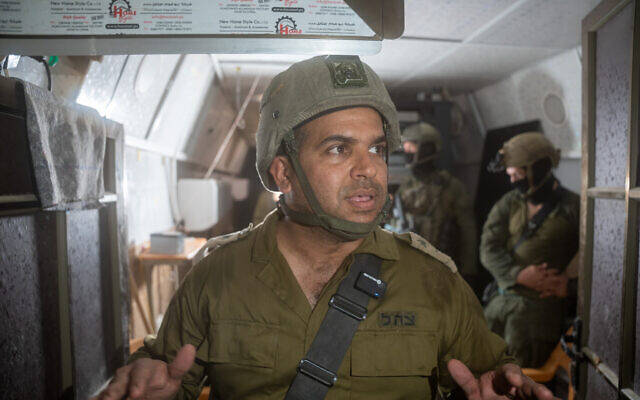 Col. Nissim Hazan speaks to reporters from a Hamas data center, beneath the UNRWA headquarters, uncovered by the IDF in Gaza City, February 8, 2024. (Emanuel Fabian/Times of Israel)
.
UNRWA’s Gaza headquarters
After leaving the tunnel back through the way we entered, we boarded an armored personnel carrier to take us to the UNRWA headquarters, as walking there aboveground was too exposed to potential Hamas snipers.
The headquarters appeared to be largely intact, unlike many of the surrounding buildings that had been pummeled by Israeli strikes.
Passing through the main gate, reading UNRWA HQ GAZA, and a nearby building with similar text in English and Arabic and bearing the UN logo, we reached the courtyard from which the combat engineers dug down into the electrical room.
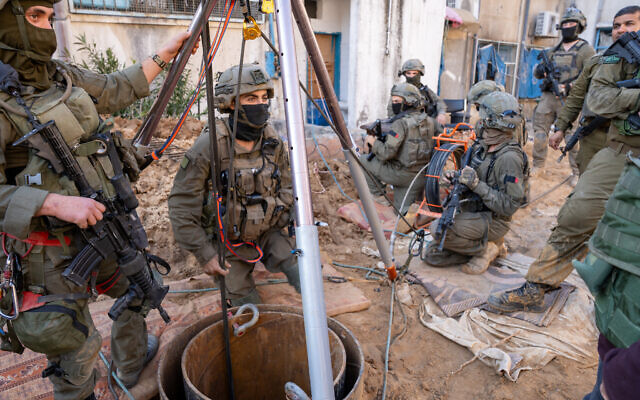 Troops of the Yahalom combat engineering unit lower a camera into a tunnel shaft they dug in the courtyard of UNRWA’s Gaza headquarters, to reach a Hamas underground electrical room, February 8, 2024. (Emanuel Fabian/Times of Israel)
At the UNRWA headquarters, Aharon said his forces found several caches of weapons belonging to Hamas when they raided and battled Hamas gunmen for the complex, although it was after the UN staff had evacuated.
“Grenades, rockets, launchers, explosives, a large amount of weapons that would put any Hamas company to shame,” he said.
The IDF also said that in some of the offices of UNRWA officials, troops found equipment and documents that indicated “that the same offices were also used by Hamas terrorists.”
“There is no doubt that UNRWA staff knew that [Hamas] was digging a massive tunnel beneath them,” Aharon said. “There’s a perimeter wall, a gate, cameras, at the gate they log who comes in and out. Whoever worked at UNRWA knew very well who was coming in, and who they were covering for.”
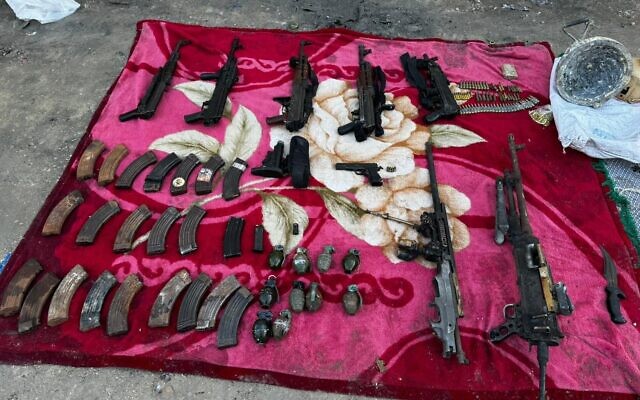 Weapons recovered by IDF troops in the UNRWA headquarters, in a photo published by the IDF on February 10, 2024. (Israel Defense Forces)
“UNRWA provides cover for Hamas, UNRWA knows exactly what is happening underground, and UNRWA uses its budget to fund some of Hamas’s military capabilities, this is for certain,” he said.
At the main building in the UN complex, Aharon led the reporters to UNRWA’s server room, which he said sits directly above the underground Hamas data center, where the reporters had been a short while earlier.
“Some of the cables connect down,” he said, showing a line of cables running down to and into the floor, as we stood above the Hamas data center.
The IDF said the electrical cables leading from the UN building to the tunnel were providing power to the Hamas infrastructure belowground.
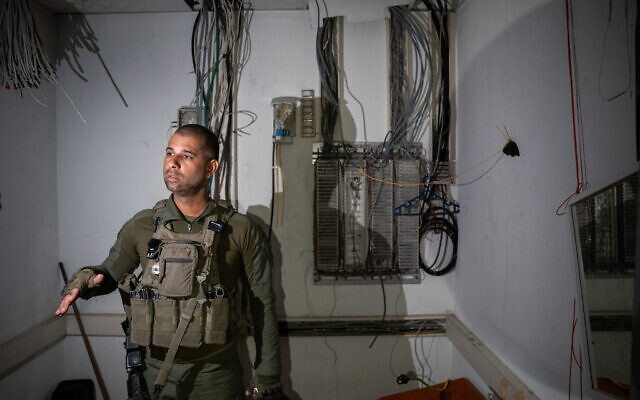 Col. Benny Aharon shows reporters UNRWA’s server room at its headquarters in Gaza City, February 8, 2024. (Emanuel Fabian/Times of Israel)
The UNRWA server room, unlike the Hamas one, appeared to be mostly empty. One server cabinet was placed outside the room, but it had been stripped of all the computers.
“They cleared out all the computers, all the DVRs (digital video recorder for surveillance cameras), cut [most of] the cables, this is the behavior of someone who has something to hide,” Aharon said.
“Someone who works at UNRWA, who is supposed to care for human rights, to care for the welfare of the population in Gaza, shouldn’t rush to disconnect all the DVRs, the cameras, cut all the wires and take all the computers. These are the actions of someone who knew the army was coming and wanted to hide the evidence,” he said.
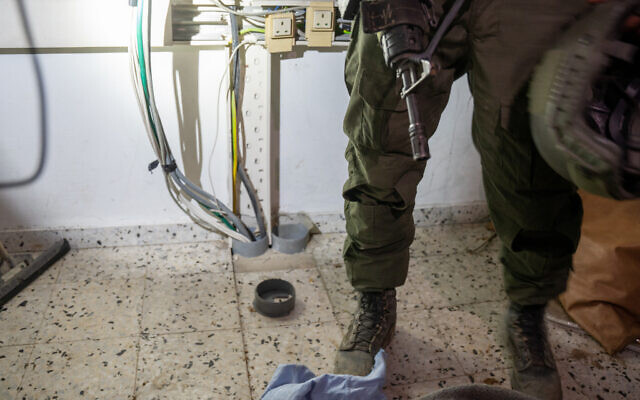 Cables running from a UNRWA server room to a Hamas data center underground in Gaza City, February 8, 2024. (Emanuel Fabian/Times of Israel)
Hazan said that Hamas “didn’t randomly select this area. It knows that during peacetime and in previous wars [Israel] didn’t have the legitimacy to strike a UNRWA building and collapse it on the tunnel.”
In addition to the allegations of its collusion with Hamas, Israel has also long accused UNRWA of perpetuating the Israeli-Palestinian conflict by extending refugee status to millions of descendants of Palestinians who fled or were forced out of homes in today’s Israel at the time of the establishment of the Jewish state in 1948, rather than limiting such status only to the original refugees, as is the norm with most refugee populations worldwide.
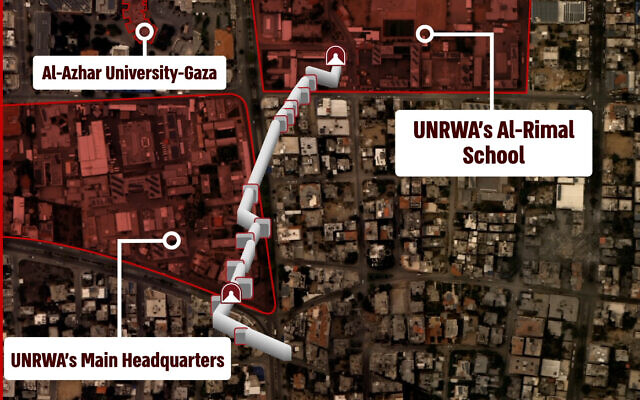 An IDF infographic released February 10, 2024, showing the route of the Hamas tunnel found under UNRWA’s Gaza headquarters. (Israel Defense Forces)
“We were shocked to the depths of our souls, that an organization that is meant to be caring for human rights, is cooperating in such a clear and brutal way, without any fears, with a terror group like Hamas,” Aharon said.
UNRWA did not immediately respond to requests for comment. In a tweet following the publication, the agency’s head Philippe Lazzarini denied any knowledge of the Hamas data center.
 Two Israelis killed, four wounded in terror shooting in south
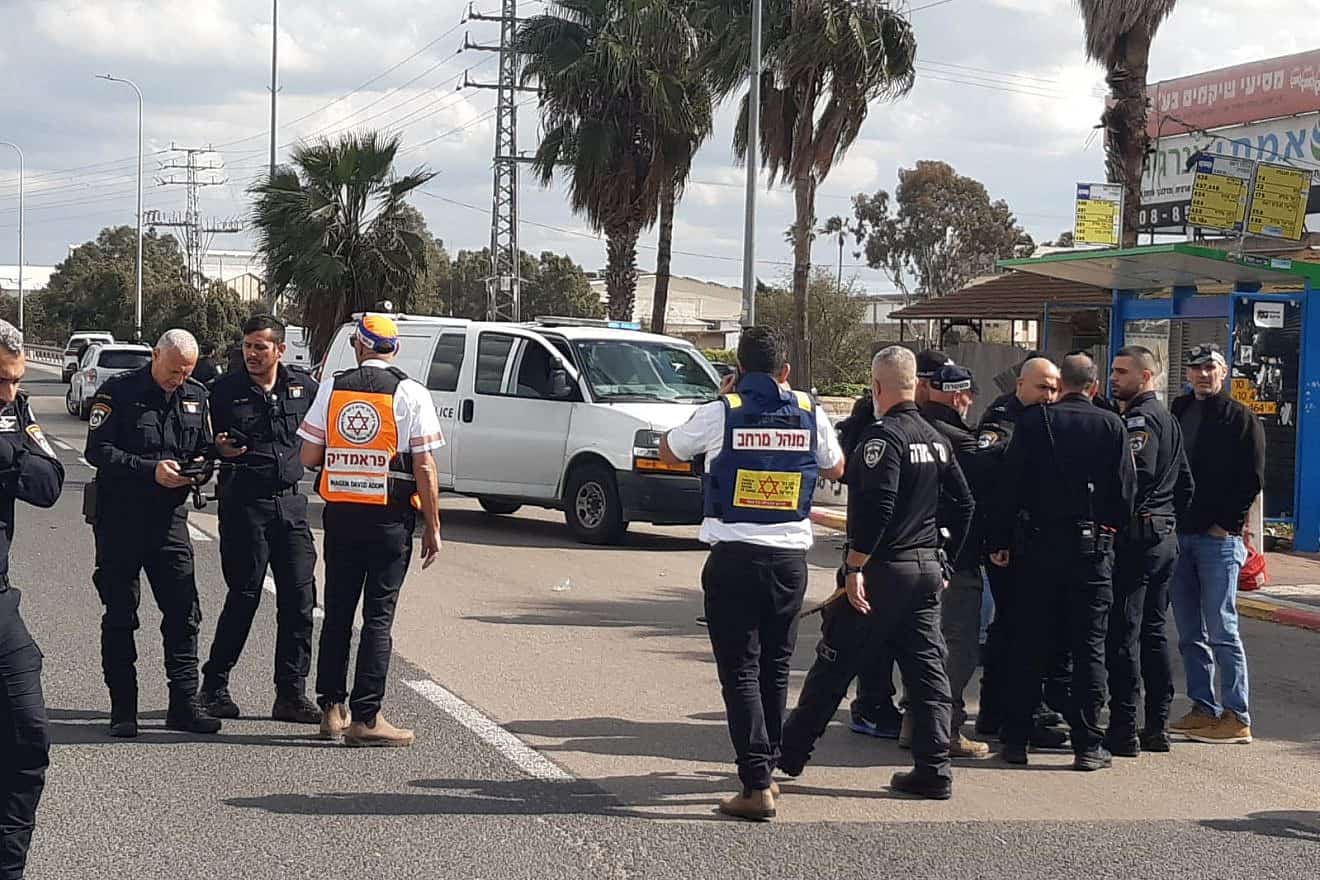 Security forces at the scene of a terrorist shooting at the Re’em Masmiya Junction near Kiryat Malachi in southern Israel, Feb. 16, 2024. Credit: Magen David Adom.
 ILTV Israel News