Andrew Bernard
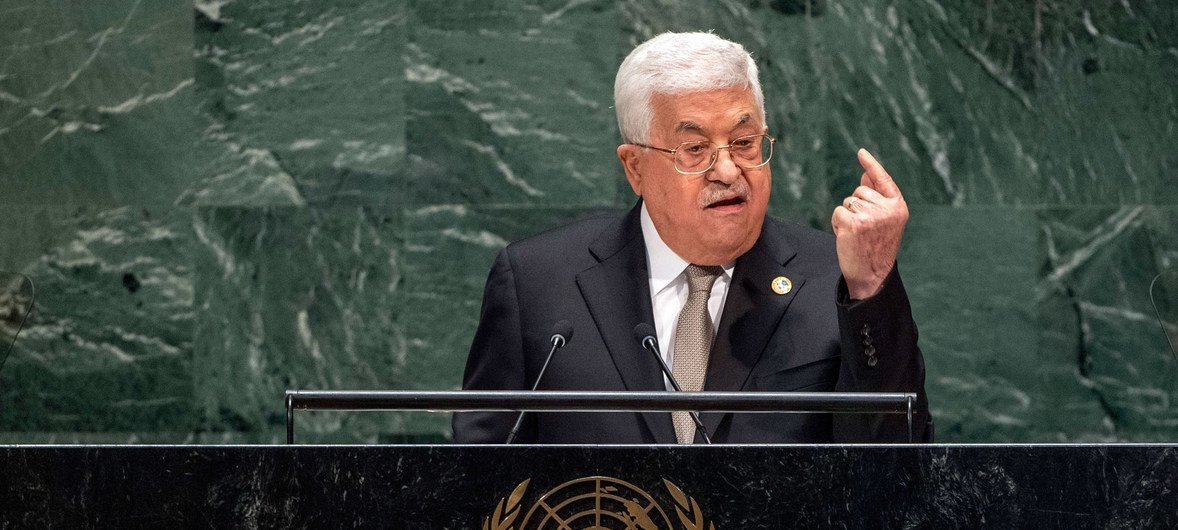 UN Photo/Cia Pak Mahmoud Abbas, President of the State of Palestine, addresses the 74th session of the United Nations General Assembly’s General Debate. (26 September 2019)
The spokesman for Palestinian Authority President Mahmoud Abbas doubled down on the legitimacy of his boss’s recent speech, which has drawn international outrage for its litany of antisemitic conspiracy theories and claims that Nazi leader Adolf Hitler did not hate the Jews as a people.
Nabil Abu Rudeineh claimed on Thursday that Abbas’ “position on this issue is clear and documented” and that the Palestinian president condemns the Holocaust. He added that Abbas’ remarks “on the Jewish issue” were based on quotes “from the writings of Jewish and American historians and writers and others” and “not considered a denial in any way of the Holocaust.”
However, neither Abbas nor his spokesman issued an apology, instead reserving blame for those who criticized the speech.
“We express our strong disapproval and condemnation of this frenzied campaign just for quoting academic and historical writings,” Rudeineh said, according to Palestinian media reports.
However, neither Abbas nor his spokesman issued an apology, instead reserving blame for those who criticized the speech.
“We express our strong disapproval and condemnation of this frenzied campaign just for quoting academic and historical writings,” Rudeineh said, according to Palestinian media reports.
Abbas has received global condemnation for a recent antisemitic speech that he delivered late last month to the Revolutionary Council of Fatah, the political party he leads. The address — which the Middle East Media Research Institute flagged and posted video of last weekend — was riddled with antisemitic conspiracies and claims that antisemitism was not a cause of the Holocaust. Among the controversial comments, Abbas claimed that Nazi leader Adolf Hitler did not hate Jews as a people but rather because of their dealings with money as usurers.
“They say that Hitler killed the Jews for being Jews, and that Europe hated the Jews because they were Jews,” Abbas said. “Not true. It was clearly explained that [the Europeans] fought [the Jews] because of their social role, and not their religion. Several authors wrote about this. Even Karl Marx said this was not true. He said that the enmity was not directed at Judaism as a religion, but to Judaism for its social role.”
Abbas went on to claim that Hitler said he “fought” the Jews because “they were dealing with usury and money,” adding that the dictator of Nazi Germany “hated” Jews because they were engaged in sabotage.” He also said that the Holocaust “was not about Semitism and antisemitism.”
Rudeineh wasn’t the only Palestinian official to lambast critics of Abbas rather than Abbas himself over the speech.
“The European and American position on President Mahmoud Abbas’ speech, which was taken out of context, is reprehensible and unjust,” said Rawhi Fattouh, chairman of the Palestinian National Council, according to Israeli and Palestinian press reports. “He [Abbas] explained that there is a suspicious misinformation campaign led by manufactured media, and false propaganda based on quotes by foreign writers and historians, and that the position of President Mahmoud Abbas is known, consistent, and clear and does not accept doubt or interpretation that he is against the Nazi Holocaust, and that he rejects antisemitism [sic].”
Earlier this week, when news of Abbas’ speech spread, Jewish groups, Israeli officials, and foreign diplomats roundly condemned it. As the week went on, however, the international condemnation continued to roll in.
The European Union on Thursday issued a statement saying that Abbas’ speech “contained false and grossly misleading remarks about Jews and antisemitism,” and that his remarks “trivialize [the] Holocaust and thereby fuel antisemitism and are an insult to the millions of victims of the Holocaust and their families.”
The EU added, however, that perhaps the real victim was Abbas himself, saying that the speech might “play into the hands of those who do not want a two-state solution [to the Israeli-Palestinian conflict], which President Abbas has repeatedly advocated for.”
During Abbas’ tenure as president, he rejected a comprehensive Israeli peace offer in 2008 that, according to Palestinian officials, would have given the Palestinians even more territory than the full area of the West Bank and Gaza.
On Friday, the mayor of Paris, Anne Hidalgo, posted an open letter to Abbas stripping him of the city’s highest honor, the Grand Vermeil medal, which she awarded him in 2015.
“You recently justified the extermination of the Jews of Europe during the Second World War with a clear desire to deny the genocide to which the Jewish populations of Europe were victims at the hands of the Nazi regime and its allies,” Hidalgo wrote. “I condemn with the greatest firmness your remarks. No cause can justify [Holocaust] revisionism and denial.”
Hidalgo said that because Abbas’ comments were “contrary to our universal values and the historical truth of the Shoah,” he could no longer avail himself of the award.
European Jewish groups including Crif, which is the umbrella organization for French Jews, and the European Jewish Congress welcomed Hidalgo’s decision to revoke the medal.
American officials in the US Congress and the Biden administration have also rebuked Abbas for his remarks.
Rep. Ritchie Torres (D-NY) on Thursday posted on X, the platform formerly known as Twitter, that Abbas was “a moral disgrace.”
“The so-called ‘moderate’ Mahmoud Abbas denies the antisemitism of Adolf Hitler, falsely claiming that Hitler ‘fought the Jews because they were dealing with usury and money,’ Torres wrote. “With ‘moderates’ like these, who needs extremists? There is and has long been a deep rot of antisemitism at the core of Mahmoud Abbas, whose Jew-hatred and corruption have only served to perpetuate the suffering of his own people while lining his own pockets.”
Rep. Jared Moskowitz (D-FL) also lambasted Abbas for what he described as the leader’s dismal record of governance over the Palestinian Authority and his failure to hold elections since he took office in 2005.
“From the guy who can’t hold an election (been 17 years) in his own territory as he would lose to a terrorist organization,” Moskowitz said. “Part of the [Palestinian Authority] that turned down several peace deals. Yet now, he is a Hitler expert? Instead of rewriting the Holocaust, he should be helping his people.”
Abbas’ comments also drew a rare rebuke, albeit an indirect one, from the United Nations Secretariat, with Under-Secretary-General Miguel Moratinos saying that he condemned “all expressions and manifestations of antisemitism including denial of the Holocaust or distortion of historical facts regardless of the motivation and by whomsoever iterated.”
Moratinos cited Abbas by name only in referencing that he “acknowledge[d] the statement issued by the office of Palestinian Pres. Mahmoud Abbas clarifying his position on this matter.”
Abbas is currently slated to address the UN on Sept. 21 at the opening of the general debate of the 78th session of the General Assembly.
 Israel Daily News – September 19, 2023



 ILTV Israel News