Archives

Smotrich: IDF ‘likely’ to step up enforcement in Lebanon


Smotrich: IDF ‘likely’ to step up enforcement in Lebanon

Charles Bybelezer, Amelie Botbol


“It is likely that we will soon need to return and operate there to preserve the gains achieved against Hezbollah,” Smotrich told JNS.
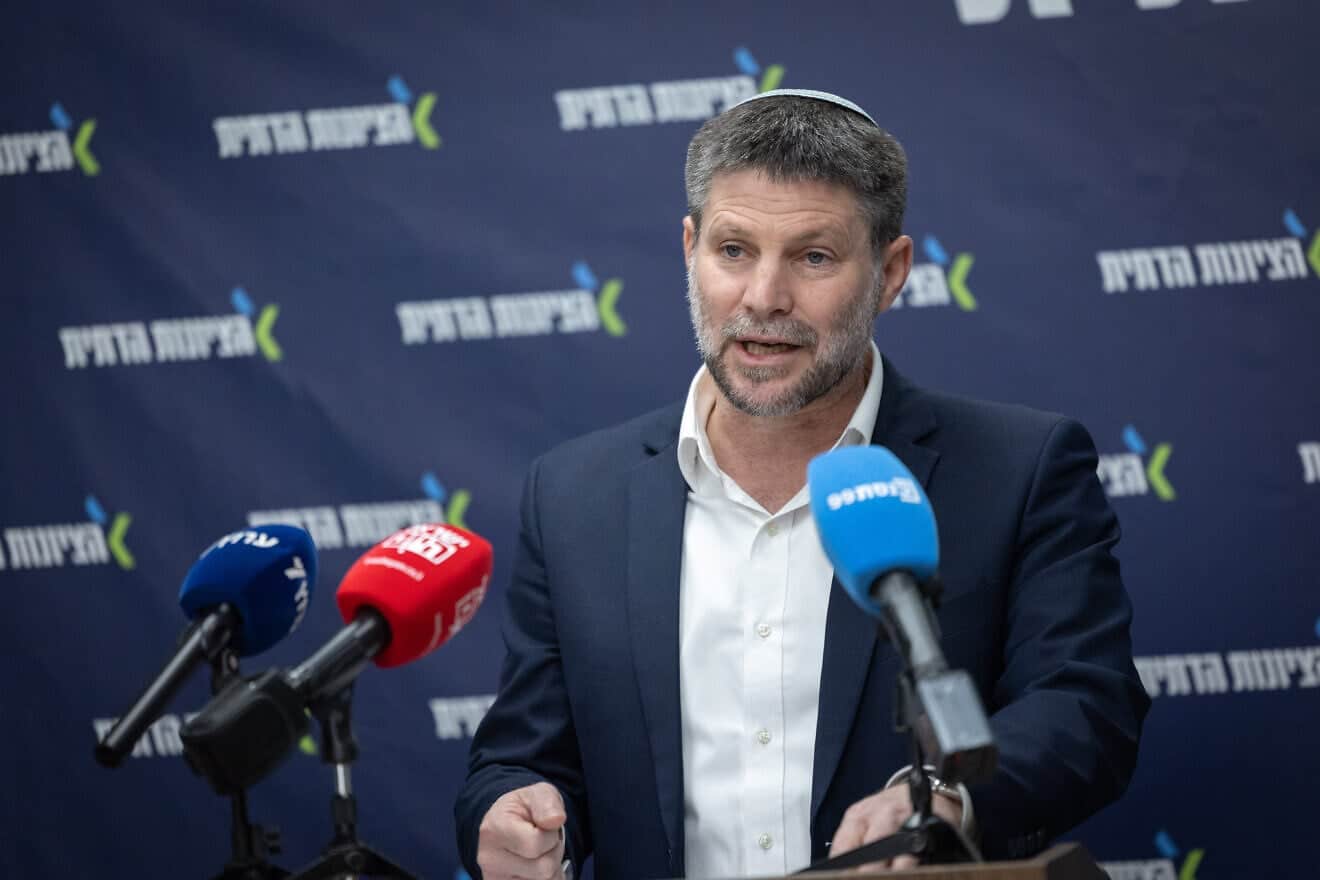
Israeli Finance Minister Bezalel Smotrich attends a Religious Zionism Party meeting in the Knesset, the Israeli parliament in Jerusalem, Dec. 8, 2025. Photo by Chaim Goldberg/Flash90.

The Israel Defense Forces will “likely” need to intensify military operations in Southern Lebanon, Israeli Finance Minister Bezalel Smotrich told JNS on Monday.

“We are enforcing in Lebanon, without compromise, against any Hezbollah armament and any violation of the ceasefire,” Smotrich stated, speaking at a Knesset meeting of his Religious Zionism Party.

“It is likely that we will soon need to return and operate there to preserve the gains achieved against Hezbollah,” he continued.

“We will not allow Hezbollah to remain,” the minister vowed. “Residents of the north deserve to live in complete security in their communities,” with the Israel Defense Forces holding strategic positions beyond the border, he added.

“There will no longer be a situation in which towns are the front line and the IDF is behind them. The IDF will be the front protecting the communities, and the communities will be behind it.

“We will continue to strike Hezbollah and defeat it,” continued Smotrich, adding, “We will not repeat the mistakes of the past 20 years.”

The IDF overnight Monday carried out strikes against Hezbollah terrorist infrastructure across Southern Lebanon, the military said.

The targets included a compound used by Hezbollah’s Radwan Force to train operatives for attacks against Israeli civilians and soldiers. Trainees there conducted shooting drills and received instruction in the use of various weapons, according to the IDF.

Military structures and a launch site used by the Iranian-backed terror group to facilitate attacks on Israeli forces and the state were also hit, the army said.

The targets “constitute a violation of the understandings between Israel and Lebanon and a threat to the State of Israel,” the IDF said, adding that it “will continue to operate to remove any threat.”

Israeli forces recently dismantled a Hezbollah tunnel in the Houla area of Southern Lebanon, the military said on Sunday. IDF troops had located and neutralized the tunnel during the war, but had now fully dismantled it to prevent any future exploitation.

IDF soldiers also recently dismantled a Hezbollah weapons storage facility in Ayta ash-Shab.

Lebanese Prime Minister Nawaf Salam told Qatar’s Al Araby Television Network on Saturday that Beirut is seeking to disarm all groups in the country’s south, including Hezbollah, by the end of the year.

The terror group had “accepted the ceasefire agreement, which restricts weapons to the hands of state forces,” Salam told the channel. “We are committed to restricting weapons south of the Litani [River] by the end of the year, and in the remaining areas during the next year.”

Days earlier, Jerusalem and Beirut dispatched officials to talks in Lebanon as “a first attempt to create a basis for economic relations and cooperation,” the Israeli Prime Minister’s Office announced.

The Israeli representative, Uri Resnick, senior director for foreign policy at Jerusalem’s National Security Council, met in Naqoura with “relevant Lebanese civilian representatives” as well as Morgan Ortagus, the deputy U.S. special envoy to the Middle East.

The meeting came after the Israel Defense Forces warned on Dec. 2 that Hezbollah was rapidly rebuilding its capabilities despite ongoing airstrikes since a truce deal last year.

The ceasefire went into effect on Nov. 27, 2024, after more than a year of war that culminated in an intense two-month IDF campaign that decimated the Iranian proxy’s leadership. The agreement was finalized by the Israeli and Lebanese governments with the involvement of five mediating countries, including the United States.


Zawartość publikowanych artykułów i materiałów nie reprezentuje poglądów ani opinii Reunion’68,
ani też webmastera Blogu Reunion’68, chyba ze jest to wyraźnie zaznaczone.
Twoje uwagi, linki, własne artykuły lub wiadomości prześlij na adres:
webmaster@reunion68.com


The Future of War: Israel Takes Global Lead on Military Innovation With New AI Division, Iron Beam Laser System


The Future of War: Israel Takes Global Lead on Military Innovation With New AI Division, Iron Beam Laser System

David Swindle


A part of Iron Beam laser anti-missile interception system, developed by Israel, is seen in this handout image obtained by Reuters on Sept. 17, 2025. Photo: Israel Defense Ministry/Handout via REUTERS

The Israel Defense Forces (IDF) announced this week a revolutionary reorganization of the technology and artificial intelligence capabilities of the Jewish state’s military, unveiling new plans to prepare for future warfare with cutting-edge advancements.

Israel’s major defense overhaul, unveiled on Tuesday, comes in preparation for the deployment of the long-anticipated “Iron Beam” laser interceptor system, which will be delivered to the military at the end of the month.

Under the name “Bina” — Hebrew word “intelligence” — the IDF has chosen to shut down its Lotem Unit from the C41 Corps, replacing it with the Artificial Intelligence (AI) Division and the Spectrum Division. The latter will focus on communications and electronic warfare with an emphasis on threats from Iran, China, and Russia.

The AI Division will grow through merging other sections within the IDF, including Mamram (the abbreviation for the Center of Computing and Information Systems) and software development units Shahar and Mitzpen. This consolidation of AI-development related divisions intends both to intensify security and avoid accidentally duplicating research efforts. The project will align with Israel’s Project Nimbus cloud computing program supplied by Amazon and Google.

The IDF also announced the ICT Division, which will focus on satellite warfare in outer space.

According to the military, about 50 percent of the new divisions are composed of women soldiers, with female officers comprising 40 percent of the senior command including two of the five top leadership positions.

Brig. Gen. Yael Grossman now heads ICT and the Cyber Defense Division, and Brig Gen. Racheli Dembinsky will head the Spectrum Division. Others in leadership positions include Chief Signals Officer Brig. Gen. Omer Cohen and Maj. Gen. Aviad Dagan.

“I have no doubt that the world is heading towards a space war, especially after the US and China defined space as a possible war arena,” Dr. Moshik Cohen, CEO for defense technology company AIPEX which focuses on missiles, told the Israeli publication Globes.

“Rival powers are already using it on the battlefield,” Cohen continued. “The Chinese have developed a way to detect stealth aircraft using satellites, and the Russians have jammed GPS signals from US satellites, which have dropped thousands of smart bombs on earth and blocked satellite communications for the Ukrainians. At the same time, the US is promoting Golden Dome, which will consist of a network of low-flying satellites able to perform military missions such as intercepting ballistic and hypersonic missiles and blocking enemy communications.”

Dagan said that the new divisions aspired to use technology to “turn one tank into 100 tanks, one soldier into 100 fighters.”

On Monday, meanwhile, Danny Gold, the head of the Israeli Defense Ministry’s Directorate of Defense Research and Development, revealed that the military would soon receive the “Iron Beam” laser interception system, a project a decade in development.

“With development complete and a comprehensive testing program that has validated the system’s capabilities, we are prepared to deliver initial operational capability to the IDF on Dec. 30, 2025,” Gold said. “The Iron Beam laser system is expected to fundamentally change the rules of engagement on the battlefield. Simultaneously, we are already advancing the next-generation systems.”

Created by Rafael Advanced Systems Ltd., the Iron Beam is intended to supplement rather than replace Israel’s Iron Dome and other air defense systems, focusing especially on smaller targets. As long as the weapon maintains a power source then it cannot run out of ammunition. However, the system does not function optimally in situations with clouds or low visibility.

The IDF chose to rename the laser weapon from Magen Or (Light Shield) to Or Eitan (Eitan’s Light) in honor of Cpt. Eitan Oster, a member of the Egoz Commando Unit killed in October 2024 while fighting the Hezbollah terrorist group in Lebanon.

Brig. Gen. Benny Aminov also announced this week an Israeli breakthrough in countering enemy drone attacks.

“We are now working on interception solutions using drone-based systems that enable response to swarm scenarios while accelerating the development of new directed-energy weapons,” Aminov said. “The issue of low-altitude threats is an example of a challenge that requires our defense establishment to fundamentally change its operational approach, responding within compressed time frames, spiral development, accelerating testing during the development process, and bridging small defense-tech companies with major defense contractors.”


Zawartość publikowanych artykułów i materiałów nie reprezentuje poglądów ani opinii Reunion’68,
ani też webmastera Blogu Reunion’68, chyba ze jest to wyraźnie zaznaczone.
Twoje uwagi, linki, własne artykuły lub wiadomości prześlij na adres:
webmaster@reunion68.com


Protest outside Israeli Cabinet meeting calls on PM to reject ‘pathway’ to ‘Palestine’


Protest outside Israeli Cabinet meeting calls on PM to reject ‘pathway’ to ‘Palestine’

Akiva Van Koningsveld, Amelie Botbol


“Only sovereignty—full control from the [Mediterranean] Sea to the Jordan [River]—will secure the state’s future,” said the Sovereignty Movement.

A protest calling for Israeli sovereignty over Judea and Samaria outside the weekly Cabinet meeting at the Prime Minister’s Office in Jerusalem, Nov. 23, 2025. Photo by Yonatan Sindel/Flash90.

Right-wing Israeli groups protested outside the weekly Cabinet meeting in Jerusalem on Sunday, calling on Prime Minister Benjamin Netanyahu to resist pressure to include a “pathway to a Palestinian state” in a Gaza peace plan.

The protest—led by the Sovereignty Movement, the Tekuma Movement and other NGOs advocating for Jerusalem to keep control of Judea and Samaria—included coalition lawmakers and activists, Israel National News reported.

“Israel cannot entrust its security borders to hostile elements. Only sovereignty—full control from the [Mediterranean] Sea to the Jordan [River]—will secure the state’s future,” according to the Sovereignty Movement.

“Instead of paving the way to a terror state threatening the heart of the nation, we must advance the vision of sovereignty,” the group stated. “Together, we will ring the bell outside the government meeting.”

Religious Zionism Party lawmaker Ohad Tal, who participated in the rally, told JNS: “I urge Prime Minister Netanyahu to state clearly that Israel opposes the establishment of a Palestinian state—now or in the future, under any conditions.

“A Palestinian state poses an existential threat to Israel. The only viable alternative is Israeli sovereignty in Judea and Samaria,” the Knesset member said.

.MK Ohad Tal speaks at a protest calling for Israeli sovereignty over Judea and Samaria outside the weekly Cabinet meeting at the Prime Minister’s Office in Jerusalem, Nov. 23, 2025. Photo by Yonatan Sindel/Flash90.

In a joint statement arranged by the United States on Nov. 14, eight nations working toward ending the war against Hamas terrorism in Gaza expressed support for Washington’s proposed International Stabilization Force that is expected to provide security in the Strip.

According to the statement, signed by Qatar, Egypt, the United Arab Emirates, Saudi Arabia, Indonesia, Pakistan, Jordan and Turkey, the process also “offers a pathway to Palestinian self-determination and statehood.”

The joint statement appeared to go further than President Donald Trump’s 20-point peace plan, which Jerusalem has approved, by not leaving Palestinian statehood up for debate.

Religious Zionism lawmaker Simcha Rothman, who spoke at the rally, told JNS the gathering served as a “call for the government, the prime minister and the Cabinet ministers to move forward on the path to sovereignty, because the Knesset has already stated this is the way to go.”

Rothman referenced the Knesset’s July 2024 resolution, which passed by a wide majority and opposed unilateral international recognition of a Palestinian state.

“Our call is to make this an urgent task for the government and not postpone it, because while I don’t believe a Palestinian state is an imminent danger, if we aren’t proactive and don’t advance sovereignty, we will find ourselves confronting what the U.N. Security Council described as a pathway to Palestinian self-determination and a Palestinian state,” he said.

“If we want to prevent that, we must act on the ground — as [Finance Minister Bezalel] Smotrich is doing by building 50 new communities, and roads and farms [in Judea and Samaria]—but it’s not enough. We need to address it in the Cabinet, in the international arena, and apply Israeli sovereignty,” Rothman said.

MK Simcha Rothman speaks at a protest calling for Israeli sovereignty over Judea and Samaria outside the weekly Cabinet meeting at the Prime Minister’s Office in Jerusalem, Nov. 23, 2025. Photo by Yonatan Sindel/Flash90.

Jerusalem will not allow a Palestinian state in Judea, Samaria and Gaza, Netanyahu said Nov. 16, responding to criticism from coalition partners.

“Our opposition to a Palestinian state on any territory west of the Jordan River exists, is firm, and has not changed in the slightest,” Netanyahu stated.

Israeli Foreign Minister Gideon Sa’ar also declared that the Jewish state would “not agree to the establishment of a Palestinian terror state in the heart of the Land of Israel, at point-blank distance from all of its population centers and with topographical control over them.”


Zawartość publikowanych artykułów i materiałów nie reprezentuje poglądów ani opinii Reunion’68,
ani też webmastera Blogu Reunion’68, chyba ze jest to wyraźnie zaznaczone.
Twoje uwagi, linki, własne artykuły lub wiadomości prześlij na adres:
webmaster@reunion68.com


Hamas Quietly Reasserts Control in Gaza as Post-War Talks Grind On


Hamas Quietly Reasserts Control in Gaza as Post-War Talks Grind On

Reuters and Algemeiner Staff


Palestinians buy vegetables at a market in Nuseirat, central Gaza Strip, November 13, 2025. Photo: REUTERS/Mahmoud Issa

From regulating the price of chicken to levying fees on cigarettes, Hamas is seeking to widen control over Gaza as US plans for its future slowly take shape, Gazans say, adding to rivals’ doubts over whether it will cede authority as promised.

After a ceasefire began last month, Hamas swiftly reestablished its hold over areas from which Israel withdrew, killing dozens of Palestinians it accused of collaborating with Israel, theft or other crimes. Foreign powers demand the group disarm and leave government but have yet to agree who will replace them.

Now, a dozen Gazans say they are increasingly feeling Hamas control in other ways. Authorities monitor everything coming into areas of Gaza held by Hamas, levying fees on some privately imported goods including fuel as well as cigarettes and fining merchants seen to be overcharging for goods, according to 10 of the Gazans, three of them merchants with direct knowledge.

Ismail Al-Thawabta, head of the media office of the Hamas government, said accounts of Hamas taxing cigarettes and fuel were inaccurate, denying the government was raising any taxes.

ANALYST SEES HAMAS ENTRENCHING

The authorities were only carrying out urgent humanitarian and administrative tasks whilst making “strenuous efforts” to control prices, Thawabta said. He reiterated Hamas’ readiness to hand over to a new technocratic administration, saying it aimed to avoid chaos in Gaza: “Our goal is for the transition to proceed smoothly.”

Hatem Abu Dalal, owner of a Gaza mall, said prices were high because not enough goods were coming into Gaza. Government representatives were trying to bring order to the economy – touring around, checking goods and setting prices, he said.

Mohammed Khalifa, shopping in central Gaza’s Nuseirat area, said prices were constantly changing despite attempts to regulate them. “It’s like a stock exchange,” he said.

“The prices are high. There’s no income, circumstances are difficult, life is hard, and winter is coming,” he said.

US President Donald Trump’s Gaza plan secured a ceasefire on October 10 and the release of the last living hostages seized during the Hamas-led October 7, 2023 attacks on Israel.

The plan calls for the establishment of a transitional authority, the deployment of a multinational security force, Hamas’ disarmament, and the start of reconstruction.

But Reuters, citing multiple sources, reported this week that Gaza’s de facto partition appeared increasingly likely, with Israeli forces still deployed in more than half the territory and efforts to advance the plan faltering.

Nearly all of Gaza’s 2 million people live in areas controlled by Hamas, which seized control of the territory from President Mahmoud Abbas’ Palestinian Authority (PA) and his Fatah Movement in 2007.

Ghaith al-Omari, a senior fellow at the Washington Institute think-tank, said Hamas’ actions aimed to show Gazans and foreign powers alike that it cannot be bypassed.

“The longer that the international community waits, the more entrenched Hamas becomes,” Omari said.

US STATE DEPARTMENT: HAMAS ‘WILL NOT GOVERN’

Asked for comment on Gazans’ accounts of Hamas levying fees on some goods, among other reported activities, a US State Department spokesperson said: “This is why Hamas cannot and will not govern in Gaza.”

A new Gaza government can be formed once the United Nations approves Trump’s plan, the spokesperson said, adding that progress has been made towards forming the multinational force.

The PA is pressing for a say in Gaza’s new government, though Israel rejects the idea of it running Gaza again. Fatah and Hamas are at odds over how the new governing body should be formed.

Munther al-Hayek, a Fatah spokesperson in Gaza, said Hamas actions “give a clear indication that Hamas wants to continue to govern.”

In the areas held by Israel, small Palestinian groups that oppose Hamas have a foothold, a lingering challenge to it.

Gazans continue to endure dire conditions, though more aid has entered since the ceasefire.

THEY ‘RECORD EVERYTHING’

A senior Gazan food importer said Hamas hadn’t returned to a full taxation policy, but they “see and record everything.”

They monitor everything that enters, with checkpoints along routes, and stop trucks and question drivers, he said, declining to be identified. Price manipulators are fined, which helps reduce some prices, but they are still much higher than before the war began and people complain they have no money.

Hamas’ Gaza government employed up to 50,000 people, including policemen, before the war. Thawabta said that thousands of them were killed, and those remaining were ready to continue working under a new administration.

Hamas authorities continued paying them salaries during the war, though it cut the highest, standardizing wages to 1,500 shekels ($470) a month, Hamas sources and economists familiar with the matter said. It is believed that Hamas drew on stockpiled cash to pay the wages, a diplomat said.

The Hamas government replaced four regional governors who were killed, sources close to Hamas said. A Hamas official said the group also replaced 11 members of its Gaza politburo who died.

Gaza City activist and commentator Mustafa Ibrahim said Hamas was exploiting delays in the Trump plan “to bolster its rule.” “Will it be allowed to continue doing so? I think it will continue until an alternative government is in place,” he said.


Zawartość publikowanych artykułów i materiałów nie reprezentuje poglądów ani opinii Reunion’68,
ani też webmastera Blogu Reunion’68, chyba ze jest to wyraźnie zaznaczone.
Twoje uwagi, linki, własne artykuły lub wiadomości prześlij na adres:
webmaster@reunion68.com