Archives

Israel Daily News– July 20, 2023

Israel Daily News– July 20, 2023

ILTV Israel News


In today’s news, in a historic address to US congress Herzog reaffirms Israel and America’s irreplaceable friendship. In additional strengthening of international ties, the King of Morocco invites Netanyahu for a visit. Furthermore, Hamas terrorists in Gaza throw a parade dedicated to their armed conflict with Israel. And much more.


Zawartość publikowanych artykułów i materiałów nie reprezentuje poglądów ani opinii Reunion’68,
ani też webmastera Blogu Reunion’68, chyba ze jest to wyraźnie zaznaczone.
Twoje uwagi, linki, własne artykuły lub wiadomości prześlij na adres:
webmaster@reunion68.com


Israel Daily News– July 19, 2023

Israel Daily News– July 19, 2023

ILTV Israel News


ISRAELI PRESIDENT ISAAC HERZOG IS ON THE SECOND AND FINAL DAY OF HIS WASHINGTON VISIT AMID STRAINS BETWEEN BIDEN AND NETANYAHU
–
MEANTIME; US HOUSE OF REPRESENTATIVES SAYING ISRAEL IS NOT A RACIST STATE IN A SYMBOLIC VOTE
–
AND FINALLY, ISRAELIS SHINING BRIGHT: A PHENOMENAL TRIUMPH AT INTERNATIONAL MATH AND PHYSICS OLYMPIAD WITH 11 MEDALS, INCLUDING GOLD


Zawartość publikowanych artykułów i materiałów nie reprezentuje poglądów ani opinii Reunion’68,
ani też webmastera Blogu Reunion’68, chyba ze jest to wyraźnie zaznaczone.
Twoje uwagi, linki, własne artykuły lub wiadomości prześlij na adres:
webmaster@reunion68.com


Archeologists discover receipt from time of Second Temple in Jerusalem – study

Archeologists discover receipt from time of Second Temple in Jerusalem – study

JERUSALEM POST STAFF


The inscription carrying the financial record that was found in the City of David in Jerusalem. / (photo credit: ELIYAHU YANAI/CITY OF DAVID)

Israeli archaeologists in Jerusalem have discovered an ancient receipt from 2,000 years ago, dating back to the Second Temple period, the Israel Antiquities Authority announced.

The artifact was found along the Pilgrimage Road that connects the City of David to the Temple Mount and is a snapshot of the bustling commercial life in biblical Israel.

The findings were published in the Israel Antiquities Authority’s peer-reviewed academic journal ‘Atiqot.

Cash or credit? An ancient Israelite financial record from the Second Temple era

The financial record was found in the form of a small stone fragment with an inscription that included seven partially preserved lines with Hebrew letters and numbers.

One of these lines, for example, contains what seems to be the name Shimon. Other lines includes a series of numbers marked with the Hebrew letters mem (short for ma’ot, meaning money) and resh (short for reva’im, meaning quarters).

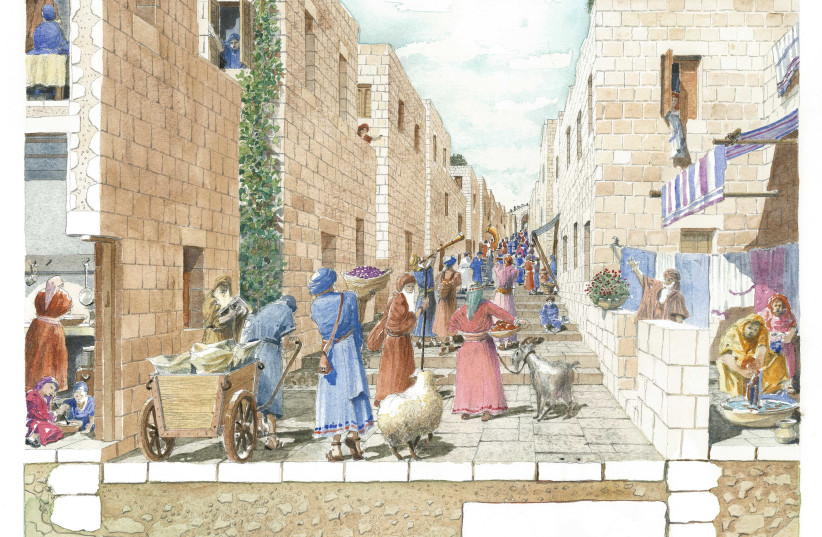
Rendering of the Pool of Siloam and the pilgrimage road, Second Temple period. (credit: Shalom Kveller/City of David Archives)

This type of discovery isn’t exactly new, which is why archaeologists are sure of what it is. Transactional records are the subject of considerable discourse in Jewish law. In the third chapter of the Talmud’s Tractate Bava Batra, there is a discussion on proof of purchase for property and real estate. 

In addition, according to Bar-Ilan University’s Prof. Esther Eshel and Israel Antiquities Authority excavation director Nahshon Szanton in their study in ‘Atiqot, there have actually been four other finds similar to this.

These artifacts, found in Jerusalem and Beit Shemesh, all with names and numbers on similar pieces of stone that date back to the early Roman era. 

However, this particular financial record stands out from the rest because it was found within the contemporary boundaries of Jerusalem. 

However, given its location, this isn’t too surprising. 

The history of the Pilgrimage Road

The financial record was found along the Pilgrimage Road. In ancient times, this 600-meter road connected the Siloam Pool to the Temple Mount. During the pilgrimage festivals of Passover, Sukkot and Shavuot, Jewish pilgrims would come to the pool here to purify themselves, after which they would walk the road over to the Second Temple. 

But the path to the Temple wasn’t just walking and talking. Archaeologists have long been aware that the road was also used for commercial purposes. Indeed, it would have essentially been a very bustling shopping district, with the sides of the Pilgrimage Road crowded with stores and vendors, selling everything from food, spices and livestock. 

Some evidence of this has been found in the excavations, and the archaeologists at the City of David have been busy parsing through all the ancient debris to find the shops. In fact, some of these stores have already been rebuilt by the City of David for future tourists to see.

And thanks to this artifact, we now have a better glimpse at just what this ancient commercial area may have been like, filling in another layer of the rich history of Israel’s capital.

This is something the Israel Antiquities Authority is well aware of.

“It is not a coincidence that the many discoveries which are being revealed in the excavation shed light on the centrality of this road even during the Second Temple period.”

Eli Escusido

“It is not a coincidence that the many discoveries which are being revealed in the excavation shed light on the centrality of this road even during the Second Temple period,” said Israel Antiquities Authority director-general Eli Escusido.

Also weighing in is Heritage Minister Amichai Eliyahu, who said: “The remarkable discovery on the Pilgrimage Road in Jerusalem uncovers another aspect of Jewish life in the city from 2,000 years ago.”


Zawartość publikowanych artykułów i materiałów nie reprezentuje poglądów ani opinii Reunion’68,
ani też webmastera Blogu Reunion’68, chyba ze jest to wyraźnie zaznaczone.
Twoje uwagi, linki, własne artykuły lub wiadomości prześlij na adres:
webmaster@reunion68.com


Israeli Arab sector violent crime is a national problem – editorial

Israeli Arab sector violent crime is a national problem – editorial

JPOST EDITORIAL


As each day goes by, more Arab citizens of Israel are being killed, and the vast majority of law-abiding, peace-loving members of Israel’s Arab society are living in fear.
.

Police at the scene of a shooting in Qalansawe, June 2023 / (photo credit: ISRAEL POLICE)

Khaled Khaldi, a 50-year-old man from the Bedouin town of Khawalad near Haifa, was gunned down on Monday, most likely the result of an ongoing criminal dispute, the police said.

According to the Abraham Initiatives organization, which tracks murder statistics in the Arab community, Khaldi’s murder marked the 91st Israeli Arab violent death in 2023, compared to 34 at this time last year.

Khaldi was murdered on the same day that Prime Minister Benjamin Netanyahu convened a meeting with a group of Arab MKs and Arab local council representatives to discuss ways to combat the escalating violence in the Arab community.

There have been more murders in the Arab sector in the first five months of 2023 than there were in all of 2016 (64), 2017 (75), and 2018 (74). The number of people killed in the Arab community this year is on the trajectory to reach more than 200, far outstripping the worst year of violence when 126 Israeli-Arabs were killed in 2021.

Those numbers are astounding, and the representatives of the Israeli Arab sector are crying out for the government and the police to do something to help them. As the violence spiraled out of control in 2021, the Bennett-Lapid government budgeted some NIS 2.5 billion for the task and drew up a holistic approach to tackle the issue.
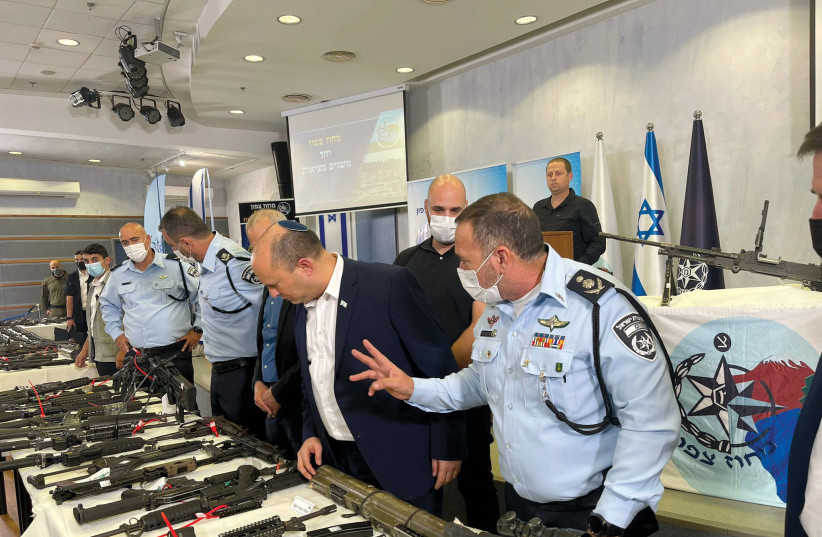
PRIME MINISTER Naftali Bennett and Police commissioner Kobi Shabtai examine rifles caught during Operation Ocean last month. (credit: ISRAEL POLICE)

The plan – called Safe Track, under the responsibility of the then deputy public security minister Yoav Segalovitz – included steps aimed at dismantling organized crime, hitting the sources of funds for organized crime, cracking down on arms smuggling, strengthening the governance in the Arab sector, and building trust and increasing cooperation with the Arab local authorities.

It is a long-term plan that would take time to implement, yet by the end of 2022, the murder rates in the Arab sector had dropped by some 13%.

“Mr. Minister, nothing can be done. They murder each other. It’s their nature. It’s the mentality of the Arabs.”

Kobi Shabtai to Itamar Ben-Gvir

Israel’s government does not prioritize tackling Arab sector crime

This trend was halted in its tracks in January. According to a study by Ephraim Lavie, Mohammed Wattad, and Meir Elran of the Institute for National Security Studies (INSS), part of the problem is that the current government is not prioritizing the problem.

The fact that Monday’s meeting with Netanyahu took place only some five months after the government’s formation points to the INSS conclusion.

The lack of trust in the government of the Arab MKs is understandable. Past statements by National Security Minister Itamar Ben-Gvir and Finance Minister Bezalel Smotrich make it clear that their priorities are the Jewish population of Israel.

In addition, the distrust deepened when a tape of Police Commissioner Kobi Shabtai emerged of him telling Ben-Gvir, “Mr. Minister, nothing can be done. They murder each other. It’s their nature. It’s the mentality of the Arabs.”

Despite their apparently well-founded distrust, the MKs from Hadash-Ta’al did meet with Netanyahu, and made it clear that they want the issue to be handled by Netanyahu directly, and not by Ben-Gvir, who earlier in the day, announced that he would appoint a special commissioner to handle crime in the Arab sector.

“In the view of many and rightly so, the fact that our lives are entrusted to that minister is evidence that the subject [of crime in the Arab community] has been dropped from the government’s scale of priorities, and that has to be changed,” the MKs wrote in the preamble to a 12-point proposal they presented to fight the crime scourge.

Ra’am chairman MK Mansour Abbas announced his support for the plan minutes later at a press conference ahead of his party’s weekly meeting, but he later said that the party had decided not to join the meeting with Netanyahu, with fellow Ra’am MK Waleed Taha tweeting, “We will not take part in a false show by Netanyahu.”

At the end of the meeting, Netanyahu agreed to the establishment of a ministerial committee, which he would chair, to fight the growing epidemic of violence and crime in Arab society.

That’s a positive development, but action now needs to take the place of words.  As each day goes by, more Arab citizens of Israel are being killed, and the vast majority of law-abiding, peace-loving members of Israel’s Arab society are living in fear.

It’s not an Arab problem, it’s a national one. Both the government – and the police – need to internalize that, and do something about it now.


Zawartość publikowanych artykułów i materiałów nie reprezentuje poglądów ani opinii Reunion’68,
ani też webmastera Blogu Reunion’68, chyba ze jest to wyraźnie zaznaczone.
Twoje uwagi, linki, własne artykuły lub wiadomości prześlij na adres:
webmaster@reunion68.com


‘I’m Very Grateful for You:’ British Singer Robbie Williams Shares Kind Words With Israeli Fans at Tel Aviv Concert

‘I’m Very Grateful for You:’ British Singer Robbie Williams Shares Kind Words With Israeli Fans at Tel Aviv Concert

Shiryn Ghermezian


Robbie Williams performing in London at the Apple Music Festival. Photo: Drew de F Fawkes via Wikimedia Commons

At his live concert in Tel Aviv’s Yarkon Park on Thursday night, British pop sensation Robbie Williams talked to thousands of his Israeli fans about how much he appreciates their support and his love of Israel.

While singing his 1997 single Let me Entertain You towards the start of the concert, Williams, 49, shouted at the audience, “Allow me to reintroduce myself. My name is Robbie f__king Williams, yalla balagan!” using the Hebrew expression that means “let’s do this” or “let’s go.”

Williams, who last performed in Israel eight years ago, later talked to the excited crowd and told them “you have something incredibly f__king special here. I went for a walk the other night. I noticed a peace here. There is a peace here that I don’t feel in London; I don’t feel in Los Angeles.”

“Considering as a people you have so much going on, there is a calm and a sincerity,” he added. “Just by this walk, I felt you, I know who you are, I know how you are, and you mean an awful lot to me. It’s always very special coming out.”

Williams additionally spoke about wanting to raise his children with Jewish values. His wife, American-Turkish actress Ayda Field, is Jewish and the couple have four children.

“My wife is Jewish so my kids are Jewish. I like to keep some of the traditions going in the family, just out of respect to you guys and to their history,” he said before showing off a wrist tattoo of the word simcha, which means happiness in Hebrew.

“As I leave you here tonight, I’m very grateful for you being there over the years… and very grateful just for you as a people. God bless you,” Williams said.

Israeli Indie rock singer Noga Erez joined Williams during the concert for the duet Kids, which Williams originally performed with Australian singer Kylie Minogue.

Days before the concert, while strolling in Tel Aviv, Williams stopped to sing with a street performer. Together they performed his hit song Angels from his 1997 album.