Archives

Israel Daily News – June 11, 2023

Israel Daily News – June 11, 2023

ILTV Israel News


Are the US and Iran coming closer to striking a deal that would alleviate sanctions on Iran’s nuclear program? Also, will a certain country purchase Israel’s Arrow 3 missile defense system and if so, why? Also, who is the first Arab leader to be hosted by China this year, and how will this meeting affect China’s involvement in the Middle East?


Zawartość publikowanych artykułów i materiałów nie reprezentuje poglądów ani opinii Reunion’68,
ani też webmastera Blogu Reunion’68, chyba ze jest to wyraźnie zaznaczone.
Twoje uwagi, linki, własne artykuły lub wiadomości prześlij na adres:
webmaster@reunion68.com


Israeli Short Film Premiering at Palm Springs Festival Explores Adolescent Rebellion in Jerusalem

Israeli Short Film Premiering at Palm Springs Festival Explores Adolescent Rebellion in Jerusalem

Shiryn Ghermezian


A photo still from the new film “Arava.” Photo: Provided

The Hebrew-language short film Arava will make its world premiere at the Palm Springs International ShortFest on June 22 and is also in the running for the festival’s award for best international short.

The 27-minute coming-of-age story by director and screenwriter Sarah Meital Benjamin takes place in the 2000s and is set in Jerusalem as a teenage girl named Arava returns home after spending six months in a secluded rehab facility. She reunites with her troublemaker best friend Tzipi, who convinces her to go on a trip up north in Israel. As the two runaways hitchhike through the country, they face experiences and situations that force them to confront their own conflicts, identities, hopes and losses as well as their friendship.

Arava is a story of friendship and unquenched passion between two young girls in an unsafe world, but beyond that, it is a portrait of the complexity, magic, pain and hope in the realities of at-risk youth in Israel,” according to a synopsis for the film.

The film was produced by Michael Utznik and co-written by Batel Zaharaa Mann with cinematography done by Keren Bergman. It stars Swell Ariel Or, from the Netflix Israeli series The Beauty Queen of Jerusalem, along with Batel Zaharaa Mann, Itamar Rothchild, Itamar Abuhatzira, Shlomi Shtern, Elisha Shwartz.

Arava is a true story based on Benjamin’s life experiences. The filmmaker was born in Jerusalem to a Mizrahi-Ashkenazi family from a Hasidic community that she then left at a young age.

Arava is a personal story picked out of my archive of adolescent adventures as a post-religious, bisexual runaway teen who spent
her youth hanging out in the punk scene of Jerusalem,” said Benjamin in a director’s note for the film. “The world of characters, the saturated city, and the unapologetic teen spirit of young adults facing distinct challenging realities, is the beating heart behind the project.”

She added: “Jerusalem at its core is a melting pot that brings together many forms of lives on a daily basis. The main characters of Arava are a depiction of this very reality; religion versus faith, untamed individuality versus a collective identity, and the constant, fruitful battle between fantasy and reality … Although Arava is based on a personal story and set in a very specific world, it is firstly a human story about a young girl in search of belonging, a primal yearning that exists within every human heart.”

ShortFest will take place from June 20-26. All of the festival’s awards, which come with a cash prize between $500-$5,000 and five Academy Award-qualifying awards, will be announced on June 25.

Watch the trailer for Arava below.


Zawartość publikowanych artykułów i materiałów nie reprezentuje poglądów ani opinii Reunion’68,
ani też webmastera Blogu Reunion’68, chyba ze jest to wyraźnie zaznaczone.
Twoje uwagi, linki, własne artykuły lub wiadomości prześlij na adres:
webmaster@reunion68.com


Israel Daily News – June 8, 2023

Israel Daily News – June 8, 2023

ILTV Israel News


IDF security forces and Palestinian militants clashed in the Palestinian city of Ramallah. Also Blinken spoke during a Gulf Cooperation Council ministerial meeting in the capital Riyadh. And a brief spat between US Vice President Kamala Harris and Foreign Minister Cohen. Furthermore Amir Ohana is the first speaker of the Knesset to be invited for an official visit to the parliament of a Muslim country, and much more.


Zawartość publikowanych artykułów i materiałów nie reprezentuje poglądów ani opinii Reunion’68,
ani też webmastera Blogu Reunion’68, chyba ze jest to wyraźnie zaznaczone.
Twoje uwagi, linki, własne artykuły lub wiadomości prześlij na adres:
webmaster@reunion68.com


Fate of Israel’s Judicial Plan May Hang on June Parliament Vote

Fate of Israel’s Judicial Plan May Hang on June Parliament Vote

Reuters and Algemeiner Staff


Israeli Prime Minister Benjamin Netanyahu attends a meeting at the Knesset, Israel’s parliament, amid demonstrations after he dismissed the defence minister as his nationalist coalition government presses on with its judicial overhaul, in Jerusalem, March 27, 2023. Photo: REUTERS/Ronen Zvulun/File Photo

Israel‘s Knesset will hold a vote next week that could tip the scales against a drive by Prime Minister Benjamin Netanyahu’s hard-right coalition to curb the Supreme Court, a move that set off one of the country’s worst political crises in years.

Parliament on June 14 is set to elect two lawmakers to join a panel that will select judges, including to the Supreme Court, one of the few checks and balances in Israel‘s political system.

The make up of the nine-member panel of lawmakers, senior judges, ministers and lawyers has been at the heart of a battle over the nature of Israel‘s democracy, which began in January when the government announced a plan to overhaul the judiciary.

This touched off protests and Western powers voiced concern about what it meant for Israel‘s democratic health.

If one of the two lawmakers chosen is from the opposition – keeping the status quo – it would be a sign of compromise by Netanyahu after weeks of talks with his opponents and a setback for hardliners in his religious-nationalist government who want more control over judicial appointments.

It could affect the Supreme Court, which must replace the chief justice and another judge, in coming months.

“There are no guarantees with someone you don’t trust,” opposition head Yair Lapid told Army Radio, although he and other lawmakers have indicated over the past week that agreements on candidates for the panel have been reached.

But Netanyahu’s Likud party has kept the opposition guessing, saying on Monday a decision would be made next week.

Critics denounce the judicial plan pushed by Netanyahu, who is on trial on graft charges that he denies. They say the move to let parliament override many Supreme Court decisions threatens the independence of the courts and endangers democracy.

The court acts as a check in Israel‘s political system which has few other balances, given it has just one chamber of parliament.

WASHINGTON WANTS CONSENSUS

Until now, Netanyahu’s talks with the opposition to defuse the crisis have yielded little. He has also sent mixed messages about the overhaul’s fate, compounding uncertainty that has hit the economy and the shekel.

The vote on the panel makeup could provide clarity for Israelis and Western allies, including Washington which has urged Netanyahu to reach a consensus over legal reforms.

If parliament adheres to a custom in the confidential vote by electing an opposition member, it would signal to opponents that Netanyahu was serious about a compromise and was ready to adjust his judicial plan.

Facing dissension from within his party, Netanyahu told Likud on May 29: “The reform is not dead but we are making every effort in talks in order to reach broad agreements.”

Likud Justice Minister Yariv Levin, a driving force behind the overhaul plan, says he and his allies want to give elected politicians more sway over what they see as a left-leaning and over-reaching Supreme Court.

Critics say it will politicise the judiciary.

Lawmaker Keti Shitrit, who is on the Likud team that is in negotiations with the opposition, said: “The reform will happen, just not in its original form.”

The Prime Minister’s Office Director-General Yossi Shelly played down questions about the judicial discussion. “I think that ultimately it will end positively,” he told Kan radio.


Zawartość publikowanych artykułów i materiałów nie reprezentuje poglądów ani opinii Reunion’68,
ani też webmastera Blogu Reunion’68, chyba ze jest to wyraźnie zaznaczone.
Twoje uwagi, linki, własne artykuły lub wiadomości prześlij na adres:
webmaster@reunion68.com


ADL data shows antisemitism is deeply entrenched in Europe. Here’s what needs to happen now

ADL data shows antisemitism is deeply entrenched in Europe. Here’s what needs to happen now

JONATHAN GREENBLATT


Belief in antisemitic stereotypes can be countered through education about the Jewish people, the history of the local Jewish community and antisemitism.
.

JONATHAN GREENBLATT
(photo credit: ADL)

There’s no question that people of good conscience are alarmed by intensifying antisemitism around the world. The signs are everywhere: more antisemitic assaults, increased expressions of anti-Zionism and more anti-Jewish vandalism. But to truly understand the scope of the problem, we need data on incidents, security, how prejudice affects Jewish communities in the diaspora and how non-Jews perceive Jews.

The Anti-Defamation League (ADL) has been a data-driven organization for generations because it knows data drives policy. By understanding the pervasiveness of antisemitism and how it manifests, we can focus on governmental and societal action to combat it more effectively. An evidence-based approach avoids hyperbole and squarely focuses on the facts.

For this reason, the ADL just released new research on antisemitic attitudes among the general populations in 10 European countries: Belgium, France, Germany, the Netherlands, Poland, Russia, Spain, Sweden, the UK and Ukraine. The findings confirmed what we long understood: antisemitism remains deeply entrenched in Europe. Roughly one out of every four residents agreed with a majority of harmful stereotypes about Jews. The news would be shocking if it was not so predictable.

First conducted in 2014 across 102 countries, the ADL Global 100 Index survey consistently has provided insights into national and regional attitudes about Jews, beliefs in antisemitic stereotypes, and knowledge of the Holocaust. Follow-up surveys in select countries continue to reveal important findings. For this reason, Global 100 data is regularly utilized by policymakers, academic researchers, journalists, Jewish communities and others around the world.

What did the latest ADL survey say about antisemitism?

In our latest survey, the ADL found that antisemitic attitudes remain higher in the four Eastern European countries it polled (Hungary, Poland, Russia and Ukraine) compared to countries in Western Europe. While the results from Western Europe remained relatively consistent with prior surveys, it was good to see lower antisemitism scores in Eastern Europe. However, overall antisemitic attitudes remain higher in the East compared to the West, exceeding one in three respondents in Hungary and Poland.
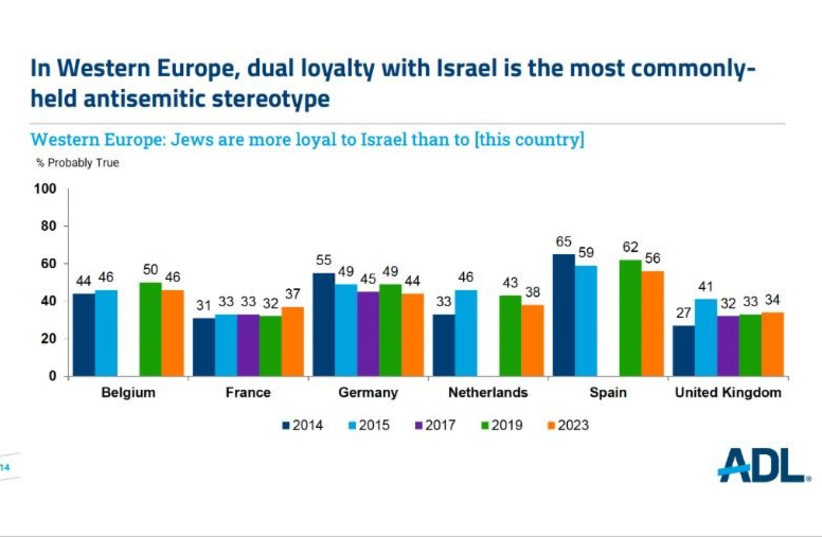
One of the findings of the Index of Antisemitic Attitudes report by the Anti-Defamation League. (credit: COURTESY/ADL)

A bright spot in the survey results was Ukraine. The country registered a 17% drop in its Index score, from 46% to 29%. One possible explanation is the courageous leadership shown by Ukraine’s Jewish president, Volodymyr Zelensky, in the face of Russia’s cruel war of aggression against Ukraine and the public support he has received from Ukrainians.

Elsewhere, despite recent commitments from many European governments to address antisemitism, our data confirms the persistence of anti-Jewish attitudes.

In Western Europe, the dual loyalty trope is the most pervasive antisemitic stereotype. Wide swaths of the population believe that Jews are more loyal to Israel than their own country. More than half of Spaniards (56%) believe this is “probably true,” as do 46% in Belgium, 38% in the Netherlands, 37% in France, and 34% in the UK.

In Eastern Europe, the dual loyalty canard is even more prevalent, with 62% in Poland agreeing, 48% in Hungary, 38% in Ukraine and 36% in Russia.

HOLOCAUST AWARENESS is universal across Europe, but Holocaust denial is markedly higher in Eastern Europe. In Hungary and Ukraine, 19% of those polled agree that “the Holocaust is a myth and did not happen,” or say the numbers of Jews who died were greatly exaggerated. In Russia and Poland, those denying the Holocaust were at 17% and 15%, respectively.

Just a few days ago, the United States issued its first-ever National Strategy to Counter Antisemitism. So too, have a number of European governments. Like America, nearly all use the International Holocaust Remembrance Alliance (IHRA) working definition of antisemitism as their guidepost for understanding antisemitism.

And yet, success requires constant vigilance and an unflinching commitment to convert smart strategies into effective programs that address antisemitism in all its forms – conspiracy theories, Holocaust denialism, fanatical anti-Zionism – all of it.

But action plans must be backed by budgets, otherwise, they little more than empty words. Programs and personnel must be resourced to do the hard work of ferociously fighting hate.

Belief in antisemitic stereotypes can be countered through education about the Jewish people, the history of the local Jewish community and antisemitism. These are key elements to inoculating people against the virus of antisemitism. The ADL sees the fruits of this labor in the schools across America where it works.

In Europe, formal education about the Jewish people is rare. Typically, it is limited to three topics: the Biblical period, the Holocaust and Israel. Studying contemporary Jewish life, Jewish contributions to Europe and how antisemitism is expressed today would diminish antisemitic attitudes. This is why the ADL has begun to export our award-winning antisemitism education programs to European countries, including France and the UK.

Education must not be limited to schools. Workplace education is crucial and governments should make anti-bias education, including against antisemitism, mandatory for public sector employees. Diversity, equity and inclusion programs in the private sector also must encompass antisemitism alongside racism and other forms of hate.

In the end, we can’t just hope that the Global 100 will prompt action by governments and other stakeholders. We need to hold them to their word. Accountability and action are essential in the fight against antisemitism.


The writer is the CEO and National Director of the ADL. He will be speaking at The Jerusalem Post Annual Conference on June 5. For more info, visit: www.jpost.com/AC23


Zawartość publikowanych artykułów i materiałów nie reprezentuje poglądów ani opinii Reunion’68,
ani też webmastera Blogu Reunion’68, chyba ze jest to wyraźnie zaznaczone.
Twoje uwagi, linki, własne artykuły lub wiadomości prześlij na adres:
webmaster@reunion68.com

