Archives

Terrorist kills three IDF soldiers on Sinai border

Terrorist kills three IDF soldiers on Sinai border

JNS


The attacker, identified as an Egyptian police officer, was shot dead.

The Israeli security fence along Egyptian border, built in 2012. Credit: Idobi via Wikimedia Commons.

Three Israel Defense Forces soldiers were killed on Saturday in two separate exchanges of fire with a terrorist along the southern border with Egypt.

In the first incident, two soldiers, one of them female, were fatally shot while manning an observation post along the frontier.

An IDF spokesman said that the soldiers had started a guard shift late Friday night and did not return radio calls the following morning. They were subsequently found dead.

Hours later, during the search for the perpetrator, another soldier died in an exchange of fire within Israeli territory. A fourth IDF soldier was lightly wounded.

The terrorist, identified as an Egyptian police officer, was killed.

Israeli forces were searching the area on Saturday afternoon to rule out the possibility of additional attackers.

The IDF, in conjunction with the Egyptian army, opened an investigation into the attacks. Maj. Gen. Eliezer Toledano, head of the Southern Command, was leading the probe.


Defense Minister Yoav Gallant convened a situational assessment with IDF Chief of Staff Lt. Gen. Herzi Halevi and other top brass.

Prime Minister Benjamin Netanyahu was being continuously briefed on the incident, his office said.

Since Israel completed a high-tech security fence along the border with Egypt, it has been largely quiet.

With its network of radars and cameras, the fence—dubbed “Hourglass” by the Israeli Defense Ministry—issues alerts to IDF units regarding suspicious movements.

It has also entirely curbed the flow of illegal African migrants into the Jewish state and significantly boosted the military’s ability to defend the country against Salafi-jihadist terrorist organizations active in the Sinai Peninsula.

Sinai-based terrorists carried out multiple attacks against Israel in 2011 and 2012, before the fence was completed. In August 2011, terrorists killed six Israeli civilians, an IDF soldier, an Israeli police counterterrorism officer and five Egyptian soldiers.


Zawartość publikowanych artykułów i materiałów nie reprezentuje poglądów ani opinii Reunion’68,
ani też webmastera Blogu Reunion’68, chyba ze jest to wyraźnie zaznaczone.
Twoje uwagi, linki, własne artykuły lub wiadomości prześlij na adres:
webmaster@reunion68.com


Seeing Israel through ISRAEL21c’s Eyes

Seeing Israel through ISRAEL21c’s Eyes

ISRAEL21c


Zawartość publikowanych artykułów i materiałów nie reprezentuje poglądów ani opinii Reunion’68,
ani też webmastera Blogu Reunion’68, chyba ze jest to wyraźnie zaznaczone.
Twoje uwagi, linki, własne artykuły lub wiadomości prześlij na adres:
webmaster@reunion68.com


Israel-Poland deal and the distortion of Holocaust history – opinion

Israel-Poland deal and the distortion of Holocaust history – opinion

DANIEL SCHATZ


The memory of the Shoah must be preserved with accuracy and honesty and the recent Polish-Israeli agreement should be scrutinized for its potential to distort history.
.
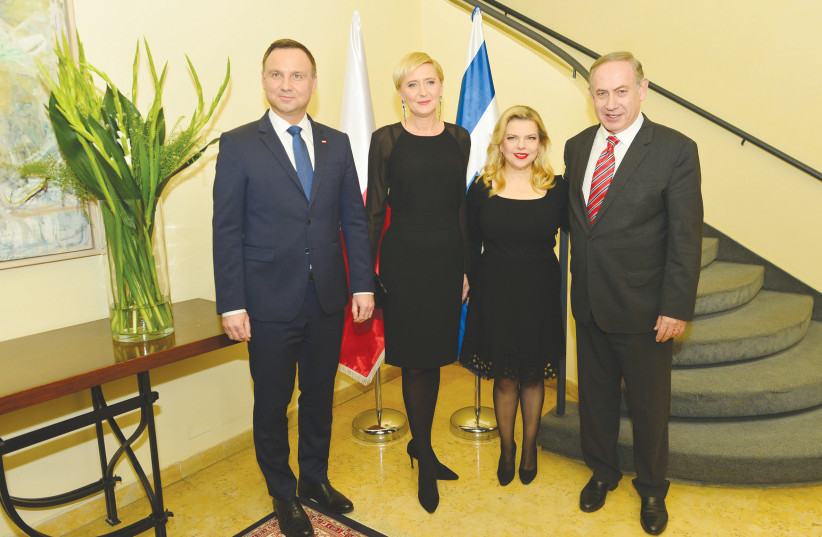
PRIME MINISTER Benjamin Netanyahu, Polish President Andrzej Duda and their wives meet at the Prime Minister’s Residence in Jerusalem, in 2017. / (photo credit: KOBI GIDEON/GPO)

The recent agreement between Israel and Poland to resume Israeli school trips to Poland has ignited significant controversy and concern among prominent historians and the wider Jewish community. Critics argue that the agreement dangerously misrepresents the memory of the Shoah, compromising historical truth and accuracy.

The agreement advises Israeli youth delegations to visit sites in Poland related to other crimes of World War II, including those documenting crimes committed by Nazi Germany against non-Jewish Poles, as well as sites commemorating Poles who participated in the murder of Jews. Joint Polish and Israeli tour guides will accompany the youth on these visits.

Distinguished historians, such as Professors Havi Dreifuss and Jan Grabowski, have criticized the inclusion of certain sites in the agreement’s appendix, including the Markowa Ulma Family Museum of Poles Who Saved Jews in World War II and the Museum of the Cursed Soldiers in Ostrołeka, which commemorates Jozef Kuras, a partisan fighter hailed as a national hero who murdered Jews.

They, along with Israel’s opposition leader Yair Lapid – whose father survived the Holocaust – have called the agreement a capitulation to Polish propaganda and a dream come true for Holocaust deniers.

“We note with satisfaction that the Israeli side referred to our point of view with understanding and has adopted the Polish position.”Zbigniew Rau

Polish Foreign Minister Zbigniew Rau praised the agreement, stating, “We note with satisfaction that the Israeli side referred to our point of view with understanding and has adopted the Polish position.” Deputy Foreign Minister Pawel Jablonski added that Israeli students will also meet with Polish youth to combat negative stereotypes that exist in Israel regarding Poland.
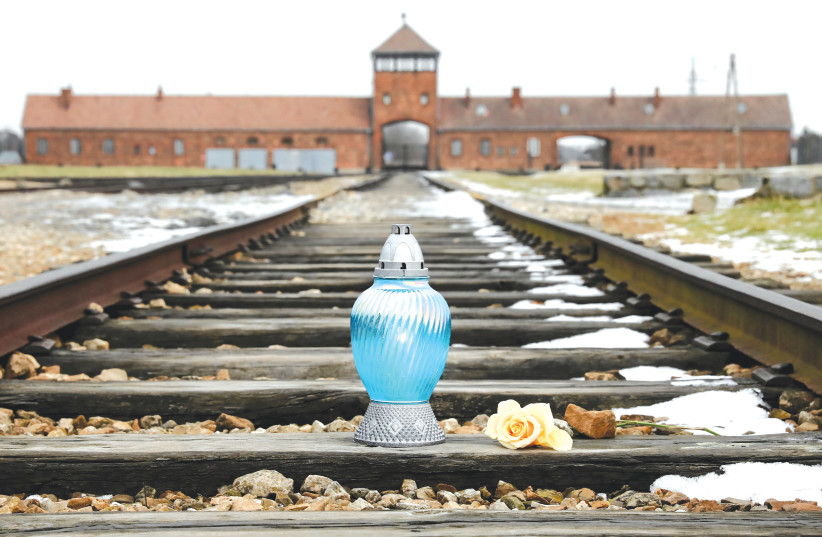
A CANDLE is lit and a flower is placed on the railway tracks at Birkenau, on International Holocaust Remembrance Day, last year. (credit: Agencja Wyborcza.pl/Reuters)

YAD VASHEM, Israel’s official Holocaust memorial, rightly denounced the deal, insisting that such trips must maintain complete historical accuracy, including the role of Poles in the persecution, betrayal and murder of Jews during the Holocaust.

This is not the first time Netanyahu has faced accusations of facilitating the distortion of the role of Poles in the mass murder of Jews in exchange for political support from Warsaw. In 2018, a joint statement between the Polish and Israeli prime ministers on the Holocaust sparked similar outrage from Yad Vashem and leading researchers for containing grave errors and deceptions.

While the systematic and industrial genocide was initiated, implemented and enforced by the German Reich, the reactions to the recent Polish-Israel agreement stem from the fact that many Poles were witnesses to and in some cases participants in the Nazi German extermination campaign.

Poland’s history of Holocaust revisionism and Israeli capitulation

Historian Jan Gross concluded in a 2015 article that Poles killed more Jews than Nazis during the occupation. Such revelations were shockingly at odds with the self-image of Poles as heroic, glorious and innocent people who, risking their own lives, did everything in their power to save their fellow countrymen.

Despite these facts, Poland’s Law and Justice (PiS) party, in power since 2015, has sought to downplay the role of Poles in the persecution of their Jewish neighbors while highlighting instances where Poles saved Jews. In 2016, then-education minister Anna Zalewska sparked controversy by claiming the Jedwabne pogrom that was perpetrated by the local villagers rather than their German occupiers as a matter of opinion. In 2018, Article 55A was passed, criminalizing public accusations of Poland’s participation in or responsibility for Nazi or communist crimes.

Holocaust denial is easy to identify and straightforward to explain; more subtly and insidiously, some governments now continue engaging in distorting the facts of their history for contemporary political purposes. While acknowledging that genocide took place, distorters strive to absolve their own nations and people of any involvement, attributing all responsibility to their Nazi occupiers.

The argument that a victim cannot be a victimizer disregards the historical reality of the widespread collaboration and bystanderism of local populations, as well as the presence of domestic antisemitism, which provided an integral component of the Holocaust’s machinery and persists to this day.

When a positive and idealized past is not available, it must – in the words of the Holocaust scholar Yehuda Bauer – be created out of a mixture of truths, half-truths and the wish for history to have happened the way it is presented. Government-run institutions, museums, schools, media outlets and monuments honoring nationalist figures have all been bent toward these aims. Partial truth becomes total distortion, which includes thought control in the service of nationalistic regimes dismantling fundamental democratic rights and freedoms, as well as the rule of law.

THE CURRENT Polish-Israeli agreement holds significance for the PiS government, as it enables them to leverage their nation’s historical experiences of foreign invasion, occupation and subjugation to present themselves as steadfast defenders of Poland’s sovereignty, values, culture and faith. This strategy has resulted in the discrediting of political opponents, including those who critically examine Poland’s World War II history, by branding them as unpatriotic or enemies of the country.

Such tactics foster a siege mentality, particularly among the government’s core supporters, in which Poland must once again defend itself from external enemies and traitors within – a mindset the party uses to distract attention from the erosion of democratic norms and institutions.

Five years ago, on International Holocaust Remembrance Day, then-economy minister Eli Cohen, who negotiated the current agreement on behalf of Netanyahu, tweeted, “No law can erase the horrors of the Holocaust and Poland’s involvement in the atrocities.” Now, as foreign minister, it appears that Cohen is willing to compromise historical memory for political and diplomatic gains.

Some Jewish groups have supported this narrative, with Sebastian Rejak, director of the American Jewish Committee in Central Europe, hailing the agreement as a step in the right direction that will give a full picture of the Holocaust on Polish state-run television.

As we commemorate Yom Hashoah today and the 80th anniversary of the Warsaw Ghetto Uprising tomorrow, it is crucial that we honor the memory of those who fought and suffered by combating all forms of Holocaust denial and distortion. This includes highlighting instances where local populations participated in the persecution, betrayal and murder of Jews during the Holocaust, as well as in acts of rescue.

Simcha Rotem, the last living fighter of the Warsaw Ghetto, conveyed these sentiments in a public letter to Polish President Andrzej Duda before his death. “As someone who fought side by side with my Jewish sisters and brothers in the streets of the Warsaw Ghetto against the Nazi Germans, I want to say that many sons of the Polish nation took an active role in the extermination of the Polish Jews during the Holocaust,” Rotem wrote.

“They took part in deporting the Jews from their homes, they acted with brutality and after the liberation, they took part in murdering those who survived the Nazi killing machine and who only wanted to return to their homes… Only once Polish society truly faces the bitter historical truth, revealing its scope and severity, will there be a chance that those horrors will not be repeated,” he concluded.

President Isaac Herzog, who will attend the commemoration in Poland and meet with Duda, would do well in echoing Rotem’s words to ensure that historical facts and truths are not lost to political expediency.

The President should remind his hosts about the inconvenient truth that contrary to the state-sanctioned narrative of Poles selflessly, bravely and constantly assisting Jews during the German occupation, the Jews of Warsaw in 1943 perished in isolation, largely forgotten and, with few exceptions, forsaken by their fellow citizens. On the Aryan, Polish side of the city, life continued as people focused on the upcoming Easter festivities – with the uprising inconveniently commencing with the Christian holy week.

CZESLAW MILOSZ, the Nobel Prize-winning Polish poet who lived in Warsaw during the occupation, observed the burning ghetto from the other side of the wall. In his evocative and moving poem “Campo dei Fiori,” he reflected on the behavior of his fellow Poles:

“At times wind from the burning
would drift dark kites along
and riders on the carousel
caught petals in midair.
That same hot wind
blew open the skirts of the girls
and the crowds were laughing
on that beautiful Warsaw Sunday.”

The memory of the Shoah must be preserved with accuracy and honesty and the recent Polish-Israeli agreement should be scrutinized for its potential to distort history. What is forgotten in the midst of all these controversies is the simple fact that close to three million Polish Jews who found themselves under German occupation perished. This ancient culture was almost entirely wiped out together with 98% of its members, leaving behind a legacy of loss and destruction.

The words of Milosz and Rotem are stark reminders of the need to uphold the truth and not allow political expediency to erase the suffering of millions of Holocaust victims. This solemn responsibility is not only owed to the past but also to future generations to ensure that such atrocities never happen again.

It is regrettable that 80 years after the annihilation of Polish Jewry, governments still need to be reminded of these facts.


The writer is a visiting scholar at Georgetown University’s School of Foreign Service and a writer on international affairs. He has served as a visiting fellow at Harvard University, Stanford University and Columbia University.


Zawartość publikowanych artykułów i materiałów nie reprezentuje poglądów ani opinii Reunion’68,
ani też webmastera Blogu Reunion’68, chyba ze jest to wyraźnie zaznaczone.
Twoje uwagi, linki, własne artykuły lub wiadomości prześlij na adres:
webmaster@reunion68.com


Modern Israeli grapes linked to grapes in the Bible – study

Modern Israeli grapes linked to grapes in the Bible – study

JUDY SIEGEL-ITZKOVICH


The seeds were found at archaeological excavations led by Prof. Guy Bar-Oz and colleagues from the University of Haifa’s School of Archaeology and Maritime Cultures.
.

Ancient winegrape seeds under a microscope from Avdat / (photo credit: Prof. Guy Bar-Oz, The University of Haifa)

Seeds that provide a genetic link between two modern varieties of red and white grapes cultivated over 1,100 years ago – and apparently were mentioned in two different books of the Bible – have resulted in an “extraordinary and thrilling discovery” by archaeologists at Tel Aviv University (TAU) and the University of Haifa.

“One ancient seed was found to belong to the Syriki variety, still used to make high-quality red wine in Greece and Lebanon. Since winegrapes are usually named after their place of origin, it is quite possible that the name Syriki is derived from Nahal Sorek, an important stream in the Judean Hills. A second seed was identified as related to the Be’er variety of white winegrapes still growing in the sands of Palmachim on the Mediterranean seashore.”

The new study was led by the paleogenomic laboratory of TAU’s Steinhardt Museum of Natural History and the University of Haifa analyzed DNA from ancient local winegrape seeds discovered at archaeological excavations in the Negev.

What did they find?

The genetic study was led by TAU’s Dr. Pnina Cohen and Dr. Meirav Meiri. The seeds were found at archaeological excavations led by Prof. Guy Bar-Oz and colleagues from the University of Haifa’s School of Archaeology and Maritime Cultures, in collaboration with researchers from the Israel Antiquities Authority.

Ancient local winegrape seeds from Shivta (credit: Prof. Guy Bar-Oz, The University of Haifa)

Other participants included researchers the Weizmann Institute of Science in Rehovot, Bar-Ilan University in Ramat Gan, together with research institutions in France, Denmark and the UK. The paper has just been published in the leading scientific journal PNAS under the title “Ancient DNA from a lost Negev Highlands desert grape reveals a Late Antiquity wine lineage.”

They said the first variety may even appear in the Bible – in Jacob’s blessing to his son Judah: “He will tether his donkey to a vine, his colt to the choicest branch (soreka); he will wash his garments in wine, his robes in the blood of grapes (Genesis 49, 11); and perhaps also suggested in the giant cluster of grapes brought back by the men sent by Moses to explore the Land of Israel:   “When they reached the Valley of Eshkol (identified by some as Nahal Sorek), they cut off a branch bearing a single cluster of grapes. Two of them carried it on a pole between them” (Numbers 13, 23).

Bar-Oz noted that “archaeological excavations conducted in the Negev in recent years have revealed a flourishing wine industry from the Byzantine and early Arab periods (around the 4th to 9th centuries CE, especially at the sites of Shivta, Haluza, Avdat and Nizana, which were large, thriving cities at the time. The findings include large winepresses, jugs in which the exclusive wine exported to Europe was stored and grape seeds preserved for more than 1,000 years.”

He added that this industry “gradually declined following the Muslim conquest in the 7 th century, since Islam forbids the consumption of wine. The cultivation of winegrapes in the Negev was renewed only in modern times, in the State of Israel, mostly since the 1980s. This industry, however, relies mainly on winegrape varieties imported from Europe.”

One especially interesting finding was a large hoard of grape seeds, discovered on the floor of a sealed room at Avdat. The researchers explain that these seeds have been relatively well-preserved thanks to protection from climatic phenomena such as extreme temperatures, flooding, or dehydration. In the hope of discovering which varieties the seeds might belong to, the researchers prepared to extract their DNA in the paleogenetic lab.

“The science of paleogenomic uses a range of advanced technologies to analyze ancient genomes, primarily from archaeological findings. Since the DNA molecule is very sensitive and disintegrates over time, especially under high temperatures, we usually get only small pieces of DNA, often in a poor state of preservation,” Meiri explained. “To protect them, we work under special conditions: the paleogenetic lab is an isolated clean laboratory with positive air pressure that keeps contaminants out, and we enter it in sterilized ‘spacesuits’ familiar to everyone from the COVID pandemic.”

The researchers first looked for any organic matter remaining in the seeds by using FTIR (Fourier-transform infrared spectroscopy) – a chemical technique applying infrared radiation to produce a light spectrum that identifies the sample's content. Finding remnants of organic matter in 16 seeds, they went on to extract DNA from the samples.

The extracted DNA was sequenced, with an emphasis on about 10,000 genomic sites where variety-specific features are usually found; the results were compared to databases of modern grapevines from around the world. In 11 samples, the quality of genetic material was too poor to allow any definite conclusions, but three of the remaining samples were identified as generally belonging to local varieties.

Finally, the two samples of the highest quality, both from around 900 CE, were identified as belonging to specific local varieties that still exist today. The other high-quality seed identified as related to Be’er, a white winegrape variety still growing in the sands of Palmachim in remnants of vineyards probably abandoned in the mid- 20 th century. For the first time ever, the researchers were able to use the genome of a grape seed to determine the color of the fruit, discovering that it was in fact a white grape – the oldest botanical specimen of a white variety ever identified.

Be’er, a unique local variety native to the Land of Israel, is used today by the Barkan winery to make a special white wine of its own. “The wonderful thing about paleogenetics is that sometimes, tiny items can tell a big story. This is exactly what happened in our study. With just a bit of DNA extracted from two grape seeds, we were able to trace continuity in the local wine industry – from the Byzantine period, more than 1,000 years ago, to the present day,” Meiri concluded.

Ancient local winegrape seeds from Shivta (credit: Prof. Guy Bar-Oz, The University of Haifa)

“We believe our findings are also significant for Israel’s modern wine industry, which has been growing and thriving in recent decades. Today, most varieties grown here have been imported from Europe, so that the local conditions are not optimal for them. Local varieties can be more suitable for the local climate and soil, especially in the Negev. Our study opens new paths for restoring and improving ancient local varieties, to create winegrapes that are more suitable for challenging climati conditions such as high temperatures and little rainfall,” she said.


Zawartość publikowanych artykułów i materiałów nie reprezentuje poglądów ani opinii Reunion’68,
ani też webmastera Blogu Reunion’68, chyba ze jest to wyraźnie zaznaczone.
Twoje uwagi, linki, własne artykuły lub wiadomości prześlij na adres:
webmaster@reunion68.com


Israel Daily News – May 28, 2023

Israel Daily News – May 28, 2023

ILTV Israel News


The security situation in Judea and Samaria remaining tense, with terror attack being prevented in the area over the holiday.
–
Meantime; Roger Waters – the controversial performance, the investigation, and the comments.
–
And later, the Israeli U-20 soccer team making history in Argentina, qualifying for the round of 16.


Zawartość publikowanych artykułów i materiałów nie reprezentuje poglądów ani opinii Reunion’68,
ani też webmastera Blogu Reunion’68, chyba ze jest to wyraźnie zaznaczone.
Twoje uwagi, linki, własne artykuły lub wiadomości prześlij na adres:
webmaster@reunion68.com