
Archive | August 2017

“Nasilenie antysemickich postaw w Polsce”. Apel do Jarosława Kaczyńskiego

“Nasilenie antysemickich postaw w Polsce”. Apel do Jarosława Kaczyńskiego

TVN24


Przedstawiciele społeczności żydowskich w Polsce wystosowali list otwarty do prezesa PiS Jarosława Kaczyńskiego. Oceniają, że w ostatnich miesiącach doszło do “nasilenia antysemickich postaw w Polsce, brutalizacji języka i zachowań”. Apelują o “mocny i zdecydowany głos potępienia antysemityzmu” i o wsparcie w tej sprawie ze strony Kaczyńskiego.

Bohaterem mediów jest ostatnio Jarosław Gowin, co komentował Borowski [“Polska i świat” z 29.07] Kandydatka SLD w ostatnich wyborach prezydenckich Magdalena Ogórek postanowiła obronić Jarosława Gowina przed krytyką ze strony Marka Borowskiego.

List otwarty został podpisany przez Lesława Piszewskiego, przewodniczącego Związku Gmin Wyznaniowych Żydowskich w RP i Annę Chipczyńską, przewodniczącą Gminy Wyznaniowej Żydowskiej w Warszawie.

Chipczyńska powiedziała agencji Associated Press w czwartek, że list został wysłany do Kaczyńskiego w ubiegłym tygodniu i jak na razie odpowiedź nie nadeszła.

“Szczególnym oburzeniem napawają wydarzenia ostatnich dni”

“Z wielkim niepokojem odnotowujemy w ostatnich miesiącach nasilenie antysemickich postaw w Polsce, brutalizację języka i zachowań, których wiele skierowanych jest przeciwko naszej społeczności” – napisano w liście. Piszewski i Chipczyńska oświadczają, że “szczególnym oburzeniem napawają wydarzenia ostatnich dni”. “Wzrastający antysemityzm w debacie publicznej, wypominanie żydowskiego pochodzenia przodkom senatora Marka Borowskiego przez dziennikarkę TVP Magdalenę Ogórek, faszystowskie hasła i flagi ONR Falangi na uroczystościach państwowych przywołują najgorsze wspomnienia” – wymieniają.
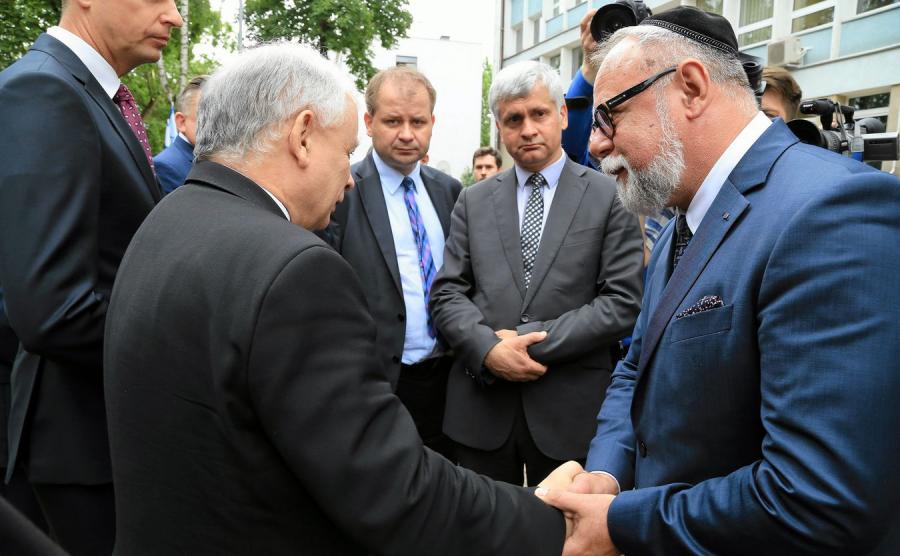
Prezes PiS podczas uroczystości upamiętniających likwidację getta w Białymstoku / Agencja Gazeta / Fot. Agnieszka Sadowska Agencja Gazeta

Wspominają także o wypowiedzi posła PiS Bogdana Rzońcy, który “podzielił się w mediach społecznościowych swoimi absurdalnymi, poniżającymi dla ludzkiej godności, przemyśleniami”. Chodzi o wpis na Twitterze, w którym polityk napisał: “Zastanawiam się, dlaczego wśród aborterów jest tylu Żydów, pomimo holocaustu”. Autorzy listu otwartego stwierdzają, że wpis Rzońcy “ukazał całkowity brak wrażliwości, niezrozumienie istoty Holocaustu”.

Przypominają także incydent związany z pobiciem członków izraelskiej ekipy sportowej pod Warszawą, co – zdaniem sygnatariuszy listu – jest dowodem na to, że “ze strefy słów antysemityzm przechodzi w fazę czynów”. Apel do Kaczyńskiego “Na to wszystko nie ma naszej zgody” – podkreślają i oświadczają, że Polska jest ich domem i nie chcą się “czuć w nim niechciani”, a coraz częściej odnoszą takie wrażenie. “Obawiamy się o nasze bezpieczeństwo i przyszłość w Polsce, nie chcemy powtórki z roku 1968. Kiedy 14 miesięcy temu przemawiał Pan w Białymstoku podczas uroczystości upamiętnienia zagłady białostockich Żydów, odebraliśmy Pana wypowiedź jako słowa otuchy. Mieliśmy nadzieję, że wesprze Pan naszą społeczność, że możemy liczyć z Pana strony na zrozumienie zarówno naszej historii, jak i obecnej sytuacji” – piszą. I apelują: “Dlatego mocny i zdecydowany głos potępienia antysemityzmu i wsparcia z Pana strony byłby dla nas szczególnie ważny”.

Pan Jarosław Kaczyński
Prezes Prawa i Sprawiedliwości


Szanowny Panie Prezesie,


Z wielkim niepokojem odnotowujemy w ostatnich miesiącach nasilenie antysemickich postaw w Polsce, brutalizację języka i zachowań, których wiele skierowanych jest przeciwko naszej społeczności.


Szczególnym oburzeniem napawają nas wydarzenia ostatnich dni, budząc obawy, że żyjemy w coraz mniej bezpiecznej dla nas rzeczywistości. Wzrastający antysemityzm w debacie publicznej, wypominanie żydowskiego pochodzenia przodkom senatora Marka Borowskiego przez dziennikarkę TVP Magdalenę Ogórek, faszystowskie hasła i flagi ONR Falangi na uroczystościach państwowych przywołują najgorsze wspomnienia. Przed kilkoma dniami poseł Prawa i Sprawiedliwości, Pan Bogdan Rzońca podzielił się w mediach społecznościowych swoimi absurdalnymi, poniżającymi dla ludzkiej godności, przemyśleniami „(…) zastanawiam się, dlaczego wśród aborterów jest tylu Żydów, pomimo holocaustu”. Ukazały one całkowity brak wrażliwości, niezrozumienie istoty Holocaustu.


Na to wszystko nie ma naszej zgody. Polska jest naszym domem i nie chcemy się czuć w nim niechciani, a coraz częściej odnosimy takie wrażenie. Incydent sprzed kilku dni z pobiciem izraelskich sportowców , gdzie motywacją agresorów był antysemityzm pokazuje, że ze strefy słów antysemityzm przechodzi w fazę czynów. Obawiamy się o nasze bezpieczeństwo i przyszłość w Polsce, nie chcemy powtórki z roku 1968. Kiedy 14 miesięcy temu przemawiał Pan w Białymstoku podczas uroczystości upamiętnienia zagłady białostockich Żydów odebraliśmy Pana wypowiedź jako słowa otuchy. Mieliśmy nadzieję, że wesprze Pan naszą społeczność, że możemy liczyć z Pana strony na zrozumienie zarówno naszej historii, jak i obecnej sytuacji.


Dlatego mocny i zdecydowany głos potępienia antysemityzmu i wsparcia z Pana strony byłby dla nas szczególnie ważny.


Z wyrazami szacunku


Anna Chipczyńska, Przewodnicząca Gminy Wyznaniowej Żydowskiej w Warszawie
Lesław Piszewski, Przewodniczący Związku Gmin Wyznaniowych Żydowskich w RP


twoje uwagi, linki, wlasne artykuly, lub wiadomosci przeslij do: webmaster@reunion68.com



Imad Mughniyeh Revealed as Founder of Iran-Backed Shia Militias in Iraq

Infamous Assassinated Hezbollah Terror Mastermind Imad Mughniyeh Revealed as Founder of Iran-Backed Shia Militias in Iraq

Ben Cohen


Late Hezbollah terrorist leader Imad Mughniyeh. Photo: File.

One of the most historically-feared architects of Iran’s terror network in Lebanon has been named as a key contributor to the growth of the Tehran-backed Shia militias that now wield decisive power in Iraq.

In an interview with Iraqi newspaper Al-Akhbar that was translated by the Middle East Media Research Institute (MEMRI), Abu Mahdi Al-Muhandis — the deputy commander of the Iranian-backed PMU militia — paid fulsome tribute to the late Hezbollah terrorist leader Imad Mughniyeh’s role with Iraqi Shia organizations stretching back to the 1980s.

Together with his Hezbollah comrade Mustafa Badr Al-Din, Mughniyeh “trained the first armed jihad groups of the Iraqi opposition in 1982, as well as the first resistance units that opposed the [American] occupation in 2003,” Al-Muhandis said.

Before his assassination in Damascus in February 2008 in a car bombing widely assumed to have been the work of a joint CIA-Mossad team of agents, Mughniyeh was renowned as one of Hezbollah’s most ruthless and effective operatives — spending nearly thirty years at the helm of a regional and global terror network that thrives more now than at any time in the past.

Mughniyeh, 45 at the time of his death, was personally responsible for the murder of hundreds of people in various terrorist outrages. As Hezbollah’s chief of international operations, Mughniyeh masterminded several deadly terror attacks — among them the 1983 bombing of the US Embassy in Beirut, which killed 63, and the subsequent bombing in the same year of military barracks in the Lebanese capital in which 241 American and 58 French service members lost their lives.

Mughniyeh’s footprint also extended to Latin America, where he directed the 1992 bombing of the Israeli Embassy in Buenos Aires and the 1994 bombing of the AMIA Jewish center in the Argentine capital — the worst single act of antisemitic terror since the Second World War.

As well as bombings, Mughniyeh was involved with hijacking, kidnapping — including the abduction of CIA Beirut station chief William Buckley, who was eventually murdered — and arms trafficking. Mughniyeh was a central player in the infamous “Karine A” affair of 2002, when the IDF intercepted a shipload of weapons bound for the Palestinian Authority (PA). Mughniyeh’s deputy, Hajj Bassem, facilitated the delivery of the weapons to the carrier, the “Karine A” ship, from an Iranian vessel under his command.

While Mughniyeh’s death was a blow to Hezbollah’s global subterfuge, the arsenal at the terror organization’s disposal in Lebanon is much greater than during its last war with Israel, in 2006, despite UN Security Council resolutions demanding its disarmament. Meanwhile, Mughniyeh’s tactical vision of maximum harm against American as well as Israeli interests survives in the threat issued by Al-Muhandis, the Shia commander in Iraq.

“The possibility of friction or a confrontation between the PMU forces and the American forces is very real,” the Al-Akhbar report said. “Al-Muhandis does not rule this out ‘if Iraq’s sovereignty comes under attack.’”


twoje uwagi, linki, wlasne artykuly, lub wiadomosci przeslij do: webmaster@reunion68.com


Israeli forces arrest 5 Palestinians said on way to terror attack

Israeli forces arrest 5 Palestinians said on way to terror attack

JUDAH ARI GROSS


Suspects nabbed in West Bank town near Jerusalem, reportedly left behind suicide notes; Shin Bet mum on details

Illustrative. Israeli security forces arrest a Palestinian rioter in Wadi Joz, near the Old City of Jerusalem, July 21, 2017. (Judah Ari Gross/Times of Israel)

Israeli forces arrested five Palestinians “suspected of being involved in terrorism” in the West Bank village of Eizariya, outside Jerusalem, on Thursday, the Shin Bet security service The agency said it could not detail of what they are suspected at this time. However, Channel 10 news reported the five men were armed and were believed to be en route to committing a major attack in Jerusalem.

According to the news outlet, the suspects had all left behind suicide notes.

The Shin Bet said it could not confirm the report and provided no further details.

The five Palestinians are all residents of the Hebron area in the West Bank, the Shin Bet said.

The arrest operation was conducted by the Shin Bet, the IDF and Israel Police.

They were taken into custody where they will be interrogated, the police said.


twoje uwagi, linki, wlasne artykuly, lub wiadomosci przeslij do: webmaster@reunion68.com



ŻiH – Newsletter 9-16 sierpnia 2017

Newsletter 9-16 sierpnia 2017

Żydowski Instytut Historyczny im. Emanuela Ringelbluma


„NIEDZIELE NA DAWNYCH NALEWKACH”.
SPOTKANIA EDUKACYJNE WOKÓŁ WYSTAWY
Najbliższe spotkanie już 13 sierpnia
(Zbiórka o godzinie 11:00 na ul. Bohaterów Getta przy plenerowej wystawie znajdującej się vis-a-vis bramy do Ogrodu Krasińskich)
 

W każdą niedzielę, od 23 lipca do 17 września 2017 r., edukatorzy Żydowskiego Instytutu Historycznego będą oprowadzać po plenerowej wystawie „Nalewki. Opowieść o nieistniejącej ulicy”, zdradzając przy okazji różne ciekawostki związane z tą najsłynniejszą przedwojenną żydowską ulicą.
Spotykamy się na ul. Bohaterów Getta przy plenerowej wystawie znajdującej się vis-a-vis bramy do Ogrodu Krasińskich.

Zaczynamy o godzinie 11:00 w każdą z poniższych niedziel:

13, 20 i 27 sierpnia,
3, 10 i 17 września.

Czas trwania wydarzenia: ok. 60 minut. Wstęp wolny.

Wystawa zorganizowana jest ze środków MKiDN w ramach 75. rocznicy Akcji Reinhardt i Zagłady Żydów polskich dokonanej przez niemiecką III Rzeszę.

PARDES FESTIVAL – SPOTKANIA Z KULTURĄ ŻYDOWSKĄ
W KAZIMIERZU DOLNYM 16-20 SIERPNIA
Prezentacja multimedialna Jakuba Bendkowskiego
„Józef Sandel o Samuelu Hirszenbergu” — 17.08, godz. 12.30.
KOKPiT (Kazimierski Ośrodek Kultury, Promocji i Turystyki ul. Lubelska 12).Józef Sandel (1894–1962), marszand, krytyk i historyk sztuki. Jako historyk zaczął działać dopiero po II wojnie, którą uznał za szczytowy moment wynaturzeń kapitalizmu. Wcześniej prowadził galerie sztuki i zajmował się handlem.


Podczas festiwalu będzie można również zakupić książki Księgarni na Tłomackiem, w tym wydawnictwa Żydowskiego Instytutu Historycznego.
Zapraszamy!
MiszMasz FESTIWAL KULTURY ŻYDOWSKIEJ W LUBLINIE
Zapraszamy na stoisko Księgarni na Tłomackiem 
w dniach 18 — 20 sierpnia
 
Festiwal jest doskonałą okazją do poznania tradycji i kultury żydowskiej, która przez wieki współtworzyła charakter Lublina. 
Nazwa festiwalu nie jest przypadkowa. Miszmasz to zaczerpnięte z języka jidysz określenie na połączenie różności, oddające bogatą i wszechstronną ofertę Festiwalu, z której każdy będzie mógł wybrać coś dla siebie: koncerty, wykłady, spektakle teatralne czy warsztaty poświęcone tradycyjnej kulturze Żydów polskich, ale także sztuka nowoczesna i kultura współczesnego Izraela. 
 

Zróżnicowany program Festiwalu pozwoli na uczestnictwo osobom w różnym wieku, zarówno nie mającym wcześniej styczności z kulturą żydowską, jak i tym, które od lat interesują się tą tematyką. „MiszMasz.Festiwal kultury żydowskiej w Lublinie” jest jednocześnie poszerzoną formułą imprezy “Nasze Wielkie Żydowskie Wesele”, od lat cieszącej się dużym zainteresowaniem mieszkańców miasta.

Podczas festiwalu będzie można zakupić książki Księgarni na Tłomackiem, w tym wydawnictwa Żydowskiego Instytutu Historycznego.

Zapraszamy!


twoje uwagi, linki, wlasne artykuly, lub wiadomosci przeslij do: webmaster@reunion68.com


Property stolen during the Holocaust

Property stolen during the Holocaust made some communities richer, even 70 years later

Evgeny Finkel and Volha Charnysh


The entrance to the former Nazi concentration camp Auschwitz-Birkenau with the lettering ‘Arbeit macht frei’ (‘Work makes you free’) (Joel Saget/AFP/Getty Images)

One month ago, on July 9, Iraq’s prime minister announced the liberation of Mosul after three years of Islamic State rule. The violence displaced almost 800,000 civilians; more than 40,000 died, and large tracts of the city were turned to rubble during the battle that had lasted since October 2016. Beyond those dramatic losses, the war also fundamentally reshaped local communities — as the remaining houses, land and other assets changed owners.

Of the Iraqi refugees interviewed by the International Organization for Migration, 89 percent said they had their dwellings confiscated; some 35 percent lost farmland, and 13 percent lost businesses. In Syria, Eastern Ukraine and other conflict zones, the victors and survivors are also taking property from those who have fled or died.

Do communities experiencing such wartime plunder change their economic status and political views?

Learning from the plunder at a Nazi death camp

Our research examines how communities were affected by property transfers during the Holocaust, one of the largest and best-documented cases of mass violence and plunder. During this time, some non-Jewish Europeans took over the homes, businesses and other property of the Nazis’ victims.

We study the effects of plunder at the Treblinka death camp in Nazi-occupied Poland, where 850,000 to 900,000 Jews were murdered between 1942 and 1943. Believing Nazi assurances that they were sent to perform agricultural labor in Ukraine, many Jews took valuables with them. After they were gassed, their property — jewelry, golden dental work, money, clothing, tools and even hair — was collected, sorted and sent to Germany. At Treblinka, plunder occurred at a gargantuan scale: the camp’s Nazi commandant Franz Stangl spoke of stepping “knee-deep into money” and “wad[ing] in notes, currency, precious stones, jewelry, clothes.”

Even though the Nazis worked hard to secure all the loot, some Jewish valuables ended up in the hands of the local population. At first, some locals traded with the camp guards, who amassed considerable wealth and paid “without even counting the bills.” When the camp closed in October 1943, some people began digging through graves at the camp site to find valuables missed by the Nazis. In accounts from the area, observers often described the scene with terms like “Eldorado,” “Klondike,” and “gold rush.”

How did this change local communities?

How we did our research

Treblinka is important for this research, because the precise placement of the camp was chosen by a mid-level German official, and had nothing to do with the local population’s pre-Holocaust wealth or political views. The locals were not involved in the killing or in the camp’s day-to-day operations. Before the war, few Jews lived in this predominantly agricultural area. Thus we are able to measure the impact of the Jewish property stolen at Treblinka by comparing communities closer to the camp with communities farther away.

Of course, not all Treblinka-area residents benefited from the Nazi plunder; some even risked their lives to help Jews. But for those who did want to trade with the guards or dig for valuables, shorter distance to Treblinka meant greater access to Jewish property.

As we did not know who benefited from Treblinka and who did not, we decided to analyze the differences between communities situated up to 70 kilometers (or about 40 miles) away from Treblinka. We collected demographic, economic and voting data from both pre- and post-World War II periods to test whether distance to the death camp is correlated with economic and political characteristics.

Being near Treblinka improved neighboring communities’ housing

We found that proximity to Treblinka is associated with newer and better housing stock. The closer to the death camp, the higher the share of homes built in the post-World War II period and of roofs made of sheet metal, a more expensive material than other roof options, as measured by the 1988 Census. For example, in communities within 15 km of Treblinka, 45 percent of dwellings on average had metal roofs; in communities 16-35 km away, that was 38 percent of dwellings; and in communities 35-50 km away, just 25 percent. All these communities were economically similar before the war, and wartime destruction cannot explain these patterns.

However, proximity to Treblinka is not associated with higher levels of economic activity, education or income in the 1980s or 1990s. To the extent that some locals benefited from Jewish goods, they invested this wealth in real estate.

Being near Treblinka pulled communities farther right in Holocaust-focused election

Communities closer to the camp exhibited higher support for the League of Polish Families (LPR) — an extreme right, anti-Semitic party — in the 2001 parliamentary election. During that election, Poles debated both Polish-Jewish relations during the Holocaust and whether property should be restored to long-ago owners. In the community closest to Treblinka, the LPR vote share was 14 percent, or almost twice its national average of 8 percent.

However, we found no relationship between proximity to Treblinka and support for non-xenophobic right-wing parties or support for the LPR in the elections in which the Holocaust and restitution of property were not discussed.
As societies transition from war to reconstruction and reconciliation, wartime property transfers create legal, political and social dilemmas. The perpetrators of the violence may be punished, but that does not prevent cleavages from emerging between those who lost and gained property because of the violence.

Our analysis suggests that raising the issue of restitution — while necessary to do justice to the victims — can strengthen support for extremist parties. Even today, more than seven decades after the Holocaust, when most direct beneficiaries and victims of wartime plunder are no longer alive, restitution debates across Europe sow anger and frustration and apparently stirred up some anti-Semitic backlash.

While it is too early to evaluate the consequences of ISIS rule in Iraq, we can expect disputes over property between the returning refugees and their former neighbors in the liberated areas. Unless handled very carefully, those may destabilize this ethnically diverse society.


Volha Charnysh is a fellow at the Niehaus Center for Globalization and Governance at Princeton University.

Evgeny Finkel is an assistant professor of political science and international affairs at George Washington University.


twoje uwagi, linki, wlasne artykuly, lub wiadomosci przeslij do: webmaster@reunion68.com