 Ukraine Crowdfunds a War With Crypto
DROR POLEG
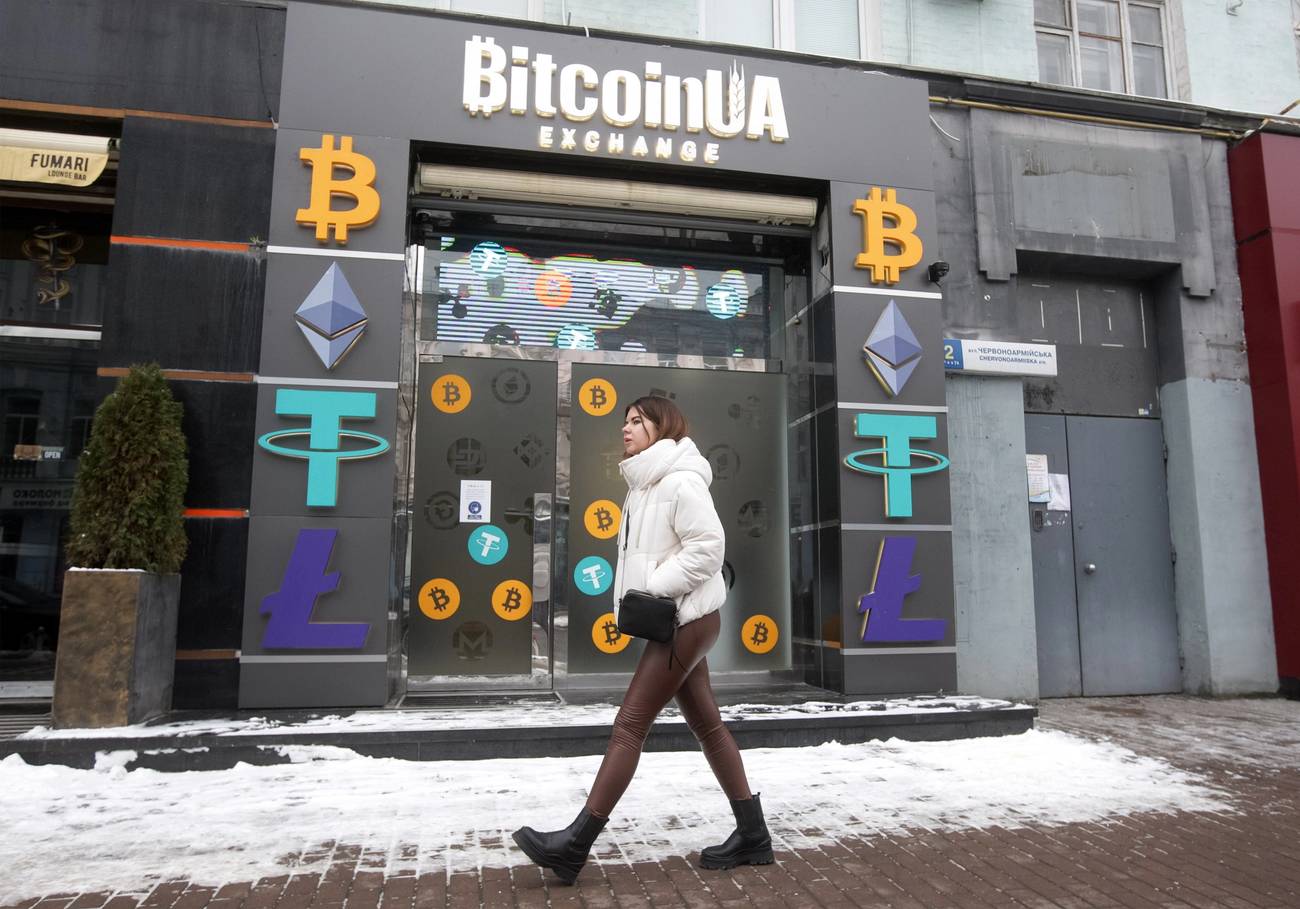 A woman walks past a cryptocurrency exchange point in the center of Kyiv, Ukraine, on Jan. 24, 2022STR/NURPHOTO VIA GETTY IMAGES.
.
What the marriage of social media and digital currencies means for freedom, America, and the Jews.
.
Every technological revolution is a double-edged sword, and the Jews often find themselves cut by both sides. The crypto revolution will be no exception. It will undermine traditional laws and political regimes and enable new ones. It will transform finance, media, and law. And it will provide social movements—and angry mobs—with new ways to organize and monetize. You may not care about crypto, but crypto cares about you.
Consider recent events in Ukraine. President Volodymyr Zelensky has become a social media star. Zelensky started the month of February with around 400,000 Twitter followers, on par with the prime ministers of Somalia and Australia. By early March, he was inching toward 5 million followers and poised to overtake Tucker Carlson and the pope. Millions on social media across the world added the Ukrainian flag and #StandWithUkraine to their profiles.
Twitter has long been a powerful force in politics, especially in the hands of professional entertainers like Zelensky—and Donald Trump. But while Trump used social media to fund his own election campaign, Zelensky’s Ukraine is using it to fundraise for a nobler cause: resistance to tyranny.
In the early days of the war—and even before it officially began—popular crowdfunding and payments platforms such as PayPal and Patreon blocked fundraising efforts run by Ukrainian NGOs, for fear that the money would be used to finance weapons and military activities in violation of their terms of service or U.S. laws. However, unlike traditional crowdfunding platforms, crypto addresses do not require anyone’s permission.
On March 1, the government of Ukraine tweeted a request for donations in cryptocurrency and included two Ethereum and Bitcoin addresses allowing individuals to transfer money directly from their crypto “wallet” to the Ukrainian government. Within days of its call for crypto donations, the country collected close to $50 million in various tokens.
As David Gauvey Herbert pointed out in a 2019 Bloomberg investigation, Ukrainian organizations have been crowdfunding for anti-Russian military activities since at least 2014. These efforts were focused mostly on current and former Ukrainian citizens who immigrated to other countries. Early on, there were concerns that funds raised overseas might end up in the wrong hands. In 2015, Congress included an explicit ban on U.S. aid to Ukraine from going to the Azov Battalion, an organization founded by a white nationalist and sporting a flag with insignia that suspiciously resembles that of the SS’s 2nd Panzer Division. Justifying the ban’s renewal in 2018, Rep. Ro Khanna, D-Calif., said, “white supremacy and neo-Nazism are unacceptable and have no place in our world.”
Despite these concerns, Ukraine’s crowdfunding efforts were not unprecedented or unique. They echoed earlier efforts by small, troubled countries to tap into wealthy immigrant communities in the United States. Starting in the early 1970s, the Northern Irish Aid Committee (NORAID) raised millions for the Provisional Irish Republican Army and Sinn Féin. Further back, in 1948, Golda Meir famously gave an “unscheduled, unrehearsed … and unannounced” speech at the General Assembly of Jewish Federations and Welfare Funds in Chicago and raised $50 million for the Haganah, the predecessor of Israel’s Defense Forces.
What’s happening online today is different, however. Ukraine is raising money based on social media posts, in the middle of a full-scale war, from people who have no historical affiliation with (or even much knowledge of) the country. On March 1, the Ukrainian government also tweeted that it is planning an “airdrop”—a cryptocurrency term for awarding tokens to people who contributed to a campaign. Airdrops are often used by cryptocurrency projects to reward their early customers and most active contributors. The tokens users receive can be converted to cash or kept as souvenirs that can be sold in the future.
But these tokens are not just souvenirs; they are financial products. By giving supporters free tokens, crypto projects are incentivizing these early supporters to recruit more people to the cause—if demand for the token goes up, so does its value. Those who “invest” early have an incentive to keep touting the project on social media.
In this case, the project is war. For the first time in history, then, a country’s military budget is dependent on the quality of memes its supporters can produce, fueled by a token-based incentive scheme that keeps them engaged. If Trump weaponized social media to contest a domestic election, Ukraine is weaponizing it to buy weapons to kill its enemies.
For the first time in history, a country’s military budget is dependent on the quality of memes its supporters can produce
Needless to say, Ukraine needs and deserves all the help it can get. But the mechanism it has pioneered is terrifying. Both social media and cryptocurrencies have been hotbeds for unwholesome activities. The former has been an efficient medium for the spread of hatred and lies (as well as love and truth), and the latter is used to finance various crimes (as well as harmless frivolity). The combination of the two presents a dangerous possibility: an online mob with a shared bank account.
Then there’s Russia. Two weeks before the invasion of Ukraine, the Russian government made a significant policy U-turn: Instead of banning crypto, as many feared it would (and as China did last year), the Kremlin published a document that outlined a framework for regulating cryptocurrencies. The document also mentioned that Russian residents own more than 12 million crypto accounts (one person can have multiple accounts), valued at more than $26 billion. That same week, Russia also reached a 30-year deal with China to provide natural gas—settlements for which will be done in euros instead of U.S. dollars.
A few days after Russian forces began advancing into Ukraine, the West imposed some of the harshest financial sanctions in history: Multiple Russian banks were kicked off the SWIFT messaging system that facilitates international money transfers, and Russia’s central bank was barred from accessing billions of its foreign-currency accounts held by international banks. In parallel, governments across the world started seizing or talking about seizing assets of Russian oligarchs or other people who allegedly made their money with Vladimir Putin’s help or blessing.
In the short term, crypto offers the Russian economy and Russian nationals an alternative financial system and a place to store wealth and transact. In the longer term, the unprecedented sanctions against a major commodities exporter might expedite the U.S. dollar’s decline as the preeminent reserve currency. It seems likely that the main challenger to the dollar will be a digital currency managed by a large country (or adopted by a large country). Which brings us to China.
Ever since the 2007-08 financial crisis and the aggressive, inflationary response by the U.S. government and Federal Reserve, pundits have been predicting that the Chinese yuan will become a true competitor to the dollar. And yet, 13 years later, the yuan only accounts for 2% of global foreign exchange reserve assets and less than 4% of international money transfers.
This is by design. China accounts for around 18% of global GDP, but it has a closed capital accounts policy, restricting the flow of money in and out of the country for both corporations and individuals. Even Chinese leaders are barely allowed to leave the country, let alone make free money transfers, especially after they retire from office. For the yuan to become a global currency, China would have to liberalize its capital account—a political nonstarter for a country seeking to increase rather than limit its control over its own citizens and bureaucrats.
But Central Bank Digital Currencies (CBDCs) offer a new approach. Digital money can be easy to use for anyone, anywhere; at the same time, it can be programmed and controlled in a way that enables the issuer (the government) to control each person’s permissions and rights. When all cash is replaced by digital money, the government can impose specific restrictions on each individual person.
Last year, China started piloting its own CBDC, the e-CNY, or digital yuan. According to the South China Morning Post, “government data showed 261 million digital wallets had been opened, and transactions totaled 87.6 billion yuan (US$13.9 billion) by the end of December [2021].” China also operates the Cross-Border Interbank Payment System (CIPS), which is used by major banks such as Citi and HSBC to settle yuan transfers. A 2022 report by CITIC, a Chinese state-owned investment firm, says that “it is necessary and urgent to vigorously promote yuan internationalization, especially the development of the CIPS system and the digital yuan.”
In the battle for money’s future, then, two diagonally opposed ideological camps are pinning their hopes on digital money: Crowds that wish to avoid traditional government restrictions, and bureaucrats that are trying to build the most powerful governments the world has ever seen. And these bureaucrats are not exclusive to China. In February, Canada invoked anti-terrorism laws to freeze the accounts of peaceful domestic protesters and anyone who provided them with financial support. Whether or not you agreed with the protesters, the swiftness with which they lost access to their own money was alarming.
A world in which crowds are empowered and private property can be confiscated without due process does not bode well for minority groups, including Jews, or small countries like Israel, which can be cut off from international financial systems (some have already suggested that the sanctions on Russia should also be applied to the Jewish state). More importantly, individuals and small groups may easily lose their property and other rights if they simply happen to find themselves on the wrong side of a trending topic on Twitter.
Jews have been here before. In 1748, Montesquieu published The Spirit of Laws which, in turn, inspired America’s founding fathers and the basic structure of all liberal democracies. In his book, the French political philosopher credited Jews with the emergence of moderate governments and civilized societies in early modern Europe. How did the Jews achieve this feat? By popularizing financial products that were resistant to tyranny.
For centuries, kings, princes, and popes banished Jews from their lands and confiscated their property. Property rights were dependent on military power, which Jews always lacked. To untangle this dependence, wrote Montesquieu, “the Jews invented letters of exchange” that substituted physical property with virtual obligations. Thanks to this method, “commerce … became capable of eluding violence, and of maintaining everywhere its ground.”
In light of this innovation, the economic cost of tyranny increased significantly: It was still easy for rulers to banish and imprison people, but it became much harder to seize their property. Tyrants faced a dilemma: Respect the rights of all people, including Jews, or see trade and economic activity move elsewhere. To keep their economies humming, “it became necessary that princes should govern with more prudence than they themselves could ever have imagined.”
According to Montesquieu, tyrants did not suddenly decide to honor the rule of law and separation of powers. These conventions took root only when tyranny became a losing economic strategy, particularly as finance and commerce overtook agriculture and local crafts. As he put it, “though their passions prompt them to be wicked,” it was in the interest of rulers to be “humane and virtuous.”
For the record, Jews in the Middle Ages did not invent letters of exchange, which have been around since antiquity. But medieval Jewish traders and bankers played a role in popularizing such financial instruments. In any case, the dynamic described by Montesquieu did not turn all countries into liberal democracies. And new innovations such as fiat currencies and the internet helped rulers take back the power they originally lost, and then some.
Fiat money—money that is not directly convertible to a specific commodity and can be printed at will—first appeared in China in the 11th century. But most currencies on Earth, including in China, remained connected to one commodity or another for the following millennium. But in 1971, President Richard Nixon ended the convertibility of U.S. dollars to gold. Ever since then, and for the first time in history, all of the world’s major currencies are fiat currencies.
The fiat system means governments—particularly the U.S. government—have the power to increase spending without increasing taxes. This mechanism helps finance wars, pay for bank bailouts, and fund other government programs that those in power deem worthy. Whatever the merits of such programs, the important point is that fiat currencies give governments the power to confiscate value out of people’s savings by printing more money.
And then there’s the internet. As more payments move online, and bank accounts are nothing more than digits in a database, it becomes easier than ever to freeze anyone’s account and prevent individuals, groups, or whole countries from participating in economic life. This power, too, is often employed for causes most people would agree with, but the point is that governments once again have the power to confiscate people’s property at will. And this time, they don’t even need to use violence.
The prevalence of fiat money and the remote control offered by the internet undermine the “balance of power” that occupied Montesquieu. It is no longer possible for minorities to prevent rulers from confiscating their property. In other words, the cost of tyranny is diminishing. Which means we will see governments exercise their powers more aggressively over time.
But the erosion of liberal democracy and individual rights is not a foregone conclusion. Cryptocurrencies offer the United States and its allies an opportunity to introduce a new form of money that enshrines these ideals and makes it difficult for any government to revoke them.
Why should the United States willingly undermine the current system and replace it with a new one? Because it is in America’s long-term interest to do so. Or at least, it might be. Its share of the global economy has diminished significantly over the past several decades—from 40% in 1960 to around 20% today. This is not bad news; it is a testament to America’s success in rebuilding Europe and Japan and bringing China into the global economy. But it does mean we’re heading into a multipolar world in which the United States will no longer reign supreme. In such a world, is it better to have a currency controlled by someone or a currency controlled by no one?
The U.S. government should have been working on digital solutions that balance the dynamism of digital money and the promise of American values, but it’s been conspicuously absent from this debate. The war in Ukraine may have prompted a new approach: On Wednesday, President Joe Biden signed an executive order that “lays out a national policy for digital assets across six key priorities: consumer and investor protection; financial stability; illicit finance; U.S. leadership in the global financial system and economic competitiveness; financial inclusion; and responsible innovation.” It is mostly a call for various authorities to explore if and how cryptocurrencies can be regulated or incorporated into U.S. policy, which isn’t much. But it’s a start.
Jews, meanwhile, are looking at a future in which crowds and tyrants—neither of which have historically been friendly—are leveraging financial innovation to increase their sway and undermine whatever is left of world order. The United States is starting to take digital money more seriously, but it would do well to take a long-term view rather than focus on immediate political and geopolitical considerations.
Do you know any Jews who work in finance or government? If so, tell them this: Promoting monetary solutions that ensure the rights of all participants at all times is in America’s interest. And it’s also good for the Jews.
Dror Poleg is an economic historian based in New York. He writes a weekly newsletter about the future of work, money, and cities. Follow him on Twitter @drorpoleg.
Zawartość publikowanych artykułów i materiałów nie reprezentuje poglądów ani opinii Reunion’68,
ani też webmastera Blogu Reunion’68, chyba ze jest to wyraźnie zaznaczone.
Twoje uwagi, linki, własne artykuły lub wiadomości prześlij na adres:
webmaster@reunion68.com






 ILTV Israel News