Archive | June 2023

India’s Bnei Menashe community in crisis as ethnic violence burns synagogues and displaces hundreds

India’s Bnei Menashe community in crisis as ethnic violence burns synagogues and displaces hundreds

JORDYN HAIME / JTA


In 2005, a chief rabbi of Israel affirmed their identity as a “lost tribe” group with historic Jewish ties, but researchers have not found sufficient evidence to back the claim.
.
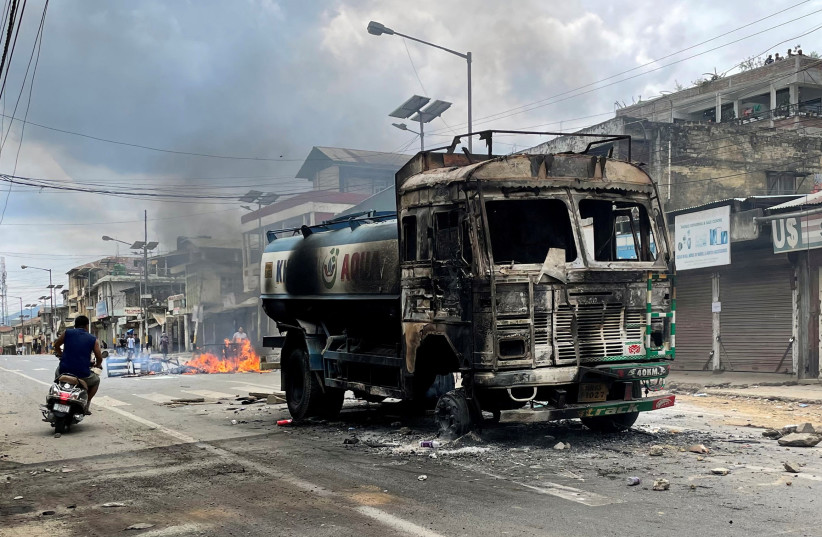
A scooterist rides past a damaged water tanker that was set afire during a protest by tribal groups in Churachandpur in the northeastern state of Manipur, India, May 4, 2023. /  (photo credit: REUTERS/STRINGER)

For the past several years, life was good for Lalam Hangshing as president of the Bnei Menashe Council, the governing body for Jewish communities in the Indian states of Manipur and Mizoram.

While living at his parents’ house, he and his wife enjoyed the clean air and beautiful scenery of Manipur, a state in northeast India home to close to 3 million people. Miles away, Hangshing rented out a newly-built four-story home to a film production company.

Everything changed on May 3, when rioting broke out between the ethnic majority Meiteis and the tribal minority Kukis, a violent conflagration that had been building up for years. Local groups say Meiteis began targeting Kuki institutions and razing homes to the ground, and Hangshing — also the general secretary of a Kuki-led political party — feared his house was next.

“When the problems started on the third of May, with military precision, the mobs went straight to [Kuki] houses,” Hangshing said. “They ransacked them and vandalized them and they burned each and every house in Imphal city within one and a half days.”

According to Shavei Israel, an NGO that helps “lost tribe” Jewish communities immigrate to Israel, over 1,000 members of the community, or 20% of their total, have been displaced. One community member was killed, and another was shot in the chest and is hospitalized. Two synagogues and mikvahs, or ritual baths, were burned down.

Bnei Menash from northern India make aliyah, December 15, 2020 (credit: ELIONORA SHILUV / ALIYAH AND ABSORPTION MINISTRY)

(Degel Menashe, an Israeli NGO that is dedicated to supporting the Bnei Menashe and has a longstanding feud with Shavei Israel, said one synagogue was burned.)

Hangshing is Kuki, as are the thousands of other Bnei Menashe Jews in Manipur. On May 4, Hangshing left his home and over a month later, has yet to return. 

He spoke with the Jewish Telegraphic Agency from Delhi, more than 1,000 miles from his home. His four-story house has been completely destroyed, but his parents’ home is somehow still standing. He worries about family possessions, such as religious books belonging to his father — who had helped found Manipur’s Jewish community — and a favorite set of golf clubs left behind, all in danger of being looted or destroyed any day now. 

More Bnei Menashe families

Another estimated 292 Bnei Menashe families have fled to Kuki-majority hill areas within Manipur or to the nearby state of Mizoram, according to Shavei Israel.

In Mizoram, over 100 Jews initially took refuge in the Shalom Tzion synagogue in Aizawl, in the houses of other Jewish families or at hotels, but most have moved to a paramilitary camp nearby. Community leaders say the refugees are not facing any immediate danger and have enough food and supplies thanks to the tens of thousands of dollars in aid rolling in from Shavei Israel and Degel Menashe.

“They basically just fled with their documents, and they have prayer books, their tefillin and ritual items, and the clothes on their back,” said Asaf Renthlei, a Mizoram Jewish community member and Degel Menashe volunteer. At relief camps, he said, community members have observed Shabbat every week since they fled.

“This is one of the gravest crises the Bnei Menashe in India have ever experienced,” said Michael Freund, who has been chairman of Shavei Israel since he founded the organization in 2002.

Over 100 Bnei Menashe have taken shelter in a synagogue in Mizoram. (Shavei Israel)

“A state gone rogue”

Violence broke out in Manipur state in early May when tribal groups launched a protest against the Meitei’s demand for Scheduled Tribe status, which is traditionally reserved for minority tribes such as the Kukis and ensures certain rights to education, government jobs and other privileges. The Kukis (which make up about 16% of the population and are majority Christian) say that the Meiteis (who make up 53% and are majority Hindu) already have outsized privilege and political representation.

The May 3 protest was only the spark that has ignited a conflict based on long-standing grievances against the Kuki minority, said Sushant Singh, a senior research fellow at India’s Centre for Policy Research.

“At the core of it, it is about Meiteis claiming that they are the original inhabitants of the state, Kukis are illegal immigrants, and… [the Meiteis] have been forced to occupy only 10% of the land,” Singh said. “And because of the special privileges that tribes have in India, they cannot go and occupy the land occupied by Kukis.”

As the conflict enters its second month, over 100 deaths have been recorded and an estimated 40,000 people have been displaced; some entire villages are destroyed and over 200 churches have been burned, as well as the two synagogues in the Imphal area. A statewide internet blackout has been in place since the beginning of May.

While both Kukis and Meiteis have participated in the violence, Kukis have “suffered the most,” and state police and security forces have joined Meitei groups in targeting Kukis, Singh said. Human Rights Watch has called on India to investigate police violence in Manipur, which local groups have disputed.

“It has essentially been a state gone rogue acting against a minority community,” Singh said.

Though the government has called for a ceasefire and established a peace committee, those efforts to quell the violence have been unsuccessful. The military has implemented security measures and evacuated Kukis further into the hills and Meiteis into the plains, but Singh said this has only reinforced geographical divides, instead of facilitating a solution that could allow the two groups to live alongside one another in the future.

Citing the government’s failure to protect them, Kukis have called for separation from the state of Manipur. As the conflict stretches into its second month, Indian Prime Minister Narendra Modi has yet to comment on the crisis in his country’s northeast.

“The army has been called in but they are very ineffective because it’s a civil war. They can’t take sides. They just stand around and when the firing gets too heavy, they stand aside so it’s left to us to fend for ourselves,” Hangshing said.
An appeal to Israel

The Bnei Menashe identify as descendants of a “lost tribe” group, tracing their origins to the Israelite tribe of Menasseh. In 2005, a chief rabbi of Israel affirmed their identity as a “lost tribe” group with historic Jewish ties, but researchers have not found sufficient evidence to back the claim. Bnei Menashe Jews began immigrating to Israel in the 1990s, and because of their “lost tribe” status, they all undergo formal Orthodox conversions upon arrival. Around 5,000 remain in the states of Manipur and Mizoram today, and about 5,000 have already immigrated to Israel.

Many have struggled to gain entry into Israel over the past two decades, and they are now asking the Jewish state to expedite the immigration process to help them escape the violence. But despite recent celebrations surrounding the opening of a new Indian-Jewish cultural center in central Israel, to which Netanyahu and President Isaac Herzog sent recorded blessings, Jerusalem has yet to publicly respond to the situation.

Israel’s foreign minister, Eli Cohen, visited India last month on a planned trip aimed at strengthening ties between the two countries. He did not comment on the matter, and his visit was cut short due to a military operation in Israel.

“I think under [Benjamin] Netanyahu, particularly in this stint as prime minister, there are very few expectations. He is very close to Mr. Modi’s government, so I don’t think anybody expects anything from Netanyahu,” Singh said.

The Bnei Menashe’s “grey zone” religious status, in the words of Renthlei, makes their immigration to Israel more complicated for them than most. Before the Bnei Menashe can even apply to immigrate, they must face a panel of rabbis — who usually come all the way to India — for interviews.

“It’s not like Ukraine. The Ukrainians are Jewish without any doubt. But the Bnei Menashe, we are in some gray zone of not exactly not Jews, but not exactly Jews also,” Renthlei said. “It’s unlikely that the Bnei Menashe would just be able to make aliyah, even in this situation, unlike the Ukrainians.” Thousands of Ukrainian Jews have immigrated to Israel since Russia’s invasion began in February 2022.

The Jewish Agency for Israel, which helps facilitate immigration, and the UJA-Federation of New York have provided funding to Shavei Israel to help displaced persons, representatives from Shavei said. The Jewish Agency, the ministry of aliyah and integration, and the Israeli consulate in India did not respond to JTA’s requests for comment.

“We’re too small to matter, I suppose,” said Isaac Thangjom, director of Degel Menashe. Thangjom, who lives in Israel, has been in contact with officials in the ministry of aliyah and integration.

“They are very concerned, but they haven’t given me any explicit answer despite my proddings,” he said. “Their responses have been very tepid.”


Zawartość publikowanych artykułów i materiałów nie reprezentuje poglądów ani opinii Reunion’68,
ani też webmastera Blogu Reunion’68, chyba ze jest to wyraźnie zaznaczone.
Twoje uwagi, linki, własne artykuły lub wiadomości prześlij na adres:
webmaster@reunion68.com


‘A Grave Slur Against the IDF’: Colonel Richard Kemp Slams UN Condemnation of IDF Response to Rocket Attacks

‘A Grave Slur Against the IDF’: Colonel Richard Kemp Slams UN Condemnation of IDF Response to Rocket Attacks

Hugh Fitzgerald, FrontPage Magazine


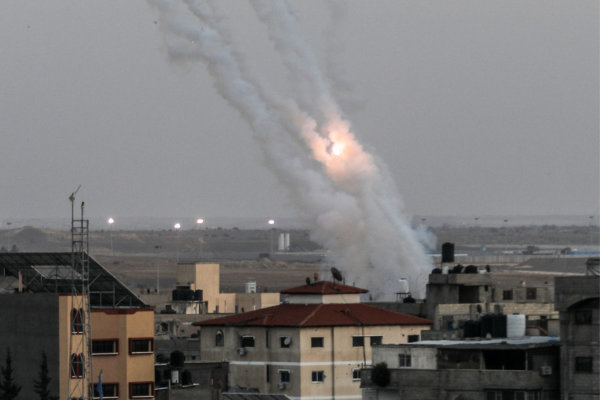
Trails of smoke are seen as rockets are fired from Gaza towards Israel, in Khan Younis, southern Gaza Strip, on May 13, 2023. Photo by Abed Rahim Khatib/Flash90

Former British Army officer says UN condemnation of IDF ensures ‘terrorists everywhere continue to use human shields and will cost many more lives.’

Colonel Richard Kemp, who led British troops in Afghanistan and has fought in another half-dozen campaigns, has long been a defender of the IDF, which he has described as “the most moral army in the world.” He looked at what Israel achieved in the first four days of Operation Shield and Arrow and come away with a heightened appreciation for the Israeli military.

More on his observations on the campaign can be found here: “‘A grave slur against IDF’: UN plays right into Islamic Jihad’s hands,” by Colonel Richard Kemp, Ynet News, May 11, 2023: “Operation Shield and Arrow has been carried out to date with breathtaking effectiveness. The shield of Iron Dome and David’s Sling have prevented major loss of life among the civilian population, although so far one man has been tragically killed and some have been injured, despite a barrage of 547 deadly rockets fired at Israel at the time of writing [as of Friday, May 12, that number had increased to 937].”

Israel managed to decapitate Palestinian Islamic Jihad, taking out by the fourth day of battle six of its senior commanders, including both the head, and the deputy head, of the PIJ’s rocket program. The IAF struck 197 targets in Gaza, including PIJ weapons storehouses, weapons fabrication plants, training centers, rocket launchers, and underground tunnels.

“The arrows of targeting intelligence, air strikes and missile attacks have decimated the Gaza terrorist leadership and destroyed many of their weapons. No other military is capable of defending its people with the ferocity and precision the IDF has been showing.”

How precise was Israel? It managed to locate the precise apartments where PIJ commanders had been hiding, and hit exactly those targets, sparing all but a handful of civilians – mostly, the wives and children of the commanders, though in the initial attack on May 9, three civilians living in an apartment adjacent to the one the IAF had targeted, also died. It managed to follow, from the skies, PIJ leaders as they moved from one apartment to another. In one case, the Israeli pilot held his fire while a PIJ leader was still with his family in an apartment, waiting until he had left them and gone, alone, to another hiding place, where he assumed he would never be found. And at that point, the Israeli pilot proved him wrong.

“Unfortunately, some of Israel’s arrows have also killed uninvolved civilians. The UN Secretary-General, Antonio Guterres, said yesterday that the civilian deaths in Gaza are ‘unacceptable’ and called on Israel to ‘abide by its obligations under international humanitarian law[…]’”

Secretary-General Antonio Guterres is wrong. There is no obligation under “international humanitarian law” to avoid all civilian casualties. No army in the history of the world has ever achieved that. He was also wrong to pass over in silence the PIJ’s practice of using women and children — family members of the terrorist commanders — as human shields.

The IDF has a duty, rather, as do all other armies, to make efforts to keep civilian casualties to a minimum. This is exactly what the IDF did in Gaza. When they thought that they might be able to hit a commander when he moved away from his family, the Israeli pilots waited for the right moment. They called off airstrikes altogether when they detected the presence of too many civilians.

By Friday night, May 12, Israel had conducted airstrikes on 197 targets inside Gaza. And how many people were killed in all those strikes? The Ministry of Health in Gaza itself admits that ministry of health in Gaza published final data about the number of Palestinians killed and wounded in Operation Shield and Arrow; according to the data, 33 Palestinians were killed, 22 fighting men, six children, three women and two non-combatant elderly men. Three Palestinian children and one man were hit by a PIJ rocket that fell short in Gaza. Another Palestinian was working in Israel and was hit by a PIJ rocket.

In other words, of the total of 33 Palestinians killed, 22 were fighters with either the PIJ or the PFLP, and five were Palestinian civilians hit by PIJ rockets, leaving only six civilians who were killed by Israeli fire. And if it turns out ultimately to be two or three times that number, it would still astonish.

“Guterres’ comments — and their echoes in the media and among human rights groups — also play directly into the hands of terrorists whose prime operational objective, short of its destruction, is international vilification of Israel. The UN Human Rights Council’s condemnation of the IDF that will follow this conflict as night follows day, flowing from thinking such as the Secretary General’s, will help ensure that Islamic Jihad and terrorists everywhere continue to use human shields and will cost many more lives.”

Israel does not deserve to be condemned – though condemned it most certainly will be, up and down the squalid corridors of power at the UN, and in such malign media as The New York Times, The Washington Post, CNN, the BBC, Agence France-Presse, and The Guardian – but should be praised for the precision of its targeting and its unbelievable ability to minimize civilian casualties, even as the PIJ fires nearly one thousand rockets indiscriminately into Israeli cities and towns, and about that, Antonio Guterres has not a word to say.

“Knowing the IDF as I [Col. Kemp] do, I can be confident that they are closely adhering to — and going beyond — international laws of war in this conflict. But there is another question as well. Should they have been given political direction to conduct offensive operations in Gaza, knowing that innocent civilian lives would be lost? Some argue, following Guterres’s line that civilian deaths are unacceptable, that Israel’s shield is sufficient to blunt the rockets and protect its population without the accompanying arrows[…]”

Should Israel, Col. Kemp asks, have simply relied on its defenses – chiefly the Iron Dome anti-missile defense system but also, now, the medium-range David’s Sling – to protect its people from incoming rockets, and not gone on the offensive against PIJ? No, because the PIJ would have kept firing thousands of rockets into populated parts of Israel. PIJ has an insatiable appetite for violence; it has gone to war twice before with the IDF. Though it was badly defeated both times, its malevolence remains, and the Israelis have clearly concluded that it has to be dealt a blow so crushing that it will take years for the PIJ to recover.

After the PIJ fired more than 100 rockets into Israel on May 2, just after the death of the PIJ hunger-striker, Khader Adnan, Israel turned that to its advantage. It had been preparing for a long time to attack the PIJ, and by May 9 it was ready, letting loose with its devastating first strike that killed three senior commanders in a single attack.

The PIJ was so stunned that it took a full day for it to respond with a rocket barrage of its own, that began late on May 3. That delay may have been the result of fear on the part of the remaining PIJ leaders – they must have worried that after the three senior commanders had been eliminated, they could be next, or to confusion as to who was now in charge and had the authority to order rocket attacks. In any case, the PIJ rallied late on May 10, starting its barrage of rockets.

Though the IAF struck 197 targets, the PIJ continued to launch rockets and mortars into southern Israel. But they were either intercepted by the Iron Dome missiles (and in one case, by a David’s Sling mid-range missile, intercepting a rocket hurtling toward Tel Aviv) or fell harmlessly into open fields, save for a half-dozen that hit dwellings.

No country can be expected in wartime to be able to avoid all civilian deaths among its enemies. Guterres should know that it is always a question of proportion: has Israel caused thousands, or even hundreds, of civilian deaths? No, not one hundred, not fifty, nor forty, nor even thirty. Israel never wantonly bombs enemy territory, indifferent to where its bombs fall, which is quite a contrast to the practice of the PIJ. Does Israel, instead, engage in pinpoint targeting of those who direct one of the most ferocious of terror groups, the Palestinian Islamic Jihad? We all know the answer to that.


Zawartość publikowanych artykułów i materiałów nie reprezentuje poglądów ani opinii Reunion’68,
ani też webmastera Blogu Reunion’68, chyba ze jest to wyraźnie zaznaczone.
Twoje uwagi, linki, własne artykuły lub wiadomości prześlij na adres:
webmaster@reunion68.com


Polemika z izraelskimi migawkami

Grobowiec w Ogrodzie w Jerozolimie. Zdjęcie: Berthold Werner, źródło Wikimedia Commons


Polemika z izraelskimi migawkami

Andrzej Koraszewski


Artykul jest odpowiedzia Andrzeja Koraszewskiego na artykuł Macieja Kozłowskiego: “Izraelskie Migawki“, ktory ukazal sie na Blogu Reunion’68 9 czerwca 2023. [ Izraelskie Migawki ]


Demonstracja przeciw reformie sądownictwa w Jerozolimie 13 lutego 2023 r. (Źródło zdjęcia: Wikipedia)

Czasami jestem zdumiony, ale uświadamiając sobie mój wiek, przywołuję się do porządku i zaczynam się zastanawiać nad przyczynami zdumienia. Ambasador Maciej Kozłowski napisał interesujący tekst o swojej wizycie w Izraelu. Autor jest historykiem i dziennikarzem, Izrael zna lepiej niż wielu innych, gdyż był tam ambasadorem w latach 1999-2003, a i później zachował kontakty z tym krajem. Odwiedzając Izrael podczas kolejnych barbarzyńskich ataków palestyńskich terrorystów z Islamskiego Dżihadu, był troszkę niespokojny przy lądowaniu, ale później rozmawiał z izraelskimi przyjaciółmi głównie o izraelskich faszystach.

Jak się okazuje głównym przedmiotem tych rozmów z przyjaciółmi była proponowana przez nowy rząd reforma sądownictwa. Wracam do tej sprawy po raz kolejny, bo jednak budzi zdziwienie, jak łatwo w pogaduszkach z przyjaciółmi zapomnieć o zasadach pracy tak historyka, jak i dziennikarza (zobowiązujących do odłożenia przyjaźni na drugi plan, kiedy próbujemy dociec prawdy).

Nawiasem  mówiąc, partii religijnych grasujących na arenie politycznej nie kocham chyba bardziej niż ambasador Kozłowski (i to niezależnie, czy jest to AWS, PiS, czy Otzma Yehudit), co nie znaczy, że w zapale gotów jestem nazywać wszystkich wierzących polityków faszystami.

Ben Gvir to okropna postać, ale  nie jest faszystą, a przynajmniej trudno byłoby go podciągnąć pod tę kategorię bez lekceważenia definicji faszyzmu. Nie jest również prawdą, że to pierwszy w historii przypadek wejścia do izraelskiego rządu partii skrajnie prawicowej, bo po pierwsze w koalicji utworzonej przez Icchaka Rabina w 1992 roku była partia Szas, a ministrem spraw wewnętrznych został wówczas Aryeh Deri. Po drugie, nie musimy sięgać aż tak daleko, ponieważ w poprzedniej koalicji była partia polityczna będąca częścią Bractwa Muzułmańskiego (czyli z autentycznymi, a nie naciąganymi, korzeniami faszystowskimi, skrajnie homofobiczna i rasistowska). Detale są ważne, szczególnie, kiedy autorem jest poważny zawodowy historyk. Możemy się również dziwić, że tak poważny autor powtarza zarzut pod adresem premiera Netanjahu, iż zdecydował się na reformę sądownictwa w związku z oskarżeniami. Śledzący tak uważnie Izrael Autor zapewne wie, że po wielu latach procesu, nie zdołano udowodnić Netanjahu ani jednego zarzutu, że prokuratura wielokrotnie występowała z propozycjami ugody, które oskarżony odrzucał, że poprzedni naczelny „Jerusalem Post”, Yaakov Katz, apelował do prezydenta, żeby czym prędzej ułaskawić Netanjahu, iżby uniknąć kompromitacji Sądu Najwyższego. Być może ważniejszy jest fakt, że za reformą sądownictwa jest większość społeczeństwa izraelskiego, że prezydent jest zwolennikiem reformy sądownictwa (chociaż chciałby, żeby przeprowadzona była w drodze negocjacji, a nie jako zwyczajna ustawa parlamentarna).

Większość nie musi mieć racji, więc być może jeszcze ważniejszy jest fakt, że wśród polityków będących dziś przeciwnikami reformy większość wcześniej domagała się takiej reformy.  

Maciej Kozłowski pisze, „system ten – lepiej czy gorzej – funkcjonował od założenia państwa, zapewniając pełnię swobód obywatelskich i ład demokratyczny niezależnie od tego czy rządziła lewica, prawica, centrum, czy też różne, nieraz bardzo egzotyczne koalicje”. Po pierwsze ten system nie istniał „od założenia państwa”. Po drugie twierdzenie, że działał dobrze, nie jest zgodne z prawdą. Przeczy temu zarówno historia „rewolucji konstytucyjnej” Aharona Baraka z 1993 roku, jak i prób cofnięcia tej rewolucji na przestrzeni dziesięcioleci. Obawiam się, że Autor nadmiernie zaufał swoim izraelskim przyjaciołom  i (podobnie jak wielu innych), nie zadał sobie trudu sprawdzania faktów. Autor podpiera się opinią byłego generała i byłego (rozgoryczonego)  polityka Likudu, chociaż może rozsądniej byłoby przejrzeć wcześniejsze spory między prawnikami.

Rewolucję Aharona Baraka krytykowali nie tylko prawnicy z prawicy, ale niesłychanie ostro krytykowała ją nieżyjąca już, związaną z partią Meretz, profesor Ruth Gavison, (której autorytet odpowiadał w Izraelu autorytetowi naszej Ewy Łętowskiej). Wśród krytyków tej „rewolucji” był Moshe Landau, były prezes Sądu Najwyższego Izraela, profesor Daniel Friedman były dziekan Wydziału Prawa Uniwersytetu w Tel Awiwie; profesor Joav Dotan, były dziekan Wydziału Prawa Uniwersytetu Hebrajskiego w Jerozolimie.

Ta reforma Baraka krytykowana była również poza granicami Izraela. Były prokurator generalny USA, Robert Bork, nazwał tę reformę „światowym rekordem sędziowskiej pychy”.  Jeden z najsławniejszych amerykańskich prawników ubiegłego wieku, profesor Richard Posner, w 2007 roku w artykule od tytułem Oświecony despota  pisał:

Aharon Barak, długoletni sędzia (ostatecznie główny sędzia) Sądu Najwyższego Izraela, który niedawno osiągnął wiek emerytalny, jest płodnym pisarzem, a to jest jego najnowsza książka. Jest to ważny dokument, nie tyle ze względu na swoje wewnętrzne zalety, ile na to, że można go uznać za Dowód A, dlaczego amerykańscy sędziowie powinni być bardzo ostrożni w cytowaniu zagranicznych orzeczeń sądowych. Barak jest światowej sławy sędzią, który zdominował swój sąd tak całkowicie, jak John Marshall zdominował nasz Sąd Najwyższy. Gdyby istniała Nagroda Nobla w dziedzinie prawa, Barak prawdopodobnie byłby jej pierwszym odbiorcą. Ale chociaż zna on amerykański system prawny i uważa, że w pewnym sensie ma wspólny język z liberalnymi amerykańskimi sędziami, w rzeczywistości zamieszkuje zupełnie inny – i dla Amerykanina dziwnie inny – prawniczy wszechświat.

Przeprowadzona przez Posnera krytyka systemu sądowego stworzonego przez Baraka jest druzgocząca. To system stawiający demokrację na głowie. Maciej Kozłowski daje ciekawy przykład jak to działa. Minister Spraw Wewnętrznych odwołuje komendanta policji w jakimś mieście, a prokurator generalny unieważnia jego decyzję. Przenieśmy to na grunt polski. Mariusz Kamiński odwołuje komendanta policji w Krakowie, a Ziobro mówi, ta decyzja jest nieważna. Idźmy dalej, zmienia się władza, ale po wyborach Ziobrę może zmienić wyłącznie zespół sędziów Trybunału Konstytucyjnego (wybranych przez Zjednoczoną Prawicę).

Posner o takiej roli sądów pisze:

Barak opiera swoją koncepcję władzy sądowniczej na abstrakcyjnych zasadach, które w jego ustach są grą słów. Wiodącą abstrakcją jest „demokracja”. Demokracja polityczna we współczesnym znaczeniu oznacza system rządów, w którym politycy kandydują w wyborach w stosunkowo krótkich odstępach czasu, a zatem są odpowiedzialni przed obywatelami. Sądownictwo, które ma swobodę dowolnego uchylania decyzji tych wybranych polityków, ogranicza demokrację. Dla Baraka demokracja ma jednak „konkretny” składnik, a mianowicie zestaw praw („prawa człowieka” nieograniczające się do praw politycznych, takich jak prawo do krytykowania urzędników publicznych, które wspiera demokrację), egzekwowanych przez sądownictwo, które podcina skrzydła wybranych polityków. To nie jest uzasadnienie dla hiperaktywnego sądownictwa, to jest jego definicja.

Gdyby Maciej Kozłowski, poświęcił czas na zbadanie historii sporu o rolę sądownictwa w Izraelu, być może, umiałby wyprowadzić swoich izraelskich przyjaciół  z absurdalnego błędu porównania izraelskiej próby przywrócenia równowagi między różnymi pionami władzy, a wysiłkami polskich władz, żeby tę równowagę skutecznie zniszczyć. Obawiam się, że ambasador Kozłowski dał się nabrać na to „Yariv Levin kan ze lo Polin”.     

Jest gorzej. Nie trzeba być Ewą Łętowską, żeby zauważyć, że dyktatura urzędników zwanych radcami prawnymi, to nie jest prawniczy nadzór przez niezależne sądy, ale nadzór komisarzy politycznych, od których woluntarystycznych decyzji nie ma odwołania.

Prezydent Herzog ma dobre powody, żeby lać oliwę na wzburzone fale i dążyć do tego, żeby ta reforma izraelskiego sądownictwa jednak doszła do skutku.     

Izraelski nacjonalizm zasadniczo różni się od rosyjskiego nacjonalizmu, węgierskiego, czy polskiego. Jest to nacjonalizm obronny, (to nie izraelska obrona przeciwlotnicza jest „zabójczo skuteczna”, to antyizraelska propaganda jest ZABÓJCZO skuteczną bronią, wprowadzającą w błąd wielu uczciwych ludzi, w tym wielu ludzi w samym Izraelu).  

Obecna koalicja może się nie podobać. Jak w każdym demokratycznym kraju przegrani nie są zadowoleni. Patrząc z boku warto próbować rozróżniać emocje i fakty. Izrael walczy o przetrwanie we wrogim świecie. Społeczeństwo izraelskie po raz kolejny powiedziało w wyborach, że taktyka nieustannych ustępstw wzmacnia terroryzm, nie łagodzi nienawiści i kłamstw świata na temat Izraela, przybliża prawdopodobieństwo (być może atomowej) wojny z tymi, którzy dążą do zniszczenia Izraela.

Ze zdumieniem przeczytałem  w artykule Macieja Kozłowskiego zdanie:  „Wówczas w tym Izraelu, który znam – czyli Izraelu wykształconym, świeckim, w większości o korzeniach aszkenazyjskich panowała atmosfera przygnębienia granicząca wręcz z rozpaczą”.  

Przepraszam, Panie Ambasadorze, ale mam wrażenie, że w tym zdaniu ukrywają się jakieś uprzedzenia. Profesor Ruth Gavison nie byłaby dziś przyjaciółką ani Ben Gvira, ani Smotricza, była jedną z pierwszych zaniepokojonych niszczeniem demokracji przez Sąd Najwyższy. W całej serii artykułów pokazywała dlaczego zasada kontradyktoryjności i rzetelności procesów regulujących procedury prawne nie może być naruszana, a sąd musi wysłuchać obydwu stron, zaś uniemożliwianie rządowi obrony swojej sprawy stanowi fundamentalne zagrożenie demokratycznego systemu. Nie wiem jednak, czy warto wracać do jej artykułów, podobno miała marokańskie korzenie.

P.S. Autor rządowego projektu reformy sądownictwa, Yariv Levin, to nie jest taki prawnik jak Ziobro czy Andrzej Duda. Ma solidny dorobek zawodowy, był wieloletnim prezesem Izby Adwokackiej, więc pewnie na Pana miejscu nie cieszyłbym się z tych porównań.


Andrzej Koraszewski – Publicysta i pisarz ekonomiczno-społeczny.  Ur. 26 marca 1940 w Szymbarku, były dziennikarz BBC, wiceszef polskiej sekcji BBC, i publicysta paryskiej „Kultury”.


Zawartość publikowanych artykułów i materiałów nie reprezentuje poglądów ani opinii Reunion’68,
ani też webmastera Blogu Reunion’68, chyba ze jest to wyraźnie zaznaczone.
Twoje uwagi, linki, własne artykuły lub wiadomości prześlij na adres:
webmaster@reunion68.com


Mahmoud Abbas’ Dissertation

Mahmoud Abbas’ Dissertation

IZABELLA TABAROVSKY


The Palestinian leader’s scholarly abstract sheds light on the crude deformations of Soviet Zionology and how they are reflected in today’s universities.
.

The ‘scholarly’ fakes produced by Soviet ‘scientific anti-Zionism’ are still with usORIGINAL IMAGE: GETTY IMAGES

On Feb. 1, 1972, the Central Committee of the Communist Party of the Soviet Union issued a directive “On further measures to fight anti-Soviet and anti-communist activities of international Zionism.” The social sciences section of the Soviet Academy of Sciences soon established a permanent commission for the coordination of scientific criticism of Zionism, to be housed at the academy’s prestigious Institute of Oriental Studies. Over the next 15 years, the IOS would serve as an important partner in the state’s fight against the imaginary global Zionist conspiracy that Soviet security services believed was sabotaging the USSR in the international arena and at home. In 1982, the IOS would grant the doctoral status to one Mahmoud Abbas, upon the defense of his thesis The Relationship Between Zionists and Nazis, 1933-1945.

Abbas’ dissertation has been a subject of considerable interest over the years. The thesis isn’t publicly available: By all accounts, it is kept in an IOS special storage facility requiring special authorization to access. But if one visits the National Library of Israel in Jerusalem, one can easily get the Palestinian leader’s so-called avtoreferat—an extended dissertation abstract. Written to the standards of the Soviet State Commission for Academic Degrees and Titles and authored by the candidate, the 19-page document outlines the dissertation’s relevance, methodology, main arguments and unique contribution to the field. It also provides a literature review and lists the individuals and institutions that were involved in shepherding the work through to completion. It therefore offers a peek not only into Mahmoud Abbas’ academic accomplishment, but also into the system that produced it.

Using the social sciences to support political and ideological agendas set by the Communist Party was a matter of course in the USSR. Entire academic disciplines had been established to grant scholarly legitimacy to the state’s guiding ideology. “Scientific atheism,” for an example, was tasked with proving scientifically that God did not exist and that religion was the opiate of the masses. “Scientific communism” was supposed to supply scientific proof that communism was the superior stage of social and economic development and would supersede both Soviet socialism and global capitalism. When, instead, capitalism superseded Soviet socialism and the cushy budgets that sustained these disciplines vanished, they, too, quietly dissolved.

As a field, “scientific anti-Zionism” never took root in the Soviet academy as broadly as the other two subjects. Like them, it died as soon as its primary client—the Soviet state—disappeared. Soon a million Soviet Jews resettled in Israel and the newly independent former Soviet states restored diplomatic relations with the country.

I grew up in Akademgorodok—a suburb of the Siberian city of Novosibirsk that was home to the Siberian Division of the Academy of Sciences. Adults around me lived and breathed science—real science, like physics and biology. It was well-known that portions of the academy were corrupted by ideological agendas. The antisemitism in its math division and elsewhere was a fact of life. Humanities and social sciences in particular were ruled by ideological priorities. But seeing the intellectual corruption that is evident in the story of Abbas’ dissertation is disturbing nonetheless.

The ‘scholarly’ fakes produced by Soviet ‘scientific anti-Zionism’ are still with us.

Worse, the “scholarly” fakes produced by Soviet “scientific anti-Zionism” are still with us. They float on the internet in multiple languages, inflaming the anti-Zionist fantasies of both the far left and the far right. Contemporary Russian right-wing presses reprint and peddle them right next to that other Russian contribution to humanity, the Protocols of the Elders of Zion—undoubtedly contributing to the American white supremacist David Duke’s conclusion that Russians could help solve the “crisis faced by the White World” because Russians understand “the power of International Zionism.”

Meanwhile, large portions of the American academy are busy adopting an anti-Zionist agenda that is grounded in the very same tropes and explanatory logic that infused its Soviet counterpart. Judging from Cary Nelson’s exhaustive Israel Denial and other writings, the output of these well-known American professors is no less of a profanation of scholarship than what was produced by their late Soviet predecessors. One way to gain a glimpse into the processes that whitewash crude anti-Israel propaganda through the scholarly apparatus is to examine Mahmoud Abbas’ avtoreferat.

“With the deepening of the crisis of capitalism in our time, the crisis of the ideology of Zionism and the inadequacy of its ideological concepts become increasingly obvious.” Thus begins Mahmoud Abbas’ dissertation abstract. “The vast majority” of Jews around the world, he writes, explaining the contemporary relevance of his work, “reject Zionist dogmas” about emigration. “The natural and objective process of Jewish assimilation” continues throughout the world, spelling out the coming failure of the Zionist project.

Despite this crisis, however, warns Abbas, Zionism remains a “shrewd and dangerous enemy of socialism and the national liberation movements.” Its role “as one of the storm troopers of world imperialist reaction is not diminishing,” he writes, deploying a widespread Soviet cliché that was meant to evoke Nazi Germany. On the contrary, “global imperialism, with the United States of America at its helm, increasingly bets on [Zionism],” particularly as it seeks to dominate the Middle East and subvert the socialist bloc. “The reactionary, aggressive essence of international Zionism and, first and foremost, its crucial component—Israel’s ruling Zionist regime—appears today in its most crude, expansionist and racist form. Violence, terror and extremism are becoming Zionists’ main methods of action.”

Back in Soviet times, my eyes would have glazed over this relentlessly formulaic Soviet-speak. But today, I appreciate its twisted brilliance. Here, in a few lines, is every major buzzword that a piece of Soviet anti-Zionist writing was supposed to incorporate and repeat. In this corner of the Soviet academic universe, the scholar’s task was not to ask new questions or propose new ideas: It was to adopt a prescribed posture, apply the right jargon, and arrive at the same conclusions as his predecessors. Not only would candidate Abbas not lose points for lack of originality; his dissertation would not pass muster had it been written in any other way.

In the third, and last, paragraph of the opening section, Abbas presents the reader with another set of Soviet clichés. Presaging contemporary American progressives by decades, he notes that the “unmasking of the reactionary ideology and politics of Zionism constitutes a pressing task of all progressive, anti-imperialist forces and is inextricably connected with the defense of peace … democracy and social progress.” All honest people of the planet must fight “the hateful ideology and practice of racism … against racial and national discrimination, Zionism and antisemitism, which are fomented by capitalist reactionary forces.”

Thus far, Abbas’ dissertation abstract reads like a typical Soviet anti-Zionist text, and it raises a question: What do incantations about the crisis of Zionism, capitalism and imperialism, and condemnations thereof, have to do with the stated topic of the dissertation—the relationship between the Zionist movement and Nazi Germany in the 1930s and 1940s?

We find the answer in the next couple of paragraphs. The history presented in this thesis, writes Abbas, helps understand “the origins” of Israel’s “aggressive and racist policy vis-à-vis Palestinians and the Arabs in other countries.” It also forces one to confront “a rather important theoretical question” about Zionism and fascism as “related social-political phenomena” arising at this time of “an overarching crisis of capitalism and the imperialist colonial system.”

In Soviet parlance, the word fascism was frequently used interchangeably with Nazism. What we have here, then, is a thesis that seeks to draw a parallel between Zionism and Nazism in order to demonstrate, with full scholarly authority, that contemporary Israel’s supposed racist, aggressive, and reactionary nature is not a bug but a feature, and that Zionism’s ugly baby, the State of Israel (a supposed present-day reincarnation of Nazi Germany), is irreparable and irredeemable.

In 2007, Abbas’ dissertation adviser, the Arabist Vladimir Kiselev, published an article in the Friendship of the People University Gazette titled “Meetings with Mahmoud Abbas.” In Soviet times, the university, known colloquially as Patrice Lumumba (the murdered Congolese independence fighter whose name it bore), served as a training ground for the up-and-coming political elites of the postcolonial world. Educated in the spirit of late-Soviet Marxism-Leninism, graduates were expected to ensure that their countries remained in the Soviet orbit, supported the Soviet posture on critical international issues, and provided Moscow with other crucial services in its face-off with the capitalist camp. It was here that Abbas, already a promising PLO leader with a master’s degree from the University of Damascus, began his Soviet educational path.

Recalling their first meeting, Kiselev wrote that the dissertation topic Abbas proposed stunned him. Collaboration between Zionism and Nazism, these two “polar opposites”? Kiselev was shocked that such a thing could even be possible, let alone proven.

We can safely assume that Kiselev’s shock was feigned. By the time Abbas arrived in Moscow, Soviet anti-Zionist propaganda had been spreading tales about Zionist collaboration with the Nazis for nearly two decades. IOS’ Israel Department, which Kiselev had come to head in 1971, had been established with the express purpose of leading the new “scientific anti-Zionism” effort. Kiselev would therefore have been deeply acquainted with the Soviet story of the supposed Zionist-Nazi collaboration, which went like this: In the 1930s, the Zionist movement in Palestine established contacts with the leadership of Nazi Germany. While Zionists claimed that the reason for the contacts was saving German Jews from impending disaster, the fate of the German Jews didn’t really matter to them. Their real motive was getting hold of the German Jewish money to infuse it into their colonial venture in Palestine, co-run with British imperialists. The Nazis, for their part, agreed to what would come to be known as the transfer deal, because they, too, had imperialist aspirations in Palestine and in any case wanted to rid Germany of Jews.

To be making money off the back of poor Jewish masses in collaboration with their future murderers was bad enough, Soviet propaganda continued, but there was more to the story. Beyond tactical considerations driven by shared imperialist interests—first and foremost, the profit motive (a condemnatory term in Soviet parlance)—Zionists and Nazis had a more intrinsic connection. It had to do with their deep-seated belief in racial superiority: Aryan, in the case of the Nazis, Jewish in the case of Zionists. It was this fundamental shared belief that motivated Zionists to collaborate with Nazis in the Holocaust, said Soviet propagandists, who then introduced the story of Rudolf Israel Kastner.

Packaged in the most sinister way possible, the Soviet rendition of this controversial and painful episode will be familiar to those who follow the obsessions of the contemporary anti-Israel left, where it survives to this day. Kastner, a leader of a Hungarian Zionist organization, the Rescue and Relief Committee, negotiated with Adolf Eichmann for the rescue of Hungarian Jews. He succeeded at saving a fraction—about 1,700 people. The rest—around 425,000 Jews—were sent to death at Auschwitz. In 1955, an Israeli court declared Kastner, who had been a senior official in Israeli Prime Minister David Ben-Gurion’s government, to have been a Nazi collaborator. The verdict was later partially reversed, but it was too late for Kastner: he was assassinated soon after the trial.

Debates as to whether Kastner was a collaborator or a rescuer continue to this day. But the complexity and human drama of this story interested Soviet propagandists only to the extent that it could be exploited for their purposes. Mixing and matching elements of the story at will, they concocted a fiction in which Kastner not only deliberately collaborated with Eichmann in the murder of Hungarian Jewry but did so with full knowledge and approval of Zionist leadership worldwide. The Zionist movement, the Soviets claimed, secretly welcomed the slaughter because it would strengthen its case for a Jewish state. The old and the infirm, who couldn’t do anything for the Zionist colonial enterprise, particularly needed to go. Kastner, a committed Zionist, obliged.

It is a monstrous claim implying a massive and sinister conspiracy, and there isn’t a shred of proof for it. Even if we conclude that Kastner was, in fact, a collaborator rather than a tragic figure who made catastrophic judgement calls in the fog of war and genocide that did in fact save Jews from death, there is nothing to suggest that he did so out of Zionist convictions, let alone on instructions from Ben-Gurion and the World Zionist Organization. But complexity and charitable interpretations were not what Soviet propagandists were after. They dug up documents they claimed proved their case, inserted decontextualized and distorted shreds of quotes from them into their collaboration narrative, then mass-produced the narrative, in multiple languages, by inserting it into countless books, pamphlets and newspaper articles.

In his dissertation abstract, Abbas closely follows this plotline. Similar to the Kastner episode, he condemns the Transfer agreement (another complex chapter of the Holocaust, which sparked outrage in parts of the Jewish world on the one hand but saved thousands of German Jews on the other) from the most extreme, simplistic, black-and-white perspective possible. Although the deal ended in 1939, when the Nazis cut off Jewish emigration, Abbas presents it as a launch of a collaboration that lasted throughout the war. “Many Zionist actors, for example, R. Kastner and J. Brand (in Hungary), R. Mandler and I. Reidlich (in Czechoslovakia), A. Nossig and Chaim Mordechai Rumkowski (in Poland),” writes Abbas, “entered, with the knowledge of Zionist leadership, into secret deals with the Nazi authorities to organize a resettlement into Palestine of specially selected groups of Jews ‘in exchange’ for the Zionists providing ‘order’ in concentration camps and [the] deportation of hundreds of thousands of Jews who were doomed for annihilation to death camps and gas chambers.”

What is Abbas talking about here? Who are these “Zionist actors” who did such monstrous things “with the knowledge of Zionist leadership”? We already know about Kastner, and Joel Brand was Kastner’s associate, so here Abbas’s logic is clear. Rumkowski and Alfred Nossig, however, were members of the Judenrats in the Lodz and Warsaw ghettos, respectively. (Rumkowski headed the Lodz Judenrat.) Their actions in the ghettos were and still are viewed as controversial, but why does Abbas refer to them as “Zionist actors”? One likely answer to this question is to be found in their biographies. Rumkowski had been involved in Zionist politics in pre-war Lodz, and Nossig was an early avid supporter of the Zionist movement. For Soviet propagandists, this would have been enough to call them Zionists and suggest that it was their Zionist beliefs that drove their decision-making in the ghettos. It’s a nonsensical claim, and a pernicious one at that. The presumption of such unconscionable evil echoes classic antisemitic conspiracy tropes, which Soviet anti-Zionist propagandists drew upon quite generously.

In essence, what Abbas is telling the “progressive, anti-imperialist forces” he addresses at the start of his abstract is the same thing that the neo-Nazis and Holocaust deniers have been telling their audiences for decades: the Jews did it. Jews killed their own people in the Holocaust.

In this narrative, which survives in far-left circles to this day, any contact with the Nazis, even for the sake of rescue, was tantamount to collaboration. Let’s set aside the fact that the accusers here are the Soviet Union, which had signed a non-aggression and trade pact with Nazi Germany, and a representative of a people whose wartime spiritual leader, Grand Mufti of Jerusalem Mohammed Amin al-Husseini, had a personal relationship with Hitler. Was there anything the Zionists could have done in the context of World War II to win Soviet ideologues’ and Abbas’s approval? Abbas has an answer. Zionist leaders faced a choice, he writes: “Either declare a war against Nazism and throw all of [the movement’s] resources into the war in the name of saving hundreds of thousands or millions of Jewish lives, or use the annihilation of the Jewish population in European countries occupied by Nazi Germany to implement the Zionist ideal of mass colonization of Palestine and create a Jewish state on its territory. And Zionist leaders chose the latter.”

What Abbas is telling the ‘progressive, anti-imperialist forces’ he addresses at the start of his abstract is the same thing that the neo-Nazis and Holocaust deniers have been telling their audiences for decades: The Jews did it.

There is no space in this piece to analyze every gap of historical logic in these two sentences. The fact that a Jewish Brigade, in fact, fought under the Zionist flag alongside the British, and hundreds of thousands of Jews fought in Allied armies, is, of course, entirely ignored. But even without going into details, the fundamental thrust of this paragraph is clear: Jewish collective suicide, which would have been the inevitable result of Zionists’ “declaring a war” against the Nazis and “throwing all resources” into it, would have been preferable to trying to rescue by whatever means possible those who could still be saved.

However we judge their actions, there isn’t a single responsible piece of scholarship suggesting that Kastner and his Hungarian aides or the leaders of the Judenrats in the ghettos acted out of Zionist convictions, still less as part of a massive Zionist conspiracy to collude in the genocide of their own people. Yet this obscene Soviet fabrication lives on, including on the contemporary anti-Israel left. So completely has the latter adopted it that a debunking of today’s claims also serves to debunk the original Soviet ones. See, for an example, Paul Bogdanor, the author of the excellent Kastner’s Crimedebunk Ken Livingstone’s claims about Zionist-Nazi collaboration. Many of the same documents that Livingstone, the former mayor of London and a prominent member of the British Labour Party, used to “prove” his claims are listed as “proof” in Soviet anti-Zionist literature. They appear in the 1983 anti-Zionist classic by the American Trotskyist Lenni Brenner, Zionism in the Age of the Dictators, also debunked by Bogdanor. Some of them appear in Abbas’s dissertation abstract as well.

It may seem surprising that Soviet propaganda bothered to present “proof” to substantiate its claims. Couldn’t they just say whatever they wanted? The answer is, yes, they could, and often did. But the fight against International Zionism—a treacherous, multitentacled enemy—demanded a sophisticated approach. Soviet ideologues wanted to appeal to educated Western audiences and opinion-makers—journalists, writers, academics. Baseless-looking claims were not going to cut it.

This desire to influence Westerners accounts for one of the most fascinating features of Soviet anti-Zionist “scholarship”—long lists of footnotes and endnotes, often featuring Western authors, most of them Jewish. These references look impressive and convincing—until one starts to check them. Let’s take a look at a couple of examples from Abbas’ dissertation abstract.

As Abbas discusses illegal Jewish immigration to British Palestine, he asserts that it was the “Israeli intelligence organization Mossad” that ran it. Anyone familiar with the subject knows that it wasn’t the spy agency that smuggled Jews into the country (it wasn’t established until 1949) but, rather, Mossad Aliyah Bet, a division of the Haganah devoted to illegal immigration. A quick check of the book that Abbas references as his source shows that its two Jewish authors had it right.

It’s tempting to make fun of what appears to be an amateur mistake—except that Abbas isn’t the only one in the Soviet academy making it. One Soviet “scholarly” anti-Zionist text after the next makes the same error, referencing the same book, leading one to conclude that Soviet authors dutifully copied this fake from each other without bothering to check the original.

Abbas further quotes from the same book to support his claim that Zionist emissaries who came to Nazi Germany to negotiate the transfer deal with the future murderers of the Jewish people were driven by monstrous, cold-hearted calculations. Saving German Jews, he writes, now quoting directly from the book, “‘wasn’t their job. Their eyes were fixed entirely on Palestine. They were looking for young men and women who wanted to go to Palestine in order to become pioneers, to struggle and to fight.’”

Two Jewish authors seem to confirm Abbas’ claim: What could be more convincing than that? The only problem is that the quote doesn’t end there. The authors say that, while the emissaries’ initial priorities were, indeed, “the needs of the Jews in Palestine,” they “jettisoned” that attitude after Kristallnacht. From that night onward, the authors report, the emissaries’ aim was “to save what they could of the Jews in German hands.” But this part of the quote changes the narrative, and so Soviet books excluded it. So did Abbas.

These kinds of malicious distortions of evidence, often repeated verbatim across the work of dozens of “scholars,” are a general feature of Soviet anti-Zionist “scholarship.” How come no one else verified these scholars’ work? The answer is simple: None of the foreign books or newspapers quoted in Soviet anti-Zionist literature was available to other Soviet scholars, let alone to ordinary Soviet citizens. The KGB opened its information vaults only to a small insider group it needed to support its anti-Zionist effort, explains the Russian historian Gennady Kostyrchenko. Those insiders could therefore distort their sources with impunity.

The “scholars” that the KGB trusted so completely were the “Zionologists”—a couple of dozen putative experts on Jews and Zionism who produced most of the bogus Soviet anti-Zionist literature. Some of their books appear in Abbas’ literature review, where he credits them with helping him understand “the history, ideology and politics of Zionism and the State of Israel” as well as “the nature of Zionism and fascism.” So let’s take a look at two of these books.

The first one is the Soviet classic: Beware: Zionism! by Yuri Ivanov. First published in 1969, the book saw multiple reprints and became the foundational text of Soviet anti-Zionism. Its singular achievement was to rewrite traditional antisemitic conspiracy theory as anti-Zionist scholarly critique. “Ivanov managed to supply a strong theoretical foundation for openly criticizing Zionism with the help of Marx’s and Lenin’s works, which no one could argue against,” recalled one of his comrades-in-arms.

Beware: Zionism! turned Ivanov into the indisputable leading light of the Zionologists, most of whom came from the loose far-right Russian nationalist movement, which in the 1960s gained influence among Soviet communist elites, the security apparatus, and sections of the media. The Zionologists’ core inner circle congregated around a high-level official in the Central Committee of the Communist Party, where Ivanov was employed. The Central Committee, we learn from Kostyrchenko, the Russian historian, was itself overrun by ethnic chauvinism and antisemitic conspiracy theory, so it must have been with a measure of affection that Ivanov’s colleagues nicknamed him the “Soviet Union’s main zhidologist.

Another book highlighted in Abbas’ literature review is titled The Ideology and Practice of International Zionism, which was co-edited by three well-known Zionologists. One of the three, Yevgeny Yevseyev, was an Arabist who began his career in the 1950s at the Soviet Embassy in Cairo. Coming home in the 1960s, he found a perch at the Institute of Philosophy, which, along with the IOS, would become a critical actor in the Soviet anti-Zionist effort. In his writings, Yevseyev plagiarized from antisemitic pamphlets published by Egyptian anti-Israel propaganda, which in the 1950s was run by a former Nazi. He also “borrowed” from prerevolutionary Russian pogromist literature.

When, in 1972, the Soviet Embassy in Paris reprinted one of Yevseyev’s articles for its French-language newsletter, its editor got sued for racial defamation. But the incident didn’t harm Yevseyev, who enjoyed high-level connections at the Ministry of Foreign Affairs, the KGB and the Central Committee, and was a member of the important Palestinian-Soviet friendship society. Kostyrchenko, who posthumously examined Yevseyev’s papers, found in them disturbing ideas on how to rid the Soviet Union of its Jews.

The second editor was Yelena Modrzhinskaya, Yevseyev’s boss at the Institute of Philosophy. Modrzhinskaya had served as an NKVD intelligence officer under Stalin’s henchman Lavrenty Beria and was stationed in the Soviet intelligence residency in London. One of her contributions to scientific anti-Zionism was Poison of Zionism, a slim volume illustrated with stylish drawings of Stars of David combined with spider nets and dollar bills.

The third co-editor was the academician Mark Mitin. A Jew by birth, Mitin wasn’t part of the Zionologists’ inner circle, but was frequently drafted by the latter into helping deflect accusations of antisemitism. Prior to hitting the anti-Zionist career gold mine, Mitin played a critical role in shaping Soviet philosophy into the handmaiden of Stalinism. “I am guided by the single idea” when approaching philosophical problems, he wrote in 1936: “How better to understand every word and thought of our beloved and wise teacher, comrade Stalin, and how to apply them to the solution of philosophical questions.” That year, countless of his colleagues and direct reports were arrested and executed for taking a wrong philosophical position. Mitin emerged unscathed and years later plagiarized a paper written by one of them.

“The Soviet Union’s chief zhidologist”; an inveterate antisemite plagiarizing from Nazi, Arab, and Russian antisemitic propaganda; an NKVD spook; a conformist, Stalinist, useful Jew who stole an executed academic colleague’s work—these are some of the Soviet “scholars” who shaped Abbas’ thinking on Zionism. But Soviet academics weren’t alone in this fight. In order to defeat the specter of International Zionism, Kostyrchenko notes, the KGB built something of an “anti-Zionist international.” Zionologists were granted special dispensations to travel abroad in order to establish contacts with like-minded organizations—primarily “the scholarly-propagandistic anti-Zionist institutions of those Arab political regimes and organizations, with which the USSR formed the closest military-political relations.”

Fabrications about Israel and Zionism that the KGB concocted with the help of the Arabists and Zionologists in the academy had real-life consequences that continue until today.

Under this program, Yevseyev delivered lectures on the dangers of International Zionism at Soviet-sponsored conferences in Egypt and Baghdad. And by the mid-1970s, IOS established relations with the Palestine Studies Center in Beirut, which was founded by the Palestinian-Syrian intellectual Fayez Sayegh and run and financed by the PLO.

The Palestine Studies Center is important to this story, because in 1978 it produced a publication that Abbas highlights in his literature review—an English-language pamphlet titled Zionist Relations with Nazi Germany. Its author, Faris Yahya (Glubb), was the son of the British army officer Sir John Bagot Glubb, better known as Glubb Pasha, who commanded Transjordan’s Arab Legion between 1939 and 1956 and fought against Israel in 1948. Faris was born in British-run Jerusalem, converted to Islam and dedicated his life to the Palestinian cause, associating himself with the Palestinian Front for the Liberation of Palestine. In the 1970s, together with the PFLP, the PLO, and the Palestine Research Center, he was stationed in Beirut, reporting for American, British, and Arab media. It must be here that he encountered and found common cause with Soviet Zionologists.

Nothing in Glubb’s background suggests expertise in European Jewry, the Holocaust or World War II. Yet in Zionist Relations with Nazi Germany, he holds forth on Kastner’s collaboration with Eichmann, “Zionist” Judenrats and Mossad intelligence agents supposedly smuggling Jews illegally into British Palestine. His book has the same plotline, the same citations, quotes, misquotes and distortions that we find in Soviet “scientific anti-Zionist” literature and Abbas’ dissertation abstract.

Abbas’ dissertation hardly offers anything that Soviet propaganda and its “anti-Zionist international” hadn’t said in the previous 15 years. There are serious problems with underlying scholarship, including factual mistakes, misquotes, selective approach to evidence, and massive distortions. The literature section appears to be a classic case of circular reporting: Despite the appearance of multiple independent sources, many can be traced to a single source—the Soviet security and propaganda apparatus. The agendas of the authors are concealed or misrepresented.

The question arises: Where were his academic superiors in all of this? Shouldn’t at least some academic advisers involved in Abbas’ dissertation have pointed out these problems? Three people are named on the cover of his avtoreferat as official reviewers—senior academics whose job it would have been to read the dissertation, challenge its arguments, and provide constructive feedback.

It only takes a quick search, however, to understand that even if the latter wanted to perform their duties, they couldn’t have: They simply were not qualified. Like Abbas’ adviser, Kiselev, all three were Arabists. There isn’t a single expert among them on any of the topics Abbas addresses in his dissertation, be it Zionism, Nazi Germany, Israel, Jews, the Holocaust or World War II. From Kiselev’s article in the Friendship of the People University Gazette, we learn that the defense went smoothly. Not a single person objected to granting the candidate the doctoral status. He flew home the next day.

As far as the Soviet academy was concerned, Abbas’s dissertation was a political project. The Cold War was at its peak. Moscow was convinced that its failure to establish a good working relationship with Washington was caused by Zionists’ behind-the-scenes machinations. It was Zionists who fomented pro-emigration sentiments among Soviet Jews while tarnishing the USSR as antisemitic and a human rights abuser. A few months before Abbas’ defense, the PLO representation in Moscow was granted diplomatic status. Abbas’ dissertation would have been viewed as an important tool in the struggle. Silly academic standards were not going to get in the way.

Fabrications about Israel and Zionism that the KGB concocted with the help of the Arabists and Zionologists in the academy had real-life consequences that continue until today. Having washed through the academy the hoax about the Mossad smuggling Jews into Palestine in the 1930s, the KGB could claim that the Mossad was also behind Soviet Jews’ demand for emigration in the 1970s and 1980s. Jewish activists like Natan Sharansky could be portrayed as foreign intelligence assets—an accusation that carried a death sentence. The Soviet academy’s “scientific anti-Zionism” project facilitated and promoted state-sponsored antisemitism. Abbas’ dissertation was part of that game.

In 2020, nearly 40 years after Abbas received his doctoral degree, the IOS published an article reviewing the history of the institute’s Israel studies department. The authors didn’t mince words. From the early 1970s, they note, when “Soviet party leadership set itself the goal of ‘fighting the Zionist ideology,’” Soviet area studies, including Middle East studies, were “largely guided and controlled by state structures.” IOS’ Israel scholars were supposed to criticize Zionism as an “‘extreme expression of reactionary bourgeois-nationalist ideology,’” highlight the “reactionary essence of Zionism,” and present Israel as an aggressor and an agent of American imperialism pursuing an “aggressive foreign policy course vis-à-vis Arab countries.” Scholars had no access to scholarly literature. They weren’t able to visit Israel. There were no Hebrew specialists among them.

Another post-Soviet IOS publication, which reviewed the history of Soviet-Israeli relations, noted that although some Soviet scholars did try to offer a more nuanced understanding of Zionism and Israel, these were viewed as confusing the matter and were censored. Anti-Zionist literature “crudely distorted historical events, manipulated and directly falsified facts that had to deal with the creation of Israel, its internal and external policy, and the causes and nature of the Arab-Israeli conflict.” In the absence of freedom of information, audiences often accepted these manipulations at face value. “They awakened ethnic prejudices … and turned people against not only the Jewish state but against the Jews.”

When the USSR prohibited contact with all things Israel, it diminished its own ability to understand the country. Starved of real knowledge, the Soviet political establishment and chunks of the academy fell victim to their own conspiracist fantasies, drifting further and further from reality.

Today, portions of the American academy, led by Middle East studies departments, are falling prey to remarkably similar ideological tendencies. Anti-Israel boycotts, often expressed in recognizably Soviet language, have become normalized on American campuses from Harvard on down. Well-known American academics routinely violate the rules of scholarship and spin anti-Zionist conspiracy theories that would have been at home at the Soviet-era IOS or Institute of Philosophy. The more campuses and academic associations endorse BDS, the more ignorant their communities, and American society as a whole, become.

Mahmoud Abbas’ dissertation may be hidden away in IOS’ special storage facility, but the old Soviet fakes on which it was based continue to circulate widely among Middle Eastern audiences. The work of Soviet Zionologists is routinely republished on the internet, in multiple languages, providing fodder both to the anti-Israel far left and the antisemitic far right throughout the West. Will the American academic institutions that are now promoting their own contemporary version of “scientific anti-Zionism” find the courage to renounce agenda-driven pseudoscholarship and confront the consequences of their deformed conspiracy theories? Let’s hope so. What’s depressing to imagine is that Abbas might be granted a doctorate today by an American university on the basis of the same dissertation, based on the same sources, in the absence of any state compulsion.


Izabella Tabarovsky is a Tablet contributor. Follow her on Twitter @IzaTabaro.


Zawartość publikowanych artykułów i materiałów nie reprezentuje poglądów ani opinii Reunion’68,
ani też webmastera Blogu Reunion’68, chyba ze jest to wyraźnie zaznaczone.
Twoje uwagi, linki, własne artykuły lub wiadomości prześlij na adres:
webmaster@reunion68.com

ZOA Calls on Biden Administration to Rescind ‘Horrific and Frightening’ Appointments to Holocaust Museum Board

ZOA Calls on Biden Administration to Rescind ‘Horrific and Frightening’ Appointments to Holocaust Museum Board

United with Israel staff


‘The Holocaust Memorial Museum – which by law is mandated to carry out ‘support for the Jewish homeland’ – should never have board members of anti-Israel organizations on the Museum’s governing board.’

The Zionist Organization of America (ZOA) and its National President, Morton Klein, called on the Biden administration to rescind the “appointment to the U.S. Holocaust Memorial Museum Council (the governing board of trustees of the museum) of two board members of hostile-to-Israel non-governmental organizations.”

In a statement released Tuesday, Klein, also speaking on behalf of the ZOA, called the appointments of Kimberly Emerson and Alan Solomont to the council “horrific and frightening.”

He noted that “Congress established the U.S. Holocaust Memorial Museum to memorialize Holocaust victims and ‘carry out the recommendations of the President’s Commission on the Holocaust in its report to the President of September 27, 1979.’” The report, in turn, had called for a focus of the museum to be “support for the Jewish homeland.”

“Thus, the Holocaust Memorial Museum – which by law is mandated to carry out ‘support for the Jewish homeland’ – should never have board members of anti-Israel organizations on the Museum’s governing board,” Klein said.

Emerson is on the board of Human Rights Watch (HRW), which “is infamous for falsely accusing Israel of ‘apartheid,’ ‘crimes against humanity,’ ‘persecuting’ and ‘systematic oppression’ and ‘inhumane acts’ against Palestinians,” according to Klein

“HRW calls for dismantling Jewish communities where 800,000 Jews live in the lawful Jewish homeland in Jerusalem and Judea/Samaria; forcibly removing these Jews to the other side of the artificial 1948 ceasefire line; free movement of Arabs to and from Gaza; dismantling much of the security fence that protects Israelis from terror attacks; and a one-sided ‘return’ of Palestinian Arabs to overrun Israel,” he added.

Solomont, on the other hand, was on the board of “vicious hostile-to-Israel groups” New Israel Fund (NIF)  and Israel Policy Forum (IPF).

According to Klein, NIF “funds numerous anti-Israel groups that promote antisemitic BDS, seek to bring Israeli soldiers before international tribunals, funded anti-Israeli government protests, and more.”

IPF, he said, ” is so radical that it was the only group to testify against moving the U.S. Embassy to Jerusalem.”

“Solomont is currently the National Board Chair of the notorious anti-Israel group J Street, which promotes anti-Israel UN resolutions; funds anti-Israel political candidates and lobbies for U.S. funding for the Palestinians – which enables the Palestinian Authority’s ‘pay to slay’ payments to Arab terrorists to murder Jews, among many other horrors,” Klein added.


Zawartość publikowanych artykułów i materiałów nie reprezentuje poglądów ani opinii Reunion’68,
ani też webmastera Blogu Reunion’68, chyba ze jest to wyraźnie zaznaczone.
Twoje uwagi, linki, własne artykuły lub wiadomości prześlij na adres:
webmaster@reunion68.com