 Merz in Israel for first visit as German chancellor
JNS Staff
The European leader said following a meeting with Israeli President Isaac Herzog in Jerusalem that his country “will always stand by your side.”
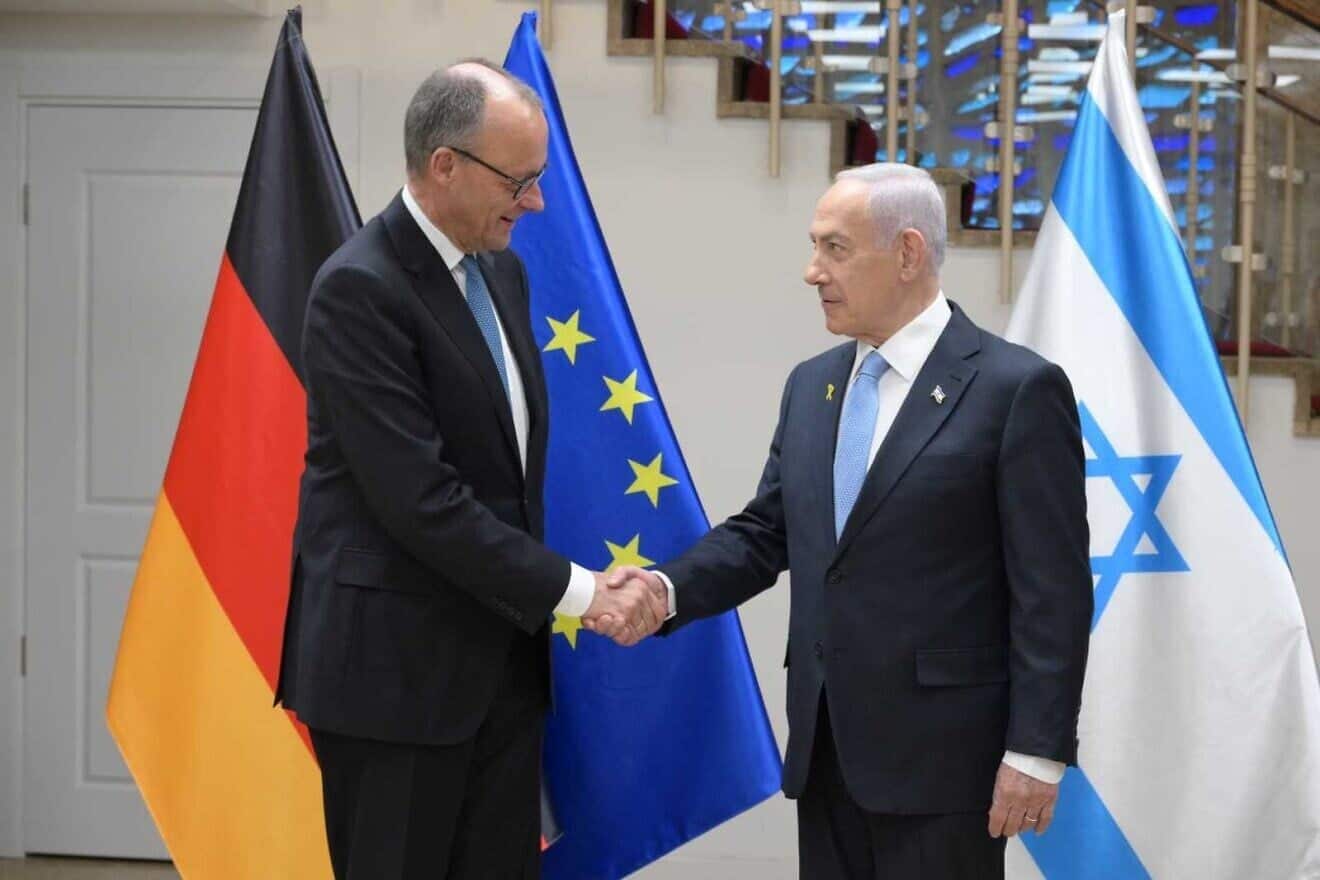 German Chancellor Friedrich Merz meets with Israeli Prime Minister Benjamin Netanyahu at the Prime Minister’s Office in Jerusalem, Dec. 7, 2025. Photo by Amos Ben-Gershom/GPO
German Chancellor Friedrich Merz met with Israeli Prime Minister Benjamin Netanyahu at his office in Jerusalem on Sunday after arriving in Israel on Saturday night for his first visit to the Jewish state since the conservative party leader took office in May.
President Isaac Herzog hosted Merz on Saturday at his official residence in the Israeli capital on Saturday, with Herzog following their meeting calling the two countries “true friends” and strategic allies.
“During our meeting this evening, we discussed the importance of implementing President [Donald] Trump’s plan, approved by the United Nations Security Council, and emphasized that Hamas must be removed from Gaza and disarmed,” Herzog stated. “In addition, Hamas must uphold the agreement and release the last remaining Israeli hostage still being held in Gaza, Ran Gvili.”
He added: “We also discussed ways to further deepen our vital partnership, in the hope of a better future.”
Writing in Hebrew on X, Merz said that “I come here with deep faith and as a friend of Israel, @Isaac_Herzog. We will always stand by your side. The very fact that our countries established diplomatic relations within such a short time after the Holocaust remains a miracle, as does the fact that the friendship between us has deepened so profoundly.”
Israeli Foreign Minister Gideon Sa’ar met the 70-year-old leader of the Christian Democratic Union on the Ben Gurion Airport tarmac when he landed after a brief stop in Jordan, calling the chancellor a “friend,” describing Germany as an “important partner,” and saying bilateral relations between Berlin and Jerusalem are “on an upward trend.”
“This trend is reflected in the removal of the partial embargo, Germany’s clear opposition to all types of boycotts against Israel, and its abstention at the UN from supporting the extension of UNRWA’s mandate,” said Sa’ar.
“Last week, an Israeli Arrow battery for defense against ballistic missiles was deployed in Germany for the first time. Germany is an important friend, and I am convinced that the Chancellor’s visit will contribute to the strengthening of the special relations between the countries,” the minister continued.
Merz wrote on X Saturday night that “the ceasefire in Gaza is stabilizing. Now we must successfully move into the second phase. This means permanently removing the basis for Hamas’s terror and ensuring that the precarious humanitarian situation of Gaza’s civilian population improves quickly and noticeably.”
Hours before taking off to Israel, Merz spoke by phone on Saturday with Palestinian Authority head Mahmoud Abbas and urged him to implement “urgently necessary reforms” in the P.A., AFP reported.
The P.A. could “play a constructive role in a post-war order,” German government spokesman Stefan Kornelius was cited as saying.
Merz expressed support for the Trump administration’s peace plan for the Mideast, welcoming what the German leader called the P.A.’s “cooperative attitude,” AFP reported.
The chancellor added that Berlin still views a two-state solution as the ultimate path toward peace and security for Israelis and Palestinians alike, the government spokesperson said.
Merz spoke with Netanyahu on Nov. 16, shortly after declaring in a speech that Berlin must “stand with Israel” as part of a renewed “Western alliance.”
A day earlier, Merz referenced Israel in a speech to the Junge Union Deutschlands—the youth wing of his Christian Democratic Union party—in Rust, near Stuttgart in western Germany.
“The position of the Federal Republic of Germany must be clear, where we stand. In the Western alliance,” said Merz. “At Israel’s side, dear friends. I have not forgotten that,” he added, to thunderous applause.
Successive German governments have described a commitment to Israel’s security as a core principle of their foreign policy, rooted in the legacy of the Nazi regime’s near annihilation of European Jewry. At the same time, Berlin has funneled millions of dollars to Palestinian and other organizations that work to undermine Israel’s legitimacy and oppose Jewish statehood.
Germany’s government has adopted a friendlier posture toward Israel than many other European countries since Hamas’s Oct. 7, 2023, massacre.
However, there have been tensions as exemplified by Merz announcing a ban on exporting “offensive” weapons to the Jewish state on Aug. 8, hours after Netanyahu’s Cabinet voted to expand the Israel Defense Forces’ operations against the Hamas terror group.
On Dec. 3, Israel Defense Ministry officials handed over the first operational Arrow 3 missile defense system to the German Army at a ceremony at a German Air Force base near Berlin.
The development “marks a significant step in implementing the defense export contract signed between the two nations approximately two years ago, and is considered the largest defense export deal in Israel’s history,” according to an Israeli Defense Ministry statement.
Zawartość publikowanych artykułów i materiałów nie reprezentuje poglądów ani opinii Reunion’68,
ani też webmastera Blogu Reunion’68, chyba ze jest to wyraźnie zaznaczone.
Twoje uwagi, linki, własne artykuły lub wiadomości prześlij na adres:
webmaster@reunion68.com