
Archives

Internal Jewish Divisions Pose the Greatest Threat of All

Internal Jewish Divisions Pose the Greatest Threat of All

Pini Dunner


Thousands of Jews gather for a mass prayer for the hostages in Gaza at the Western Wall in the Old City of Jerusalem, Jan. 10, 2024. Photo: Yaacov Cohen

On June 28, 1863, Samuel Goodwin Stout wrote a letter to his mother from Chambersburg, Pennsylvania. He was 20-years old and bursting with the optimism and adrenaline of a young Confederate soldier.

“Dear Mother,” he began, “I can inform you that I am well at this time, and I hope those lines will find you all well. We have been through Maryland, and we are now going through Pennsylvania. But we don’t think that we shall get far into Pennsylvania before we shall get into a fight. But we are all in good spirit. We have got a strong army with us — we have got 122,000 now across the Potomac.”

Days later, Samuel was on the battlefield at Gettysburg. It was one of the bloodiest days of the Civil War, often cited as the turning point of the conflict. There were approximately 51,000 casualties (killed, wounded, captured, or missing), with 23,000 from the Union Army and 28,000 from the Confederate Army.

Samuel survived that dreadful day, and — against the odds — survived the Civil War, dying in 1919 at the age of 75. But the positive spirit he displayed during the early part of the conflict, evident in his letter home, quickly disappeared, and by the time the war was over, he was damaged goods. Indeed, Samuel’s early letters were filled with zeal and a sincere belief in the cause he was fighting for, but as the war dragged on, the tone of his letters shifted dramatically. The eager participant was transformed into a war-weary young man, deeply affected by the brutal realities of conflict.

On February 10, 1864, he wrote a letter brimming with dejection: “I see no cessation of it. Now only to look to the all-wise and merciful God for peace, and that is the only way we are to have peace anyway. We have to give in to a higher power than Jefferson Davis or General Lee to end this horrible conflict in which we are struggling.” The idealism had faded, replaced by a longing for the war’s end and a divinely inspired return to peace.

The American Civil War is often referred to as the “War of Brothers.” This evocative phrase captures what was undoubtedly the most devastating aspect of this horrific conflict: that the war pitted family members and close friends against each other. It was truly a Milchemet Achim — the Hebrew phrase for civil war.

Stories abound of brothers fighting on opposite sides, like the Terrill brothers, James Barbour Terrill, a brigadier general for the Confederate army, and William Rufus Terrill, a brigadier general for the Union Army. Both were killed in battle. Another Terrill brother, Philip Mallory of the Confederate 12th Virginia Cavalry, was also killed in battle.

Every American family was somehow affected. The eager letter writer Samuel Goodwin Stout’s great-great-grandson is Mike Wise, the award-winning Washington Post sportswriter. While researching his family, Wise discovered that another ancestor, his great-great-great-grandfather Tilman Settles, was a Union Army corporal, killed by Confederates while walking back to his Missouri home in December 1861.

The impact of such a deeply personal conflict cannot be overstated. Families were torn apart, friendships shattered, and communities divided. The war forced individuals to confront loved ones as enemies, challenging their loyalties and convictions. This internal division was more devastating than any external threat could have been.

The emotional and psychological toll was immense, leaving scars that would last for generations. The Civil War’s legacy of bitterness and animosity lingered long after the last shot was fired, evidence of the profound damage caused by internecine strife. Unlike other conflicts that are fought against foreign adversaries, this war was fought within the national family, making the violence and suffering all the more personal and tragic.

In every epoch of human history, division and discord within societies and national groups have often paved the way for the most harmful consequences. The American Civil War may have been triggered by disagreements on states’ rights and slavery, but it was the tearing apart of a nation not yet a century old that left the deepest scars.

The memory of the blood-soaked fields of Gettysburg and Antietam act as grim reminders of what happens when a society turns against itself. But beyond the battlefield, it underscores a critical point: countries and societies are much more vulnerable to collapse because of internal strife than they are from external enemies. It wasn’t an invading force that brought the United States to the brink of destruction; it was its own internal divisions.

The theme of internal division resonates profoundly in the Torah portion of Korach. The story of Korach’s rebellion is one of the most distressing narratives in the entire Torah. Korach, a Levite, led a coup against his first cousins Moshe and Aaron, challenging their leadership and looking to overthrow them with the help of a group of malcontents, all of whom were part of the Jewish nation. As such, Korach’s challenge was more than just a power struggle — it was an insidious attack on the unity of the Israelite people.

In his writings, Rabbi Jonathan Sacks often reflects on the grave danger posed by fraternal strife, drawing from various episodes in the Book of Genesis, such as the conflicts between Cain and Abel, Isaac and Ishmael, Jacob and Esau, and Joseph and his brothers. Sacks notes that these narratives highlight how sibling rivalry and internal discord lead to devastating consequences, which he says is the reason the Torah gives these stories so much attention.

As Rabbi Sacks puts it, “The greatest challenge to humankind is not the stranger, but the brother. Peace in the world begins with peace at home.”

Korach’s rebellion is a stark reminder from the dawn of Jewish history of the dangers of internal division, illustrating how internal discord can threaten our stability in ways that no other threat can. The rebellion against Moshe and Aaron by their cousin was more dangerous than any external threat the Israelites faced in the wilderness, as it came from within and sought to destabilize the core of their society.

The narrative of Korach’s rebellion concludes with a dramatic and divine resolution: the earth opens up and swallows Korach and his immediate family, and a fire consumes his 250 princely followers as they offer up incense (Num. 16:31-35). This powerful and terrifying punishment is intended to indicate the severity of the sin of causing and perpetuating division within the community.

We are living through a critical time in our history, when the threat of “Milchemet Achim” is very real, and probably poses the greatest danger we have faced as Jews for millennia.

The intensifying split between Jews in the Diaspora who have taken to using Israel as a punching bag, and the Jewish community in Israel, is deeply worrying. The factionalization of Israeli society, with the rifts that exist between right and left, religious and secular, haredim and non-haredim, are far more worrying than the threats from our enemies.

Divided we fall, but united — we not only stand, but we thrive beyond our dreams. Let us take on board the lessons of Parshat Korach, and learn from the devastation caused by the American Civil War. Rather than focus our energies on fanning the flames of division, we must use all our resources to find the common ground that can give us the foundation for a future full of light and hope.


The author is a rabbi in Beverly Hills, California.


Zawartość publikowanych artykułów i materiałów nie reprezentuje poglądów ani opinii Reunion’68,
ani też webmastera Blogu Reunion’68, chyba ze jest to wyraźnie zaznaczone.
Twoje uwagi, linki, własne artykuły lub wiadomości prześlij na adres:
webmaster@reunion68.com

Temple Mount earth-filtering project discovers ancient clay tokens

Temple Mount earth-filtering project discovers ancient clay tokens

JUDY SIEGEL-ITZKOVICH


Tokens found in Temple Mount Sifting Project excavations may have been used by ancient pilgrims.

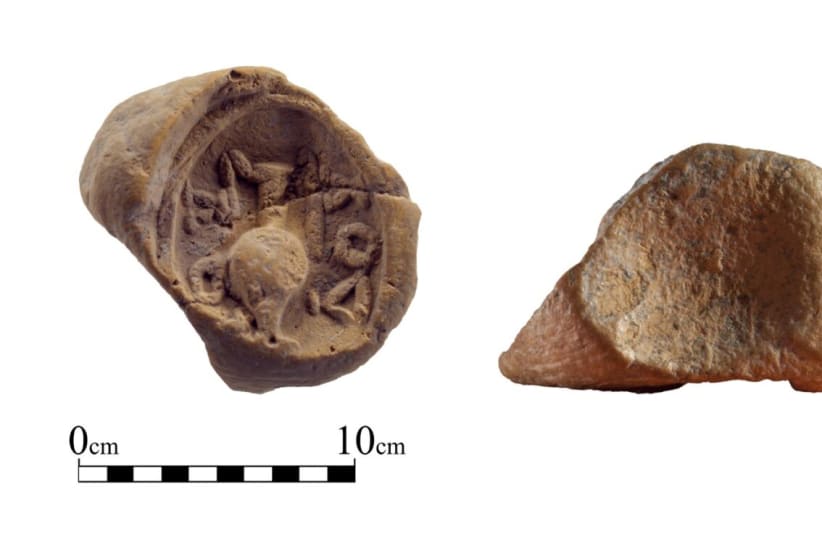
The clay token found in the sifting of dirt from the Temple Mount bearing the Greek Inscription ΔΟΥ-ΛΟ[Υ] (DOULOU) / (photo credit: ZACHI DVIRA)

More than a decade ago, a tiny clay token with a seal imprint depicting a wine jar (amphora) with a Greek inscription was discovered by a team working on the Temple Mount Sifting Project. Due to its resemblance to another clay token with an Aramaic inscription that had been found near the Temple Mount, scholars have wondered whether these sealings functioned as tokens for exchanging offerings used by pilgrims who ascended to the Temple.

Archaeologists are still trying to understand the nature of the 2,000-year-old mysterious clay token that was found in September 2011 while sorting pottery shards collected from previous siftings at the site. Archaeologist Gal Zagdon, who was in charge of the sifting facility, noted a tiny, irregularly shaped clay object. Upon closer inspection, it was clear that it was not a potsherd but a tiny lump of clay with a seal impression on it. Unlike common clay sealings (sometimes named bullae), its back side was pinched, suggesting it was a type of token given by hand to the recipient, unlike a sealing that was attached to a knot securing a document or container.

The seal impression depicts an amphora known from the second half of the first century CE (about 100 years before the Second Temple’s destruction). Six Greek letters appear around the wine jar; one of them was not well preserved in the imprint. The reading of the inscription, done with the kind help of Dr. Leah Di Segni of the Hebrew University of Jerusalem (HU) – an expert in ancient Greek epigraphy – resulted in the letters ΔΟΥ-ΛΟ[Υ] (DOULOU), the genitive (the grammatical case that marks a word, usually a noun, as modifying another word) of the personal name Doulês. Such a name was common in Thrace, Macedonia and the northern regions of the Black Sea – areas where Jews had settled by the late Hellenistic-Early Roman periods.

The token may have been used as payment by pilgrims ascending to the temple

Two months after the discovery of the Greek token, another very similar one was found in excavations at the drainage channel under Robinson’s Arch (below the Western Wall’s southern section), directed by Eli Shukrun and Prof. Ronny Reich of the Israel Antiquities Authority (IAA).

This token bore an Aramaic inscription that had initially been translated by the archaeologists as “pure to God.” However, HU Talmudic scholar Prof. Shlomo Naeh later suggested that the token was used by pilgrims ascending to the Temple as a token to receive their offerings after payment, with the writing on the sealing intended to prevent forgeries by including the abbreviations of the sacrifice type, the day, the month, and the name of the priestly division of that week.

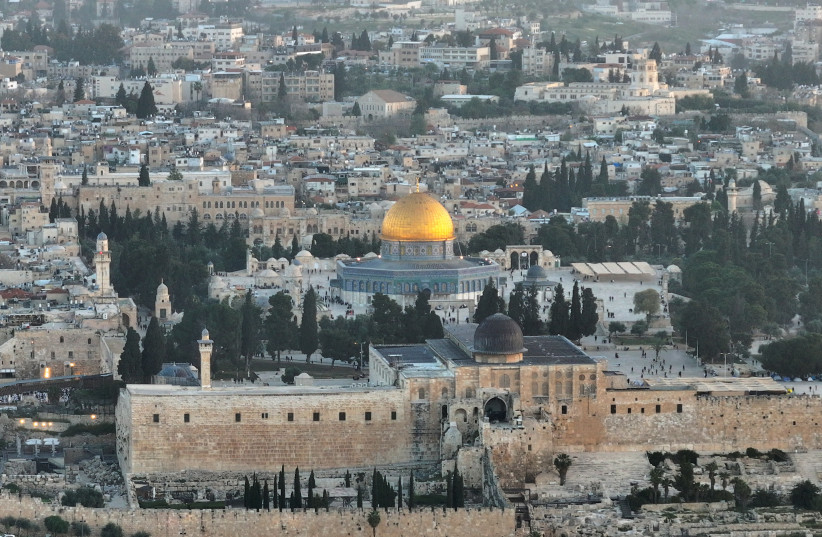
A drone view shows the Dome of the Rock on the Temple Mount, at sunrise on the last Friday of Ramadan, amid the ongoing conflict between Israel and Hamas, in Jerusalem’s Old City April 5, 2024. (credit: ILAN ROSENBERG/REUTERS)

This practice is described in Mishna tractate Shekalim (5:4), the art of the oral Jewish law compiled in the 2nd century CE. Other scholars, including Prof. Ze’ev Safrai and Dr. Avi Shweika, criticized this interpretation and suggested other meanings for the token.

The Aramaic token adds further context to the Greek-inscribed token from the Temple Mount. Notably, it depicts a wine jar, aligning with the Mishnaic text that discusses nesachim, a term for the wine libation poured on the Temple altar and also used to refer generally to all the offering components. The researchers said it is plausible that this token was intended for Greek-speaking pilgrims, possibly including Jews from the diaspora. Significantly, the Mishna confirms the presence of Greek writing in the Temple, noting in another chapter of Tractate Shekalim (3:2) that baskets in the treasury chamber were marked with Greek letters.

In research conducted for the Hebrew University Institute of Archaeology, Dr. Yoav Farhi examined several clay tokens found in Jerusalem. Among them the two mentioned above, another token from the Temple Mount Sifting Project with a poorly preserved impression and another found in 1970 during the Jewish Quarter excavations by Prof. Nachman Avigad that bore a seal impression depicting a chalice symbol that also appeared on shekel coins from the last days of the Second Temple period, typically interpreted as one of the Temple vessels. Farhi confirmed Di Segni’s reading of the Greek inscribed token from the Temple Mount and examined the composition of the clay of the tokens, with the help of Prof. Yuval Goren from Ben-Gurion University, finding similarities between the token from the Jewish Quarter and that from the Temple Mount.

Clay sealings from the Early Roman period (the last two centuries of the Second Temple period) are very rare finds in Israel, and those with a pinched reverse side are not known from any other sites. All four tokens studied by Farhi were found in the proximity of the Temple Mount, and were likely associated in some way with the activities that took place in the Temple. Their style is completely different from that of other known tokens from the Roman world.

Many questions remain unanswered regarding these tokens: Who used them? Who issued them? How were they used? What is the significance of the wine jar symbol on the Greek inscribed token? Who was Doulês? Is the last letter in this name, which was poorly preserved, really an Upsilon? Are there other possible readings of this inscription?

The Temple Mount Sifting Project launched exactly 20 years ago aims to recover archaeological artifacts from 400 truckloads of soil rich with archaeological artifacts removed from the Temple Mount and dumped in the nearby Kidron Valley. This soil had been excavated illegally by the Waqf during construction activities in the late 1990s. The project’s goal is to salvage as many artifacts as possible from the discarded soil and study them extensively to shed new light on the archaeology and history of the Temple Mount. The sifting is carried out as a tourism-education attraction, with over 250,000 people participating so far, an unprecedented phenomenon in the history of archaeological research. The project has yielded more than half a million artifacts that are kept in its storage awaiting scientific and more widely popular publication.

As a result of the war, the Temple Mount Sifting Project has been plunged into a state of uncertainty regarding its future operations. Most of the project’s major donors have redirected their resources to support issues directly connected to the war, leaving the sifting operation facing potential closure in the coming months. In the last year, the project was approved for several government grants, and one was received just a few days before the war started. Still, all other grants are now on hold due to the government reallocating all available budgets to war-related issues.


Zawartość publikowanych artykułów i materiałów nie reprezentuje poglądów ani opinii Reunion’68,
ani też webmastera Blogu Reunion’68, chyba ze jest to wyraźnie zaznaczone.
Twoje uwagi, linki, własne artykuły lub wiadomości prześlij na adres:
webmaster@reunion68.com


Graphic New Hamas Video Shows Abduction of Three Hostages Into Gaza

Graphic New Hamas Video Shows Abduction of Three Hostages Into Gaza

Debbie Weiss


Disturbing footage of Hamas terrorists abducting three Israeli hostages from the Nova music festival on Oct. 7, 2023, including Eliya Cohen (pictured). Photo: Screenshot

Disturbing footage of Hamas terrorists abducting three Israeli hostages from the Nova music festival, including dual US citizen Hersh Goldberg-Polin, was released for the first time on Monday evening.

The two-minute bodycam footage shows Hersh Goldberg-Polin, Or Levy, and Eliya Cohen bloodied but alive in the back of a pickup truck while being taken to Gaza, the Hamas-ruled enclave from which the Palestinian terrorist group launched its Oct. 7 invasion of and brutal rampage across southern Israel.

The families of the three made the decision to release the footage to highlight the “neglect” of the Israeli government in failing to secure their return 262 days after their abduction.

“Hersh, Eliya, and Or were kidnapped alive and so they have to return, today. Every day that passes endangers the abductees and may torpedo the ability to bring them home,” the Hostages and Missing Families Forum said in a statement.


WARNING: Viewer discretion advised. Some readers may find the following footage, which includes graphic content, disturbing and upsetting.


Goldberg-Polin, Cohen, and Levy were all in the same roadside bomb shelter when Hamas terrorists lobbed grenades inside.

Goldberg-Polin, who sought shelter with his friend Aner Shapira, had his arm blown off below the elbow. The video shows the 23-year-old American-Israeli clutching his arm with bone protruding out of it bound by a makeshift tourniquet.

Shapira caught seven of the grenades thrown inside the bomb shelter and managed to throw them back outside at the terrorists. The eighth grenade killed him.

Israeli Prime Minister Benjamin Netanyahu responded to the new footage, saying it “breaks all of our hearts, and once again underlines the cruelty of the enemy that we have vowed to eliminate.”

“We will not stop the war until we bring all of our 120 loved ones home,” Netanyahu said, referring to the hostages still in Gaza. Over 250 people were initially kidnapped during the Oct. 7 massacre in which 1,200 people were killed. More than 100 hostages were released as part of a temporary truce in November, and Israeli forces have rescued others, both living and deceased, as part of their ongoing operations in Gaza.

Or Levy, 33, and his wife Einav attended the music festival, arriving in the early morning shortly before terrorists overran the area. The couple took refuge in the same shelter as Goldberg-Polin and Shapira. Einav was killed and Or was taken hostage. They left an only child, Almog, who will turn three years old on Tuesday.

Eliya Cohen arrived at the festival with his girlfriend Ziv Abud, her nephew, and the nephew’s girlfriend. When the attack began, the four sought refuge in the shelter. Abud’s nephew and his girlfriend were murdered. Cohen was kidnapped from the shelter, while Ziv survived by being buried under the bodies for six hours.

On April 24, Hamas released a propaganda video showing Goldberg-Polin for the first time since his capture. The footage revealed he was missing his right lower arm.

In the undated three-minute video, Goldberg-Polin mentioned being held captive for “nearly 200 days,” suggesting a recent filming date. His mother, Rachel Goldberg-Polin, cited Israeli video experts as concluding that the footage was very recent.

Hamas murdered more than 360 people at the Nova festival and kidnapped a further 40. They also maimed and sexually assaulted both men and women at the scene.

Also on Monday evening, the Israel Defense Forces (IDF) revealed that hostage Sergeant Major Mohammed Alatrash, a tracker in the Gaza Division, was killed while battling Hamas terrorists on Oct. 7, new findings have shown. Alatrash’s body was taken into Gaza. He was survived by two wives and thirteen children, the youngest of whom was born a month before his murder.


Zawartość publikowanych artykułów i materiałów nie reprezentuje poglądów ani opinii Reunion’68,
ani też webmastera Blogu Reunion’68, chyba ze jest to wyraźnie zaznaczone.
Twoje uwagi, linki, własne artykuły lub wiadomości prześlij na adres:
webmaster@reunion68.com


Protesters block PA workers’ entry to Efrat

Protesters block PA workers’ entry to Efrat

JOSH HASTEN


“Following Oct. 7…we refuse to accept the notion that in order to build or run our town we need to hire people who support terrorism against us, or could themselves be a terror threat.”

.
A protest organized by B’yadaim Shelanu to prevent the entry of P.A. workers to Efrat in Gush Etzion, June 23, 2024. Credit: B’yadaim Shelanu.

Some 120 protesters gathered in the Gush Etzion town of Efrat on Sunday morning to prevent local building contractors from bringing Palestinian laborers into the community.

The protest, the third of its kind over the past several weeks, was organized by “B’yadaim Shelanu” (In Our Hands), an initiative launched by a dedicated group of Efrat women in December 2023. The group opposes the reinstatement of Arab workers from the Palestinian Authority in the wake of Hamas’s Oct. 7 massacre. 

According to Israeli intelligence, Arab workers from Gaza who had been allowed into southern Israeli kibbutzim aided Hamas’s attack, mapping out homes and passing detailed information to the terrorist group.

Before the war, 193,000 P.A. workers were employed throughout Israel, including 30,000 in Judea and Samaria. Today only around 8,000 P.A. workers are employed by Jewish businesses in Judea and Samaria, mainly in local industrial zones or construction sites.  

According to an Israeli security official, while communities can request that P.A. workers be brought in, residents cannot keep them out.

“If a community wants to bring in P.A. workers, they can approach their local security chief and ask him to put in a special request with the IDF regional commander who makes the decisions,” the official, who asked not to be identified, explained to JNS. However, he continued, the only way to stop them being brought in is to “block the entrance.”

In addition to the protests, B’yadaim Shelanu has been raising awareness among local residents with the slogan “Efrat is not returning to Oct. 6.” The group has also been voicing their security concerns to local municipal leaders and Knesset members.

Social media strategist and activist Malkah Fleisher, one of the movement’s founders, has lived in Efrat for around seven years.

“Following Oct. 7…we refuse to accept the notion that in order to build or run our town we need to hire people who support terrorism against us, or could themselves be a terror threat,” she told JNS.

She went on to state that “polls have shown that an overwhelming number of residents of the P.A. support the wanton rape, murder, mutilation and kidnapping of Jewish children, women and men.”

Due to this, “We came together, a group of wives and moms, to say something very simple: We will not stand for terror supporters coming into our town. We are a town that wants to be built by lovers of Israel…not by those who want us to fail and to die.”  

According to Fleisher, in the wake of the Oct. 7 massacre, P.A. workers were barred from Judea and Samaria communities for several months. However, the IDF then decided to relax this policy, starting with construction sites, she said.

“We refuse to ignore and forget the lessons of Oct. 7; We are going to stand strong and make sure that we do not accept the idea that we are dependent on a population that seeks our destruction. We demand that solutions be found that do not threaten the lives of our people just to save some money,” she said.

Business owner Stephanie Treger, who has been living in Efrat for nine years and is another of the movement’s founders, told JNS her group “will work tirelessly to prevent terror supporters from entering our streets. We will meet with every Knesset member and influencer to change the pre-Oct. 7 status quo and make sure our children are safe and our grandchildren can live peacefully.”    

She explained that Sunday’s protest succeeded because when the military grants permission for P.A. workers to enter a community, it sets a specific time for them to do so. In the case of Efrat on Sunday, that window was 6:30 a.m. to 7:30 a.m.

When the Jewish Israeli building contractor arrived and saw the protesters blocking the entrance, he decided to avoid confrontation, she said.

Lactation consultant Rachel Pearson, another B’yadaim Shelanu founder, has lived in Efrat for the past 15 years.

“After Oct. 7 we know P.A. Arabs cannot be trusted,” she told JNS. “We need to keep our children and families safe and we cannot go back to the way things were on Oct 6. We cannot bring them into our town, especially while we are at war with them. Our safety and our lives come before all else,” she added.

Efrat Mayor Dovi Shefler, who was elected this past March, has attended several of B’yadaim’s protests. He took to Facebook over the weekend to emphasize that the decision on whether or not to allow P.A. workers into Efrat was not up to him but “in the hands of the army.” 

He explained that these decisions would greatly impact “new building projects, cleanliness of the community, gardening and other community functions.”

One of the protesters, who asked not to be identified, told JNS that Shefler “is basically looking to the building contractors to come up with solutions, but won’t prevent them from bringing in P.A. Arabs as building is his top priority.”

The mayor claims that the workers will only be allowed into construction sites and not the community at large, “but this is a slippery slope and we must keep our families safe.” 


Zawartość publikowanych artykułów i materiałów nie reprezentuje poglądów ani opinii Reunion’68,
ani też webmastera Blogu Reunion’68, chyba ze jest to wyraźnie zaznaczone.
Twoje uwagi, linki, własne artykuły lub wiadomości prześlij na adres:
webmaster@reunion68.com


Israeli Hostage Naama Levy Turns 20 in Hamas Captivity

Israeli Hostage Naama Levy Turns 20 in Hamas Captivity

i24 News and Algemeiner Staff


Naama Levy – Courtesy of the family


Naama’s mother Ayelet Levy Shachar wrote a heart-wrenching letter to her daughter published in the New York Post.

“This is a letter no mother should ever have to write to her daughter. Today is your 20th birthday. You should be celebrating this occasion surrounded by friends and family. Instead, you are enduring your 260th day as a hostage in Gaza surrounded by terrorists,”

“Ever since your abduction, we have been working relentlessly and in every way possible to bring you home. Every day without you is a day without air. The uncertainty and dread I experience is suffocating, and each passing day that you are not with us feels like an eternity. We will not stop fighting for you until you are home.”


Zawartość publikowanych artykułów i materiałów nie reprezentuje poglądów ani opinii Reunion’68,
ani też webmastera Blogu Reunion’68, chyba ze jest to wyraźnie zaznaczone.
Twoje uwagi, linki, własne artykuły lub wiadomości prześlij na adres:
webmaster@reunion68.com