Archives

Plant, fruit analysis from Goliath’s biblical city sheds light on Philistine rituals

Plant, fruit analysis from Goliath’s biblical city sheds light on Philistine rituals

JUDY SIEGEL-ITZKOVICH


In the systematic excavation project of the temple area in the lower city of Gath, a team from Bar-Ilan University has overseen the reconstruction of the plants used in Philistine rituals.
.
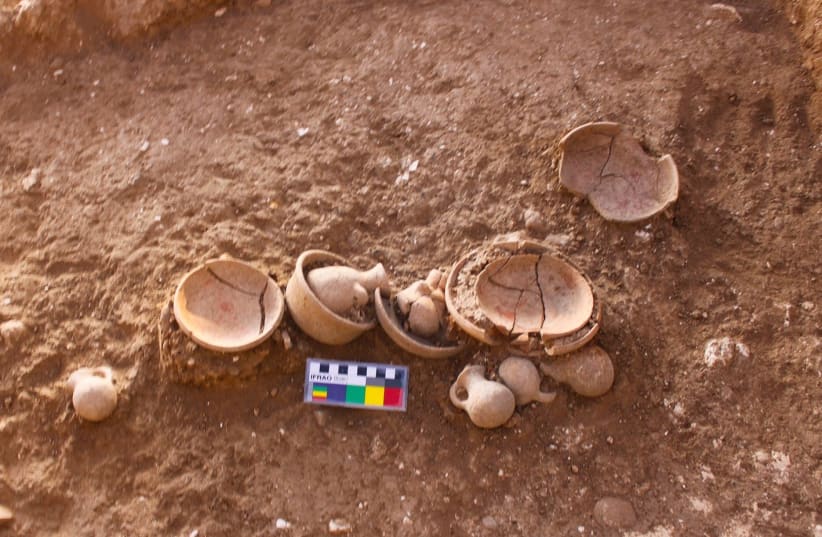
Temple offerings – miniature as well as food serving vessels, and a shell of marine mollusc, Tonna galea found in one of the temples / (photo credit: AREN MAEIR)

The mysterious culture of the Philistines that flourished during the Iron Age (1200-604 BCE) profoundly affected the southern Levant’s cultural history, agronomy, and dietary customs. More than a quarter century of excavations at Tell es-Safi/Gath in central Israel, identified as the biblical Gath of the Philistines and the home of Goliath, has provided a unique window into the world of this ancient civilization.

In the systematic excavation project of the temple area in the lower city of Gath, a team from Bar-Ilan University (BIU) in Ramat Gan – led by archaeology Prof. Aren Maeir and archaeobotany Prof. Ehud Weiss – has overseen the reconstruction of the plants used in Philistine rituals.

“Our findings challenge previous understanding of Philistine ritual practices, offering a fresh perspective on their cultural practices, and the connections between Philistine culture and broader Mediterranean religious traditions,” Weiss said.

While many aspects of Philistine culture are well-documented, the specifics of Philistine religious practices and gods have long remained shrouded in mystery. The study by Maeir, Weiss, Dr. Suembikya Frumin, Maria Eniukhina, and Amit Dagan in Nature’s prestigious Scientific Reports entitled “Plant-Related Philistine Ritual Practices at Biblical Gath” contributes valuable new data to our understanding of the Philistines’ ritual practices, the team said.
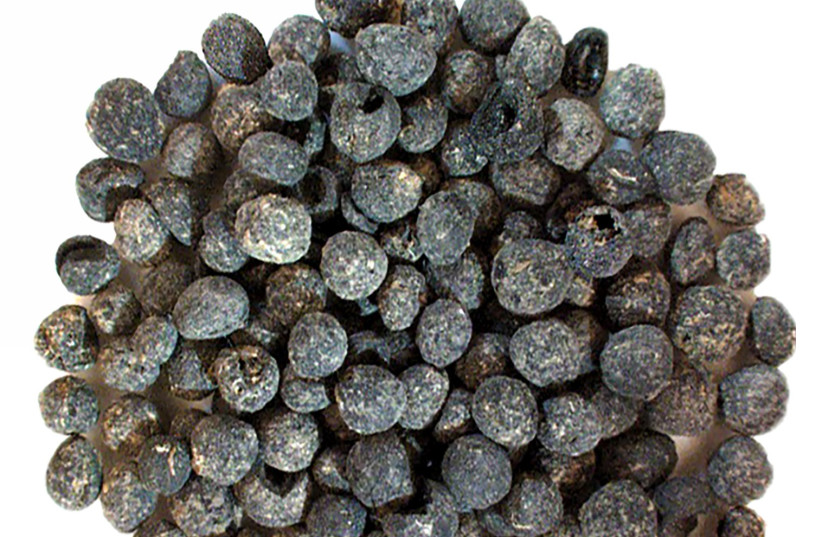
Photograph of Chaste tree fruits produced using stereoscopic light microscope (credit: Dr. Suembikya Frumin)

The discovery of numerous plants in two temples unearthed at the site unraveled unprecedented insights into Philistine cultic rituals and beliefs – the food ingredients in their temple, the timing of ceremonies, and plants for temple decoration. Freshwater, agriculture, and the cyclical birth, death, and rebirth of a plant are recognized and venerated as transformative, and even magical, in the oldest myths, such as the Gilgamesh epic, the tale of Aqhat, and the worship of deities such as Tammuz, Ishtar, and Baal, they wrote. There is evidence of cultural connections between specific cultic traditions and certain plants.

Seasons affect Philistine religious practices

The fact that the wild plants in the assemblages are widespread in the Shephelah may also show that the Philistines used any fresh plants that could be used for decoration.

Frumin, the study’s lead researcher under Weiss’s supervision, studied Philistine plant use in their temples as part of her doctoral project. The team delved into the plant assemblages discovered within the temples’ precincts, uncovering a wealth of information regarding the significance of various plant species in Philistine religious rituals. Through meticulous examination and quantitative and qualitative analysis of the types of plants used, the timing of their harvest, modes of offering, and potential symbolic significance, the researchers pieced together a clearer picture of the Philistine approach to spirituality.

FRUMIN EXPLAINED: “One of the most significant findings is the identification of earliest known ritual uses of several Mediterranean plants such as the lilac chaste tree (Vitex agnus-castus), crown daisy (Glebionis coronaria), and silvery scabious (Lomelosia argentea). These widespread Mediterranean plants connect Philistines with cultic rituals, mythology, and paraphernalia related to early Greek deities, such as Hera, Artemis, Demeter, and Asclepios. In addition, plants with psychoactive and medicinal properties in the Philistine temples reveal their use for cultic activities.

The study revealed that the Philistine religion relied on the magic and power of nature, such as running water and seasonality – aspects that influence human health and life.”

An analysis of the temples’ seeds and fruits provided valuable insights into the timing of rituals, with the importance of the early spring for temple rites, and the date of the final utilization of the temples – and their destruction by Hazael of Aram – which occurred in late summer or early fall. The seasonal aspect of Philistine religious practices underscores their deep connection to the natural world and the cycles of agriculture.

Weiss commented, “Our findings challenge previous understandings of Philistine ritual practices and offer a fresh perspective on their cultural practices, and the connections between Philistine culture and broader Mediterranean religious traditions. By examining the plants they used in ritual contexts, we better understand how the Philistines perceived and interacted with the world around them.”

In addition, the study suggests intriguing parallels between Philistine and Aegean ceremonial practices. The discovery of loom weights (an apparatus used for fabric production) within Philistine temples, a common feature in Aegean cult locations associated with Hera, further strengthens the hypothesis of cultural exchange and influence between the two regions.

“These findings open up new avenues for research into the cultural and religious interactions between the Philistines and neighboring regions,” added study co-author Maeir of BIU’s Martin (Szusz) Land of Israel studies and archaeology department, who has directed the excavations at Tell es-Safi/Gath for more than a quarter of a century. “By employing advanced quantitative and qualitative analyses of plant assemblages, we have deepened our understanding of ancient cultic practices and their significance in the broader Mediterranean world.”

“This new data indicates knowledgeable activity by temple personnel regarding the use of plants with mood-affecting features. Our method of quantitative and qualitative analysis of total plant assemblage should be highly relevant for analyzing other ancient cults and for the study of the cultural and cultic history of the region and beyond,” Frumin concluded. 


Zawartość publikowanych artykułów i materiałów nie reprezentuje poglądów ani opinii Reunion’68,
ani też webmastera Blogu Reunion’68, chyba ze jest to wyraźnie zaznaczone.
Twoje uwagi, linki, własne artykuły lub wiadomości prześlij na adres:
webmaster@reunion68.com


Swords of Iron, Israel at War – Day 150 – UPDATE 4.3.24

Swords of Iron, Israel at War – Day 150 – UPDATE 4.3.24

TV7 Israel News


Zawartość publikowanych artykułów i materiałów nie reprezentuje poglądów ani opinii Reunion’68,
ani też webmastera Blogu Reunion’68, chyba ze jest to wyraźnie zaznaczone.
Twoje uwagi, linki, własne artykuły lub wiadomości prześlij na adres:
webmaster@reunion68.com


Rare coin from the Bar Kochba Revolt discovered in Judean Desert

Rare coin from the Bar Kochba Revolt discovered in Judean Desert

JUDY SIEGEL-ITZKOVICH


Since 2017, a team of archaeologists from the IAA’s Prevention of Archaeological Theft unit has been systematically surveying the Judean Desert to reach valuable finds before the antiquity looters.

.
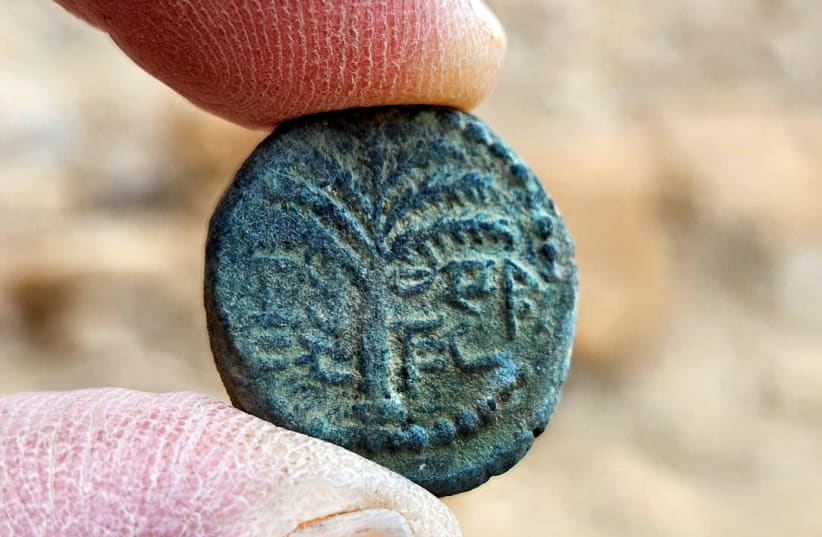
The rare coin. A date palm is engraved, with the inscription “Eleazar the Priest” inscribed in ancient Hebrew script. / (photo credit: Emil Aladjem, Israel Antiquities Authority)

The inscription “Year One of the Redemption of Israel” appears on a rare coin from the time of the Bar Kochba Revolt, bearing the name of “Eleazar the Priest” and dated to the first year of the revolt (132 CE), has been found in the course of the Judean Desert Cave Survey carried out by the Israel Antiquities Authority (IAA). 

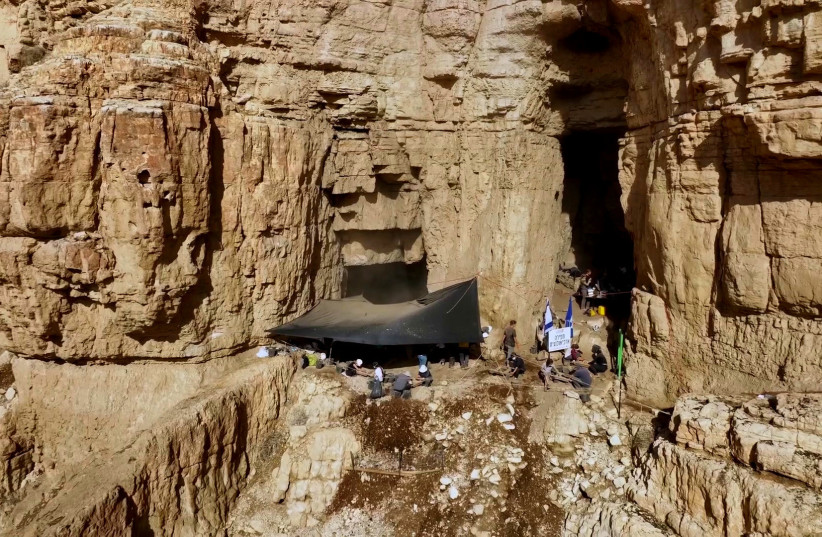
The dig at the Mazuq Ha-he’teqim Nature Reserve, whose aim is to retrieve the ancient treasures before they are stolen by antiquity looters, is being carried out in cooperation with the Ministry of Heritage and the Archaeological Office for the Military Administration of Judea and Samaria. Three additional Revolt coins bearing the name “Simeon” were also found with the rare coin.

Members of the public are invited to the excavation 

Interested public members are invited to participate in the excavation season in the desert, which will begin on March 11 and last for ten days. The volunteers will stay in a camp set up in the desert by the IAA and will be able to hear and participate in other activities. Registration and details are on the Hebrew-language site of the IAA at https://www.iaa.org.il/.

There are a few theories about the identity of Eleazar the Priest, whose name appears on the coin. One is Rabbi Eleazar Hamod‘ai, a Tannaic rabbi from the time of Rabbi Akiva, a pupil of Rabbi Yohanan ben Zakai. It seems that Rabbi Eleazar Hamod‘ai played a significant religious role at the time of the Bar Kochba Revolt, and he was living in the town of Beitar – the location of the revolt headquarters. The Talmud accounts that he died in Beitar, probably during the Revolt. (Jerusalem Talmud: Ta‘anit 4:5).

On the obverse face of the coin, a date palm is engraved with “Eleazar the Priest” inscribed in ancient Hebrew script. On the reverse, a bunch of grapes is surrounded by the text “Year One of the Redemption of Israel,” again in ancient Hebrew script.

Excavations of the Israel Antiquities Authority in the Judean Desert. The public is invited. (credit: Emil Aladjem, Israel Antiquities Authority)

“We invite the public to join us in the seventh excavation season in the desert to help save the Judean Desert archaeological finds, endangered by antiquities theft,” said IAA director Eli Escuzido. 

“They are invited for a taste of Zionism and a touch of ‘escapism,’ volunteering on a dig, together with the IAA archaeological team in the Murabba‘at Caves along Nahal Darga. The Judean Desert excavations do not cease to amaze us, and we hope that in this season, we will also be able to report important finds.”


Zawartość publikowanych artykułów i materiałów nie reprezentuje poglądów ani opinii Reunion’68,
ani też webmastera Blogu Reunion’68, chyba ze jest to wyraźnie zaznaczone.
Twoje uwagi, linki, własne artykuły lub wiadomości prześlij na adres:
webmaster@reunion68.com


Rothman to ‘Post’: Israel has veto power over Palestinian state, it’s a matter of life and death

Rothman to ‘Post’: Israel has veto power over Palestinian state, it’s a matter of life and death

SIMCHA ROTHMAN


The state the Palestinian spokespersons are gunning for is also smack in the middle of the land-starved Jewish people’s tiny, zero-strategic-depth homeland.
.

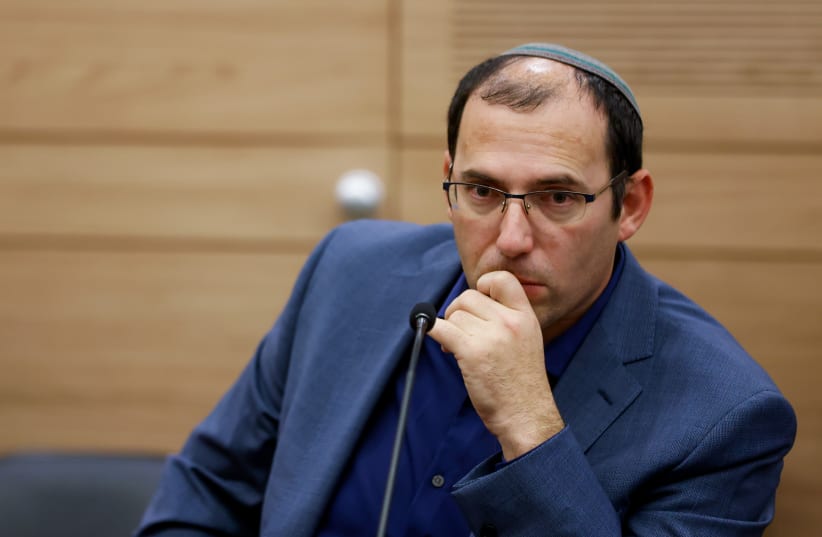
MK Simcha Rothman at a special committee meeting on the “Deri Law”, at the Knesset, the Israeli Knesset in Jerusalem, on December 15, 2022. / (photo credit: OLIVIER FITOUSSI/FLASH90)

Responding to “Israel has no veto power over Palestinian statehood, PA tells ICJ,” Palestinian Arab spokespersons excel in generating rhetoric that always sounds plausible and always presents them as the most deserving of persons, as opposed to Jews who, it seems, barely deserve their own lives.

But this rhetoric is non-factual. In this case, for example, of course, Israel must have, and does have, “veto power” over Palestinian statehood. That’s because preventing that calamity is a matter of life and death for Israel.

That’s also because the state the Palestinian spokespersons are gunning for is smack in the middle of the land-starved Jewish people’s tiny, zero-strategic-depth homeland – which is no accident. Let’s understand:

Irrevocable international commitments have been made to the ancient Jewish people for the western Land of Israel – even in the United Nations’ own Charter (Article 80), which obligates everybody. So Israel does have “veto power” over establishing a Palestinian state in the western part of The Land of Israel, for the same reason that any home-owner in the world has “veto power” over her or his own living room.

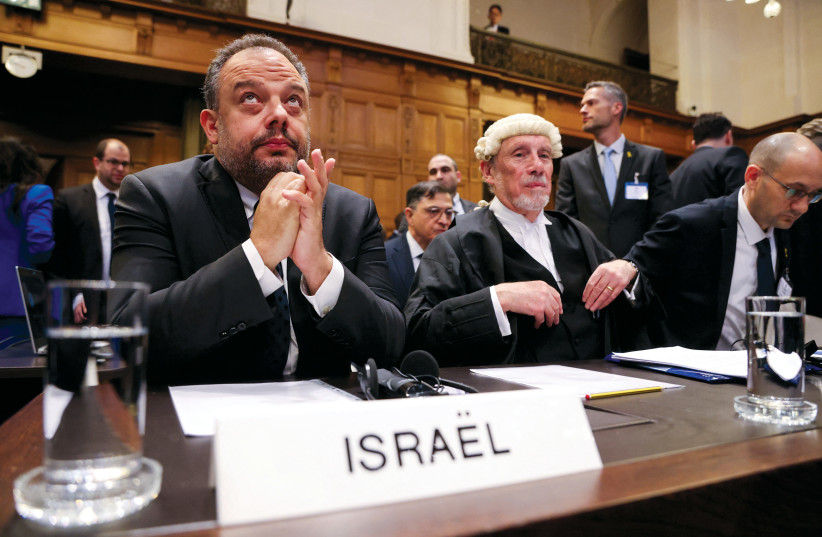
Israeli Foreign Ministry legal adviser Tal Becker and British jurist Malcom Shaw sit in the International Court of Justice on January 12, 2024. (credit: THILO SCHMUELGEN)

If this sounds unfair, recall that Israel doesn’t have “veto power” over any of the over 20 spacious Arab states that serve the ancient Arab nation (“Umma”). To this nation, all Palestinian Arabs belong; they share this ancient nation’s language, national dress, religion and origin. All this makes the Arab nation, to which all Palestinians belong, one of the most generously endowed nations, territorially, in the world. 

I also thank Dr. Alan Baker for his recent contribution, aptly entitled “The latest legal misconception: The call for unilateral recognition of a Palestinian state.”  Dr. Baker delicately raises the possibility that politicians abroad may not understand what they are talking about.  Indeed, many political figures abroad are unaware of the following three key considerations for Jews. First,  there is no way back from statehood; divorce is the well-known procedure for dismantling a bad marriage, but there is no procedure for dismantling a bad (hostile or fail) state. Second, a “state” (as opposed to an “authority” like the Palestinian “Authority”) is entitled to arm itself as much as it pleases, eventually becoming a behemoth that is militarily impossible for an overshadowed small country like Israel to defeat.

Third, and most important, there is no such thing as a “demilitarized state”. That is a pure contradiction in terms – like a “chilly heat wave.” It is also not true that there are various “types” of states, some of which are not risky for Israel. Why?  Let us say that a state is established whose Constitution includes an Article assuring de-militarization. This sounds wonderful, but there’s a “small” catch: a state is entitled to change its constitution! What happens if (and when) the “Palestinian state” abolishes this de-militarization article and heavily arms itself? The answer is an existential catastrophe for Israel, the state next door.

Judea and Samaria belong to the Jewish people, irrevocably, by international law, which many like to ignore. The same is true of Gaza. If these are officially taken over by Iran, which is what would happen the morning after a “Palestinian” state were established, this would be an absolute disaster for the Jewish people.

The leadership of the Jewish people is entitled, indeed obligated, to prevent this from happening at a distance of a few meters from our capital, Jerusalem, and Road 6 (Israel’s main artery), and if we prevent it, we will. All well-meaning leaders and journalists are invited to support our efforts to do the right thing publicly.  The message of the Israeli Right and Center has always been, and will always be, that incessant “two-state” rhetoric does not promote co-existence – it promotes danger and war. Israel’s hand is ever extended in peace. True peace, peace-for-peace.

Some 99 Knesset members just voted that a “Palestinian state” will be a “prize for terror.”

Our friends should respect our right to exist as a Jewish state. Our friends must respect our independence and our democracy.

Recognizing a “Palestinian State” in the land of Israel will ignore our democratic process and will bring the destruction of the one and only Jewish State.  


Simcha Rothman is an Israeli MK and Chair of Israel’s Constitution, Law and Justice Committee 


Zawartość publikowanych artykułów i materiałów nie reprezentuje poglądów ani opinii Reunion’68,
ani też webmastera Blogu Reunion’68, chyba ze jest to wyraźnie zaznaczone.
Twoje uwagi, linki, własne artykuły lub wiadomości prześlij na adres:
webmaster@reunion68.com


Swords of Iron, Israel at War – Day 144 – UPDATE 27.02.24

TV7 Israel News – Swords of Iron, Israel at War – Day 144 – UPDATE 27.02.24

TV7 Israel News


Zawartość publikowanych artykułów i materiałów nie reprezentuje poglądów ani opinii Reunion’68,
ani też webmastera Blogu Reunion’68, chyba ze jest to wyraźnie zaznaczone.
Twoje uwagi, linki, własne artykuły lub wiadomości prześlij na adres:
webmaster@reunion68.com