Archive | December 2017

PRZYKRE. “MIDRASZ” ZAWIÓDŁ TAK, ŻE BARDZIEJ NIE MOŻNA

PRZYKRE. “MIDRASZ” ZAWIÓDŁ TAK, ŻE BARDZIEJ NIE MOŻNA

Paweł Jędrzejewski


 Jaka jest najważniejsza księga w kulturze, religii i historii Żydów?

Oczywiście jest to Tora, czyli – używając nomenklatury przyjętej w tradycji polskiej –Pięcioksiąg Mojżeszowy. Jedna z podstaw zachodniej kultury. I cywilizacji.

Jednak Tora to znacznie więcej, niż jej w miarę dosłowne tłumaczenia na języki narodowe, a więc – w tradycji chrześcijańskiej – tzw. Stary Testament.

Tory są DWIE: Tora Pisana (Tora Szebichtaw) i Tora Ustna (Tora Szebealpe). Istnieje specjalny sposób tłumaczenia i zarazem WY-tłumaczenia Tory z języka hebrajskiego. Jest to metoda targumu, która umożliwia odczytanie tekstu świętej księgi poprzez tradycję Talmudu. Ta metoda splata Torę Pisaną z Torą Ustną, tworząc jedność.

Takie połączenie było przez tysiące lat i jest podstawą żydowskiej świadomości i tożsamości.

I tylko takie tłumaczenie Tory z języka hebrajskiego na inny język (np. na język polski) może być nazwane “tłumaczeniem żydowskim”.

Pierwszy przekład Tory na język polski dokonany metodą targumu to monumentalne dzieło (ponad 2360 stron) ortodoksyjnego rabina Sachy Pecarica, opublikowane w pięciu tomach w latach 2001-2006 przez krakowskie Stowarzyszenie Pardes.

Rabin Sacha Pecaric to postać niezwykła.

Ktoś mógłby śmiało powiedzieć o nim: “człowiek skierowany przez Niebiosa do Polski” dla dobra społeczności żydowskiej i nie tylko. Autor, filozof, tłumacz, który specjalnie NAUCZYŁ SIĘ polskiego, aby przetłumaczyć Torę na polski.

Można z powodzeniem argumentować, że rabin Pecaric w wydawnictwie Stowarzyszenie Pardes dokonał więcej dla przywracania tożsamości religijnej Żydom w Polsce – przez kilkanaście lat działalności translatorskiej i wydawniczej (ponad 30bardzo ważnych pozycji książkowych!) – niż wszystkie żydowskie wydawnictwa i instytucje działające po Zagładzie razem wzięte.

Ale to osobna historia.

Przed prawie siedmiu laty przeprowadziłem z rabinem Pecaricem serię rozmów, które ukazały się w książce “Czy Torę można czytać po polsku?“. Moja rola była minimalna: zadawałem dość oczywiste pytania. Rola rabina była – w kontraście – ogromna. Na 180 stronach ksiażki zalazł się opis unikalnych doświadczeń autora tego niezwykłego, monumentalnego przekładu.

To, co mówi o tłumaczeniu Tory rabin Pecaric, jest czymś wyjątkowym: tylko on jeden ma takie doświadczenie, bo tylko on zdecydował się podjąć wielkie dzieło tłumaczenia Tory i doprowadził swój zamiar do końca.

Suma jego wiedzy, opis translatorskich problemów i trudności, sposoby pokonywania tych trudności, zagadnienia samej filozofii tłumaczenia ze świętego języka (leszon hakodesz) na inne języki i wreszcie umieszczenie przekładu polskiego w szerszej tradycji przekładów Tory, to tylko część zagadnień poruszonych przez rabina Pecarica w tej książce.

Książka ukazała się w styczniu roku 2011.

I co? 
I nic.

Jak zareagowały na tę publikację instytucje zajmujące się ze swojego POWOŁANIAtematyką żydowskiej tożsamości, świadomości, religii, tradycji, kultury, historii?

Martwa cisza. Milczenie.

Jedyną recenzję książki, która udało mi się odszukać, napisał – zaskakujące! – katolicki publicysta Tomasz Terlikowski.

Mam wielki, ogromny żal przede wszystkim do redakcji “Midrasza” i do jego redaktora naczelnego – Piotra Pazińskiego.

Dlaczego akurat do “Midrasza” i jego naczelnego?

Dlatego, że “Midrasz” to najbardziej ambitne i intelektualnie poważne pismo.

Jest absolutnym skandalem pominięcie – zarówno w momencie wydania jak i przez następne długie SIEDEM LAT – całkowitym milczeniem tak ważnej publikacji. Podobnie zresztą jak pozostałych dzieł wydanych przez wydawnictwo Stowarzyszenie Pardes, wśród których znalazły się pozycje przede wszystkim  klasyczne – wielkie i ważne, w tym np. pierwsze w historii wydanie obszernych fragmentów Talmudu w tłumaczeniu na polski. Kolejna rzecz bezprecedensowa!

“Midrasz” zawiódł.

Zawiódł tak, że bardziej nie można.

Instytucja i pismo, na którego stronie internetowej czytamy, że to “żydowske czasopismo społeczno-kulturalne, skierowane do wszystkich osób zainteresowanych życiem Żydów w Polsce i na świecie. Znajdziecie tu Państwo rzetelne informacje, szerokie spektrum opinii, kompetentne recenzje, ciekawe wywiady (…)” zlekceważyłozjawisko całkiem wyjątkowe i niezwykle ważne w życiu żydowskim ostatnich 20 lat.Zlekceważyło w sposób zasługujący na najostrzejsze potępienie.

Przez prawie 20 lat “Midrasz” nie znalazł na swoich łamach miejsca ani dla recenzji, ani dyskusji, ani polemiki, ani nawet rzetelnego odnotowania kolejno wydawanych książek, w tym tak istotnego podsumowania doświadczeń całkiem wyjątkowych: książki-rozmowy z jedynym żyjącym człowiekiem, który dokonał żydowskiego przekładu Tory na język polski.
 
Milczałem cierpliwie przez długie, “biblijne” siedem lat. Liczyłem na opamiętanie.

Nie doczekałem się.

Powtórzę więc jeszcze raz: skandal!


27 grudnia 2017


twoje uwagi, linki, wlasne artykuly, lub wiadomosci przeslij do: webmaster@reunion68.com



SYRIAN REGIME CLOSES IN ON VILLAGE NEAR ISRAELI GOLAN

REPORT: SYRIAN REGIME CLOSES IN ON VILLAGE NEAR ISRAELI GOLAN

SETH J. FRANTZMAN


Beit Jinn has been held by Syrian rebels for the last several years, surrounded on three sides by the Syrian regime and its allies.

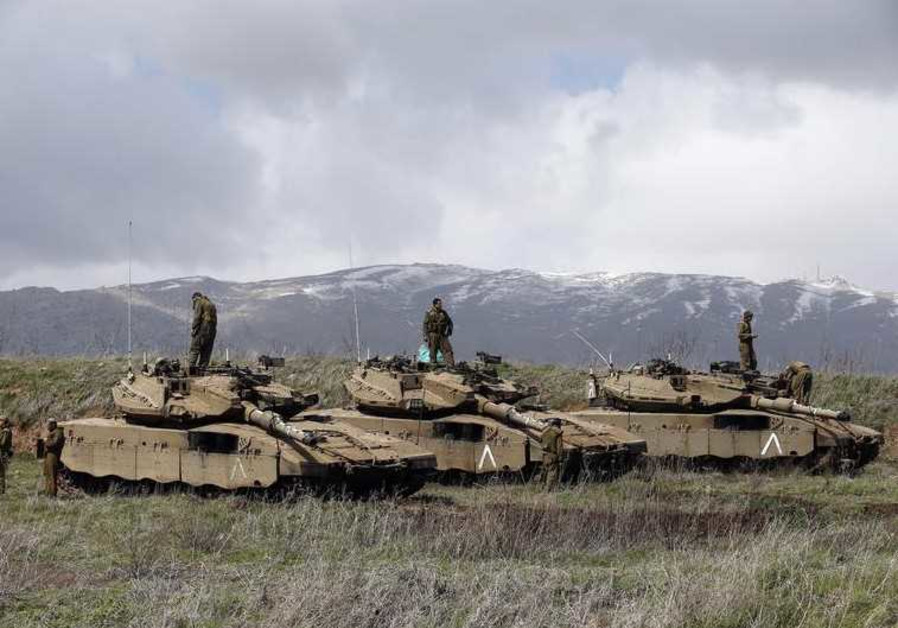
Israeli soldiers stand atop tanks in the Golan Heights near Israel’s border with Syria. (photo credit: REUTERS)

On Monday Syrian regime forces and their allies began to close in on a village near Mount Hermon across from Israeli positions on the Golan Heights. Beit Jinn has been held by Syrian rebels for the last several years, surrounded on three sides by the Syrian regime and its allies, including Hezbollah. The Beit Jinn pocket stretches east from Mount Hermon toward Damascus. Syrian rebels have held Beit Jinn, the nearby Beit Jinn farms, Mugh al-Mir, Bayt Sabir and two other villages for several years. On December 21 the Syrian regime quietly moved into three of the villages, leaving the village of Beit Jinn isolated.

In early November fighting near Beit Jinn between rebels and the Syrian regime in the village of Khadr led to concerns that Israel would intervene to protect the Druze across the border.

Although Israel has enjoyed amicable relations with the Syrian rebels on the Golan it has also said it would not let them conquer the Druse village to link up with Beit Jinn because Golan Druze sympathize with their coreligionists across the border. In November residents of Beit Jinn reported that the Syrian regime had dropped chlorine barrel bombs on their positions injuring people.

On Christmas eve, Al-Mayadeen News, which is pro-Damascus, claimed that the Syrian army had taken some ground near the Beit Jinn farms. Al-Manar, which is close to Hezbollah, also reported similar accounts on December 25th. Wiam Wahhab, a former Lebanese Minister of the Environment, tweeted congratulations to the Syrian army and “sons of the Hermon” for the “collapse of the terrorists in Beit Jinn.” He said that the areas around Beit Jinn had “raised the white flag.”

The Beit Jinn pocket stretches east from Mount Hermon toward Damascus. Syrian rebels have held Beit Jinn, the nearby Beit Jinn farms, Mugh al-Mir, Bayt Sabir and two other villages for several years. On December 21 the Syrian regime quietly moved into three of the villages, leaving the village of Beit Jinn isolated.

In early November fighting near Beit Jinn between rebels and the Syrian regime in the village of Khadr led to concerns that Israel would intervene to protect the Druze across the border.

Although Israel has enjoyed amicable relations with the Syrian rebels on the Golan it has also said it would not let them conquer the Druse village to link up with Beit Jinn because Golan Druze sympathize with their coreligionists across the border. In November residents of Beit Jinn reported that the Syrian regime had dropped chlorine barrel bombs on their positions injuring people.

On Christmas eve, Al-Mayadeen News, which is pro-Damascus, claimed that the Syrian army had taken some ground near the Beit Jinn farms. Al-Manar, which is close to Hezbollah, also reported similar accounts on December 25th. Wiam Wahhab, a former Lebanese Minister of the Environment, tweeted congratulations to the Syrian army and “sons of the Hermon” for the “collapse of the terrorists in Beit Jinn.” He said that the areas around Beit Jinn had “raised the white flag.”

Other accounts celebrated the “defeat of the terrorists after five years of fighting,” and claimed the Syrian rebels in Beit Jinn had received “protection from the Zionists.”

Another Arabic website, muraselon.com, claimed that the Syrian rebels in the pocket, including members of Hayat Tahrir al-Sham, which was formerly Al-Qaeda in Syria, will either be “reconciled” with the regime forces or be bused out to Dar’ar or Idlib province. This is how Damascus has sought to put down the rebellion in recent years, instead of fighting for every village it has a “reconciliation agreement” where the village agrees to come back under the control of the government. Those rebels who do not put down their arms have agreed to be bused to enclaves still in their control.

This happened when Aleppo fell in December 2016 and thousands were bused out to Idlib. According to reports from the area the regime has been trying for four months to take back Beit Jinn and has not succeeded yet.

In July the US, Russia and Jordan signed a ceasefire that included the areas in southwest Syria near Jordan and the Golan. Since then the border area has been relatively quiet. However the Beit Jinn pocket does not appear to have been included in the ceasefire.

The Syrian regime declared victory over ISIS in November and Russia did the same in December and began drawing down its troops in Syria which have support Bashar al-Assad’s government. Now the Syrian regime wants to slowly take back the remaining rebel enclaves after six years of war.

For Israel this presents a challenge because Jerusalem has warned it will not allow an Iranian presence in Syria and has carried out airstrikes to prevent weapons transfers to Hezbollah via Syria. Any Syrian government attack on villages near the Golan raises fears that Hezbollah or Iranian agents could exploit the changes on the ground.


twoje uwagi, linki, wlasne artykuly, lub wiadomosci przeslij do: webmaster@reunion68.com


Co izraelscy żołnierze robią palestyńskim dzieciom

Co izraelscy żołnierze robią palestyńskim dzieciom

   Malgorzata Koraszewska


Każdego tygodnia są jakieś palestyńskie demonstracje. Widzimy w nich głównie ludzi młodych, często dzieci. Te dzieci są często pod opieką rodziców, a zawsze pod czułym okiem kamer i aparatów fotograficznych. Blond dziewczynka nazywa się Ahed Tamimi i jest Palestynką, nagrodzoną za “odwagę” przez Mahmouda Abbasa i prezydenta Turcji Recepa Tayyipa Erdogana. Jest również kuzynką Ahlam Tamimi, morderczyni 8 dzieci i 7 dorosłych.
(Jeśli chcesz wiedzieć więcej, przeczytaj książkę Andrzeja Koraszewskiego “Wszystkie winy Izraela”, jest dostępna w wielu księgarniach internetowych.)


twoje uwagi, linki, wlasne artykuly, lub wiadomosci przeslij do: webmaster@reunion68.com



Rabin Samuel Rosenberg o chasydach, przemianach i Lag ba-Omer w Meron

Rabin Samuel Rosenberg o chasydach, przemianach i Lag ba-Omer w Meron

MICHAŁ BOJANOWSKI


CHIDUSZ-LAG-BA-OMER-MEROR-CHASIDIM-CHASYDZI

MICHAŁ BOJANOWSKI: DLACZEGO PRZESTAŁ RABIN BYĆ CHASYDEM?

Samuel Rosenberg: To nie tak, że przestałem być chasydem, takie stwierdzenie nie byłoby prawdą. Opuściłem wspólnotę (oraz jesziwę), do której należałem oraz praktykę życia chasydzkiego, jednakże nadal czuję się chasydem, wiele pięknych elementów życia chasydzkiego pozostało i pozostanie we mnie na zawsze.

NA PRZYKŁAD?

To, że kawana (hebr. intencja) jest najważniejsza, że bez odpowiednich intencji praktyka życia żydowskiego traci swoją wartość. Żeby nie oceniać ludzi po wyglądzie – ktoś o wyglądzie mordercy w rzeczywistości może być jego przeciwieństwem. I żeby kochać każdego Żyda (ahawat Israel). To są ogólnie istotne wartości w judaizmie, ale chasydyzm uczynił je bardzo ważnymi.

A jednak nie czułem, że życie we wspólnocie chasydzkiej jest miejscem, w którym mogę być tak blisko Boga, jak bym chciał. Zrozumiałem w pewnym momencie, że to nie jest droga, którą chcę wielbić Boga, to nie było awodat Haszem szeli.

ALE TO NIE BYŁA NAGŁA DECYZJA?

Nie rozmyślałem latami o odejściu. Jednak gdy byłem młodzieńcem, już zaczynałem powątpiewać, czy to aby na pewno droga dla mnie.

ILE OSÓB W IZRAELU OPUSZCZA NAJBARDZIEJ ORTODOKSYJNE NURTY W JUDAIZMIE?

Niewiele.

DLACZEGO?

Wydaje mi się, że jest taka zasada w życiu ludzi, że większość z nas żyje takim życiem, w jakim się wychowało. Edukacja, młodość, przykład rodziców i znajomych – to wszystko sprawia, że bardzo rzadko porzucamy ten wyuczony, przejęty niejako z mlekiem matki wzór życia. To nawet mocniej działa w przypadku środowisk ultraortodoksyjnych w Izraelu, gdyż nikt tam publicznie nie poddaje w wątpliwość słuszności obranej drogi. Dlaczego mieliby więc opuszczać swój dom, swoją wspólnotę? Mało kto jest zdolny do radykalnych zmian, mało kto ich tak naprawdę chce.

JAKA BYŁA REAKCJA MAMY?

Jak każdy rodzic byłaby szczęśliwa, gdybym wyznawał wiarę w Boga w ten sam sposób, w jaki ona to robi. Ale jest szczęśliwa, widząc, że i ja jestem szczęśliwy w moim – religijnym przecież – życiu. Nadal studiuję Talmud, co prawda na uniwersytecie a nie w jesziwie, ale mama widzi, że jest to dobre dla mnie.

JAK WYGLĄDAŁO RABINA ŻYCIE W WIEKU 20 LAT?

Byłem w jesziwie. Chasyd studiuje w jesziwie aż do wzięcia ślubu. Potem albo kontynuujesz naukę albo zaczynasz pracę. Dni studentów jesziwy wyglądają dość monotonnie. Wstajesz rano i idziesz do mykwy, co jest bardzo typową chasydzką praktyką. Po obmyciu rytualnym jest czas na studiowanie, modlitwę poranną, śniadanie i powrót do studiowania Talmudu. Większość dnia spędzasz nad studiami. Oczywiście są przerwy. Obiad, kolacja. Wieczorna modlitwa i znowu studiowanie. Dzień kończy się o 22. Jesteś już dość zmęczony, więc idziesz spać.

I ZAWSZE W TAKIM TRYBIE?

Tak. Na szabat i pozostałe święta możesz wrócić do domu. Jednak tygodnie w jesziwie wyglądają właśnie w ten sposób.

A JAKIŚ SPORT? GRY ZESPOŁOWE?

W jesziwie nie ma miejsca na sport, ani gry i zabawy. Jednakże spotykaliśmy się na wspólnym śpiewaniu, czy tańczeniu.

A KONTAKT Z ZEWNĘTRZNYM ŚWIATEM?

Moja jesziwa była w Bnej Brak. To dość religijne miasto. Więcej tam fast foodów niż restauracji. Podobnie jak w niektórych dzielnicach Jerozolimy, również tam należy być ubranym skromnie. Na co dzień studenci jesziwy nie mają kontaktu z rówieśnikami z niereligijnych szkół. Nie widać tam nastolatków palących papierosy czy całujących się w bramach budynków. W mieście są tylko religijne szkoły.

WIĘC NAGŁA ZMIANA MUSI BYĆ SZOKIEM?

Dla innych osób pewnie tak, ale musisz pamiętać, że ja przecież pochodzę z samego centrum Tel Awiwu i tam właśnie wracałem chociażby na szabaty, więc nie byłem tak odcięty od nieortodoksyjnego świata, jakby to się mogło wydawać. Po opuszczeniu jesziwy wróciłem więc do Tel Awiwu, do rodzinnego domu. Zacząłem przygotowania do matury i pracowałem.

CZYLI JEDNAK NIE BYŁO ZASKOCZENIA?

Nie, w ogóle. Uczyłem się w prywatnej szkole, gdzie nie panowała atmosfera ogólniaka, a raczej są ludzie poważnie skoncentrowani na przygotowaniach do egzaminów. Nie znajomości, pierwsze miłości, czy wspólne spędzanie czasu – a jedynie nauka. Było to momentami trudne, bo abstrakcyjne rozważania nad Talmudem musiałem nagle przenieść na grunt wyuczenia się konkretnych zagadnień do egzaminów.

I NIE CZUŁ SIĘ RABIN SAMOTNY PO OPUSZCZENIU JESZIWY?

Nie miałem żadnych bliskich przyjaciół, jedynie kilku starych znajomych z sąsiedztwa. Ale szybko to nadrobiłem.

ROZUMIEM, ŻE TRADYCYJNYCH CHASYDZKICH NAKRYĆ GŁOWY RABIN NIE NOSIŁ, ALE PŁASZCZ – CHYBA TAK?

Tak. Owe nakrycia głowy noszą mężczyźni po ślubie, płaszcze zaś chłopcy po bar micwie.

PEWNIE W TAKIM PŁASZCZU MUSIAŁO BYĆ DOŚĆ GORĄCO?

Wszyscy noszą takie same płaszcze, więc to nie jest pytanie. Z zewnątrz wydawać się może, że gotujemy się w nich, jednakże gdy absolutnie wszyscy noszą takie same okrycia, nie jest to poddawane pod dyskusję. Zakładasz i nie zadajesz pytań, bo zakładają je wszyscy. Da się przyzwyczaić.

ŚWIĘTOWALIŚCIE LAG BA-OMER W JESZIWIE?

To bardzo radosne święto na pamiątkę końca zarazy, która panowała pośród studentów rabiego Akiwy. To również dzień, w którym umarł Raszbi (Szymon Bar Johaj), przez tradycję uznany za twórcę Zoharu. Podobno zanim umarł, miał mieć wyjaśnionych wiele sekretów Tory. Przekazał je swoim uczniom. Dlatego też głównie to chasydzi przyjeżdżają do Meron, gdyż nurt ten jest częścią mistycyzmu żydowskiego. A oprócz chasydów wiele osób głęboko zaangażowanych w studia nad kabałą.

Moja jesziwa w ten dzień organizowała wyjazd autobusem do Meron. Podczas drogi studiowaliśmy Talmud oraz śpiewaliśmy piosenki i niguny na specjalne, używane w Meron, melodie.

JAK WYGLĄDAŁA CELEBRACJA W MERON?

Jedną z tradycji w Lag ba-Omer jest rozpalanie ognisk. Na dachu grobowca, w którym pochowany jest Raszbi, specjalnie wybrany do tego chasydzki rabin rozpala największe w mieście ognisko. Chasydzi modlą się, tańczą i śpiewają bądź to klezmerskie piosenki, bądź niguny z Meron. Ale jest jeszcze jeden ciekawy element celebracji Lag ba-Omer w Meron.

W tradycji chasydzkiej nie ścina się włosów chłopcom do trzeciego roku życia. Właśnie w Meron w święto Lag ba-Omer odbywa się chalake – ścinanie włosów młodym chłopcom oraz pozostawianie im tradycyjnych pejsów. Również i ja, gdy byłem dzieckiem, miałem ścięte tam włosy. Do tej pory zachowałem kopertę, w której są schowane.

W Meron jest wtedy bardzo wiele osób – w tym wieku szanowanych rabinów i cadyków, dlatego zwyczajem jest, że podchodzi się do nich i prosi, aby odcięli nożycami trochę włosów z głowy dziecka. Nie jest to w żaden sposób zorganizowane, widzisz cadyka albo rabina i podchodzisz do niego z prośbą o ścięcie włosów.

MINĘŁY CZASY, ŻE DZIECI W CHEDERZE RAZ W ROKU TYLKO MOGŁY ODERWAĆ SIĘ OD STUDIOWANIA TORY I PÓJŚĆ ZA MIASTO NA BITWĘ?

We współczesnym Izraelu w większości ortodoksyjnych chederów dzieci mają na co dzień możliwość oderwania się od nauki. Bawią się razem, uprawiają sporty. Właściwie cheder to tak, jak szkoła podstawowa.

CZYLI W DZIECIŃSTWIE RABIN NIE ODRYWAŁ SIĘ RAZ W ROKU NA ZABAWĘ W LAG BA-OMER?

Nie. Ale pamiętam potężne ogniska, budowane przez dorosłych poza miastem. To właściwie były całe misternie zaplanowane wielkie konstrukcje. Pamiętam, że używaliśmy łuków, którymi celowaliśmy w te właśnie ogniska.

ALE NIE BYŁA TO JEDYNA AKTYWNOŚĆ FIZYCZNA W CIĄGU ROKU?

Zdecydowanie nie. Na pewno znajdziesz takie chedery w Izraelu, ale większość religijnych chederów zapewnia dzieciom nie tylko naukę angielskiego i matematyki, ale również różnorodne aktywności fizyczne.


twoje uwagi, linki, wlasne artykuly, lub wiadomosci przeslij do: webmaster@reunion68.com


Who Are The Jews Celebrating Christmas… in Israel?

Who Are The Jews Celebrating Christmas… in Israel?

Eetta Prince-Gibson


Shira Greenblatt, a secular Israeli Jew who was born and raised in Jerusalem, loves Christmas. “Every year I attend Christmas services at the Dormition Abbey on Mt. Zion in Jerusalem, and I will go again this year, too. It’s very special to learn about Christianity here, in Jerusalem. And I love the lights, the songs, and the majesty,” she enthused.

Greenblatt, 42, a secretary, is one of the thousands of Israeli Jews who attend Christmas festivities and religious services throughout the country. Christmas in Israel has become so popular that even Go Tel Aviv, a hip city guide, is offering an edition of The Five Top Places to Celebrate the Holiday Season in the Holy Land. “There is nothing like a beautiful Christmas tree to get into the atmosphere of the holiday season,” the guide advises, citing some of Israel’s best-lit trees and most inspiring masses.

In towns with a Christian majority, mostly located in northern Israel, Christmas is a public holiday. The Jewish National Fund provides Christmas trees for NIS 80 (about $23.00), and the Jerusalem municipality provides lighted decorations, “in areas where the holiday is observed,” according to a municipal announcement, referring to non-Jewish neighborhoods.

But for most Jewish and Muslim Israelis, Christmas is just another workday, with no religious, social or commercial impact. That suits some people just fine. “As an observant Jew who grew up in New York City, I am delighted that I don’t feel Christmas here,” said Benjie Cohen, 43, a businessman who lives in a religious neighborhood in Jerusalem. “Christmas shouldn’t be observed in the Jewish state.”

But many Israelis do not agree. “My grandparents, who came from Poland, are upset that I go to the Christmas service at the Dormition Abbey every year. They have terrible memories about Christmas,” said Matti Koller, 31, a Hebrew University student. “I don’t have any of those hang-ups. Judaism has its own simple beauty, but I love knowing about other religions, too.”

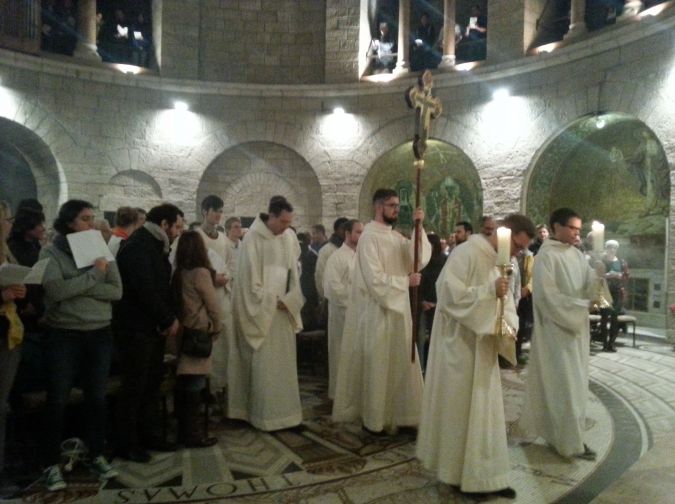
The Dormition Abbey holds a service in German (the Benedictine vernacular) earlier in the evening for its own parishioners, and invites the Jewish visitors for a midnight service held mostly in English, with some Hebrew.

“I probably have the distinction of being the only priest in the world who delivers a Christmas sermon to a mostly-Jewish audience,” said Father Nikodemus, a Benedictine monk at the Dormition Abbey, who’s in charge of the Christmas service. He estimates that about 1,000 Jews attend.

A Window On Mt. Zion / Monks filing into the service at the Dormition Abbey in the Christmas procession in the mostly-Jewish Israeli congregation.

In fact, there are so many visitors, that the “Window on Mount Zion” project, part of the non-profit Jerusalem Intercultural Center, enlists and trains dozens of Jewish volunteers to act as ushers at the service.He believes for many of the Jewish visitors, the hymn-singing is the height of the service. “They especially love to hear ‘Silent Night,’ sung in German,” he says. “I actually think it’s a bit kitschy – but if they like it, then we can sing it.”

Nikodemus is aware that Jesus can be difficult for Jews. “Christianity was not kind to the Jews. So every year, I say the same thing: I have no intention to missionize. I merely want to share our joy at the birth of Jesus. I know that most of the people in my church do not believe that Jesus is the son of God and the Messiah. But at least we can all agree with something Jesus said: ‘Love God and your neighbor as yourself.’”
After the service, at about 1 am, the monks invite the participants to a reception in the Abbey, with traditional Christmas cookies and candies.

“I am thankful to the Benedictines for inviting us,” Greenblatt said. “It’s terrible that because we are the majority, we ignore Christmas, which is so important to Christians here and throughout the world. The only thing we know about Christmas is from TV and movies. I want to learn first-hand.”

A few other Jerusalem churches open their doors to Jewish visitors on Christmas Eve, although many have limited their numbers, because “there were so many Jewish visitors that there wasn’t enough room for the members of our own congregations,” said a Protestant church official who asked not to be identified because “he didn’t want to offend the Jews who show an interest in Christianity. But there were just so many of them!”

The YMCA in West Jerusalem sponsors an annual Christmas Eve concert and a Christmas Bazaar, each of which is attended by hundreds of people, and its brightly lit tree is also a big attraction. “I bring my children here to see the tree every year,” says Merav Armoni, an elementary school teacher. “I love the colors, the excitement, the lights. Everything in Israel is so Jewish, just looking at the tree feels like I’m in Europe.”

“Jerusalem is the most international city in the world,” says YMCA director, Amos Gil. “We are proud when we help members of one religion learn about the others.”

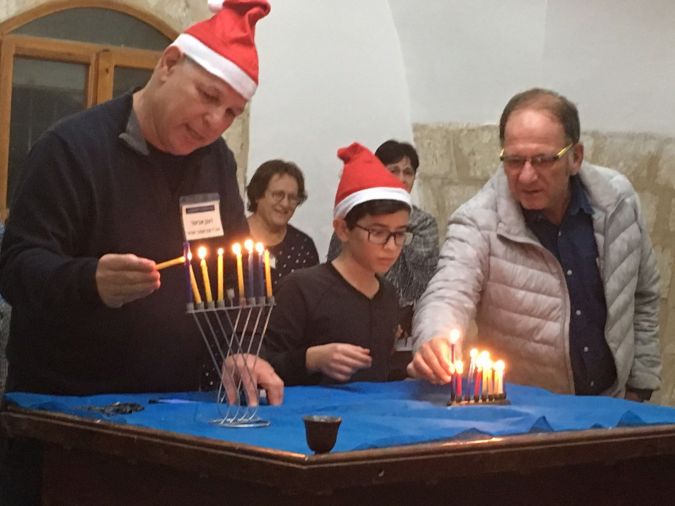
For others, Christmas provides an opportunity for Jewish-Arab coexistence activities. The NGO Shared Tourism, for example, organized over a dozen tours to Shefar-Am, an Arab city in the Galilee. According to Noam Horowitz, Program Director for Shared Tourism, more than 800 people – almost all of them Israeli Jews – attended these events, which included visits to Christmas markets and local churches (and even an interfaith candle-lighting ceremony during Hanukkah in the ancient synagogue in Shefar-Am.)

Shared Tourism / An interfaith candle-lighting ceremony in Shfar’am. Close to 800 Jews participated in the Christmas tour by “Shared Tourism,” a joint Arab-Jewish venture in the Galilee.

Hana Bendcowsky, a tour guide and program director of the Jerusalem Center for Jewish – Christian Relations (JCJCR), an interfaith Jerusalem-based NGO, laments that for many Israeli Jews, the “the attraction of Christmas is the feeling that they are abroad, enjoying churches and Christmas markets.” Despite that superficial pleasure she believes it can “lead to curiosity and to greater familiarity with the Christians who live in Israel.”

The rabbinic establishment sees things differently. Each year, the rabbinate issues a “reminder” to hotels and restaurants to “avoid hosting parties to mark the end of the secular year.” Until 2015, kashrut inspectors could even revoke the kosher certification from hotels and other establishments if they displayed a Christmas tree or sponsored a New Year’s Eve party. (In 2015, under public pressure, the rabbinate disallowed this policy.)

And last year, the rabbi of the Technion Institute of Technology in Haifa forbade students to enter the student union building due to a Christmas tree placed there. Writing on a website geared to the national-religious community, Rabbai Elad Dokow described the tree as an “attack on Jewish identity,” and added, “It is not a Christian religious symbol but, even worse, a pagan one.”

“There’s a lot of anti-Christian sentiment in Israel, and especially in some of the religious establishment,” said Dr. Deborah Weissman, author of Memoirs of a Hopeful Pessimist and consultant to the International Council of Christians and Jews. “Some of our religious leaders act as if we still have to be fearful of the Christians,” she said, because of the years of persecution. “But those days are long gone.”

“Secular Israelis – even those who would never step into a synagogue – are open to other religions,” Weissman said, noting that it’s not assimilation but coming from “the security of living in a majority culture.”

Israeli education should include lessons on Christianity and Islam, she said. “After all, Jesus was the most famous Jew of all time, and we should be secure enough to appreciate his teachings, even though we do not see him as the Messiah.”

Rabbi David Rosen, the former Chief Rabbi of Ireland and current Director of the American Jewish Committee’s Department of Interreligious Affairs, agrees.

“The rabbinic establishment in Israel is living in a time-warp,” Rosen said, pointing out the ridiculousness of the rabbinate and other religious officials calling New Year’s Eve Sylvester, since the day originally marked the day of the death of 4th century Pope Sylvester.

“The only Sylvester I knew about when I grew up in England was the cartoon character that chased Tweety-Bird.”

“I’m delighted that Israeli Jews are interested in other faiths. Indeed, the entire Jewish world needs to seriously reevaluate its relationship to Christianity,” Rosen said. “And what better place than in the State of Israel – where we are a majority and no longer victims?”


Eetta Prince-Gibson, the former editor in chief of The Jerusalem Report, is an award-winning journalist who lives in Jerusalem.


twoje uwagi, linki, wlasne artykuly, lub wiadomosci przeslij do: webmaster@reunion68.com