Archive | May 2021

How the Biden administration set the stage for a new war with Hamas

How the Biden administration set the stage for a new war with Hamas

JONATHAN S. TOBIN
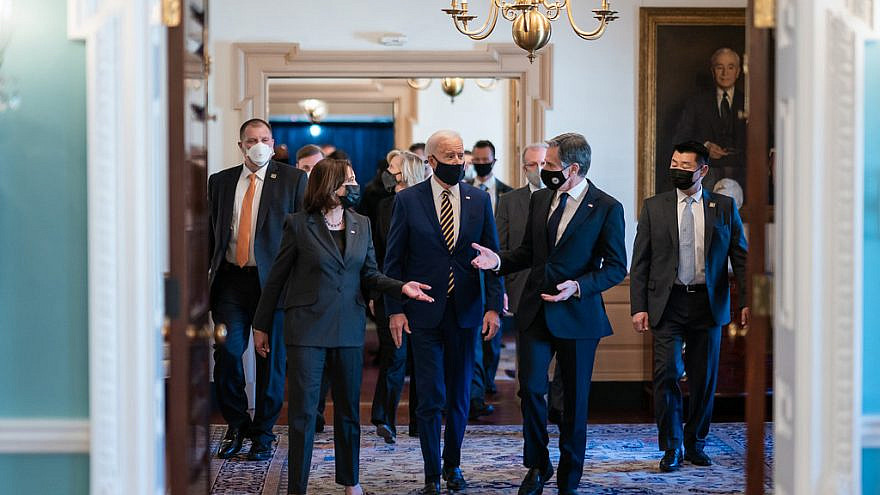

U.S. President Joe Biden walks with Vice President Kamala Harris and Secretary of State Antony Blinken after delivering remarks at the U.S. State Department in Washington, D.C., on Feb. 4, 2021. Credit: Official White House Photo by Adam Schultz.

A policy shift away from closeness to Israel created the opening. Along with Palestinian politics, the hope for a reward from the new president helped ignite riots and sent missiles flying into Israel.

 America’s European allies don’t get it. On Monday, the Biden administration decided to hold up a U.N. Security Council resolution that would have effectively condemned Israel, along with Hamas, for the current round of violence. The text of the proposed resolution called for Israel to prevent Jews from prevailing in a controversial Jerusalem property dispute and to “respect” the status quo at holy sites in the city while also opposing Hamas’s shooting rockets and missiles at Israeli cities, towns and communities.

That the administration backed away at the last minute from a measure that treated terrorist attacks on civilians as morally equivalent to an attempt to enforce Jewish property rights in Israel’s capital and attempts by Israeli security to prevent Palestinians from using the Temple Mount to store projectiles and fireworks to use against Jewish worshippers and authorities was a step in the right direction.

But the Europeans had a right to feel aggrieved. The resolution reflected positions taken by the Biden administration just a couple of days earlier. After having spent the previous months making it clear that the era of special closeness between Israel and the United States that had characterized the policies of the Trump administration was over, the president’s foreign-policy team wasn’t quite prepared to double down on that position in the middle of a full-blown crisis.

That incident is representative of an administration that has been at odds with itself throughout its brief tenure with respect to the Middle East. On the one hand, President Joe Biden, Secretary of State Antony Blinken and National Security Advisor Jake Sullivan have attempted to reassure the pro-Israel community that they are committed to the alliance with the Jewish state, and that given the grim prospects for talks with the Palestinians, they were not seeking to invest the same time and energy that the Obama administration wasted on the peace process. But most of the Biden team is made of people who, like Iran envoy Robert Malley and current envoy to the Middle East Hady Amr, have a history of hostility to Israel.

Biden’s foreign-policy priority has been an attempt to revive the 2015 Iran nuclear deal—something that is being put in motion by a new round of appeasement of Tehran being carried out by Malley. But that effort, and the chill between Washington and the government of Israeli Prime Minister Benjamin Netanyahu, left no one in any doubt that Israel was out of favor in an administration staffed by those who saw it, at best, as run by Trump allies who needed to be put in their place.

Did that contribute to the outbreak of the worst regional violence since 2014?

The question of who is responsible for the events of the last week is not a simple one. It first began with a property case involving a failure of Arab tenants to pay rent to Jewish landlords, coupled with the long-running Palestinian effort to make the Temple Mount a “no go” zone for both Jews and Israeli security, metastasized into riots in Jerusalem, civil strife between Jews and Arabs in Israeli cities, and now, a full-blown military confrontation with the terrorist government of Gaza.

One can second-guess the government of Netanyahu for its failure to anticipate Hamas’s willingness to turn the country into a war zone. Israeli legislators can also share some blame for being perceived as weak because of four elections in the past two years that have failed to produce a stable government.

Still, the lion’s share of the blame belongs to the Palestinians, who chose violence time and again rather than seeking peace. Still, that shouldn’t blind us to the way the Biden administration’s policy shifts have given both major Palestinian factions an incentive to blow things up. At some point, an inevitable cease-fire with Hamas and the end of violence in the streets of Jerusalem and other Israeli cities will come. Whether that will happen sooner or later, or if Israel is able to accomplish military objectives in its offensive into Gaza that will do more than restore the dangerous status quo that existed before this week, remains uncertain. But the aftermath of the fighting is now likely to bring a renewed interest on the part of Washington in reviving the dead-in-the-water peace process between Israel and the Palestinians. That makes it clear that the signals that Biden sent out before all this started created a scenario in which the carnage of recent days was almost inevitable.

The factor that led directly to the worst violence since the 2014 summer war with Hamas was primarily a matter of Palestinian politics. Palestinian Authority leader Mahmoud Abbas’s decision to cancel elections scheduled for this month forced him to come up with some sort of distraction from his appalling misrule of the West Bank. Faced with the likelihood of a defeat at the hands of either dissident members of his Fatah Party or its Islamist rivals in Hamas, Abbas did what Palestinian leaders always do: divert attention from their own failures by inciting nationalist and religious-based hatred against Jews.

That involved the usual lies and heated rhetoric about protecting the Temple Mount from the depredations of Jews—something that Palestinian Arab leaders have been doing for the last century. But it also played off the successful Palestinian effort to turn a property dispute in the Sheik Jarrah section of Jerusalem into a cause célèbre to generate both international opprobrium against Israel, as well as gin up anger among Palestinians and Israeli Arabs. Unfortunately, the Biden administration and the rest of the international community bought the false narrative that denying Jewish property rights in Jerusalem is a human-rights issue.

Hamas’s decision to escalate the conflict by firing more than 1,600 projectiles into Israel was not about “protecting Jerusalem.” It was just another example of how violence and murder is the currency by which one gains credibility in Palestinian political culture. Killing several Israelis and sending much of the country scurrying into bomb shelters was its way of competing with Abbas and other Fatah factions for popularity.

That still raises the question of why both Abbas, and especially Hamas, chose to ramp up the violence now after years of relative quiet.

recomended by: Leon Rozenbaum

One can argue that tension in Jerusalem has been simmering for years and was bound to explode at some point. But the problem with that is from 2017 to 2021, both Abbas and Hamas understood that they had no chance to detach the United States from Israel. By abandoning former President Barack Obama’s policy of increasing “daylight” between the United States and Israel—making it clear to the Palestinians that they must abandon hope of American pressure on the Jewish state—former President Donald Trump had de-incentivized Palestinian violence.

By contrast, Biden had set the stage for a new round of violence precisely because he had shifted away from Trump’s policies, while also demonstrating indifference to the Palestinians. Abbas needed a way to get Biden’s attention. That would presumably force him to listen to those on the left-wing of his Democratic Party who were disappointed that pressure on Israel to make concessions to the Palestinians was not being pursued at the same time as the renewed rapprochement with Iran.

It remains to be seen whether Biden and Blinken can resist their party’s anti-Israel faction and their inherent belief in pushing for a two-state solution (in which Palestinians have little interest) in order to avoid getting sucked into the same fool’s errand every American administration that preceded Trump was eventually pulled.

With many in the media and the Democratic Party having already accepted the false narrative about Israel being in the wrong about the Sheikh Jarrah buildings or the Temple Mount, the role that Biden’s fumbling played in the events that have just unfolded will be obscured. But the blood being shed in Israel and Gaza is a disaster he could have avoided had he stuck to Trump’s policies on Israel. By not realizing that his return to more “daylight” would encourage Palestinian violence, the president has taken a stable though unsolvable problem and turned it into a catastrophe. That serves the purposes of Abbas, Hamas and the growing anti-Israel faction among Democrats, though not the interests of the United States or peace.


Jonathan S. Tobin is editor in chief of JNS—Jewish News Syndicate. Follow him on Twitter at: @jonathans_tobin.


Zawartość publikowanych artykułów i materiałów nie reprezentuje poglądów ani opinii Reunion’68,
ani też webmastera Blogu Reunion’68, chyba ze jest to wyraźnie zaznaczone.
Twoje uwagi, linki, własne artykuły lub wiadomości prześlij na adres:
webmaster@reunion68.com

Iran’s hand seen in Hamas drone threat against Israel – analysis

Iran’s hand seen in Hamas drone threat against Israel – analysis

SETH J. FRANTZMAN


Why do drone threats matter? Because drones can carry warheads and also move slowly and may maneuver.

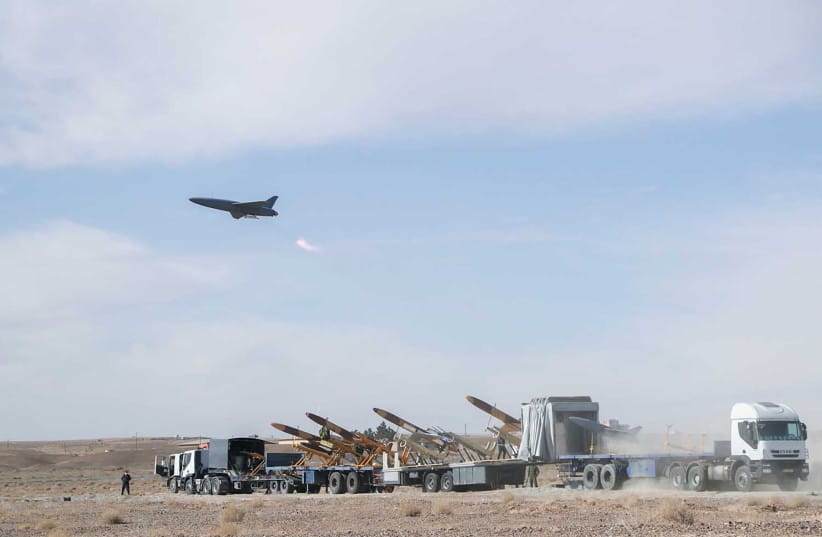
A drone is launched during a large-scale drone combat exercise of Army of the Islamic Republic of Iran, in Semnan, Iran January 4, 2021. Picture taken January 4, 2021 / (photo credit: IRANIAN ARMY/WANA/REUTERS)

Israel has increasingly had to deal with drone threats by Hamas, and said on Thursday that it downed a UAV that crossed from the Gaza Strip into Israeli territory.

The new drone threat has also been showcased by Hamas in a video circulated online that shows the Palestinian terror group with several medium-size drones in Gaza. Hamas says its new drones are called “Shehab.”

Drone Experts such as Nick Waters and others have pointed out the close connection between the Hamas “Shehab” and the Iranian Ababil.

The IDF has released video of the drone flying and being shot down. These drones appear to be based on Iranian Ababil drones, models of which have been exported to the Houthis in Yemen, and which the Houthis built and used against Saudi Arabia. The US has warned for years about the Iranian drone threat, including putting Iran drones on display in Washington.

The IDF said on Wednesday that it “struck a squad of terrorists operating explosive UAV launchers belonging to the Hamas terrorist organization in the Gaza Strip. The squad was struck while they were preparing to launch the UAV into Israeli territory.”

Israel also said on Wednesday that the Iron Dome Aerial Defense System intercepted a Hamas UAV that crossed from Gaza into Israeli territory. Israel’s Defense Ministry has said that the Iron Dome system has new capabilities, developed and made operational over the years, that make it effective against drones.

Why do drone threats matter? Because drones can carry warheads and also move slowly and may maneuver. Most of the Iranian-style drones, which are called “loitering munitions” or “kamikaze” drones, are the kind that can be programmed to fly to a certain destination and then sent on their way.

They are launched from a rail and can be transported on a truck or even a boat and launched that way. They have a propeller at the back, and gyroscope technology used in the drones for guidance links Iran to the drone exports that have gone to Yemen, Iraq, Syria, and even further afield, to be used in places like Sudan, Afghanistan, and Venezuela, according to various reports.

Iran used drones to attack the Abqaiq oil processing facilities in September 2019 that appeared to be a warning to Israel. Iran also used a drone flown from the T-4 base in Syria to attack Israel in 2018. It flew into Israeli airspace and was shot down by a helicopter. Iran also advised Hezbollah to send what Israel called a “killer drone” team to an area near the Golan in 2019. Israel struck that team.

There have been numerous drone incidents on the Lebanese border, and also several on the Syrian border. In addition, Israel’s enemies have tried to shoot down Israeli drones. In March, Israel’s IDF said “during routine IDF UAV activity over Lebanon, anti-aircraft missiles were fired toward the UAV. The aircraft was not hit and continued its mission as planned.”

Last month Israel said that troops downed a drone and located an additional drone “belonging to the Hezbollah terror organization that crossed from Lebanon into Israeli airspace.”

The IDF shot down another drone from Lebanon in January, and shot down a drone that flew from Lebanon in November. Additionally, there were drone infiltrations in July and August.

In addition, Israel said it struck a drone site in September related to Hamas in Gaza. Israel said in September 2019 that “a drone infiltrated into Israeli airspace from the Gaza Strip and dropped an explosive device on a military vehicle.”

All this points to an increasing drone capability by Hamas, and this week’s conflict has seen several references to Hamas’s UAVs.

Israel uses several terms for drones, usually calling the smaller quadcopters rakhfanim, and larger drones malatim, meaning a UAV.

The Hamas drones that resemble the Ababil will likely have a warhead on the front and some sort of guidance system. They have two sets of wings, one toward the rear and a smaller set in the front, looking similar to a flying fish with fins. They are slightly longer than an average person.

Apparently the design is relatively easy to manufacture because the Houthis have become experts at using drones to terrorize Saudi Arabia.

Some of these drones also have increasingly longer ranges. Concern in January pointed to a new drone based in Yemen among the Houthis,which had a 2,000-km. range that could reach Eilat.

Iran has long boasted that it has drones with ranges of thousands of kilometers, and Iran has said it has increased the armaments it can put on the drones. That means Iran has a drone army that combines the kind of smart munition elements that cruise missiles have. The drones can be operationalized in swarms.

Iran has also tried to copy the US Predator and Sentinel as well as other drones, adding munitions to them as has the US Reaper. However, Iran has had mixed success in this.

It also has mixed success supplying the Houthis, Hamas, Hezbollah or Iraq-based militias with a way to fly the drones with a live video feed or have them return to base. This means that Iran’s drones are still quite antiquated, and that its allies like Hamas possess drones that have outdated aspects.

Hamas drones are a threat because they can maneuver and fly low, but they still may be a blend between aspects of the V-1, – old Israeli drones from the 1980s – and cruise missiles. However, it is clear Iran is exporting its technology.

Iran first began using Ababils in the 1980s against Iraq during the Iran-Iraq war. They were built at a HESA factory that is based on a factory that was once built by Textron, which constructed Bell 214 helicopters prior to 1979.

The Islamic Revolutionary Guard Corps today often uses the Ababil drones, and this makes sense because the IRGC’s Quds Force oversees support for Hamas, Hezbollah, and the Houthis.

It is believed that pro-Iran militias in Iraq have now used drones several times against US facilities. This points to a wider drone war being waged by Iran against Israel, Saudi Arabia, the US and others.


Zawartość publikowanych artykułów i materiałów nie reprezentuje poglądów ani opinii Reunion’68,
ani też webmastera Blogu Reunion’68, chyba ze jest to wyraźnie zaznaczone.
Twoje uwagi, linki, własne artykuły lub wiadomości prześlij na adres:
webmaster@reunion68.com


Komisarz UNRWA twierdzi, że agencja nie jest polityczna. Jest WYŁĄCZNIE polityczna!

Philippe Lazzarini, komisarz generalny UNRWA, napisał artykuł opublikowany przez Al Dżazira pełen wierutnych kłamstw.


Komisarz UNRWA twierdzi, że agencja nie jest polityczna. Jest WYŁĄCZNIE polityczna!

Elder of Ziyon
Tłumaczenie: Małgorzata Koraszewska


Philippe Lazzarini, komisarz generalny UNRWA, napisał artykuł opublikowany przez Al Dżazira pełen wierutnych kłamstw.

Kłamstwa zaczynają się od tytułu: „Pomoc palestyńskim uchodźcom nie jest polityczna”

Samo nazywanie ich “uchodźcami” już jest polityczne! Istnieje tylko jedna definicja uchodźcy i jest to definicja Konwencji dotyczącej statusu uchodźców. Mówienie, że palestyńscy potomkowie tych, którzy uciekli ze swoich domów w 1948 roku, są „uchodźcami”, jest polityczne. Mówienie, że Palestyńczycy, którzy żyją na terenach byłego Mandatu Brytyjskiego, są “uchodźcami” jest polityczne. Mówienie, że niemal dwa miliony obywateli Jordanii są uchodźcami” jest polityczne.

UNRWA jest czysto polityczną organizacją. Istnieje jedynie po to, by przedłużać własne istnienie.

Gaza- więzienie pod gołym niebem.Gaza- więzienie pod gołym niebem.

Mohammad jest siedmioletnim chłopcem żyjącym w Gazie, która w czerwcu wejdzie w 15 rok blokady ziemi, powietrza i morza. Podobnie jak niemal 300 tysięcy uczniów w Gazie, którzy chodzą do szkół prowadzonych przez Agencję Narodów Zjednoczonych Pomocy Uchodźcom Palestyńskim na Bliskim Wschodzie (UNRWA), nie chodził do szkoły i uczył się na odległość od wybuchu pandemii COVID-19 rok temu. Codziennie boryka się z przerwami w dostawach elektryczności, by zdobyć edukacyjny materiał online przygotowany przez nauczycieli UNRWA, którzy także walczą o dostęp do elektryczności i Internetu. Prawo Mohammada do edukacji jest niezbywalne także podczas pandemii i humanitarnego kryzysu.

Wiecie co? Większość uczniów na planecie boryka się z tym od roku! Tutaj jest raport o problemach dzieci w Afryce. Wiele dzieci ucierpiało, nie mogąc chodzić do szkoły i bez dostępu do Internetu, by uczyć się zdalnie.

Gdzie jest ich UNRWA, która dostarczyłaby darmowej edukacji? Nie istnieje – ponieważ tylko Palestyńczycy mają UNRWA do kształcenia ich dzieci! Nie jest zadaniem ONZ dostarczanie darmowej edukacji wszystkim dzieciom na świecie – dlaczego ma być ich zadaniem dostarczanie darmowej edukacji wyłącznie Palestyńczykom?

Jako komisarz generalny UNRWA jestem odpowiedzialny za zapewnienie, że palestyńscy uchodźcy na Zachodnim Brzegu włącznie ze wschodnią Jerozolimą, w Gazie, Jordanii, Libanie i Syrii otrzymują podstawowe usługi, do których mają prawo. A przecież w ostatnim roku UNRWA była przedmiotem ataków o bezprecedensowej zaciętości i uprzedzeniach.

Dlaczego oni mają “prawo” do darmowego kształcenia za pieniądze reszty świata? Dlaczego ich kraje-gospodarze nie dają im edukacji tam, gdzie mieszkają i w krajach w których urodzili się także ich dziadkowie?

Jak zwykle funkcjonariusze UNRWA dokonują retorycznych sztuczek, by powstrzymać ludzi przed zadawaniem tych podstawowych pytań. A to właśnie robią politycy.

Oskarżeniem najczęściej wysuwanym przeciwko nam jest, że UNRWA odgrywa polityczną rolę. Nie mogłoby to być dalsze od prawdy. UNRWA ma mandat dostarczania bezpośredniej, niezbędnej pomocy humanitarnej palestyńskim uchodźcom w oczekiwaniu na sprawiedliwe i trwałe rozwiązanie ich losu. To jest priorytet i główny cel agencji. Nie angażuje się w politykę. UNRWA, podobnie jak wszystkie agencje ONZ i międzynarodowe NGO jest związana czterema humanitarnymi zasadami (humanitarność, bezstronność, neutralność i niezależność), które są zapisane w dwóch rezolucjach Zgromadzenia Ogólnego ONZ.

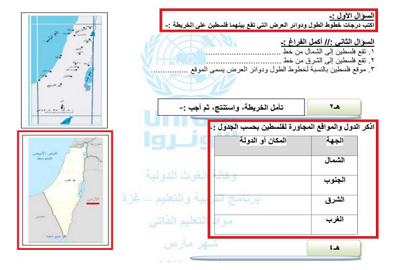
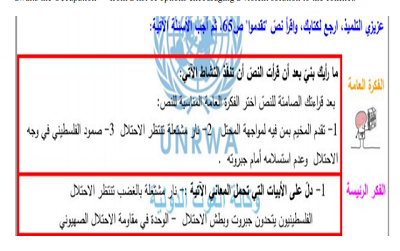
Tutaj są przykłady ze szkolnego materiału UNRWA – z logo UNRWA – z wierszem mówiącym o tym, że „szalejący ogień oczekuje Okupację”.

To nie jest humanitarne, bezstronne ani neutralne. I to jest zdecydowanie polityczne.

Podobnie jest z tym stworzonym przez UNRWA materiałem z mapą, która wymazuje Izrael.

Niedawne ataki na UNRWA – z twierdzeniami, że uczymy “dżihadu” i “terroryzmu” – są stronniczymi próbami wciągnięcia humanitarnej agencji w wysoce upolitycznioną strefę, do której nie należy.

UNRWA jawnie uczy dżihadu!  Szkolne materiały zawierają następujące zdania, których uczniowie mają się uczyć:

Dżihad jest jednym z drzwi do raju.
Palestyńczycy stali się przykładem poświęcenia.
(Znajdź czasownik) w zdaniu: “Wojownicy oporu atakowali pozycje wroga”.
Palestyńczyk zginął jako męczennik, by bronić ojczyzny.
Krwią będziemy bronić ojczyzny.
Zapach piżma emanuje z męczennika.
By zbawić ich ojczyznę krwią, bo to jest najcenniejsze, co mają.

A to jest tylko kilka przykładów.

UNRWA kłamie. I nie płaci żadnej ceny za kłamstwa, bo tak wielu ludzi chce wierzyć w te kłamstwa.


Eldfer of Ziyon – Amedrykański bloger śledzący antysemityzm w amerykańskich mediach i instytucjach.


Zawartość publikowanych artykułów i materiałów nie reprezentuje poglądów ani opinii Reunion’68,
ani też webmastera Blogu Reunion’68, chyba ze jest to wyraźnie zaznaczone.
Twoje uwagi, linki, własne artykuły lub wiadomości prześlij na adres:
webmaster@reunion68.com


New Documents Reveal FDR’s Eugenic Project to ‘Resettle’ Jews During World War II

New Documents Reveal FDR’s Eugenic Project to ‘Resettle’ Jews During World War II

STEVE USDIN


As the Holocaust raged, the American president secretly asked his government to study the possible resettlement of remaining European refugees in Africa and South America. His goal: for Jews to be ‘spread thin all over the world.’

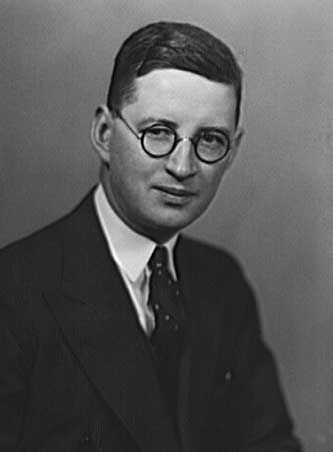
Franklin D. Roosevelt in 1941.LIBRARY OF CONGRESS

A new exhibition at the U.S. Holocaust Memorial Museum, Americans and the Holocaust, explores Americans’ knowledge of and responses to Nazism, war, and genocide. An unstated question runs through the photographs, films, and artifacts: What explains FDR’s apparent indifference to the plight of the Jews? If he’d had complete freedom to act without concern for the political consequences, what would he have done? Visitors leave the museum without answers.

Roosevelt didn’t address these issues publicly, but confidential files kept in his personal safe in the White House and released to the public decades after his death, as well as correspondence in his personal files, provide valuable clues. They make it clear that the question of where to settle the Jews had been on FDR’s mind for years. While he was uncertain about whether they would be better off on the slopes of the Andes or the savannahs of central Africa, there was one place he knew he didn’t want them: the United States of America.

Among the files in Roosevelt’s safe were documents about the origins and goals of the “M Project,” a secret study he commissioned of options for post-war migration (hence “M”) of the millions of Europeans, especially Jews, expected to be displaced by the war. The President first discussed the project in the summer of 1942 with John Franklin Carter, a journalist, novelist, and former diplomat who ran an informal secret intelligence service for Roosevelt. Carter’s No. 2 was an anthropologist named Henry Field.

In the beginning of July, FDR asked Carter and Field to sound out prominent anthropologists and geographers about the possibility of undertaking a survey of regions that would be suitable for settlement of displaced Europeans.

John Franklin Carter in 1936.LIBRARY OF CONGRESS

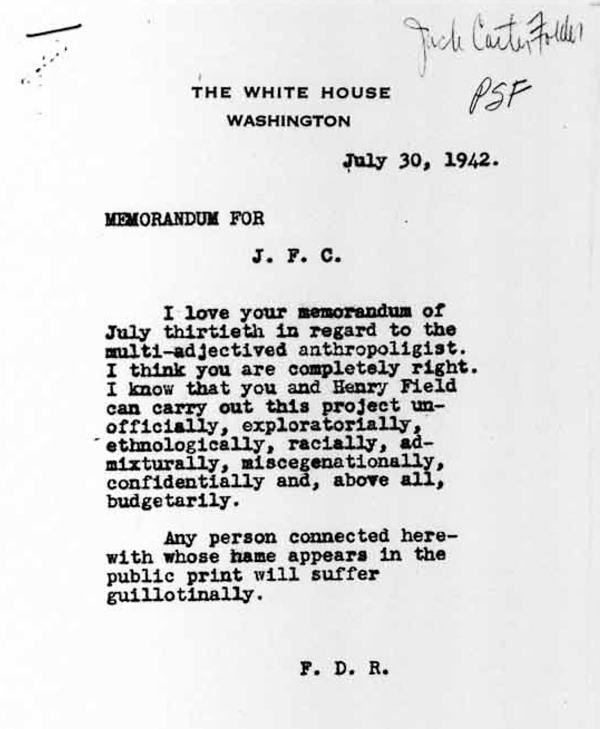
FDR found time on the afternoon of July 30, 1942, in the midst of a schedule packed with meetings with Soviet Ambassador Maxim Litvinov, Secretary of State Cordell Hull, and General ‘Hap’ Arnold, to dictate a memo greenlighting the M Project. The memo, delivered by White House courier to Carter in his office in the National Press Building, a few blocks from the White House, stated: “I know that you and Henry Field can carry out this project unofficially, exploratorially, ethnologically, racially, admixturally, miscegenationally, confidentially and, above all, budgetarily.” It concluded: “Any person connected herewith whose name appears in the public print will suffer guillotinally.” Roosevelt repeatedly admonished Carter to keep the M Project completely secret.

Roosevelt’s first choice to head the M Project was Aleš Hrdlička, curator of physical anthropology at the Smithsonian Museum of Natural History. The two men had carried on a lively correspondence for over a decade and the President had absorbed the scientist’s theories about racial mixtures and eugenics. Roosevelt, the scion of two families that considered themselves American aristocrats, was especially attracted to Hrdlička’s notions of human racial “stock.”

A prominent public intellectual who had dominated American physical anthropology for decades, Hrdlička was convinced of the superiority of the white race and obsessed with racial identity. Shortly after the Pearl Harbor attack, he’d written to Roosevelt expressing the view that the “less developed skulls” of Japanese were proof that they were innately warlike and had a lower level of evolutionary development than other races. The president wrote back asking whether the “Japanese problem” could be solved through mass interbreeding.

Roosevelt had asked Carter to recruit Hrdlička, and to tell him his task would be to head up a secret international committee of anthropologists to study the “ethnological problems anticipated in post-war population movements.” Outlining the president’s charge for the committee, Carter told Hrdlička it was expected to “formulate agreed opinions as to problems arising out of racial admixtures and to consider the scientific principles involved in the process of miscegenation as contrasted with the opposing policies of so-called ‘racialism.’ ” The instructions were consistent with views Roosevelt had expressed for decades.

In 1925, while undergoing therapy for polio at Warm Springs, Georgia, FDR wrote a series of columns for the Macon Telegraph, including one that touched on his ideas about immigration. He praised elements of Canada’s immigration policy, especially its regulations “to prevent large groups of foreign-born from congregating in any one locality.” Roosevelt added: “If, 25 years ago, the United States had adopted a policy of this kind we would not have the huge foreign sections which exist in so many of our cities.”

Memo from FDR to John Franklin Carter authorizing the M Project, July 30, 1942. FDR LIBRARY

The future president remarked that “no sensible American wants this country to be made a dumping ground for foreigners of any nation, but it is equally true that there are a great many foreigners who, if they came here, would make exceedingly desirable citizens. It becomes, therefore, in the first place, a question of selection.” Roosevelt informed his readers that “a little new European blood of the right sort does a lot of good in every community.”

While the column doesn’t define “the right sort,” it provides two examples of good emigrants, those from Southern Germany and Northern Italy. Roosevelt also expressed the opinion that “for a good many years to come European immigration should remain greatly restricted,” and that “foreigners” who had congregated in large American cities should be encouraged to disperse into the heartland. Roosevelt apparently held onto these opinions when he moved into the White House.

Roosevelt’s goals for the committee were consistent with the views he had expressed in 1925. He wanted it to identify “the vacant places of the earth suitable for post-war settlement” and the “type of people who could live in those places.” Initial work was to focus on South America and Central Africa. Roosevelt wanted the committee to explore questions such as the probable outcomes from mixing people from various parts of Europe with the South American “base stock.”

FDR asked the committee to consider some specific questions, such as: “Is the South Italian stock—say, Sicilian—as good as the North Italian stock—say, Milanese—if given equal economic and social opportunity? Thus, in a given case, where 10,000 Italians were to be offer[ed] settlement facilities, what proportion of the 10,000 should be Northern Italians and what Southern Italian?”

Roosevelt “also pointed out,” Carter informed Hrdlička, “that while most South American countries would be glad to admit Jewish immigration, it was on the condition that the Jewish group were not localized in the cities, they want no ‘Jewish colonies,’ ‘Italian colonies,’ etc.” Keeping with this theme, the president also tasked the committee with determining how to “resettle the Jews on the land and keep them there.”

Hrdlička ultimately refused to participate in the M Project because Roosevelt wouldn’t give him absolute control. Isaiah Bowman, president of Johns Hopkins University and a geographer, was promoted from his role as a member of the committee to the head of the project. Roosevelt knew Bowman well and so was presumably aware of his anti-Semitic views.

recomended by: Leon Rozenbaum

Bowman understood what Roosevelt was trying to achieve through the M Project. Years earlier, in November 1938, he had undertaken research for FDR about the prospects for European settlement in South America. Requesting the research, Roosevelt wrote to Bowman: “Frankly, what I am rather looking for is the possibility of uninhabited or sparsely inhabited good agricultural lands to which Jewish colonies might be sent.” Roosevelt added that “such colonies need not be large but, in all probability, should be large enough for mutual cooperation and assistance—say 50 to 100,000 people in a given area.”

The M Project expanded far beyond Roosevelt’s original charge, producing thousands of pages of reports, maps, and charts analyzing the suitability of locations around the globe for settlement by Europeans who were expected to be displaced by the war, analyzing the characteristics of myriad racial and ethnic groups, and theorizing about optimal proportions in which to combine them in their new homelands.

Bowman provided overall direction to the M Project. The hands-on leader was Robert Strausz-Hupe, an Austrian émigré intellectual who went on to hold prominent positions in the Reagan and George H.W. Bush administrations, including U.S. Ambassador to NATO. Strausz-Hupe was in charge of six social scientists and three secretaries, along with additional part-time translators, cartographers, and secretaries. They produced memos on a plan for Jewish settlement in northwestern Australia, rice farming in Manchukuo, settlement possibilities in Nigeria, and scores of other topics.

Settlement contingencies for a wide range of peoples were studied, but when Roosevelt described the M Project to Churchill during a lunch at the White House in May 1943, he focused on one particular group. FDR described it as a study about “the problem of working out the best way to settle the Jewish question,” Vice President Henry Wallace, who attended the meeting, recorded in his diary. The solution, which the President endorsed, “essentially is to spread the Jews thin all over the world,” rather than allow them to congregate anywhere in large numbers.

After Roosevelt died on April 12, 1945, Carter wrote to Truman explaining his work for FDR, offering to continue his unit’s covert activities and urging the new President to fund completion of the M Project.

Truman was deeply skeptical about the need for espionage or secret intelligence, and he had been informed by the State Department that the $10,000 per month that was being spent on the M Project was a waste of money. He terminated Carter’s operations and cut off funding for the migration studies.

Very few people outside the team that produced the reports were allowed to see them and they had no discernible impact on policy decisions. In retrospect, the M Project’s principal accomplishment was to shed light on how now-discredited eugenic theories influenced FDR’s thinking about race, immigration, and the Jews of Europe. As the M Project’s reports rolled into the White House, so did news about the methodical starvation, torture, and extermination of Europe’s Jews in the Nazi Holocaust.


Steve Usdin is the author ofEngineering Communism: How two Americans spied for Stalin and Founded the Soviet Silicon Valley and the forthcomingBureau of Spies: Secret Connections between Journalism and Espionage in Washington.


Zawartość publikowanych artykułów i materiałów nie reprezentuje poglądów ani opinii Reunion’68,
ani też webmastera Blogu Reunion’68, chyba ze jest to wyraźnie zaznaczone.
Twoje uwagi, linki, własne artykuły lub wiadomości prześlij na adres:
webmaster@reunion68.com

Gantz Asks Government for Two-Week Extension to Home Front State of Emergency

Gantz Asks Government for Two-Week Extension to Home Front State of Emergency

i24 News


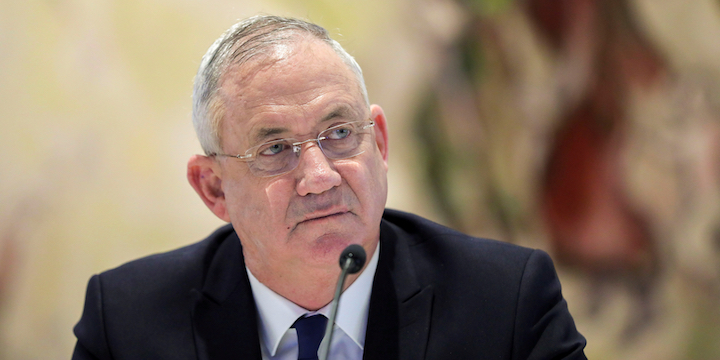
Israeli Defense Minister Benny Gantz attends a cabinet meeting of the new government, at the Chagall Hall in the Knesset, the Israeli parliament in Jerusalem, May 24, 2020. Photo: Abir Sultan / Pool via Reuters / File.

Israel’s Defense Minister and Alternate Prime Minister Benny Gantz asked the government on Wednesday to extend the Home Front’s state of emergency another two weeks, which includes all communities within an 80-kilometer radius from the Gaza Strip.

Gantz said that there was “no end date” to the Gaza military operation as Israel likely faces another night of rocket attacks aimed not just at the south but the center of the country where the overwhelming majority of the population resides.

A new wave of rocket attacks could come in retaliation for a major military operation conducted jointly by the IDF and Shin Bet (Israel Security Agency) that killed a number of senior Hamas commanders, many of them thought to be close to Hamas military wing commander Mohammed Deif.

“Israel is not preparing for a ceasefire. There is currently no end date for the operation. Only when we achieve complete quiet can we talk about calm,” Gantz said. “We will not listen to moral preaching from any organization or institution regarding our right and duty to protect the citizens of Israel.”


Zawartość publikowanych artykułów i materiałów nie reprezentuje poglądów ani opinii Reunion’68,
ani też webmastera Blogu Reunion’68, chyba ze jest to wyraźnie zaznaczone.
Twoje uwagi, linki, własne artykuły lub wiadomości prześlij na adres:
webmaster@reunion68.com