
Archive | March 2024

Krugman vs. Krugman

Krugman vs. Krugman

MICHAEL LIND


New York Times columnist tries to memory-hole his prior views on immigration.

.
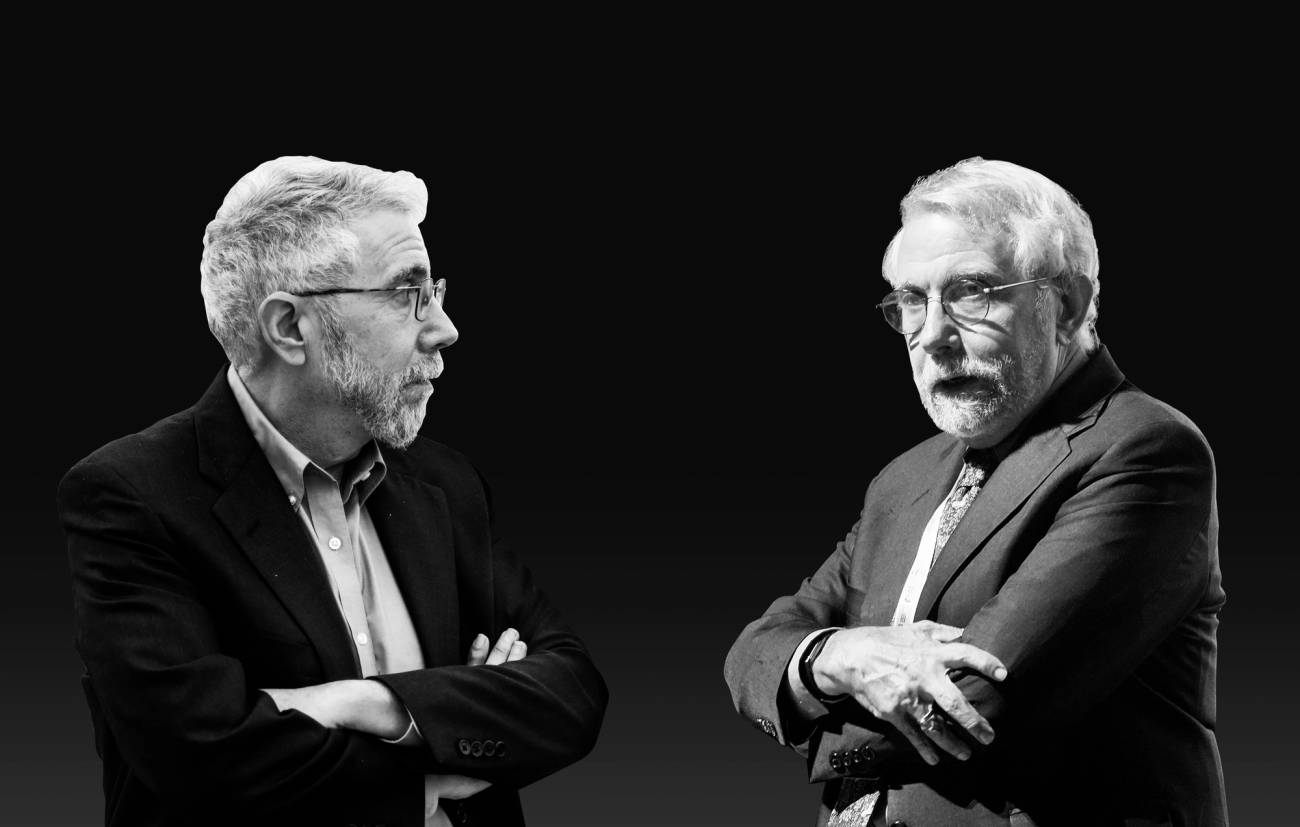
ORIGINAL PHOTOS: RICARDO RUBIO/EUROPA PRESS VIA GETTY IMAGES; JAVIER VAZQUEZ/EUROPA PRESS VIA GETTY IMAGES

“Immigrants Make America Stronger and Richer” is the headline of a Feb. 5 column by New York Times columnist Paul Krugman. Krugman lends his prestige as a Nobel Prize-winning economist to the assertion of partisan Democrats that mass unskilled immigration of the kind encouraged by the Biden administration is entirely beneficial to America: “So this seems like a good time to point out that negative views of the economics of immigration are all wrong.”

Thus writes Paul Krugman in 2024. Here, however, is the same Krugman in his New York Times column on March 27, 2006: “But a review of serious, nonpartisan research reveals some uncomfortable facts about the economics of modern immigration, and immigration from Mexico in particular.”

Today’s Krugman: “Did those foreign-born workers take jobs away from Americans—in particular, native-born Americans? No.”

Krugman again in 2006, when both immigration and the immigrant share of the U.S. labor force was much lower: “Second, while immigration may have raised overall income slightly, many of the worst-off native-born Americans are hurt by immigration—especially immigration from Mexico. Because Mexican immigrants have much less education than the average U.S. worker, they increase the supply of less-skilled labor, driving down the wages of the worst-paid Americans.”

The soundness of Krugman’s 2006 views on labor economics and immigration has not diminished. What has changed since, however, is the political environment. In 2024, what Krugman said 18 years ago now counts as white nationalist, nativist bigotry, and economic illiteracy.

Hence in 2024, Krugman claims that not a single job in the last few years that might have gone to a worker born in the U.S. or naturalized earlier has been taken by an immigrant: “The native-born labor force declined slightly over the past four years, reflecting an aging population, while we added three million foreign-born workers … The unemployment rate among native-born workers averaged just under 3.7 percent in 2023 …”

The Democratic Party has become the home of the affluent, educated whites, a dwindling number of nonwhites, and most immigrants, along with many large corporations and the billionaires who profit from them.

But, as Krugman in 2006 would have understood, this argument is plainly absurd, because all jobs are not interchangeable. It is quite possible that unemployment as a whole has gone down, while the influx of both legal and illegal immigrants has crowded out other workers who compete with them in specific low-wage industries like agriculture, construction, housecleaning, fast food, and retail. Moreover, the major problem is not the one-for-one replacement of natives and naturalized immigrants by new immigrants in particular jobs, but the fact that rapidly enlarging the labor pool in a particular sector can weaken or destroy the bargaining power of workers in that sector—native and immigrant alike.

My authority for this statement? Why, it’s Paul Krugman in 2006: “That’s why it’s intellectually dishonest to say, as President Bush does, that immigrants do ‘jobs that Americans will not do.’ The willingness of Americans to do a job depends on how much that job pays—and the reason some jobs pay too little to attract native-born Americans is competition from poorly paid immigrants.”

Krugman 2024, however, thinks Krugman 2006 was wrong.

Today’s Krugman cites unnamed “research literature on the economic impact of immigration” which allegedly finds that “immigrant workers often turn out to be complementary to the native-born work force.” The research literature to which Krugman gestures includes unrealistic studies like those of the economist Giovanni Peri, who claims, on the basis of dubious mathematical models and data from large regions, that all immigrants magically complement existing workers instead of competing with them. In 1997, however, an expert panel of the National Research Council of the National Academy of Sciences concluded that competition with unskilled immigrants was the cause of nearly half of the decline in wages between 1980 and 1994 for native-born high school dropouts, who were disproportionately Black and Hispanic.

The National Academy of Sciences study also estimated that the annual economywide benefit from immigration would be a mere $10 billion—in other words, less than 1% of America’s 1997 GDP of $8.6 trillion. Way back in 2006, Paul Krugman agreed that the benefits to the U.S. economy of mass low-skilled immigration were negligible: “First, the net benefits to the U.S. economy from immigration, aside from the large gains to the immigrants themselves, are small. Realistic estimates suggest that immigration since 1980 has raised the total income of native-born Americans by no more than a fraction of 1 percent.”

The most relevant studies of the economic effects of immigration on workers are those that focus on specific industries. The union-weakening, wage-depressing, native-displacing effects of mass unskilled immigration have been well-documented in the case of janitorsconstruction workers, and meatpackers.

In the case of meatpacking, industry experts (Krugman is not one) acknowledge that immigration has enabled employers to pay low wages, as an alternative to raising wages and benefits to attract citizen-workers. The authors of a 2022 study in the Journal of the Agricultural and Applied Economics Association conclude: “The results indicate that higher wages along with additional nonwage benefits would have expanded the labor supply”—in the absence of expanded immigration.

Krugman 2024 also justifies the guest worker programs lobbied for by U.S. tech, agribusiness, and other business lobbies, claiming that “immigrant workers often turn out to be complementary to the native-born work force, bringing different skills that, in effect, help avoid supply bottlenecks and allow faster job creation. Silicon Valley, for instance, hires a lot of foreign-born engineers because they bring something additional to the table; the same is true for workers in many less-glamorous occupations.”

Really? Between 1980 and 2010, chiefly as a result of the massive expansion of the H-1B program, the number of American computer science jobs held by foreign-born workers exploded from 7.1% to 27.8%. In 2021, 74.1% of the 407,071 H-1B visas issued to specialty foreign workers by the U.S. went to nationals from India. The overwhelming share of young Indian men among H-1Bs reflects not any extraordinary skills that they alone possess but rather their willingness to work for lower wages and benefits than their American counterparts, as well as the accidental importance of Indian labor contractors or “body shops” as suppliers of indentured servants to U.S. companies beginning in the 1990s.

The U.S. Department of Labor sets four H-1B wage levels, based on the median wage of other workers in the same occupation and region, with the help of survey data from the Occupational Employment Statistics survey by the Bureau of Labor Statistics (BLS). As Daniel Costa and Ron Hira point out in a 2020 study, the Department of Labor sets the two lowest wage levels for H-1Bs well below the local median wage. “Not surprisingly,” Costa and Hira write, “three-fifths of all H-1B jobs were certified at the two lowest prevailing wage levels in 2019.”

This finding bears some attention. If H-1Bs are all geniuses with unique and valuable skills that both American workers and immigrants with green cards lack, then why are tech firms and their contractors so determined to pay most of their H-1Bs the very lowest wages permissible under U.S. law? Costa and Hira point to corporate savings on wages: “Wage-level data make clear that most H-1B employers—but especially the biggest users, by nature of the sheer volume of workers they employ—are taking advantage of a flawed H-1B prevailing wage rule to underpay their workers relative to market wage standards, resulting in major savings in labor costs for companies that use the H-1B.”

Krugman 2024 to the contrary, the H-1B program has nothing to do with any lack of skills among American workers. Rather it is an example of labor arbitrage by employers who prefer to employ nonunion foreign indentured servants without voting rights and many legal rights over Americans who would demand higher wages and better treatment. Disney and other companies have even forced their American employees to train the H-1Bs brought in to replace them. If H-1B guest workers have unique skills that American workers lack, why do they need to be trained for their jobs by the American workers they are replacing?

On this issue, Krugman has performed an intellectual somersault. In 2006, Krugman sternly denounced exploitative guest-worker programs like H-1B: “Meanwhile, Mr. Bush’s plan for a ‘guest worker’ program is clearly designed by and for corporate interests, who’d love to have a low-wage work force that couldn’t vote. Not only is it deeply un-American; it does nothing to reduce the adverse effect of immigration on wages.” Expanding guest worker programs, Krugman 2006 warned, “could create a permanent underclass of disenfranchised workers.”

Why the shift? Well, if Krugman wrote that in the political climate of 2024, he would be denounced in the overwhelmingly Democratic prestige media as a racist, xenophobic Trumper who is ignorant of economics.

In fact, nothing has changed in the field of labor economics over the last two decades to refute the views that Paul Krugman held about immigration in 2006. What has changed is the class composition of America’s two major parties. In 2006, Sens. Barack Obama and Hillary Clinton voted to erect massive fences along the U.S.-Mexican border. A decade earlier, in 1996, Democratic President Bill Clinton signed the Illegal Immigration Reform and Immigrant Responsibility Act, which expanded the list of offenses to be punished by deportation. Clinton had appointed the U.S. Commission on Immigration Reform, chaired by Black liberal former U.S. Rep. Barbara Jordan, which called for cracking down on illegal immigration, punishing employers of illegal immigrants, and drastically slashing legal immigration numbers in order to protect American workers, including former immigrants, from unfair competition. All of these measures and policies were denounced at the time by Republican libertarians and U.S. business lobbies, for all the reasons that Krugman 2006 made clear.

Within the last generation, however, the Democratic Party has lost the allegiance of most white working-class voters, along with a growing share of working-class Black and Hispanic voters. Meanwhile it has become the home of affluent, educated whites, a dwindling number of nonwhites, and most immigrants, along with many large corporations and the billionaires who profit from them.

Just as Republicans favored wage-suppressing mass immigration when they were the party of the affluent, college-educated overclass, today’s elitist Democrats now favor a never-ending stream of immigrant workers with little or no bargaining power for their constituents—like Silicon Valley donors whose firms depend on exploiting H-1B indentured servants, and urban professionals whose two-income lifestyle depends on a bountiful supply of cheap nannies, maids, restaurant workers, and Uber drivers.

Krugman’s authority depends on the perception that he is a principled expert on economics who follows the evidence where it leads him. If Krugman was completely wrong about the economics of immigration in 2006, this raises the question of whether he has been similarly wrong about other major economic issues throughout his career. Conversely, if he changes his economic views periodically in consonance with the rise and fall of interest groups in the Democratic Party hierarchy, he is a Nobel Prize-winning economist who believes that the truths his discipline has to offer are less significant than the work of being a partisan Democratic opinion columnist.

You have seen the evidence. You decide.


Michael Lind is a Tablet columnist, a fellow at New America, and author of Hell to Pay: How the Suppression of Wages Is Destroying America.


Zawartość publikowanych artykułów i materiałów nie reprezentuje poglądów ani opinii Reunion’68,
ani też webmastera Blogu Reunion’68, chyba ze jest to wyraźnie zaznaczone.
Twoje uwagi, linki, własne artykuły lub wiadomości prześlij na adres:
webmaster@reunion68.com



Time to huddle: Antisemitism on the field

Time to huddle: Antisemitism on the field

BEN COHEN


The world of sport is emerging as the next battleground.

.
Sagiv Jehezkel played for the Turkish soccer team Antalyaspor. Credit: Antalyaspor.

As unsettling and painful as the current wave of global antisemitism that followed the Oct. 7 Hamas pogrom in Israel is, it’s still important to remember that those bestial atrocities were an episode in, and not the fundamental cause of, the renewal and remodeling of this ancient superstition.

Where it all began remains a matter of debate. Many analysts nod to the U.N. World Conference Against Racism in 2001 in Durban, South Africa, where several of the memes visible in today’s pro-Hamas protests were rudely on display, as the point of origin. Others go back further, into the Cold War, when the Soviet Union ran a vicious campaign of anti-Zionist propaganda centered on the claim that Zionism is a form of Nazism. And one can go back even further, to the antisemitic riots and revolts targeting Jewish communities in British Mandate Palestine in 1929 and 1936. The point is that the basic message—Jews as colonial interlopers who must be destroyed—hasn’t really changed.

The other consideration is that certain sectors are more amenable than are others to anti-Zionist antisemitism, or antizionism, as I prefer to call it. Over the last two decades, the boycott, divestment and sanctions (BDS) movement seeking to quarantine Israel alone among the world’s nations has been the most tangible and energetic expression of contemporary opposition to Zionism. In the worlds of culture and academia, especially, boycotts of Israel and shrill rhetoric denouncing Zionism (or more precisely, a caricature of Zionism) have been the order of the day.

Regardless, then, of where and when we believe the current wave began, that discussion is less important than an assessment of where we are headed—and specifically, which spheres of human activity alongside art and education will start to echo the growing antisemitic chorus, both in their words and in their deeds.

The world of sport is emerging as the next battleground. It is a much more fearsome prospect; a row over an art exhibition featuring antisemitic caricatures or a lecture at a provincial campus promoting antisemitic tropes is, let’s be honest, a picnic compared to a row involving an athlete with instant, global name recognition.

Someone like the French soccer icon Karim Benzema, a former Real Madrid striker and winner of the coveted Ballon d’Or football (soccer) award who now plays in Saudi Arabia, and who this week announced that he would be suing Interior Minister Gerald Darmanin. A devout Muslim, at least outwardly, Benzema fired off an angry social-media post denouncing Israel’s “unjust bombardments” in the Gaza Strip. When Darmanin was asked about the post in an interview with a conservative broadcaster, he lambasted Benzema for his silence on the Oct. 7 atrocities in Israel and then charged that the player retained close links with the Muslim Brotherhood, the global Islamist network that includes Hamas.

Benzema angrily denied any links with the Brotherhood, accusing Darmanin of exploiting his fame—and notoriety—to push an Islamophobic smear. Now Darmanin may have to answer in court for his impulsive statement (it would have been more prudent to describe Benzema as an “echo chamber” for the Brotherhood) in a spectacle that will draw the French and international media like bees to honey. Benzema will present himself as the victim and will enclose the Palestinian population of Gaza in his victimhood in a circus that will only compound the fear prevailing among French Jews and bolster the view among hundreds of millions of soccer fans that the State of Israel is a criminal enterprise—whether or not he wins or loses any eventual court case.

The demonizing discourse about Israel now percolating in the world of sports is, alarmingly, being matched with acts of discrimination against Israeli and Jewish athletes—just as Jewish and Israeli academics, artists and musicians have suffered discrimination as a result of antisemitic agitation in their spaces.

Last week, Sagiv Jehezkel, an Israeli winger playing for the Turkish soccer club Antalyaspor, was arrested by security forces before being booted out of both his contract and the country. Jehezkel’s offense was to score an equalizing goal in a match against Trabzonspor and then celebrate by displaying his bandaged wrist to the cameras. On the bandage, Jehezkel had scrawled a Star of David and the words “100 days” (a reference to the continuing plight of Israeli hostages in Gaza) and “7/10” (the date of the Hamas pogrom.)

The reaction in Turkey was furious. Jehezkel was abused as a “Zionist dog” and accused of violating Turkish sensibilities. Should he ever return to Turkey, he will likely face arrest and prosecution. But it is unlikely that he will go back, just as it is unlikely that any Israeli soccer talent will find its way to Turkey for the foreseeable future. Sports in Turkey are effectively Judenrein.

There are good grounds to fear that a similar situation is emerging in South Africa, too, where the U-19 Cricket World Cup is currently being hosted. One week before the tournament commenced, Cricket South Africa (CSA), the sport’s domestic governing body, announced that it was removing David Teeger, the South African team’s sole Jewish player, from his role as captain, citing “security fears” about angry protests by Hamas supporters targeting Teeger as the official reason.

This was—in a word summed up by MLB Hall-of-Famer Kevin Youkilis, who declared his solidarity with Teeger—“bullsh*t.” Shortly after the Hamas pogrom, Teeger was the subject of a complaint submitted to CSA by pro-Hamas campaigners who objected to his remarks at a Jewish communal award ceremony, where he lauded “the State of Israel and every single soldier fighting so that we can live and thrive in the diaspora.” They argued that Teeger had brought the game into disrepute, though an independent commission reporting to CSA duly found that Teeger had not violated CSA’s code of conduct with his speech, clearing the way for the talented young batsman to be appointed as captain the following month.

Even so, the political pressure from the ruling ANC was unrelenting. It is no accident that Teeger was humiliated in the same week that South Africa launched a legal case against Israel at the International Court of Justice on the trumped-up charge of “genocide”—elegantly, if inadvertently, illustrating the inevitable domestic impact of an antisemitic foreign policy.

Here in the United States, Jewish professional athletes are unlikely, for the moment, to experience this kind of discrimination. Yet as the recent antisemitism scandal involving the NBA’s Kyrie Irving (and others in different athletic arenas before him) demonstrated, our sporting scene is as vulnerable as anywhere else to antisemitic propaganda, often of the crudest sort. It’s definitely time to huddle.


Ben Cohen – writes a weekly column for JNS on Jewish affairs and Middle Eastern politics. His writings have been published in the New York Post, The Wall Street Journal, Commentary, Haaretz and many other publications.


Zawartość publikowanych artykułów i materiałów nie reprezentuje poglądów ani opinii Reunion’68,
ani też webmastera Blogu Reunion’68, chyba ze jest to wyraźnie zaznaczone.
Twoje uwagi, linki, własne artykuły lub wiadomości prześlij na adres:
webmaster@reunion68.com


Joe Biden: Izraelowi wojna w Gazie szkodzi, nie pomaga


Joe Biden: Izraelowi wojna w Gazie szkodzi, nie pomaga

Marta Urzędowska


Prezydent USA Joe Biden skrytykował izraelskiego premiera Benjamina Netanjahu, przekonując, że kontynuowanie wojny w Gazie bez skutecznego chronienia cywilów szkodzi Izraelowi i jest “sprzeczne z tym, co Izrael reprezentuje”.

– Premier Izraela Benjamin Netanjahu ma prawo bronić Izraela, ma prawo kontynuować walkę z Hamasem – przyznał amerykański prezydent Joe Biden w weekendowym wywiadzie dla telewizji MSNBC. Odnosił się do wojny w Strefie Gazy rozpętanej atakiem Hamasu na Izrael z 7 października, podczas którego palestyńscy terroryści zabili 1,2 tys. osób, a 250 porwali do Gazy.

W odpowiedzi izraelska armia prowadzi na miejscu naloty i inwazję lądową, w których zginęło już – według źródeł Hamasu – ok. 31 tys. Palestyńczyków, w większości cywilów.

Biden do Izraela: Rafah będzie czerwoną linią

Biden odniósł się do doniesień o ogromnej liczbie cywilnych ofiar, podkreślając, że Izraelczycy muszą skuteczniej chronić palestyńskich cywilów. – Netanjahu musi, po prostu musi zwracać baczniejszą uwagę na śmierć niewinnych ludzi będącą konsekwencją podejmowanych działań – przekonywał amerykański przywódca. – Szkodzi tym Izraelowi, bo to sprzeczne z tym, co Izrael reprezentuje, uważam, że jest to duży błąd – dodał.

Słowa Bidena pokazują, że sojusznicy Izraela coraz bardziej niepokoją się o Palestyńczyków w Gazie, których sytuacja w najbliższych dniach może się jeszcze pogorszyć. 10 marca rozpoczął się ramadan, a izraelskie władze zapowiadały wcześniej, że  jeśli do tego czasu nie uda się zawiesić broni, przypuszczą atak na Rafah. To miasto na południu Strefy Gazy, w którym w tej chwili przebywa ok. 1,5 mln cywilów, w większości koczujących w namiotach uchodźców z innych części enklawy.

Świat ostrzega, że inwazja lądowa w takich warunkach musi oznaczać dużą liczbę cywilnych ofiar, Izraelczycy odpowiadają, że zaatakować muszą, bo na miejscu pozostają tysiące aktywnych terrorystów z Hamasu, a celem prowadzonej przez Izrael wojny jest całkowite wyeliminowanie grupy – przynajmniej w samej Gazie.

Amerykański prezydent odniósł się w wywiadzie do kwestii ewentualnej inwazji na Rafah. Stwierdził, że byłaby to „czerwona linia”, choć jednocześnie zaznaczył, że „nigdy nie opuści Izraela”. – Obrona Izraela nadal pozostaje kluczowa, nie ma więc takiej linii, za którą odciąłbym ich od całej broni, tak, że nie chroniłaby ich nawet Żelazna Kopuła – przekonywał Amerykanin, odnosząc się do izraelskiej superskutecznej tarczy antyrakietowej.

Netanjahu w trudnej sytuacji. Izraelczycy zaczynają protestować

Izraelski premier nie traci rezonu, mimo krytyki ze strony najważniejszego sojusznika. W niedzielę wieczorem, w rozmowie z portalem Politico, w ostrych słowach skomentował wypowiedź Bidena. – Jeśli chodzi mu o to, że realizuję jakąś prywatną politykę wbrew woli większości Izraelczyków, i że szkodzi to interesom Izraela, to w obu kwestiach się myli – skwitował. Odniósł się też do liczby ofiar w Strefie Gazy. Przekonywał, że wśród zabitych co najmniej 13 tys. to terroryści z Hamasu i innych ugrupowań, choć nie poinformował, skąd pochodzą te szacunki.

Sytuacja Netanjahu nie jest obecnie łatwa. Choć wśród Izraelczyków nie spada poparcie dla samej wojny w Gazie i wyeliminowania Hamasu, jednocześnie narasta oburzenie, że izraelskie władze przez blisko pół roku nie były w stanie doprowadzić do zwolnienia wszystkich zakładników przetrzymywanych przez palestyńskich terrorystów.

W ramach siedmiodniowego rozejmu, który udało się wynegocjować w listopadzie ubiegłego roku, Hamas zwolnił ponad setkę porwanych w zamian za kilkuset palestyńskich więźniów siedzących w izraelskich zakładach karnych. Terroryści wciąż nie zwolnili ok. 130 zakładników. Według źródeł cytowanych przez izraelskie media kilkudziesięciu z nich nie żyje – najpewniej zginęli z rąk terrorystów albo w izraelskich nalotach.

Pod koniec lutego załamały się prowadzone przez ostatnie tygodnie negocjacje w sprawie kolejnego rozejmu z udziałem pośredników z Ameryki, Kataru i Egiptu. Według Izraelczyków powodem fiaska jest stanowisko Hamasu: nie chciał przekazać listy kolejnych izraelskich zakładników, którzy w ramach zawieszenia broni mieliby odzyskać wolność.

W efekcie w Izraelu zaczynają się antyrządowe protesty – w ostatnią sobotę demonstrowali m. in. mieszkańcy Tel Awiwu, domagając się przeprowadzenia wcześniejszych wyborów.

Świat zastanawia się, jak pomóc mieszkańcom Gazy

Sytuacja humanitarna w całej Strefie Gazy wciąż jest dramatyczna. ONZ i Światowa Organizacja Zdrowia alarmują w kolejnych oświadczeniach, że mieszkańcom enklawy brakuje jedzenia, wody i leków, a dzieci zaczynają umierać z głodu. W ostatnią sobotę ministerstwo zdrowia Strefy Gazy – powiązane z Hamasem – podało, że w ciągu ostatnich dziesięciu dni z niedożywienia i odwodnienia zmarły 23 osoby, wśród nich kilkoro dzieci.

Dostarczanie pomocy na miejsce jest bardzo trudne. Izraelczycy i Egipcjanie blokują enklawę od lat, a odkąd wybuchła wojna, przejściem w Rafah wpuszczana jest jedynie minimalna ilość pomocy, która – zdaniem ekspertów – zaspokaja jedynie ułamek potrzeb miejscowych Palestyńczyków. Teraz narasta niepokój, że jeśli Izrael uderzy w Rafah, pomoc w ogóle ustanie.

W dodatku na północ enklawy, gdzie nadal przebywają setki tysięcy cywilów, pomoc nie dociera od miesięcy. W ostatnich tygodniach dostawy wstrzymał nawet Światowy Program Żywnościowy, tłumacząc, że nie jest w stanie zapanować nad chaosem przy dostarczaniu pomocy, a do mediów trafiła dramatyczna historia z okolic miasta Gaza, gdzie ponad sto osób zginęło, próbując dostać się do ciężarówek z pomocą. Nie jest jasne czy zginęli zadeptani przez tłum i rozjechani przez ciężarówki, czy zostali zabici przez izraelskich żołnierzy.

Z powodu kłopotów z dostarczeniem pomocy lądem, świat próbuje wesprzeć Palestyńczyków na inne sposoby. Zrzucanie pomocy z samolotów w ostatnich dniach skończyło się tragicznie – kilka osób zginęło przygniecionych zrzuconymi paczkami, nad którymi nie otworzyły się spadochrony. 

Amerykanie zapowiedzieli w ubiegłym tygodniu, że zbudują w enklawie przystań, poprzez którąbędzie docierała pomoc wysyłana morzem. Przystań zbudują żołnierze, którzy już zmierzają w region.


Zawartość publikowanych artykułów i materiałów nie reprezentuje poglądów ani opinii Reunion’68,
ani też webmastera Blogu Reunion’68, chyba ze jest to wyraźnie zaznaczone.
Twoje uwagi, linki, własne artykuły lub wiadomości prześlij na adres:
webmaster@reunion68.com


‘As a Jew’ Oscar moment shows how woke antisemitism works

‘As a Jew’ Oscar moment shows how woke antisemitism works

JONATHAN S. TOBIN


A winner of the film award for a Holocaust movie used his moment on the stage to virtue-signal his opposition to Israel and tacit support for modern-day Nazis.

.
British Film director Jonathan Glazer attends “The Zone of Interest” premiere during the 67th BFI London Film Festival at the Royal Festival Hall on Oct. 12, 2023. Credit: Fred Duval/Shutterstock.

Unless you’re a film buff, you may not have heard of Jonathan Glazer before his viral moment at this year’s annual Academy Awards ceremony. After “The Zone of Interest”—a highly-praised film about the commandant of the Auschwitz death camp that is very loosely based on a Martin Amis novel with the same title—was named the winner of the Oscar for Best International Feature Film, Glazer appeared on the stage along with the rest of the production team to accept their trophies. Standing with producer James Wilson and their billionaire financial backer Leonard Blavatnik, Glazer, who wrote and directed the movie, chose not to speak extemporaneously but instead read the following prepared statement:

“Our film shows where dehumanization leads at its worst. It’s shaped all of our past and present. Right now, we stand here as men who refute their Jewishness in a Holocaust being hijacked by an occupation which has led to conflict for so many innocent people. Whether the victims of October the 7th in Israel or the ongoing attack on Gaza—all the victims of this dehumanization, how do we resist?”

The tortured syntax of his comments notwithstanding, what Glazer said wasn’t merely deeply offensive. It marked a new low in Hollywood’s descent into fashionable rationalizations of hatred for Jews. It also showed us how the new woke antisemitism works, especially when its standard-bearers are Jews with little or no connection to their heritage. As such, it was the quintessential “as a Jew” moment in which persons invoke their Jewish identity to denounce other Jews.

Who ‘hijacked’ the Holocaust?

Glazer had made a movie about the extermination of Jews at Auschwitz, and on Sunday night was being showered with praise and all the financial, professional and social benefits that go with it. But he was not content with that. He decided to use his invocation of the most painful moment in Jewish history to smear Israel and the Jews.

To link the Holocaust to Israel’s campaign in the Gaza Strip to eradicate the organization that perpetrated the atrocities committed in Jewish communities in southern Israel on Oct. 7 is to turn history on its head. Pretending that it is the Jews who are today’s Nazis, rather than Hamas and its Palestinian supporters, is a big lie. It is the Palestinians of Hamas who are the contemporary torch-bearers for Adolf Hitler’s plans for the genocide of the Jewish people, as made explicit in their charter and all of their propaganda, which seeks Israel’s destruction and the slaughter of its population. This sort of inversion tactic is—as the International Holocaust Remembrance Alliance (IHRA)’s working definition of the term makes plain—textbook antisemitism.

To speak of the “occupation” in this context is to use the word in the way that Palestinians deploy it. When they say “occupation,” they refer to the Jewish state’s rebirth in 1948 and are referencing all of Israel, as Hamas makes explicit.

Moreover, by speaking of an “occupation” that had “hijacked” the Holocaust, he was using carefully chosen language to back up the canard that the existence of the one Jewish state on the planet was the result of Jews exploiting the Nazi campaign of extermination that he had depicted on film. Zionists didn’t “hijack” the Holocaust to help create a Jewish state. They had asserted Jewish historical rights to their ancient homeland which they had never abandoned. The murder of 6 million Jews who lacked the power that a sovereign state would give them and who had no safe haven to go to was proof that the establishment of one was necessary and just.

If anyone “hijacked” the Holocaust, it was Glazer.

To say that the “occupation” led to the current conflict is also a lie if it is a reference to Israel’s gaining control of Judea and Samaria, Jerusalem or the Gaza Strip in the 1967 Six-Day War or whether Jews have the right to live there. The Gaza Strip wasn’t “occupied” on Oct. 7. Israel had withdrawn every soldier, settler and settlement from it in 2005, and it had been an independent Palestinian state in all but name since then. And to treat the largest mass murder of Jews since the Holocaust in the Palestinian orgy of slaughter, rape, torture and kidnapping on Oct. 7 as analogous to Israel’s efforts to eradicate the terrorists is as absurd as it is immoral. That puts the murderers on the same moral plane as those who wish to stop them from murdering again.

And what else could he have meant by saying that he and his colleagues “refute our Jewishness” in connection with this “occupation” other than to try to disassociate Jews and Judaism from Israel and its efforts to defend itself?

But that is the point of such “as a Jew” virtue-signaling. Such protestations that seek to differentiate the “good” Jews who want to tell the world that they want nothing to do with the “bad” Jews in Israel and those who support them are particularly important right now. They are an essential element of the new version of antisemitism that is rooted in the toxic ideas of critical race theory and intersectionality in which the world is divided between two perpetually warring groups: “white” oppressors and “people of color” who are their victims.

In this worldview dictated by the woke catechism of diversity, equity and inclusion (DEI), it is incumbent that members of the oppressor class—who are all deemed as guilty of racism as the worst neo-Nazi or Ku Klux Klan member—must repent of their crimes by embracing “anti-racism.” DEI deems Jews and Israel to be “white” oppressors” of Palestinians, even though the conflict isn’t racial and half of all Jewish Israelis are themselves “people of color” since they trace their origins to North Africa or the Middle East. So “good” Jews must condemn Israel, regardless of what it or those who wish to destroy it do.

And that is what Glazer, as well as those who wore red pins—which bear an eerie resemblance to the bloody hands of a Palestinian Arab who had participated in the lynching of two Israelis at the start of the Second Intifada in 2000 in an iconic photograph of that awful moment—in support of an immediate ceasefire, was doing at the Oscars this year.

Politics at the Oscars

There is nothing new about Oscar winners using the internationally televised ceremony to virtue-signal their political beliefs or to highlight the causes they support. We’ve come a long way from the moment in 1973 when Marlon Brando decided to have Sacheen Littlefeather accept his Best Actor Oscar for appearing in “The Godfather” to highlight his support for the plight of Native Americans. When the buckskin-dress-clad woman took the podium, she was booed by the audience. But like everyone else in Hollywood, Littlefeather was just playacting. It turned out that she was not, as she claimed, a member of the White Mountain Apache tribe or any other sort of Native American, though that only became known after her death.

Five years later, when Vanessa Redgrave accepted her Best Supporting Actress award for “Julia,” she used her moment to denounce “Zionist hoodlums” who had protested her support for the terrorists of the Palestine Liberation Organization that sought Israel’s destruction. Later in the show, the writer Paddy Chayefsky—himself a three-time Oscar winner, as well as a wounded combat veteran of the war against the Nazis and an ardent supporter of Israel—repudiated Redgrave to the applause of those in attendance.

But what seemed shocking then is commonplace now. In recent years, as just about everyone associated with the entertainment industry has become more and more concerned about demonstrating their adherence to fashionable leftist causes (or determined to hide their actual beliefs if they don’t), politics at the Oscars is a given. And the best way to curry favor with the woke mob that’s always ready to tear apart anyone in the public eye who dissents from the current orthodoxy is to proclaim one’s fealty to its causes. There was no audible booing and no refutation of Glazer’s statement from any of the actors and filmmakers who subsequently were seen on stage.

That is why so many in Hollywood are following the lead of political progressives and wrongly characterizing Israel’s efforts to ensure that there will be no more Oct. 7 pogroms as “genocide.” They treat the war in Gaza as an unpardonable crime rather than a campaign that is a necessity if peace is to ever have a chance in the Middle East.

Fighting Nazis, then and now

It is no small irony that the only way the mass murderers who are depicted in “The Zone of Interest” were defeated and brought to justice was by Allied soldiers and airmen who were presented with the same dilemma faced today by Israel. In 1945, as American, British and Soviet troops closed in on the last Nazi strongholds, the Germans refused to acknowledge their inevitable defeat and fought to the bitter end. As they did elsewhere, they made the Red Army fight for every street and house in Berlin. Two million German civilians were killed in Allied bombing campaigns and the conquest of the Third Reich, and as many as 125,000 were killed in the last weeks of the war in Berlin alone.

As horrible as those numbers may sound, decent people everywhere understood that the future of civilization required the defeat of the Nazis, and if that meant German civilians must die, then so be it. They knew that massive civilian casualties—far outstripping even the dubious figures supplied by Hamas of those killed in the current war—were the price that the German nation had to pay for allowing itself to be led by a genocidal movement that most of its citizens had supported so long as the Nazis were winning the war.

The Palestinians and Hamas are in a similar position today. Their ideology of hatred for Jews is hardly different from that of the Nazis depicted in Glazer’s movie. Their crimes on Oct. 7 were committed with a shameless embrace of barbarism that those who administered Auschwitz actually sought to conceal from the world. But because woke ideology deems the Palestinians to be intersectional victims and Israelis as their oppressors, fashionable opinion is adamant that the war to eradicate Hamas must stop and the Jews must be subjected to more atrocities in the future, if not killed and robbed of their homeland “from the river to the sea” as the pro-terror mobs demand.

Sadly, in 2024, there was no proud Jew who would refute and denounce Glazer later in the ceremony as Chayefsky did to Redgrave in 1978. Steven Spielberg had the chance to say something but chose to stick to his script. In contemporary Hollywood, complaints that Jews are being erased by the woke catechism that is inextricably linked to antisemitism in the new Oscar “diversity” rules going into effect for next year’s awards are ignored. It is the “as a Jew” celebrities who have the bully pulpit and those who would speak for the justice of Israel’s cause who are marginalized.

Those, like Glazer, whose efforts are aimed at helping contemporary practitioners of Jewish genocide survive and win—and do so “as Jews”—are a disgrace and deserve to be remembered throughout history with opprobrium along with the worst examples of those who betrayed their own people. They also illustrate the moral depravity of artists and intellectuals who have been captured by an ideology that enables a virulent form of antisemitism that masquerades as advocacy for human rights.


Jonathan S. Tobin is editor-in-chief of JNS (Jewish News Syndicate). Follow him: @jonathans_tobin.


Zawartość publikowanych artykułów i materiałów nie reprezentuje poglądów ani opinii Reunion’68,
ani też webmastera Blogu Reunion’68, chyba ze jest to wyraźnie zaznaczone.
Twoje uwagi, linki, własne artykuły lub wiadomości prześlij na adres:
webmaster@reunion68.com

Sword of Iron, Israel at War – Day 157

Sword of Iron, Israel at War – Day 157

TV7 Israel News


Zawartość publikowanych artykułów i materiałów nie reprezentuje poglądów ani opinii Reunion’68,
ani też webmastera Blogu Reunion’68, chyba ze jest to wyraźnie zaznaczone.
Twoje uwagi, linki, własne artykuły lub wiadomości prześlij na adres:
webmaster@reunion68.com