 The ‘nakba’ is not our problem
Ben Cohen
There is no reason why Jews should be troubled by the neurosis it projects. Their defeat was our liberation, and we should rejoice in that fact.
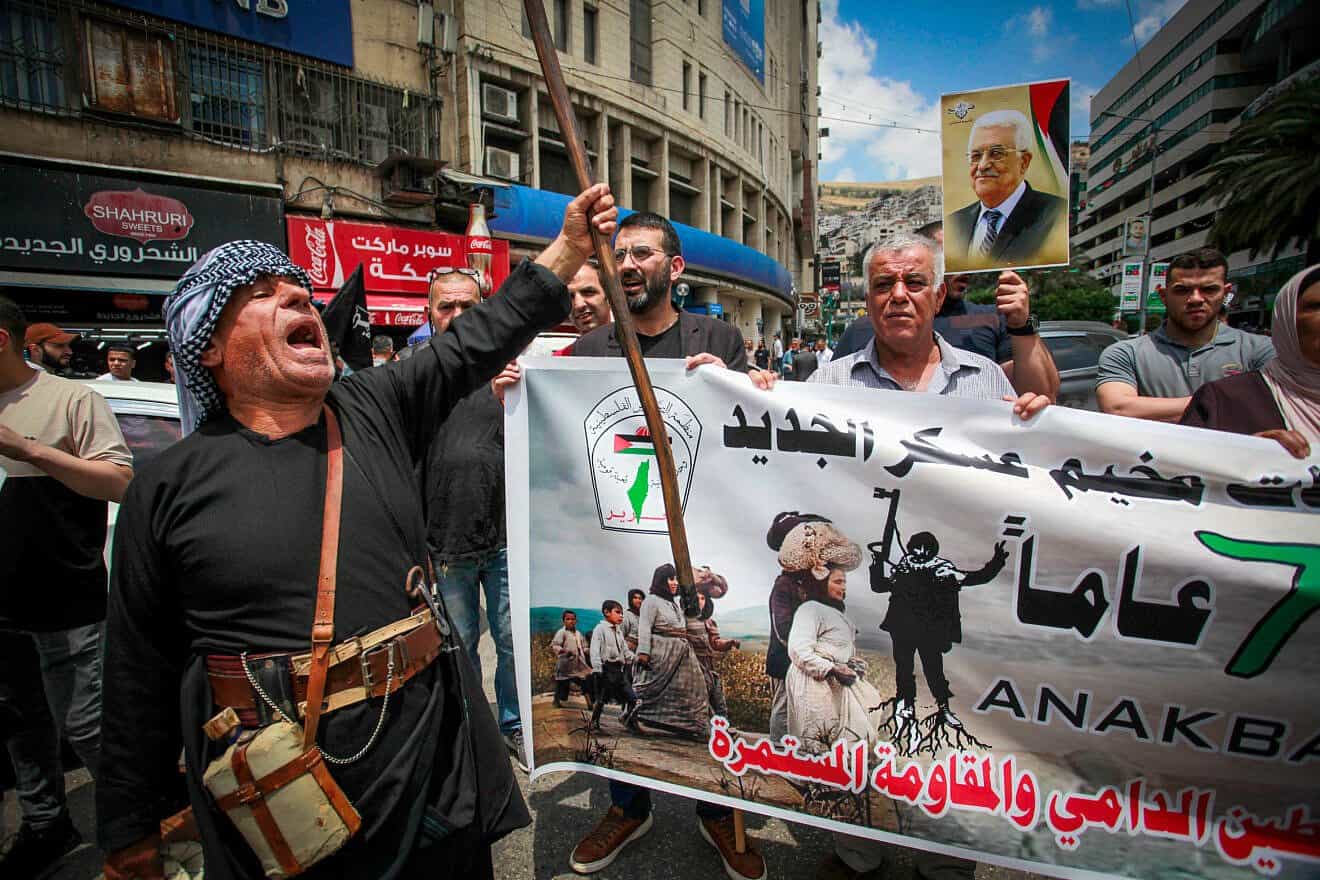 Palestinian protesters march during a rally marking the anniversary of the “nakba” in the West Bank city of Nablus, May 15, 2024. Photo by Nasser Ishtayeh/Flash90.
A smattering of Arabic words has entered the English language in recent years, the direct result of more than a century of conflict between the Zionist movement and Arab regimes determined to prevent the Jews from exercising self-determination in their historic homeland.
These words include fedayeen, which refers to the armed Palestinian factions; intifada, which denotes successive violent Palestinian uprisings against Israel; and naksa, which pertains to the defeat sustained by the Arab armies in their failed bid to destroy Israel during the June 1967 war.
At the top of this list, however, is nakba, the word in Arabic for “disaster” or “catastrophe.” The emergence of the Palestinian refugee question following Israel’s 1948-49 War of Independence is now widely described as “The Nakba,” and the term has become a stick wielded by anti-Zionists to beat Israel and, increasingly, Jews outside.
Last Thursday, a date which the U.N. General Assembly has named for an annual “Nakba Day,” workers at a cluster of Jewish-owned businesses in the English city of Manchester arrived at the building housing their offices to find that it had been badly vandalized overnight. The front of the building, located in a neighborhood with a significant Jewish community, was splattered with red paint. An external wall displayed the crudely painted words “Happy Nakba Day.”
The culprits were a group called Palestine Action, a pro-Hamas collective of activists whose sole mission is to intimidate the Jewish community in the United Kingdom in much the same way as Sir Oswald Mosley’s British Union of Fascists did back in the 1930s. Its equivalents in the United States are groups like Within Our Lifetime and Students for Justice in Palestine, who have shown themselves equally enthused when it comes to intimidating Jewish communities by conducting loud, sometimes violent, demonstrations outside synagogues and other communal facilities, all too frequently showering Jews with the kind of abuse that was once the preserve of neo-Nazis. These thugs, cosplaying with keffiyehs instead of swastika armbands, can reasonably be described as the neo-neo-Nazis.
The overarching point here is that ideological constructs like nakba play a key role in enabling the intimidation they practice. It allows them to diminish the historic victimhood of the Jews, born of centuries of stateless disempowerment, with dimwitted formulas equating the nakba with the Nazi Holocaust. It also enables them to camouflage hate speech and hate crimes as human-rights advocacy—a key reason why law enforcement, in the United States as well as in Canada, Australia and most of Europe, has been found sorely wanting when it comes to dealing with the surge of antisemitism globally.
Part of the response needs to be legislative. That means clamping down on both sides of the Atlantic on groups that glorify designated terrorist organizations by preventing them from fundraising; policing their access to social media; and restricting their demonstrations to static events in a specific location with a predetermined limit on attendees, rather than a march that anyone can join, along with an outright ban on any such events in the environs of Jewish community buildings.
These are not independent civil society organizations, as they pretend to be, but rather extensions of terrorist organizations like Hamas and—in the case of Samidoun, another group describing itself as a “solidarity” organization—the Popular Front for the Liberation of Palestine. If we cannot ban them outright, we need to contain them much more effectively. We can start by framing the issue as a national security challenge and worry less about their “freedom of speech.”
But this is also a fight that takes us into the realm of ideas and arguments. We need to stop thinking about the nakba as a Palestinian narrative of pain deserving of empathy by exposing it for what it is—another tool in the arsenal of groups whose goal is to bring about the elimination of Israel as a Jewish state.
When it was originally introduced in the late 1940s, the word nakba had nothing to do with the plight of the Palestinian refugees or their dubious claim to be the uninterrupted, indigenous inhabitants of a land seized by dispossessing foreign colonists. Popularized by the late Syrian writer Constantine Zureik in a 1948 book titled The Meaning of Disaster, the nakba described therein was, as the Israeli scholar Shany Mor has crisply pointed out, simply “the failure of the Arabs to defeat the Jews.”
Zureik was agonized by this defeat, calling it “one of the harshest of the trials and tribulations with which the Arabs have been inflicted throughout their long history.” His story is fundamentally a story of national humiliation and wounded pride. Yet there is absolutely no reason why Jews should be remotely troubled by the neurosis it projects. Their defeat was our victory and our liberation, and we should unreservedly rejoice in that fact.
The only aspect of the nakba that we should worry about is the impact it has on us as a community, as well as on the status of Israel as a sovereign member of the international society of states. As Mizrahi Jews know well (my own family among them), the nakba assembled in Zureik’s imagination really was a “catastrophe”— for us. Resoundingly defeated on the battlefield by the superior courage and tactical nous of the nascent Israeli Defense Forces, the Arabs compensated by turning on the defenseless Jews in their midst. From Libya to Iraq, ancient and established Jewish communities were the victims of a cowardly, spiteful policy of expropriation, mob violence and expulsion.
The inheritors of that policy are the various groups that compose the Palestinian solidarity movement today. Apoplectic at the realization that they have been unable to dislodge the “Zionists”—and knowing now that the main consequence of the Oct. 7, 2023 pogrom in Israel has been the destruction of Gaza—they, too, have turned on the Jews in their midst.
They have done so with one major advantage that the original neo-Nazis never had: sympathy and endorsement from academics, celebrities, politicians and even the United Nations. Indeed, the world body hosted a two-day seminar on “Ending the Nakba” at its New York headquarters at the same time that pro-Hamas fanatics were causing havoc just a few blocks downtown. Even so, we should take heart at the knowledge that nakba is not so much a symbol of resistance as it is defeat. Just as the rejectionists and eliminationists have lost previous wars through a combination of political stupidity, diplomatic ineptitude and military flimsiness, so, too, can they lose this one.
 Ben Cohen is a senior analyst with the Foundation for the Defense of Democracies (FDD) and director of FDD’s rapid response outreach, specializing in global antisemitism, anti-Zionism and Middle East/European Union relations. A London-born journalist with 30 years of experience, he previously worked for BBC World and has contributed to Commentary, The Wall Street Journal, Tablet and Congressional Quarterly. He was a senior correspondent at The Algemeiner for more than a decade and is a weekly columnist for JNS. Cohen has reported from conflict zones worldwide and held leadership roles at the Anti-Defamation League and the American Jewish Committee. His books include Some of My Best Friends: A Journey Through 21st Century Antisemitism.
Zawartość publikowanych artykułów i materiałów nie reprezentuje poglądów ani opinii Reunion’68,
ani też webmastera Blogu Reunion’68, chyba ze jest to wyraźnie zaznaczone.
Twoje uwagi, linki, własne artykuły lub wiadomości prześlij na adres:
webmaster@reunion68.com

