Archive | 2026/09/06

Zbliżają się wybory w Izraelu. Wszystko, co musimy wiedzieć o głosowaniu

Typowany na następnego premiera Izraela Gadi Eisenkot – były szef sztabu izraelskiej armii. Izrael, 17.08.2026. (Fot. REUTERS/Amir Cohen)


Zbliżają się wybory w Izraelu. Wszystko, co musimy wiedzieć o głosowaniu

Marta Urzędowska


W październiku Izraelczycy będą wybierać parlament. Sondaże wskazują, że Benjamin Netanjahu, który jest premierem już po raz szósty, może stracić władzę.

Zgłaszanie kandydatów do październikowych wyborów potrwa do 8 września. Sondaże wskazują, że Benjamin Netanjahu przegra. Kto ma szanse na wygraną, co jest najważniejszym tematem kampanii wyborczej i jak ważne będą wybory dla Izraela i świata?

Czy Netanjahu ma szanse utrzymać się u władzy?

Niewielkie. Wybory są uznawane za formę referendum poparcia dla premiera, a Netanjahu naraził się Izraelczykom w ważnych kwestiach:

  • Nie powołał komisji śledczej, która wyjaśniłaby dlaczego izraelskie służby dopuściły do ataku Hamasu.
  • Prowadzi trzy wojny: w Strefie Gazy, Libanie i Iranie, które nie poprawiają bezpieczeństwa Izraela i mogą się ciągnąć latami.
  • Rząd Netanjahu ograniczył niezależność sądów, dlatego jeszcze przed atakiem Hamasu i wojną w Gazie setki tysięcy Izraelczyków co tydzień wychodziły na ulice protestując przeciwko planom rządu.

W 2022 r. Netanjahu, który półtora roku wcześniej stracił władzę, ponownie zdobył większość i utworzył skrajnie prawicowy i nacjonalistyczny, najmniej demokratyczny rząd w historii Izraela. Jego partia Likud miała 32 miejsca w  Knesecie, dziś sondaże dają jej o dziesięć mniej. Do tego sam premier jest w konflikcie z prawem – w kraju jest sądzony w trzech osobnych procesach o korupcję, a Międzynarodowy Trybunał Karny wydał nakaz aresztowania go za domniemane zbrodnie wojenne w Gazie.

W koalicji rządzącej poza Likudem jest dziś partia osadników Religijny Syjonizm ministra finansów Bezalela Smotricza i skrajnie prawicowa Żydowska Siła ministra bezpieczeństwa narodowego Itamara Ben-Gwira. Ultraortodoksyjne partie Zjednoczony Judaizm Tory i Szas opuściły rząd w 2024 r., ale nadal wspierają go z zewnątrz głosując za budżetem i kluczowymi ustawami.

Czy sytuacja polityczna w Izraelu jest stabilna?

Choć wybory do liczącego 120 miejsc Knesetu teoretycznie odbywają się co cztery lata, rzadko zdarza się, żeby parlament przetrwał pełną kadencję. Mandaty rozdzielane są proporcjonalnie krajowym listom partyjnym, które przekraczają próg 3,25 proc. głosów w skali kraju, co odpowiada minimum czterem mandatów. Pojedyncza partia nigdy nie uzyskała samodzielnej większości, rządy tworzone są koalicyjnie, co daje mniejszym partiom wpływ na to kto zostanie premierem.

Netanjahu, żeby utrzymać się przy władzy, musiał spełniać żądania partii ultraortodoksyjnych Żydów, co zmusiło go do zwolnienia ortodoksów z obowiązkowej służby wojskowej. Wywołuje to w kraju ogromne emocje. Szczególnie dziś, kiedy w Strefie Gazy trwa wojna, Izraelczycy mają dość sytuacji, w której ich dzieci giną na froncie, a ortodoksi muszą jedynie modlić się i czytać Torę.

Izraelski czołg jedzie wzdłuż linii zawieszenia broni między okupowanymi przez Izrael Wzgórzami Golan a Syrią, po stronie izraelskiej.

Izraelski czołg jedzie wzdłuż linii zawieszenia broni między okupowanymi przez Izrael Wzgórzami Golan a Syrią, po stronie izraelskiej. Fot. REUTERS/Ayal Margolin

Jest ktoś, kto może poważnie zagrozić Netanjahu?

Choć sondaże wróżą Netanjahu porażkę, nie wskazują wyraźnie zwycięzcy. Poparcie zyskuje Gadi Eisenkot – były szef sztabu izraelskiej armii, który dla Izraelczyków jest wiarygodny choćby z tego powodu, że jego syn i dwaj siostrzeńcy zginęli, walcząc w Strefie Gazy, podczas gdy syn Netanjahu spędza wojnę na Florydzie.

Do tego Eisenkot, syn imigrantów z Maroka, przedstawiany jest w kampanii jako człowiek uczciwy, podczas gdy obecny premier unika odpowiedzialności karnej. Eisenkot w swoim programie zapewnia, że przywróci w kraju bezpieczeństwo, jedność i instytucje demokratyczne Izraela. Jego partia to Jaszar (hebr. „uczciwy” lub „prosty”).

Kandydat obiecuje, że – jeśli wygra – powoła komisję śledczą, która wyjaśni, jak izraelskie służby dopuściły do ataku. Zapowiada też, że rozszerzy obowiązkową służbę wojskową na ortodoksów i Arabów. Ostro krytykował w kampanii decyzję Netanjahu by pozwolić ortodoksom nadal unikać służby „w czasie brutalnej wojny, gdy najlepsi synowie i córki narodu walczą na wszystkich frontach”.

Czy są inni poważni kandydaci?

Do wyścigu z Netanjahu stają też dwaj byli premierzy – Naftali Bennett i Yair Lapid, którzy nie pierwszy raz próbują odsunąć go od władzy. Kiedy w 2021 r. zawarli sojusz, Netanjahu stracił władzę, a ich rząd złożony z partii liberalnych i konserwatywnych, do którego weszła też partia arabska, przetrwał półtora roku. Dziś ich sojusz – Razem – ponownie rzuca premierowi wyzwanie. Choć w sondażach wypada nieźle, nie ma tak mocnej pozycji jak Eisenkot.

Do wyborów staje też Nasz Dom Izrael – partia Awigdora Liebermana, byłego ministra obrony i dawnego sojusznika Netanjahu. Przez ponad trzy dekady pełnił kluczowe funkcje w rządach – był  ministrem obrony, spraw zagranicznych i finansów. To kandydat poważny, ale ma mniejsze szanse niż Eisenkot.

Jak wypadają poszczególne partie w sondażach?

Najnowszy sondaż dla Kanału 12 z 25 sierpnia 2026 r. wskazuje na następujące rozłożenie szans wśród najważniejszych ugrupowań:

  • Jaszar (Gadi Eisenkot): 24 mandaty
  • Likud (Benjamin Netanjahu): 22 mandaty
  • Razem (Naftali Bennett i Jair Lapid): 15 mandatów
  • Demokraci (Jair Golan): 11 mandatów
  • Nasz Dom Izrael (Awigdor Lieberman): 9 mandatów

Jeśli chodzi o dwóch głównych rywali, w tym samym badaniu 43 proc. respondentów uznało Eisenkota za najbardziej odpowiedniego kandydata na premiera. Tylko 34 proc. uznało, że jest nim Netanjahu.

Benjamin Netanjahu

Benjamin Netanjahu Fot. REUTERS/Ohad Zwigenberg

Jak ważne są prowadzone dziś wojny w kontekście wyborów?

Choć sondaże pokazują, że Izraelczycy są zmęczeni po trzech latach nieustannych wojen, jednocześnie opowiadają się za ich kontynuowaniem, bo nie widzą innej drogi.  

Partia Likud w czasie kampanii chętnie odwoływała się do wojennej retoryki, obiecując Izraelczykom „całkowite zwycięstwo” na wszystkich frontach. Podobnie Demokraci podkreślają, że ich najlepsi kandydaci wywodzą się z armii.

Także Eisenkot podkreśla swoje wojskowe pochodzenie zapewniając, że będzie lepszy w rządzeniu Izraelem od cywilów, bo zna się na bezpieczeństwie. Przekonuje, że ma pomysł na „nową doktrynę bezpieczeństwa”, która „umocni armię i granice Izraela”. Obiecuje też, że będzie chronił niezależność sądów, pilnował rządów prawa i wolności mediów.

Wybory przyniosą Izraelowi polityczną stabilność?

To mało prawdopodobne. Partii, które przekroczą próg wyborczy, jest dużo, co oznacza rozdrobnienie. Na razie opozycja wydaje się mocniejsza niż partie obecnej koalicji, jednak jest też mocno podzielona – partie syjonistyczne nie chcą zawiązać sojuszu z ugrupowaniami arabskimi, co sprawia, że trudno będzie opozycji zdobyć większość w Knesecie.

W jednej kwestii partie opozycji są zgodne – nie chcą wchodzić w koalicję z Netanjahu. Zgodnie chcą też utworzenia komisji śledczej w sprawie ataku Hamasu i poboru ortodoksów do armii.

Jednocześnie opozycja próbuje na ostatnią chwilę przesunięć, które mają zwiększyć jej szanse. W ostatnich dniach Mansur Abbas, lider arabskiej partii Raam (Zjednoczona Lista Arabska), dał drugie po sobie miejsce na liście kandydatów swojej partii Joawowi Segalowitzowi, znanemu syjoniście, weteranowi izraelskiej armii, który blisko trzydzieści lat pracował w policji i był wiceministrem ds. bezpieczeństwa narodowego. Wcześniej do arabskich partii należeli tylko Żydzi ze skrajnie lewicowych środowisk, podczas gdy Segalowitz należy do otwarcie syjonistycznej partii Jesz Atid.

W każdym pokoleniu przychodzi moment, kiedy strach i nadzieja stoją razem w jednym pomieszczeniu. Dziś wieczorem, w tym pokoju, wygrała nadzieja

– zachwalał Abbas, stojąc obok Segalowitza na konferencji prasowej. – Witaj Joaw, mamy robotę do wykonania – dodał.

Bez poparcia partii Raam opozycja nie zdobędzie wystarczającej liczby mandatów by odsunąć Netanjahu od władzy.

Segalowitz cieszy się poparciem arabskich Izraelczyków, bo skutecznie walczy z przestępczością w arabskich społecznościach. W ostatnich latach jako zastępca ministra zmniejszył liczbę zabójstw o 16 proc., a strzelanin o 30 proc. Arabowie stanowią jedną piątą mieszkańców Izraela.

Jakie są najważniejsze tematy w kampanii wyborczej?

Przyszłość Benjamina Netanjahu na stołku premiera, bezpieczeństwo – w kontekście wojen w Strefie Gazy, Libanie i Iranie, kwestia zwolnienia ortodoksów z służby wojskowej, utworzenie komisji śledczej w sprawie 7 października 2023. Kwestia Palestyńczyków – ewentualnego utworzenia w przyszłości palestyńskiego państwa – dziś jest na dalekim planie. A po atakach Hamasu Izraelczycy przestali wierzyć w pokojowe rozwiązanie bliskowschodniego konfliktu.


Redagował Michał Olszewski


Zawartość publikowanych artykułów i materiałów nie reprezentuje poglądów ani opinii Reunion’68,
ani też webmastera Blogu Reunion’68, chyba ze jest to wyraźnie zaznaczone.
Twoje uwagi, linki, własne artykuły lub wiadomości prześlij na adres:
webmaster@reunion68.com

Hamas Has No Intention of Disarming — So Why Is the US Still Negotiating?


Hamas Has No Intention of Disarming — So Why Is the US Still Negotiating?

Khaled Abu Toameh


  • Hamas official Osama Hamdan recently said, “No one said that we will hand over our weapons.” According to Hamdan, the word “hand over” was never part of the agreement his terrorist group reached with the mediators. Instead, Hamdan said, the agreed framework calls for the “containment and storage” of Hamas’s heavy weapons. He added that this would be carried out by the Palestinian Committee for the Administration of Gaza and the Palestinian “resistance factions.”
  • Hamas… is talking about keeping its weapons.
  • When [senior Hamas official Ghazi] Hamad’s interviewer asked him, “Does that mean the annihilation of Israel?,” Hamad responded, “Yes, of course.”
  • Hamas cannot have it both ways. It cannot demand an end to Israel’s military presence in Gaza while simultaneously insisting on retaining the weapons that it has used — and clearly plans to use again — to attack Israel. The victims of Hamas’s weapons have a say in the matter too.
  • The question is not who gets to decide what happens to Hamas’s weapons. The question is why Hamas should be allowed to keep them at all.
  • Hamas is essentially saying: First give us political power and remove Israelis forces from the Gaza Strip. Afterward, we may discuss what happens to our weapons.
  • Hamas’s laying down its weapons and relinquishing its political and military control over the Gaza Strip must be unconditional. Hamas is a terrorist organization that launched the October 7, 2023 invasion and massacre. It is not a sovereign state entitled to negotiate the terms of its own disarmament.
  • Trump’s 20-Point Gaza Peace Plan calls for the “demilitarization” of the Gaza Strip and the “decommissioning” of weapons. Point 13 states:
  • “Hamas and other factions agree to not have any role in the governance of Gaza, directly, indirectly, or in any form. All military, terror, and offensive infrastructure, including tunnels and weapon production facilities, will be destroyed and not rebuilt. There will be a process of demilitarization of Gaza under the supervision of independent monitors, which will include placing weapons permanently beyond use through an agreed process of decommissioning, and supported by an internationally funded buy back and reintegration program all verified by the independent monitors.”
  • Yet somehow, nearly three years after October 7, the discussion has apparently moved from demilitarization and decommissioning to “containment” and “storage.”
  • Who will guarantee that Hamas terrorists will not simply take them out of storage when they decide that the time has come to resume their jihad (holy war) against Israel?
  • Would the new Palestinian Committee for the Administration of Gaza really be capable of preventing Hamas and other terrorist groups from accessing these weapons? Would foreign troops… be expected to stand guard over weapons belonging to terrorist organizations and prevent them from storming the warehouses?
  • Was al-Qaeda ever asked to “contain” its weapons? Was ISIS ever asked to “store” its weapons? Terrorist organizations are supposed to be disarmed. Their weapons are supposed to be confiscated and destroyed. There is no legitimate reason for Hamas or any other Palestinian terrorist faction to possess weapons either in the Gaza Strip or in any other territory.
  • Palestinians do not need rockets, explosive drones and anti-tank missiles to build a better future. They need economic development and accountable institutions.
  • Why are the United States and other mediators talking to Hamas about elections when the organization has not even agreed to genuine disarmament?
  • Time is on Hamas’s side, or so its leaders might calculate. US presidents come and go. Administrations change. International attention shifts. Why surrender weapons today if Hamas can simply wait and see who occupies the White House tomorrow?
  • Allowing Hamas-affiliated candidates to participate in Palestinian elections while it retains its weapons would create the absurd situation of a terrorist organization being permitted to transform its military power into political power — a perfect recipe for legitimizing Hamas.
  • So why is Washington still negotiating the terms? Striking deals with Islamist terrorist organizations is not a substitute for enforcing their disarmament. Agreements that allow terrorists to keep their weapons are not worth the paper on which they are written.
  • Hamas must be eliminated as a political and military entity. Its weapons must be confiscated or destroyed, not “stored”, “contained,” or hidden. Until that happens, Hamas remains armed, Iran remains influential, and the threat of another October 7 massacre — or more — remains in the works.

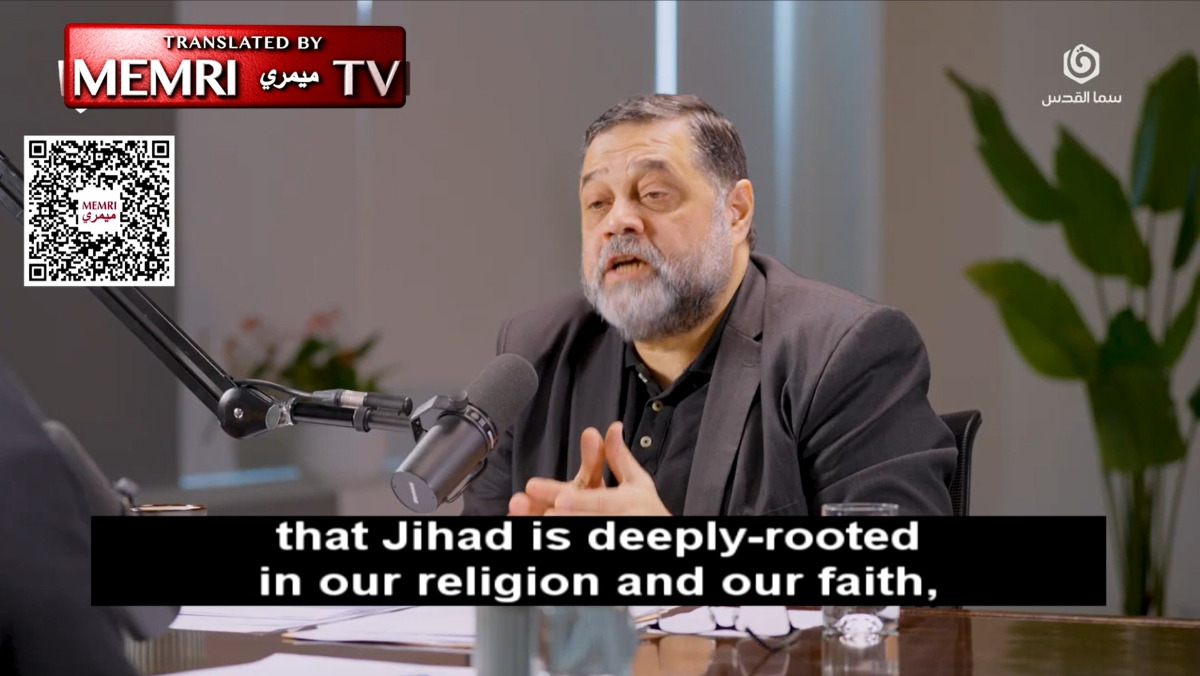
Hamas official Osama Hamdan said, “No one said that we will hand over our weapons.” According to Hamdan, the word “hand over” was never part of the agreement his terrorist group reached with the mediators. Instead, Hamdan said, the agreed framework calls for the “containment and storage” of Hamas’s heavy weapons. Hamas’s laying down its weapons and relinquishing its political and military control over the Gaza Strip must be unconditional. Hamas is a terrorist organization that launched the October 7, 2023 invasion and massacre. It is not a sovereign state entitled to negotiate the terms of its own disarmament. Pictured: Hamdan on a podcast on November 10, 2025. (Image source: MEMRI)

Hamas, like its long-time benefactor Iran, has once again made its position unmistakably clear: It has no intention of surrendering its weapons, abandoning its armed “resistance” against Israel, or relinquishing control over the Gaza Strip.

If anyone in Washington or elsewhere still believes that Hamas has agreed to disarm under the Gaza peace plan presented by US President Donald J. Trump and his Board of Peace, they should listen carefully to what Hamas officials themselves are saying.

Two recent interviews with senior Hamas officials leave little room for doubt.

Hamas official Osama Hamdan said, “No one said that we will hand over our weapons.” According to Hamdan, the word “hand over” was never part of the agreement his terrorist group reached with the mediators. Instead, Hamdan said, the agreed framework calls for the “containment and storage” of Hamas’s heavy weapons. He added that this would be carried out by the Palestinian Committee for the Administration of Gaza and the Palestinian “resistance factions.”

Most revealingly, Hamdan declared: “Not a single bullet will leave the Gaza Strip according to this agreement [with the Board of Peace representatives].” He also insisted that no weapons would be handed over to a non-Palestinian party and that “the weapons will remain in the hands of the Palestinians.”

Hamas is not talking about disarmament. It is talking about keeping its weapons. This discussion is not actually about semantics. It goes to the heart of whether Hamas is prepared to abandon terrorism and, in particular, its decades-old goal of destroying Israel.

Hamas’s position was reinforced by Khaled Qaddoumi, the terrorist organization’s representative in Iran. In an interview published by Iran’s Islamic Republic News Agency, Qaddoumi made clear that Hamas regards weapons as essential to its struggle against Israel. He rejected the idea that the question of weapons should even be discussed before Israel’s military presence in the Gaza Strip ends. “The question of weapons, whether heavy or light, has nothing to do with Israel,” Qaddoumi said. “Only the Palestinians will decide on it.”

Qaddoumi’s claim that the weapons “have nothing to do with Israel” is particularly revealing. Hamas’s weapons are not being stockpiled to fight Canada, Australia, or some other distant country. They are weapons that Hamas has used, and openly intends to use, against Israel. As senior Hamas official Ghazi Hamad vowed soon after the group’s October 7, 2023 invasion of Israel:

“The Al-Aqsa Flood [Palestinian name for the October 7 attack] is just the first time And there will be a second, third and fourth. We must teach Israel a lesson and we will do this again and again…”

When Hamad’s interviewer asked him, “Does that mean the annihilation of Israel?,” Hamad responded, “Yes, of course.”

Rockets, anti-tank missiles, explosives, and firearms are not abstract “Palestinian internal matters.” They are the very weapons with which Hamas has attacked Israeli civilians and soldiers.

Qaddoumi’s formulation is also a reminder of the fundamental problem with the current approach to Hamas. The terrorist group wants the international community to recognize its political claims while treating its military arsenal as an internal Palestinian issue.

Hamas cannot have it both ways. It cannot demand an end to Israel’s military presence in Gaza while simultaneously insisting on retaining the weapons that it has used — and clearly plans to use again — to attack Israel. The victims of Hamas’s weapons have a say in the matter too.

The question is not who gets to decide what happens to Hamas’s weapons. The question is why Hamas should be allowed to keep them at all.

Qaddoumi argued that a Palestinian political framework and a new Palestinian government must first be established. Only afterward, he said, could Palestinians decide whether their weapons should be collected.

This is exactly the opposite of disarmament. Hamas is essentially saying: First give us political power and remove Israelis forces from the Gaza Strip. Afterward, we may discuss what happens to our weapons.

Why should the surrender of weapons be conditional on anything?

Hamas’s laying down its weapons and relinquishing its political and military control over the Gaza Strip must be unconditional. Hamas is a terrorist organization that launched the October 7, 2023 invasion and massacre. It is not a sovereign state entitled to negotiate the terms of its own disarmament.

Trump’s 20-Point Gaza Peace Plan calls for the “demilitarization” of the Gaza Strip and the “decommissioning” of weapons. Point 13 states:

“Hamas and other factions agree to not have any role in the governance of Gaza, directly, indirectly, or in any form. All military, terror, and offensive infrastructure, including tunnels and weapon production facilities, will be destroyed and not rebuilt. There will be a process of demilitarization of Gaza under the supervision of independent monitors, which will include placing weapons permanently beyond use through an agreed process of decommissioning, and supported by an internationally funded buy back and reintegration program all verified by the independent monitors.”

Yet somehow, nearly three years after October 7, the discussion has apparently moved from demilitarization and decommissioning to “containment” and “storage.”

Can someone on the Board of Peace explain what “containment” means? Does it mean Hamas will hide its weapons in closets or under terrorists’ beds? Does it mean the weapons can be displayed in public only after dark?

Also, what exactly does “storage” mean? “Storage” for what purpose? Are Hamas’s weapons being stored so they can be used at some future date to murder more Israelis and launch more October 7-style massacres?

Where should these weapons be stored? In warehouses? In tunnels? In facilities controlled by the new Palestinian administration? Who will guarantee that Hamas terrorists will not simply take them out of storage when they decide that the time has come to resume their jihad (holy war) against Israel?

Would the new Palestinian Committee for the Administration of Gaza really be capable of preventing Hamas and other terrorist groups from accessing these weapons? Would foreign troops, whether from Uganda, Morocco, or elsewhere, be expected to stand guard over weapons belonging to terrorist organizations and prevent them from storming the warehouses?

The entire concept is difficult to take seriously. Was al-Qaeda ever asked to “contain” its weapons? Was ISIS ever asked to “store” its weapons? Terrorist organizations are supposed to be disarmed. Their weapons are supposed to be confiscated and destroyed. There is no legitimate reason for Hamas or any other Palestinian terrorist faction to possess weapons either in the Gaza Strip or in any other territory.

Palestinians do not need rockets, explosive drones and anti-tank missiles to build a better future. They need economic development and accountable institutions.

Weapons have brought catastrophe after catastrophe to Palestinians and the Arab world. They helped turn Jordan and Lebanon into battlefields and rubble. Heavily armed Palestinian factions confronted the Jordanian army, culminating in the 1970-71 “Black September” conflict, prompting King Hussein’s forces to reassert their authority over the Jordanian state. In Lebanon, Palestinian organizations ignited the country’s descent into civil war in 1975, while subsequently becoming deeply intertwined with Lebanon’s government, its internal conflicts and its confrontation with Israel. The Gaza Strip should not be given another opportunity to repeat this history.

Hamas’s statements also expose another important problem: the group’s strategic relationship with the Iranian regime.

Qaddoumi openly portrayed Iran and Hamas as sharing a common enemy and a common destiny. “Today, we in Palestine and Iran have much in common, and we have come to understand that we have the same enemy,” he said. He went on to praise Iran’s regime for providing “strong strategic support” to Palestinian “resistance movements.”

Hamas has long been part of Iran’s regional network of armed groups. Qaddoumi’s comments are a reminder that the issue of Hamas’s weapons cannot be separated from Iran’s strategy of using armed proxies to wage war against Israel and the United States.

The Iranian regime has perfected the strategy of buying time, delaying, negotiating, and exploiting diplomatic processes while preserving its military capabilities and those of its proxies. Hamas appears to be following the same playbook.

Hamas, like its benefactors in Iran, may well believe that its best strategy is to drag out negotiations for as long as possible, at least until Trump is no longer president and someone more accommodating might take his place. Time is on Hamas’s side, or so its leaders might calculate. US presidents come and go. Administrations change. International attention shifts. Why surrender weapons today if Hamas can simply wait and see who occupies the White House tomorrow?

This strategy may also explain why Hamas is so interested in the Palestinian parliamentary elections, scheduled for November 28, 2026. Why are the United States and other mediators talking to Hamas about elections when the organization has not even agreed to genuine disarmament?

Allowing Hamas-affiliated candidates to participate in Palestinian elections while it retains its weapons would create the absurd situation of a terrorist organization being permitted to transform its military power into political power — a perfect recipe for legitimizing Hamas.

The United States and its allies should not allow themselves to be trapped by Hamas’s terminology.

Hamdan’s declaration that “not a single bullet” will leave the Gaza Strip should be enough to settle the matter. Hamas is telling the world exactly what it intends to do: keep its weapons. Qaddoumi is saying essentially the same thing while openly celebrating Hamas’s strategic alliance with Iran.

So why is Washington still negotiating the terms? Striking deals with Islamist terrorist organizations is not a substitute for enforcing their disarmament. Agreements that allow terrorists to keep their weapons are not worth the paper on which they are written.

There is only one viable solution for the Gaza Strip: Hamas must be eliminated as a political and military entity. Its weapons must be confiscated or destroyed, not “stored”, “contained,” or hidden. Until that happens, Hamas remains armed, Iran remains influential, and the threat of another October 7 massacre — or more — remains in the works.


Khaled Abu Toameh is an award-winning journalist based in Jerusalem.


Zawartość publikowanych artykułów i materiałów nie reprezentuje poglądów ani opinii Reunion’68,
ani też webmastera Blogu Reunion’68, chyba ze jest to wyraźnie zaznaczone.
Twoje uwagi, linki, własne artykuły lub wiadomości prześlij na adres:
webmaster@reunion68.com


New Nonprofit Publishing Company for Jewish, Israeli, Zionist Writers Welcomes Submissions


New Nonprofit Publishing Company for Jewish, Israeli, Zionist Writers Welcomes Submissions

Shiryn Ghermezian


A group of people reading. Photo: Wikimedia Commons

A new nonprofit press that will focus on publishing adult fiction and nonfiction by Jewish, Israeli, and Zionist writers launched on Wednesday and is now taking submissions.

Canary Publishing welcomes writers who feel their work has been dropped, canceled, rejected, or ignored simply being of its Jewish, Zionist, or Israel-related subject matter since the Hamas-led terrorist attack in Israel on Oct. 7, 2023.

Canary Publishing is the “home for authentic Jewish voices,” and is looking for submissions that “reflect the breadth of Jewish thought and experience,” as stated on its website. “Like the canary in the coal mine, how a society treats its Jews is the warning sign: When our voices go quiet, the air has turned dangerous for everyone. We consider it our duty to fill the world with fiction and nonfiction that reflect the breadth of Jewish thought and creativity. We especially favor work that has been canceled by the mainstream literary world. We can say yes when they say no.”

Canary Publishing editor-in-chief Howard Lovy has worked as an editor in journalism and book publishing for 40 years and has written extensively about Jewish voices in literature being sidelined following the Oct. 7 massacre. During his experiences editing Jewish authors, Lovy said he met writers who have been marginalized but also grassroots Jewish groups — such as book clubs and reader communities — that rallied in response to support those who feel like they’ve been cast aside. Canary Publishing was created to support those writers who need a press, and the community who wants to read their work.

“The mainstream publishing industry has decided that some Jewish stories are too inconvenient to publish,” Lovy said. “We believe now is exactly the time. There is a growing grassroots movement of Jewish readers, writers, and communities that refuses to be silenced — and Canary Publishing is its press.”

Guidelines for submissions are explained on the Canary Publishing website. The publishing company operates as a traditional publisher by offering advances and royalties to writers.


Zawartość publikowanych artykułów i materiałów nie reprezentuje poglądów ani opinii Reunion’68,
ani też webmastera Blogu Reunion’68, chyba ze jest to wyraźnie zaznaczone.
Twoje uwagi, linki, własne artykuły lub wiadomości prześlij na adres:
webmaster@reunion68.com