 US forces down Iranian missiles and drones across Gulf region
Joshua Marks
CENTCOM said all Iranian attacks failed as the U.S. intercepted strikes on Kuwait and Bahrain and hit a drone site on Qeshm Island.
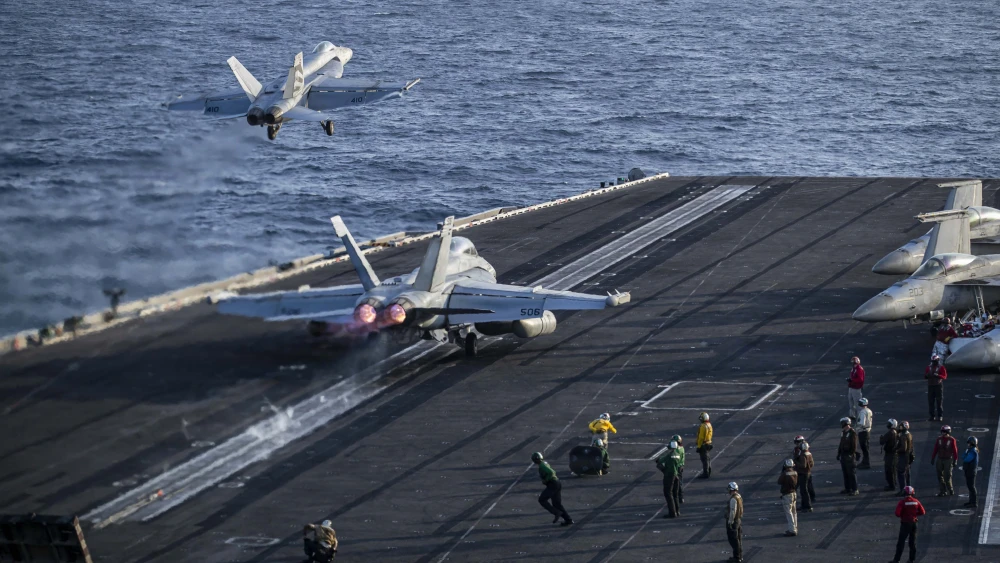 An F/A-18E Super Hornet assigned to Strike Fighter Squadron 151 and an EA-18G Growler assigned to Electronic Attack Squadron 133 launch from the flight deck of the Nimitz-class aircraft carrier USS Abraham Lincoln in the U.S. 5th Fleet area of operations, May 9, 2026. U.S. Navy photo by NAVCENT Public Affairs.
Central Command said early on Wednesday that American and partner forces had intercepted multiple Iranian missile and drone attacks across the Gulf region overnight, while also conducting retaliatory strikes and enforcing maritime restrictions.
According to CENTCOM, Iran launched several ballistic missiles toward regional targets late Tuesday into early Wednesday. Two missiles aimed at Kuwait failed mid-flight, while three others targeting Bahrain were intercepted by U.S. and Bahraini air defenses. Kuwaiti authorities confirmed air defenses were actively engaging incoming threats, and Bahrain’s Interior Ministry reported warning sirens were activated.
Kuwait’s Foreign Ministry announced that the Iranian attacks targeting its territory killed one person and injured several others. Health Ministry spokesperson Dr. Abdullah Al-Sanad later reported that at least 63 people were injured and “seven urgent major surgeries have been performed” since the “brutal Iranian attack on the State of Kuwait.”
In a statement, Kuwait City condemned the attacks “that once again targeted vital and civilian infrastructure, including Kuwait International Airport, killing one person and injuring others, in addition to causing damage to vital infrastructure including diplomatic missions.”
Kuwait’s civil aviation authority earlier on Wednesday declared a state of emergency at Kuwait International Airport following an Iranian attack involving drones and missiles that caused several injuries and extensive damage, officials said. Flights were suspended or diverted to other airports as authorities assessed the impact of the attack. Hostile drones struck the airport’s main passenger terminal (T1), damaging the building and injuring several individuals, according to a statement by Defense Ministry spokesman Saud Abdulaziz Al-Otaibi.
During the overnight hours, residents near Iran’s Qeshm Island reported explosions, according to the Iranian regime-aligned Mehr News Agency.
CENTCOM said U.S. forces had earlier shot down three Iranian drones targeting civilian maritime traffic and conducted a self-defense strike on an Iranian military ground control station on Qeshm Island.
In a statement posted at 2:57 a.m. local time, CENTCOM rejected Iranian Revolutionary Guard claims that U.S. positions, including the Fifth Fleet headquarters in Bahrain, had been successfully struck, calling the assertions false and stating that all Iranian attacks had failed.
At 4:26 a.m. local time, CENTCOM reported an additional wave of Iranian drones targeting U.S. forces in Kuwait. The drones were intercepted by air defenses, with no American casualties or damage reported.
Separately, CENTCOM said it had disabled a Botswana-flagged oil tanker, the M/T Lexie, on Tuesday after the vessel ignored repeated warnings and attempted to proceed toward Iran’s Kharg Island. A U.S. aircraft struck the ship’s engine room with a Hellfire missile, rendering it inoperable. The command said the action was part of an ongoing maritime blockade, under which six vessels have been disabled and 122 redirected since April.
CENTCOM said no U.S. personnel were harmed in the overnight incidents and that forces remain on high alert amid continued tensions despite an ongoing ceasefire.
Zawartość publikowanych artykułów i materiałów nie reprezentuje poglądów ani opinii Reunion’68,
ani też webmastera Blogu Reunion’68, chyba ze jest to wyraźnie zaznaczone.
Twoje uwagi, linki, własne artykuły lub wiadomości prześlij na adres:
webmaster@reunion68.com