Archives

Who Are The Jews Celebrating Christmas… in Israel?

Who Are The Jews Celebrating Christmas… in Israel?

Eetta Prince-Gibson

Shira Greenblatt, a secular Israeli Jew who was born and raised in Jerusalem, loves Christmas. “Every year I attend Christmas services at the Dormition Abbey on Mt. Zion in Jerusalem, and I will go again this year, too. It’s very special to learn about Christianity here, in Jerusalem. And I love the lights, the songs, and the majesty,” she enthused.

Greenblatt, 42, a secretary, is one of the thousands of Israeli Jews who attend Christmas festivities and religious services throughout the country. Christmas in Israel has become so popular that even Go Tel Aviv, a hip city guide, is offering an edition of The Five Top Places to Celebrate the Holiday Season in the Holy Land. “There is nothing like a beautiful Christmas tree to get into the atmosphere of the holiday season,” the guide advises, citing some of Israel’s best-lit trees and most inspiring masses.

In towns with a Christian majority, mostly located in northern Israel, Christmas is a public holiday. The Jewish National Fund provides Christmas trees for NIS 80 (about $23.00), and the Jerusalem municipality provides lighted decorations, “in areas where the holiday is observed,” according to a municipal announcement, referring to non-Jewish neighborhoods.

But for most Jewish and Muslim Israelis, Christmas is just another workday, with no religious, social or commercial impact. That suits some people just fine. “As an observant Jew who grew up in New York City, I am delighted that I don’t feel Christmas here,” said Benjie Cohen, 43, a businessman who lives in a religious neighborhood in Jerusalem. “Christmas shouldn’t be observed in the Jewish state.”

But many Israelis do not agree. “My grandparents, who came from Poland, are upset that I go to the Christmas service at the Dormition Abbey every year. They have terrible memories about Christmas,” said Matti Koller, 31, a Hebrew University student. “I don’t have any of those hang-ups. Judaism has its own simple beauty, but I love knowing about other religions, too.”

The Dormition Abbey holds a service in German (the Benedictine vernacular) earlier in the evening for its own parishioners, and invites the Jewish visitors for a midnight service held mostly in English, with some Hebrew.

“I probably have the distinction of being the only priest in the world who delivers a Christmas sermon to a mostly-Jewish audience,” said Father Nikodemus, a Benedictine monk at the Dormition Abbey, who’s in charge of the Christmas service. He estimates that about 1,000 Jews attend.
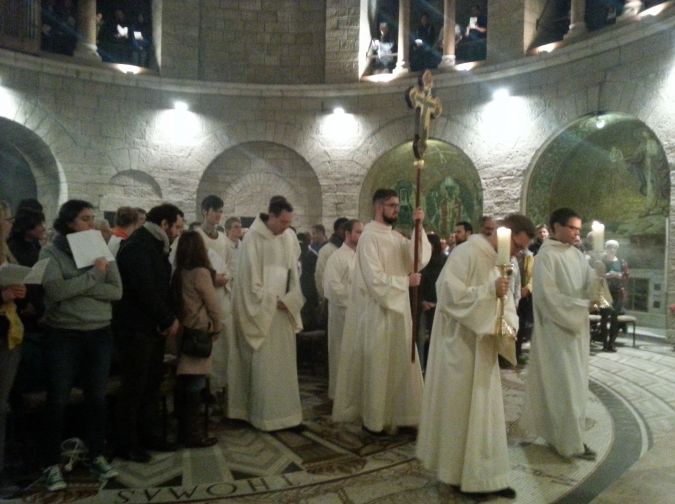
A Window On Mt. Zion / Monks filing into the service at the Dormition Abbey in the Christmas procession in the mostly-Jewish Israeli congregation.

In fact, there are so many visitors, that the “Window on Mount Zion” project, part of the non-profit Jerusalem Intercultural Center, enlists and trains dozens of Jewish volunteers to act as ushers at the service.He believes for many of the Jewish visitors, the hymn-singing is the height of the service. “They especially love to hear ‘Silent Night,’ sung in German,” he says. “I actually think it’s a bit kitschy – but if they like it, then we can sing it.”

Nikodemus is aware that Jesus can be difficult for Jews. “Christianity was not kind to the Jews. So every year, I say the same thing: I have no intention to missionize. I merely want to share our joy at the birth of Jesus. I know that most of the people in my church do not believe that Jesus is the son of God and the Messiah. But at least we can all agree with something Jesus said: ‘Love God and your neighbor as yourself.’”
After the service, at about 1 am, the monks invite the participants to a reception in the Abbey, with traditional Christmas cookies and candies.

“I am thankful to the Benedictines for inviting us,” Greenblatt said. “It’s terrible that because we are the majority, we ignore Christmas, which is so important to Christians here and throughout the world. The only thing we know about Christmas is from TV and movies. I want to learn first-hand.”

A few other Jerusalem churches open their doors to Jewish visitors on Christmas Eve, although many have limited their numbers, because “there were so many Jewish visitors that there wasn’t enough room for the members of our own congregations,” said a Protestant church official who asked not to be identified because “he didn’t want to offend the Jews who show an interest in Christianity. But there were just so many of them!”

The YMCA in West Jerusalem sponsors an annual Christmas Eve concert and a Christmas Bazaar, each of which is attended by hundreds of people, and its brightly lit tree is also a big attraction. “I bring my children here to see the tree every year,” says Merav Armoni, an elementary school teacher. “I love the colors, the excitement, the lights. Everything in Israel is so Jewish, just looking at the tree feels like I’m in Europe.”

“Jerusalem is the most international city in the world,” says YMCA director, Amos Gil. “We are proud when we help members of one religion learn about the others.”

For others, Christmas provides an opportunity for Jewish-Arab coexistence activities. The NGO Shared Tourism, for example, organized over a dozen tours to Shefar-Am, an Arab city in the Galilee. According to Noam Horowitz, Program Director for Shared Tourism, more than 800 people – almost all of them Israeli Jews – attended these events, which included visits to Christmas markets and local churches (and even an interfaith candle-lighting ceremony during Hanukkah in the ancient synagogue in Shefar-Am.)
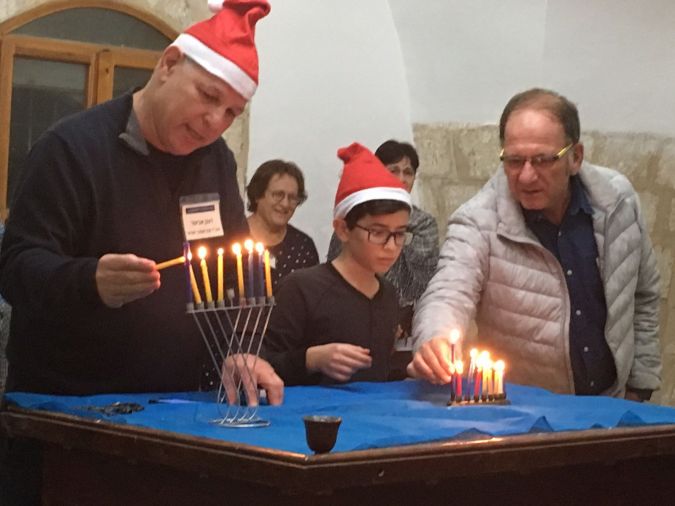
Shared Tourism / An interfaith candle-lighting ceremony in Shfar’am. Close to 800 Jews participated in the Christmas tour by “Shared Tourism,” a joint Arab-Jewish venture in the Galilee.

Hana Bendcowsky, a tour guide and program director of the Jerusalem Center for Jewish – Christian Relations (JCJCR), an interfaith Jerusalem-based NGO, laments that for many Israeli Jews, the “the attraction of Christmas is the feeling that they are abroad, enjoying churches and Christmas markets.” Despite that superficial pleasure she believes it can “lead to curiosity and to greater familiarity with the Christians who live in Israel.”

The rabbinic establishment sees things differently. Each year, the rabbinate issues a “reminder” to hotels and restaurants to “avoid hosting parties to mark the end of the secular year.” Until 2015, kashrut inspectors could even revoke the kosher certification from hotels and other establishments if they displayed a Christmas tree or sponsored a New Year’s Eve party. (In 2015, under public pressure, the rabbinate disallowed this policy.)

And last year, the rabbi of the Technion Institute of Technology in Haifa forbade students to enter the student union building due to a Christmas tree placed there. Writing on a website geared to the national-religious community, Rabbai Elad Dokow described the tree as an “attack on Jewish identity,” and added, “It is not a Christian religious symbol but, even worse, a pagan one.”

“There’s a lot of anti-Christian sentiment in Israel, and especially in some of the religious establishment,” said Dr. Deborah Weissman, author of Memoirs of a Hopeful Pessimist and consultant to the International Council of Christians and Jews. “Some of our religious leaders act as if we still have to be fearful of the Christians,” she said, because of the years of persecution. “But those days are long gone.”

“Secular Israelis – even those who would never step into a synagogue – are open to other religions,” Weissman said, noting that it’s not assimilation but coming from “the security of living in a majority culture.”

Israeli education should include lessons on Christianity and Islam, she said. “After all, Jesus was the most famous Jew of all time, and we should be secure enough to appreciate his teachings, even though we do not see him as the Messiah.”

Rabbi David Rosen, the former Chief Rabbi of Ireland and current Director of the American Jewish Committee’s Department of Interreligious Affairs, agrees.

“The rabbinic establishment in Israel is living in a time-warp,” Rosen said, pointing out the ridiculousness of the rabbinate and other religious officials calling New Year’s Eve Sylvester, since the day originally marked the day of the death of 4th century Pope Sylvester.

“The only Sylvester I knew about when I grew up in England was the cartoon character that chased Tweety-Bird.”

“I’m delighted that Israeli Jews are interested in other faiths. Indeed, the entire Jewish world needs to seriously reevaluate its relationship to Christianity,” Rosen said. “And what better place than in the State of Israel – where we are a majority and no longer victims?”


Eetta Prince-Gibson, the former editor in chief of The Jerusalem Report, is an award-winning journalist who lives in Jerusalem.


twoje uwagi, linki, wlasne artykuly, lub wiadomosci przeslij do: webmaster@reunion68.com



WHY DO PRO-ISRAEL GROUPS KEEP INVITING ANTI-ISRAEL OBAMA OFFICIALS?

WHY DO PRO-ISRAEL GROUPS KEEP INVITING ANTI-ISRAEL OBAMA OFFICIALS?

Daniel Greenfield


Whatever excuses there were for inviting the likes of Aaron David Miller or Ilan Goldenberg during the Obama era are long over.
Barack Obama is out. Trump is in. These people aren’t making policy. So why do they keep being invited by supposed pro-Israel groups to bash Israel?
Here’s one recent incident.

A former Israeli general and an ex-State Department official presented sharply differing views on the obstacles to Middle East peace during a Zionist event in America’s capital last week.

Miller, by contrast, told the American Zionist Movement conference that Israel and the PA are equally to blame for the fact that peace has not yet been achieved. He said that “both sides lack leaders who will make decisions and who are not prisoners of ideologies.” Miller said that he “cannot imagine either Israeli or Palestinian leaders getting up in front of their people and announcing that the conflict is over.”

According to Miller, the other major “missing ingredient” today is “effective US leadership.” He praised former President Jimmy Carter as well as former Secretaries of State Henry Kissinger and James Baker as “the only American leaders who understood that you have to use not just honey, but also a fair amount of vinegar” in dealing with Israel.

Effective leadership means bashing and pressuring Israel. While being pro-terrorist.
And here’s another.

AIPAC, the country’s most prominent pro-Israel organization, sponsored an Iran briefing at its Washington, D.C., headquarters with policy experts Ilan Goldenberg and Michael Singh, according to those familiar with the event.

Goldenberg, a senior fellow at the Center for a New American Security, or CNAS, which backed the Obama administration’s nuclear deal, is said to have blasted Trump administration efforts to tighten the landmark nuclear deal and advocated for closer ties with the Islamic Republic, according to those familiar with the briefing.

These sources expressed concern that the nation’s foremost pro-Israel policy shop would sponsor such an event, particularly given its past efforts to rally against the nuclear deal.

Yes, I’m shocked that AIPAC is more committed to shmoozing Washington insiders than to Israel. Truly, shocked.

This is only the 1,092nd time that this has happened.

Let me reiterate what I’ve said in the past. The bare minimum standard for being pro-Israel is not being anti-Israel. When you invite creatures like Miller to praise James Baker and Jimmy Carter or Ilan Goldenberg to act as Iran’s lobby, you’re not pro-Israel.

It doesn’t matter what’s on your letterhead. It matters what you actually do.


DANIEL GREENFIELD
Daniel Greenfield, a Shillman Journalism Fellow at the Freedom Center, is a New York writer focusing on radical Islam.


twoje uwagi, linki, wlasne artykuly, lub wiadomosci przeslij do: webmaster@reunion68.com


I Hid From Neo-Nazis In Poland. But They Found Me Online

I Hid From Neo-Nazis In Poland. But They Found Me Online

Sam Rubin


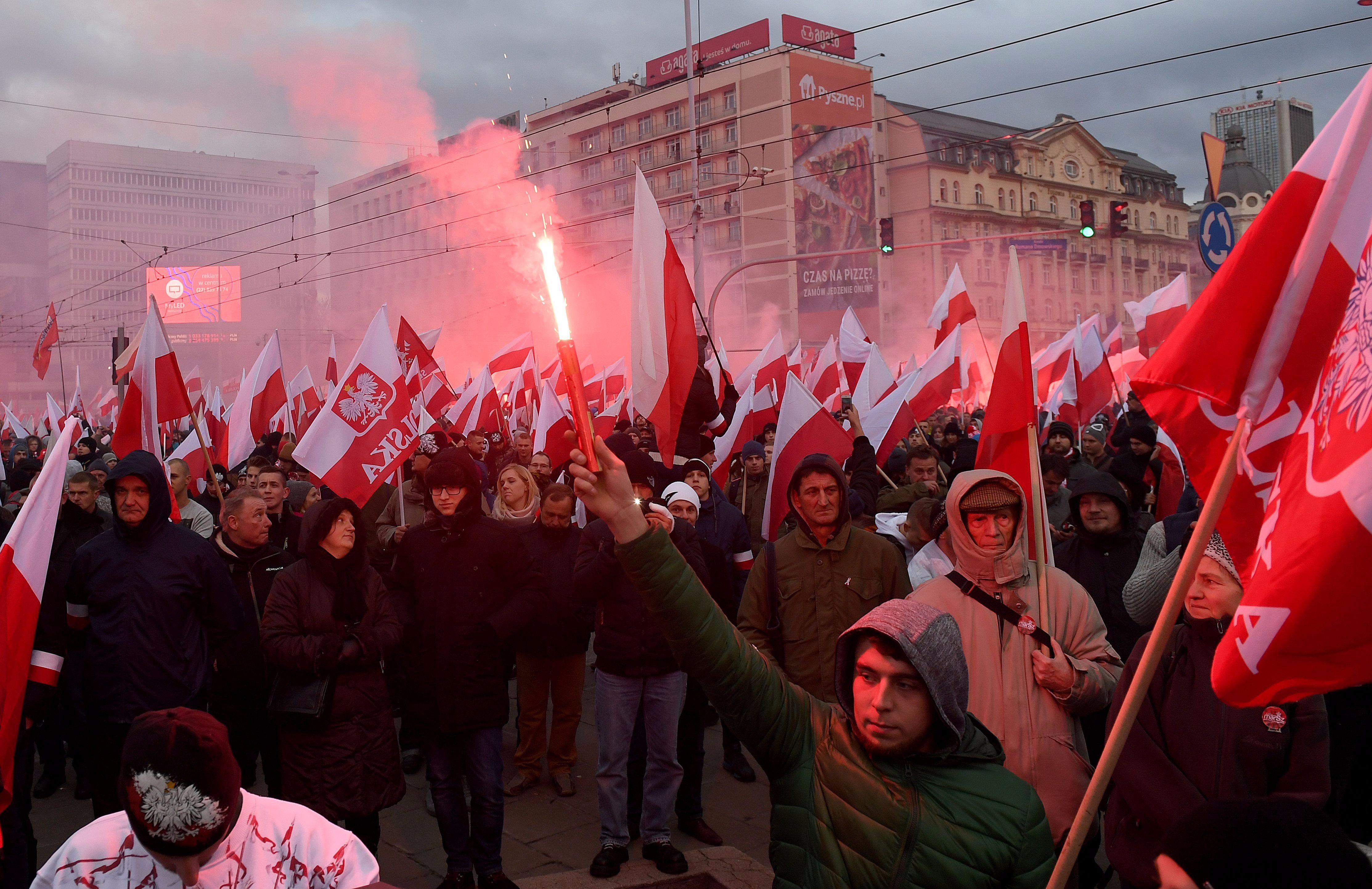
On November 11th, 60,000 protesters assembled in Warsaw to commemorate Polish Independence Day. The march was organized in part by two self-described “radical nationalist” youth movements, both of which draw their names from anti-Semitic leagues of the 1920’s and 30’s. The protest featured torches, chants of “Sieg Heil” and “Ku Klux Klan,” and banners reading “White Europe” and “Clean Blood.”

As a contingency of the protest marched through my Warsaw neighborhood in the former Jewish Ghetto, I hid. I’m Jewish, and I was terrified. I closed the windows, unplugged every light, and retreated to the bathroom, as I later depicted in the Forward.

I knew that my piece would garner attention. But I didn’t foresee the emotions it would elicit or the intensity of debate it would spark. And I definitely didn’t foresee the online hateful barrage aimed at me, so clearly aligned with the march’s anti-Semitic roots.

As I wrote in my first piece, I came to Warsaw because I didn’t believe what I’d been told about anti-Semitism. If the march wasn’t enough to convince me that anti-Semitism remains alive and well in Poland and elsewhere, the response I got to my piece certainly was.

It wasn’t all bad. I received thoughtful, encouraging, and at times apologetic emails from many Polish readers, Polish people who are worried by the country’s shift toward insularity.

But there were some ugly responses, too. Some wrote that Poland “doesn’t exist to serve or please Jews,” that I was a “man of Soros.” Over and over I read tweets, emails, and comments with a singular message: “Poland is for Poles.” I wrote to my editor to ask her to take the name of my street out of the piece, fearing that online attacks could become real threats.

@jdforward Don’t just hide in the washroom. Just leave. Poland is NOT your nation. Poland is for Poles. It doesn’t exist to serve or please Jews. Where do Jews get the chutzpah to think that Poles should not be patriotic in their own motherland? Jews are imperialists.— Gubbler Chechenova (@gubblerchecheno) November 16, 2017

It was terrifying. But these were not the worst of it.

The most troubling part of the Polish response to my piece came not from the uneducated nationalist masses, but from Western-educated, seemingly cosmopolitan intellectual elites. These elites, who voiced their response to my piece on Twitter and in the comments section of the Forward, did not stoop to name calling. Rather, they introduced ahistorical facts and apologist language that should worry those who care about Poland’s future possibly as much as the anti-Semitic hate speech.

A few anecdotes:

A PhD history candidate from the country’s premier research institution insinuated in the comments section that my op-ed was “a propaganda piece on behalf of people that probably manipulated him into writing it.” This claim rehearses the ugly anti-Semitic notion of media manipulation by Jews, a mainstay of both propaganda of the past and today’s “alt-right”.

Then, a prominent Polish journalist and commentator maligned both my reporting of and reaction to the march, writing, “Lies, lies, lies. Awful, dreadful, disgusting lies…pathetic.” Both toxic masculinity and cries of ‘Fake News’ find a home in Poland, too, it turns out.

Explicit in many comments was the absolute victimhood complex that finds a home in the right-wing government today: Poles have been persecuted by the Germans and Russians for centuries, and therefore cannot be the oppressors when it comes to Jews and other minorities.

These views don’t come from nowhere. The idea that Poles are absolute victims – rather than a group capable of both hatred and compassion – is displayed all too clearly at the Museum of the History of Polish Jews (POLIN) where I went after my article’s publication with a fresh perspective. There I found that Polish pogroms and anti-Semitic fascist leagues are drastically underrepresented in the museum’s permanent exhibit. While the German’s atrocious treatment of Poland’s Jewish population is rightfully given space, the complicit role of some Poles in the Holocaust is absent, it seemed to me. A museum that claims to present history should present the entire history, both the heroic actions of Poles who helped Jews and the hateful actions of those who harmed them. We can learn from both.

I also got many responses from Jews to my piece. Many Polish Jews who fled the country wrote to tell me how dismayed they were that these elements still exist in such force. And yet, as I wrote, Jewish cultural and religious institutions are being rebuilt and remnant communities are thriving. The size of Jewish life isn’t comparable to life here before emigration and the Holocaust. Nevertheless, the remaining Jews persist.

Another frequent Jewish response I received was a call to physical action. Drawing on communally-internalized notions of Jewish men’s weakness, these readers urged me to arm myself and fight anti-Semites in the street.

To them, I say this: I fight with my words. My previous piece was shared thousands of times, sparking debate in America, Israel and Poland. Does that not do more to forward the cause of Jewish existence than my fists ever could?

The dynamics of my life in Warsaw have fundamentally changed since publication; many I barely knew have reached out with heartfelt support and validation — with calls of ‘I see you’ — while others I thought friends have clearly been made uncomfortable or worse by my naming and drawing attention to this dangerous political situation. For those, I have become the other, as we have always been.

Sans yarmulke, I could hide. Now, with publicization and a forthcoming documentary from Polish newsite Wirtualna Polska, I am truly an out Jew. I ended my last piece with an acknowledgement of my own naïveté: ‘The shelter has been cracked.’ I finish this with the same responding clause: A defiance seeps through.


Sam Rubin is a Fulbright Research Fellow based in Warsaw, Poland. He can be contacted at srubinpolimus@gmail.com


twoje uwagi, linki, wlasne artykuly, lub wiadomosci przeslij do: webmaster@reunion68.com


Israel’s Unknown Heroic Spies of World War I

Israel’s Unknown Heroic Spies of World War I

Dr. Yvette Alt Miller


Sarah Aaronsohn

The Aaronsohn siblings founded an espionage ring in Zichron Yaakov to help Britain defeat the Turks.

November 11, 2018, marks Armistice day, the anniversary of the end of World War I.That bloody conflict drew to a close as Winston Churchill famously described, at 11am, the Eleventh Hour of the Eleventh Day of the Eleventh Month in 1918.

Amid the ceremonies marking this day around the globe, few, if any, will remember the courageous band of Jewish spies who formed the top-secret organization NILI, based in the Israeli town of Zichron Yaakov, who spied for Britain during the War. British intelligence official Baron William Ormsby-Gore said that NILI was “admittedly the most valuable nucleus of our intelligence in Palestine during the war.” A secret letter thanking the NILI network acknowledged that Britain could not have won the War without the aid of the NILI spies.

The heroes who made up NILI are all but forgotten. As we recall World War I a century later, let’s reclaim the legacy of the Jews of NILI and proclaim their decisive contribution to the Allied victory to the world.

Zichron Yaakov: First Flowering of the Desert

The story of the NILI spy ring begins in Zichron Yaakov, a town settled by Jewish immigrants from Romania in 1882. They were part of a group of idealistic Jews who were beginning to buy land in the Land of Israel, then controlled by the Ottoman Empire, and establish Jewish farms and towns. When Romania gained independence from the Ottoman Empire in 1878, it effectively stripped most of its Jews from citizenship and began a system of anti-Semitic persecution. Many Romanian Jews fled to the United States. Others turned to the Land of Israel as a haven.
Life wasn’t easy for these idealistic, young Zionists. Historian Howard M. Sachar writes, “Eaten alive…by flies, periodically robbed of their livestock by Bedouins, the settlers and their families quickly began to wilt under disease, heat, and sheer exhaustion.”
Edmond de Rothschild, the ennobled French Jew who had amassed a fortune in banking, supported the struggling Jewish towns and farms. Zichron Yaakov is named for Edmund de Rothschild’s father, Jacob. (Zichron Yaakov means “memory of Jacob” in Hebrew.)

The Remarkable Aaronsohn Family

A hundred Jewish families moved from Romania to Zichron Yaakov in the 1880s. Among these were Ephraim and Malkah Aaronsohn and their six children.

One of the Aaronsohn’s sons, Aaron, became one of the world’s foremost agronomists. In 1906, he discovered the genetic forebear of wheat and in 1909 he established the Jewish Agricultural Experiment Station, where he experimented with adapting new growth to the arid conditions of the Middle East. A passionate Zionist, he travelled the world, explaining to people how Jewish farmers were transforming the Land of Israel, making the desert bloom.

Aaron was often assisted by his younger sister Sarah, an exceptional woman who spoke Hebrew, Yiddish, Turkish, French, Arabic and English.

In 1914, Sarah married an older man, a Jewish immigrant from Bulgaria, and moved with him to Istanbul. The marriage was an unhappy one, and the following year, as Turkey was in the midst of fighting in World War I alongside Germany, Sarah left her husband and travelled home by train to Zichron Yaakov.

The sights that Sarah saw from her train carriage as it moved through the Ottoman countryside horrified her. Ottoman Turks were in the midst of conducting what would be known as the Armenian Genocide, which saw the murder of one million men, women and children during World War I. Sarah later described seeing hundreds of bodies being loaded onto trains, and witnessing the brutal murder of up to 5,000 Armenians, whose bodies were then piled in a pyramid with kindling, and set on fire.

Aaron Aaronsohn

The Ottoman Turks who administered the Land of Israel made no secret of their hatred of Jews, and Sarah feared that the genocide she’d witnessed against the Armenians of the Ottoman Empire would next be directed against Jews if the Ottomans won the war. When she returned to Zichron Yaakov, she was determined to do all she could to aid Great Britain, which was fighting Ottoman Forces across the Middle East.

A World at War

With the outbreak of World War I in 1914, the Ottoman Empire had joined with the Central Powers – Germany and Austria – to fight the allies, led by Britain and France. The Jews living in the Land of Israel, which was then under Ottoman rule, found themselves the target of anti-Semitism. The Ottoman Empire ruled that Jews and Christians must be drafted to fight – or else pay ruinous taxes to be exempted from military service.

In 1914, Sultan Mehmed V announced that that the Ottoman Empire was joining the Great War – and also declared that this was a jihad, a religious war against non-Muslims as well. As historian Eugene Rogan recounts, “On 14 November … the call for holy war (was) read out in public to a large crowd gathered outside the Mosque of Mehmed the Conqueror in the sultan’s name. The crowd roared its support.”
Inside the Jewish settlements, panic ensued. Were the Jews, like the Ottoman Empire’s Armenians and other minorities, going to become target of hate and violence?

The God of Israel Does Not Lie

The Aaronsohns decided to do what they could to support Britain in the war against the Turkish Ottomans. They founded a secret group, aided by their brother-in-law Avshalom Feinberg and close friend Joseph Lishansky. About 40 other young Jews joined the group, which was dubbed NILI, an acronym for the Biblical phrase Netzah Yisrael Lo Yeshaker, The Eternal One of Israel does not lie (Samuel I 15:29)

Sarah Aaronsohn and Avshalom Feinberg, 1916

read more: Israel’s Unknown Heroic Spies of World War I


twoje uwagi, linki, wlasne artykuly, lub wiadomosci przeslij do: webmaster@reunion68.com


DESPITE JEWISH ALARM, BRITAIN REFUSES TO OUTLAW PRO-HEZBOLLAH DEMONSTRATION

DESPITE JEWISH ALARM, BRITAIN REFUSES TO OUTLAW PRO-HEZBOLLAH DEMONSTRATION

BENJAMIN WEINTHAL


The annual al-Quds march promotes support for terrorism, yet the British government doesn’t see any cause to call the questionable protest off.

SUPPORTERS OF Hezbollah leader Sayyed Hassan Nasrallah display Hezbollah and Lebanese flags in Lebanon’s Bekaa valley. . (photo credit:REUTERS)

The United Kingdom’s home secretary rejected in early September London Mayor Sadiq Khan’s request to ban the annual al-Quds Day march because it is a pro-Hezbollah demonstration that promotes antisemitism and support for terrorism.

“The group that reportedly organized the parade, the Islamic Human Rights Commission, is not a proscribed terrorist organization. This means they can express their views and demonstrate, provided that they do so within the law,” wrote Home Secretary Amber Rudd in a letter to Khan that was first published Monday on the website of The Jewish Chronicle.

According to the London newspaper, a source close to Khan said he was “extremely disappointed” that the Home Secretary will allow the al-Quds Day march to continue.

Rudd said: “The flag for the [Hezbollah] organization’s military wing is the same as the flag for its political wing. Therefore, for it to be an offense under Section 13 of the Terrorism Act of 2000, for an individual to display the Hezbollah flag, the context and manner in which the flag is displayed must demonstrate that it is specifically in support of the proscribed elements of the group.”

The United Kingdom banned Hezbollah’s entire military structure in 2008. The UK government said at the time: “Hezbollah’s military wing also provides support to Palestinian terrorist groups in the occupied Palestinian territories, such as Palestinian Islamic Jihad.”

The UK permits Hezbollah’s so-called political wing to legally operate in England. The European Union proscribed only Hezbollah’s military wing as a terrorist organization in 2013. In February of that year, Bulgaria’s government charged Hezbollah’s military wing with executing a terrorist attack against Israelis at the seaside resort town of Burgas, committing the murders of five Israelis and their Bulgarian bus driver. Another 32 Israelis were injured in the attack.

The Netherlands, the US and Canada have designated Hezbollah’s entire organization a foreign terrorist entity.

The Jewish Chronicle reported that Andrew Dismore, a Labour Party London Assembly member, said: “I have spent over a decade campaigning for the complete proscription of Hezbollah, as I believe the distinction made between the ‘political’ and ‘military’ wings to be utterly bogus.”

Mayor Khan wrote in his July letter to Rudd that extremist groups were “exploiting a loophole” because they carried Hezbollah’s flags.
“Hezbollah is an illegal, proscribed organization, yet many perceive that it was actively celebrated during the Al Quds Day march,” Khan wrote, adding, “I would appreciate a response from the government that acknowledges the hurt that is felt and your plans to close any loophole.”


twoje uwagi, linki, wlasne artykuly, lub wiadomosci przeslij do: webmaster@reunion68.com