Archives

JORDANIAN TV SHOW: THE ROTHSCHILDS RULE THE WORLD

JORDANIAN TV SHOW: THE ROTHSCHILDS RULE THE WORLD, ASSASSINATED 6 U.S. PRESIDENTS; JEWS WITHHOLD CURE FOR CANCER AND AIDS

A Jordanian TV channel recently aired a program about the Rothschild family, according to which it was “the founder of the United States” and owned much of the world’s resources, media, and banks. The show included an interview with Jordanian economic analyst Mohammed Sami Abugoush, who said that “any leader who refused to deal with the Rothschilds would be assassinated.” Abugoush and TV host Rita Altaji agreed that it was Rothschild, and not President Macron, who ruled France, and that “even the U.S. and the mighty British royal family do not rule Britain.” She and her guest concurred that the Rothschilds assassinated U.S. Presidents Lincoln, Kennedy, Garfield, Harrison, Tyler, and Jackson. Abugoush further said that the Jews control the weapons, pharmaceutical, shipping, and agricultural industries, and are withholding the cure for cancer and AIDS from the world in order to make a profit. The show aired on Altaghier TV on June 24.

On-screen text: “‘Buy real estate wherever there is blood in the world’ -Lord Rothschild”

Narrator: “They are the prophets of money and bonds, the richest family ever known to the world. It controls half of the world’s wealth and owns one-third of the planet’s fresh water. It has the final say regarding the price of gold around the world, controls the American media, and owns most of the world’s banks. [The Rothschilds] own CNN and Hollywood, as well as 80 percent of all Israeli settlements. Egypt has not been spared [the control of the Rothschilds], who own stocks in the Suez Canal. Eighty percent of the world’s uranium belong to them. The Rothschild family, which is German-Jewish in origin, is the founder of the United States, and owns most of the central banks in the world.”

[…]

Mohammed Sami Abugoush: “As soon as they instated usury in global transactions, they began to lend money to countries and leaders. Any leader who refused to deal with the Rothschilds would be assassinated. He would be killed, ostracized or accused of being crazy…”

Rita Altaji: “That family would not allow anyone to oppose its goals and interests. Since you have mentioned this, is it true that the Rothschild family was responsible for the assassination of about six world leaders, in addition to many congressmen and bank owners? The most famous among those presidents were Abraham Lincoln and John Kennedy, in addition to Garfield, Harrison, Tyler and Jackson. Is this true?”

Mohammed Sami Abugoush: “Yes, 100 percent true.”

[…]

“In 2000 there were only eight countries not controlled by the Rothschild family. In 2011, only three countries were left, and now, almost all the countries, with the exception of Cuba and North Korea…”

Rita Altaji: “Iran too. Three countries… We will get to that, but first does this family still control the five countries to which it sent its sons?”

Mohammed Sami Abugoush: “Absolutely. It controls them politically, economically, and demographically. They even control people’s mentality. They control the media networks. CNN belongs to them.”

Rita Altaji: “Hollywood, too.”

Mohammed Sami Abugoush: “The broadcasting rights throughout Europe and in Hollywood, the rights to broadcast films, and all the TV channels – not just CNN, but also Fox News, CBS, and ABC – are owned by them. They own the advertising rights, they own the broadcasting rights, they own the media, and they own the doctrinal guidance in those countries. When I was in the U.S., I experienced how they fabricate facts in order to serve the interests of a certain group of people.”

[…]

Rita Altaji: “Macron is the new French president, and is also a new member of the New World Order system, the famous NWO, which is written on the one dollar bill in Latin, as you just said when you talked about the Freemasons and the Illuminati. So does Rothschild rule France while Macron is merely the president?”

Mohammed Sami Abugoush: “Positive. Even the U.S. and the mighty British royal family do not rule Britain.”

[…]

“Who rules the White House? The Jews. Who rules the Congress? The Jews. Who rules the Senate? The Jews. Who rules America economically? Who rules the American firms and banks? All the gigantic American banks belong to the Jews.”

Rita Altaji: “Right.”

Mohammed Sami Abugoush: “The weapon industry, the pharmaceutical industry, the shipping industry, the agricultural industry…”

Rita Altaji: “With regard to the pharmaceutical industry, people say that there is a cure for cancer, but these powerful families refuse to provide it to the people, because they want to profit from selling these drugs.”

Mohammed Sami Abugoush: “It’s the same with AIDS.”

Rita Altaji: “Yes, AIDS too.”

Mohammed Sami Abugoush: “They have the cure for AIDS, but they won’t give it away, because they want to have a monopoly. After 20 years, the disease has spread, and instead of one million sick people, there are 100 million. Now they present the treatment in the market, and instead of one million doses, they sell 100 million. With this mentality, they wish to control all the sources of life on the planet.”


twoje uwagi, linki, wlasne artykuly, lub wiadomosci przeslij do: webmaster@reunion68.com



A Virginia Jew Created These Controversial Confederate Statues

A Virginia Jew Created These Controversial Confederate Statues

Tamar Fox


Jews are a prominent part of today’s conversation about American racism and confederate history. Many have denounced Trump’s response to the events in Charlottesville, and this week, three groups of rabbis canceled the President’s annual High Holiday conference call. But there’s another way that Jews are mixed up in the debate about Confederate memorials—some of them were crafted by an unusual Jew.

Moses Jacob Ezekiel was born in Virginia and was the first Jew to attend the Virginia Military Institute. He went on to fight for the Confederacy during the Civil War. Afterward, he moved to Rome, where he became a celebrated and eccentric artist. His neo-classical sculptures focused on Confederate heroes like Robert E. Lee and Stonewall Jackson, and paradoxically, the Constitution, and religious liberty. He lived in an abandoned bath house, and was knighted by the King of Italy.

One of Ezekiel’s most prominent sculptures is called the Confederate Memorial, and it stands in Arlington National Cemetery. Unveiled in 1914, it glorifies the South, slavery, Rebel soldiers, and their sacrifices. This week, almost two dozen members of Ezekiel’s extended family signed a letter asking that the monument be removed from Arlington National Cemetery. They requested it be put in a museum instead.


twoje uwagi, linki, wlasne artykuly, lub wiadomosci przeslij do: webmaster@reunion68.com


Property stolen during the Holocaust

Property stolen during the Holocaust made some communities richer, even 70 years later

Evgeny Finkel and Volha Charnysh


The entrance to the former Nazi concentration camp Auschwitz-Birkenau with the lettering ‘Arbeit macht frei’ (‘Work makes you free’) (Joel Saget/AFP/Getty Images)

One month ago, on July 9, Iraq’s prime minister announced the liberation of Mosul after three years of Islamic State rule. The violence displaced almost 800,000 civilians; more than 40,000 died, and large tracts of the city were turned to rubble during the battle that had lasted since October 2016. Beyond those dramatic losses, the war also fundamentally reshaped local communities — as the remaining houses, land and other assets changed owners.

Of the Iraqi refugees interviewed by the International Organization for Migration, 89 percent said they had their dwellings confiscated; some 35 percent lost farmland, and 13 percent lost businesses. In Syria, Eastern Ukraine and other conflict zones, the victors and survivors are also taking property from those who have fled or died.

Do communities experiencing such wartime plunder change their economic status and political views?

Learning from the plunder at a Nazi death camp

Our research examines how communities were affected by property transfers during the Holocaust, one of the largest and best-documented cases of mass violence and plunder. During this time, some non-Jewish Europeans took over the homes, businesses and other property of the Nazis’ victims.

We study the effects of plunder at the Treblinka death camp in Nazi-occupied Poland, where 850,000 to 900,000 Jews were murdered between 1942 and 1943. Believing Nazi assurances that they were sent to perform agricultural labor in Ukraine, many Jews took valuables with them. After they were gassed, their property — jewelry, golden dental work, money, clothing, tools and even hair — was collected, sorted and sent to Germany. At Treblinka, plunder occurred at a gargantuan scale: the camp’s Nazi commandant Franz Stangl spoke of stepping “knee-deep into money” and “wad[ing] in notes, currency, precious stones, jewelry, clothes.”

Even though the Nazis worked hard to secure all the loot, some Jewish valuables ended up in the hands of the local population. At first, some locals traded with the camp guards, who amassed considerable wealth and paid “without even counting the bills.” When the camp closed in October 1943, some people began digging through graves at the camp site to find valuables missed by the Nazis. In accounts from the area, observers often described the scene with terms like “Eldorado,” “Klondike,” and “gold rush.”

How did this change local communities?

How we did our research

Treblinka is important for this research, because the precise placement of the camp was chosen by a mid-level German official, and had nothing to do with the local population’s pre-Holocaust wealth or political views. The locals were not involved in the killing or in the camp’s day-to-day operations. Before the war, few Jews lived in this predominantly agricultural area. Thus we are able to measure the impact of the Jewish property stolen at Treblinka by comparing communities closer to the camp with communities farther away.

Of course, not all Treblinka-area residents benefited from the Nazi plunder; some even risked their lives to help Jews. But for those who did want to trade with the guards or dig for valuables, shorter distance to Treblinka meant greater access to Jewish property.

As we did not know who benefited from Treblinka and who did not, we decided to analyze the differences between communities situated up to 70 kilometers (or about 40 miles) away from Treblinka. We collected demographic, economic and voting data from both pre- and post-World War II periods to test whether distance to the death camp is correlated with economic and political characteristics.

Being near Treblinka improved neighboring communities’ housing

We found that proximity to Treblinka is associated with newer and better housing stock. The closer to the death camp, the higher the share of homes built in the post-World War II period and of roofs made of sheet metal, a more expensive material than other roof options, as measured by the 1988 Census. For example, in communities within 15 km of Treblinka, 45 percent of dwellings on average had metal roofs; in communities 16-35 km away, that was 38 percent of dwellings; and in communities 35-50 km away, just 25 percent. All these communities were economically similar before the war, and wartime destruction cannot explain these patterns.

However, proximity to Treblinka is not associated with higher levels of economic activity, education or income in the 1980s or 1990s. To the extent that some locals benefited from Jewish goods, they invested this wealth in real estate.

Being near Treblinka pulled communities farther right in Holocaust-focused election

Communities closer to the camp exhibited higher support for the League of Polish Families (LPR) — an extreme right, anti-Semitic party — in the 2001 parliamentary election. During that election, Poles debated both Polish-Jewish relations during the Holocaust and whether property should be restored to long-ago owners. In the community closest to Treblinka, the LPR vote share was 14 percent, or almost twice its national average of 8 percent.

However, we found no relationship between proximity to Treblinka and support for non-xenophobic right-wing parties or support for the LPR in the elections in which the Holocaust and restitution of property were not discussed.
As societies transition from war to reconstruction and reconciliation, wartime property transfers create legal, political and social dilemmas. The perpetrators of the violence may be punished, but that does not prevent cleavages from emerging between those who lost and gained property because of the violence.

Our analysis suggests that raising the issue of restitution — while necessary to do justice to the victims — can strengthen support for extremist parties. Even today, more than seven decades after the Holocaust, when most direct beneficiaries and victims of wartime plunder are no longer alive, restitution debates across Europe sow anger and frustration and apparently stirred up some anti-Semitic backlash.

While it is too early to evaluate the consequences of ISIS rule in Iraq, we can expect disputes over property between the returning refugees and their former neighbors in the liberated areas. Unless handled very carefully, those may destabilize this ethnically diverse society.


Volha Charnysh is a fellow at the Niehaus Center for Globalization and Governance at Princeton University.

Evgeny Finkel is an assistant professor of political science and international affairs at George Washington University.


twoje uwagi, linki, wlasne artykuly, lub wiadomosci przeslij do: webmaster@reunion68.com



PA UN Envoy Refuses to Condemn Halamish Terror Attack

PA UN Envoy Refuses to Condemn Halamish Terror Attack, Saying ‘Don’t Expect All Palestinians to Be Angels’

Barney Breen-Portnoy


Palestinian Authority Ambassador to UN Riyad Mansour. Photo: Screenshot.

Palestinian Authority Ambassador to the UN Riyad Mansour declined this week to condemn last Friday’s terrorist attack in Halamish — in which three Israelis were stabbed to death at a Shabbat dinner — and instead justified the act.

Addressing reporters at the UN headquarters in New York City, Mansour said, “When you have an occupation with its ruthlessness…then don’t expect all Palestinians to be angels [and] not to react to it.”

“If people think that the Palestinian people are going to live in that situation without any form of resistance to it, that is not realistic and that is not fair,” Mansour went on to assert.
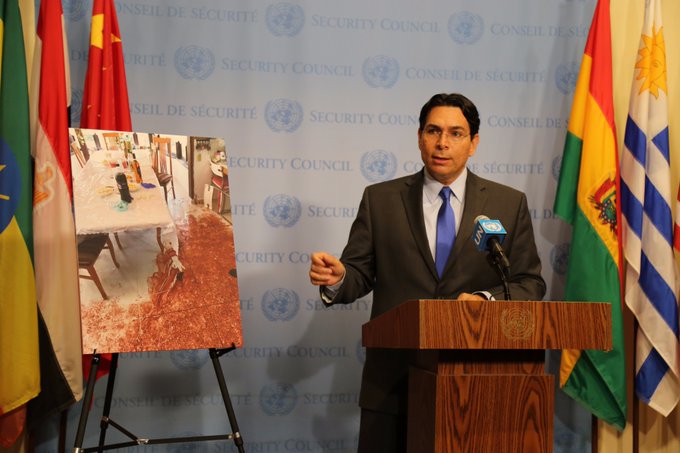
Israel’s UN envoy, Danny Danon, said the Halamish attack was a “direct result of hateful Palestinian incitement.”

The international community, Danon continued, must demand that the Palestinian Authority “immediately end terror and glorification of violence.”


The horrific murder of the Salomon family is a direct result of hateful Palestinian incitement.


Watch Mansour’s remarks below (they begin at around the 15:30 mark):


twoje uwagi, linki, wlasne artykuly, lub wiadomosci przeslij do: webmaster@reunion68.com


Stop Infantilizing the Palestinians

Stop Infantilizing the Palestinians

David Harris


It’s high time for the international community to wake up to certain Palestinian realities that many would rather avoid.

Recent events in the region, including the brutal killing of two Israeli policemen and three members of an Israeli family, as well as the wild conspiracy stories circulated in regard to the Temple Mount in Jerusalem, only underscore the point.

By the way, for the purpose of context, I write as the representative of an organization, AJC, long committed to the search for an enduring two-state agreement, coexistence between Muslims and Jews, and friendly ties with moderate Arab countries. Indeed, the AJC record in these areas is quite unique.

For too many observers of the region, however, their obsession with Israel and what it should (and should not) do blinds them to the other side of the equation—what the Palestinians should (and should not) do.

Here are five things that could end the infantilization of the Palestinians and lead, perhaps, to a more hospitable climate for restarting a long-dormant peace process.

First, how can there be serious talk of a two-state accord when the Palestinians are divided between the West Bank and Gaza?

As a reminder, when Israel withdrew all of its soldiers and settlers from Gaza in 2005, it gave the residents of Gaza the first chance in history to govern themselves, something no one else, not the Egyptians or any other occupiers, ever even remotely considered.

What happened? By 2007, Hamas, labeled by both the United States and the European Union a a terrorist organization, was in power, and the Palestinian Authority (PA) was physically ejected. Since then, PA President Abbas has never, not once, visited Gaza. So all this talk today about two states could, just as easily, be about three states.

Israel cannot solve the problem of this division. Only the Palestinians can, possibly with outside help from the larger Arab world and beyond. But will they?

Second, whenever we hear about Gaza, we inevitably hear about “refugee camps.” But, pray tell, why are there refugee camps in Gaza?

It’s been 12 years since Israel left the coastal strip. What is the purpose of maintaining these camps, which have only served to perpetuate the notion, generation after generation, of a displaced people hankering for their “return.” Return to where? To Israel, presumably, and that would mean the end of the Jewish state.

Breaking news: The Palestinians are not the first refugee population in the world, far from it, nor, incidentally, are they the only refugee population from the Arab-Israeli conflict. Nearly a million Jews were forcibly evicted from their homes in Arab countries, but all of them resettled elsewhere rather than opt to languish in refugee camps ad infinitum.

But the Palestinians definitely are the first to be designated by the UN as “refugees in perpetuity,” handing the title to their children and their children’s children. How long must this unique status on the planet go on? Shouldn’t there be some statute of limitation in order to begin to change the mindset and put a halt to these camps, which serve as incubators of hatred and revenge?

After all, many of us come from refugee families, but that status applied to those who actually lost their homes, not to every descendant.

Third, why doesn’t the international community show more backbone in insisting that Palestinians take responsibility for their own behavior?

For example, the Palestinians could have had a state on more than one occasion between 1947 and 2017, yet they rejected each opportunity. That’s not an opinion, but a fact.

But, of course, the price to be paid was recognition of Israel as a sovereign nation alongside the Palestinian state, a price they have been unwilling to pay.

So, while Israel has evolved in its own thinking and come to accept Palestinian nationalism, there has been no reciprocal movement on the Palestinian side to accept Jewish self-determination as its complement.

Moreover, Palestinians launch gruesome terror attacks against Israel, such as the murder of three people in Halamish last week, and then reward the killers and their families with generous monthly stipends. One estimate is that the Palestinians will spend up to $300 million in 2017 alone for this purpose. This should be kept in mind the next time someone wonders why more schools and hospitals aren’t being built in the West Bank.

Is this strategy, if that’s what it is, a pathway to the negotiating table? Is this likely to allay Israel’s legitimate security concerns and increase Israeli confidence that a genuine peace partner exists with whom to pursue a final settlement? And is the incitement that surrounds such vicious attacks, including calls for the death of Israelis, Zionists, and Jews, contributing to a climate conducive to confidence and compromise?

Fourth, the popular Palestinian belief that Jews are “outsiders,” “interlopers,” “colonialists,” and “crusaders” must be confronted. Jews are indigenous to the region. The age-old link between the Jewish people and the land is documented and irrefutable.

Yet too many countries are willing to go along with this trumped-up narrative, as evidenced, for instance, by recent votes at the UNESCO Executive Board and its World Heritage Committee.

To deny the Jewish link to Jerusalem is tantamount to denying the Muslim link to Mecca or the Catholic link to Rome. It’s totally ludicrous, yet it happens again and again – and, it must be noted, countries like Sweden and Brazil risk their own credibility by buying into this charade. Indulging the Palestinians in their fanciful history allows them to live in an alternate universe, one where Israel doesn’t exist, or, if it does, is only a “temporary and illegitimate” phenomenon.

And fifth, the world should make it clear: Terrorism is terrorism is terrorism. Take Europe. Countries like France and Belgium have been the targets of fatal attacks. And they respond as they should: with a no-holds-barred effort to find the perpetrators and their support networks, and to declare a no-tolerance policy for such bestiality.

But when it comes to attacks against Israelis, the language often changes, sometime subtly, other times overtly. There can be a hint of rationalization here, an immediate call for Israeli restraint there. Phrases like “cycles of violence” appear, implying that no one really knows, or cares, who started the process, or that this is really just a Hatfield-McCoy spat without any distinction between the two sides.

Yet surely there must always be a clear distinction between the fireman and the arsonist, the democrat and the despot, as there is in Europe and elsewhere when such outrages occur. Otherwise, moral fog replaces moral clarity.

Ending the infantilization of the Palestinians – and beginning to hold them responsible for their actions – could be one promising way forward for the peacemakers.


twoje uwagi, linki, wlasne artykuly, lub wiadomosci przeslij do: webmaster@reunion68.com