Archives

Israel Daily News – May 17, 2023

Israel Daily News – May 17, 2023

ILTV Israel News


Jerusalem flag march taking place tomorrow, and the capital is preparing for the tense day.
–
Meantime: Elon Musk’s tweet making the phrase “the Jews” enter the list of trending topics on the platform.
–
And later, ILTV reporting from the kosher and food wine experience, this time, in Tel Aviv.


Zawartość publikowanych artykułów i materiałów nie reprezentuje poglądów ani opinii Reunion’68,
ani też webmastera Blogu Reunion’68, chyba ze jest to wyraźnie zaznaczone.
Twoje uwagi, linki, własne artykuły lub wiadomości prześlij na adres:
webmaster@reunion68.com


Israeli experts create AI to translate ancient cuneiform text – study

Israeli experts create AI to translate ancient cuneiform text – study

JUDY SIEGEL-ITZKOVICH


Researchers at Tel Aviv University (TAU) and Ariel University have developed an artificial intelligence model that can automatically translate Akkadian text written in cuneiform into English.

.
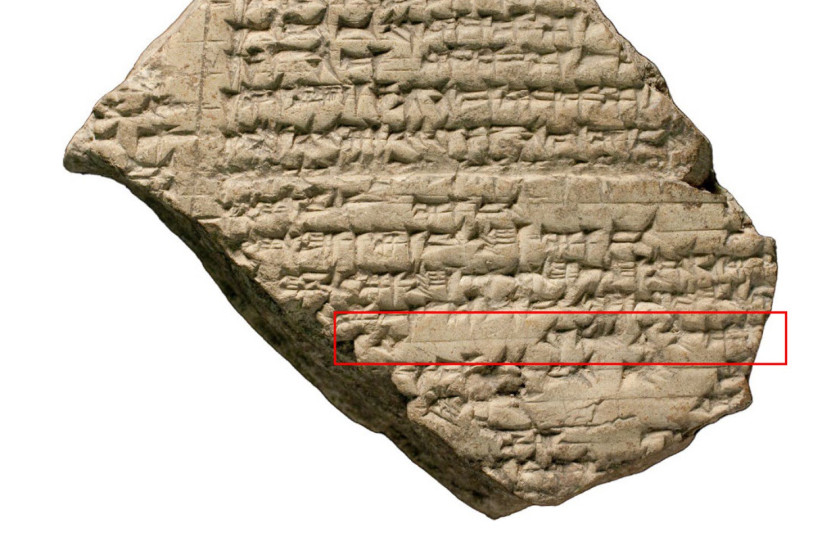
An ancient Assyrian tablet with writing in cuneiform from the Library of Ashurbanipal. /  (photo credit: The Trustees of the British Museum)

Experts in Assyriology – who specialize in the archaeological, historical, cultural and linguistic study of Assyria and the rest of ancient Mesopotamia (Iraq) –spend many years painstakingly trying to understand Akkadian texts written in cuneiform, one of the oldest forms of writing known.

Cuneiform is translated as “wedge-shaped” because in ancient times, people wrote it using a reed stylus cut to make a wedge-shaped mark on a clay tablet.

But now, researchers at Tel Aviv University (TAU) and Ariel University have developed an artificial intelligence model that will save all this effort. The AI model can automatically translate Akkadian text written in cuneiform into English.

Who were the ancient Assyrians?

In 721 BCE, Assyria swept out of the North, captured the Northern Kingdom of Israel and took the Ten Tribes into captivity, after which they became lost to history. Assyria, named for the god Ashur (highest in the pantheon of Assyrian gods), was located in the Mesopotamian plain. Historians note that Assyrian Jews first appeared in that region when the Israelites were exiled there, and they lived continuously alongside the Assyrian people in the territories after the Assyrian exile.

Hundreds of thousands of clay tablets from ancient Mesopotamia, written in cuneiform and dating back as far as 3,400 BCE have been found by archeologists – far more than could easily be translated by the limited number of experts who can read them.
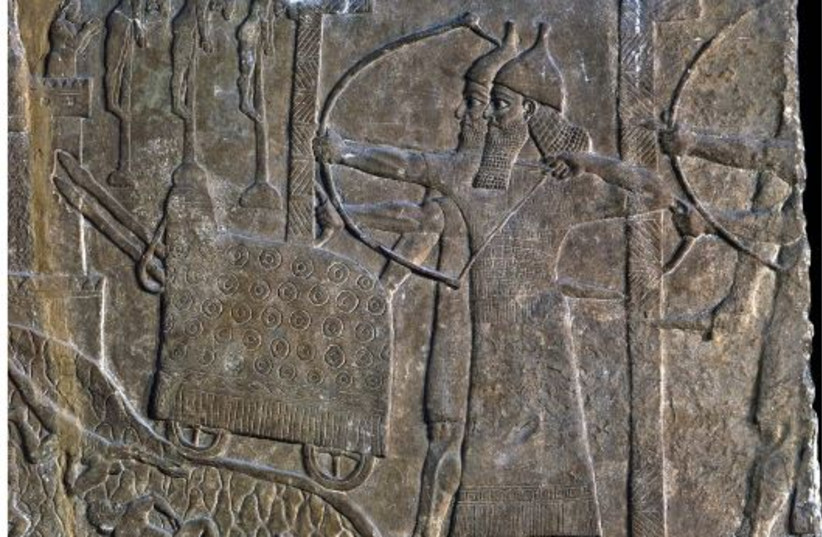
Siege scene with two massive L-shaped shields protecting Assyrian soldiers, in a relief from the palace of Tiglath-Pileser III at Nimrud (credit: Courtesy of the British Museum)

Dr. Shai Gordin of Ariel University and Dr. Gai Gutherz, Dr. Jonathan Berant and Dr. Omer Levy of TAU and colleagues have just published their findings in the journal PNAS Nexus under the title “Translating Akkadian to English with neural machine translation.”

When they developed the new machine-learning model, they trained two versions – one that translates the Akkadian from representations of the cuneiform signs in Latin script and another that translates from unicode representations of the cuneiform signs. The first version, using Latin transliteration, gave more satisfactory results in this study, achieving a score of 37.47 in the Best Bilingual Evaluation Understudy 4 (BLEU4), which is a test of the level of correspondence between machine and human translation of the same text.

The program is most effective when translating sentences of 118 or fewer characters. In some of the sentences, the program produced “hallucinations” – output that was syntactically correct in English but not accurate.

Gordin noted that in most cases, the translation would be usable as a first-pass at the text. The authors propose that machine translation can be used as part of a “human-machine collaboration,” in which human scholars correct and refine the models’ output.

Hundreds of thousands of clay tablets inscribed in the cuneiform script document the political, social, economic and scientific history of ancient Mesopotamia, they wrote. “Yet, most of these documents remain untranslated and inaccessible due to their sheer number and the limited quantity of experts able to read them.”

They concluded that translation is a fundamental human activity, with a long scholarly history since the beginning of writing. “It can be a complex process, since it commonly requires not only expert knowledge of two different languages but also different cultural milieus. Digital tools that can assist with translation are becoming more ubiquitous every year, tied to advances in fields like optical character recognition (OCR) and machine translation. Ancient languages, however, still pose a towering problem in this regard. Their reading and comprehension require knowledge of a long-dead linguistic community, and moreover, the texts themselves can also be very fragmentary.”


Zawartość publikowanych artykułów i materiałów nie reprezentuje poglądów ani opinii Reunion’68,
ani też webmastera Blogu Reunion’68, chyba ze jest to wyraźnie zaznaczone.
Twoje uwagi, linki, własne artykuły lub wiadomości prześlij na adres:
webmaster@reunion68.com


Israel Daily News – May 15, 2023

Israel Daily News – May 15, 2023

ILTV Israel News


One rocket was fired towards Israel on Sunday night from Gaza…But despite this the ceasefire is currently holding.
–
For the first time in its history the United Nations Is marking Nakba day – Israel’s ambassador to the un is calling on countries to shun the event…
–
And could King Charles the third be planning a visit to Israel in the very near future?


Zawartość publikowanych artykułów i materiałów nie reprezentuje poglądów ani opinii Reunion’68,
ani też webmastera Blogu Reunion’68, chyba ze jest to wyraźnie zaznaczone.
Twoje uwagi, linki, własne artykuły lub wiadomości prześlij na adres:
webmaster@reunion68.com


Disturbed Frontman David Draiman Announces Band’s Second Tel Aviv Summer Concert ‘Due to Incredible Demand’

Disturbed Frontman David Draiman Announces Band’s Second Tel Aviv Summer Concert ‘Due to Incredible Demand’

Shiryn Ghermezian


Disturbed frontman David Draiman. Photo: RPS via Wikimedia Commons

David Draiman, the Jewish lead vocalist of Disturbed, announced this week that the heavy metal band will do a second concert in Israel this summer in response to an overwhelming demand after their first show sold out.

“Israel, I’m amazing at the love you’re showing us,” the Sound of Silence singer said in an Instagram video, announcing the concert on June 29 in Tel Aviv to follow the band’s show a day earlier at the Expo Tel Aviv convention center. The singer added that two Israeli bands will also perform with Disturbed on stage — Saffek during the June 28 concert and Subterranean Masquerade for the performance the following night.

“And we’re planning to invite a couple more acts from the amazing Israeli scene to join us as well,” Draiman revealed. He concluded by saying, “I’m so excited to come to see all of you and celebrate your beautiful metal scene along with your music. See you on June 28 and now June 29 in Tel Aviv.”

Disturbed will perform in Israel as part of their Take Back Your Life Tour world tour. This will be the band’s second time performing in Israel following their sold-out show at Live Park in 2019.

Draiman’s father and grandfather served in the Israel Defense Forces and both of the singer’s maternal grandparents were Holocaust survivors. His grandfather was also a cantor in Israel and Draiman trained as a cantor as well before starting his professional singing career.

Draiman has spoken in great length in the past about his love of Israel, the thousands of relatives he has in the country and his pride in his Jewish heritage. He said in a recent podcast interview that he pays no attention to supporters of the boycott, divestment and sanctions movement against Israel who try to convince musicians to not perform in the Jewish state. He called Israeli fans “amazing and dedicated” and said he believes music “should be the entity that brings people together, not continues to separate. It should build bridges and it’s not supposed to be something you withhold from people.”


Zawartość publikowanych artykułów i materiałów nie reprezentuje poglądów ani opinii Reunion’68,
ani też webmastera Blogu Reunion’68, chyba ze jest to wyraźnie zaznaczone.
Twoje uwagi, linki, własne artykuły lub wiadomości prześlij na adres:
webmaster@reunion68.com


Murals Across Israel Show Solidarity With ‘Women, Life, Freedom’ Protesters in Iran

Murals Across Israel Show Solidarity With ‘Women, Life, Freedom’ Protesters in Iran

Shiryn Ghermezian


Hooman Khalili speaking at the unveiling of one of his mural in Netanya, Israel. Photo: Michael Stevens

A fifth mural was recently completed in Israel that features aspects of both Israeli and Iranian culture while also showing support for the nationwide, anti-government protests led by women that is currently taking place in Iran, the Iranian designer behind the art told The Algemeiner.

The murals produced, funded and designed by Hooman Khalil in collaboration with local Israeli artists include in Hebrew, English and Farsi the phrase “Women, Life, Freedom,” which has become the unofficial slogan of protesters in Iran who took to the streets after the September 2022 death of Mahsa Amini, a 22-year-old Kurdish woman who died while in the custody of Iran’s morality police. Each mural also depicts different women killed by Iranian authorities, including Amini. Khalili’s first mural was unveiled in Jerusalem in January and was completed by Israeli artist Ana Kogan. Khalili has since designed murals in Nazareth, another in Jerusalem outside the Museum for Islamic Art and two in Netanya.

“All of these murals are ultimately doing one thing: they are reminding the world that the Persians have been the friends of the Jews for 3,000 years. I do as much as I can to unify both cultures in one mural,” Khalili, 48 told The Algemeiner. “In all the murals you’ll see the flag of Jerusalem, because all my murals are pointing back to Jerusalem, you’ll always see a woman riding a lion with a sword in her hand, because it’s a women-led revolution, [and] you’ll always see the flag of Iran with a lion with a sword in his hand, with the sun rising in his back, [which is] the Zorastrian symbol.”

Khalili was born in Iran but left his birth country with his mother when he was 3 years old. His father remained in Iran and the artist has not seen him in 45 years. He currently lives in California and works as a creative director for a boutique hotel. In November of 2022, he helped create a mural in San Francisco, California, in support of the Iranian protesters. A picture of the mural went viral on social media and was seen by the Vice Mayor of Jerusalem Fleur Hassan Nahoum, who then contacted Khalili and asked him to design murals in Israel in support of the people of Iran fighting for human rights.

The first mural in Netanya, unveiled in late March, depicts Niloufar Aghaei, a nurse whose eye was deliberately shot out by the Iranian regime as punishment for joining the anti-government protests. The bird covering Aghaei’s eye in the mural is the nightingale, which is the official bird of Iran. Iranian Crown Prince Reza Pahlavi visited the mural during his recent trip to Israel.

The latest mural in Netanya, done by Israeli graffiti artist Benzi Brofman and unveiled on May 1, features an image of Ghazal Ranjkesh, a protester whose eye was also shot out by Iranian authorities. In that mural, the bird covering Ranjkesh’s missing eye is the hoopoe, the national bird of Israel.

The next mural will be unveiled in June in the Druze village of Beit Jann in northern Israel, Khalili told The Algemeiner. His goal is to complete 18 murals in total across Israel that unify the Israeli and Iranian cultures, and show solidarity with the protesters in Iran. Three of the already completed murals also say “it’s time for the Esthers of the world to rise up,” a reference to the biblical Jewish Queen Esther, who lived in ancient Persia and risked her life to save the Jewish people.

“This is a woman-led revolution,” Khalili said about the anti-government protests taking place in Iran and it’s connection to Queen Esther. “If you think about the story of Esther, her bravery, the way she was able to put her life on the line to save the Jews — this is a time for Israel and Iran to become friends again, for the woman of the world to lead, like they did during the time of Esther, and for all of us collectively to give a voice to the Persian people who have no voice.”


Zawartość publikowanych artykułów i materiałów nie reprezentuje poglądów ani opinii Reunion’68,
ani też webmastera Blogu Reunion’68, chyba ze jest to wyraźnie zaznaczone.
Twoje uwagi, linki, własne artykuły lub wiadomości prześlij na adres:
webmaster@reunion68.com

