Archives

Are American Universities the Next Front in a Gulf Rivalry?


Are American Universities the Next Front in a Gulf Rivalry?

Nira Broner Worcman


Pro-Hamas demonstrators at Columbia University in New York City, US, April 29, 2024. Photo: REUTERS/Caitlin Ochs

A recent report by the US House Committee on Education and the Workforce on antisemitism in higher education delivers a stark conclusion: In the wake of the Hamas-led Oct. 7, 2023, attack on Israel, many US campuses have shifted from being sites of debate to environments where hostility toward Jewish students is increasingly normalized. The report documents rising harassment, rhetoric that blurs into justification of violence, and a growing reluctance by university leaders to enforce their own rules when speech is framed as political activism.

That warning points to a broader institutional problem. Universities are not only struggling to respond to ideological extremism; they are also increasingly embedded in global networks of funding, influence, and political engagement. In this environment, they risk becoming more than passive hosts of debate, emerging as spaces where external conflicts are projected inward, including the strategic rivalry between Gulf states now playing out on Western campuses.

Earlier this year, the United Arab Emirates suspended government scholarships for students planning to attend British universities, citing concerns about Islamist radicalization on UK campuses. For decades, Western institutions were viewed across the Arab world as gateways to modernity — exporters of science and pluralism. Now an Arab state is signaling that those campuses may no longer be ideologically neutral.

Britain’s situation reflects long-standing policy choices. The United Kingdom does not formally designate the Muslim Brotherhood as a terrorist organization and has long served as a hub for Brotherhood-linked activism. British academia enrolls significant numbers of Qatari students and maintains financial and institutional ties with Doha, placing campuses within a broader ecosystem of Qatari engagement and soft power. That matters because Qatar and the UAE sit on opposing sides of a wider Gulf competition over political Islam.

Since the signing of the Abraham Accords in 2020, the UAE has positioned itself as a regional actor seeking stability, economic integration, and the containment of Islamist influence. Qatar, by contrast, continues to host Muslim Brotherhood figures and Hamas political leaders while expanding its global reach through media and partnerships with research institutions and universities.

The United Kingdom may have presented the most immediate concern for Emirati policymakers. But the broader question of ideological influence within Western institutions extends beyond Britain. Nowhere is that dynamic more consequential than in the United States.

Disclosures filed with the US Department of Education show that American universities have reported receiving more than $4 billion from Qatar over the past two decades, placing the Gulf state among the largest foreign funders of US higher education. Institutions such as Cornell University, Georgetown University, Northwestern University, and Texas A&M University have reported substantial Qatari funding supporting research programs, faculty, and academic centers.

Foreign partnerships and international funding are common in global higher education and do not automatically translate into political influence. The concern arises not from these relationships themselves, but from the political environment in which they operate — particularly when ideological movements tied to geopolitical actors become increasingly visible in campus activism.

Recent events on American campuses help explain why this matters. After the Oct. 7, 2023, attacks, universities including Harvard, Columbia, UCLA, and NYU witnessed demonstrations that in some cases moved beyond criticism of Israeli policy into justification of violence, calls for a “global intifada,” and rhetoric widely understood by Jewish students as eliminationist. Congressional hearings later exposed how difficult it had become for some university leaders to state clearly that calls for genocide violate campus rules when framed as political expression.

The issue is not protest itself, which is intrinsic to academic life, but ideological activism that normalizes movements rejecting liberal democratic principles. In such an environment, Gulf rivalry intersects with Western institutional hesitation, and campuses risk becoming arenas not merely of debate but of strategic signaling.

If Abu Dhabi concludes that British universities are incubating ideologies it considers destabilizing, the same logic could extend to the United States. American universities are even more globally influential than their British counterparts, educating future ministers, financiers, and opinion leaders from across the Middle East — making them higher-value terrain in any competition over ideas.

Whether the UAE would take similar measures regarding US institutions remains uncertain. The strategic partnership between Washington and Abu Dhabi is deeper than the UAE’s educational ties with Britain. And while the United States does not designate the entire Muslim Brotherhood as a Foreign Terrorist Organization, it does designate Hamas — which originated as a Palestinian branch of the Brotherhood — as a terrorist group.

The UAE’s decision regarding British scholarships should therefore be seen as part of a broader regional struggle over political Islam and the future direction of the Middle East. If that struggle is increasingly playing out on Western campuses, Americans should ask a sober question: Are their universities merely observers of this rivalry — or are they becoming its next front?


Nira Broner Worcman is a Brazilian journalist, CEO of Art Presse Communications, and author of A Sisyphean Task (translated from the Brazilian edition, Enxugando Gelo), on media coverage of the war between Israel and terrorist groups. She was a Knight Science Fellow at MIT and earned her master’s degree at NYU’s Science, Health, and Environmental Reporting Program.


Zawartość publikowanych artykułów i materiałów nie reprezentuje poglądów ani opinii Reunion’68,
ani też webmastera Blogu Reunion’68, chyba ze jest to wyraźnie zaznaczone.
Twoje uwagi, linki, własne artykuły lub wiadomości prześlij na adres:
webmaster@reunion68.com


Iran fires two missiles at US-UK military base beyond known Iranian military range – WSJ


Iran fires two missiles at US-UK military base beyond known Iranian military range – WSJ

JERUSALEM POST STAFF

A US Air Force B-2 Spirit stealth bomber departs from Diego Garcia, British Indian Ocean Territory, to conduct a combat mission, April 19, 2025. / (photo credit: US Air Force photo by Tech. Sgt. Anthony Hetlage)

Iran fired two ballistic missiles at a joint US-UK military base, Diego Garcia, the Wall Street Journal reported Friday night, citing multiple US officials.

One of the missiles failed in flight, and a US warship fired an interception at the other. At this time, it has not been determined if an interception was made, but neither missile hit the base, officials told WSJ.

Diego Garcia is located about 4,000 kilometers from Iran, double the 2,000-kilometer range that Iranian Foreign Minister Abbas Araghchi said Iran’s ballistic missiles had last month.

A banner with a photo of a new hypersonic ballistic missile called ”Fattah” and with text reading ”400 seconds to Tel Aviv” is seen on a street in Tehran, Iran June 8, 2023 (credit: MAJID ASGARIPOUR/WANA (WEST ASIA NEWS AGENCY) VIA REUTERS)

Iran ‘in advanced stages of development’ of long-range missiles

According to a report published by Israel’s Alma Research and Education Center at the start of the war, Iran’s missile inventory primarily consists of short-range ballistic missiles, which reach up to 1,000 kilometers, and medium-range ballistic missiles, which can reach as far as 3,000 kilometers.

However, the Center added that “according to various reports, long-range ballistic missiles are currently in advanced stages of development.”

Diego Garcia is located on an island in the middle of the Indian Ocean and functions as a strategic base, from which the US hosts bombers, nuclear submarines, and guided-missile destroyers, WSJ wrote. 


Zawartość publikowanych artykułów i materiałów nie reprezentuje poglądów ani opinii Reunion’68,
ani też webmastera Blogu Reunion’68, chyba ze jest to wyraźnie zaznaczone.
Twoje uwagi, linki, własne artykuły lub wiadomości prześlij na adres:
webmaster@reunion68.com


Instrumentalizacja antysemityzmu, elegancki sposób na zamknięcie ust


Instrumentalizacja antysemityzmu, elegancki sposób na zamknięcie ust

Anna Grabowska (Anne Goldschmid)


“Mahmoud Khalil przypomina mi mojego dawnego przeciwnika z czasów studiów w latach 80. Pojawiał się w redakcji mojej studenckiej gazety, żeby mnie atakować, pisał listy do redakcji, skarżąc się na moje teksty o sprawach żydowskich i izraelskich, i nękał mnie, gdy spotykał mnie na kampusie. Byłem młody i wciąż się uczyłem, więc nie miałem nic przeciwko dyskusjom. Ale mój przeciwnik tak naprawdę nigdy nie dyskutował. Wygłaszał tyrady o żydowskim spisku mającym na celu zdominowanie świata i o tym, jak Izrael rzekomo wypełnia „proroctwa” z „Protokołów mędrców Syjonu”. Nie byłem w stanie wtrącić ani słowa. Kiedy sugerowałem, że jego poglądy opierają się na starych antysemickich stereotypach, rozkładał ręce i zaprzeczał, że jest antysemitą. Dziś oskarżenie brzmi: „uzbrajanie antysemityzmu”. Ma to być sposób na zamknięcie dyskusji — ale ma to dziś tyle samo sensu, co wtedy, gdy byłem na studiach. To sposób na zakończenie debaty, zanim jeszcze się zacznie.”

Ten fragment, opublikowany przez Howarda Lovy’ego, powinien być czytany powoli. Bo to nie jest wspomnienie. To jest diagnoza. I niestety – diagnoza, która przestała dotyczyć jednego amerykańskiego kampusu, a zaczęła opisywać cały Zachód.

Mechanizm jest prosty, niemal prymitywny, ale właśnie dlatego skuteczny. Kiedyś mówiło się wprost o “spiskach”. Dziś nikt rozsądny nie używa już takiego języka publicznie, zamiast tego pojawia się formuła bardziej elegancka, bardziej akademicka, czyli zarzut, że antysemityzm jest “uzbrajany”, że to narzędzie, którym próbuje się uciszyć krytykę. Brzmi subtelniej a w rzeczywistości robi dokładnie to samo. Nie chodzi o to, żeby odpowiedzieć na zarzut, tylko o to, żeby go unieważnić, zanim ktokolwiek zdąży go rozwinąć. To jest ruch retoryczny, który zamyka debatę w jednym zdaniu. Jeśli oskarżenie o antysemityzm jest tylko narzędziem, to nie trzeba już sprawdzać, czy jest zasadne. Wystarczy je odrzucić jako element gry.

I w tym miejscu wracamy do Lovy’ego. Jego przeciwnik z lat 80. nie chciał rozmawiać, chciał dominować przestrzeń, zagłuszyć, zasypać słowami, nie dopuścić do odpowiedzi. Dzisiejsza wersja tej samej postawy jest bardziej wyrafinowana, ale cel pozostaje identyczny: nie dopuścić do rozmowy, tylko ją uprzedzić i zamknąć.

Europa zna ten mechanizm aż za dobrze. Wystarczy przyjrzeć się debatom w Paryżu, Berlinie czy Londynie. Wystarczy zobaczyć, jak szybko każda próba nazwania antysemityzmu kończy się oskarżeniem o jego instrumentalizację. Jak błyskawicznie ciężar dowodu zostaje odwrócony. Jak to nie autor słów musi się tłumaczyć tylko ten, kto je obnaża.

I dokładnie ten sam schemat widzimy dziś w Polsce. W moich dwóch ostatnich tekstach pokazywałam coś, co wielu próbuje zignorować: ludzie zaczynają swoje wypowiedzi od deklaracji – “nie jestem antysemitą” – a następnie budują narrację, która systematycznie pomija kluczowe fakty, selekcjonuje informacje i układa z nich własną, zamkniętą rzeczywistość. Rzeczywistość wygodną, spójną, ale niekoniecznie prawdziwą.

To nie jest przypadek. To jest konstrukcja.

Bo jeśli usuwa się z obrazu pewne elementy, jeśli nie mówi się o tym, co burzy tezę, to nie trzeba już niczego tłumaczyć. Wystarczy powtarzać własną wersję wydarzeń. A kiedy ktoś próbuje ją zakwestionować, pojawia się natychmiastowa obrona: “to próba uciszenia”, “to nadużycie”, “to właśnie ta weaponizacja” – (instrumentalizacja). I w tym momencie koło się zamyka. To jest moment, w którym debata publiczna przestaje być debatą, a zaczyna być grą sił. Kto pierwszy narzuci ramę, ten wygrywa. A “weaponizacja antysemityzmu” jest dziś jedną z najskuteczniejszych ram, bo daje iluzję moralnej wyższości. Pozwala mówić: “to nie ja mam problem, to wy próbujecie mnie uciszyć”. I w tej jednej formule mieści się wszystko: uniewinnienie, odwrócenie ról i zamknięcie dyskusji.

Nieprzypadkowo w tym samym czasie pojawia się coś jeszcze: odmowa nazwania rzeczy po imieniu. Jeśli ktoś nie potrafi potępić oczywistej przemocy, ale potrafi godzinami mówić o kontekście, strukturach i narracjach, to nie jest to przypadek. To jest wybór, i ten wybór mówi więcej niż wszystkie deklaracje.

Niepokojące jest jednak jak szybko ta logika została przyjęta jako coś normalnego. Jak łatwo weszła do głównego nurtu, do mediów, do uniwersytetów. Jak wielu ludzi – inteligentnych, wykształconych – zaczęło ją powtarzać, jakby była oczywistością. A przecież sprawa jest prosta, jeśli odrzucić cały ten retoryczny dym, albo rozmawiamy o faktach, albo uciekamy w konstrukcje, które mają nas przed faktami chronić. Albo potrafimy nazwać nienawiść, kiedy ją widzimy, albo będziemy ją bez końca relatywizować, aż stanie się “jedną z wielu perspektyw”.

Lovy przypomina coś, co powinno być banalne, że można zmienić słowa, ale nie zmieni się rzeczywistości, którą te słowa próbują zakryć. I że czasem największym luksusem w debacie publicznej nie jest prawo do mówienia, tylko zdolność do powiedzenia: sprawdzam.

Bo bez tego zostaje już tylko monolog, który nigdy nie jest niewinny.


Źródło:

Howard Lovy6d

Mahmoud Khalil reminds me of a nemesis of mine from when I was in college in the ’80s. He would show up at my school newspaper to attack me, write letters to the editor complaining about my coverage of Jewish and Israeli issues, and harass me when he saw me on campus.

I was young and still learning, so I didn’t mind arguing the issues. Bu…

Od redakcji „Listów z naszego sadu”

W 1960 roku ówczesny redaktor naczelny „Więzi”, Tadeusz Mazowiecki wygłosił w warszawskim Klubie Inteligencji Katolickiej wykład pod tytułem ”Antysemityzm ludzi łagodnych i dobrych”. Tekst tego wykładu należy do kanonu lektur tych Polaków, których interesuje i przeraża zjawisko antysemityzmu. Mazowiecki pisał w nim między innymi, że „Międzynarodowy zasięg antysemityzmu świadczy o tym, że odbiega on swoim charakterem od zwykłych konfliktów narodowościowych.” Mówił w tym wykładzie m. in.: Antysemitów wśród nas nie ma. Nikt, poza jednym czy drugim fanatykiem, do takiej nazwy dziś się nie przyzna. Zawsze zresztą ludzie łagodni i dobrzy mówili: „Antysemitą, to ja nie jestem, potępiam tego rodzaju postawę, …ale ci Żydzi.”


Zawartość publikowanych artykułów i materiałów nie reprezentuje poglądów ani opinii Reunion’68,
ani też webmastera Blogu Reunion’68, chyba ze jest to wyraźnie zaznaczone.
Twoje uwagi, linki, własne artykuły lub wiadomości prześlij na adres:
webmaster@reunion68.com


US Direct Talks with Hamas: Legitimizing and Empowering Terrorists


US Direct Talks with Hamas: Legitimizing and Empowering Terrorists

Khaled Abu Toameh


  • Engagement clearly signals to terrorists that violence is an effective path to power, land, and international recognition. Hamas is a group that is explicitly and fundamentally committed, in both ideology and practice, to “armed resistance” (terrorism)
    .
  • Hamas is not some misunderstood political faction waiting to be coaxed into moderation. It advocates jihad (holy war) as an “individual duty [of all Muslims] for the liberation of Palestine.”
    .
  • Article 13 of the Hamas charter says: “There is no solution for the Palestinian question except through Jihad. Initiatives, proposals and international conferences are all a waste of time and vain endeavors.”
    .
  • [T]here is no evidence that the terror group intends to fundamentally alter its long-term goals
    .
  • Talking to Hamas now, without its first adhering to Trump’s preconditions, marks a sharp and potentially confusing policy reversal that weakens US credibility globally
    .
  • Across the region, the Iranian regime and its terror proxies are watching closely. The lesson for them will unmistakably be: hold out, escalate, and eventually the world’s most powerful democracy will come to deliver victory to you
    .
  • Engaging Hamas as if it were a normal governing authority will only demonstrate to other terrorist groups that terrorism works
    .
  • Launching direct talks with Hamas or other Islamist terror groups absent any fundamental change in their positions is not diplomacy. It is capitulation and surrender dressed up as “realism.”
    .
  • Above all, direct engagement of Hamas is a concession to the jihadis, who believe Muslims are in an eternal confrontation with the enemies of Islam and must overthrow secular regimes to restore a “pure” Islamic state.

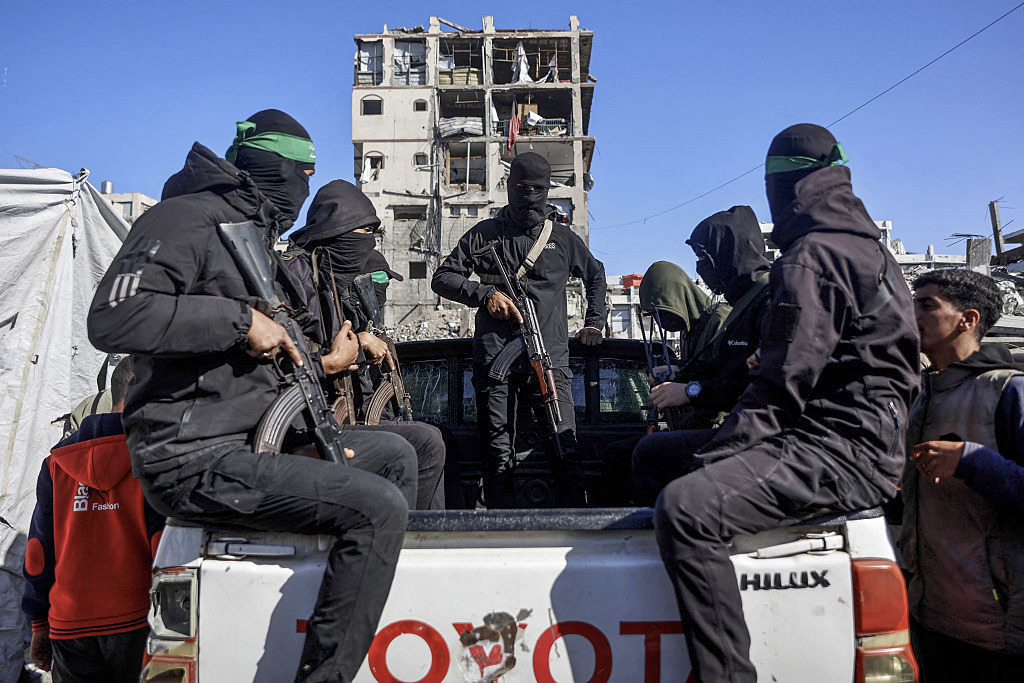
Hamas is not some misunderstood political faction waiting to be coaxed into moderation. It advocates jihad (holy war) as an “individual duty [of all Muslims] for the liberation of Palestine.” Pictured: Hamas terrorists in Jabalia refugee camp, in the Gaza Strip, on December 1, 2025. (Photo by Omar Al-Qataa/AFP via Getty Images)

Envoys from U.S. President Donald J. Trump’s “Board of Peace” recently met representatives of Hamas in the Egyptian capital of Cairo in an effort to safeguard the Gaza ceasefire, Reuters reported on March 16.

“The weekend meeting is the first publicly reported since ‌the start of the Iran war between the Palestinian militant group and the board, a new international body personally headed by Trump, which has been tasked with overseeing post-war Gaza….

“One of the sources says Trump’s board was represented at the talks with Hamas by Aryeh Lightstone, an American aide to Trump’s special envoy Steve Witkoff…. Further meetings were expected ‌this week. “

The Trump administration is making a huge mistake by engaging an Islamist terror group.

Direct talks with Hamas, officially designated by the US government as a Foreign Terrorist Organization, risk conferring legitimacy on a group that rejects Israel’s right to exist and for decades has carried out attacks against countless Israeli civilians.

Engagement clearly signals to terrorists that violence is an effective path to power, land, and international recognition. Hamas is a group that is explicitly and fundamentally committed, in both ideology and practice, to “armed resistance” (terrorism).

Hamas’s October 7, 2023 invasion of Israel was a large-scale terror operation that illustrated the group’s commitment to terrorism. Senior Hamas officials have repeatedly vowed that they fully intend to continue such attacks.

Hamas is hardly a controversial political actor. The group, an offshoot of the Muslim Brotherhood, aims to establish an Islamic state encompassing the entirety of present-day Israel and the West Bank and Gaza Strip, through armed conflict.

Hamas’s 1988 charter as well as repeated statements by its leaders, rejects the legitimacy of Israel. Its charter quotes Muslim Brotherhood founder Hassan al-Banna as saying: “Israel will exist and continue to exist until Islam will obliterate it, just as it obliterated others before it.”

Article 11 of the Hamas charter states:

“The Islamic Resistance Movement [Hamas] believes that the land of Palestine is an Islamic Waqf consecrated for future Moslem generations until Judgement Day. It, or any part of it, should not be squandered: it, or any part of it, should not be given up. Neither a single Arab country nor all Arab countries, neither any king or president, nor all the kings and presidents, neither any organization nor all of them, be they Palestinian or Arab, possess the right to do that.”

Hamas is not some misunderstood political faction waiting to be coaxed into moderation. It advocates jihad (holy war) as an “individual duty [of all Muslims] for the liberation of Palestine.”

Article 13 of the Hamas charter says:

“There is no solution for the Palestinian question except through Jihad. Initiatives, proposals and international conferences are all a waste of time and vain endeavors.”

Since its establishment in 1987, Hamas has remained fully committed to its “armed resistance” and the elimination of Israel. In Hamas’s lexicon, the terms “compromise” and “concessions” do not exist.

Hamas’s ideological framework — rooted in Islamist “resistance” — make compromise and concessions impossible. Needless to say, there is no evidence that the terror group intends to fundamentally alter its long-term goals.

For Hamas, direct talks with the US provide an opportunity to gain time, legitimacy, and concessions. As Trump’s envoys are talking to Hamas, the terror group has been continuing by force to reassert its rule in the Gaza Strip.

Unfortunately, negotiating with terrorist groups and the like, instead of defeating them, tends to end in disaster. The minute it becomes convenient, they go right back to terrorizing. The Taliban have been expanding their repression throughout Afghanistan. Russia disregarded the 1994 Budapest Memorandum, in which it guaranteed Ukraine’s sovereignty, borders and freedom from aggression if Ukraine gave up its nuclear weapons; and China appears to assume that agreements exist to be violated (such as here, here and here).

Hamas has consistently refused to disarm, recognize Israel, cease ruling Gaza, renounce violence, and accept past agreements between Israel and the Palestinians. Talking to Hamas now, without its first adhering to Trump’s preconditions, marks a sharp and potentially confusing policy reversal that weakens US credibility globally.

If Hamas is allowed to gain diplomatic access without changing its core positions, other Islamist terror groups will draw an empowering lesson: violence pays.

Across the region, the Iranian regime and its terror proxies are watching closely. The lesson for them will unmistakably be: hold out, escalate, and eventually the world’s most powerful democracy will come to deliver victory to you.

For Palestinians, direct talks would mean that Hamas’s rule in the Gaza Strip — which began with a violent coup against the Palestinian Authority in 2007 — has been marked by nearly twenty years of repression at home. It has consisted of crackdowns on dissent, summary executions, torture, intimidation and murder of rivals, stealing humanitarian aid from civilians, shooting at their own people trying to flee, using their citizens as human shields to escalate the death count and blame it on Israel; and the imposition of heavy economic burdens.

Engaging Hamas as if it were a normal governing authority will only demonstrate to other terrorist groups that terrorism works. Negotiating will not moderate reality. The message it sends to the Palestinians and like-minded groups is: The international community is willing to overlook internal abuses and human rights violations so long as the rulers in question enforce obedience. That is the job for a prison warden, not for a government one hopes will stabilize the neighborhood.

Direct negotiations with Hamas also sideline other Palestinians who are not affiliated with the terror group or who are opposed to violence and terrorism. Direct negotiations just reinforce Hamas’s claim that “armed resistance,” not diplomacy, gets results.

The Trump administration, if it believes that talking to Hamas represents a pragmatic and necessary approach for achieving peace and stability, is dangerously mistaken. This belief collapses under scrutiny. Talking directly to Hamas will only reward extremism and terrorism, weaken anti-Hamas individuals and parties, and erode the very principles Washington claims to defend.

Launching direct talks with Hamas or other Islamist terror groups absent any fundamental change in their positions is not diplomacy. It is capitulation and surrender dressed up as “realism.”

The Trump administration would do well to see that talking to Hamas only normalizes it as a legitimate regional actor rather than ostracizing it as an Islamist terror group.

Above all, direct engagement of Hamas is a concession to the jihadis, who believe Muslims are in an eternal confrontation with the enemies of Islam and must overthrow secular regimes to restore a “pure” Islamic state.


Khaled Abu Toameh is an award-winning journalist based in Jerusalem.


Zawartość publikowanych artykułów i materiałów nie reprezentuje poglądów ani opinii Reunion’68,
ani też webmastera Blogu Reunion’68, chyba ze jest to wyraźnie zaznaczone.
Twoje uwagi, linki, własne artykuły lub wiadomości prześlij na adres:
webmaster@reunion68.com

Hundreds Wounded in Iran Missile Attacks Across Central, Southern Israel, Including Near Nuclear Site


Hundreds Wounded in Iran Missile Attacks Across Central, Southern Israel, Including Near Nuclear Site

Debbie Weiss


A drone view shows a damage in a residential neighborhood, following a night of Iranian missile strikes which injured dozens of Israelis, amid the US-Israel conflict with Iran, in Dimona, southern Israel, March 22, 2026. Photo: REUTERS/Roei Kastro

More than 200 people were wounded in several Iranian strikes on central and southern Israel over the weekend, including children who were seriously injured, after Israeli air defenses failed to intercept at least two ballistic missiles, prompting the defense minister to threaten to send Iran “back decades.”

Fifteen people were injured on Sunday following an Iranian cluster missile strike in the central Israeli cities of Tel Aviv, Petah Tikva, and Ramat Gan. By early evening, several homes and roads were damaged by the strikes.

A direct hit by a missile launched from Iran the prior evening on Arad and Dimona in southern Israel caused widespread damage to buildings and prompted the evacuation of nearly 300 people to hospital. As of Sunday afternoon, 18 children were still hospitalized.

A ballistic missile carrying a payload of several hundred kilograms of explosives landed next to residential buildings in Dimona, with the shockwave ripping through them and leaving about 30 people wounded, including a young boy.

Israel’s Shimon Peres Negev Nuclear Research Center, located roughly eight miles southeast of the city, was likely the target, analysts said. But according to the International Atomic Energy Agency (IAEA), the site was not harmed in the strikes.

“Information from regional states indicates that no abnormal radiation levels have been detected,” the UN nuclear watchdog tweeted.

Iranian state TV said on Saturday the salvos were in response to an attack on Iran’s Natanz nuclear facility earlier that day.
.

At Soroka Medical Center in Beersheba, more than 160 injured patients arrived overnight, including over 70 children, according to Prof. Shlomi Codish, the hospital’s director. He described the influx as a “highly complex mass casualty event” involving blast injuries, shrapnel wounds, and trauma, including critically and moderately injured patients who required urgent surgery.

Codish said authorities were working to provide “immediate support and shelter” for those impacted, adding that entire families were evacuated to the hospital.

“The challenge is not only medical but also human. The strike hit the heart of a civilian neighborhood, and entire families arrived together, injured and distressed. We worked to map family connections in order to provide coordinated care and preserve family unity as much as possible,” he told The Algemeiner.

The missiles in both Arad and Dimona were engaged by air defenses, but the interceptors failed to bring them down.

In both cases, most of those injured in the missile did not make it to bomb shelters in time.

Prime Minister Benjamin Netanyahu, visiting the scene of the strike in Arad, said it was a “miracle” that no one was killed but added “we don’t want to rely on miracles.”

“If you’re in a shelter, you’re protected,” he said.

Defense Minister Israel Katz, who was also in Arad, accused Iran of intentionally targeting civilians.

“If this continues, we’ll make sure to hit Iran so hard it will be sent back decades,” Katz said.

Tehran aimed to generate domestic pressure on Israel’s government to stop the war, he said, but added that “it won’t happen because our home front is strong.”

In a statement posted on X, IAEA Director-General Rafael Grossi stressed that “maximum military restraint should be observed, in particular in the vicinity of nuclear facilities.”

Since the Feb. 28 US-Israeli strikes on Iran, Tehran has launched more than 400 missiles toward Israel, with the Israeli Air Force saying roughly 92 percent were intercepted. More than 4,500 Israelis have been evacuated to hospitals from the strikes, the health ministry said.


Zawartość publikowanych artykułów i materiałów nie reprezentuje poglądów ani opinii Reunion’68,
ani też webmastera Blogu Reunion’68, chyba ze jest to wyraźnie zaznaczone.
Twoje uwagi, linki, własne artykuły lub wiadomości prześlij na adres:
webmaster@reunion68.com