Amir Taheri
- “If my experiences in the days and weeks devoted to this problem have taught me any one thing, it is that everywhere the need is felt for an American foreign policy — a foreign policy so firmly embedded on principle that it will hold equally for United States troops in China or the atom bomb, or Palestine.” — Bartley Crum.
- [Crum’s] account … clearly shows that President Truman, who always… sided with the forces of freedom and progress, was often opposed by his own State Department that practiced a value-free diplomacy in the name of preserving the status quo.
- “We can throw our lot in with the forces… who prop up feudalistic regimes in the Arab states in the hope that these will serve as a cordon sanitaire against Soviet; who believe they can successfully continue the same processes of exploitation in the future which have proved successful in the past. Or we can throw our lot in with the progressive forces in the Middle East. We can recognize that there is a slow rising of the peoples, and that we must place ourselves on the side of this inevitable development toward literacy, health, and a decent way of life.” — Bartley Crum.
- He was against a status quo that subjected the nations of the region to despotism and poverty. He also realized that Arab despots and their hangers-on used the issue of Palestine as a means of diverting attention from their own misdeeds, wasting Arab energies on xenophobia and religious bigotry. The irony in all this was that Great Britain… sided with the Arab despots, and did all it could to discourage and weaken the very forces of reform and change that Crum saw as the natural allies of Western democracies.
- The history of the past six decades shows that… [b]etting on the Arab “strongmen” was morally wrong and politically shortsighted…. By 1960, the switch that the British had tried to prevent in the Middle East had taken place almost everywhere, leaving the Western powers with no reliable ally but Israel, the very state whose emergence they had tried to prevent.
- “[H]ere we Americans, too, have compromised with the basic principle of freedom for reasons of expediency. We have taken our cue from those British statesmen who have based their policy…. upon cooperation with local potentates rather than upon promotion of the genuine interests of the masses.” — Bartley Crum.
- Crum believes that Jews in Palestine could bring the modern world to the Arabs…..A Jewish state could be a model of modernity and democracy that Arabs could adopt. Arabs, Crum believed, needed a dose of the same creative spirit, love of hard work, social solidarity and egalitarianism that marked out Jewish settlements alongside poor and insalubrious Arab villages. Crum was shocked to see that none of the Arab witnesses testifying to the mission showed the slightest interest in improving the lives of the Arab masses.
- In other words, real peace… depends on reform and democratization in the region.
- Although war has a bad name these days, there are occasions when it is the only reasonable means of preventing even greater tragedies.
- The Middle East conflict has been and, to a large extent remains, a struggle between the future and the past, democracy versus tyranny, and an open society against closed ones.
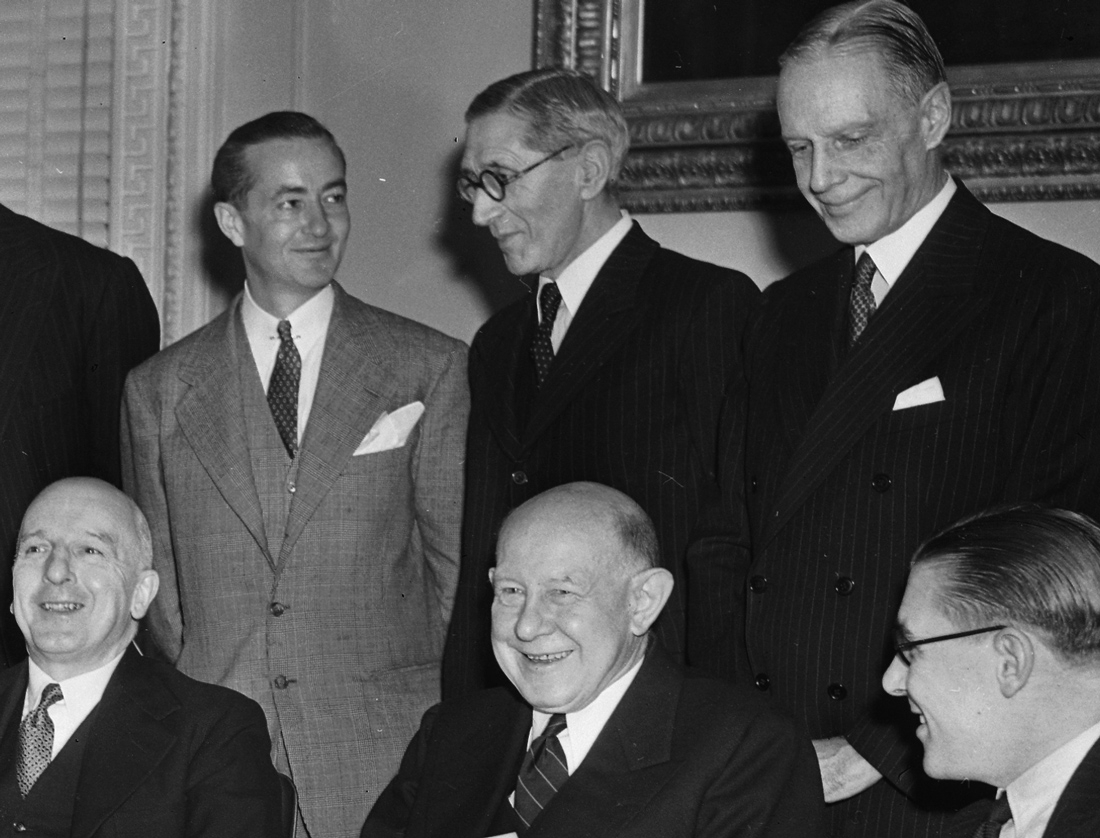 Bartley C. Crum’s 1947 account clearly shows that President Harry Truman, who always sided with the forces of freedom and progress, was often opposed by his own State Department that practiced a value-free diplomacy in the name of preserving the status quo. Pictured: Crum (top left) with some of the other members of the Anglo American Committee on Palestine at the U.S. State Department, on January 5, 1946. (Image source Bettmann Collection via Getty Images)
Behind the Silken Curtain: A personal account of Anglo-American diplomacy in Palestine and the Middle East
by Bartley C. Crum
New York: Simon and Schuster, 1947. 297 pp. $3.00
In 1946, with the tragic memory of the Second World War still very much alive, few Americans could have imagined, or would have wanted to admit that far away Middle East would soon develop into one of the top concerns of US foreign policy.
One American who realized this before many others was Bartley C. Crum, recruited by President Harry Truman to serve as a member of the American team on a United States-United Kingdom mission on Palestine. Although a Republican, Crum enjoyed enough of a reputation as a man who could transcend partisan boundaries to serve under a Democrat president, in the interest of the nation.
Prior to his mission, Crum had had little interest in the Middle East that, to most Americans, was not the popular, and often passion-arousing, subject it has since become. This enabled Crum to embark on his mission with an open mind and certainly no hidden agenda.
For Crum, the mission that took several months and covered more than a dozen countries in the Middle East and Europe became an introductory course on the politics of a region that has dominated the headlines to this day.
Crum writes:
“If my experiences in the days and weeks devoted to this problem have taught me any one thing, it is that everywhere the need is felt for an American foreign policy — a foreign policy so firmly embedded on principle that it will hold equally for United States troops in China or the atom bomb, or Palestine.”
However, no one had told Crum what that policy was supposed to be. And his account of the mission clearly shows that President Truman, who always relied on his own instincts and sided with the forces of freedom and progress, was often opposed by his own State Department that practiced a value-free diplomacy in the name of preserving the status quo.
Crum states that the US faces a choice in the Middle East:
“We can throw our lot in with the forces of reaction who prop up feudalistic regimes in the Arab states in the hope that these will serve as a cordon sanitaire against the Soviet; who believe they can successfully continue the same processes of exploitation in the future which have proved successful in the past. Or we can throw our lot in with the progressive forces in the Middle East. We can recognize that there is a slow rising of the peoples, and that we must place ourselves on the side of this inevitable development toward literacy, health, and a decent way of life.”
Crum had no doubts as to where his own sentiments lay. He was against a status quo that subjected the nations of the region to despotism and poverty. He also realized that Arab despots and their hangers-on used the issue of Palestine as a means of diverting attention from their own misdeeds, wasting Arab energies on xenophobia and religious bigotry. The irony in all this was that Great Britain, then under a Socialist Labour government, sided with the Arab despots, and did all it could to discourage and weaken the very forces of reform and change that Crum saw as the natural allies of Western democracies.
Before winning power in the general election of 1945, The British Labour Party had passed a key resolution on the Middle East, in effect endorsing the creation of a Jewish homeland in mandate Palestine. Once in power, however, Prime Minister Clement Attlee and Foreign Secretary Ernest Bevin were convinced by the Foreign and Colonial Office, where British policy was made, that any change in Britain’s traditional policy could weaken the Western position vis-à-vis the Soviet Union in the context of a looming Cold War.
The British establishment’s policy on the Middle East was based on three assumptions.
The first was that it is natural for Arabs to be ruled by a “strongman”. The second was that the Arab “strongman” had no principles apart from a keen desire to stay alive and in power. The third was that, if handled intelligently, the Arab “strongman” could be useful to the West.
The “strongman” could take decisions that no democratic government, subject the vagaries of public opinion and the pressure of elections, would be able to contemplate.
Within days of the start of the Anglo-American mission, it had become clear to Crum that some members of the American team found the British analysis irresistible. Loy Henderson, the senior State Department diplomat and head of the Middle East desk at Foggy Bottom, was one example. At times, he sounded more British than the British themselves. (Henderson was to become US Ambassador to Iran in the early 1950s.)
When the Anglo-American mission ended, it had become clear that the British colonialist view had triumphed over American idealism as echoed by Crum and a few other members of the US team. This meant that the two allies were committed to preventing change in the Middle East.
At the time change also included the creation of a Jewish homeland in Palestine.
Crum’s account refutes one of the most persistent fables in the Middle East: that Britain and the United States created Israel as an outpost of the “Imperialist West” in the Muslim world. Crum shows that, far from creating Israel as a state, the two Western powers did what they could to prevent its birth. It was the Jews’ determination and their readiness to fight that forced both powers to admit the emergence of Israel as a state.
The history of the past six decades shows that Crum was right. Betting on the Arab “strongmen” was morally wrong and politically shortsighted. Five years after the Anglo-American mission, Egypt’s feudalist monarchy had been replaced by a leftist military regime that regarded Britain and the US as guarantors of the ancien regime, and quickly turned to the Soviets for support. Six years after that the second pillar of the British policy in the Middle East collapsed when another group of leftist army officers toppled the British-installed monarchy in Iraq. In between, the Syrian “strongmen” had also found their way into the dustbin of history. By 1960, the switch that the British had tried to prevent in the Middle East had taken place almost everywhere, leaving the Western powers with no reliable ally but Israel, the very state whose emergence they had tried to prevent.
The tragic irony in all this is that while the British assumed that the Arab masses would not accept a Jewish state in Palestine, Crum found evidence to the contrary. Both Arabs and Jews in Palestine told him that they could, and in some cases actually desired, to live and work together. It was up to Britain and to a lesser extent the US to show leadership and help Arabs and Jews create the post-colonial state structures required for their coexistence.
Crum quotes a senior Arab supporter of reform:
“If they were sure that Britain and America wished the Jews and Arabs to get together, we would. But they are not convinced, these Arab leaders: they wish to maintain their position of power, and they know that depends upon toeing the {British} Colonial Office line.”
While opposing the creation of a Jewish state, Britain moved quickly to create an Arab state in mandate Palestine. However, this was not a state for the Palestinians. It was an emirate carved out for the Hashemite family of Hejaz as a reward for their collaboration with Great Britain during the First World War. The newly created state was named the Emirate of Trans-Jordan, ignoring that its territory covered almost 90 per cent of mandate Palestine while 90 per cent of its inhabitants were Arabs from the British Mandate of Palestine.
Crum saw this as a scandalous example of colonial cynicism, and recommended that the United States reject the admission of Trans-Jordan to the United Nations. He writes: “There is no question that the removal of Trans-Jordan from the terms of the mandate was a violation of its original purpose.”
One could only guess Crum’s sense of outrage. While Britain used its military and diplomatic power to prevent the entry of Jewish survivors of the Nazi Holocaust into Palestine, the Colonial Office, was creating an emirate for a wealthy Arab family whose members lived in Britain in golden exile and hardly felt homeless.
Crum is saddened by what he regarded as Britain’s change of course in the name of Realpolitik. However, he is not censorious. Major powers make their biggest mistakes in the name of realism and expediency. He writes:
“It is tragic that Great Britain today seems to have forgotten the original intent of her own men of vision who knew what they were building and why. However, we must be careful, in judging Britain, to remember that here we Americans, too, have compromised with the basic principle of freedom for reasons of expediency. We have taken our cue from those British statesmen who have based their policy in undeveloped regions of the earth upon cooperation with local potentates rather than upon promotion of the genuine interests of the masses. Our course has been one of duplicity, with conflicting public and private pledges. I am sure our policymakers have been able to do this only because of lack of clear popular understanding of the issues involved.”
Crum makes no claims to prophethood. However, it seems that having spent time in the Middle East where prophecy has been an export item for millennia, he acquired a vision that most of his fellow mission-members lacked. In a series of policy proposals at the end of the book, he foresees the so-called two-state solution that became official US policy only in 2004 under President George W Bush. He also insists that it must be made “fundamentally clear that Arab states have no special position in relation to Palestine.”
Crum’s wish was granted in 1980 at the Khartoum Summit when the League of Arab States eventually gave up its claims with regard to Palestine, accepting that the matter be left to Israel and the Palestinians. Thanks to Crum’s exceptional powers of observation and the meticulous notes he took, we catch telling glimpses of a number of interesting figures who were to play bigger roles in later years.
Appearing in cameo roles here are such figures as Habib Bourguiba, the future father of Tunisia’s independence. A French citizen at the time and a lawyer, he was enlisted by the Arabs to argue the case against a Jewish homeland at a series of hearings organized by the Anglo-American mission. A decade later, the same Bourguiba was to become the first Arab leader to recommend full Arab recognition of Israel. We also meet Hassan al-Banna, the mysterious Egyptian schoolteacher who had founded the Muslim Brotherhood, a rightwing religious outfit the British often used against the Left in Egypt. Here, al-Banna is fielded to back the British position and argue for the inclusion of Palestine into an undefined “Arab world.”
Crum describes the grandfather of present-day Islamist terrorism as “a dark-headed, heavy-set figure with glowing eyes.”
Echoing British claims, Banna tells the Anglo-American commission that Muslims will never accept a Jewish state in their midst.
Crum writes:
“El-Banna insisted that the Koran mentioned Christians and Moslems favorably, but had nothing good to say about the Jews, and that religious bonds between Jews and Palestine meant nothing because these bonds were diametrically opposed to the Koran and Moslem practices.”
Incidentally, Crum describes the Muslim Brotherhood as “a Fascist religious organization”, thus refuting the claim that “neo-cons” invented the concept of an Islamic fascism in the 21st century.
Other characters fielded by the British in what looked like a theatrical production included His Eminence Sheikh Ahmad Murad al-Bakri who bore the lofty title of The Grand Chief of the Sufis but was on British Colonial Office’s payroll. We also meet Muhammad Fadil al-Jamali who was to become Iraq’s Prime Minister thanks to the British before being put to death by pro-Soviet officers who seized power in 1958. At the time al-Jamali wanted the coastal part of mandate Palestine to be handed over to Iraq.
Then there was Azzam Pasha, an Egyptian grandee, who told the commission that it was not the Jew but the West that Arabs regarded as evil. He said European Jews were being brought to the Middle East as “Westerners in disguise” and “with imperialist ideas.” In the next breath, however the same Azzam was calling on Britain to let Egypt annex the Sudan!
The Syrians testifying at the commission denied that a Palestinian entity ever existed, and argued that the mandate Palestine should be handed over to the military regime in in Damascus.
Remarkably, while all Arabs opposed the creation of a Jewish state in any part of the mandate area, few were prepared to hint at the possibility of creating a state for Arab Palestinians. The Syrians insisted that Palestine was part of Syria while the Egyptians had claims of their own. The Iraqis believe that Palestine actually belonged to them because, in al-Jamali’s words “the coastline of Palestine represents the seaport of Iraq.”
In his book, Crum makes no secret of whose side he is on. He is on the side of the Jews who came to Palestine to build a new country. However, he is not on their side solely, or even largely, because they are Jews. Nor is he supporting them only because so many Jews had suffered at the hands of the Nazis. Crum believes that Jews in Palestine could bring the modern world to the Arabs as well, a vision first raised by Theodor Herzl in his “New-Old State”, one of the founding texts of Zionism.
A Jewish state could be a model of modernity and democracy that Arabs could adopt. Arabs, Crum believed, needed a dose of the same creative spirit, love of hard work, social solidarity and egalitarianism that marked out Jewish settlements alongside poor and insalubrious Arab villages. Crum was shocked to see that none of the Arab witnesses testifying to the mission showed the slightest interest in improving the lives of the Arab masses.
He writes:
“One felt their ever-present sense of fatalism. A child born crippled limps through life; a child made blind by trachoma is a victim of Allah’s will, not man’s. And, who is to say that Allah chose wrongly in singling out this child?”
To Crum the blame rests with nature and the imperial powers that dominated the Arabs for centuries. He writes:
“I did not blame the Arabs: they were the products of a cruel physical environment where nature sapped strength and vitality. They were the products of a political and social environment that only complicated their helplessness. For four centuries under Turkish rule, they had been subject to every pressure of ignorance. Human welfare had no part in the Ottoman Empire. It was truly pointed out to us that as far as the Middle East was concerned, the French and American revolutions might never have taken place. The doctrine of human rights and personal liberty — the concept that man had dignity as human being and the latent power to lift himself from the mire of animal existence- had not penetrated the citadels of Islamic authoritarianism. “
Crum could not have known that the Anglo-American decision to effectively side with the Arab despots would in time breed four major wars and seven decades of tension and conflict in a region of vital importance to the Western powers. However, he knew full well that Arab ruling elites were not prepared to accept the existence of a Jewish state and that they would continue to use the Palestine issue as a means of diverting the attention of their own people from real problems such as tyranny, terror and poverty. Many Arab leaders still use the same arguments and excuses they did 70 years ago. The reason is that many Arab states have failed to modernize and democratize. In many cases, they remain as despotic as they were at the end of Second World War. Regimes of this type cannot conceive of rivals or adversaries in the normal political sense of the terms. What they need is an “enemy” who could be vilified on religious, ethnic and ideological grounds. Israel continues to fit the bill on all those scores.
The Human Development reports prepared by Arab intellectuals in the past few years paint a picture that is strikingly similar to the one that shocked Crum six decades ago. Israel remains the enemy because, being democratic, modern, economically successful and self-confident, it is the quintessential “other” to states that remain despotic, semi-medieval, economically underachieving, and ridden by self-doubt. Real peace, that is to say durable and “warm” peace, is possible only between states organized on similar principles and subscribing to similar values. Only like with like could live together in warm peace. The best that states based on divergent principles could hope for is a ceasefire or “cold” peace.”
This means that as long as Arab states have not democratized, that is to say not transformed themselves into modern societies based on the rule of law, they cannot live in warm peace with Israel or any other democracy. In other words, real peace and thus Israel’s ultimate security depends on reform and democratization in the region. In the meantime, while every effort should be made to promote peace, even in its “cold” version, that is to say a ceasefire with a more attractive label, armed vigilance remains necessary. Although war has a bad name these days, there are occasions when it is the only reasonable means of preventing even greater tragedies. For Israel, it is important to understand that it is involved in a long game in which patience and steadfastness are keys to ultimate success that in its case means survival. Building policies on quick fixes or looking for miracle solutions could generate even more complications, as did the rehabilitation of Yasser Arafat through the Oslo accords.
Crum’s valuable book clearly shows that no amount of politics and diplomacy would have saved the still fragile Jewish “homeland” from total destruction, an eventuality that the British Colonial Office would not have regretted.
What saved the Jews was their readiness to fight even when the odds seemed heavily stacked against them. And, as Crum shows they were ready to fight because they knew they were fighting for themselves not for a despotic lord and master. David Ben Gurion’s adamant quest for statehood was based on the understanding that the ideal could be an enemy of the real. This is why he accepted to build his dream state on a tiny chunk of land as full of holes as Swiss cheese. What mattered was to transform a cause into a state as quickly as possible.
The Middle East conflict has been and, to a large extent remains, a struggle between the future and the past, democracy versus tyranny, and an open society against closed ones. It also illustrates a fight between the ideal, which for many Palestinian elders is the destruction of Israel, and the possible reality of coexistence by two nations even in the context of a cold peace. Much of what Crum wrote 70 years ago remains true today.
Amir Taheri was the executive editor-in-chief of the daily Kayhan in Iran from 1972 to 1979. He has worked at or written for innumerable publications, published eleven books, and has been a columnist for Asharq Al-Awsat since 1987.
This article has been reprinted by the kind permission of the author.
 The Defenders of Mariupol
 A photo released on May 10, 2022, by the Azov Battalion, showing an injured Ukrainian serviceman inside the Azovstal iron and steel works factory in eastern Mariupol, UkraineDMYTRO ‘OREST’ KOZATSKYI/AFP VIA GETTY IMAGES



 ILTV Israel News