 After intrigue, theft and deterioration, Holocaust collection secure at CU Boulder
By Uriel Heilman
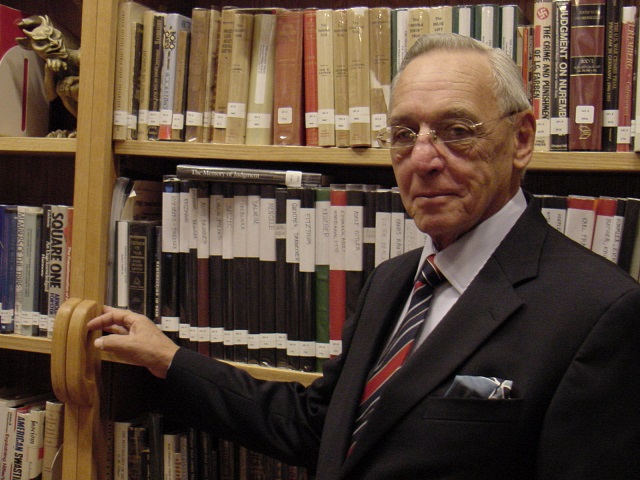
After discovering in his teens that he was Jewish, Harry Mazal, pictured here in his home Holocaust library in 2002, spent the latter years of his life obsessed with amassing a collection of material on the Holocaust. (courtesy Aimee Mazal Skillin)
BOULDER, Colo. (JTA) — The yellowing document is crumbling and fading, but the smooth signature on its cover is as legible as it is chilling: Rudolf Hess, the Nazi who served as a Hitler deputy from 1933 to 1941.
The signature, which adorns a 70-year-old leniency plea for top Nazi Hermann Goering during the postwar Nuremberg trials, is one of some 500,000 discrete items and 20,000 books donated last year to the University of Colorado at Boulder — nearly the entirety of one of the world’s largest privately owned Holocaust collections. The unusual trove includes aerial surveillance photos of the Auschwitz-Birkenau extermination camp, decaying copies of the Nazi newspaper Der Sturmer, Nuremberg trial transcripts, and a trove of pro-Nazi and Holocaust denial literature.
“We don’t even know what we have,” said David Shneer, director of the Jewish Studies program at University of Colorado at Boulder and the person responsible for bringing the archive to the university. “We have teams of students inventorying it. We hope to get through everything by the fall.”
The unlikely story of how the archive, known as the Mazal Holocaust Collection, ended up in Boulder is a tale of Holocaust denial, a hidden Jewish past and the shady market for Holocaust artifacts.
The collection represents the life’s work of Harry Mazal, a businessman from Mexico City who was raised Protestant and discovered during his teen years that he was Jewish. Mazal’s family emigrated from present-day Turkey before World War II, and his father built a successful women’s lingerie business that he subsequently passed on to his son.
Though neither Mazal nor his parents personally experienced the Holocaust, Mazal became increasingly disturbed by the rising tide of claims that the genocide against the Jews was fabricated. Determined to do something about it, Mazal, who made his first research trip to Germany in the 1960s and died in 2011 at age 74, began collecting and carefully documenting evidence of the concentration camps, the Final Solution and the murder of the 6 million Jews.
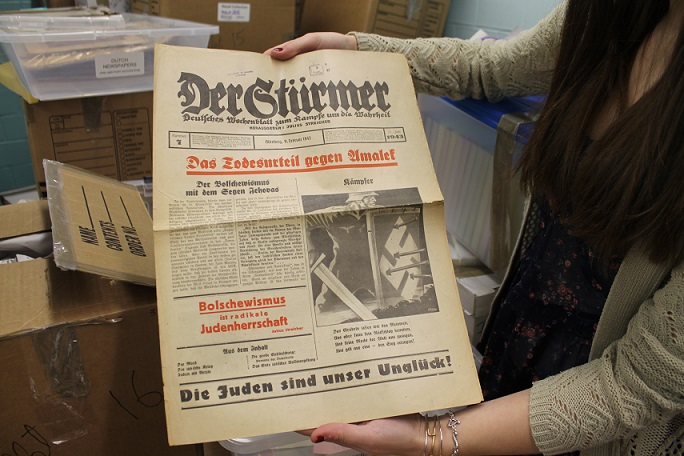
A copy of the Nazi weekly Der Sturmer from February 1943, with a headline at bottom left reading “Bolshevism is radical Jewish domination.” The newspaper is part of the Mazal Holocaust Collection at the University of Colorado-Boulder. (Uriel Heilman)
Mazal became fixated on documenting the Holocaust. He traveled to Europe to photograph the camps and bought rare Holocaust artifacts on eBay. He established a relationship with the U.S. Holocaust Memorial Museum in Washington and became a repository for trial transcripts that were duplicates of material the museum already had. He collected Yizkor memorial books, original sketches of extermination camps and aerial photographs of the camps taken by the U.S. military, American Nazi newspapers from the 1930s and ‘40s, materials relating to the David Irving-Deborah Lipstadt Holocaust denial trial in England, and an extensive array of Holocaust denial literature. He also wrote scholarly articles and lectured about the attempted genocide of the Jews.
“I remember him being very offended by the fact that Holocaust denial was so prevalent,” Mazal’s daughter, Aimee Mazal Skillin, told JTA. “He really took it to heart. He began to collect as much information as he could about the Holocaust and the war, and about how the Jews were mistreated. Combating Holocaust denial was his real motivation. It was like he was walking around with horse blinders and saw nothing else other than this mission.”
Read more: After intrigue,…
twoje uwagi, linki, wlasne artykuly, lub wiadomosci przeslij do: webmaster@reunion68.com