Archive | March 2016

W Leżajsku powstaje centrum chasydzkie

W Leżajsku powstaje centrum chasydzkie

Krzysztof Bielawski


Synagoga, mykwa, hotel i muzeum chasydyzmu. Rozpoczęły się prace przy budowie centrum chasydzkiego w Leżajsku.

Grób cadyka Elimelecha co roku przyciąga do Leżajska około 100 tys. chasydów. Największe natężenie przyjazdów przypada w rocznicę śmierci cadyka.


Chasydzi przy grobie cadyka Elimelecha z Leżajska (fot. Zbigniew Nowak)

Od lat problem stanowi brak odpowiedniej infrastruktury. W Leżajsku jest niewiele miejsc noclegowych, nie ma stałej synagogi, trudno zdobyć koszerną żywność. Podczas jorcajtów za synagogę służy duży namiot, a posiłki wydawane są w prowizorycznych stołówkach.

Ten stan ma ulec zmianie. Po 10 latach planowania ruszyła budowa centrum chasydzkiego, które powstaje obok cmentarza. Inwestycję prowadzi Fundacja Chasydów Leżajsk-Polska, a partnerem projektu jest Fundacja Ochrony Dziedzictwa Żydowskiego, prawny właściciel cmentarza.

Centrum będzie składać się z 2 części. Już teraz od podstaw wznoszony jest budynek, w którym znajdzie się synagoga z salami dla 250 mężczyzn i 150 kobiet oraz pokoje gościnne. Budowa powinna zakończyć się jeszcze w tym roku.

Dodatkowo zmodernizowany zostanie pobliski budynek przy ul. Studziennej. Będzie mieścił dom pielgrzyma. Ta część centrum zostanie oddana do użytku prawdopodobnie w 2017 roku.


Chasydzi w Leżajsku (fot. Mieczysław Wroński)

W centrum znajdzie się też mykwa, kuchnia z jadalnią dla 250 osób, 40 toalet. Na pielgrzymów będzie czekać łącznie 70 pokoi noclegowych.

Na etapie planowania jest muzeum tradycji chasydzkiej. Ekspozycja ma opowiadać o cadyku Elimelechu, a także o życiu Żydów przed wojną i w latach Zagłady.

Monika Krawczyk z Fundacji Ochrony Dziedzictwa Żydowskiego liczy, że powstanie ośrodka przyciągnie do Leżajska jeszcze więcej osób, w tym także nieżydowskich turystów.

– Mamy nadzieję, że dzięki tej inwestycji Leżajsk będzie zyskiwał na popularności. Szczególnie jako element naszego programu popularyzacji miejsc związanych z chasydyzmem, czyli „Szlaku Chasydzkiego” – powiedziała Monika Krawczyk w rozmowie z Małgorzatą Motor z dziennika „Nowiny”.


twoje uwagi, linki, wlasne artykuly, lub wiadomosci przeslij do: webmaster@reunion68.com


The Labour Party is increasingly anti-Semitic

The Labour Party is increasingly anti-Semitic

Tom Harris


The influx of anti-Israel far Left supporters has worsened the bias of the PLP against Jewish people

A Labour rosette

Does Labour, my party, have a problem with anti-Semitism? When someone like Gerry Downing, a member of the Socialist Fight organisation, can demand that the “Jewish problem” be addressed, and then apply and gain party membership (albeit briefly), it’s clear that it might. And when Vicky Kirby, Labour’s former candidate in Woking, who was suspended after tweeting “What do you know abt Jews? They’ve got big noses and support Spurs. lol” gets readmitted to the party, one feels still greater unease.

Brought up in the west of Scotland, I was only too familiar with the curse of religious bigotry. I was well aware of the reasons why enmity existed between the Protestant and Catholic communities – although, to my parents’ credit, they never encouraged us to give it houseroom. Similarly, although there were no black faces among the population of my small Ayrshire town in the Seventies, I knew all about racism. But anti-Semitism? What on earth was that all about?

“Unfortunately for Labour, the election of Corbyn as its leader has thrown a spotlight on a nasty kind of politics that, until last year, the media were content to ignore because of its irrelevance”

Only as an adult did I become more aware of the (and I can think of no more appropriate word) snobbery that is still exhibited towards Jews by people who, frankly, should know better. As in so many other areas, anti-Semitism has been an issue that feeds the Left’s unjustified self-righteousness. It’s a problem for the upper classes, we tell ourselves. And when we say “upper classes” we mean, of course, the Conservative Party.

There’s no doubt some truth in that, or at least there has been in the past. It’s a matter of record that Jewish Tory MPs like Edwina Currie and Leon Brittan suffered anti-Semitic barbs from a minority of their parliamentary colleagues at least occasionally, if not consistently.

Historically, the anti-Semitic label has been too often used carelessly: the Zionist Labour MP and cabinet minister Richard Crossman once branded his own party leader, Clement Attlee, and his foreign secretary, Ernest Bevin, as anti-Semitic because of their reluctance to support the creation of Israel in 1948.

But Labour today is no longer the party of Attlee, or Crossman or even Blair. Labour leader Jeremy Corbyn, while no anti-Semite himself, has rarely hesitated to share platforms – or tea on the terrace of the House of Commons – with men who promote the blood libel (that Jews murder Christian children to use their blood in religious rituals) or with those who encourage followers to paint graffiti declaring: “Hoax gas chambers built in Hollywood”. Such men are without a shadow of a doubt anti-Semites, Jew-haters.

Dyab Abou Jahjah (centre) and Jeremy Coirbyn (right)
Dyab Abou Jahjah (centre) and Jeremy Coirbyn (right) Photo: twitter.com/Abou​jahjah

Unfortunately for Labour, the election of Corbyn as its leader has thrown a spotlight on a nasty kind of politics that, until last year, the media were content to ignore because of its irrelevance. Corbyn’s association with, and friendship of, the Hamas terrorist organisation is a good starting point: here is an organisation which, far from denying its anti-Semitism, proudly states its commitment to killing Jews in its own constitution.

The outspoken Labour MP John Mann has raised the recent growth in party membership as a root cause of Labour’s current anti-Semitism problem: hatred of Israel – real, blind, vicious, hatred – is felt most keenly and most loudly by those on the extreme Left, many of them Trotskyites who joined to shore up Mr Corbyn’s leadership and who see him as the world’s last best hope of overturning capitalism and, they hope, Israel while he’s at it. Corbyn undoubtedly raised the expectations of such people by attending a Labour Friends of Israel reception at last year’s party conference, then pointedly refused to allow the word “Israel” to pass his lips.


John Mann has warned of an anti-semitism row

Read more here: The Labour Party is (…) anti-Semitic


twoje uwagi, linki, wlasne artykuly, lub wiadomosci przeslij do: webmaster@reunion68.com


Inside the Twisted Anti-Semitic Mind of Oberlin Professor Joy Karega

Inside the Twisted Anti-Semitic Mind of Oberlin Professor Joy Karega

Matthew Gindin


Isabel Sherizzy, an alumna of Oberlin College, recently did something courageous. She decided to treat her alma mater’s assistant professor of rhetoric and composition, Dr. Joy Karega, like a human being and actually reach out. She wanted to dialogue over the anti-Semitic conspiracy theories that Karega had reportedly been posting about on Facebook.

Karega has shared a series of posts alleging that Jews or Israelis were behind 9/11, ISIS, Charlie Hebdo and the Paris attacks, The Tower reported. The posts suggest she believes that Jews control the U.S. government and that Mossad engineered the downing of a Malaysian airliner over Ukraine in 2014, and that she agrees with aspects of Nation of Islam leader Louis Farrakhan’s beliefs.

In Sherizzy’s own words on her Facebook page: “I sent this professor an honest, respectful, and open-hearted response to her anti-Semitic Facebook page. Good to know that I was operating on a false assumption: that she is a good-hearted person who is not educated on the history of anti-Semitism and thus via ignorance has fallen into the trap of perpetuating classic Jew hatred. Nope, nope, nope.”

Karega’s recent response on Facebook to the multiple letters, tweets, phone calls and messages she has received offer further insight into her beliefs. Karega views letters like Sherizzy’s and others as fodder for her theories: “My Oberlin email, my Facebook message inbox, my office phone voicemail, and my Twitter account are the gifts that keep on giving. Honestly, I’ve been having these moments (very brief moments, haha) where I want to say to those of you who are emailing, calling, and surveilling my social media accounts for malicious, intimidation, and/or silencing purposes: ‘Folks, you all are making my work too easy; handing my research right to me.’”

What research is that? “My second book project, which I have made significant progress on in terms of research, planning, and the drafting of chapter templates, is entitled Conspiratorial Political Literacies: Rhetorical Practice, Contested Knowledge, and Subversive Politics… It’s downright lazy, uncritical, apolitical, homogenizing, and reductionist to frame conspiracy theories — and the rhetors, writers, and theorists who espouse such theories — in the way that much of the general public, governments, and the academy do. (I won’t lay out that argument here. But it’ll be CLEARLY articulated in one of the chapters of the book).”

Oberlin President Opens Up About Professor’s Anti-Semitic Rants

In his book “The Open Society and Its Enemies,” Karl Popper famously argued that “conspiracy theories” draw on imaginary plots driven by paranoid scenarios predicated on tribalism, chauvinism or racism. In Karega’s upside down world, anyone who presents evidence that a “conspiracy theory” is a “conspiracy theory” as Popper defined it is merely asserting his or her power in service of the conspiracy. In other words, those who demand evidence for the conspiracy theory are the racists.

Karega continues: “(1) How has the term “conspiracy theory” been used (is being used) to control the parameters of inquiry and research in the academy?; (2) How has the uncomplicated tying of conspiracy theories to accusations of anti-Semitism been used (is being used) to control the parameters of inquiry and research in the academy?; (3) What are we dealing with when we’re witnessing accusations of anti-Semitism being directed at scholars and researchers who explore, espouse, and even defend conspiracy theories? Rhetorically, are we looking at silencing techniques, intimidation tactics, etc.?”

The disturbing argument at work behind all the impressive academic verbiage is that a conspiracy theory, and more specifically an anti-Semitic conspiracy theory, is a legitimate social discourse that should not be silenced or controlled by “relations of power” that authorize accusations of anti-Semitism. In other words, Karega wants to study how Jews silence anti-Semites.

For those dulled to such language, how would it sound if we substituted “how Muslims silence Islamophobes” or “how African Americans silence White Supremacists”? And of course the question here is not whether Karega should be “silenced,” but rather whether she should be funded as a professor at one of the leading liberal arts colleges in the U.S.

Here’s Karega again: “Also worth investigating and exploring, I can generate articles for days on what I can describe as ‘anti-Semitism call-out culture’ and some of its accompanying practices. I don’t have to tell some of you that these recent activities in my own professional life have handed me a LARGE body of data (emails, voicemail messages, tweets, Facebook inbox messages, etc.) that will shed light on and provide insight into how and to what extent anti-Blackness rhetorics show up in anti-Semitic call-out culture and practices.”

“Anti-Semitism call-out culture” (which, despite its flaws, other people might think of as “social justice culture” or “human rights culture”) contains “anti-Blackness rhetorics,” according to Karega. So when Jews defend themselves against racism and hate speech they are 1) engaging in a kind of rhetoric based not in morality but in power dynamics, and 2) they are themselves guilty, in an as yet undisclosed manner, of anti-black rhetoric. Elsewhere Karega has argued that it is common “for Black women, who are early in their career on the tenure track as part of the professoriate, to be prime targets for these kinds of activities and practices.”

Oberlin President Defends Free Speech of Professor in Anti-Semitic Facebook Rant


Meanwhile, Karega’s rhetorical practices are having real-world consequences on campus. As Sherizzy wrote in response to Karega’s Facebook post: “Apparently, this professor is intent on demeaning and belittling Jewish students and alumni concerns about her anti-Jewish ideology and how much of it spills into her classroom lectures. She doesn’t care that people are deeply hurt, sad, scared, not going to class, or feeling physically ill because her posts are so violent against us. Apparently, this professor sees us as objects to be scrutinized, we are sources for her research, we aren’t real people who deserve a response let alone an apology, we are mere specimens under her microscope!!!”

Oberlin president Marvin Krislov, who is Jewish, has refused to discipline Karega, and defended her right to free speech, stating, “Acknowledgement of this right does not signal institutional support for, or endorsement of, any specific position. The statements posted on social media by Dr. Joy Karega, assistant professor of rhetoric and composition, are hers alone and do not represent the views of Oberlin College.”

But that’s cold comfort for an alumna like Sherizzy. “These are not just ideas,” she told me on the phone. “These are ideas which have been used to kill Jews.”


Matthew Gindin is a freelance writer and journalist located in Vancouver. He blogs on spirituality and social justice at “seeking her voice” and writes for the Jewish Independent. He has also been published in Tikkun, Elephant Journal, Wisdom Pills and elsewhere.


twoje uwagi, linki, wlasne artykuly, lub wiadomosci przeslij do: webmaster@reunion68.com


IPN umorzył śledztwo ws. mordu Żydów w Wąsoszu w 1941 r.

IPN umorzył śledztwo ws. mordu Żydów w Wąsoszu w 1941 r.

PAP


Pion śledczy oddziału IPN w Białymstoku umorzył śledztwo dotyczące mordu Żydów w Wąsoszu w lipcu 1941 r. Postępowanie karne wobec dwóch osób oskarżonych o to po wojnie zostało prawomocnie zakończone, a innych sprawców nie wykryto – podał Instytut.
IPN /Wojciech Stróżyk /Reporter

IPN zbadał miejsce pochówku Żydów zamordowanych
w Wąsoszu w 1941 roku, fot. Adam Dąbrowski”

IPN zbadał miejsce pochówku Żydów zamordowanych w Wąsoszu w 1941 roku, fot. Adam DąbrowskiJak poinformował PAP szef pionu śledczego IPN w Białymstoku prok. Janusz Romańczuk, śledztwo dotyczyło nazistowskiej zbrodni wojennej ludobójstwa, popełnionej 5-6 lipca 1941 r. w Wąsoszu (dawne województwo białostockie, obecnie podlaskie).

Jak wynika z informacji przekazanej PAP, chodziło o dokonanie zabójstw “nie mniej niż 70 osób narodowości żydowskiej”, które zostały zastrzelone lub zamordowane przy użyciu noży, siekier, kołków lub innych podobnych narzędzi.

Wątek mordu Żydów w Wąsoszu został wyłączony w 2006 r. do odrębnego postępowania z zakończonego wówczas także umorzeniem – śledztwa dotyczącego zbrodni niemieckich w tej miejscowości w czasie II wojny światowej.

W 2012 r. przeprowadzone zostały na zlecenie Instytutu badania archeologiczne, które nie potwierdziły przypuszczeń, że także poza terenem zbiorowej mogiły w Wąsoszu (stoi tam pomnik upamiętniający ofiary) pochowani są Żydzi, zamordowani tam w lipcu 1941 r., czyli jeszcze przed wkroczeniem niemieckiej żandarmerii.

Prokurator Romańczuk przyznał, że w śledztwie rozważano też celowość przeprowadzenia prac ekshumacyjnych w Wąsoszu. Jak dodał, prowadzący postępowanie uznał jednak, iż takie czynności byłyby zbędne, bo zgromadzony i bez nich materiał dowodowy pozwalał na merytoryczne zakończenie śledztwa, bez konieczności przeprowadzenia prac ekshumacyjnych.

IPN nie udało się jednak ustalić innych sprawców niż osoby, które zostały już za to osądzone i skazane po wojnie. “Przeprowadzono szereg czynności procesowych, które nie ukierunkowały śledztwa na określonych sprawców” – podał Instytut.

Źródła różnią się w szacunkach liczby ofiar, niektóre mówią nawet o 250 zamordowanych w Wąsoszu Żydach (taka liczba wymieniona jest też na pomniku upamiętniającym ofiary – PAP). Ostatecznie Instytut przyjął, iż ofiar było “nie mniej niż 70”.

Sprawa wydarzeń z 5-6 lipca 1941 r. w Wąsoszu była ostatnim śledztwem dotyczącym pogromów żydowskich, prowadzonym przez pion śledczy IPN w Białymstoku. Oprócz najgłośniejszego, dotyczącego Jedwabnego, białostocki IPN prowadził także sprawy dotyczące mordów Żydów w Radziłowie, Szczuczynie oraz mordu żydowskich kobiet w okolicach wsi Bzury.

One również zostały umorzone. Powody był podobne: albo w ogóle nie udało się ustalić sprawców lub już zmarli, albo nie udało się ustalić sprawców innych niż ci, którzy po wojnie byli za te zbrodnie osądzeni.


Annihilation of Jews in the Districts of Grajewo and Lomza in July 1941

Translation from Polish, pages 232-234 of the Grajewo Yizkor Book*

Province
Jewish Historical Commission
Bialystok, 14 May 1946
L.p. 5/46

Deposition of Menachem Finkielsztejn
Resident of Radzilow, age 22

22 June 1941 was the start of the war. The two districts are adjacent. The first line of Germans overran the district without doing any damage. A week later, the Polish police allied with the Germans, entered the houses. The Germans terrorized and the Poles looted. The Poles asked the Germans what penalty there was for killing Jews. The Germans replied that killing Jews was not a crime. A week later the Germans left. The Poles would enter Jewish homes at night to terrorize and rob.

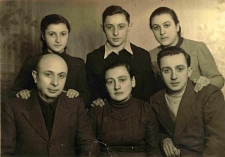
Finkielsztejn Family
Upon arrival in Israel, 1946
[Bottom row L-R]: Yisrael Finkielsztejn, wife Chaya (nee Wasersztejn) Finkielsztejn and eldest son Menachem
[Top row L-R]: Chana, Sholem, Yaffa
Entire family of six survived the Holocaust
Went to Israel, 1946


5 July, the Polish police surrounded the little village of Wasosz (district of Grajewo). The hooligans went from door to door murdering inside and outside the Jewish houses. They raped the women, cut off their breasts and threw children against the walls. Also killed were the wives of the Soviet commandant and Soviet workers. The fingers of the cadavers were cut off to secure any jewelry and teeth were removed from the mouths for the gold. Any surviving children were killed while their parents watched and then they killed the parents. The pogrom lasted 3 days, the amount of time the Germans allowed the Poles for murder and robbery. Graves were dug and the bodies were buried. In the course of this 1200 Jews perished (the town had about 800 Jews but more were brought from other places). About 15 people survived until June 1942 in Wasosz. The Germans behaved well but the Poles could kill and plunder at will.

1 June 1942, a model farm was created in Milewo, community of Szczuczyn. This was on the property of a landowner from Grajewo. All the Jews were moved there as well as the Jews from neighboring villages, all together 500 people. The people were worked extremely hard from dawn to night. Supervisors were the Poles. Even the children were worked very hard. Shelter was very meager and there was terribly severe discipline.

2 November 1942, they were deported to the village of Bogusze on the German border. There was a former camp there where Soviet and Polish prisoners were literally worked to death. They were kept in this camp until January 1943 when they were sent to their deaths in Majdanek and also Treblinka.

In Bogusze there were no houses for the Jews. They slept outside in the fields and were thrown raw potatoes. Those that caught them ate. Half of the Jews died on this spot.

Stories were told that Soviet prisoners in the barracks were starved to death. There was one Jew that possibly survived. His name, Mroczek from Kolno (now in Lomza).

7 July 1941, the Polish hooligans who were armed with rifles and pistols by the Germans burned approximately 1500 Jews in Radzilow, community of Bialystok (100 from Radzilow and 500 from Szczuczyn, Jedwabne, etc.). This pogrom lasted 3 days. 22 Jews hid and they survived, including the family of Finkielsztejn (father, mother, 4 children, and one cousin who perished later – Zina Wasersztejn). The Finkielsztejn’s were hidden in the village of Konopki-Blonie, community of Hawiski, Lomza district. Other Jews stayed in Radzilow. After a month, the Jews remaining there were housed in a synagogue. They were forced into intense labor removing heavy stones from the Radzilow River [Radzilowka River] to build a bridge. This lasted 3 weeks. The Jews bought themselves out at the office of the police commander (Konstanty Kiluk). He allowed them to live in one of the Jewish houses on Koscielna Street. They were required to do heavy labor (street cleaning, etc.). This lasted until 1 June 1942. Meanwhile, they arrested Benjamin Kruk, Szapsa Moruszewski and others for being communists. They disappeared without a trace.

1 June, the people were deported to Milewo. The only survivors were the Finkielsztejn’s, Mojzez [Moshe] Dorogoj and his son Akiwa (they perished 28 January 1945, one week after the liberation by the Red Army). They were killed by the Poles in the village of Itucz, community of Radzilow.


Destruction of the Village of Jedwabne 11 July 1941 (also 3 days):
Translation from Polish, page 234 of the Grajewo Yizkor Book*

Before the war there were 2800 Jews there. They were all burned in a barn. The first in the death procession was the Rabbi and the butcher. The Rabbi carried a portrait of Stalin and the rest of the Jews carried red flags. As they passed before the monument of Stalin they were told to kiss his feet and cheer in his honor. As in Radzilow, the second day, the Poles went into the burnt remnants of the barn and pulled gold teeth from the jaws of the cadavers. 3300 Jews perished (3000 were burned, the rest were found and killed in the following 2 days). There were 302 that survived. They remained in Jedwabne in 3 houses until 11 February 1942. However, 15 from among them, due to some Polish provocation (the Jews were accused of hanging anti German banners), disappeared . . .

2 November 1942, the rest, along with the inhabitants of the Lomza ghetto were taken to Zambrow and then in January to Treblinka? . . .

Those left were Zyna Cukierbraun and 3 males (the males are in Jedwabne and Zyna is in Warsaw).

Witness:
Protocolant:
Jewish Historical Commission:  M. Turek, Mgr.


*The Grayewo Memorial Book
Published by the United Grayever Relief Committee, New York, N.Y. 1950.
Pages 232-234, in Polish.

Editor’s notes or definitions are entered in [brackets].
(Parentheses) in the translation appear here as they appeared in the original text.
Translated from Polish by: Janine Oberrotman. Edited by: Roy M. Warshawsky and Jose Gutstein.
Translation Copyright ©2001 by Jose Gutstein.
Note: A few names and phrases have been deliberately inserted throughout the text, which are not in the original,
but which do not alter the context, to easily detect unauthorized use and publication of this material, on the internet or elsewhere.


twoje uwagi, linki, wlasne artykuly, lub wiadomosci przeslij do: webmaster@reunion68.com


TSKZ Warszawa – Purimowy koncert “Wielkie gwiazdy dwudziestolecia”

TSKZ Warszawa – Purimowy koncert “Wielkie gwiazdy dwudziestolecia”

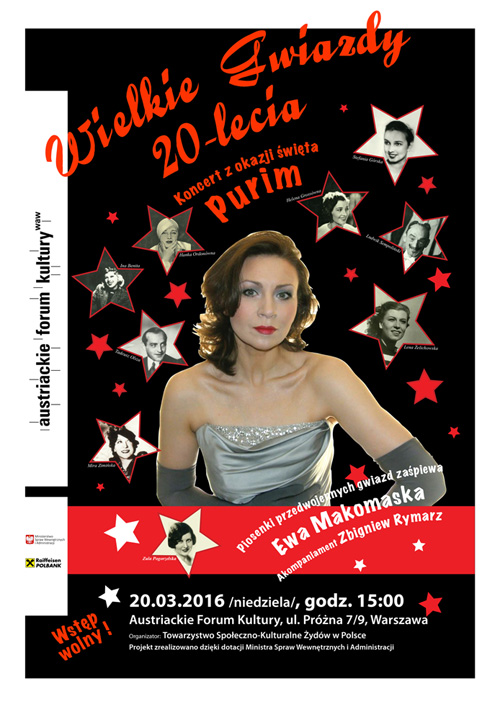
W imieniu Oddziału Warszawskiego TSKŻ, serdecznie zapraszam na purimowy koncert “Wielkie gwiazdy dwudziestolecia” w wykonaniu Ewy Makomaskiej, której akompaniować będzie Zbigniew Rymarz. Podczas koncertu usłyszymy utwory wykonywane niegdyś przez takie gwiazdy jak: Hanka Ordonówna, Zula Pogorzelska, Zofia Terne czy Mira Zimińska.

Po koncercie zapraszamy na tradycyjny, świąteczny poczęstunek.

Koncert odbędzie się 20 marca (niedziela) o godz. 15.00 w Austriackim Forum Kultury w Warszawie (ul. Próżna 7/9).

Informacje o artystach:

Ewa Makomaska – Absolwentka PWSFTv i T. w Łodzi, od 1994r. aktorka Teatru Polskiego w Warszawie. W czasie studiów debiutowała w Teatrze im. Jaracza w Łodzi rolą Duni Raskolnikow w „Zbrodni i karze” w reż. L. Wosiewicza. Za rolę Pani w „Pokojówkach” J.Geneta nagrodzona na Festiwalu Szkół Teatralnych w Łodzi. Otrzymała też nagrodę dziennikarzy dla najlepszej aktorki Festiwalu.

Za rolę Madame Sztok w sztuce A. Fredry „Z Przemyśla do Przeszowy” w reż. A. Łapickiego otrzymała Nagrodę im. Arnolda Szyfmana.

W tym samym czasie aktorka współpracowała też z Teatrem Ochoty („Królik, królik”) i Teatrem Komedia („Stepping aut”). Aktywność w Scenie Inicjatyw Aktorskich działającej w Teatrze Polskim w Warszawie przyniosła takie role jak: Anni Otto w „Grach pałacowych”, Wilhelmina w „Mistrzu Piotrze Pathelinie”, Zofia Lass w „Cyjanku o piątej”, Anna w „Gwiazdach na porannym niebie”.

Efektem nawiązania współpracy ze Zbigniewem Rymarzem, znakomitym akompaniatorem był spektakl „Bodo- pieśniarz Warszawy” i kilka programów złożonych z najpiękniejszych piosenek retro, co zostało docenione przez Kapitułę Ogólnopolskiego Festiwalu Piosenki Retro im. M.Fogga, przynosząc artystce Złoty Liść Retro 2010.

Zbigniew Rymarz- kompozytor, pianista, autor tekstów, archiwista i miłośnik piosenki retro. Współpracował jako kierownik muzyczny z wieloma teatrami na terenie całego kraju. Laureat wielu nagród, odznaczony najwyższym odznaczeniem artystycznym „GLORIA ARTIS”

Obchody święta Purim zorganizowano dzięki dotacji Ministra Spraw Wewnętrznych i Administracji


twoje uwagi, linki, wlasne artykuly, lub wiadomosci przeslij do: webmaster@reunion68.com