 Professor who called for Iran to strike US base removed, Georgetown says at House hearing
Andrew Bernard
Interim president Robert Groves told the House Education and Workforce Committee that Jonathan Brown “is no longer chair of his department. He’s on leave, and we’re beginning a process of reviewing the case.”
.
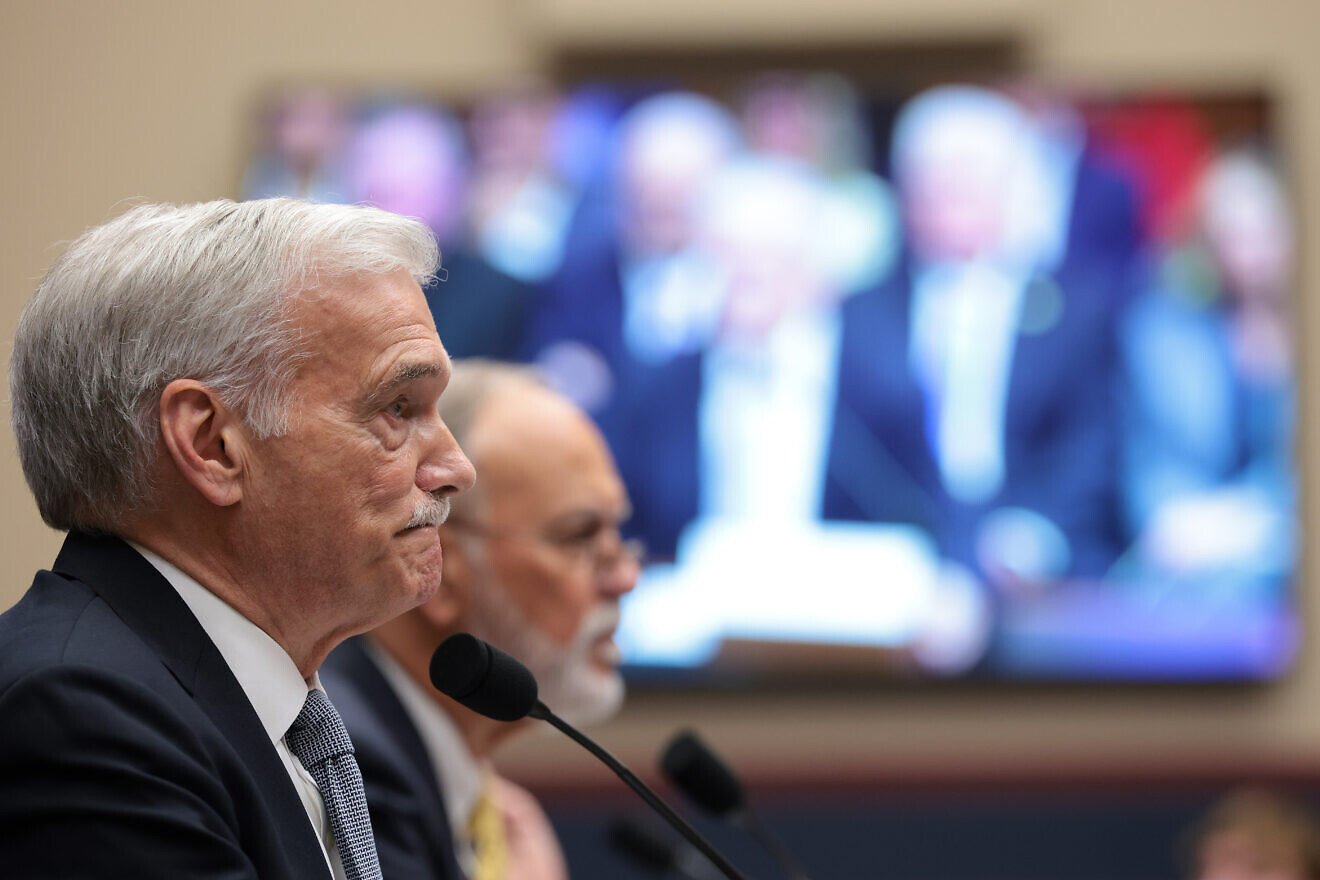 Robert Groves, interim president of Georgetown University, testifies before the House Committee on Education and Workforce in the Rayburn House Office Building in Washington, D.C., July 15, 2025. Photo by Win McNamee/Getty Images.
Robert Groves, the interim president of Georgetown University, told members of Congress on Tuesday that the school removed a professor who called for Iran to attack U.S. military bases in the Middle East.
Speaking at the House Committee on Education and Workforce’s latest hearing on campus antisemitism, Groves said that Jonathan Brown was no longer the chair of Georgetown’s department of Arabic and Islamic studies.
“Within minutes of our learning of that tweet, the dean contacted Professor Brown. The tweet was removed,” Groves told lawmakers. “We issued a statement condemning the tweet. Professor Brown is no longer chair of his department. He’s on leave, and we’re beginning a process of reviewing the case.”
A spokesman for Georgetown told JNS that Brown retains his faculty appointment as Prince Alwaleed bin Talal Chair of Islamic Civilization at the university’s School of Foreign Service.
Shortly after the U.S. concluded airstrikes against Iran in June, Brown wrote on social media, in a since-deleted post, that he wanted Iran to retaliate.
“I hope Iran does some symbolic strike on a base, then everyone stops,” Brown wrote.
A specialist in traditional Islamic sources, Brown has attracted controversy for years over his academic views and anti-Israel advocacy. In 2017, he issued an apology for a lecture about the morality of slavery and rape.
“I don’t think it’s morally evil to own somebody, because we own lots of people all around us and were owned by people, and this obsession about thinking of slavery as property,” he said in the lecture.
During questions from the audience, the professor cited the example of the Islamic prophet Muhammad. “He had slaves, there is no denying that,” he said. “Are you more morally mature than the prophet of God? No, you’re not.”
A convert to Islam, Brown is also the son-in-law of Sami al-Arian, who pleaded guilty in 2006 to a terrorism conspiracy charge over his support for Palestinian Islamic Jihad and was deported from the country in 2015.
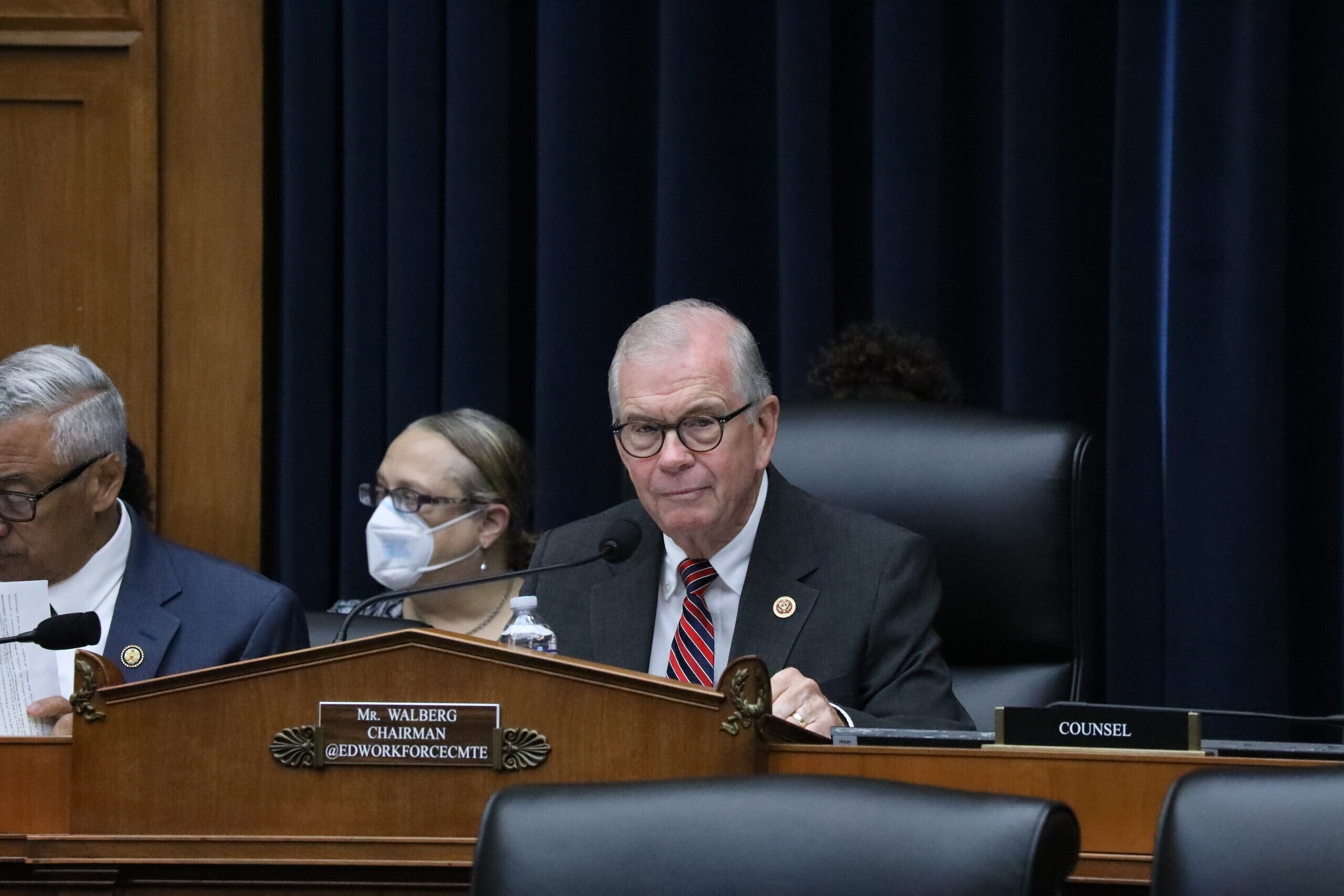 Rep. Tim Walberg (R-Mich.), chair of the House Education and Workforce Committee, during a committee hearing about antisemitism on campus with leaders from Georgetown University, City University of New York and University of California, Berkeley, July 15, 2025. Credit: Courtesy of the House Committee on Education and Workforce.
‘Why did you give a medal?’
Tuesday’s hearing, the ninth that the education committee has held on antisemitism, also featured Félix Matos Rodríguez, chancellor of the City University of New York, and Rich Lyons, chancellor of the University of California, Berkeley.
Members of the committee were generally divided along partisan lines for the scope of their questioning; Republicans asked the university leaders about faculty and student statements about Israel, and the war in Gaza. Democrats asked about the Trump administration’s cuts to the Department of Education’s Office for Civil Rights.
“This is yet another hearing to demonize Muslims and their religion, to demonize Palestinians, including those in Gaza who have undeniably faced unspeakable harms—a humanitarian crisis and human-rights crisis—and particularly, the young student activists and faculty who are determined to stand up against human rights violations,” said Rep. Summer Lee (D-Pa.).
“This is particularly another public opportunity for Republicans to pit Jewish Americans against Muslim Americans, Muslim against Christian, black against white,” she said.
Another focus of the hearing was foreign funding for the universities, particularly Georgetown’s relationship with Qatar, where the school has had a satellite campus for 20 years.
Rep. Mark Harris (R-N.C.) asked Groves about the university’s decision to award a humanitarian medal to Sheikha Moza bint Nasser, the mother of Qatar’s emir.
“Months prior to giving this award, Sheikha Moza had posted on social-media comments praising the Oct. 7 attack on Israel,” Harris said. “She praised the mastermind of the Oct. 7 attack, Yahya Sinwar, saying, ‘The name Yahya means the one who lives. They thought him dead, but he lives.’”
“She added, apparently referring to Israel, ‘He will live on, and they will be gone,’” Harris continued. “I have to ask: Why did you give a medal to someone who had made such antisemitic comments?”
Groves said Sheikha Moza’s post “is not consistent with Georgetown policy,” but that the school would not consider revoking the award, which was given for Sheikha Moza’s contributions to educating impoverished children around the world.
The university leaders were also confronted with anti-Israel and pro-Hamas statements and incidents from students and professors, as well as questioned about whether they had adequately rooted out Jew-hatred on their campuses.
‘You get to decide who to hire’
Rep. Randy Fine (R-Fla.) asked Lyons, Berkeley’s chancellor, about Ussama Makdisi, professor of history and chancellor’s chair at the university.
“In the fall of 2024, you named Ussama Makdisi the inaugural chair of a newly endowed program in Palestinian Arab studies. On Oct. 7, Makdisi described the Hamas attacks against Israel as ‘resistance,’” Fine said. “I understand freedom of speech, but you get to decide who to hire. Why would you give a position to someone who said Oct. 7 was justified?”
“Professor Makdisi is a fine scholar,” Lyons replied. “He was awarded that position from his colleagues based on academic standards.”
Rep. Tim Walberg (R-Mich.), the committee chairman, stated in his closing remarks that he was “disappointed” by the responses from the witnesses.
“Berkeley admits abhorrence of the views of the professor rewarded with his own program, but won’t do anything about it, and refers to him as a fine scholar,” Walberg said.
“That’s something I could not refer to him, when he misses the moral issue of humanity,” he said. “Georgetown couldn’t affirmatively say it wouldn’t allow a member of the KKK to come speak. CUNY severely underrepresented the number of antisemitism complaints received. So those are concerns that we still have.”
Zawartość publikowanych artykułów i materiałów nie reprezentuje poglądów ani opinii Reunion’68,
ani też webmastera Blogu Reunion’68, chyba ze jest to wyraźnie zaznaczone.
Twoje uwagi, linki, własne artykuły lub wiadomości prześlij na adres:
webmaster@reunion68.com