.
 House foreign affairs panel advances bill to designate Muslim Brotherhood as terrorists
Andrew Bernard
The committee also voted in favor of legislation to monitor Jew-hatred in Europe and impose sanctions on Iranian clerics calling for the deaths of the U.S. president and Israeli prime minister.
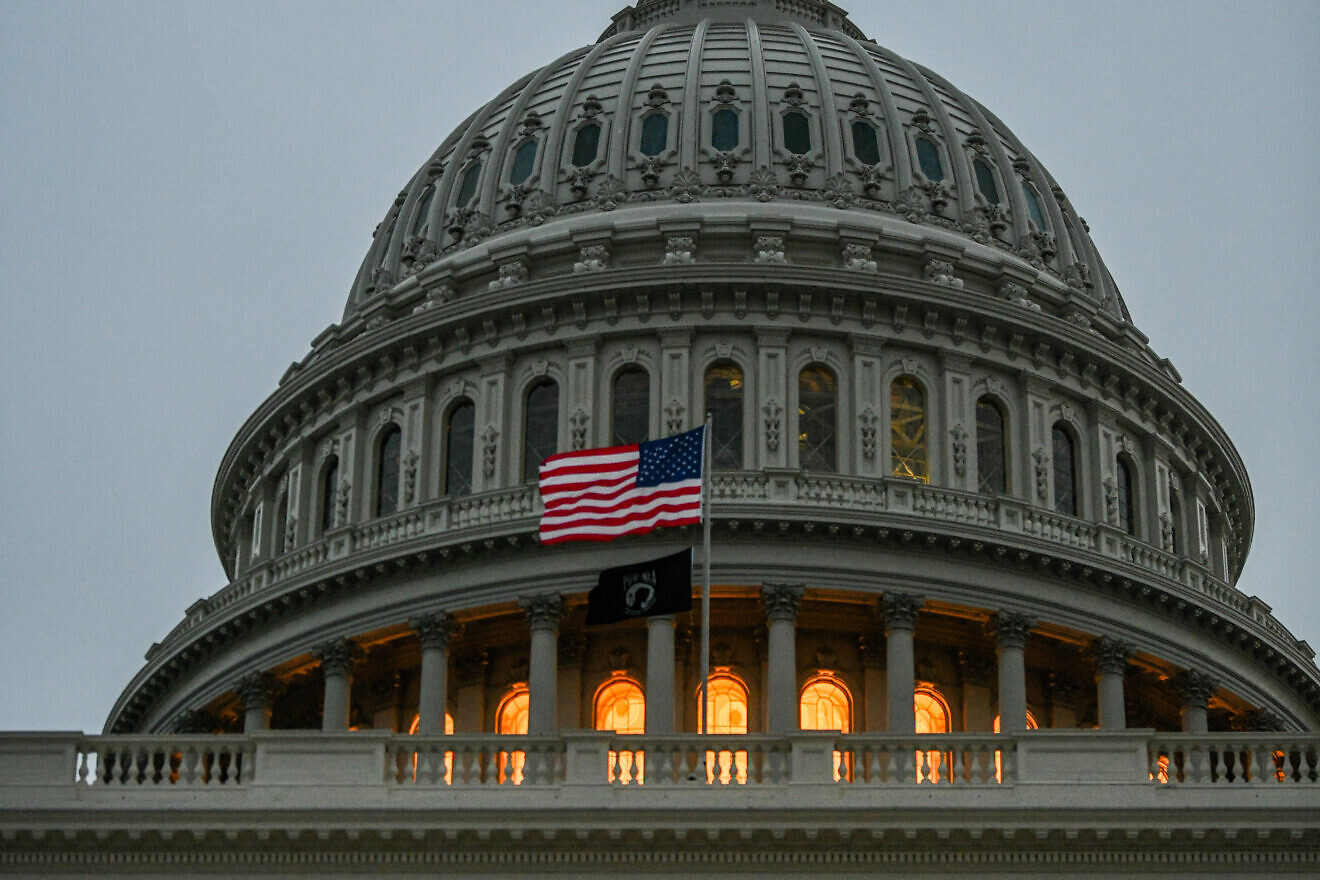 The U.S. Capitol on July 16, 2025. Credit: Arie Leib Abrams/Flash90.
The House Foreign Affairs Committee advanced legislation on Wednesday to require U.S. President Donald Trump to designate the Muslim Brotherhood as a terrorist organization.
The bipartisan bill, introduced by Rep. Mario Diaz-Balart (R-Fla.), passed through the committee with the support of every Republican and about half of the panel’s Democrats, including Reps. Brad Sherman (D-Calif.), Brad Schneider (D-Ill.), Jared Moskowitz (D-Fla.) and George Latimer (D-N.Y.).
Ranking Member Gregory Meeks (D-N.Y.) opposed the legislation, which he said was overly broad and could be used as an excuse to discriminate against Muslims and harm relations with U.S. allies, such as Qatar and Turkey, that support the Brotherhood.
“I am also deeply concerned about the implications that this bill would have domestically,” Meeks said. “Section 2 has sweeping visa prohibitions, which amounts, to me, to be a backdoor Muslim ban. It could subject millions of people, including many Americans, many Muslims who live in my district for example, to arbitrary and subjective determinations based on vague, indirect or tangential affiliations.”
Meeks added that he feared that the law could be used to investigate and prosecute Muslim-Americans and Arab and Muslim civil rights organizations.
Moskowitz, who co-sponsored the bill, said he rejected the idea that designating the Muslim Brotherhood as a terrorist organization amounted to a “Muslim ban.”
“I don’t support a Muslim ban in this country,” Moskowitz said. “I didn’t support it in the first Trump administration, but I do think it is extremely telling that Saudi Arabia, Jordan, the United Arab Emirates and Egypt designated this group a terrorist organization and banned them from their countries.”
“Our allies in the region, who know this group the best, ban them in their own countries,” Moskowitz said. “But for some reason, we can’t get it done. We’ve been trying to do this for like a decade.”
“In my conversations with ambassadors from our allies in this region—they’re surprised we’ve not been able to get it done, quite frankly,” he added.
Founded in 1928 in Egypt as a pan-Islamic revivalist movement, the Muslim Brotherhood has spread across the Sunni Muslim world in the form of local chapters and offshoots, including Hamas, as well as ideologically-inspired fellow-travelling militant groups and political parties, like the ruling Justice and Development Party (AKP) in Turkey.
In November, Trump issued an executive order asking the State and Treasury Departments for recommendations about whether to designate the Brotherhood as a terrorist organization, either in whole or in part.
In response, the Brotherhood, whose leaders are based in Turkey, issued a statement denying responsibility for the actions of its local chapters.
“The Muslim Brotherhood does not operate through ‘branches,’” the group stated. “While independent Brotherhood organizations in some Muslim-majority countries share common Islamic ideological elements, they are fundamentally separate entities that make their own decisions and operate within the law of the countries in which they are present.”
The group’s web materials nonetheless contain extensive material praising Hamas’s former leader Yahya Sinwar as “a noble knight and courageous hero,” who led “the glorious epic of Oct. 7” in murdering more than 1,200 people in southern Israel and taking hundreds more hostage.
During the committee’s debate, Rep. Keith Self (R-Texas), a former army officer who deployed to Egypt, described how that country dealt with the Muslim Brotherhood during the reign of its former president, Hosni Mubarak.
“He had Egyptian armed forces kick down doors and simply shoot who was in the room: Muslim Brotherhood,” Self said.
The committee also unanimously advanced legislation to require the State Department to provide briefings on antisemitism in Europe and to impose additional sanctions on the Houthis in Yemen.
Rep. Darrell Issa (R-Calif.) described how Yemen’s former religious diversity, including a substantial Jewish population, has been shattered under Houthi rule.
“There was a thriving community with synagogues and a tolerance of their people for their fellow man and their fellow Yemenis. That was before the Houthis,” Issa said. “Since that time, they have destroyed the ability to be anything other than what they want you to be. They have imposed Sharia law.”
“Just as we know Hezbollah is a cancer on the society of Lebanon and anywhere else it touches, the Houthis’ activities have to be dealt with,” he said.
The committee also adopted a bill to impose sanctions on Iranian clerics, who have issued fatwas calling for the deaths of Trump and Israeli Prime Minister Benjamin Netanyahu, and against other Iranian leaders who have plotted to assassinate the two leaders.
Meeks, who supported that bill, said that sanctions were nonetheless an insufficient deterrent to Iranian aggression.
“Congress should be hearing directly from the secretary of state on how he plans to keep the Iranian regime in check at a moment of extreme volatility in the region,” Meeks said. “We need to understand what steps are being taken to ensure that Iran’s massive stockpile of highly enriched uranium remains secure and that the nuclear program does not advance from its current post-12-day-war state.”
“I just can’t pretend that it will fundamentally alter Iran’s trajectory,” he said. “What will make a difference is serious, sustained oversight, credible diplomacy, allied coordination and a whole-of-government strategy that goes beyond simply adding one more sanctions designation to a list.”
Zawartość publikowanych artykułów i materiałów nie reprezentuje poglądów ani opinii Reunion’68,
ani też webmastera Blogu Reunion’68, chyba ze jest to wyraźnie zaznaczone.
Twoje uwagi, linki, własne artykuły lub wiadomości prześlij na adres:
webmaster@reunion68.com