As a result of such ambivalence, which is the product of lingering doctrinal arguments and political pressure, the church is failing to take the kind of unequivocal stand against the current surge in antisemitism coming from both the left and the right.
That is deeply unfortunate—and not just because Pope Leo XIV, as both a fresh face on the international scene and the first American pontiff, is in a singular position to weigh in decisively on the issue in a manner that might make a real difference.
The Church’s inherent concern for the downtrodden and the perception that Leo’s predecessor Pope Francis was closely linked to the cause of social justice, if not “liberation theology,” has given it some influence on the political left, where Jew-hatred is growing. At the same time, the Church also has great sway over many conservatives, especially in the United States, among whose ranks the virus of antisemitism seems to be gaining purchase, especially among the younger generation.
This latter is crucial because at the heart of the current controversy over former Fox News host Tucker Carlson’s efforts to promote the beliefs of “groyper” neo-Nazi Nick Fuentes is something that speaks directly to the legacy of Nostra Aetate.
Some of Carlson’s defenders claim that outrage about his obsessive platforming of anyone who will speak ill of Israel and the Jews isn’t really about antisemitism. Instead, they say it is all about two things.
One is the supposed desire of “neo-conservatives”—a once-relevant term that denoted former liberals and leftists who had become conservative in the 1970s and 1980s, but now seems to be a general term of abuse for supporters of Israel, or “Israel Firsters,” to silence dissenting views about the U.S.-Israel alliance or President Donald Trump’s Middle East policies.
The other is their abhorrence for “gatekeeping”—a mistaken belief that any attempt to marginalize hatemongers, racists and antisemites is no different from woke progressive efforts to stifle free speech and suppress mainstream conservative views, as well as those who seek to defend Western civilization and traditional understandings of American values and history.
Both claims are either misunderstandings or disingenuous.
Isolating Jews from Christians
At the heart of both Carlson’s attacks on mainstream pro-Israel journalists and politicians, as well as Fuentes’s extremist rants, is an assault on the whole idea of a Judeo-Christian heritage that is the foundation of Western culture and political thought. As Jason Willick detailed in The Washington Post, Tucker’s argument goes deeper than the usual litany of falsehoods and blood libels that seek to delegitimize Israel or isolate Jews. What bothers him is not so much the mythical power of the Jews or the “Israel lobby,” but the idea that there is common theological ground between Judaism and Christianity, and the belief that Western civilization is the cumulative product of the traditions of Jerusalem, Athens and Rome.
Instead, in one of many instances of what can only be described as “Jew-baiting,” Carlson has said he believes that the Hebrew bible is a dark, vengeful book that explains the awfulness of Israeli efforts to defend its people against terrorism. He argues that Western civilization is the sole product of the Christian New Testament with its message of love and kindness.
He also asserts that his views are distinct from the cruder, Nazi-like racist beliefs of Fuentes, who hates all Jews by saying that he likes those Jews who disavow the essential element of their faith and peoplehood by joining him in his detestation for the State of Israel.
But his fundamentally ahistorical and anti-intellectual attempt to detach Jews from the Western tradition is merely a more sophisticated and sinister version of the same hate that is driving Fuentes. It explains why he claims he is so intolerant of Christian Zionists, who number in the tens of millions and are an essential part of the conservative Republican base. He says he dislikes them “more than anybody,” even saying during the course of his chummy interview with Fuentes that they are practicing a “heresy” and suffer from a “brain virus.”
An ancient Christian heresy
Of course, there’s nothing new about this kind of thinking. In its earliest form, it was called Marcionism after the second century C.E. Gnostic movement led by Marcion of Sinope. And contrary to Carlson’s assertion, it was itself rejected by the early Christian church as heretical.
But Carlson and Fuentes aren’t alone in feeling this way.
The anti-Jewish sentiment voiced by some on the right in response to the backlash against Carlson’s platforming of antisemitism bears all the marks of the same sort of intolerance and determination to distance Christian practice from the Jewish roots of their faith. The resentment voiced by some younger staffers at the Heritage Foundation at the institution’s town hall staff meeting at the suggestion that they attend Shabbat dinners as part of an effort to combat Jew-hatred seems to be related to this kind of distorted thinking.
And that is why Nostra Aetate is so relevant today.
What wound up being published by the Vatican 60 years ago was itself the product of a vigorous and not altogether enlightened debate. In 1965, antisemitism was still deeply rooted in the church, and many at the time opposed any outreach to the Jews. Others were opposed to the existence of Israel for either theological reasons or because they shared the pan-Arabist ideas of many Christians in the Middle East.
To place this argument in perspective, it should be noted that Vatican II took place two years before the “occupation” of Jerusalem, Judea and Samaria by Israel as a result of its winning a defensive war against those Arab nations that sought its elimination.
Pope John XXIII’s legacy
The effort was largely the inspiration of Paul VI’s predecessor Pope John XXIII, who had, as papal legate to Greece and Turkey, and then France, actively sought to save Jews and work against the German Nazi effort to carry out mass murder. He believed that the church had helped to establish a tradition of Jew-hatred that facilitated the crimes of the Nazis, even though Adolf Hitler’s movement and ideology were themselves anti-Christian.
Before his death in 1963, John XXIII wrote a statement he intended to be read aloud in all Roman Catholic Churches of the world. In it, he said:
“We are conscious today that many centuries of blindness have cloaked our eyes so that we can no longer either see the beauty of Thy Chosen People nor recognize in their faces the features of our privileged brethren. We realize that the mark of Cain stands upon our foreheads. Across the centuries, our brother Abel has lain in the blood which we drew or shed the tears we caused by forgetting Thy Love. Forgive us for the curse we falsely attached to their name as Jews. Forgive us for crucifying Thee a second time in their flesh. For we knew not what we did.”
In the end, Nostra Aetate was the result of compromise among its authors, who chose a final text that was more ecumenical in nature, rather than solely focused on making amends with and bettering relations with the Jews. Yet in discarding the deicide myth and ending the use of anti-Jewish language in Easter services, the Church took a decisive step against antisemitism. That served as the foundation for the later efforts of Pope John Paul II, who, as a Pole living under German occupation during the Second World War, had Jewish friends and understood the cost of Jew-hatred, to go even further in bringing the two faith traditions closer. And it led to the Vatican’s decision to finally formally recognize the State of Israel in 1993.
That is why the church’s stances—both under Francis and now Leo XIV—to both oppose antisemitism while also lending its voice to some of the calumnies hurled at Israel are so disappointing. Instead of joining with those who seek to debunk the blood libels about Israel committing genocide and leaving no doubt that those who seek the destruction of the one Jewish state on the planet are instead supporting genocide of the Jews, the Vatican has sought a morally dubious middle ground on the issue.
Courageous Catholics
Many Catholics have not gone down that road. In particular, Cardinal Timothy Dolan, who heads the archdiocese of New York, has been an eloquent and courageous opponent of antisemitism. Other Catholics, not least legal scholar and philosopher Robert George, have been vocal in their opposition to Carlson’s views. George resigned from the Heritage Foundation board of trustees because of its unwillingness to cut ties with Carlson.
Like the vast number of evangelical Christians who remain fervently pro-Israel and philo-semitic, the same is true of many Catholics. The drumbeat of incitement against Israel, coupled with the way that leftist ideologies have fueled antisemitism by falsely labeling Jews and the Jewish state as “white oppressors,” has helped mainstream hatred against Jews in the media, culture, and especially, in the education system. But most Americans are still pro-Israel and remain firmly opposed to Carlson’s ideas.
Jews and Christians should be allies in a joint campaign to defend the Judeo-Christian heritage that is essential to the achievements and freedoms that are the legacy of Western civilization.
Sixty years after Nostra Aetate, the voice of the Vatican needs to be raised against the growing tide of antisemitism that the destructive rants of Carlson, Fuentes, and their enablers and defenders are fueling. But it must be done without also being accompanied, as it so often has, with support for arguments about Israel that delegitimize it and basic elements of Jewish identity that are linked to the land of Israel. Its failure to do so in an unambiguous way is helping to undermine the heroic efforts of Leo’s 20th-century predecessors who worked so hard to make amends for and to undo the harm caused by the Church in the past.
 Defending the Judeo-Christian tradition 60 years after ‘Nostra Aetate’
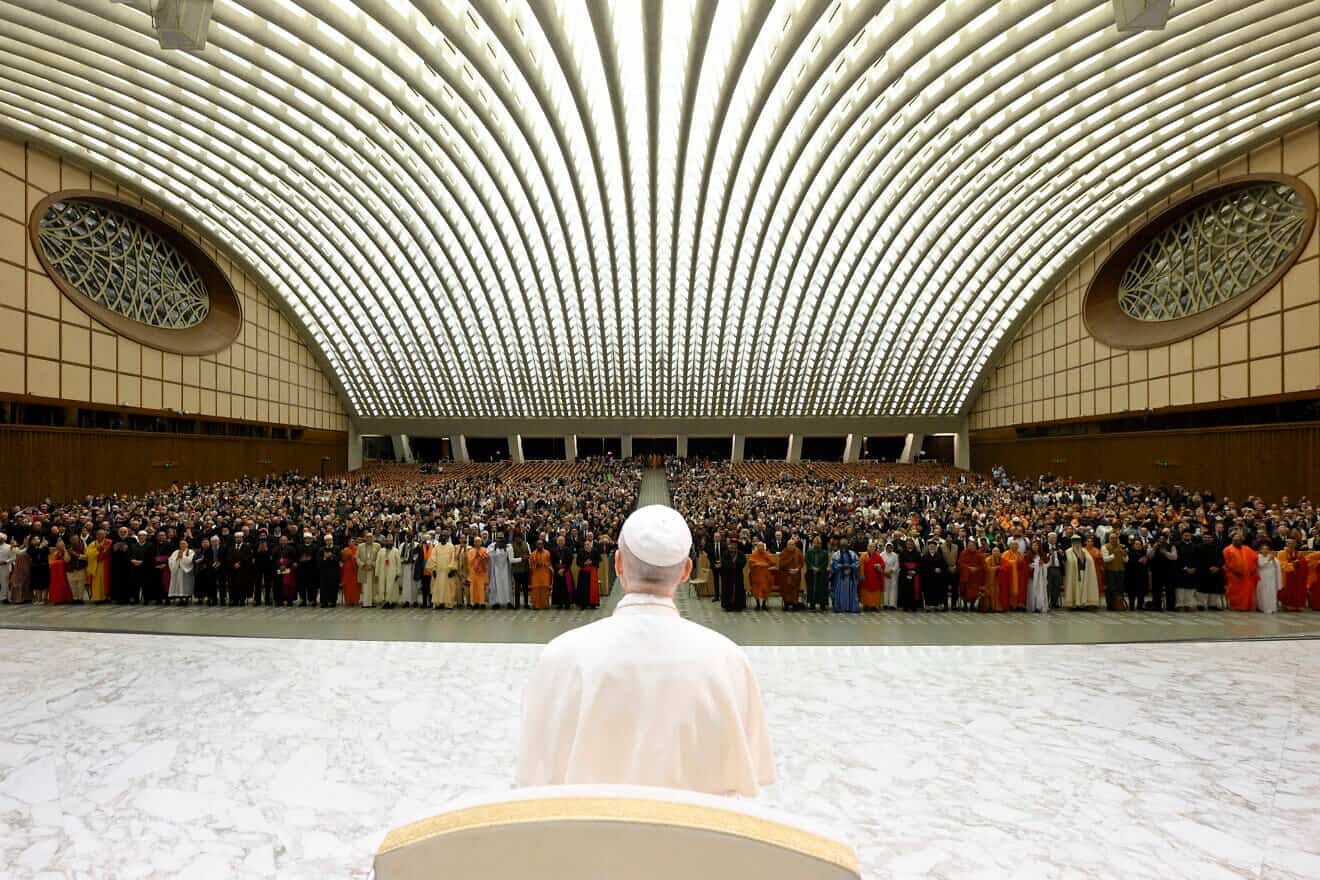 Pope Leo XIV presides at “Walking Together in Hope,” a celebration of 60 years of “Nostra Aetate,” the Second Vatican Council’s Declaration on Interreligious Dialogue at Paul VI Hall on Oct. 28, 2025 in Vatican City, Vatican. Photo by Simone Risoluti, Vatican Media via Vatican Pool/Getty Images.
 Jonathan S. Tobin is editor-in-chief of the Jewish News Syndicate, a senior contributor for The Federalist, a columnist for Newsweek and a contributor to many other publications. He covers the American political scene, foreign policy, the U.S.-Israel relationship, Middle East diplomacy, the Jewish world and the arts. He hosts the JNS “Think Twice” podcast, both the weekly video program and the “Jonathan Tobin Daily” program, which are available on all major audio platforms and YouTube. Previously, he was executive editor, then senior online editor and chief political blogger, for Commentary magazine. Before that, he was editor-in-chief of The Jewish Exponent in Philadelphia and editor of the Connecticut Jewish Ledger. He has won more than 60 awards for commentary, art criticism and other writing. He appears regularly on television, commenting on politics and foreign policy. Born in New York City, he studied history at Columbia University.