 ‘Agreement drives a wedge between Iran and Lebanon’
Yaakov Lappin
A precedent-setting deal allows the IDF to operate against Hezbollah, but the Lebanese army’s capacity is in doubt, experts tell JNS.
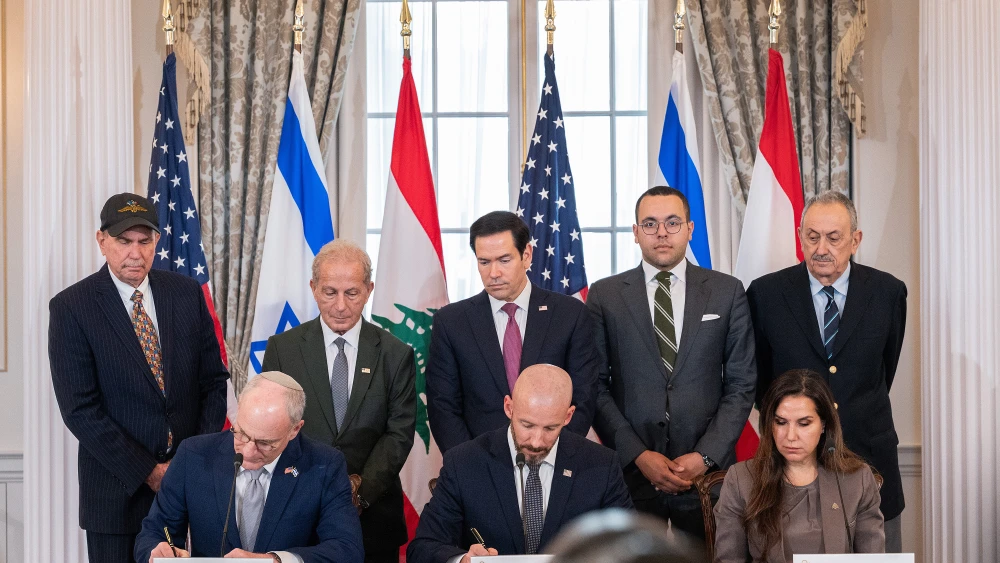 U.S. Secretary of State Marco Rubio participates in a trilateral framework signing ceremony with State Department Counselor Dan Holler, Lebanese Ambassador to the United States Nada Hamadeh Moawad and Israeli Ambassador to the United States Yechiel Leiter, between the United States, Lebanon and Israel at the Department of State in Washington, D.C., June 26, 2026. Credit: James Pan/U.S. State Department.
Israel achieved a substantial strategic gain in the newly signed trilateral framework with Lebanon and the United States by wedging Lebanon away from Iran, yet there is significant doubt over the Lebanese Armed Forces’ ability to implement the deal against Hezbollah in the near future, observers in Israel told JNS.
The trilateral framework was signed on June 26 at the State Department in Washington, D.C., by Israeli Ambassador to the United States Yechiel Leiter and Lebanese Ambassador to the United States Nada Hamadeh Moawad, in a ceremony overseen by Secretary of State Marco Rubio. He said the agreement “establishes a clear and structured process to restore Lebanon’s sovereignty, disarm Hezbollah and dismantle its terrorist infrastructure, and enable Israel to return to its borders once that threat to its citizens is removed.”
Prime Minister Benjamin Netanyahu described the deal as “a significant achievement” and said Israel “will remain in the security zone in Southern Lebanon” for as long as Hezbollah remained armed.
Professor Kobi Michael, a senior researcher at the Misgav Institute for National Security and Zionist Strategy and the Tel Aviv-based Institute for National Security Studies, described the agreement as a major Israeli accomplishment on multiple levels.
“The agreement is a most important Israeli achievement. First, because this is an official declaration by the states regarding respect for sovereignty, the right to security of the citizens in both states, and the pursuit of peace,” Michael told JNS.
He added, “But beyond that, this is a precedent-setting agreement in which an Arab state allows the IDF to remain on its territory and to act against a terror organization whose members are citizens of the state, while Israel’s conditions regarding withdrawal from the territory, conditioned on the quality of implementation by the Lebanese army and the pace of progress of Hezbollah’s disarmament, are acceptable to that same Arab state.”
Michael argued that the framework’s principal value was in cutting Tehran out. “The agreement drives a wedge between Iran and Lebanon and disrupts the declared Iranian aspirations to include Lebanon as part of the Memorandum of Understanding with the United States and the conditions regarding an Israeli withdrawal and the threats against Israel,” he said.
He added that Beirut’s alignment with Israel, under American sponsorship and mediation, denied Iran “the right to intervene in Lebanon, to create a linkage between it and Iran and the Memorandum of Understanding, and in this sense make it very difficult for Iran to support Hezbollah as it would want to, and to use this support as a signal to the rest of the proxies regarding its commitment to defend them, in order to secure the possibility of reviving the ring of fire and the axis of resistance.”
On the burden now placed on the Lebanese Armed Forces, Michael was measured about the timeline, stating, “It is not certain that the Lebanese army will be up to the task, certainly not in the near future, but the IDF will continue to act and to weaken Hezbollah.”
With American and possibly also French and Saudi assistance to the Lebanese army in its arms, force build-up and training, “the conditions will be prepared for a gradual and responsible transfer of responsibility from the IDF to the Lebanese army,” said Michael. He noted that until then the IDF stays in Southern Lebanon and retains the legitimacy to act against Hezbollah even outside that area should the Iranian-backed terror organization violate the ceasefire or attack Israel.
Asked whether the framework effectively forced the Lebanese government to choose between civil war with Hezbollah or admitting it could not uproot the group, Michael said, “The Lebanese government has already decided by the very act of signing the framework agreement and the public and firm support for the agreement even after signing it,” he said. He assessed that the government did not want a civil war and did not expect one, and that “it feels relatively secure because of the Israeli presence, the American backing and Hezbollah’s weakness at home in Lebanon itself.”
The restraint that Israel took upon itself because of American pressure is not final, he said, adding that once Hezbollah violates the truce, “I assess that Israel will respond also in Hezbollah’s zones of immunity [north of the security zone].” Michael cautioned that this was a bounded and limited period tied to the U.S.-Iran negotiations, and that “if the negotiations collapse or fail, everything will probably change.”
Col. (res.) Dr. Jacques Neriah of the Jerusalem Center for Security and Foreign Affairs, who is a former deputy head of assessment in IDF Military Intelligence, identified Lebanon’s separation from Iran as the principal gain so far, while stressing the fragility of the momentum.
“The only advantage so far is the success in separating Lebanon from its inclusion in the Iranian front,” Neriah said.
He tied that success to Beirut’s ability to press ahead against internal opposition, naming the figures arrayed against the deal, and framed the security zone as a double-edged asset that both shielded northern Israeli communities and left IDF troops exposed to Hezbollah attacks because of the American-imposed prohibition on operating beyond the yellow line.
“At the moment, neither side is interested in a frontal conflict,” Neriah said, in reference to the Lebanese government and Hezbollah. “The opponents [of the deal] rely on the inability to ratify the agreement in parliament, and are preparing themselves for a future clash. Much has been said about the firing or resignation of the Lebanese Army’s commander, who tends to cooperate with Hezbollah. Under these conditions, one cannot expect full cooperation from him against Hezbollah.”
Neriah concluded that the war has compelled Israel to adopt a new strategy based on strategic depth inside enemy territory.
In a separate briefing hosted by the Jerusalem Press Club on June 28, 2026, addressing the trilateral framework and the recent U.S.-Iran military exchanges, Neriah said that the Lebanese army lacked the capacity to deal with Hezbollah in the event of a full Israeli withdrawal, which is why the sides adopted a gradual approach beginning with two pilot areas in the northeastern part of the security belt.
He located the core obstacle in the army’s sectarian composition.
“Right now the Lebanese army, as you know, 60% of it is Shi’ite, it has a Shi’ite component. And it’s quite difficult to imagine that Shi’ites would be fighting other Shi’ites in Lebanon,” Neriah said, warning that using Shi’ite units against other Shi’ites would bring “total disaster” while using Christian or other units would lead to “a bloodbath between the parties, as usual happens in Lebanon.”
 Yaakov Lappin is an Israel-based military affairs correspondent and analyst. He is the in-house analyst at the Miryam Institute; a research associate at the Alma Research and Education Center; and a research associate at the Begin-Sadat Center for Strategic Studies at Bar-Ilan University. He is a frequent guest commentator on international television news networks, including Sky News and i24 News. Lappin is the author of Virtual Caliphate: Exposing the Islamist State on the Internet. Follow him at: www.patreon.com/yaakovlappin.
Zawartość publikowanych artykułów i materiałów nie reprezentuje poglądów ani opinii Reunion’68,
ani też webmastera Blogu Reunion’68, chyba ze jest to wyraźnie zaznaczone.
Twoje uwagi, linki, własne artykuły lub wiadomości prześlij na adres:
webmaster@reunion68.com