 Carlos the Jackal says Switzerland protected the PLO
Switzerland last month began looking into whether a former government minister, now dead, had struck a covert deal with the PLO.
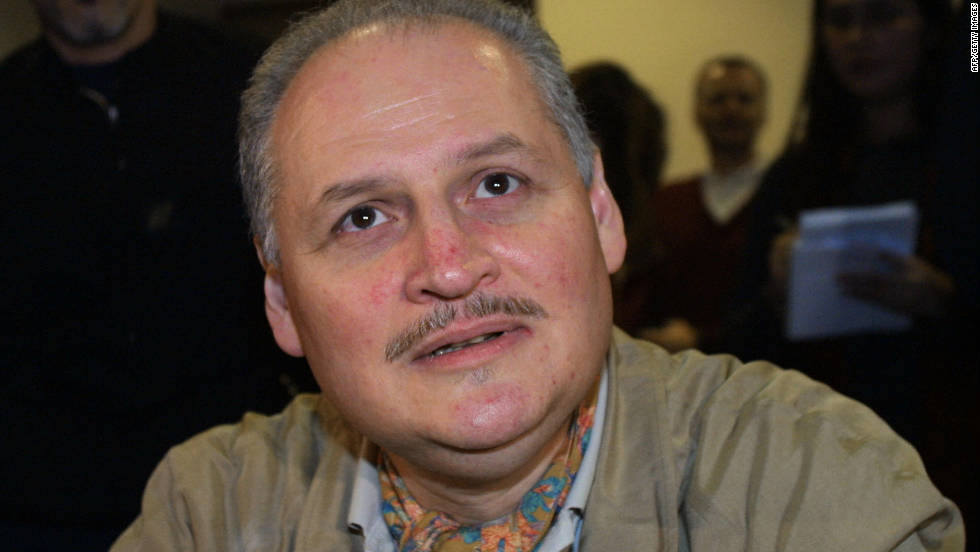
ZURICH – Carlos the Jackal, the Marxist guerrilla who became a symbol of Cold War anti-imperialism, has told a newspaper that he moved freely through Switzerland in the 1970s under a “non-aggression pact” between the government and the Palestine Liberation Organization.
He felt so safe that he flew to Zurich rather than Vienna airport on his way to neighboring Austria for his most spectacular coup: the kidnapping of oil ministers at OPEC headquarters in 1975, he told the Neue Zuercher Zeitung (NZZ) in a telephone interview from his prison in France.
His comments, published on Monday, seem sure to inflame a debate about whether Swiss authorities secretly agreed to turn a blind eye to PLO activity in the 1970s and give it diplomatic support in exchange for an end to attacks on Swiss targets.
The NZZ said it had made contact with the 66-year-old Venezuelan, whose real name is Ilich Ramirez Sanchez, through his lawyer. Ramirez is serving life sentences in France for a series of attacks.
He told the paper it had been common knowledge among PLO militants that they would not be arrested in Switzerland, on condition was that they refrained from making trouble. “Of course we stuck to that,” he said.
He recalled seeing a wanted poster with his picture on it in the guard’s booth as he stood in line for passport checks after flying into Zurich from Beirut on his way to Vienna, only to be waved through with his fake South American passport.
Ramirez sealed his notoriety by taking OPEC’s oil ministers hostage in the name of the Palestinian struggle, in an attack in which three people were killed, and went on to be an international gun-for-hire with Soviet bloc protectors.
But the revolutionary mystique he once enjoyed – helped by a Che Guevara beret, leather jacket and dark glasses – wore thin after he was captured in Khartoum in 1994 by French special forces.
Switzerland last month began looking into whether a former government minister, now dead, had struck a covert deal with the PLO.
The allegation emerged this year in a book by Swiss journalist Marcel Gyr, who conducted the NZZ interview. The book, “Swiss Terror Years”, has also raised questions about whether such a pact interfered with an investigation into the bombing of a Swissair plane in 1970 that killed 47 people, for which no one was ever charged.


Carlos the Jackal
Ilich Ramírez Sánchez (pronounced: [ilitʃ raˈmiɾes santʃes]; born October 12, 1949), also known as Carlos the Jackal, is a Venezuelan terrorist currently serving a life sentence in France for the 1975 murder of an informant for the French government and two French counter-intelligence agents.[3][4] While in prison he was further convicted of attacks in France that killed 11 and injured 150 people and sentenced to an additional life term.[5][6]
A committed Marxist-Leninist, Ramírez Sánchez is commonly described as one of the most notorious political terrorists of his era.[7][8][9] When he joined the Popular Front for the Liberation of Palestine (PFLP) in 1970, recruiting officer Bassam Abu Sharif gave him the code name “Carlos” because of his South American roots.[10] After several bungled bombings, Ramírez Sánchez achieved notoriety for the 1975 raid on the Organization of the Petroleum Exporting Countries (OPEC) headquarters in Vienna, which killed three people. This was followed by a string of attacks against Western targets. For many years he was among the most wanted international fugitives. Carlos was dubbed “The Jackal” by The Guardian after one of its correspondents reportedly spotted Frederick Forsyth‘s 1971 novel The Day of the Jackal near some of the fugitive’s belongings.[11]
For his part, Ramírez Sánchez denied the 1975 killings, saying they were orchestrated by Mossad, the Israeli secret service, and condemned Israel as a terrorist state. During his trial in France in 1997, he said, “When one wages war for 30 years, there is a lot of blood spilled—mine and others. But we never killed anyone for money, but for a cause—the liberation of Palestine.”[12]
PFLP
On completing guerrilla training, Carlos (as he was now calling himself) played an active role for the PFLP in the north of Jordan during the Black September conflict of 1970, gaining a reputation as a fighter. After the organisation was pushed out of Jordan, he returned to Beirut. He was sent to be trained by Wadie Haddad.[20] He eventually left the Middle East to attend courses at the Polytechnic of Central London (now known as the University of Westminster), and apparently continued to work for the PFLP.
In 1973, Carlos conducted a failed PFLP assassination attempt on Joseph Sieff, a Jewish businessman and vice president of the British Zionist Federation. On 30 December Carlos called on Sieff’s home on Queen’s Grove in St John’s Wood and ordered the maid to take him to Sieff.[21] Finding Sieff in the bathroom, in his bath, Carlos fired one bullet at Sieff from his Tokarev 7.62mm pistol, which bounced off Sieff just between his nose and upper lip and knocked him unconscious; the gun then jammed and Carlos fled.[21][22][23] The attack was announced as retaliation for Mossad‘s assassination in Paris of Mohamed Boudia, a PFLP leader.
Carlos admits responsibility for a failed bomb attack on the Bank Hapoalim in London and car bomb attacks on three French newspapers accused of pro-Israeli leanings. He claimed to be the grenade thrower at a Parisian restaurant in an attack that killed two and injured 30. He later participated in two failed rocket propelled grenade attacks on El Al airplanes at Orly Airport near Paris, on January 13 and 17, 1975.
According to FBI agent Robert Scherrer one MIR and one ERP member were arrested in Paraguay in June 1975. These would have had Carlos phone number in Paris. Paraguayan authorities would then have handed over the information to France.[24]
On June 27, 1975, Carlos’s PFLP contact, Lebanon-born Michel Moukharbal, was captured and interrogated by the French domestic intelligence agency, the DST.[citation needed] When two unarmed agents of the DST interrogated Carlos at a Parisian house party, Moukharbal revealed Carlos’s identity. Carlos then shot and killed the two agents and Moukharbal,[25] fled the scene, and managed to escape via Brussels to Beirut.
OPEC raid and expulsion from PFLP[edit]
From Beirut, Carlos participated in the planning for the attack on the headquarters of OPEC (Organization of the Petroleum Exporting Countries) in Vienna. On December 21, 1975, he led the six-person team (which included Gabriele Kröcher-Tiedemann) that attacked the meeting of OPEC leaders; they took more than 60 hostages and killed three: an Austrian policeman, an Iraqi OPEC employee and a member of the Libyan delegation. Carlos demanded that the Austrian authorities read a communiqué about the Palestinian cause on Austrian radio and television networks every two hours. To avoid the threatened execution of a hostage every 15 minutes, the Austrian government agreed and the communiqué was broadcast as demanded.
On December 22, the government provided the PFLP and 42 hostages an airplane and flew them to Algiers, as demanded for the hostages’ release. Ex-Royal Navy pilot Neville Atkinson, at that time the personal pilot for Libya‘s leader Muammar al-Gaddafi, flew Carlos and a number of others, including Hans-Joachim Klein, a supporter of the imprisoned Red Army Faction and a member of the Revolutionary Cells, and Gabriele Kröcher-Tiedemann, from Algiers.[26] Atkinson flew the DC-9 to Tripoli, where more hostages were freed, before he returned to Algiers. The last hostages were freed there and some of the terrorists were granted asylum.
In the years following the OPEC raid, Bassam Abu Sharif, another PLFP agent, and Klein claimed that Carlos had received a large sum of money for the safe release of the Arab hostages and had kept it for his personal use. Claims are that the amount was between US$20 million and US$50 million. The source of the money is also uncertain but, according to Klein, it was from “an Arab president”. Carlos later told his lawyers that the money was paid by the Saudis on behalf of the Iranians and was “diverted en route and lost by the Revolution.”
Carlos left Algeria for Libya and then Aden, where he attended a meeting of senior PFLP officials to justify his failure to execute two senior OPEC hostages – the finance minister of Iran, Jamshid Amuzgar, and the oil minister of Saudi Arabia, Ahmed Zaki Yamani. His trainer and PFLP-EO leader Wadie Haddad expelled Carlos for not shooting hostages when PFLP demands were not met, thus failing his mission.[27]
twoje uwagi, linki, wlasne artykuly, lub wiadomosci przeslij do: webmaster@reunion68.com