 A history of the disappearing Western Wall & its slow reapearence

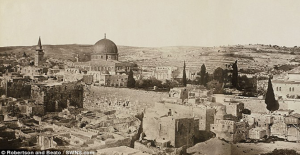 Western Wall and Dome of the Rock – Photo: Bonfils/SWNS.com
The Western Wall plaza was cleared after the liberation of Jerusalem almost 50 years ago, allowing the Jewish people to view their sacred site freely. But still, much of the Wall is hidden under Arab houses. “Those houses were built up against the Western Wall a few hundred years ago with the express intention of hiding it… Sewage drains empty directly onto the stones of the Western Wall. What other people would allow such a thing?” remarked PM Menachem Begin.
The secret of the disappearing Wall
On June 8, 1967, while IDF paratroopers were clearing out the last pockets of resistance in the alleys of the Old City, Israel’s first Prime Minister, David Ben-Gurion, came to the Western Wall passageway, accompanied by Jerusalem Mayor Teddy Kollek and head of the Israel Nature and Parks Authority Yaakov Yanai. The old leader, who by then had been out of office for four years, laid his head on the Western Wall and wept bitterly. After he calmed down, he ordered one of his bodyguards to remove the sign reading “Al-Buraq,” the Muslim name for the Western Wall, and then turned to Yanai: “Aren’t you ashamed? Look — toilets next to the Western Wall.”
 Prime Minister David Ben-Gurion and Jerusalem Mayor Teddy Kollek at the Western Wall in 1967 – Photo Collection of Rabbi Yosef Shechter
Yanai defended himself,saying, “We only got here yesterday.” But Ben-Gurion insisted, “Nevertheless, this is intolerable.” Yanai went up to Kollek and told him about his exchange with Ben-Gurion. “We need to clean the place up. We need to get the Wall in shape,” he said. Kollek promised he’d take care of it. “I’ll talk to the army,” he said.
Ben-Gurion, and the hundreds of thousands of Israelis who would visit the Western Wall only days later on the Shavuot holiday, were standing in front of their people’s most important historical site for the first time in two decades.
For 19 years, until Jerusalem was liberated, the Wall was “imprisoned.” When the War of Independence ended in 1949, Jordan controlled the eastern part of Jerusalem, including the Temple Mount and the Western Wall. As part of the cease-fire agreement, the Hashemite kingdom promised to allow Jews to visit the Wall, but never allowed it in practice. Nor did it address the sewage and stink that the residents of the Mughrabi Quarter left at the Wall. Years earlier, during the British Mandate and the Ottoman Empire, the Muslim residents of that neighborhood had made the lives of Jews who came to pray at the Wall a misery, intentionally sullying it with human and animal feces. Frequently, they even demanded that the Jews pay a tax of sorts (using the threat of violence) for the right to pray at the Western Wall.
The “status quo” declared by the British at the site added more problems. Jews were forbidden to set up benches or a barrier dividing it into men’s and women’s sections; the number of Torah scrolls allowed on site was limited; and blowing a shofar there to mark the end of Yom Kippur was prohibited. The status quo even allowed animals to be herded past it.
The liberation of Jerusalem in the 1967 Six-Day War provided a unique opportunity to change the reality. If ever the phrase “historic justice” meant anything, it was perfectly distilled right then at the foot of the Western Wall and the Temple Mount. Israel threw itself energetically into righting the wrongs and was determined to turn the narrow Western Wall alley into a site suitable for public prayer. A group of enthusiastic veteran contractors enlisted to complete the mission. Journalist Uzi Benziman documented the atmosphere in those days. Eitan Ben Moshe, the chief engineering officer for the IDF’s Central Command, instructed the contractors to “clear this filth away.” They asked for orders in writing. Ben Moshe scribbled instructions, and the contractors began to work. At first, they used shovels and hammers to knock down the toilet facilities, but a few hours later, bulldozers and trucks arrived and began razing the area.
“With deafening noise, the bulldozers moved slowly toward the Mughrabi neighborhood in front of the Western Wall, their jaws open wide and their steel teeth chewing up the little houses that crowded up against each other. … They retreated a bit and then struck again,” is how the writer Yehuda Haezrachi described what happened.
“Alleys were eradicated … clouds of dust rose up around, and in front of them was revealed a wide square as broad as the valley; and the Western Wall also came into sight in the clouds of dust, not from close up, as it had come into sight until now, but from far away, from everywhere, from every part of the giant new square.”
Overnight, on June 10, 1967, the work was completed. The 108 families who had lived in the Mughrabi Quarter were removed. By sunrise, the little neighborhood that had been stuck onto the Western Wall was in ruins. Now, instead of a small prayer plaza that measured 28 by 3.4 meters (92 by 11 feet) and could barely accommodate a few hundred people, a new plaza had been prepared for thousands. The length of the section of the Western Wall designated for prayer had been extended by 60 meters (197 feet). Most of the new prayer area extended 40 meters (130 feet) west and another huge plaza higher up was designated as a site for demonstrations and for swearing-in ceremonies for IDF soldiers.
It felt as though relief and light had finally arrived at the Wall, as one era ended and a new one in the history of the Wall began, but not everyone believed the work was done. Now, 49 years after the reunification of Jerusalem, that the entire length of Western Wall has been exposed, including its underground tunnels, a massive dispute is emerging from the pages of history: There were those who believed then that the removal of the Mughrabi Quarter was the end of it. That it was enough. But there were others who planned to enact Mughrabi-style evacuations along other, lesser known, parts of the Wall, in order to expose them as well.
‘Only out of fear of the nations of the world’
With the benefit of nearly 50 years of perspective, this debate that we know so little about teaches us that we must have missed something. We thought we knew almost everything about the Western Wall, that famous place, the most researched and visited place in Israel. But it turns out that we know very little. Surprising as it might sound, the visible Wall is not complete. Hundreds of meters of it are missing. Underground, in the Western Wall tunnels, the entire 488-meter (1,601-foot) length of the Wall is exposed. But above ground, for hundreds of meters north of the prayer plaza, the Western Wall disappears.
 In this 1967 photo, Rabbi Shlomo Goren carries the Torah scroll as he holds the first Jewish prayer session at the Western Wall since 1948 – Photo Benny Ron
read more: A history of the disappearing Western Wall & its slow reapearence
twoje uwagi, linki, wlasne artykuly, lub wiadomosci przeslij do: webmaster@reunion68.com