 Trapped in Translation
SETH M. LIMMER
 TABLET MAGAZINE
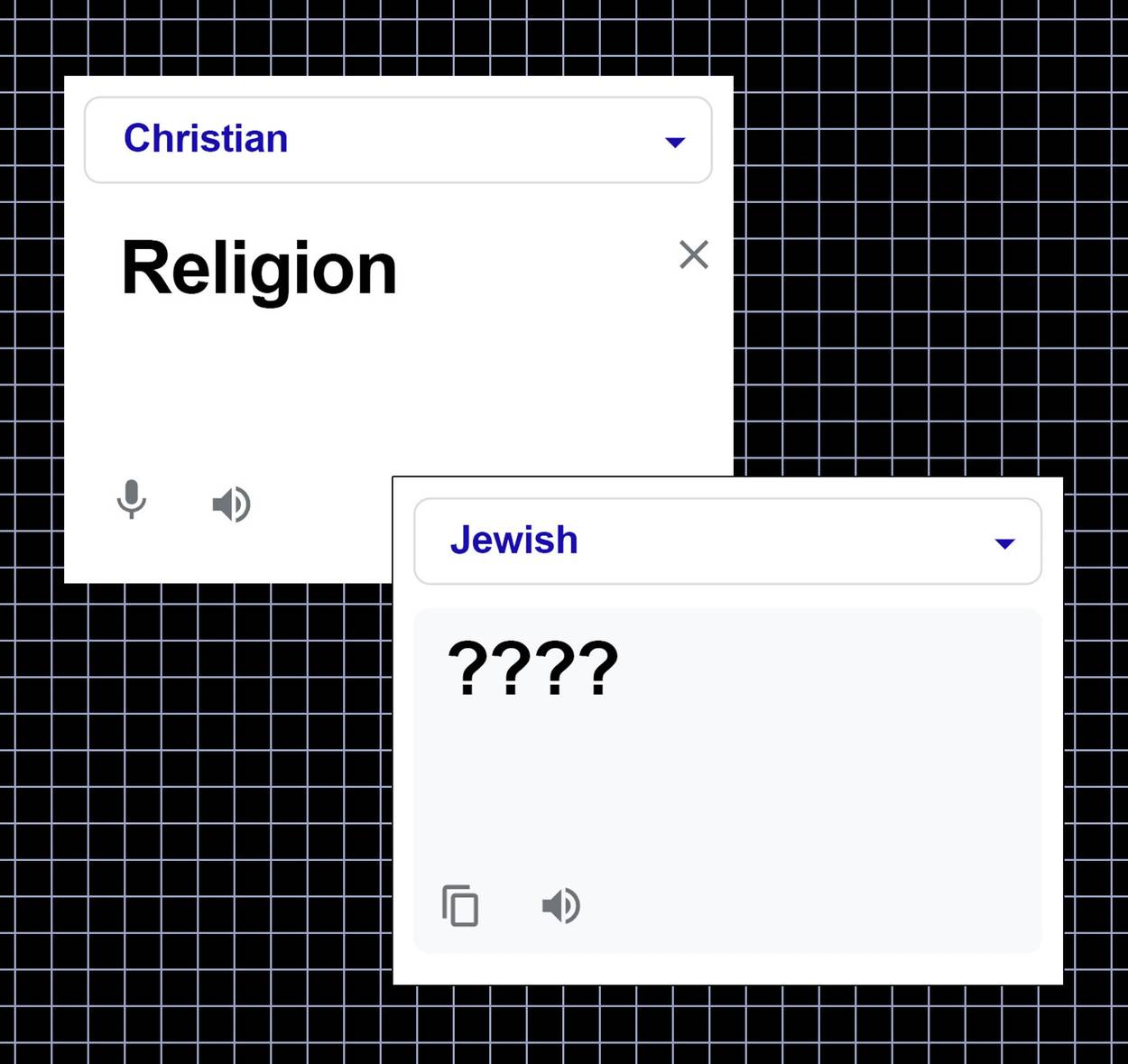
How to explain Judaism in English—a language whose terminology around religion is built on Christian concepts.
.
We can’t translate everything. At least not precisely. Concepts exist in certain cultures that are absent, or markedly different, in others. We all know the adage that Eskimos have 47 different words for snow. Whether or not that’s true, it is clear that Inuit and Yupik cultures have a closer connection to snow than do the residents of Tahiti. It makes sense that these cultures would differentiate the many kinds of snowfall according to the many ways that those distinctions affect their daily lives. We even might be able to translate some of these snow words into English: Aqilokoq is softly falling snow, piegnartoq is snow that’s perfect for sled-driving. We can know what these snow words mean. But unless and until we understand the Eskimo mindset, we cannot truly glean what they signify.
English has words deemed essential for religion: faith, liturgy, Bible, even “religion” itself. None of these words really exist in Hebrew. Certainly, not a single one of these Christian concepts correlates directly to anything that can be considered Jewish. Of course, Modern Hebrew has the vocabulary to translate these English phrases. And, obviously, Judaism does possess ideas and structures that share a similarity with Christian concepts like worship and Scripture. But that similarity all too often masks a vast difference. That difference prevents us from understanding what Judaism is at its essence. But before we examine those differences, let’s go back and examine the origins of the English language.
The furthest back we can trace a distinct English language is to the sixth century, the earliest date for the emergence of Old English. Now, Old English has far more in common with German than any English we know today; most scholars believe it is an utterly distinct language from Modern English. It’s only in the ninth century that Middle English emerges. Coming into its heyday after the Norman conquest of 1066, Middle English, as anyone who’s every struggled to read Chaucer knows, resembles our English, but is still a ways away. Most people have never heard of the “Great Vowel Shift” that marked the transition to Modern English, but with the arrival of Shakespeare’s works and the King James Bible, the language we know today was coming into its own.
Because of the time it took for English to evolve into anything we recognize today, the tongue that shapes most American Jews’ thinking is at most 1,000 years old. Jewish traditions, in even the most cautious of counting, extend back 3,000 years. Until the Greco-Roman period, Jewish thought was expressed in Hebrew; then, Aramaic, a sister language to Hebrew that was the international parlance of its day, became a secondary vessel for transmitting Jewish tradition. By the time Old English emerged around 550 CE, the Torah and the Talmud, the two core texts of Jewish thought and practice, were effectively complete. The great frames and structures of Judaism existed before any Jew ever spoke English.
English, in contrast, was brought into existence, effectively and exclusively, by Christians. With rare exception or incursion, the island of Britain was Christian before and since the emergence of English. As polyglot language, English has its roots in many places. In terms of religious phrases, Greek and Latin, and therefore, Christian, etymologies dominate. Faith is derived from fidere, for “trust,” religion from religio, for “cult, or mode of worship.”Bible is from the Greek, ta Biblia: the Book. Leitourgia, etymon of liturgy, is likewise Attic Greek for public performance. Each of these words, and every English word connected to religion, is born of and steeped in Christian thought.
Judaism is a square peg that refuses to fit in the proverbial round hole of Christianity. Hebrew not only precedes both Christianity and English, but it is markedly different in its vocabulary and concepts. As English evolved, it of necessity coined terms to describe Christian phenomenon. Hebrew, the foundational language of Judaism, had no such need. Students of religion, a discipline that seeks to find parallels in order to appreciate distinctions, might be horrified to find that there is no Jewish word for liturgy, that there is no Jewish word for faith, that there is no Jewish word for Bible, let alone one that can barely be made to fit “Scripture.” There is even no real Jewish word for religion.
“Even the most honest attempts to understand Judaism authentically are unconsciously undermined simply because these attempts are in English, are limited by English.”
In a moment, we will explore each of these important distinctions. But first, we should pause and reflect on the significance of this unfathomable gap between Jewish vocabulary and Christian concepts. Most modern Jews outside Israel (and certainly the audience of this work) are native English speakers. Their worldviews and expectations are formed by the contours of the English language. Sunday morning cartoons depict Bible stories, not Torah tales. Our conversations are filled with faith: Keep the faith, act in good faith, have faith in yourself. Intermediate schools teach comparative religion, subsuming Judaism into a category it doesn’t neatly fit. So when most modern Jews approach Judaism, they come with questions and preconceptions that are Christian. They believe Judaism is a religion; they imagine faith in God is a prerequisite. They want to know about liturgy and worship, and learn all about the Bible (which, in the most obvious acquiescence to Christian English, they usually call the Old Testament). Even the most honest attempts to understand Judaism authentically are unconsciously undermined simply because these attempts are in English, are limited by English.
Most English speakers operate under the false linguistic assumption that Judaism and Christianity run on the same operating system. Nothing could be further from the case. Anyone who remembers back to the days of floppy discs recalls that what worked on a Mac would need to be entirely reformatted for a PC. The analogy holds here: Judaism just has a different source code from Christianity. Its program language is Am and Avodah, Torah and Talmud. And it hardly suffices to translate these terms as people, worship, Bible, and (fascinatingly) Talmud. That’s not really what these essential Jewish concepts are about. To delimit these millennia-old, remarkably robust ideas with one-word terms born of alien Christianity is simply unfair. To truly appreciate Judaism, its core concepts need to be liberated from their simplistic English “definitions.” Judaism’s concepts, and Judaism itself, need to be appreciated for what they are, and—especially for English speakers—need to be distinguished from common Christian concepts.
Let’s start with “religion.” It is only the fifth definition of the phrase in the Oxford English Dictionary that doesn’t use the word religion as part of the definition:
Belief in or acknowledgement of some superhuman power or powers (esp. a god or gods) which is typically manifested in obedience, reverence, and worship; such a belief as part of a system defining a code of living, esp. as a means of achieving spiritual or material improvement.
Now, some might say this definition of religion describes Judaism perfectly: There is a belief, or at least covenant with, Yahweh, which is manifest in a series of commandments that both define a code of life and set a prescribed course for worship. Even though I will argue later that little of that is true, this OED understanding of religion fails to capture an essential element of Judaism: the self-conception as an Am, a people. From Torah’s time through our own, there are plenty of individuals who are born “Jewish” yet neither believe in nor acknowledge any sort of superhuman power who defines their code of living. Regardless, many of these individuals fully consider themselves “Jewish.” Judaism might overlap with certain aspects of “religion,” but it far exceeds the boundaries of such a limiting term.
Proof positive of the failure of “religion” to define Judaism is a phrase I have heard countless times in my career: I’m Jewish, but not religious. Early in my rabbinate, I took this assertion as a challenge. I would ask people what they found meaningful about their Jewish life, and answers would include everything from cooking for holidays to doing the work of social justice all the way through—shockingly—coming to Shabbat services. I sometimes sensed that what people meant when they said, “I’m Jewish, but not religious,” was that they loved Judaism—they were willingly engaging with a rabbi, after all—but that they didn’t believe in God. Sometimes, I even tried to convince people that they were fully Jewish, and shouldn’t let anything stand in the way of their own self-perception. Over time, however, I realized that these people didn’t have a problem. The problem was the word “religion” itself. It’s a Christian concept that simply doesn’t fit Judaism.
Opening any Hebrew-English dictionary will tell you that the Hebrew word for “religion” is dat. In this, there is a double irony. First of all, dat is a hardly Hebrew; it’s an Old Iranian loan-word that first appears in the biblical book of Esther, one of the later entrants in the Jewish canon. Secondly, dat means “law,” “edict,” or “practice.” In the book of Esther, dat indicates in one instance the edict of the king, and in another the custom of drinking to excess. By the time of the Talmud, dat maintained this same semantic range from custom through law. It wasn’t until the revival of Modern Hebrew started by Eliezer Ben-Yehuda in the 19th century that dat came to mean “religion.” And why did this happen? Modern Hebrew needed to compete in the international marketplace of ideas: Modern Hebrew required its own words for phrases that were widespread in other languages, most prominent among which was English. And so this loan-word of antiquity was equated with “religion,” translated as such in a dictionary. Hebrew needed a place holder, and dat seemed to fit the bill. But dat doesn’t fit the definition of “religion” in any meaningful way. Hebrew really has no concept of religion whatsoever.
The chasm between English and Hebrew is equally deep when it comes to the Bible. For Christians, the Bible has always been a written document. There’s a reason it’s called ta Biblia: the book. By the time Christianity arrived on the scene, there were already texts of what they call the Old Testament. The Christian movement was propelled forward by the written word: Gospels authored by individuals sharing the stories of Jesus, and Epistles—literally “letters”—early authorities supposedly scripted and sent to Galicia, Thessalonia, Rome, and more. Christianity began with the written word as it foundation. The first chapter of the first Gospel cites the text of the Jewish prophet Isaiah; the last of the Gospels opens with the line, “In the beginning was the word.” From the beginning, Christianity had a book, the book, ta Biblia: the Bible.
Judaism has no Bible—at least not in the Christian sense of the word. The earliest name for a collection of Jewish traditions and teachings that come down to us is Torah. Over the millennia, Torah has become a most elastic word, meaning either something very specific or something incredibly broad. For our purposes here, Torah simply means teaching. This is why Torah can be something as narrow as a set of regulations regarding lepers, can indicate a five-volume literary collection falsely attributed to Moses, and also is able to signify the remarkably broad category of “all legitimate Jewish learning.” Torah is teaching. In the time that the collection we call “Torah” was created, the primary vehicle for this teaching was oral transmission. Yes, the words capturing these teachings were collected and put to parchment. But that inscription and collection happened long after the tales and laws were common cultural currency. To the Jewish mind, it matters not that these matters are written. What is important is that the words of Torah are taught, transmitted, from one generation to the next.
“Religion. Bible. Scripture. Worship. The phrases fit Judaism like a hand-me-down outfit from a sibling who’s a different size.”
The same is true of Scripture. Obviously, Judaism has (at least one) sacred text. The Tanakh, a term often translated as Hebrew for “Bible,” is in fact an acronym of three collections: Torah (here, specifically the five books of Genesis, Exodus, Leviticus, Numbers, and Deuteronomy), Neviim/Prophets (histories from their time and reports of their words), and Ketuvim/Writings (perhaps the world’s most perfectly named miscellany of texts). Tanakh as a term originated during the time of the Rabbis whose argument and reasoning are captured in the Talmud. Even though Tanakh was coined by the Rabbis, they hardly used it as the word for what we today might call the Hebrew Bible. Instead, they employed an entirely different word: Mikra. Mikra means “that which is proclaimed,” or read out loud. Even though, by the Rabbinic Period, Judaism’s earliest sacred text were written down, what was important to that Jewish community wasn’t the fact of their inscription, but the importance of their being pronounced aloud. The Rabbis made mainstream the practice of ensuring that Jewish teaching (Torah) was publicly proclaimed (Mikra) three times every week. Was this Torah written in a scroll? Were the collections of Tanakh bound in a book? Definitely, and probably. But the existence of Torah in written form was not the important issue; that it was a book or a scroll was of secondary importance (if any at all). Mikra mattered to the Jews of antiquity because it was read aloud, performed publicly. Tanakh might look like a book, and be roughly parallel to what Christians call the Bible, but in essence an orally proclaimed Mikra is something far different from a book.
Scripture and Bible belong to the Christian realm of religion. They do not nest neatly into the Jewish worldview imagined in Hebrew. And neither does worship, one of the great expectations of religion, fit snugly within Jewish thought. Worship of the Christian God is quite distinct from the Jewish conception of Divine Service. “Worship” originates from the idea of attributing esteem, which we see through the usage of “worshipful” as “honorable.” From its early English usage, this honor was quickly connected to divinity: As a verb, “worship” became expressing reverence for God. Most contemporary English speakers roughly equate “worship” with “praise”: We see evangelicals engaging in “Praise the Lord!” sessions, or see Protestant prayer services replete with hymns honoring God’s good works. Now, as those Protestant hymnals robustly attest—with their ample implementation of Halleluyah—Hebrew does have words for both “praise” and “worship.” “Halleluyah” means “praise God”: hallelu is the Hebrew vocative, “let us pray,” and “Yah” is a short form of God’s proper name. Likewise, as many who attend Jewish services know, “worship” has its rough parallel in Hebrew. Toward the end of daily services, we read the prayer “Aleinu l’shabeach,” “it is upon us to attest to the goodness,” of God. Prayer and worship do exist in Hebrew.
However, neither prayer nor worship are essential Jewish categories. The “worship” of Aleinu l’shabeach is liturgical language reserved for certain small segments of the service. And while scores of Halleluyah-shouting poems of praise were created by Psalmists, and notwithstanding some of the Psalms’ placement in standard Jewish prayer books, these paeans are not the standard of what many call Jewish “worship.” The Jewish act of regular engagement with our duty to the Divine has a proper Hebrew name: Avodah. Hebrew for “service,” even servitude, Avodah was the descriptor of Jewish obligations during the time when the temple stood and such service was effectuated through sacrifices on the altar. As Judaism shifted from its cultic center in Jerusalem to a way of life played out in synagogues strewn across the world, Avodah remained the word for one’s service, one’s regular obligations to God. The proper name of our prayerbook is Seder Avodat Israel, the “Order of the Service of Israel.” The thrice-daily series of readings contained in these liturgies are the service Jews are meant to perform for God on a most regular basis.
Service to God is what “worship” is in Judaism. Our service to God is rooted in our Exodus experience: We were slaves (avadim) to Pharaoh, and were redeemed, or restored to God, that we might be servants (avadim) of the Divine. Jewish “worship” is one of our forms of servitude to the Divine. And while this service certainly contains some praise and some worship, its fundamental building block is entirely other: Most of our sacred service is composed of rabbinic blessings or scriptural citations. Worship and praise are about expressing honor to God; that is part, but hardly all of what passes for worship in Jewish setting. Study, history, and theology are much more a part of a Jewish service than are praise and worship.
Religion. Bible. Scripture. Worship. The phrases fit Judaism like a hand-me-down outfit from a sibling who’s a different size. I could go on at greater length, explaining how “faith” isn’t a Jewish concept, how “charity” didn’t exist in Judaism until we encountered Christians, and how—despite what many of us were taught at temple—angels are a huge part of Hebrew heritage. Actually, this last example is the perfect summary of contemporary Jewish existence. Christian culture (and the English language that expresses it) has some powerful portrayals of angels: Archangel Rafael comes to heal, cute little cherubs surround Jesus in Heaven, and fallen angel Satan is evil incarnate. Now, even though Torah and Talmud are filled with angels, melachim, or “divine messengers” in Hebrew, our angels infrequently function in such fashions. Furthermore, while angelology is central to Christianity, it lives on the fringe and mystical territories of Jewish life. Rather than labor at length to explain these vast differences between what we take “angels” to indicate in English and what melachim means in Hebrew, generations of Jewish teachers—despite knowing better—have thrown their hands in the air and simply said, “Judaism doesn’t believe in angels.” It is sometimes easier for English-speaking Jews to deny the truths of our tradition than to bother with the limits of translation.
This is the trap of translation: Jews tend to deny essential, or important, aspects of who we really are because of the difficulty of expressing ourselves within and against Christian language. It can be exhausting to be an English-speaking Jew. This hardly means Jewish life can only honestly be lived in Hebrew. A vibrant Jewish life is entirely possible in English, even only in English. But, in order to create such a life of meaning, we must be honest about where Judaism fits in English, and where it doesn’t. Even in English, we must explain and understand crucial differences between linguistic expectations regarding what are called “religions,” but which we Jews understand as traditions that encompass particular practices, hierarchies of value, understandings of the Divine, folkways and foodstuffs, and, of course, our own language. It will only be when we remove ourselves from this trap of translation that we will be free to understand, to live, and to grow Jewish life in our modern world.
Rabbi Seth M. Limmer, DHL, is a widely published intellectual in the Jewish world, a national leader in the Reform movement, and a vocal advocate for justice in his hometown of Chicago and across America.
Zawartość publikowanych artykułów i materiałów nie reprezentuje poglądów ani opinii Reunion’68,
ani też webmastera Blogu Reunion’68, chyba ze jest to wyraźnie zaznaczone.
Twoje uwagi, linki, własne artykuły lub wiadomości prześlij na adres:
webmaster@reunion68.com

 ILTV Israel News