Joanna Tokarska Bakir
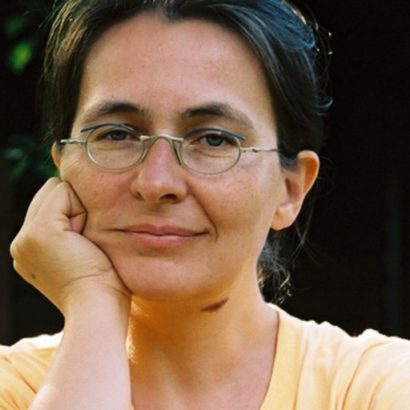 Professor Joanna Tokarska-Bakir is Chair of Ethnic and National Relations at the Institute for Slavic Studies, Polish Academy of Sciences. She has spent the last academic year working at the Holocaust Museum in Washington. Her article first appeared under the title ‘A dog’s longing for a wolf in the woods’ in the Polish journal Gazeta Wyborcza. It has been translated by Nicholas Hodge.
I spent the morning of 7 October in Bethesda, near Washington, at the home of Polish Jews Basia and Marek, March ’68 émigrés whose parents were Holocaust survivors. Our breakfast was interrupted by the telephone, and a string of updates on the fate of my hosts’ Israeli family and friends. At that time, people were just getting to know the names of the kibbutzim that had been attacked, as well as the faces of the hostages who would later appear repeatedly in the news: Naama Levy, the young woman in bloody pajama bottoms, her hands tied behind their backs, Shani Louk trussed up on the back of a pickup truck like a sacrificial animal, Hersh Goldberg-Polin, whose forearm had been blown off by a grenade, or Eden Yerushalmi, a bartender at the Nova Music Festival, the scene of one of the largest massacres.
As Simon Sebag Montefiore wrote, the Hamas attack was reminiscent of a medieval Mongol raid,[i] with people being murdered or taken captive, only that in this case, the raid was recorded and streamed on social media, in real time. Within the space of a couple of hours, ten per cent of the inhabitants of the kibbutizim had been killed, including at left-wing kibbutizim such as Be’eri, which had striven towards reconciliation with the Palestinians.[ii]
Actions such as abducting dead bodies and removing them to Gaza, cutting off the fingers of old people, the execution of a father or a mother in front of their children,[iii] or showing a murder on camera after the victim had been forced to call relatives,[iv] inventively expanded the catalogue of historical acts of cruelty that people have inflicted on others over the centuries. This cruelty extended to pets too, as evidenced by the shooting of a black labrador that had wagged its tail in a friendly way at the approaching terrorists.[v]
As it turned out though, 8 October proved to be worse than 7 October, because it was then that the campaign of denial began. Western academics, artists and activists, some under the banner of justice and humanitarianism, others devoid of any banner, rushed to explain how the whole attack was simply armed resistance, and not genocide,[vi] even though Palestinian terrorists had killed everyone in their path.
The American writer Najma Sharif tweeted sneeringly: ‘What did y’all think decolonisation meant? Vibes? Papers? Essays? Losers!’[vii] Former minister Yannis Varoufakis, leader of the Greek left, declared that it was not Hamas, but ‘Europeans’, who were the criminals[viii]. Furthermore, in a joint statement, 35 organisations from the University of Harvard placed all the blame for the massacre on one actor – Israel of course.[ix] While attendees of the ill-fated rave party were still hiding in bushes from the terrorists, the New York section of the Democratic Socialists of America and the anti-Zionist organisation the Jewish Voice for Peace held a rally on Times Square in support of ‘Gaza’. [x] Susan Sarandon, the unforgettable star of Thelma and Louise, spoke at the next demo, and expressed satisfaction that Jews were finally ‘getting a taste of what it feels like to be a Muslim in this country’.[xi]
Meanwhile, a photograph went viral of a man paragliding over the Gaza barrier on 7 October so as to take part in the massacre. The image was shared by the Chicago branch of Black Lives Matter and Jodie Dean, a political theorist from Hobart College. The latter viewed the event as ‘exhilarating’.[xii] ‘And what do you stand for? For liberation, or for Zionism and imperialism?’ she asked.[xiii] The creators of the posters that were put up across New York got straight to the point: ‘Zionism = terrorism’.[xiv]
The terrorists themselves seemed somewhat disorientated by the unexpected outpouring of sympathy, and they published contradictory statements. Some claimed that no hostages had been taken, because Muslims do not wage war against civilians.[xv] Others declared that there are no civilians in Israel, because all the Jewish inhabitants were occupiers[xvi].
All this took place amidst the deafening silence of humanitarian and progressive organisations, who in the wake of the murder of George Floyd or the outbreak of war in Ukraine had issued statements around the clock.[xvii]
Slogans such as ‘Queers for Palestine’ drew comparisons with the little dog from Moominland Midwinter who longs to be with real wolves in the woods.
Go back to Poland
The slogan ‘Go back to Poland’ was tested by Lebanon’s Hezbollah following Hamas’s attack,[xviii] and a couple of months later it spread to the placards of American students protesting against the war in Gaza.[xix] Confronted by the fact that their postulates conformed to the definition of colonialism – dictating a situation overseas at someone else’s expense – the students superciliously shrugged their shoulders.
They had clearly never been exposed to the view that at the time of the creation of Israel, the majority of Jews were refugees, and Palestine was their haven (refugium), established by UN resolution no. 181 in 1947. This concept did not conform to the narrative about settler colonisers, and the same could be said about the traumatised kibbutzniks, peers of Hanna Krall from the orphanage in Otwock such as Lili Szynowłoga, who had miraculously survived the war by hiding in the cemetery in the town of Chęciny.[xx]
In Stanford, the first sit-in was held in mid-October, so before Israel entered Gaza. The young participants were angry and resolute: in their bid to justify the violence of the liberators, they cited Franz Fannon,[xxi] likened Hamas to Nelson Mandela, and compared the massacre of the kibbutzniks to Ukrainian self-defence in the war with Russia. In fact, Hamas and Hezbollah flags were few and far between at the New York demonstrations in early November, but soon the Columbia students announced that ‘We are Hamas’, while also championing such slogans as ‘By any means necessary’, ‘Globalize intifada’, ‘Abolish the settler state’ and ‘Glory to our martyrs’.[xxii] The red, upturned triangle that is used by terrorists to denote their aims started to appear on Jewish institutions (for example the Brooklyn Museum).[xxiii] One day, passengers on the New York subway heard something that Polish Jews remembered from 1968: “Raise your hand if you’re a Zionist. (…) This is your chance to get out.’[xxiv]
At Stanford, students were only let into the building if they recited the words ‘Fuck Israel, free Palestine’.[xxv] There were calls for boycotts of Israel – academic and others; these slogans had been launched by the anti-Israel movement Boycott, Divestment and Sanctions, which had been prohibited by Trump, but which now found itself back in action. Recently, it gained official support from the American Anthropological Association, an organisation of specialists that nevertheless had vehemently opposed the movement for many years (i.e. when the serving president was the daughter of one of the survivors of the Jedwabne Pogrom).[xxvi]
The reality I have described thus far might seem like a clumsy imitation of Philip Roth’s The Plot Against America. The next installment is, however, more of a dark satire on universities – factories of the world’s greatest minds – as if straight from the movie The Social Network.
‘We don’t want no two states! We want all of ’48!’ chanted Stanford students, calling for a return to the situation prior to Israel’s 1948 war of independence (which was started, like the wars of 1967 and 1973, by Israel’s Arab neighbours who, rejecting the previously mentioned UN resolution and the creation of Jewish and Palestinian states, attacked the former, but did not win).[xxvii]
‘We are Stanford University! We control things!’ – shouted young Americans in keffiyehs. They covered their faces, so as not to jeopardise their future careers. The creator of the idea of civil disobedience, Henry David Thoreau, believed that the condition for carrying out such defiance was voluntary submission to the resulting penalty, but this notion was considered ridiculously out of date by the protesters.
Worse than Again
I observed all this while in the US, where I spent the last academic year. My vantage point could be called privileged, considering that I was based at the Holocaust Museum in Washington, but that autumn, it was one of the more unfortunate places to be.
Although school groups bustled to and fro outside the museum, which adjoins the National Mall, the building seemed deserted in early October, and its lifts, which had been designed to bring to mind gas chambers, broke down more than usual.
The black cloud that hovered over the institution following the events of 7 October was expressed in a vigil in honour of those who had been killed or abducted by Hamas. A handful of pale, elderly Holocaust survivors took part. For the first time in the history of the museum, only the initials of those who attended the vigil were provided, due to security fears, but the situation gave the impression that the participants were culprits, not victims.
The official optimism that had been part of the museum’s mission for several decades disintegrated when social media started to swarm with unfriendly statements in the aftermath of 7 October. Suddenly, Jews found themselves on the wrong side. Rywka, a relative of Kielce Pogrom-survivor Anszel Pinkusewicz[xxviii], was on duty answering the constantly ringing telephone, but when the situation became completely unbearable, she started to consider handing in her notice. In November, things got even worse, when pictures of Hamas’s hostages were torn down under the cover of night. The fact that the institution was in crisis was plain to see: within just a few hours of the attack taking place, the museum’s main exhibition, with its motto ‘Never Again’, became painfully outdated. When clips from terrorists’ bodycams were uploaded onto the net, old symbols such as cattle trucks transporting Jews to Auschwitz receded far into the distance. Something had begun that Henry Grynberg had described as ‘Worse than Again’,[xxix] and the hallmark of this was the deafening silence in which it took place.
For many, ‘Hamas’s attack was full of echoes of Polish pogroms’ (Anna Zawadzka)[xxx] and the Holocaust,[xxxi] yet almost immediately – apparently because of the abuses of the Israeli government – calls were made to not associate it with the Holocaust.[xxxii] This gave the impression of someone with a not entirely clear conscience (the figures included several distinguished Holocaust historians, such as Michael Rothberg) defending himself against such an overwhelming comparison. With the aid of the verb ‘to evoke’, Nobel Prize-winner Herta Müller[xxxiii] attempted to dismantle this ban, but the memory controllers did not even deign to listen to her.
Proscription forces prescription, so right after the embargo, a rash of recommended metaphors appeared. Israel’s response to the terror? Revenge of the victims and repetition compulsion. The Gaza Strip? The Warsaw Ghetto Uprising. A photograph of a Jewish boy with his hands up? It’s a Palestinian child. Meanwhile, the word Gaza was even daubed on the Anne Frank statue in Amsterdam.[xxxiv]
The crowning element of this action was Pankaj Mishra’s essay ‘The Shoah after Gaza’ in the London Review of Books, in which the author claimed that ‘even before Gaza, the Shoah was losing its central place in our imagination’.[xxxv] Monika Bobako’s piece in Krytyka Polityczna was in a similar vein, recommending – with references to moral repercussions – a broadening of Holocaust Studies to include the Israeli-Palestinian conflict.[xxxvi]
It would be a fitting culmination of the decades-long process of erasing Jews from the Holocaust, a situation that was summarised by Sunday Times journalist Hadley Freeman as follows: ‘Holocaust Memorial Day (HMD, known outside Britain as Holocaust Remembrance Day) falls every year on January 27, the anniversary of the liberation of Auschwitz-Birkenau by the Soviets. And yet HMD is no longer about the 6 million Jews killed in the Holocaust, but “all victims of genocide”, and any Jew foolish enough to query this shift is firmly reprimanded for being exclusionary. (That was the real problem with the Holocaust: not inclusive enough.).’ [xxxvii]
Tectonic shock
Following complaints by frightened Jewish students, Republicans held a hearing of university rectors in Congress.[xxxviii] When Harvard president Claudine Gay was asked whether it was permissible to call for genocide against Jews, she replied that ‘it depends’. Her answer confirmed the existence of double standards – it would be hard to imagine similar hesitancy in the case of African Americans.
The context of the hearing in Congress was the wider discussion about the limits of freedom of expression, an issue that had flared up in the wake of the Hamas attack. The demand for radical freedom of speech was something of a surprise, given that it was called for by a generation that attached weight to ‘safe spaces’, having grown up with the conviction that even micro aggression was not permissible towards minorities. As Hadley Freeman wrote, clearly the massacre of Jews by Hamas was ‘too micro’,[xxxix] given that the narrative had now taken a hundred-and-eighty-degree turn.
How was all this possible, given that for many years, the country had been experiencing a ‘golden age for American Jews’? [xl] The country of Philip Roth, Robert Oppenheimer, Barbra Streisand, Susan Sontag, Betty Friedan, Ruth Bader Ginsburg, Woody Allen and Bob Dylan? Was it all an illusion?
Over the last year, antisemitic attacks in the US increased fourfold (a drop in the ocean compared to Great Britain, where the figure rose by 1350 per cent!)[xli] , due to which many Jews went incognito, removing mezuzahs from their doors and keeping their kippahs well hidden. They were right to do so, considering that young Americans had effectively declared their solidarity not so much with Palestinians, but with Hamas. Dara Horn, author of People Love Dead Jews, clarified the situation as follows: ‘U.S. rally organizers named their efforts “floods” (“Flood Seattle for Palestine,” “Flood Manhattan for Gaza”) after “Operation Al Aqsa Flood,” Hamas’s name for its October 7 butchery.’ [xlii]
How can American youth’s radical change in attitude be explained, given that for decades, their parents fought arm in arm with Jews of all denominations in the battle for civil rights? Antisemitism is an unavoidable answer, but it is insufficient. Looking for further answers, I came across an explanation by Theo Baker, a Stanford student[xliii]. He blames the aggression on students’ deluded sense of agency and – surprise! – their conformity. In his view, elite universities attract a certain type of ambitious youth, who sees the world as a series of multiple-choice questions, with answers that are simply right or wrong. Once a candidate has made it to a given institution, the surest way of staying in the saddle is by taking the side of the majority and condemning Israel – this is the response that they think will be best for them. This is indeed what their progressive teachers and peers expect of them, even if their parents do not share such a point of view. In times past, such behaviour was called other-directedness (David
Riesman’s The Lonely Crowd), today it is rather referred to as adaptation.
The pro-activism mentality, which is hostile to intellectual nuances, prioritises the end over the means, and rejects the lessons of totalitarianism, is destroying universities, which suicidally encourage it. Theo Baker: ‘Today’s students grew up in the Trump era, in which violent rhetoric has become a normal part of political discourse and activism is as easy as reposting an infographic. Many young people have come to feel that being angry is enough to foment change.’
This mentality perfectly suits social media, which provides its mouthpiece. What came first: the chicken or the egg? In spite of their name and the aura in which they appeared, social media outlets are geared towards dividing, rather than connecting people. The greater the outrage and polarisation, the greater the earnings.
And yet it had all been so beautiful: universities had introduced DEI programmes (Diversity, Equality and Inclusion), protecting people against discrimination, not only in relation to skin colour, but also to ethnic and sexual identity. The ‘culture of white supremacy’ had been condemned, along with its preference for the written word, because there are other forms of communication, after all (sport? music? storytelling?).[xliv] Even the use of the wrong pronoun could prompt extra sensitivity classes. So as not to offend anyone, trigger warnings were applied, informing about controversial content. Nevertheless, the DEI preferences concerned every group with the exception of Jews, who simply had to keep quiet if they were offended. [xlv] How had this come about?
In the US, the prevailing view of race as a visible stigma is that only non-white people are affected by it. This would explain Whoopi Goldberg’s unfortunate remark about the Holocaust, which in her view, had nothing to do with race.[xlvi] In spite of visits to the Holocaust Museum and obligatory classes about the Shoah in school, antisemitism is still viewed in the US as a problem that concerns Poles, and perhaps Germans, but certainly not progressive young Americans.
Although the presence of Jewish students at American universities grew strikingly following the abolition of the quota system (which remained in place at Ivy League institutions until, more or less, 1945), today the vast majority of students hail from wealthy families from all over the globe. [xlvii] Under the guise of fighting for equal rights, here the privileged fight to improve their own image, by taking a virtuous stance. Yet as James Baldwin once wrote, virtues are almost always ‘ambiguity itself’. [xlviii] The spread of postcolonial theory, condemnation of capitalism and contempt for liberal restraint have been accompanied at universities by a prolific blindness to their own hypocrisy.
Reminiscence: The Satanic Verses
Hamas’s attack on Israeli kibbutzim, and the polarisation that it prompted, revealed a crisis that had long been growing in the shadows. However, attentive observers had managed to spot its symptoms, as can be seen in an occasionally hilarious essay called ‘Jews Don’t Count’, written by the English comic David Baddiel in 2021. He notes that ‘for a long time, antisemitism has been downgraded as not a real or proper racism by progressives. Now, in the social media frenzy, which demands villains, things must have justice meted out to them immediately, things have moved beyond that. The idea that collective responsibility is racist has got lost in the righteous fury…. As I was writing this, a British-Lebanese blogger told her 11k followers to come and harass me on my stand-up tour, because the proceeds from my book are no doubt going to fund illegal settlements and Israeli Defence Forces killing’.[xlix] The pressure on Jews to publicly distance themselves from Israel or ‘Zionism’ is rooted in just such racism.
Two decades ago, antisemitic resentments revealed themselves in the form of conspiracy theories about the attack on the World Trade Centre on September 11th, 2001. Peculiar interpretations of the attack, such as the unexpected rise in American conversions to Islam, did not make headlines. In later years, few noticed how diverse – to say the least – the international reactions were to Salman Rushdie’s The Satanic Verses.
As the aforementioned writer stated in Joseph Anton, the principle of freedom of speech, which he had fought for his whole life, was already in a state of deterioration around 2010: ‘Something new was happening here: the growth of a new intolerance. It was spreading across the surface of the earth, but nobody wanted to know. A new word had been created to help the blind remain blind: Islamophobia (…). One billion believers could not be wrong, therefore the critics must be the ones foaming at the mouth’.[l]
A sign of how far things had come can be found in an article about The Satanic Verses by the deputy editor of The Independent, a centre-left British newspaper, in which the author stated that it was not only ‘a silly, childish book’ which should be banned in the light of hate speech laws, but that he would have nothing against burning it. [li] A complete turnaround had occurred: black had become white.
Small talk on Olympus
I experienced this first hand ten years ago, when I found myself in Princeton at the Institute for Advanced Study, a centre that was created for Albert Einstein. One day during lunch, the small talk moved to my book Legendy o krwi. Antropologia przesądu[lii] [Legends about blood: an anthropology of prejudice], which explores Sandomierz (central Poland) tales about Jews killing children for matzah.
I was rather surprised when the director of the School of Social Sciences, the French anthropologist and physician Didier Fassin, said that the titular ‘prejudice’ was itself a discriminatory, classist construct, and he proceeded to speculate as to whether there might have been a grain of truth in the myth after all. Silence fell, and everyone continued chewing. Only Steven Lukes (a Durkheim specialist), who was sitting next to me, muttered under his breath that something ‘akin’ to truth manifests itself in every statement. Well, well, I thought, to hear the same opinion in Princeton as in Sandomierz is rather perverse.
This impression was strengthened during a lecture by one of my Princeton colleagues, given within the framework of a seminar on equality. The colleague in question, a Muslim theologist, portrayed the ḏimmī system, via which medieval Islam protected ‘infidels’, as superior to John Locke’s conception of tolerance. (The ḏimmī system was based on the levying of a tribute by the caliphate, which, being focused on conquering ‘external aliens’, left ‘internal aliens’ —Jews and Christians—in peace.)
The lecture was attended by a queer/feminist audience, colourful even by American standards. Someone asked how, in this context, does one explain the stoning of adultresses in Islamic culture. The lecturer blamed it all on the Jews: it was the fault of the convert Abd Allah ibn Salam,[liii] who had whispered to the Prophet that this punishment was what the Torah prescribes, and the naive Prophet listened to him. ‘Once, I was in favour of tolerance, now I am rather pro-Empire,’ the speaker declared at the end of the speech, undeterred by the fact that the Islamic State had announced on Twitter that the Caliphate had been reborn.
Shortly afterwards, the delegates of the empire massacred the editors of Charlie Hebdo, shooting to death ‘external aliens’, who had dared to make fun of the Prophet. Princeton was outraged. I remember the grim mood during a meeting in the university’s largest hall, where our anthropologist and physician Didier Fassin explained to those present that rather being outraged, they should simply understand the terrorists.
‘You don’t understand.’
On the back of the print edition of the London Review of Books, one finds letters to the editor that are written in a distinctly English way. Readers elegantly lambast authors they don’t agree with, and the editor coolly prints every last word.
How this looks from the inside I discovered after Hamas’ s attack on Israeli kibbutzim, when the LRB published a piece by Judith Butler titled ‘Compass of Mourning’.[liv] Explaining that the role of intellectuals is to place events in context, the philosopher and gender studies scholar insisted that the historical background of the massacre had to be taken into account, namely the ‘Israeli violence against Palestinians … waged against a people who are subject to apartheid rules, colonial rule’.
Shortly afterwards, I wrote to the LRB (my letter was not published), suggesting that the context could be broadened to include the post-war pogroms that compelled thousands of Jews to leave Poland for the Middle East, or the violence from 1948, the 1950s and the1960s, which affected the mizrahim, the ‘Oriental Jews’. Indeed, the cry of ‘Jews to Palestine!’ was remembered by Henrietta Borensztajn, the protagonist of my book Cursed (2023). Having survived the Kielce Pogrom of 1946, she settled near Tel Aviv, in keeping with the perpetrators’ wishes. How surprised she would be today if she were to hear that Jews are being encouraged to go back in the other direction!
Didier Fassin’s orations at Princeton, like Judith Butler’s article ‘The Compass of Mourning’, continue a tradition of the American left that was initiated by Susan Sontag, who in response to accusations that Bin Laden’s terrorists were cowardly, defended their aggression, calling it the consequence of ‘specific American alliances and actions’.[lv] In Sontag’s eyes, America itself was guilty, just as Israel was, according to Butler, and French journalists in Fassin’s perspective. Until recently, it seemed that there were limits to blaming the victim. This all changed though with the left’s reaction to the rapes committed by Palestinians on 7 October.
The first pointer was a photograph of a dead woman, taken the day after the attack on Route 232, a country road near Gaza. The victim was wearing a black dress and she had a charred face.[lvi] Gal Abdush had attended the Nova Festival, and it turned out that she had been raped and then shot. The last message she sent to her family was ‘You don’t understand.’
A two-month investigation by journalists from the New York Times, making use of GPS data from the mobile phones of over 150 people, as well as interviews with victims, therapists and soldiers, revealed that this was not an isolated rape, but ‘part of a broader pattern’.[lvii] A report released by the UN in March stated that ‘there are reasonable grounds to believe that conflict-related sexual violence occurred during the 7 October attacks in multiple locations across Gaza periphery’, against both women and men, ‘including rape and gang rape,’ and that there was ‘clear and convincing information’ concerning ‘rape and sexualised torture’ of hostages.’[lviii]
How did the left react to these findings? More or less like the Catholic Church did to the Kielce Pogrom of 1946: violence was condemned per se, but without going into specifics. Voices that were usually forthright, such as Human Rights Watch, #MeToo and Amnesty International, chose to remain silent, and it took the UN’s organisation for women’s rights eight months to express its concern.[lix] The film Bearing Witness, which was made by Israelis using clips of drastic scenes, as well as Sheryl Sandberg documentary, [lx] was received with incredulity, and one of the more sensitive journalists who watched it claimed that he had been unnecessarily traumatised. A hundred and forty American feminist scholars, including Angela Davis, an iconic figure during the Vietnam War, spoke out against the manipulation of sexual violence (1800 people from other countries signed this letter too[lxi]), and one of them claimed that the descriptions of the rapes were not trustworthy, as they were extremely fetishistic – as if that was not the case with normal rape. The slogans ‘Believe Women’ and ‘Silence is Violence’ had suddenly ceased to be valid.
Judith Butler reacted to the whole situation like a typical 1950s policeman who had been confronted with claims of rape – she demanded proof. This led Israeli sociologist and feminist Eva Illouz to comment: ‘Judith Butler built their career off of challenging notions of objectivity, essence, and reality. Judith Butler was able to circulate a letter supporting someone accused of harassment without evidence [this concerns Avital Ronell, a professor at New York University, who was suspended after a PhD student accused her of harrassment in 2017[lxii]]. But now, they seem (for the time being) to have changed their mind. (…) They declare that were this evidence provided, they would “deplore” these rapes. The indecency of Butler’s words desecrates the blessed memory of those women who were tortured, raped, shot, or stabbed and disqualify them from being considered a feminist.’[lxiii]
Natalia Mehlman Petrzela, a historian from The New School in New York, theorises that the left’s negation of the rapes is connected with the failure of the previously described anti-discrimination programmes in the US: here too the problem hinges on the unacceptable whiteness of the victims.[lxiv] In the past, sexual violence against white women was a tool used by racists to carry out lynchings, yet today’s defenders of Hamas compare the terrorists[lxv] to Emmett Till, a black 14-year-old who was murdered in 1955 in Mississippi because he whistled at a white married woman.[lxvi] However, the problem is that these two events are fundamentally different, and we, weakened by relativism à la Judith Butler, have ever fewer tools to illuminate this difference.
The dehumanisation of an antisemite
Will left-wing antisemitism become a new fashion, which will ultimately enable the progressive elite to fraternise with the masses? It cannot be ruled out, all the more so given that it is supported by a historical mechanism that has led us by the nose for a couple of thousand years. In keeping with the best definition of antisemitism that I know, proposed by David Nirenberg in his book Anti-Judaism (2015), antisemitism does not depend on one or other way of thinking about Jews, but on thinking ‘by means of Jews.’
Since ancient times, various cultures, including religions such as Christianity and Islam, have defined themselves via opposition to how they viewed Judaism. This had nothing to do with what Judaism was, and everything to do with wanting to avoid the evil which it was perceived to be.
In the age of piety, Israel was a blasphemer and an unbeliever. When secularism became fashionable, Jews were loathed as ‘dark reactionaries’. Under capitalism, they were persecuted as communists, and under communism, as capitalist exploiters. Nationalist movements were not indifferent to them either, labelling them cosmopolitans, whereas ebbing nationalism allows Jews to be stigmatised as crazed chauvinists.
We can also observe the functioning of these principles in today’s world. In a time when human rights are so highly valued, Israel has once again been cast as the villain, and we unstintingly strive to convince ourselves that we are on the right side.
Day after day, progressive newspapers – The New York Times, Gazeta Wyborcza or Oko Press – exacerbate the crisis in the Middle East, by contrasting omnipotent Israel with Palestinians who are deprived of agency. Hamas and Hezbollah are not dehumanised by Jews, who, even if they hate them, have to deal with the everyday, life-and-death consequences of their actions – but by those who treat them like non-human factors, like an element, or a natural disaster, things which cannot be asked to take responsibility for themselves.
For left-wing politics today, support for the Palestinian cause has become as important as anti-capitalism, vegetarianism, opposition to coal mining and support for the right to abortion. The left craves a simple way of looking at the world, and it needs some groups which it can hate with impunity, and others which it can bombard with love.
Jews do not need the left, for in spite of what antisemites say about them, they are a collective of anti-victims: following the greatest catastrophe in history, they took advantage of a historical opportunity to build a collective life. That is why we will never forgive them for what we did to them.
references
[i] https://www.theatlantic.com/author/simon-sebag-montefiore/
[ii] https://www.nytimes.com/interactive/2023/12/22/world/europe/beeri-massacre.html
[iii] https://www.timesofisrael.com/adi-vital-kaploun-33-amazing-mother-killed-in-front-of-her-children/#:~:text=Dual%20Israeli%2DCanadian%20citizen%20was,and%204%2Dmonth%2Dold%20Eshel&text=Adi%20Vital%2DKaploun%2C%2033%2C,her%20children%2C%20husband%20and%20father.
[iv] https://unherd.com/2023/10/i-watched-hamas-unleash-hell/
[v] https://wyborcza.pl/magazyn/7,124059,30449519,wiekszosc-ludzi-nigdy-nie-zobaczy-filmikow-hamasu-ktore-obejrzalem.html#S.TD-K.C-B.8-L.3.maly
[vi] ‘Hamas’s Genocidal Intentions Were Never a Secret’, https://www.theatlantic.com/international/archive/2023/10/hamas-covenant-israel-attack-war-genocide/675602/
[vii] https://x.com/najmamsharif/status/1710689657757769783
[viii] Etan Nechin, How Can Left-wingers Hail Hamas Atrocities Against Israelis as ‘Palestinian Resistance?’, https://www.haaretz.com/opinion/2023-10-11/ty-article-opinion/.premium/how-can-left-wingers-hail-hamas-atrocities-against-israelis-as-palestinian-resistance/0000018b-1e0b-df31-a99f-7fcb56df0000
[ix] Hadley Freeman , ‘Blindness’: ‘hold the Israeli regime entirely responsible for all the unfolding violence’, see also: https://x.com/yaelbt/status/1710875529249792487
[x] https://www.haaretz.com/opinion/2023-10-11/ty-article-opinion/.premium/how-can-left-wingers-hail-hamas-atrocities-against-israelis-as-palestinian-resistance/0000018b-1e0b-df31-a99f-7fcb56df0000
[xi] The progressive left hates the Jews | Hadley Freeman | The Blogs.pdf; https://blogs.timesofisrael.com/author/hadley-freeman/
[xii] ‘The images from October 7 of paragliders evading Israeli air defenses were for many of us exhilarating,’ https://www.versobooks.com/blogs/news/palestine-speaks-for-everyone
[xiii] Why America’s Leftist Literati Loves to Fetishize Hamas Brutality – Opinion – Haaretz.com.pdf
[xiv] Franklin Foer/ ‘Everyday Jewish Life in the U.S. Will Be Punctuated by Antisemitism’ – Podcasts – Ha.pdf
[xv] https://news.sky.com/video/israel-hamas-war-we-have-not-killed-any-civilians-hamas-official-tells-sky-news-12981219?ref=quillette.com
[xvi] https://fathomjournal.org/fathom-long-read-a-progressive-pogrom-of-shani-louk-jean-amery-and-the-anti-zionist-left/
[xvii] Gal Beckerman, ‘The Left Abandoned Me’, https://www.theatlantic.com/ideas/archive/2023/10/left-jewish-suffering-israel-hamas/675621/
[xviii] https://wyborcza.pl/7,179012,30296709,hezbollah-ma-swoja-strategie-zydzi-musza-wrocic-tam-skad.html
[xix] Go back to Poland, Columbia, 22/4/24.jpeg (on platform X); Go to Poland and bomb Tel Aviv_Columbia Calls Off In-person Classes as pro-Palestinian Protests Escalate – U.S. News – Haaretz.com.pdf
[xx] I described these events in ‘Barabasz i Żydzi’ chapter in my book Pogrom Cries (2017).
[xxi] https://www.theatlantic.com/books/archive/2024/03/frantz-fanon-adam-shatz-the-rebels-clinic/677904/
[xxii] Edytorial redakcji ‘The Wall Street Journal’, pt. Celebrating the Nova Massacre in New York City,
https://www.wsj.com/articles/nova-massacre-remembrance-new-york-city-protesters-hamas-antisemitism-0d7f4eb0
[xxiii] https://www.wsj.com/articles/nova-massacre-remembrance-new-york-city-protesters-hamas-antisemitism-0d7f4eb0
[xxiv] https://www.theatlantic.com/ideas/archive/2024/10/october-7-anti-semitism-united-states/680176/
[xxv] https://www.theatlantic.com/ideas/archive/2024/03/stanford-israel-gaza-hamas/677864/
[xxvi] See Alisse Waterson, My Father’s Wars: Migration, Memory, and the Violence of a Century (2013)
[xxvii] https://www.theatlantic.com/ideas/archive/2024/03/stanford-israel-gaza-hamas/677864/
[xxviii] Joanna Tokarska-Bakir, Cursed. A Social Portrait of the Kielce Pogrom, transl. by Ewa Wampuszyc (Ithaca: Cornell 2023), 3.
[xxix] Henryk Grynberg, Worse than Again, https://doi.org/10.1080/23739770.2024.2365025
[xxx] Tomasz Żukowski’s interview with Anna Zawadzka, https://wyborcza.pl/magazyn/7,124059,30913876,atak-hamasu-z-7-pazdziernika-byl-pelen-cytatow-z-polskich-pogromow.html?_gl=1*168um8c*_gcl_au*MTkyODQ4NjY4NS4xNzIwMjY2NTYx*_ga*OTIxMDQ1OTcyLjE3MjUzNjI4MDY.*_ga_6R71ZMJ3KN*MTcyNjUwNDg5NC4xNjEuMC4xNzI2NTA0ODk0LjAuMC4w&_ga=2.224908179.845884764.1725960372-921045972.1725362806
[xxxi] Gal Beckerman, ‘The Left Abandoned Me’, https://www.theatlantic.com/ideas/archive/2023/10/left-jewish-suffering-israel-hamas/675621/
[xxxii] ‘An Open Letter on the Misuse of Holocaust Memory’ | Omer Bartov, et al. | The New York Review of Book.pdf
[xxxiii] https://www.haaretz.com/israel-news/2024-06-08/ty-article-magazine/.highlight/hamas-wanted-to-evoke-the-shoah-an-interview-with-nobel-winning-author-herta-muller/0000018f-edf4-d3f3-a7ff-fff482590000
[xxxiv] ‘What Has Anne Frank Got to Do With the Gaza War?’ https://www.haaretz.com/opinion/2024-07-12/ty-article-opinion/.premium/what-has-anne-frank-got-to-do-with-the-gaza-war/00000190-a32b-d03e-a5fd-bbbba9d90000
[xxxv] Pankaj Mishra · ‘The Shoah after Gaza’, Vol. 46 No. 5 · 7 March 2024, https://www.lrb.co.uk/the-paper/v46/n06/pankaj-mishra/the-shoah-after-gaza
[xxxvi] https://krytykapolityczna.pl/swiat/instrumentalizacja-zaglady-i-antypalestynski-rasizm/
[xxxvii] Hadley Freeman, ‘Blindness: October 7 and the Left’, The Jewish Quarterly, 256.
[xxxviii] Bret Stephens, ‘Double Standards’, https://www.nytimes.com/2023/12/08/opinion/antisemitism-college-free-speech.html?searchResultPosition=1
[xxxix] Hadley Freeman, ‘Blindness: October 7 and the Left’, Jewish Quarterly 256
[xl] https://www.theatlantic.com/author/franklin-foer/
[xli] From Hadley Freeman, Blindness…: ‘In the weeks after October 7, antisemitic hate crimes in London – such as attacks on Jewish schools and shops – exploded by 1350 per cent compared with the same period the year before; Islamophobic hate crimes also increased by 140 per cent in that time – an appalling increase, but a tenth of what Jews were experiencing. In the United States, anti-Jewish attacks increased by 400 per cent; in Germany, 240 per cent; in France, almost 100 per cent.’ ADL’s statistics are considerably higher: https://www.adl.org/resources/report/audit-antisemitic-incidents-2023
[xlii] Dara Horn, ‘Why The Most Educated People In America Fall For Anti-Semitic Lies’, https://www.theatlantic.com/ideas/archive/2024/02/jewish-anti-semitism-harvard-claudine-gay-zionism/677454/
[xliii] Theo Baker, The War At Stanford, https://www.theatlantic.com/ideas/archive/2024/03/stanford-israel-gaza-hamas/677864/
[xliv] https://www.theatlantic.com/ideas/archive/2024/09/campus-antisemitism-response-proposals/679669/
[xlv] https://www.theatlantic.com/ideas/archive/2024/09/campus-antisemitism-response-proposals/679669/
[xlvi] https://www.pbs.org/newshour/arts/abc-suspends-whoopi-goldberg-for-comments-on-jews-race-and-the-holocaust
[xlvii] https://www.tabletmag.com/sections/news/articles/the-vanishing
[xlviii] Michael Wood, ‘White Man’s Heaven’: ‘Baldwin admires virtue, but as he says elsewhere, ‘most virtues’ are ‘ambiguity itself’’, https://www.lrb.co.uk/the-paper/v13/n03/michael-wood/white-man-s-heaven
[xlix] David Baddiel, ‘Jews Don’t Count. How Identity Politics Failed One Particular Identity’, TSL, 2021, p.98-99: ‘For a long time, antisemitism has been downgraded as not a real or proper racism by progressives. Now, in the social media frenzy, which demands villains, things must have justice meted out to them immediately, things moved beyond that. The idea that collective responsability is racist has got lost in the righteous fury. Any Jew is fair game. As I was writing this, a British-Lebanese blogger told her 11k followers to come and harass me on my stand-up tour, because the proceeds from my book are no doubt going to fund illegal settlements and Israeli Defence Forces killing’.
[l] Salman Rushdie, Joseph Anton: A Memoir, 2012, p. 385: ‘It was Islam that had changed, not people like himself. It was Islam that become phobic of a very wide range of ideas, behaviours and things. In those years and in the years that followed, Islamic voices in this or that part of the world – Algeria, Pakistan, Afganistan – anathematised theatre, film and music, and musicians and performers were mutilated and killed. Representational art was evil, and so the ancient Buddhist statues and Bamiyan were destroyed by the Taliban. There were Islamic attacks on socialists and unionists, cartoonists and journalists, prostitutes and homosexuals, women in skirts and beardless men, and also, surreally, on such evils as frozen chickens and samosas’.
[li] Sean O’Grady: ‘Rushdie’s silly, childish book should be banned under today’s anti-hate legislation. It’s no better than racist graffiti on a bus stop. I wouldn’t have it in my house, out of respect to Muslim people and contempt for Rushdie, and because it sounds quite boring. I’d be quite inclined to burn it, in fact. It’s a free country, after all.’, https://www.independent.co.uk/arts-entertainment/tv/reviews/satanic-verses-salman-rushdie-review-fatwa-muslim-iran-heresy-a8799771.html
[lii] J.Tokarska-Bakir, Legendy o krwi. Antropologia przesądu (2008), French edition: Légendes du sang, Albin Michel 2015, trans. by Małgorzata Maliszewska.
[liii] https://en.wikipedia.org/wiki/Abd_Allah_ibn_Salam
[liv] Judith Butler, ‘Compass of Mourning’, LRB, https://www.lrb.co.uk/the-paper/v45/n20/judith-butler/the-compass-of-mourning
[lv] ‘Where is the acknowledgment that this was not a ‘cowardly’ attack on ‘civilization’ or ‘liberty’ or ‘humanity’ or ‘the free world’ but an attack on the world’s self-proclaimed superpower, undertaken as a consequence of specific American alliances and actions?’, from: Beckerman, https://www.theatlantic.com/books/archive/2024/09/homeland-war-terror-richard-beck-book/679764/
[lvi] ‘Screams Without Words: How Hamas Weaponized Sexual Violence on Oct. 7’, https://www.nytimes.com/2023/12/28/world/middleeast/oct-7-attacks-hamas-israel-sexual-violence.html
[lvii] ‘Screams Without Words: How Hamas Weaponized Sexual Violence on Oct. 7’, https://www.nytimes.com/2023/12/28/world/middleeast/oct-7-attacks-hamas-israel-sexual-violence.html
[lviii] https://www.un.org/sexualviolenceinconflict/wp-content/uploads/2024/03/report/mission-report-official-visit-of-the-office-of-the-srsg-svc-to-israel-and-the-occupied-west-bank-29-january-14-february-2024/20240304-Israel-oWB-CRSV-report.pdf
[lix] https://www.nytimes.com/2023/12/05/opinion/silence-rape-israel-jews.html
[lx] https://cddrl.fsi.stanford.edu/news/sheryl-sandberg-screens-discusses-documentary-oct-7-sexual-violence
[lxi] https://stopmanipulatingsexualassault.org/#signers; https://truthout.org/articles/over-140-prominent-feminist-scholars-demand-ceasefire-end-to-occupation-in-gaza/
[lxii] https://www.nytimes.com/2018/08/13/nyregion/sexual-harassment-nyu-female-professor.html
[lxiii] ‘The Global Left Needs to Renounce Judith Butler’ – Opinion – Haaretz.com.pdf, https://www.haaretz.com/opinion/2024-02-03/ty-article-opinion/.highlight/how-the-left-became-a-politics-of-hatred-against-jews/0000018d-6562-d7f7-adcf-6def4fe50000
[lxiv] Michael A.Cohen, ‘The Rape Denialists’, https://www.theatlantic.com/ideas/archive/2024/04/october-7-hamas-sexual-assault/678091/
[lxv] https://x.com/islamocommunism/status/1732039775698481241?s=20
[lxvi] https://en.wikipedia.org/wiki/Emmett_Till
 Hamas, część Bractwa Muzułmańskiego, organizacja zbrojona przez Katar, Turcję i Iran i wspomagana finansowo przez Unię Europejską, Amerykę i ONZ
 Długi cień nazistowskiej twierdzy