
Protest outside Israeli Cabinet meeting calls on PM to reject ‘pathway’ to ‘Palestine’


Protest outside Israeli Cabinet meeting calls on PM to reject ‘pathway’ to ‘Palestine’

Akiva Van Koningsveld, Amelie Botbol


“Only sovereignty—full control from the [Mediterranean] Sea to the Jordan [River]—will secure the state’s future,” said the Sovereignty Movement.
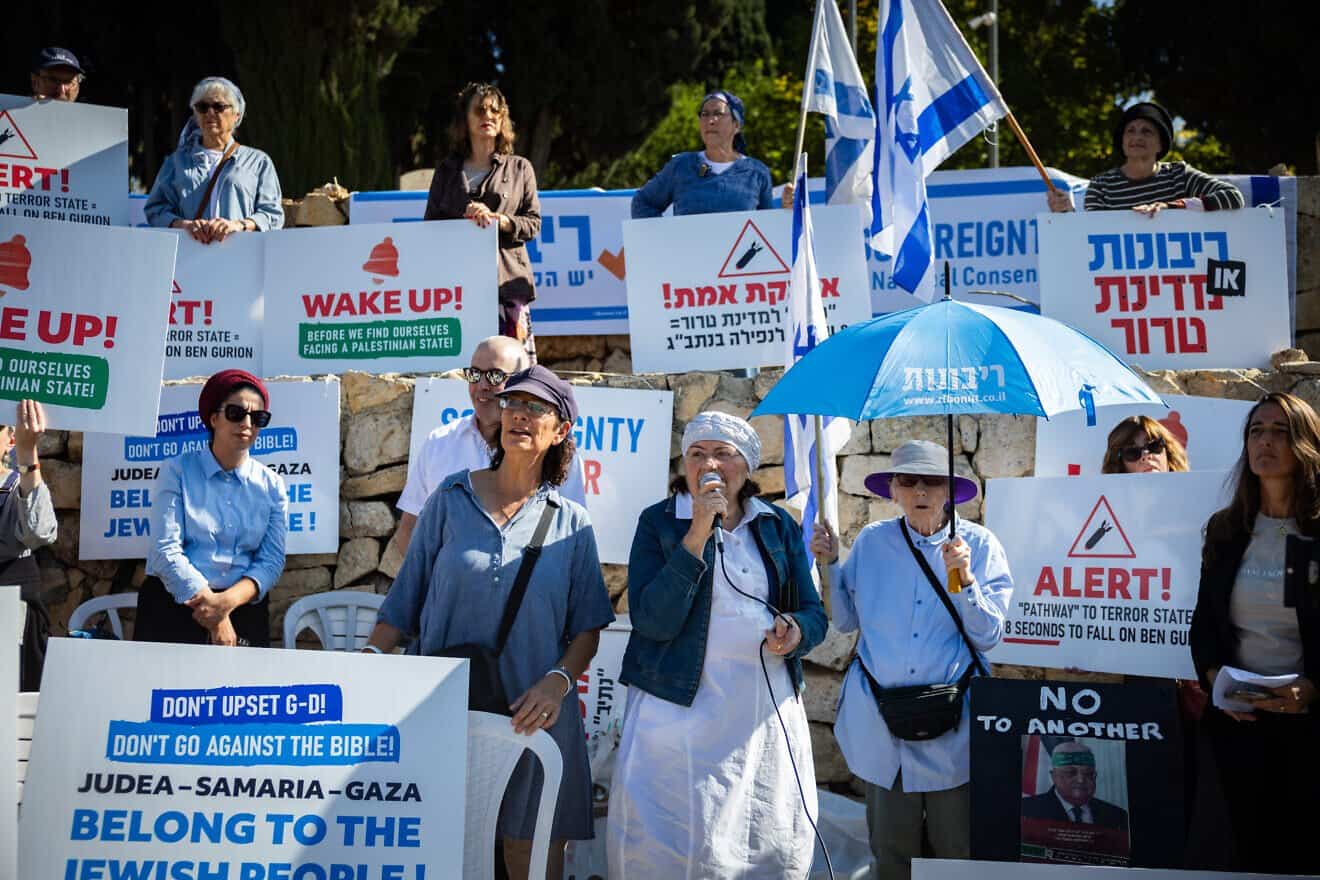
A protest calling for Israeli sovereignty over Judea and Samaria outside the weekly Cabinet meeting at the Prime Minister’s Office in Jerusalem, Nov. 23, 2025. Photo by Yonatan Sindel/Flash90.

Right-wing Israeli groups protested outside the weekly Cabinet meeting in Jerusalem on Sunday, calling on Prime Minister Benjamin Netanyahu to resist pressure to include a “pathway to a Palestinian state” in a Gaza peace plan.

The protest—led by the Sovereignty Movement, the Tekuma Movement and other NGOs advocating for Jerusalem to keep control of Judea and Samaria—included coalition lawmakers and activists, Israel National News reported.

“Israel cannot entrust its security borders to hostile elements. Only sovereignty—full control from the [Mediterranean] Sea to the Jordan [River]—will secure the state’s future,” according to the Sovereignty Movement.

“Instead of paving the way to a terror state threatening the heart of the nation, we must advance the vision of sovereignty,” the group stated. “Together, we will ring the bell outside the government meeting.”

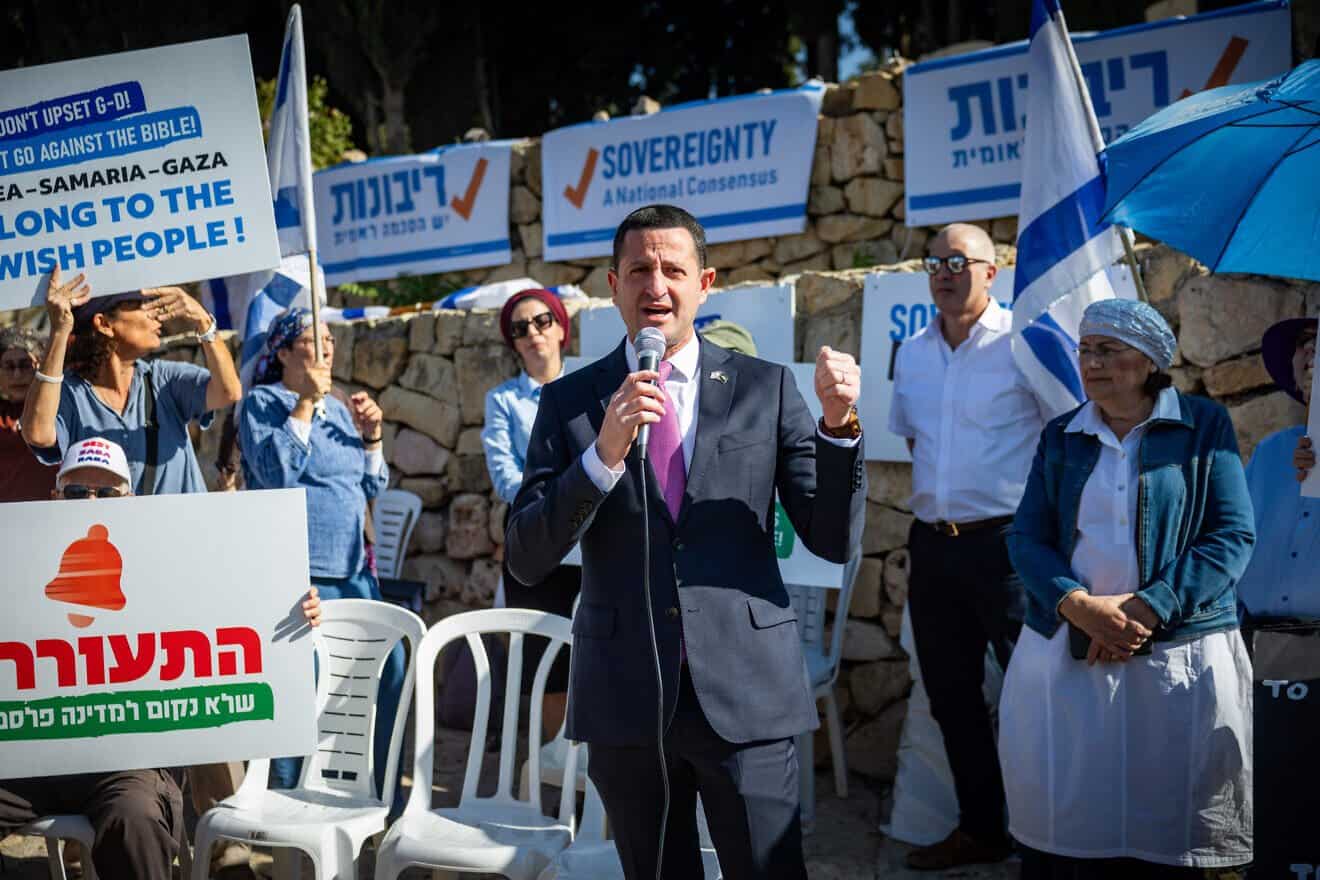
Religious Zionism Party lawmaker Ohad Tal, who participated in the rally, told JNS: “I urge Prime Minister Netanyahu to state clearly that Israel opposes the establishment of a Palestinian state—now or in the future, under any conditions.

“A Palestinian state poses an existential threat to Israel. The only viable alternative is Israeli sovereignty in Judea and Samaria,” the Knesset member said.

.MK Ohad Tal speaks at a protest calling for Israeli sovereignty over Judea and Samaria outside the weekly Cabinet meeting at the Prime Minister’s Office in Jerusalem, Nov. 23, 2025. Photo by Yonatan Sindel/Flash90.
In a joint statement arranged by the United States on Nov. 14, eight nations working toward ending the war against Hamas terrorism in Gaza expressed support for Washington’s proposed International Stabilization Force that is expected to provide security in the Strip.

According to the statement, signed by Qatar, Egypt, the United Arab Emirates, Saudi Arabia, Indonesia, Pakistan, Jordan and Turkey, the process also “offers a pathway to Palestinian self-determination and statehood.”

The joint statement appeared to go further than President Donald Trump’s 20-point peace plan, which Jerusalem has approved, by not leaving Palestinian statehood up for debate.

Religious Zionism lawmaker Simcha Rothman, who spoke at the rally, told JNS the gathering served as a “call for the government, the prime minister and the Cabinet ministers to move forward on the path to sovereignty, because the Knesset has already stated this is the way to go.”

Rothman referenced the Knesset’s July 2024 resolution, which passed by a wide majority and opposed unilateral international recognition of a Palestinian state.

“Our call is to make this an urgent task for the government and not postpone it, because while I don’t believe a Palestinian state is an imminent danger, if we aren’t proactive and don’t advance sovereignty, we will find ourselves confronting what the U.N. Security Council described as a pathway to Palestinian self-determination and a Palestinian state,” he said.

“If we want to prevent that, we must act on the ground — as [Finance Minister Bezalel] Smotrich is doing by building 50 new communities, and roads and farms [in Judea and Samaria]—but it’s not enough. We need to address it in the Cabinet, in the international arena, and apply Israeli sovereignty,” Rothman said.
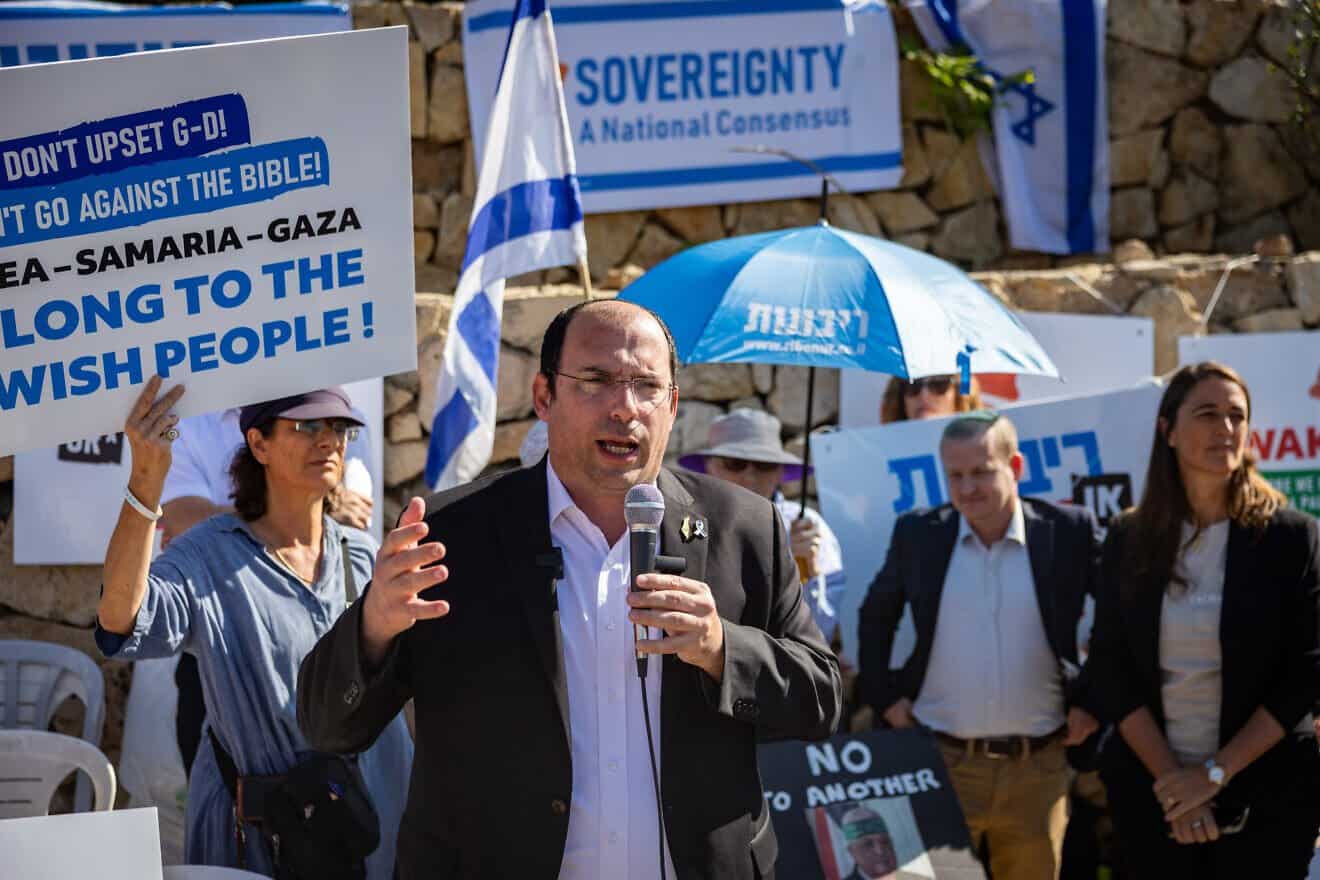
MK Simcha Rothman speaks at a protest calling for Israeli sovereignty over Judea and Samaria outside the weekly Cabinet meeting at the Prime Minister’s Office in Jerusalem, Nov. 23, 2025. Photo by Yonatan Sindel/Flash90.

Jerusalem will not allow a Palestinian state in Judea, Samaria and Gaza, Netanyahu said Nov. 16, responding to criticism from coalition partners.

“Our opposition to a Palestinian state on any territory west of the Jordan River exists, is firm, and has not changed in the slightest,” Netanyahu stated.

Israeli Foreign Minister Gideon Sa’ar also declared that the Jewish state would “not agree to the establishment of a Palestinian terror state in the heart of the Land of Israel, at point-blank distance from all of its population centers and with topographical control over them.”


Zawartość publikowanych artykułów i materiałów nie reprezentuje poglądów ani opinii Reunion’68,
ani też webmastera Blogu Reunion’68, chyba ze jest to wyraźnie zaznaczone.
Twoje uwagi, linki, własne artykuły lub wiadomości prześlij na adres:
webmaster@reunion68.com


MAGA Favorite Marjorie Taylor Greene to Resign After Split with Trump


MAGA Favorite Marjorie Taylor Greene to Resign After Split with Trump

Reuters and Algemeiner Staff


U.S. Representative Marjorie Taylor Greene (R-GA) announces her resignation from her position, in this screen grab from a statement released on social media, November 21, 2025. Marjorie Taylor Greene via X/Handout via REUTERS

Saying she refused to be a “battered wife,” US Representative Marjorie Taylor Greene announced on Friday she was resigning from the House of Representatives in the wake of a dramatic falling out with President Donald Trump.

Her exit marks a stunning turn of events that few would have imagined months ago. Greene, a Republican from Georgia, was once one of Trump’s closest allies and an outspoken advocate of his “America First” agenda, but the rift between the two widened in recent months over the release of government files related to sex offender Jeffrey Epstein and other matters.

In a 10-minute video posted on social media, Greene said she was spurred to resign by the prospect of having to face a Trump-backed Republican primary challenger and the potential takeover of the House by Democrats in next year’s midterm elections. She also complained that Congress has largely been “sidelined” since Trump returned to the presidency in January.

RUPTURE PROMPTS CONCERNS OVER MAGA BASE BEFORE MIDTERMS

“I have too much self-respect and dignity, love my family way too much, and do not want my sweet district to have to endure a hurtful and hateful primary against me by the president we all fought for, only to fight and win my election while Republicans will likely lose the midterms,” Greene said.

“I refuse to be a battered wife hoping it all goes away and gets better,” she added.

Interviewed by ABC News, Trump said Greene’s resignation, to take effect on January 5, was “great news for the country. It’s great.”

Greene lamented the state of American politics, contending that neither Republicans nor Democratic lawmakers were working to solve the nation’s problems, including the rising cost of living.

She said voters were tuning out Washington because “they know how much credit card debt they have, they know how much their own bills have gone up over the past five years, they actually do their own grocery shopping and know food costs too much, their rent has increasingly gone up, they have been outbid by corporate asset managers too many times when they put in an offer to buy a house.”

The public dispute between Trump and Greene had fueled concerns among some Republicans that Trump’s “Make America Great Again” base could fracture a year before the midterms, when Democrats hope to regain control of Congress.

Greene’s resignation will narrow the Republican majority in the House to 218 members over the Democrats’ 213. Republicans have a 53-47 majority in the Senate.

Greene had been increasingly exhibiting her independence from Trump, joining a House effort to force the release of the Epstein files over his objections, blasting House leadership for not doing more to address healthcare costs during the recent government shutdown and calling Israel’s assault on Gaza a genocide.

Trump, in turn, became more critical of her.

Before the House voted overwhelmingly to release the Epstein files, he called her a “traitor” and “disgrace” to the Republican Party. He withdrew his support for her and called her a “ranting lunatic.”

GREENE SAYS ORDINARY AMERICANS BEING ‘CAST ASIDE’

In her video, Greene defended her Epstein vote.

“Standing up for American women who were raped at 14, trafficked and used by rich powerful men, should not result in me being called a traitor and threatened by the president of the United States, whom I fought for,” she said.

Greene said she was proud of her conservative voting record, adding, in a swipe at Trump, that “loyalty should be a two-way street.”

Her ally in the House, Representative Thomas Massie, posted on X that Greene “embodies what a true representative should be.”

Barbara Comstock, a former Republican House member and a Trump critic, lauded Greene’s decision on social media.

“She doesn’t want to be a Republican ‘battered wife’ taking Trump’s abuse and getting death threats and pretending it’s all ok only to end up in the minority. Good for her,” Comstock posted.

Greene won her northwest Georgia district with 64% of the vote in 2024. Residents there said this week they hoped her rift with Trump would soon heal and expressed a willingness to support both of them. But Greene made clear on Friday that she had no interest in sparring with a Trump-backed opponent.

Even if she prevailed, she said, she likely would be in the House minority after the midterms and would have to defend Trump in impeachment proceedings, a situation she called “absurd” and “completely unserious.”

“If I am cast aside by MAGA Inc and replaced by Neocons, Big Pharma, Big Tech, Military Industrial War Complex, foreign leaders, and the elite donor class that can’t even relate to real Americans, then many common Americans have been cast aside and replaced as well,” she said.


Zawartość publikowanych artykułów i materiałów nie reprezentuje poglądów ani opinii Reunion’68,
ani też webmastera Blogu Reunion’68, chyba ze jest to wyraźnie zaznaczone.
Twoje uwagi, linki, własne artykuły lub wiadomości prześlij na adres:
webmaster@reunion68.com


Izrael zbombardował cele Hamasu w Libanie. Nie żyje kilkanaście osób

Ratownicy medyczni w miejscu izraelskiego nalotu, który w nocy zabił kilka osób, według libańskiego Ministerstwa Zdrowia, w palestyńskim obozie uchodźców Ain al-Hilweh w mieście Sydon w Libanie, 19 listopada 2025 r. (Fot. REUTERS/Ali Hankir)


Izrael zbombardował cele Hamasu w Libanie. Nie żyje kilkanaście osób

Anna Wyrwik Marta Urzędowska


Kilkanaście osób zginęło w izraelskich atakach na cele Hamasu w Libanie, w okolicach obozu dla palestyńskich uchodźców Ejn al-Hilwa. Izraelska armia regularnie bombarduje cele Hamasu i Hezbollahu na tych terenach.

Izraelskie bomby spadły w poniedziałek (18.11) w okolicach miasta Sydon i pobliskiego obozu dla uchodźców palestyńskich Ein al-Hilwa na południu Libanu. Ein al-Hilwa, jak wiele tzw. obozów dla Palestyńczyków w Libanie, to spore miasto. Liczy kilkadziesiąt tysięcy mieszkańców.

Jak podaje BBC, na miejscu zginęło trzynaście osób.

Ratownicy medyczni w miejscu izraelskiego nalotu, który w nocy zabił kilka osób, według libańskiego Ministerstwa Zdrowia, w palestyńskim obozie uchodźców Ain al-Hilweh w południowym mieście Sydon w Libanie, 19 listopada 2025 r. Fot. REUTERS/Ali Hankir

Izraelskie wojsko twierdzi, że atak był wycelowany w ośrodek szkoleniowy palestyńsiiego Hamasu na terenie obozu. Izraelczycy twierdzą, że miejsce to było wykorzystywane przez Hamas do przeprowadzania ataków na Izrael.

Reuters cytuje oświadczenie Hamasu: – Twierdzenia i insynuacje syjonistycznej armii okupacyjnej, jakoby zaatakowany obiekt był <<ośrodkiem treningowym należącym do ruchu>> są zwykłym kłamstwem, które ma na celu usprawiedliwienie zbrodniczej agresji. 

Kruchy rozejm trwa od roku. Ale izraelskie naloty to codzienność

Do ataków izraelskiej armii na cele Hamasu i Hezbollahu w południowym Libanie dochodzi regularnie. Zaczęły się jesienią 2023 r., kiedy w odpowiedzi na atak Hamasu na Izrael i wybuch wojny w Gazie libański Hezbollah, solidaryzując się z Hamasem, rozpoczął ostrzał północnego Izraela. 

Izraelczycy, skupieni na walce z hamasowcami w Gazie, przez kilka miesięcy odpowiadali jedynie ograniczonym ostrzałem. Dopiero jesienią 2024 przeprowadzili intensywną kampanię nalotów i operację lądową w Libanie. Celem była infrastruktura i terroryści Hezbollahu — izraelskiej armii udało się zdziesiątkować potężną grupę, zabić wszystkich jej najważniejszych przywódców, wśród nich szefa grupy Hassana Nasrallaha. Do najintensywniejszych nalotów dochodziło w głównych przyczółkach Hezbollahu — w Bejrucie i Dolinie Bekaa na południu kraju.

Choć pod koniec listopada 2024 r. wszedł w życie rozejm, na granicy nadal jest niespokojnie. Izraelska armia regularnie prowadzi naloty na cele Hezbollahu i rzadziej Hamasu w Libanie, libańscy terroryści nie wycofali się, jak obiecali, z południa kraju. Podobnie jak izraelska armia, która nadal pozostaje na miejscu.

Latem b. roku libański rząd ogłosił plan rozbrojenia Hezbollahu, jednak łatwo nie będzie. Rozbrojenie będzie trudne, Hezbollah nie chce złożyć broni — tłumaczył “Wyborczej” mieszkający w Bejrucie Nicholas Blanford, ekspert Atlantic Council i autor m.in. „Warriors of God: Inside Hezbollah’s Thirty-Year Struggle Against Israel”. – Ma świadomość, co to oznacza dla jego przyszłości, ostatecznie jest ugrupowaniem militarnym. Jeśli chodzi o fundament, to jest to organizacja dżihadystyczna, powołana do walki z Izraelem — dodał.

Kolejne ataki Izraela w Libanie

Tymczasem telewizja Al-Dżazira poinformowała, że jedna osoba zginęła, a wiele zostało rannych w kolejnym izraelskim ataku – na pojazd w południowym Libanie. Na razie nie są znane szczegóły, ale to zapewne kolejny atak na cel Hezbollahu albo Hamasu.

Według Al-Dżaziry Izraelczycy przeprowadzili też w środę naloty na części miast Rafah i Chan Junis w południowej części Strefy Gazy. Telewizja informuje o jednej ofierze śmiertelnej i dwóch osobach rannych (kobiecie i dziecku). Na miejscu od miesiąca trwa pierwsza faza rozejmu między Izraelem i Hamasem, w ramach których hamasowcy zwolnili resztę przetrzymywanych w enklawie zakładników, a izraelscy żołnierze wycofali się z połowy terytorium Gazy. Trwają wysiłki, by przejść do kolejnych etapów, ale na razie nie ma na to szans — izraelska armia nie chce wyjść z enklawy, a Hamas — złożyć broni.

“Guardian”: Izrael używał bomb kasetowych w Libanie

Tymczasem brytyjski dziennik “The Guardian” ujawnił w środę 19 listopada, że dotarł do zdjęć pozostałości amunicji, wykorzystywanej przez Izrael podczas 13-miesięcznej wojny w Libanie w 2023-2024 r. Wskazują one na użycie przez Izraelczyków powszechnie zakazanej amunicji kasetowej. Do takich wniosków doszło sześciu ekspertów, którzy przeanalizowali zdjęcia. Jak pisze dziennik, pozostałości broni kasetowej znaleziono na południe od rzeki Litani w zalesionych dolinach Wadi Zibqin, Wadi Barghouz i Wadi Deir Siryan.

“Dowody te stanowią pierwszą wskazówkę, że Izrael używał amunicji kasetowej od prawie dwóch dekad, odkąd użył jej podczas wojny w Libanie w 2006 roku. Byłby to również pierwszy raz, kiedy Izrael użył dwóch nowych rodzajów amunicji kasetowej – pocisków kierowanych M999 Barak Eitan kal. 155 mm i Ra’am Eitan kal. 227 mm” – pisze dziennik.

Jak dodaje, Izrael nie potwierdził ani nie zaprzeczył stosowaniu amunicji kasetowej. Stwierdził natomiast, że „używa wyłącznie legalnej broni, zgodnie z prawem międzynarodowym i przy jednoczesnym ograniczaniu szkód wyrządzanych ludności cywilnej”.


Zawartość publikowanych artykułów i materiałów nie reprezentuje poglądów ani opinii Reunion’68,
ani też webmastera Blogu Reunion’68, chyba ze jest to wyraźnie zaznaczone.
Twoje uwagi, linki, własne artykuły lub wiadomości prześlij na adres:
webmaster@reunion68.com


Hamas Quietly Reasserts Control in Gaza as Post-War Talks Grind On


Hamas Quietly Reasserts Control in Gaza as Post-War Talks Grind On

Reuters and Algemeiner Staff


Palestinians buy vegetables at a market in Nuseirat, central Gaza Strip, November 13, 2025. Photo: REUTERS/Mahmoud Issa

From regulating the price of chicken to levying fees on cigarettes, Hamas is seeking to widen control over Gaza as US plans for its future slowly take shape, Gazans say, adding to rivals’ doubts over whether it will cede authority as promised.

After a ceasefire began last month, Hamas swiftly reestablished its hold over areas from which Israel withdrew, killing dozens of Palestinians it accused of collaborating with Israel, theft or other crimes. Foreign powers demand the group disarm and leave government but have yet to agree who will replace them.

Now, a dozen Gazans say they are increasingly feeling Hamas control in other ways. Authorities monitor everything coming into areas of Gaza held by Hamas, levying fees on some privately imported goods including fuel as well as cigarettes and fining merchants seen to be overcharging for goods, according to 10 of the Gazans, three of them merchants with direct knowledge.

Ismail Al-Thawabta, head of the media office of the Hamas government, said accounts of Hamas taxing cigarettes and fuel were inaccurate, denying the government was raising any taxes.

ANALYST SEES HAMAS ENTRENCHING

The authorities were only carrying out urgent humanitarian and administrative tasks whilst making “strenuous efforts” to control prices, Thawabta said. He reiterated Hamas’ readiness to hand over to a new technocratic administration, saying it aimed to avoid chaos in Gaza: “Our goal is for the transition to proceed smoothly.”

Hatem Abu Dalal, owner of a Gaza mall, said prices were high because not enough goods were coming into Gaza. Government representatives were trying to bring order to the economy – touring around, checking goods and setting prices, he said.

Mohammed Khalifa, shopping in central Gaza’s Nuseirat area, said prices were constantly changing despite attempts to regulate them. “It’s like a stock exchange,” he said.

“The prices are high. There’s no income, circumstances are difficult, life is hard, and winter is coming,” he said.

US President Donald Trump’s Gaza plan secured a ceasefire on October 10 and the release of the last living hostages seized during the Hamas-led October 7, 2023 attacks on Israel.

The plan calls for the establishment of a transitional authority, the deployment of a multinational security force, Hamas’ disarmament, and the start of reconstruction.

But Reuters, citing multiple sources, reported this week that Gaza’s de facto partition appeared increasingly likely, with Israeli forces still deployed in more than half the territory and efforts to advance the plan faltering.

Nearly all of Gaza’s 2 million people live in areas controlled by Hamas, which seized control of the territory from President Mahmoud Abbas’ Palestinian Authority (PA) and his Fatah Movement in 2007.

Ghaith al-Omari, a senior fellow at the Washington Institute think-tank, said Hamas’ actions aimed to show Gazans and foreign powers alike that it cannot be bypassed.

“The longer that the international community waits, the more entrenched Hamas becomes,” Omari said.

US STATE DEPARTMENT: HAMAS ‘WILL NOT GOVERN’

Asked for comment on Gazans’ accounts of Hamas levying fees on some goods, among other reported activities, a US State Department spokesperson said: “This is why Hamas cannot and will not govern in Gaza.”

A new Gaza government can be formed once the United Nations approves Trump’s plan, the spokesperson said, adding that progress has been made towards forming the multinational force.

The PA is pressing for a say in Gaza’s new government, though Israel rejects the idea of it running Gaza again. Fatah and Hamas are at odds over how the new governing body should be formed.

Munther al-Hayek, a Fatah spokesperson in Gaza, said Hamas actions “give a clear indication that Hamas wants to continue to govern.”

In the areas held by Israel, small Palestinian groups that oppose Hamas have a foothold, a lingering challenge to it.

Gazans continue to endure dire conditions, though more aid has entered since the ceasefire.

THEY ‘RECORD EVERYTHING’

A senior Gazan food importer said Hamas hadn’t returned to a full taxation policy, but they “see and record everything.”

They monitor everything that enters, with checkpoints along routes, and stop trucks and question drivers, he said, declining to be identified. Price manipulators are fined, which helps reduce some prices, but they are still much higher than before the war began and people complain they have no money.

Hamas’ Gaza government employed up to 50,000 people, including policemen, before the war. Thawabta said that thousands of them were killed, and those remaining were ready to continue working under a new administration.

Hamas authorities continued paying them salaries during the war, though it cut the highest, standardizing wages to 1,500 shekels ($470) a month, Hamas sources and economists familiar with the matter said. It is believed that Hamas drew on stockpiled cash to pay the wages, a diplomat said.

The Hamas government replaced four regional governors who were killed, sources close to Hamas said. A Hamas official said the group also replaced 11 members of its Gaza politburo who died.

Gaza City activist and commentator Mustafa Ibrahim said Hamas was exploiting delays in the Trump plan “to bolster its rule.” “Will it be allowed to continue doing so? I think it will continue until an alternative government is in place,” he said.


Zawartość publikowanych artykułów i materiałów nie reprezentuje poglądów ani opinii Reunion’68,
ani też webmastera Blogu Reunion’68, chyba ze jest to wyraźnie zaznaczone.
Twoje uwagi, linki, własne artykuły lub wiadomości prześlij na adres:
webmaster@reunion68.com


Israel Exposed Hamas’s Terror Network Across Europe. Will UK Media Now Stop Treating Its Leaders With Kid Gloves?


Israel Exposed Hamas’s Terror Network Across Europe. Will UK Media Now Stop Treating Its Leaders With Kid Gloves?

Jonathan Sacerdoti


Basem Naim, a senior Hamas official in Gaza, speaks during an interview with Reuters in Istanbul, Turkey, Oct. 16, 2024. Photo: REUTERS/Murad Sezer

Over the past two years, senior Hamas official Basem Naim has been granted multiple high‑profile interviews on UK platforms such as Sky News and the BBC — remarkable visibility for someone with a leadership position in a designated terrorist group. Now, in light of a startling disclosure by Israel’s intelligence agency Mossad concerning a Europe‑wide terror infrastructure attributed to Hamas, those media appearances demand re‑examination.

The Israeli Prime Minister’s Office released a statement this week on behalf of the Mossad saying the agency, in cooperation with European counterparts, has dismantled a network of terror cells across Germany, Austria, and beyond — cells that stockpiled weapons and stood ready to strike Jewish and Israeli targets on the continent.

Among the most striking details was a weapons cache seized in Vienna last September, consisting of pistols and explosives and traced to a certain Muhammad Naim, who was identified by Israeli intelligence as the son of Basem Naim. Investigators reportedly uncovered a meeting in Qatar between father and son, allegedly signaling leadership‑level approval of the European operation.

When one considers that Basem Naim has been treated in the UK media as a mainstream political figure, flattered with copious airtime, speaking from Istanbul and Doha, questions must be asked.

On Oct. 10, Sky News’ lightweight foreign news presenter Yalda Hakim interviewed Naim in Doha (perhaps she flew there on Sky News’ weather forecast sponsor Qatar Airways’ own fleet), where she didn’t once question Hamas’s international terrorism aimed at Jews. Instead, Naim was given time to claim Hamas was prepared to relinquish governing Gaza but would not agree to disarm.

Hakim’s three softball interviews of Naim never one challenged the terrorist and his organization’s evil, sadistic behaviors or ideology in as aggressive a way as she badgered me for doubting the discredited and disproven Hamas-supplied casualty figures during the Gaza war. Earlier, a BBC “HardTalk” session with Sarah Montague on Jan. 29 featured Naim on Gaza’s future, once again without evident interrogation of his organization’s international terror links.

I myself appeared on Hakim’s Sky studio show back in February 2024, immediately after another segment with Naim, and openly criticized the absurdity of the interview — from Turkey, during active warfare in Gaza — where no questions were asked about Hamas’s torture of its own people or its transnational terror ambitions. I pointed out that he had served as minister of health in the first government of arch-terrorist Ismael Haniyeh, only for the other guest, Baroness Sayeeda Warsi, to jump in and suggest that his willingness to perpetuate the suffering of Gazans while he was safe in Turkey was somehow akin to Yair Netanyahu, the son of the Israeli Prime Minister and a private citizen, living in the US. In conversion outside the studio, she insisted to me that Israel’s main problem was its democratically elected leader but, when challenged, couldn’t name a single other Israeli leader who she thought would act differently in the circumstances. I’m not sure she could name any other Israeli politicians at all. No criticism of Dr. Naim, though.

Having highlighted this at the time, I hope that now the mainstream media and establishment’s choice to confer legitimacy on Naim without substantive challenge on important issues is reconsidered. (I haven’t had the opportunity to ask Hakim or Warsi since then).

To dismiss Palestinian terrorism as only a local Israeli problem is to ignore how Hamas has long viewed itself: as a regional, even global, movement, and an offshoot of the Muslim Brotherhood — a transnational Islamic jihadist movement. Indeed, senior Hamas leadership in Gaza have, for years, framed their cause not simply as liberation of the enclave but as vanguard of a broader “resistance” spanning all of Israel, with their own founding charter clear on its views of Jews in general. They want us dead. To anyone who claims it’s all just rhetoric, the European arrests and weapon caches expose their ambitions in operational form.

The recent arrest in London of a British man accused of helping move firearms into Europe for attacks on Jewish and Israeli targets should dispel any lingering doubt about how far these networks extend.

German authorities say the suspect was detained in the UK on a German warrant after a monthslong investigation into a Hamas-linked cell operating across Germany and Austria. According to Germany’s Federal Prosecutor, he was a member of Hamas and twice traveled to Berlin over the summer to meet a German citizen referred to as Abed Al G, who was arrested earlier alongside two others described as “foreign operatives” alleged to have been seeking weapons for attacks on Jewish sites. During those arrests police seized an AK-47, several handguns, and quantities of ammunition. Prosecutors say the suspect had already taken delivery of five handguns and ammunition and transported them to Vienna for safekeeping.

The picture emerging is of a network that now reaches into Britain itself.

In this context, Britain’s recent decision to admit young Palestinian students from Gaza with fully‑funded scholarships — and dependent family members — is disturbing. On the face of it, the initiative is humanitarian. But when set against the backdrop of a terror network active on European soil, rooted into Hamas leadership and stretched into host‑countries, it smacks of policy naïveté, or worse, “suicidal empathy.”

Granting access to students and their families from a territory under Hamas control where generations have been educated to idolize terrorists and carry out attacks like the Oct. 7, 2023, invasion of southern Israel seems more than a little foolish. UK campuses are experiencing rising extremism as it is, and radicalization is a known problem without importing the children of a Gazan education system built on antisemitism and violence.

The threat, it seems, is not only on Israel’s doorstep — it may be on our own. And while compassion is a noble instinct, in a world of asymmetric warfare, porous borders, and subterranean terror networks, we risk opening doors without knowing what, or whom, may walk through.

When the media treats a senior Hamas figure as legitimate without challenge, when Western academic institutions open their doors to students from societies led by terrorist groups, and when intelligence agencies expose the apparatus of terror on our continent, can we still afford to view Palestinian terrorism as someone else’s problem? Or have we now become part of that problem ourselves?


Jonathan Sacerdoti, a writer and broadcaster, is now a contributor to The Algemeiner.


Zawartość publikowanych artykułów i materiałów nie reprezentuje poglądów ani opinii Reunion’68,
ani też webmastera Blogu Reunion’68, chyba ze jest to wyraźnie zaznaczone.
Twoje uwagi, linki, własne artykuły lub wiadomości prześlij na adres:
webmaster@reunion68.com