Talibanizacja Bangladeszu: “Kampania ludobójcza przeciwko hinduskiej mniejszości”. Gdzie jest Mohammad Junus?

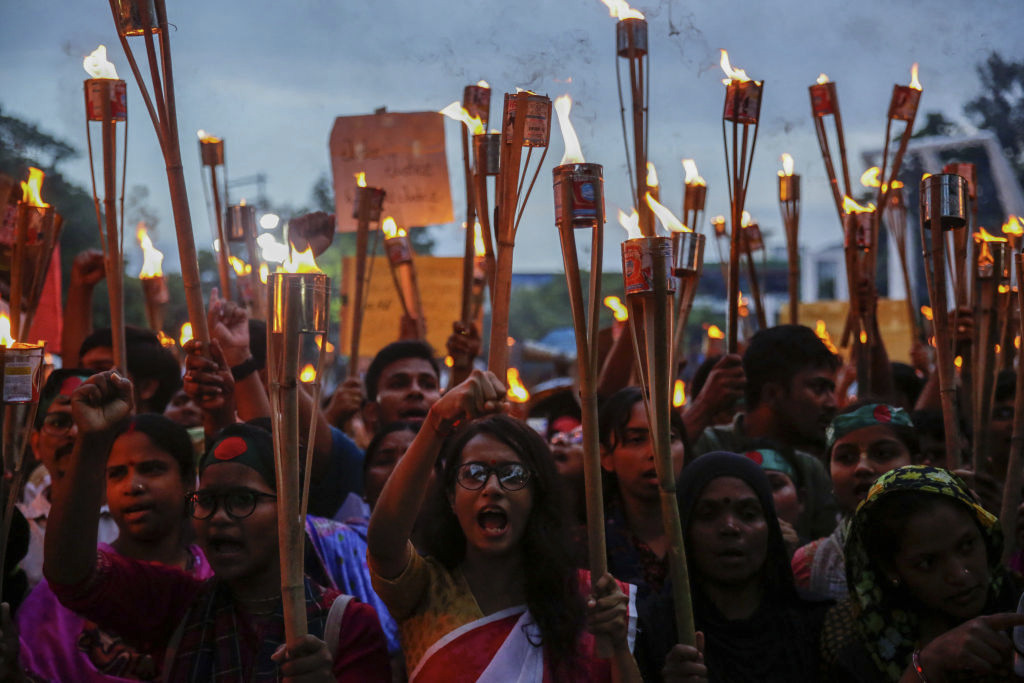
Od czasu upadku w sierpniu rządu Ligi Awami pod przywództwem Sheikh Hasiny świat był świadkiem pełnej islamizacji i talibanizacji Bangladeszu. Piątego listopada społeczność hinduska została zaatakowana przez policję i wojsko w Chittagong, drugim co do wielkości mieście w Bangladeszu. Na zdjęciu: członkowie mniejszości religijnych Bangladeszu protestują w Dhakce przeciwko atakom, grabieżom, wandalizmowi i podpaleniom świątyń w całym kraju. (Zdjęcie: Mehedi Hasan/Middle East Images via AFP)


Talibanizacja Bangladeszu: “Kampania ludobójcza przeciwko hinduskiej mniejszości”. Gdzie jest Mohammad Junus?

Uzay Bulut
Tłumaczenie: Andrzej Koraszewsk


Przemoc islamistów wobec mniejszości, w tym hinduistów i chrześcijan, trwa od czasu brutalnego odsunięcia od władzy świeckiej premier Bangladeszu Sheikh Hasiny 5 sierpnia 2024 r.. Osoby niebędące muzułmanami są narażone na zwiększone ryzyko w związku z trwającym kryzysem politycznym i społecznym.

Piątego listopada społeczność hinduska została zaatakowana przez policję i wojsko w Chittagong, drugim co do wielkości mieście w Bangladeszu. Filmy zamieszczone przez serwis informacyjny OpIndia pokazują policjantów i żołnierzy polujących na Hindusów. Filmy pokazują również, jak organy ścigania celowo niszczą kamery przemysłowe.

O atakach poinformowało także wiele kont na Twitterze: Amy Mek napisała:

“Świat milczy, biernie przyglądając się ludobójstwu Hindusów w Bangladeszu.

“Trump już wydał ostrzeżenie dla Bangladeszu, wzywając rząd do zaprzestania ataków na Hindusów — przypomnienie, że do rozwiązania tego kryzysu potrzebne jest silne przywództwo”.

Gazeta “India Today” pisze:

“Hindusi ponownie na celowniku w #Bangladeszu. Tym razem w Chittagong. Czy administracja kierowana przez laureata Nagrody Nobla, prof. Muhammada Junusa, nie jest w stanie lub nie chce pomóc Hindusom?”

Chrześcijanie w Bangladeszu również są brutalnie atakowani. Na przykład piątego września:

“Dwóch chrześcijan w Bangladeszu zostało pobitych i zatrzymanych przez policję… zostali zatrzymani na noc bez żadnego opatrzenia ran… Wielu takich wierzących żyje w strachu i panice. Tymczasem działalność kościelna została zakłócona, a kaznodzieje i pastorzy, zwłaszcza ci z terenów wiejskich, obawiają się ataku. Proszę, módlcie się za waszą rodzinę z Bangladeszu”.

Od upadku świeckiego rządu Hasiny, partii Ligi Awami (AL), w sierpniu, świat był świadkiem pełnej islamizacji i talibanizacji Bangladeszu. Jeśli ten proces zostanie ukończony, Bangladesz będzie drugim krajem – po Afganistanie – całkowicie przejętym przez islamistów w ciągu niecałych czterech lat.

W październiku islamskie władze rewolucyjne w Bangladeszu oficjalnie zakazały działalności Ligi Bangladesh Chhatra (BCL), studenckiego skrzydła Ligi Awami, uznając ją za “organizację terrorystyczną”.

Według regionalnych wiadomości tymczasowy rząd Bangladeszu pod przewodnictwem Mohammeda Junusa może również zakazać Lidze Awami udziału w działalności politycznej, w tym w wyborach. Większość liderów partii uciekła.

Zakazanie Ligi Awami, która była główną partią rządzącą w kraju przez 21 lat, po odegraniu ogromnej roli w osiągnięciu niepodległości Bangladeszu, byłoby równoznaczne z zakazaniem jedynej realnej grupy opozycyjnej wobec islamistów. Jest to jedyna partia, która ma reprezentację obejmującą nie tylko muzułmanów, ale także mniejszości hinduskie i chrześcijańskie.

Trwający dżihad przeciwko mniejszościom niemuzułmańskim w Bangladeszu opisał Sreemoy Talukdar, redaktor serwisu Firstpost:

“To, co zaczęło się jako studencki “ruch wyzwoleńczy” w Bangladeszu, który doprowadził do odsunięcia Sheikh Hasiny. [Ten ruch] jest zagrożony utratą swojej legitymacji w oczach świata, ponieważ, jak się wydaje, został zawłaszczony i przejęty przez islamskich fundamentalistów, którzy wykorzystali chaos, zawirowania, bezprawie i brak jakiejkolwiek władzy, aby rozpocząć kampanię ludobójstwa przeciwko mniejszości hinduskiej.

Od czasu, gdy premier Bangladeszu została zmuszona do ucieczki, co doprowadziło do próżni władzy w ósmym najludniejszym kraju świata, napływają obrazy, filmy i relacje o okrucieństwach wobec mniejszości hinduskiej w Bangladeszu, której liczebność niebezpiecznie spadła w ciągu ostatnich dziesięcioleci, niemal do granic wyginięcia…

Armia Bangladeszu, będąca obecnie strażnikiem wszelkiej władzy do czasu złożenia przysięgi przez zapowiadany tymczasowy rząd pod przewodnictwem laureata Nagrody Nobla Muhammada Junusa, tajemniczo stała się niewidoczna. Funkcjonariusze organów ścigania uciekają, niektórzy padli ofiarą odwetowych ataków ze strony mściwych “protestujących”, a w wyniku tego wszystkiego hinduskie nieruchomości, miejsca kultu i kobiety stały się łupem dla religijnych fanatyków zamieszanych w powszechną przemoc.

W mediach społecznościowych pojawiły się wstrząsające filmy, które wskazują na niepojęte okrucieństwo i ludobójczą naturę przemocy stosowanej wobec bezbronnych mniejszości. Jeden z klipów wideo pokazuje radykalnych islamskich szaleńców badających genitalia zamordowanego mężczyzny, prawdopodobnie zlinczowanego, i wyrażających zadowolenie, że był Hindusem”.

W wielu przypadkach za tymi atakami i naruszeniami praw człowieka stoją członkowie Jamaat-e-Islami, największej partii islamistycznej w Bangladeszu.

Jamaat-e-Islami zostało zakazane przez rząd Ligę Awami 1 sierpnia. Cztery dni później premier Hasina została zmuszona do rezygnacji, a jej rząd upadł. 28 sierpnia tymczasowy rząd Bangladeszu zniósł zakaz. Członkowie Jamaat-e-Islami współpracowali z Pakistanem podczas ludobójstwa w Pakistanie w 1971 r. i wojny o wyzwolenie Bangladeszu.

W 1971 roku rząd Pakistanu Zachodniego rozpoczął trwającą dziesięć miesięcy niszczycielską kampanię masowych morderstw, gwałtów i innych okrucieństw wobec bengalskich i hinduskich mieszkańców Pakistanu Wschodniego (obecnie Bangladesz).

Muzeum Holokaustu w Houston podaje:

“Po uzyskaniu niepodległości od Wielkiej Brytanii w 1947 r. Indie zostały podzielone na dwa odrębne państwa: Indie i Pakistan, co było jednym z największych i najbardziej gwałtownych masowych ruchów ludności w historii…

Ludobójstwo rozpoczęło się od masakr w stolicy, Dhakce, 25 marca 1971 r. i wkrótce rozprzestrzeniło się na resztę Bangladeszu. Armia miała przygotowane listy celów, w tym członków bengalskich nacjonalistów, intelektualistów i Hindusów. Armia wierzyła, że masowa przemoc zmusi do uległości ludność, którą uważała za rasowo niższą populację, zwłaszcza jeśli elity bengalskie zostaną wymordowane. Młodzi mężczyźni byli zabijani jako potencjalne źródła oporu, a kobiety i dziewczęta były gwałcone w celu zniszczenia bengalskich rodzin”.

Do czasu interwencji Indii i zmuszenia Pakistanu do kapitulacji w grudniu 1971 r. zginęło około trzech milionów ludzi, około 200 tysięcy kobiet zostało zgwałconych, a miliony innych musiały szukać schronienia w Indiach lub Bangladeszu.

Pod rządami Hasiny niektórzy czołowi przywódcy Jamaat-e-Islami zostali skazani na śmierć lub uwięzieni za okrucieństwa, których dopuścili się wobec cywilów podczas ludobójstwa. Jamaat-e-Islami zyskało teraz siłę pod rządami islamistycznego tymczasowego rządu Bangladeszu, kierowanego przez Muhammada Junusa. To radykalni islamiści doprowadzili Junusa do władzy.

31 sierpnia Junus i Mamunul Haque, lider organizacji Hefazat-e-Islam (“Obrońca Islamu”) spotkali się, pomimo historii utrzymywania przez grupę radykalnego stanowiska islamistycznego. Hefazat-e-Islam powstało w 2010 r. w ramach protestu przeciwko polityce emancypacji kobiet zainicjonowanej przez rząd Ligi Awami, która zakładała przyznanie kobietom równych praw dziedziczenia. Hefazat-e-Islam sprzeciwiało się tej polityce: jest ona sprzeczna z islamskim prawem szariatu.

Tymczasowy rząd Junusa uwolnił również Jaszimuddina Rahmaniego, szefa Zespołu Ansarullah Bangla, organizacji terrorystycznej powiązanej z Al-Kaidą. Rahmani został w grudniu 2015 r. i skazany na pięć lat więzienia za podżeganie do zabójstwa blogera Rajiba Haidera w 2013 r. Oskarżono go również o współudział w zamachach terrorystycznych.

Wpływy Hizb-ut Tahrir (HuT) – kolejnej organizacji islamistycznej dążącej do ponownego ustanowienia kalifatu islamskiego i wprowadzenia prawa szariatu na całym świecie – również stale rosną.

Chociaż Hizb-ut Tahrir został zakazany w Bangladeszu w 2009 r., “jego zwolennicy organizują marsze, m.in. w Dhakce, a plakaty propagujące ich ideologię mnożą się jak grzyby po deszczu”. “New Indian Express” donosił:

“9 sierpnia zwolennicy HuT zorganizowali wiec przy Północnej Bramie Baitul Mukarram w Dhakce i domagali się ustanowienia kalifatu w Bangladeszu w oparciu o prawo szariatu, które ich zdaniem zapewniłoby ‘prawdziwą sprawiedliwość i dobrobyt’ wszystkim obywatelom Bangladeszu”.

Hizb-ut Tahrir wezwał również tymczasowy rząd Bangladeszu do odwołania jego delegalizacji z 2009 r. Lider HuT Imtiaz Selim powiedział, że rząd powinien powtórzyć wzór, który zastosował, aby znieść zakaz działania Jamaat-e-Islami. Jego żądanie pojawia się w obliczu uwolnienia kilku przywódców grup terrorystycznych i radykałów w kraju.

Jak zauważył Raja Muneeb, redaktor Firstpost:

“Tymczasowy rząd kierowany przez Mohammada Junusa w dużej mierze nie powstrzymał przemocy wobec mniejszości i pogorszył sytuację, znosząc zakazy dla radykalnych grup islamistycznych i wypuszczając z więzień skazanych za terroryzm, pozwalając im rządzić na ulicach Bangladeszu”.

Jeśli mocarstwo takie jak USA będzie siedzieć z założonymi rękami, nic nie robić i przyglądać się, jak rozwija się talibanizacja Bangladeszu – jak zrobiła to administracja Bidena – prawdopodobne jest, że chaos nie zatrzyma się na granicach Bangladeszu. Indie nie pozwolą, aby kolejne państwo islamistyczne na ich granicach wymordowało Hindusów, chrześcijan i świeckich muzułmanów w Bangladeszu. Indie mogą słusznie uznać, że ich bezpieczeństwo jest poważnie zagrożone.


Uzay Bulut, turecka dziennikarka związana z Gatestone Institute. Jest również badaczką w African Jewish Alliance.


Zawartość publikowanych artykułów i materiałów nie reprezentuje poglądów ani opinii Reunion’68,
ani też webmastera Blogu Reunion’68, chyba ze jest to wyraźnie zaznaczone.
Twoje uwagi, linki, własne artykuły lub wiadomości prześlij na adres:
webmaster@reunion68.com


Headhunters

Headhunters

Alex Joffe


How anthropology helps us understand the Oct. 7 massacres and the people who committed them.

Penta Springs Limited/Alamy

I have a theory that Neolithic farmers occasionally took part in headhunting: the ritual practice of severing and preserving human heads. At various sites in Syria and the Levant, like Jericho, archaeologists found plastered and otherwise decorated skulls. Whereas most scholars believe that the skulls belonged to venerated ancestors, I and a few other archaeologists believe that these were victims of headhunting expeditions—ritualized violence. As in much later cultures, the skulls were artifacts of magic and power collected by deeply violent societies.

So here’s the thing: Hamas are headhunters.

If you’ve never seen a person beheaded I do not recommend it. There are several aspects, the sawing motion, which takes a good deal of time and effort, is one. But mostly there is the transformation of a human being into meat. And then there is the person doing the sawing.

There are many striking things about the full video of the Oct. 7 massacres, which I recently saw for the first time, many more than I can process in a few days. The death, the blood and gore, dramatic yet not, somehow banal, only by virtue of the unstaged, uncinematic, often silent, nature of the footage. The screaming and panic, unrehearsed, the scene uncomposed. Reality is chaotic but our human minds look for structure, for flow. We know the narrative, but a 45-minute video composed of clips in which 139 Israelis are murdered cannot provide that structure.

But the humans who executed the act were the most striking of all. They provide the structure. There are countless academic and literary explorations of “perpetrators.” These have undoubted value. But to see murderers, as we cannot see the Nazis, in full color, unrehearsed, is something nearly beyond comprehension.

Anthropological descriptions of headhunting are clinical and nonjudgmental, which is useful, at least initially, in understanding what is before us.

The image of the headhunter epitomizes the exotic, faraway native in an uncharted land, whose stories are told by adventurers, travelers, and anthropologists. But what happens when that act is recorded and celebrated by the society itself? How do the rest of us judge and what conclusions can we draw?

It is easy to fall back on terms like primitive, meaning crude or ancestral. The instinct is to separate ourselves as quickly and completely as possibly from those who undertake acts that are practically unthinkable to us. And yet here they are. Taking a man’s head and then carrying it off is the most inexplicable thing I’ve ever seen. The joyousness though—no, the mixture of total glee and total matter of factness, that is the real crux of the matter.

One thing I haven’t figured out about the Neolithic headhunters is whether the practice was the religion itself or just a part of their culture. What is the relationship between religion and culture anyway?

You could conclude from the Oct. 7 video that the slaughter was a religious act: not a form of extremism, but absolutely routine hatred that has nothing to do with land and everything to do with Jews. The cosmic affront to the attackers’ orthodoxy posed by Jews with dignity, sovereignty, and power, causes them to cry out in pain and, at the moment of their triumph, in celebration, constantly, as if it were the only phrase they know: Allahu akbar—the most frequently heard term throughout the video. The Jew’s magical power has not only been conquered, but absorbed.

Or you could conclude it’s culture: habitual behavior and violence. The routineness of the exercise leads them to casually or even with annoyance, instruct each other to get on with it and shoot women hiding in a room. In the head, they repeat, in the head. Or to kill a man with a grenade and take a bottle from the refrigerator while his two sons shriek in the same room, close the refrigerator door—because that is what one does with a refrigerator door—and then walk out. And the radioed instructions to crucify victims in order for crowds to abuse their bodies, simply part of the job. They are playing with the head, the radio voices report. Routine.

To see it all unfold, from the initial attack to the slaughter to the taking and abuse of captives is to see an updated version of a classic razzia of the seventh century and later. The tribal honor accrued is frankly reflected in the excited phone call made by one participant to his father—he exclaimed that he had killed 10 Jews with his own hands. He then demanded his mother be put on the phone and repeated the claim as she wept with happiness.

This is not brainwashing or extremism. It is casual orthodoxy. The end of the Jews of the Banu Qurayza beheaded in 627—just the males, “those over whom the razors had passed,” the women and children were sold as slaves—effectively ending Judaism in northern Arabia. In southern Israel, the head of an already dead Jew is a good start.

But to see it happen, recorded by the perpetrators themselves—that empty word again—standing in for so much, including the most inexplicable act of violence one person can perpetrate against another, puts the events in another category. It puts the people in another category.

Normative language used to describe let alone make sense of these acts is completely inadequate, as it refers to an entirely different reality, and is therefore misleading. The ban on using atavistic language prevents us from plainly describing reality. But anthropologists should have no such misplaced scruples.

Primitive? We may dismiss that phrase despite the appeal. Animals? Also too easy. Subhuman? Another pejorative. All these terms remove human agency, willfulness, glee, obedience, structure, intent.

Headhunters. Anthropological descriptions of headhunting are clinical and nonjudgmental, which is useful, at least initially, in understanding what is before us.

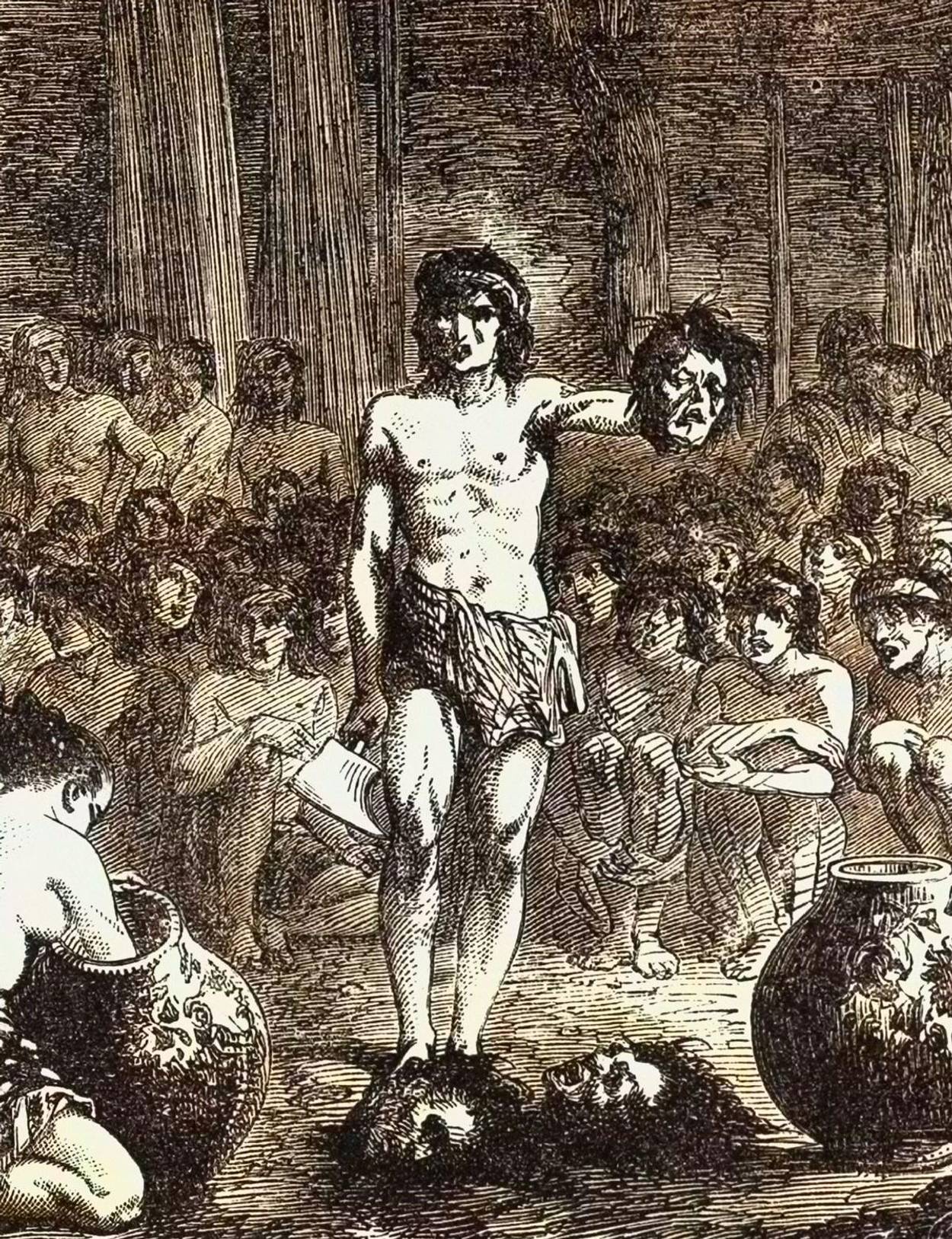
Headhunting globally had many purposes or meanings centered around ancestors and enemies. In Borneo decapitation was the beginning of a long relationship between the perpetrator and the deceased, who became a kind of venerated guest. In Iron Age Europe there was a relationship between the taking of human heads and natural fertility, as their bones are sometimes commingled in deposits with those of animals. But this is complemented by a more base militarism connected to emerging structures of authority that encouraged dehumanization and brutality. I think this is how it worked in the Neolithic era of the Near East.

And of course it happens in war (Japanese officers loved their swords). And to prisoners (think William Wallace and Cromwell). Nineteenth-century Montenegrins going into battle would have a pact to take each other’s head so as not to be buried by the enemy. And then there’s anthropology and archaeology (grave-robbing for science!). There is always a system. But what drives the system?

As practiced in Gaza, headhunting as ritual violence entails enacting, preferably for the camera, multiple deaths, one of the living Jew and another of the dead Jew. Humiliating the individual and, by broadcasting those deaths at home and to others as part of continuing celebrations, targeting the Jewish collective; by holding, torturing and finally killing hostages, and hiding their bodies for the possibility of later exchange, prolonging death.

Death is a continuing, unfolding, unending process. The object of headhunting is not, as in some anthropologically attested cultures, to steal the power of the defeated enemy, or to hold the head as a trophy of a battle glorious. It is to enact and reenact deaths, to steal life from the living who learn of the acts. It is the pinnacle act of torture that underpins their own society, which also trumpets its own welcoming of death, as if there is a death competition which they must win, some calculus of killing and dying/dying and killing. In that sense headhunting is cosmological; it is punishment and sacrifice that sustains a universe. So is it religion? Then what about the ritual defacement of hostage posters, the Upper West Side’s kinder, gentler form of beheading?

Stealing dead bodies which are gleefully abused by civilians—a term that makes too much of a moral distinction, especially as they film themselves stomping and cursing dead bodies—or hidden as currency, transports death into the heart of their society. It provides sustenance, while the quantum uncertainty of death/not death tortures the living.

Are headhunters like us? Neolithic headhunters, were there indeed any, were people in the act of becoming fully human. Separating themselves from the animal world through self-awareness and action was accomplished by growing food, creating villages, and enacting horrific violence upon one another for no particular reason except that they could. All things that animals cannot do. Well, except hunt together. So perhaps a link to the animal world.

Certainly ethnographically attested headhunters saw this specific act of violence, as well as murder and torture generally, as natural means to maintain the sense of difference from one another. You capture others for fun and profit and to make a point, then torture, enslave and murder them. This is part, although not all, of maintaining the self. Sometimes you eat them just to make a point, or if you’re hungry (see under, man corn, the Nahuatl word tlacatlaolli). They were fully human in the sense of being bipeds with cultures, stories, looking to the skies for clues or instructions. The people they killed were too, but that commonality meant little to nothing. Like us but not like us.

How then do we categorize Hamas headhunters? Religion has been stressed, as has the absolute centrality of death. This is not a mere ideology, an argument that can be replaced by a better argument—more complete, more logical, more parsimonious; it is essential, constitutive. We love death, they always say, we raise our children to be martyrs, the mothers proudly announce. Indeed they do, the flip side being the willingness to saw off people’s heads and steal them. So, culture?

Violence, blood, feuds, abuse of women, children and animals, these have always been present in Palestinian society, as they are in most patriarchal, theocratic, and authoritarian societies. But something is different: the glee, not of the id temporarily unleashed (who remembers My Lai, or necklaces of ears, raise your hand), but the id triumphant, the superego gone who knows where.

That’s still not it. The entire superstructure services the id, looting, murder, rape, in this life and the next, those are the supreme goals.

You see a person beheaded and nothing makes much sense after that, unless it makes a certain kind of terrible sense. As a system.

Well, they’re all dead. All the faces of all the Hamasniks, laughing, yelling, talking, shooting, they percolate through databases that lead only to their deaths, now or later, on the battlefield or below, from a 5.56 mm round or a munition of greater or lesser power, or merely over time, in a cell, alas. Stamping out the headhunters and their cults is how the world was won, and rightly so.

The headhunting instinct, however, is intrinsic to orthodoxy, and erupts periodically worldwide. Falling upon the neck is increasingly popular as an orthodox solution, for example in France (look up Samuel Paty, or just ask Salman Rushdie). After the video I tried to explain this to a state attorney general, that it’s not “hate” or extremism; that orthodoxy is here, in this country and his state. He said he was still educating himself.

Headhunting and its discontents, something I never thought I would have to think about except as a contrarian prehistorian, from a safe remove of 10,000 years, now collapsing in on me, much less try to explain something that took place 20 miles from my sister’s house. Headhunters are not like us. Scratch away the present and it looks a lot like the past, but there are different paths to us and them.


Alex Joffe is an archaeologist and historian. He is the Director of Strategic Initiatives for the Association for the Study of the Middle East and Africa.


Zawartość publikowanych artykułów i materiałów nie reprezentuje poglądów ani opinii Reunion’68,
ani też webmastera Blogu Reunion’68, chyba ze jest to wyraźnie zaznaczone.
Twoje uwagi, linki, własne artykuły lub wiadomości prześlij na adres:
webmaster@reunion68.com


Bibi between Biden and a hard place

Bibi between Biden and a hard place

Caroline B. Glick


Most Israelis were outraged to hear of what seemed to be capitulation in the form of a ceasefire in the war with Hezbollah.

What happened behind the scenes, however, draws a much more complicated picture that forced Israeli Prime Minister Benjamin Netanyahu to choose between bad and worse options.

JNS senior contributing editor Caroline Glick has all the details on today’s episode of “In-Focus”!


Zawartość publikowanych artykułów i materiałów nie reprezentuje poglądów ani opinii Reunion’68,
ani też webmastera Blogu Reunion’68, chyba ze jest to wyraźnie zaznaczone.
Twoje uwagi, linki, własne artykuły lub wiadomości prześlij na adres:
webmaster@reunion68.com


Rozejm między Izraelem i Hezbollahem. Co oznacza dla regionu i czy ma szansę przetrwać?

Radość w Bejrucie, po tym, jak zawieszenie broni między Izraelem a wspieraną przez Iran grupą Hezbollah weszło w życie o godzinie 02:00 GMT, 27 listopada 2024 r.


Rozejm między Izraelem i Hezbollahem. Co oznacza dla regionu i czy ma szansę przetrwać?

Marta Urzędowska


Wśrodę rano weszło w życie zawieszenie broni między Izraelem a libańskim Hezbollahem. Choć tłumy Libańczyków świętują i wracają do domów, rozejm jest kruchy, a w obecnej sytuacji na Bliskim Wschodzie będzie trudno utrzymać.

– Ma stać się początkiem stałego zakończenia działań wojennych, końcem najbardziej krwawego konfliktu między Izraelem i Hezbollahem od dekad – zapewniał prezydent USA Joe Biden, ogłaszając we wtorek w ogrodzie różanym Białego Domu, że od czwartej rano w środę czasu lokalnego w Libanie rozpoczyna się zawieszenie broni. – Przypomina nam, że pokój jest możliwy – zachwalał amerykański przywódca, jednocześnie od razu zastrzegając, że jeśli Hezbollah złamie warunki zawieszenia broni, Izraelczycy mają prawo do samoobrony.

Libańczycy i Izraelczycy chcą wracać do domów. Władze: Jest za wcześnie

Także izraelski premier Beniamin Netanjahu, potwierdzając, że jego rząd zgodził się na rozejm, zaznaczył, że Izrael zachowuje „całkowitą wojskową swobodę działania” i odpowie „z całą siłą”, jeśli Hezbollah naruszy porozumienie. Przyznał, że Izraelczycy zgodzili się zawiesić broń, bo musieli – chcą skupić się na zagrożeniu z Iranu, uzupełnić zapasy broni i dać odpocząć zmęczonym żołnierzom.

W środę odbędzie się specjalne posiedzenie libańskiego rządu, na którym porozumienie rozejmowe zostanie formalnie zatwierdzone. Choć libański rząd formalnie nie uczestniczył w wojnie i nie jest powiązany z Hezbollahem, grupa ma w Libanie potężne wpływy – polityczne, społeczne i militarne, dlatego libańskie władze pełniły kluczową rolę w negocjacjach rozejmowych.

Rozejm kończy ostatnią odsłonę wojny izraelskiej armii z libańskim Hezbollahem. Zaczęła się we wrześniu, kiedy Izraelczycy, mając dość trwającego od miesięcy ostrzału północnego Izraela, rozpoczęli serię nalotów na cele grupy w Libanie, a niedługo później dorzucili do nich inwazję lądową na południe kraju.

Od tego czasu lista ich sukcesów stale się wydłużała – pozabijali najważniejszych liderów Hezbollahu, wśród nich szefa grupy, Hassana Nasrallaha, wyeliminowali tysiące bojowników, zniszczyli magazyny broni, środki komunikacji i banki.

Jednocześnie, choć izraelska armia zapewnia, że celowała wyłącznie w Hezbollah, na miejscu ginęli też zwykli Libańczycy. Od września śmierć poniosło blisko 3 tys. osób, choć nie wiadomo ile spośród nich to cywile. 1,2 mln osób musiało uciekać z domów na południu Libanu i dziś – po ogłoszeniu rozejmu – rzucili się do nich wracać, nie oglądając się na zniszczenia i niewybuchy.

Według izraelskiej armii i libańskich władz powroty są przedwczesne. Obie strony wystosowały oświadczenia, prosząc mieszkańców tych terenów, aby nie wracali, dopóki warunki zawieszenia broni nie wejdą w życie. W ramach rozejmu izraelscy żołnierze i członkowie Hezbollahu mają dwa miesiące na wycofanie się z południa Libanu, gdzie spokoju będą pilnować libańscy żołnierze i siły międzynarodowe.

Także mieszkańcy północnego Izraela, którzy z powodu rakiet słanych na te tereny przez Hezbollah od miesięcy nie mogli wrócić do domów, liczą, że rozejm pozwoli im na bezpieczny powrót.

Rozejm trudny do utrzymania

Światowe media pokazują obrazki świętujących Libańczyków cieszących się z końca wojny, ale nie jest pewne, czy rozejm przetrwa. Dosłownie do ostatnich minut przed jego wejściem w życie obie strony kontynuowały ataki – rakiety Hezbollahu leciały na Izrael, izraelskie samoloty bombardowały Bejrut.

Radość w Bejrucie, po tym, jak zawieszenie broni między Izraelem a wspieraną przez Iran grupą Hezbollah weszło w życie o godzinie 02:00 GMT, 27 listopada 2024 r. Fot. REUTERS/Thaier Al-sudani

Niełatwo będzie utrzymać pokój. Sytuację na granicy mają monitorować siły ONZ i dodatkowi obserwatorzy pod egidą Ameryki, jednak jak dotąd, obecnym tu od dziesięcioleci ONZ-owskim błękitnym hełmom nie udawało się powstrzymać Hezbollahu przed budowaniem baz i ostrzeliwaniem Izraela. Także libańska armia, która wyśle na południe kraju 5 tys. żołnierzy, jest o wiele słabsza militarnie niż Partia Boga.

Jak informuje Reuters, w porozumieniu zapisano też, że w całym Libanie broń mogą nosić tylko żołnierze, policjanci i funkcjonariusze innych oficjalnych libańskich służb, co może okazać się trudne do wyegzekwowania. Ludzie Hezbollahu są uzbrojeni po zęby.

Rozejm będzie też trudny do utrzymania, bo wojna w Libanie to efekt walk w Strefie Gazy, rozpętanych atakiem Hamasu na Izrael w październiku zeszłego roku. Właśnie w ramach solidarności z palestyńską grupą, Hezbollah rozpoczął rok temu ostrzał Izraela, na co zdecydowanie odpowiedziała izraelska armia.

Tymczasem wojna w Gazie trwa w najlepsze. Negocjacje na temat rozejmu w enklawie od miesięcy tkwią w martwym punkcie, a wojna nadal będzie destabilizowała region. Szczególnie że Hamas cieszy się nieograniczonym wsparciem Iranu – arcywroga Izraela, a Izrael, zakończywszy walki w Libanie, będzie mógł ponownie rzucić większe siły do Gazy. Izraelski premier ukrywa, że deal z Hezbollahem oznacza większą izolację Hamasu. – Zostali sami, teraz zwiększymy presję na Hamas, co pomoże nam w naszej uświęconej misji uwolnienia zakładników – stwierdził w środę.

Rozejm w Libanie udało się wypracować, bo Partia Boga, osłabiona izraelskimi atakami, zmuszona była do ustępstw, w tym – do rezygnacji z podstawowego żądania, by Izrael wycofał żołnierzy ze Strefy Gazy. W Gazie o rozejm będzie znacznie trudniej, bo Hamas nie chce oddać zakładników, izraelskie władze nie chcą wycofać z enklawy wszystkich żołnierzy, a premierowi Netanjahu jakikolwiek kompromis na rzecz terrorystów grozi rozpadem rządu złożonego ze skrajnie prawicowych ministrów, którzy nie chcą żadnych negocjacji z Hamasem, domagając się walki do ostatecznego wyeliminowania grupy.

Biden: Palestyńczycy też zasługują na pokój

Joe Biden, ogłaszając rozejm w Libanie, przyznał, że martwi się o palestyńską enklawę.

– Tamtejsi mieszkańcy również zasługują na zakończenie walk i wysiedleń, bo przeszli przez piekło, zbyt wiele wycierpieli, a ich świat legł w gruzach – przypomniał.

Jednocześnie dodał, że decyzja o zakończeniu wojny zależy od Hamasu, a jedyne wyjście z impasu to zwolnienie wszystkich porwanych ponad rok temu zakładników. W rękach Palestyńczyków nadal pozostaje ok. 100 Izraelczyków, spośród których ok. 30 najpewniej nie żyje.

Biden obiecuje, że teraz, kiedy udało się doprowadzić do rozejmu w Libanie, Amerykanie po raz kolejny spróbują „osiągnąć zawieszenie broni w Gazie”. Podkreśla, że Waszyngton jest gotowy na „historyczne porozumienia”, które pozwolą utworzyć palestyńskie państwo i znormalizować relacje Izraela z Arabią Saudyjską.

Już wcześniej podejmowano podobne próby, ale przerwał je atak Hamasu i wojna w Gazie.

– Wierzę, że porozumienie nadal jest możliwe – zapewnia dziś amerykański przywódca, dodając, że spędzi ostatnie dni swojej prezydentury „pracując bez wytchnienia”, by je osiągnąć.

Apele o trwały pokój na Bliskim Wschodzie

Na rozejm w Libanie zareagowali sojusznicy USA – Wielka Brytania i Unia Europejska.

Premier Keir Starmer zaapelował, by zawieszenie broni przeszło w „trwałe rozwiązanie polityczne” i dodał, że jego kraj będzie na czele wysiłków na rzecz „przerwania cyklu przemocy” w regionie.

Szefowa Komisji Europejskiej, Ursula von der Leyen przyznała, że wieści o rozejmie są „bardzo zachęcające”.

Także sekretarz generalny ONZ, Antonio Guterres wezwał „strony konfliktu do uszanowania i wdrożenia zobowiązań wynikających z porozumienia” i wyraził nadzieję, że rozejm „położy kres przemocy, zniszczeniu i cierpieniu”.

Doniesienia o zawieszeniu broni skomentowali ponadto Irańczycy. Z oświadczenia władz w Teheranie wynika, że cieszą się z „zakończenia izraelskiej agresji w Libanie” i wspierają libański rząd.

Do wieści o rozejmie odniósł się też Hamas.

– Doceniamy prawo Libanu i Hezbollahu do osiągnięcia porozumienia, które chroni libański naród. Liczymy, że otworzy to drogę do osiągnięcia dealu, który zakończy też ludobójczą wojnę wymierzoną w nasz naród w Gazie – stwierdził w rozmowie z Reutersem rzecznik grupy Sami Abu Zuhri.


Zawartość publikowanych artykułów i materiałów nie reprezentuje poglądów ani opinii Reunion’68,
ani też webmastera Blogu Reunion’68, chyba ze jest to wyraźnie zaznaczone.
Twoje uwagi, linki, własne artykuły lub wiadomości prześlij na adres:
webmaster@reunion68.com


Preacher Slammed for ‘Appalling’ Remarks at Irish Memorial, Accusing Israel of Viewing Itself as a ‘Master Race’

Preacher Slammed for ‘Appalling’ Remarks at Irish Memorial, Accusing Israel of Viewing Itself as a ‘Master Race’

Debbie Weiss


A man walks past graffiti reading ‘Victory to Palestine’ after Ireland has announced it will recognize a Palestinian state, in Dublin, Ireland, May 22, 2024. Photo: REUTERS/Hannah McKay

An Irish cleric has come under fire for delivering an antisemitic memorial sermon in which he suggested that Israelis and Jews see themselves as a “master race” that justifies “eliminating” other groups “because they don’t count.”

Reverend Canon David Oxley delivered the sermon last week at St. Patrick’s Cathedral in Dublin during a Remembrance Sunday service attended by Irish President Michael Higgins and other high-ranking dignitaries.

Ironically, Oxley had previously revealed familial ties to the Nazis in a sermon delivered at the same event five years ago.

In last week’s remarks, Oxley contended that Israel’s war against the Hamas terrorist group in Gaza represented “the horrible blasphemy of the master race in action.”

“This takes different forms in different times and places, but it is the same horrible idea, that one group of people is intrinsically more valuable than any other. Once that is accepted, then the elimination of others follows as a matter of course — because they don’t count,” he said.

Oxley’s comments sparked strong condemnation from both Israeli officials and Jewish leaders in Ireland.

Israel’s embassy in Ireland said Oxley had “hijacked” the memorial service in favor of an “outrageous and dangerous … libel on the State of Israel.”

The statement published on X also said the diatribe was “divorced from reality” and “willfully ignored the complexities of the Middle East.”

Ireland’s Chief Rabbi Yoni Wieder condemned the Anglican establishment for allowing such remarks, saying it was “an abrogation of moral and religious leadership that such a speech could be delivered by a representative of the Church of Ireland.”

“This type of inflammatory, hateful rhetoric has been used by politicians here countless times over the past year, and we’ve seen it constantly across mainstream Irish media. Now it’s gone beyond politics and journalism and is coming from a senior religious figure, a minister in a Christian Church,” Wieder told The Algemeiner.

“The anti-Israel narrative in Ireland now regularly spills over into overt antisemitism,” he added.

In an open letter addressed to Oxley, Wieder condemned the preacher’s “appalling” accusations.

“You fail to grasp the depth of offense invoked by suggesting that Jewish people have adopted the same murderous outlook that was perpetuated against them by the Nazis,” Wieder wrote.

He also slammed the Anglican cleric’s failure to make any mention of the threats posed by the Hamas and Hezbollah terrorist groups, which “are explicitly committed to destroying Israel and murdering Jews.”

“You claim Israel has a policy of targeting schools, hospitals, and mosques, yet you fail to mention that Hamas purposefully positions itself within and beneath such civilian infrastructure — and they do so precisely because they know it will deter attacks against them. Hamas have openly stated that it is their strategy to place civilians in harm’s way,” the chief rabbi continued.

Wieder called the destruction in Gaza as well as the loss of life “an unbearable humanitarian catastrophe.”

“You and I are united by a desire to see an end to this heartbreaking tragedy. But the situation is also fraught with complexities, which cannot be ignored. Would it not be more honest to acknowledge this, rather than to proffer an simplistic and partisan perspective?” he wrote.

During a 2019 address at the same event, Oxley reportedly disclosed his wife’s ties to the Nazis, according to a report published this week by the British Jewish Chronicle, which cited an article published at the time in the Irish Independent.

In that sermon, also delivered in the presence of the Irish president, Oxley shared that his wife, Amalia, was German and that her family included members who fought for the Third Reich.

“It’s not everyone who can boast that their mother-in-law had Adolf Hitler as a godfather. It’s not everyone who would want to,” he quipped, before going on to praise the Irish citizens who opposed Nazism.

Oxley told the Jewish Chronicle that his comments, which did not represent the Church of Ireland, contained “no hatred” and he stood by them.

“In delivering my sermon, I speak only for myself. I do not speak on behalf of the Church of Ireland, or of St Patrick’s Cathedral. As our church does not believe in infallibility, it is quite conceivable that I am mistaken. No one is obliged to agree with me. However, I am prepared to stand over my remarks,” he said.

“There was no hatred in my sermon, except a hatred of all theories that make one group of people more valuable than another, so that some become expendable,” Oxley added.

A 2021 report by antisemitism researcher David Collier found that traditional Christian attitudes play a significant role in shaping antisemitism in Ireland, with Christian NGOs often playing a role in perpetuating and spreading these sentiments.

“[M]uch of the antisemitism in Ireland appears to be driven from the top down. Regrettably, this certainly seems to be the state of affairs at the moment. Words carry weight, and political and religious leaders in particular ought to remember this,” Wieder said.

He also condemned the Church of Ireland for not distancing itself from Oxley’s comments.

A spokesperson from St Patrick’s Cathedral told the Jewish Chronicle: “In St Patrick’s Cathedral we continue to pray daily for peace in all the countries of the Middle East. We pray fervently for an end to all wars and the human suffering that they bring. Everybody, of all faiths, is welcomed in St Patrick’s Cathedral.”

In Europe, Ireland has been among the fiercest critics of Israel since Oct. 7 of last year, when Hamas-led Palestinian terrorists invaded the Jewish state from neighboring Gaza. The terrorists murdered 1,200 people, wounded thousands more, and abducted over 250 hostages in their rampage, the deadliest single-day massacre of Jews since the Holocaust. Israel responded with an ongoing military campaign in Hamas-ruled Gaza aimed at freeing the hostages and dismantling the terrorist group’s military and governing capabilities.

Earlier this month, the Irish parliament passed a non-binding motion saying that “genocide is being perpetrated before our eyes by Israel in Gaza.” As the measure passed, Irish Foreign Minister Micheal Martin said that the government intended to join South Africa’s genocide case against Israel at the International Court of Justice (ICJ) before the end of the year.

Around the same time, Ireland accepted the appointment of a full Palestinian ambassador for the first time, confirming that Jilan Wahba Abdalmajid would step up from her current position as Palestinian head of mission to Ireland.

In May, Ireland officially recognized a Palestinian state, prompting outrage in Israel, which described the move as a “reward for terrorism.” According to The Irish Times, Ireland is due to have its presence in Ramallah in the West Bank upgraded from a representative office to a full embassy.

Israel’s Ambassador in Dublin Dana Erlich said at the time of Ireland’s recognition of “Palestine” that Ireland was “not an honest broker” in the Israeli-Palestinian conflict.

More recently, Irish Prime Minister Simon Harris last month called on the European Union to “review its trade relations” with Israel after the Israeli parliament passed legislation banning the activities in the country of UNRWA, the United Nations agency responsible for Palestinian refugees, because of its ties to Hamas.

Recent anti-Israel actions in Ireland came shortly after the Institute for Monitoring Peace and Cultural Tolerance in School Education (Impact-se), an Israeli education watchdog group, released a new report revealing Irish school textbooks have been filled with negative stereotypes and distortions of Israel, Judaism, and Jewish history.

Antisemitism in Ireland has become “blatant and obvious” in the wake of Hamas’s Oct. 7 onslaught, according to Alan Shatter, a former member of parliament who served in the Irish cabinet between 2011 and 2014 as Minister for Justice, Equality and Defense.

Shatter told The Algemeiner in an interview earlier this year that Ireland has “evolved into the most hostile state towards Israel in the entire EU.”

Just last month, an Irish official, Dublin City Councilor Punam Rane, claimed during a council meeting that Jews and Israel control the US economy, arguing that is why Washington, DC does not oppose Israel’s war against Hamas.


Zawartość publikowanych artykułów i materiałów nie reprezentuje poglądów ani opinii Reunion’68,
ani też webmastera Blogu Reunion’68, chyba ze jest to wyraźnie zaznaczone.
Twoje uwagi, linki, własne artykuły lub wiadomości prześlij na adres:
webmaster@reunion68.com
