A Dangerous Deal: Trump’s Board of Peace and Hamas


A Dangerous Deal: Trump’s Board of Peace and Hamas

Khaled Abu Toameh


  • The original goal of Trump’s peace plan was not to relocate Hamas’s arsenal. It was to eliminate it permanently.
  • Weapons stored in warehouses remain weapons that function. Explosives stored today can be easily recovered tomorrow. Rocket factories that are preserved can resume production. Tunnels that are mapped rather than destroyed can be used again.
  • The issue has never been where Hamas keeps its weapons. The issue has always been Hamas having access them.
  • Transferring weapons from one Palestinian group to another is not demilitarization.
  • Even more disturbing is the new deal’s assertion that “no weapons shall be transferred or handed to Israel or non-Palestinian parties.”
  • Equally disturbing is the new roadmap’s conditioning of disarmament on an Israeli withdrawal from the Gaza Strip….
  • Why should a terrorist organization that carried out the October 7, 2023 massacre in Israel be allowed to dictate the conditions of its own disarmament? No country fighting ISIS or al-Qaeda would first withdraw its forces and only then hope terrorists voluntarily surrender their weapons. Hamas should not be negotiating the terms of its defeat. It should be compelled to unconditionally surrender and disarm.
  • This is the same Ghazi Hamad [senior Hamas official] who publicly vowed that Hamas would repeat the October 7 massacre time and again until Israel is eliminated: “The Al-Aqsa Flood [the name Hamas uses to describe the October 7 massacre] is just the first time, and there will be a second, a third, a fourth, because we have the determination, the resolve, and the capabilities to fight.”
  • Anyone who thinks that the newly established NCAG will somehow confront Hamas and impose its authority over the terrorist organization is living under an illusion.
  • The far more likely scenario is that Hamas will continue to call the shots from behind the scenes while allowing another Palestinian body to assume responsibility for governance, civil service salaries, reconstruction, and collecting international aid.
  • This would essentially replicate the Hezbollah model in Lebanon, where a heavily-armed Iran-backed terrorist militia coexists with a formal government while retaining independent military power and ultimate political influence.
  • Within hours of the announcement of the roadmap, Iran’s Islamic Revolutionary Guard Corps dismissed the plan outright, declaring… that “the resistance” (Hamas) would remain steadfast until what it called the “final victory” over Israel.
  • Iran understands Hamas better than anyone else because it has financed, armed and trained the terrorist organization for decades. If the Iranian regime is openly rejecting the prospect of Hamas’s disarmament, why should anyone else believe that Hamas intends to honor the agreement?
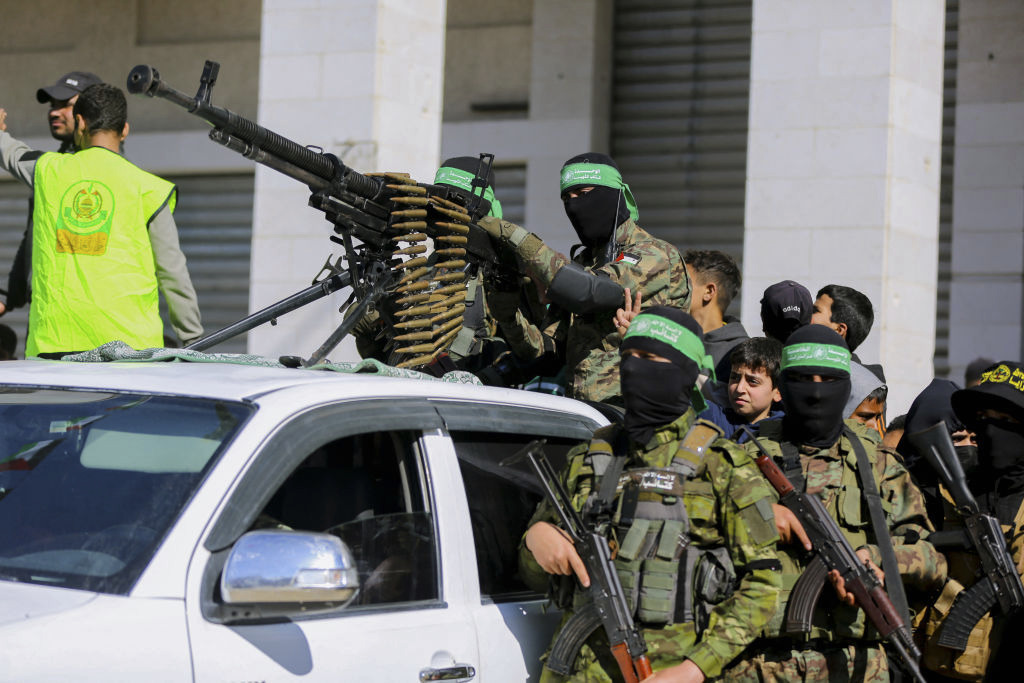
The original goal of Trump’s peace plan was not to relocate Hamas’s arsenal. It was to eliminate it permanently. Weapons stored in warehouses remain weapons that function. Explosives stored today can be easily recovered tomorrow. Rocket factories that are preserved can resume production. Tunnels that are mapped rather than destroyed can be used again. Pictured: Hamas terrorists in Gaza City on January 25, 2025. (Photo by Abood Abusalama/Middle East Images via AFP)

For nearly a year, the international community insisted that there could be no future for the Gaza Strip unless Hamas was stripped of every weapon, every tunnel, every missile factory, and every military capability.

US President Donald J. Trump’s September 2025 peace plan was explicit: Gaza would be demilitarized, terrorist infrastructure destroyed, and weapons rendered permanently unusable.

Article 13 of Trump’s 20-point plan states:

“All military, terror, and offensive infrastructure, including tunnels and weapon production facilities, will be destroyed and not rebuilt. There will be a process of demilitarization of Gaza under the supervision of independent monitors, which will include placing weapons permanently beyond use through an agreed process of decommissioning, and supported by an internationally funded buy back and reintegration program all verified by the independent monitors.”

Now, however, that clear objective appears to have been replaced by something radically different. Instead of eliminating Hamas’s arsenal, negotiators are discussing storing weapons, transferring them to another Palestinian party, and even allowing Hamas members to retain “personal firearms.”

The original goal of Trump’s peace plan was not to relocate Hamas’s arsenal. It was to eliminate it permanently. Replacing “demilitarization” with “storage” is a win for Hamas and other Palestinian terrorist groups in the Gaza Strip.

The latest deal between Trump’s Board of Peace and Hamas, titled “A Roadmap for Completing the Implementation of President Trump’s Comprehensive Peace Plan in Gaza,” states:

“A process to decommission and store heavy weapons, military production sites, depots of weapons, and tunnels, shall begin after completing the remaining commitments under Sharm Sheikh Protocol, the entry of NCAG [National Committee for the Administration of Gaza] and deployment of ISF [International Stabilization Force].”

How did the promise of permanent demilitarization become a discussion about warehouses full of Hamas weapons? Weapons stored in warehouses remain weapons that function. Explosives stored today can be easily recovered tomorrow. Rocket factories that are preserved can resume production. Tunnels that are mapped rather than destroyed can be used again.

The issue has never been where Hamas keeps its weapons. The issue has always been Hamas having access them.

The assumption that the NCAG or ISF would be able to prevent terrorists from regaining control over the stored weapons is totally misleading. Even more disturbing is the new deal’s assertion that “no weapons shall be transferred or handed to Israel or non-Palestinian parties.”

Transferring weapons from one Palestinian group to another is not demilitarization.

Equally disturbing is the new roadmap’s conditioning of disarmament on an Israeli withdrawal from the Gaza Strip:

“This process [to decommission and store heavy weapons, military production sites, depots of weapons, and tunnels] shall be linked to an Israeli withdrawal, in phases, from the areas under its control in Gaza and the decommissioning of [Israel-backed] armed militias.”

Why should a terrorist organization that carried out the October 7, 2023 massacre in Israel be allowed to dictate the conditions of its own disarmament? No country fighting ISIS or al-Qaeda would first withdraw its forces and only then hope terrorists voluntarily surrender their weapons. Hamas should not be negotiating the terms of its defeat. It should be compelled to unconditionally surrender and disarm.

While discussions about disarmament were underway, Hamas reportedly began distributing more automatic rifles to operatives under the guise of “personal ownership.” Israel’s Kan News quoted an unnamed Palestinian source as saying that the goal of the rifle distribution was to ensure that weapons stay in the hands of Hamas members. “Hamas will not disarm. Period,” the source asserted.

Before the first stage had even been implemented, Hamas was already looking for loopholes.

Shortly after the new roadmap was announced, senior Hamas official Ghazi Hamad said in an interview with Saudi-owned Al-Arabiya TV:

“The weapons will be stored and not handed over, and this is conditional on Israel’s commitment. What we agreed upon with the mediators is storing the weapons, not surrendering them. Our political and civilian role in Gaza continues. Hamas has not and will not abandon its national project to reclaim the Palestinian land. We consider the current phase exceptional due to the circumstances that the Gaza Strip is going through.”

This is the same Ghazi Hamad who publicly vowed that Hamas would repeat the October 7 massacre time and again until Israel is eliminated:

“We must teach Israel a lesson, and we will do this again and again. The Al-Aqsa Flood [the name Hamas uses to describe the October 7 massacre] is just the first time, and there will be a second, a third, a fourth, because we have the determination, the resolve, and the capabilities to fight.”

This quote alone should destroy confidence in Hamas’s promises to the Board of Peace.

Anyone who thinks that the newly established NCAG will somehow confront Hamas and impose its authority over the terrorist organization is living under an illusion. Hamas has ruled the Gaza Strip since 2007. It controls thousands of armed men, intelligence networks, clan alliances, financial resources, and a deeply entrenched political and security apparatus. No technocratic committee can simply arrive and displace an organization that has spent nearly two decades ruthlessly consolidating its power.

The far more likely scenario is that Hamas will continue to call the shots from behind the scenes while allowing another Palestinian body to assume responsibility for governance, civil service salaries, reconstruction, and collecting international aid.

This would essentially replicate the Hezbollah model in Lebanon, where a heavily-armed Iran-backed terrorist militia coexists with a formal government while retaining independent military power and ultimate political influence.

Supporters of the new roadmap argue that international observers and the ISF will oversee implementation. International observers may monitor warehouses and oversee the delivery of humanitarian assistance, and the ISF may train Palestinian security forces. They will not confront Hamas if it decides to rearm. They definitely will not risk their lives dismantling some terrorist infrastructure.

Within hours of the announcement of the roadmap, Iran’s Islamic Revolutionary Guard Corps dismissed the plan outright, declaring that the effort to disarm Hamas “will achieve nothing” and had already failed. Tehran pledged that “the resistance” (Hamas) would remain steadfast until what it called the “final victory” over Israel.

Iran understands Hamas better than anyone else because it has financed, armed and trained the terrorist organization for decades. If the Iranian regime is openly rejecting the prospect of Hamas’s disarmament, why should anyone else believe that Hamas intends to honor the agreement?


Khaled Abu Toameh is an award-winning journalist based in Jerusalem.


Zawartość publikowanych artykułów i materiałów nie reprezentuje poglądów ani opinii Reunion’68,
ani też webmastera Blogu Reunion’68, chyba ze jest to wyraźnie zaznaczone.
Twoje uwagi, linki, własne artykuły lub wiadomości prześlij na adres:
webmaster@reunion68.com



Why Tisha B’Av — and the Current Moment — Are Not the End of the Story


Why Tisha B’Av — and the Current Moment — Are Not the End of the Story

Pini Dunner


The Western Wall in Jerusalem. Photo: Wikicommons.

The Tisha B’Av experience is utterly unique. You sit on the floor in the half-dark, your shoes off, your voice cracking through the dirge-like cadences of Eichah, and then you recite — line by line, calamity by calamity — the worst tragedies that have ever happened to the Jewish people. 

The destruction of two Temples. The expulsions. The massacres. The Crusades. The pogroms. The death camps. It is, without question — and deliberately so — the saddest day in the Jewish calendar, a day set aside to stare directly into the abyss of our tragic history and weep.

And yet, as I went through the Tisha B’Av motions this year, sitting on the floor and reciting the Kinnot, something struck me with unexpected force. This day of mourning — this concentrated distillation of every Jewish tragedy into twenty-five hours of grief and lamentation — carries within it the very antidote to the sorrows it commemorates. 

Because here is the astonishing thing: we are still here to mourn them, but every enemy catalogued in those Kinnot is gone. 

Just consider that for a moment. The very fact that there is a Jew in 2026 who can sit on the floor and cry over Jerusalem destroyed by Roman legionaries is itself the punchline to a two-thousand-year-old joke that Rome did not live to hear. Titus is dust. We are not.

Or consider the Crusaders. In the spring and early summer of 1096, mobs sweeping toward Jerusalem turned their swords, clubs, maces and spears on the flourishing Jewish communities of the Rhineland — Speyer, Worms and Mainz, the great triad of communities that stood at the heart of the emerging Ashkenazi world. These were thriving centers of Torah, commerce and communal life. Within a matter of weeks, they were annihilated.

In Worms, approximately eight hundred Jews were slaughtered. In Mainz, the greatest carnage of all, more than eleven hundred were brutally murdered. Speyer escaped destruction on the same scale only because its bishop intervened to protect the community. 

The chronicles that survive this tragedy read like Eichah itself. Had you stood among the mutilated bodies of Mainz’s murdered Jews in the summer of 1096, you would have been certain — utterly certain — that it was over for good. After all, who could possibly rebuild from that?

But what happened next is astounding. The Crusader horde led by the repulsive Count Emicho — many thousands strong, and convinced that the murder of Jews was a holy task — never made it to Jerusalem. 

They marched toward Hungary and laid siege to the fortress of Moson. Then, just as victory seemed within reach, panic swept through their ranks. The Hungarian defenders surged out, the Crusading army disintegrated, and many of them were slaughtered or drowned. 

The force that had imagined itself an instrument of divine judgment collapsed before it ever reached the Holy Land. The wheel had turned, and it turned fast. 

Meanwhile, the Jews of the Rhineland began the astonishing work of rebuilding. Within years, synagogues and communities were restored. Within generations, the great centers of Rhineland Torah learning had re-emerged, producing scholars, liturgy and faith energy that would shape Jewish life for centuries.

It is a pattern so consistent that it has become almost tediously reliable. The Nazis built an empire meant to last a thousand years and to stand upon the ashes of our people. It lasted twelve. Its leaders died in bunkers, fled like fugitives, or stood in the dock at Nuremberg. Ten of the principal defendants ended their lives at the end of a hangman’s rope. 

The men who orchestrated the horrors of October 7 imagined that they were writing the opening chapter of the end of Israel. Instead, one by one, they are being eliminated. Yahya Sinwar — the arch-mastermind, the man who thought he had lit the fuse of our destruction — was hunted down and killed. 

And it isn’t only the leaders. A few weeks ago, the IDF eliminated Mohammed Abu Taima, a Nukhba commander who participated in the October 7 assault and infiltrated Kibbutz Nirim. 

He is not the only one. Scroll through your X feed. Day after day, terrorists who participated in the massacre — some of whom filmed their crimes on GoPros — are being located, targeted and eliminated, in real time, on our watch.

I am fully aware that not everyone sees hope in the present moment. There are those who look at the world around us and predict doom. They point to the surging antisemitism on our streets and campuses, the diplomatic isolation of Israel, the exhaustion of a nation at war, the fracturing of old alliances, and the rise of politicians like Zohran Mamdani to positions of power and influence. 

And they say: this time it is different. This time we will not come back.

Here is the uncomfortable truth: in a narrow and immediate sense, they may not be entirely wrong. Things may get darker before they get lighter, and the road ahead may be harder for Jews and for Israel than any of us would wish. 

But darkness has a peculiar power. The final hours before dawn can feel like the blackest part of the night, deceiving the frightened eye into believing that the sun will never rise. And that is precisely the moment when judgment fails. 

The Jews who survived Mainz in 1096 could not see 1120. The Jews of 1943 could not see 1948. Standing inside a disaster, it is nearly impossible to believe that there will be an afterward — and harder still to imagine that the afterward might be positive. And yet there always, always is.

To be clear, this is not naive optimism. It is the single most well-documented fact in the entire span of human history — a fact written in the disappearance of every civilization that ever raised its hand against the Jews, and in the stubborn, miraculous persistence of the Jewish people. 

The Shabbat immediately following Tisha B’Av is Shabbat Nachamu. Before we have even wiped away our tears, the Haftarah roars back at us with the words of the prophet Isaiah (Is. 40:1): נַחֲמוּ נַחֲמוּ עַמִּי – “Comfort, comfort My people.” 

Just days after the deepest grief, as if to insist that mourning was never intended to be a destination, the prophet who was among the sharpest in his predictions of tragedy guarantees comfort and relief from that very same tragedy.

So let the pessimists have their say. I will not argue that the night is not dark. But I will point out that we have been here before. We have stood in the ruins of the Rhineland, in the ruins of the Temple, and in the ruins of Europe. We buried our dead. We said Kaddish. We wiped our eyes.  And then we got up, dusted ourselves off and rebuilt what was gone — bigger and better than before.

The Jewish people are going to fight back. And make no mistake: we are going to win. Not because we are stronger, cleverer or more numerous than our enemies. We will win for the same reason we have always won: Because they are chapters, and we are the book. 

Because while the remnants of the army that thought it had ended Jewish life in the Rhineland were scattering across Hungary, there was already a Jewish child being born amid the ruins of Mainz who would grow up to teach Torah. 

Be comforted, My people – the tears of Tisha B’Av are real, but they are not the end of the story. Dawn is coming — it always does — and when it breaks, as it broke over the Rhineland, over the DP camps and over a reborn Jerusalem, we will still be standing.


The author is a rabbi in Beverly Hills, California. 


Zawartość publikowanych artykułów i materiałów nie reprezentuje poglądów ani opinii Reunion’68,
ani też webmastera Blogu Reunion’68, chyba ze jest to wyraźnie zaznaczone.
Twoje uwagi, linki, własne artykuły lub wiadomości prześlij na adres:
webmaster@reunion68.com


Tylko żydowska niepodległość gwarantuje przetrwanie narodu żydowskiego

Izraelskie lotnictwo (Źródło: Wikipedia)


Tylko żydowska niepodległość gwarantuje przetrwanie narodu żydowskiego

Dr Alex Grobman


Naród żydowski posiada niezbywalne prawo do życia w pokoju i bezpieczeństwie w swojej ojczystej ziemi. Nie jest to jedynie przedmiot współczesnego sporu politycznego; jest to nieustający egzystencjalny test. Przez tysiąclecia historia Żydów była historią rozproszenia, pozostawiając naród pozbawiony własnego państwa, strukturalnie narażony na zagrożenia i zależny od tego, co Edmund Burke określił mianem zmiennej „życzliwości narodów”.

Rewolucja syjonistyczna całkowicie odwróciła ten paradygmat, wychodząc z założenia, że prawdziwego bezpieczeństwa nie można powierzyć innym. Rzeczywiste bezpieczeństwo wymaga autonomii – fizycznej, militarnej i dyplomatycznej zdolności narodu do obrony samego siebie.

Dziś, gdy Izrael mierzy się z nieustannymi wyzwaniami wobec swojej legitymacji, filozoficzne uzasadnienie jego istnienia nadal opiera się na dwóch filarach: moralnym imperatywie suwerennej samodzielności oraz bezprecedensowej historycznej trwałości, która wymyka się konwencjonalnym wzorcom dziejów cywilizacji.

Suwerenne bezpieczeństwo kontra historyczna podatność na zagrożenia

Codzienne wyzwania zagrażające pokojowi i bezpieczeństwu Żydów w ich ojczystej ziemi uwidaczniają podstawowe napięcie między suwerennym bezpieczeństwem a historyczną podatnością na zagrożenia.

Jak zauważył Edmund Burke w 1782 roku, społeczności pozbawione własnego państwa nie dysponowały wojskowymi, dyplomatycznymi ani prawnymi mechanizmami samoobrony, z których korzystają suwerenne państwa. Były zatem całkowicie uzależnione od zmiennej życzliwości społeczeństw, wśród których żyły.

David Ben-Gurion, pierwszy premier Izraela, argumentował, że prawdziwe bezpieczeństwo wymaga, aby naród sam zapewniał sobie fizyczną ochronę. Podkreślał, że nawet w pozornie bezpiecznych warunkach diaspory mniejszości nie cieszą się autentycznym bezpieczeństwem, ponieważ polegają na ochronie zapewnianej przez innych.

Wtórowała mu zmarła profesor prawa Ruth Gavison, specjalistka w dziedzinie praw człowieka z Uniwersytetu Hebrajskiego, ostrzegając, że rezygnacja z własnego państwa skazałaby naród żydowski na ponowne funkcjonowanie jako mniejszość rozproszona na całym świecie, narażając go na odrodzenie antysemityzmu, prześladowań oraz ostatecznie asymilację – los, który określiła mianem narodowego samobójstwa.

Odpowiedź na współczesnych krytyków

Potrzeba niepodległości stanowi odpowiedź na współczesne zarzuty, zgodnie z którymi istnienie Izraela lub jego polityka zwiększają zagrożenie dla społeczności żydowskich na świecie. Gavison odpowiadała na te argumenty, podkreślając, że nawet w obliczu realnych zagrożeń obywatele Izraela nie są uzależnieni od dobrej woli zagranicznych władców. Ponadto, choć współczesne spory polityczne są faktem, antysemityzm istniał na długo przed powstaniem państwa Izrael, które dziś służy zarówno jako fizyczne schronienie, jak i dyplomatyczna tarcza dla Żydów na całym świecie.

Poza samym przetrwaniem fizycznym suwerenność umożliwia wyjątkową jakość życia, tworząc jedyne środowisko, w którym judaizm może być realizowany we wszystkich wymiarach egzystencji, również w sferze sprawowania władzy. Powstaje w ten sposób odrębna przestrzeń publiczna, w której normy społeczne i kulturowe naturalnie wzmacniają, zamiast osłabiać, żydowską tożsamość, odwracając presję asymilacyjną obecną w innych częściach świata.

Wbrew konwencjonalnym prawom historii

Ostatecznie przetrwanie i odrodzenie narodu żydowskiego przedstawiane są jako zjawiska wymykające się zwykłym prawom historii. Myśliciele tacy jak Jaakow Herzog twierdzili, że wyjątkowa droga narodu żydowskiego stawia go poza standardowymi prawami dziejów, dając mu niezaprzeczalny związek z własną ziemią, zakorzeniony zarówno w wierze, jak i historii. Yoram Hazony argumentował, że historyczna ciągłość narodu podczas wieków wygnania była podtrzymywana nie zwykłą troską o biologiczne przetrwanie, lecz wspólnym oddaniem transcendentnemu historycznemu powołaniu i tożsamości.

Hazony utrzymywał, że to właśnie gotowość do ryzykowania życia dla tego ideału, a nie koncentracja na samym przetrwaniu, zapewniła ciągłość narodu.

Ben-Gurion również podkreślał bezprecedensowy charakter narodu, który mimo dwóch tysięcy lat rozproszenia i prześladowań nie porzucił dążenia do powrotu i odzyskania niepodległości. W konsekwencji, pomimo współczesnej międzynarodowej krytyki i podważania jego legitymacji, przetrwanie państwa nie jest przedstawiane jako zależne od zewnętrznego konsensusu, lecz od jego przyrodzonego prawa do tej ziemi oraz niezależnej zdolności do jej obrony.

David Ben-Gurion o suwerennym bezpieczeństwie

W swoim przełomowym zeznaniu z 1946 roku przed Anglo-Amerykańską Komisją Śledczą David Ben-Gurion, pełniący wówczas funkcję przewodniczącego Komitetu Wykonawczego Agencji Żydowskiej, wyjaśnił, że państwo żydowskie jest w istocie równoznaczne z „żydowskim bezpieczeństwem”. Zauważył, że nawet w krajach, gdzie Żyd może wydawać się bezpieczny, w rzeczywistości nie odczuwa pełnego bezpieczeństwa, ponieważ zapewnia je ktoś inny, a nie on sam. Powstanie Państwa Izrael dało narodowi żydowskiemu możliwość samodzielnego zapewnienia i zagwarantowania własnego bezpieczeństwa, przechodząc od zależności od zewnętrznych obrońców do samowystarczalnej obrony.

Ben-Gurion podkreślał również niezwykłość dziejów narodu żydowskiego, wskazując, że nie zna innego narodu, który po dwóch tysiącach lat wygnania, rozproszenia, nienawiści i prześladowań nie zniknął z kart historii, nie popadł w rozpacz ani nie uległ całkowitej asymilacji. Przeciwnie – nieustająca tęsknota za powrotem i wiara w odkupienie doprowadziły do bezprecedensowego odrodzenia narodowej niepodległości.

Gavison o przetrwaniu i kulturze

Profesor Ruth Gavison stanowczo wzmacniała pogląd, że istnienie Izraela jest niezbędnym warunkiem bezpieczeństwa jego żydowskich obywateli oraz trwania cywilizacji żydowskiej, ostrzegając, że rezygnacja z własnego państwa oznaczałaby katastrofalny powrót do statusu mniejszości rozrzuconej na całym świecie. Odpowiadając krytykom polityki Izraela, przedstawiła cztery zasadnicze argumenty: po pierwsze, bezpieczeństwo Izraelczyków nie zależy od dobrej woli społeczeństw, wśród których żyją; po drugie, antysemityzm istniał na długo przed powstaniem współczesnego państwa, a Izrael stanowi kluczowe schronienie i oparcie dyplomatyczne; po trzecie, syjonizm zapewnia wysoką jakość życia żydowskiego, umożliwiając realizację judaizmu we wszystkich wymiarach egzystencji, również w polityce; po czwarte, Izrael jest jedyną przestrzenią publiczną, w której presja kulturowa sprzyja zachowaniu tożsamości, zamiast prowadzić do asymilacji.

Gavison uznała, że utworzenie Izraela było w pełni uzasadnione w chwili jego powstania i pozostaje uzasadnione także dziś, ponieważ porzucenie państwowości oznaczałoby powrót do nieustannego strachu przed prześladowaniami i ludobójstwem, czyniąc rezygnację z własnego państwa równoznaczną z narodowym samobójstwem.

W odpowiedzi na silną presję zewnętrzną i międzynarodową krytykę premier Izraela Benjamin Netanjahu stanowczo przenosi podstawę legitymacji państwa z zagranicznej akceptacji i negocjacji dyplomatycznych na inne fundamenty. Jak stwierdził: „Nasze istnienie nie zależy od gotowości Palestyńczyków do zawarcia z nami pokoju. Nasze istnienie jest zabezpieczone przez nasze prawo do życia na tej ziemi oraz naszą zdolność do obrony tego prawa.” W tym ujęciu przetrwanie państwa opiera się wyłącznie na jego historycznym prawie do ojczystej ziemi oraz na autonomicznej, suwerennej zdolności militarnej do obrony tego prawa przed każdym zagrożeniem.

Uwagi końcowe: trwały imperatyw autonomii

Ostatecznie współczesne państwo Izrael jest czymś znacznie więcej niż geopolityczną odpowiedzią na tragedię czy eksperymentem w zakresie państwowości. Stanowi urzeczywistnienie egzystencjalnej konieczności. Od osiemnastowiecznej obrony społeczności pozbawionych państwa przez Edmunda Burke’a po ostrzeżenia Davida Ben-Guriona i Ruth Gavison, zasadniczy wniosek pozostaje ten sam: naród, który polega na „życzliwości innych” w kwestii własnego fizycznego bezpieczeństwa, żyje na pożyczonym czasie. Odrzucając powrót do strukturalnej podatności wynikającej ze statusu mniejszości, państwo żydowskie zabezpiecza nie tylko fizyczne życie swoich obywateli, ale także przyszłość cywilizacji żydowskiej i zachodniej.

W epoce, w której legitymacja Izraela jest nieustannie poddawana ocenie, o jego przetrwaniu nie będzie decydował zmieniający się międzynarodowy konsensus ani zagraniczna aprobata. W miarę jak historia toczy się dalej, istnienie Izraela pozostaje trwale zakorzenione w jego niezbywalnym prawie do ojczystej ziemi oraz w jego niezależnej, suwerennej zdolności do obrony tego prawa.

Dr Alex Grobman jest starszym rezydentem naukowym w John C. Danforth Society, członkiem Council of Scholars for Peace in the Middle East oraz członkiem rady doradczej National Christian Leadership Conference of Israel (NCLCI). Uzyskał tytuły magistra i doktora współczesnej historii Żydów na Uniwersytecie Hebrajskim w Jerozolimie.


Link do oryginału: https://www.israelnationalnews.com/news/430113?utm_source=substack&utm_medium=email

Israel National News, 14 lipca 2026


Zawartość publikowanych artykułów i materiałów nie reprezentuje poglądów ani opinii Reunion’68,
ani też webmastera Blogu Reunion’68, chyba ze jest to wyraźnie zaznaczone.
Twoje uwagi, linki, własne artykuły lub wiadomości prześlij na adres:
webmaster@reunion68.com


Lawyers Accuse ‘Love Island’ Producers Of Ignoring Concerns About Contestant’s Anti-Israel Instagram Posts


Lawyers Accuse ‘Love Island’ Producers Of Ignoring Concerns About Contestant’s Anti-Israel Instagram Posts

Shiryn Ghermezian


Jasmine Gaziza Müller. Photo: YouTube screenshot

Producers of the British reality television show “Love Island” have come under fire for not taking action against a contestant who has uploaded more than 60 Instagram posts against Israel’s existence and legitimacy as well as the country’s supporters.

UK Lawyers For Israel, which is an association of lawyers who support the Jewish country, said on Thursday the broadcaster ITV has not addressed their concerns and request to conduct an urgent review of Jasmine Gaziza Müller’s participation on the dating show because of her social media posts. “Love Island” is being broadcast on ITV2 and Müller is currently “coupled up” on the show with 21-year-old electrician Kavan Murphy.

UKLFI originally wrote to ITV chief executive Dame Carolyn McCall on Sunday after reviewing dozens of screenshots from Müller’s Instagram account. ITV passed the complaint on to Lifted Entertainment, which produces “Love Island.” Lifted Entertainment then responded to UKLFI on Wednesday, acknowledging concerns expressed by the association but also saying it believed the show complied with all legal and regulatory regulations, including Ofcom Broadcasting Codes.

“Ms Müller’s views, while strong and subject to debate, represent her personal exercise of freedom of speech and have been expressed independently of the program,” the producers wrote to UKLFI in their letter, which has been shared with The Algemeiner. “Both Lifted Entertainment and ITV do not and would never accept or condone any form of discrimination or racism,” they added. “Our contributors are monitored 24 hours a day and all conversations are recorded. We are confident that there is no indication of any kind of risk to the welfare, wellbeing and dignity of the participants in the program.”

Müller is a 27-year-old from Dubai who lives in London. She has shared messages online that deny Israel’s legitimacy, claim Israel should not exist and is a “s—t country,” and express hostility towards Israel supporters. The hateful messages were posted or reshared on Instagram between approximately May 2021 and February 2024, according to UKLFI. She has 496,000 followers on the platform.

Müller, who runs a fashion label called Mahila Intimates with her sister, posted one graphic that stated: “Educate the younger generation. Tell them it’s [sic] called Palestine not Israel.” Other posts described Israel as a “colonial project” and “the entity” that is “UNLAWFUL in EVERYTHING that it does.” One photograph showed a sign that said: “No way am I spending eternity in hell with the pro-Israelers!!!” Another image shows a fighter beside a map in which Israel, the West Bank and the Gaza Strip are all presented as Palestine, with Israel erased.

In their original letter to ITV, which was shared with The Algemeiner, UKLFI said it was not objecting to advocacy for Palestinian rights or criticism of Israeli policies. Rather, the association was concerned with material shared by Muller that denies Israel’s existence and calls for its erasure, with would result in the displacement or subjugation of millions of Jews, and targets its supporters with hostility, including many British Jews.

UKLFI asked ITV to treat the matter primarily as a participant-welfare issue. It said if any contestant were Jewish, Israeli or pro-Israel, the risk to their welfare and dignity would be “obvious and foreseeable.” It added that ITV’s promotion of a contestant associated with such hateful social media posts risks normalizing such material and causing distress to Jewish and Israeli viewers.

“UKLFI has asked ITV to confirm whether the material was identified during background checks, carry out an urgent welfare-led risk assessment, consider whether Ms Müller’s continued participation is appropriate and review its vetting procedures,” the letter said.

“This is not about preventing legitimate advocacy for Palestinians or criticism of an Israeli government. It concerns posts that erase Israel altogether and express hostility towards people simply because they support it,” noted a UKLFI spokesperson. “ITV must urgently assess the implications for other contestants and for its young viewers.”

In its response, Lifted Entertainment said in part: “We do not believe that ITV, the program and its official channels have ‘amplified’ or ‘rewarded’ the personal views of Ms Müller that you have referred to.” However, in a follow-up letter to ITV and Lifted Entertainment on Thursday, UKLFI said it does “not accept” their claim, and accused the broadcaster and producer of failing to address their principal concerns.

“Participation in one of the country’s most prominent reality programs inevitably increased a contestant’s public profile, social media following and influence. Our concern was that this amplification occurred without any apparent public acknowledgement or meaningful assessment of the material retained on her account,” UKLFI wrote.

The association of lawyers said their complaint was primarily about the show’s decision “to select and promote a contest at whose publicly available social media material included hostility towards ‘pro-Israelers,’ denial or erasure of Israel’s existence, and imagery presenting the whole territory of Israel, the West Bank and Gaza as Palestine.”

“It is insufficient to treat all the material as no more than a controversial political viewpoint,” said UKLFI. They asked ITV to again address their specific concerns, including those about the broadcaster’s vetting process, welfare assessment of contestants and their response to Muller’s social media posts. UKLFI said they would like a “full response from ITV’s Compliance Department” and not just “a general statement from the program’s production company.”


Zawartość publikowanych artykułów i materiałów nie reprezentuje poglądów ani opinii Reunion’68,
ani też webmastera Blogu Reunion’68, chyba ze jest to wyraźnie zaznaczone.
Twoje uwagi, linki, własne artykuły lub wiadomości prześlij na adres:
webmaster@reunion68.com


Israeli Team Wins 5 Medals, Including Gold, at International Physics Olympiad in Colombia


Israeli Team Wins 5 Medals, Including Gold, at International Physics Olympiad in Colombia

Shiryn Ghermezian


The Israeli delegation at the 56th International Physics Olympiad. Photo: Facebook/Israel’s Ministry of Education

Israel’s national physics team has won a gold medal and four silver medals at the 56th International Physics Olympiad in Bucaramanga, Colombia, according to Israel’s Ministry of Education.

Every member of the Israeli delegation earned a medal at the competition, which ran from July 4-12, 2026. The gold went to the team’s youngest member, 10th grader Ruth Kozlowski, who was competing in the Olympiad for the first time. Silver medals went to Noam Fleisig and Ahaya Kellner, both high school seniors, along with Eitan Rothman and Elad Agmon.

The team trained at the Jusidman Science Center for Youth at Ben-Gurion University of the Negev, under academic director Prof. Oleg Kryczevsky and head coach Pavel Radziwilovsky.

A total of 381 students from 87 countries competed in this year’s Olympiad, one of the world’s most prestigious physics competitions for secondary school students. Contestants were tested across a range of areas, including thermodynamics, optics, particle physics and nuclear physics.

The result continues a strong recent run for Israeli competitors: at the 2025 Olympiad, held in France, the national team also brought home one gold and four silver medals. First staged in Warsaw in 1967, the International Physics Olympiad was hosted by Israel in 2019.


Zawartość publikowanych artykułów i materiałów nie reprezentuje poglądów ani opinii Reunion’68,
ani też webmastera Blogu Reunion’68, chyba ze jest to wyraźnie zaznaczone.
Twoje uwagi, linki, własne artykuły lub wiadomości prześlij na adres:
webmaster@reunion68.com