
Archives

US, EU should butt out of Israel’s security policies – opinion

US, EU should butt out of Israel’s security policies – opinion

By DAVID M. WEINBERG


Washington and Brussels have no business second-guessing Israel’s security operations.
.

PALESTINIAN GUNMEN from al-Aqsa Martyrs Brigades hold a military parade in the Balata refugee camp, east of Nablus, last week. Israel need not apologize for defending itself against Palestinian terrorist cells, says the writer. / (photo credit: NASSER ISHTAYEH/FLASH90)

Finally, finally we’ve got some pushback against the increasingly vulgar practice of some foreign leaders second-guessing Israel’s security operations. This is long overdue.

The penchant to pronounce judgment on every Israeli counter-terror incident is becoming quite a fun blood sport for the unfriendly-to-Israel crowd, and it extends to non-military matters too.

Prime Minister Lapid and Defense Minister Gantz this week followed the lead of former prime minister and defense minister Naftali Bennett in repulsing the State Department’s call for a change in IDF rules of engagement in Judea and Samaria (the West Bank).

“We’re going to continue to press our Israeli partners to closely review its policies and practices on rules of engagement and consider additional steps to mitigate the risk of civilian harm, protect journalists, and prevent similar tragedies in the future. That is a key goal for us,” State Department Deputy Spokesman Vedant Patel said.

“We’re going to continue to press our Israeli partners to closely review its policies and practices on rules of engagement and consider additional steps to mitigate the risk of civilian harm, protect journalists, and prevent similar tragedies in the future. That is a key goal for us.”US State Department Deputy Spokesman Vedant

He went on to demand “accountability” from the Israeli military, not just the taking of responsibility by Israel, regarding the shooting of Al Jazeera journalist Shireen Abu Akleh during a firefight between the IDF and Palestinian terrorists in May. This apparently means that Washington wants some Israeli soldiers scalped and impaled on a spike for all to see.

Shireen Abu Akleh (credit: AL JAZEERA)

Bennett made a rare foray out of his self-imposed cone of silence to take a well-deserved whack at Washington. The decision as to when and how IDF soldiers use live fire will be determined only by Israeli army commanders and not the White House, he responded defiantly.

“At any given moment there are Palestinian terrorists trying to murder Israelis, not the other way around,” Bennett added. “Our hand is not light on the trigger, but there is a moral imperative to strike terrorists to save human lives.”

“At any given moment there are Palestinian terrorists trying to murder Israelis, not the other way around. Our hand is not light on the trigger, but there is a moral imperative to strike terrorists to save human lives.”

Naftali Bennett

A day later Lapid added that “no one will dictate our live-fire instructions to us when we are fighting for our lives. I will not let a fighter in the IDF who defended his life under fire from terrorists be prosecuted just so that we will receive applause abroad.”

Indeed, it seems that Israeli friends and foes abroad alike need to be reminded that a series of Palestinian terrorist attacks killed 19 Israelis between March and May, driving the IDF onto the offensive.

IDF fights Palestinian terrorist cells in the West Bank

THE IDF has been forced into nightly operations against terrorist cells across the West Bank, especially in Jenin and Nablus where the Palestinian Authority has lost all control. Israeli troops repeatedly have come under heavy gunfire during these raids in which 1,500 terrorists and terrorist suspects have been arrested and quite a few assailants killed.

“Our test is protecting the citizens of Israel, and our mission is to thwart terrorism. We will reach every city, neighborhood, alley, house or basement for that purpose,” asserted IDF Chief of Staff Lt. Gen. Aviv Kohavi this week. “Our activity will continue, and we are prepared to intensify it as needed.”

Nonetheless, foreign attempts to interfere in Israel’s security posture and operations continue. Secretary of State Antony Blinken personally has pressed Israeli officials about IDF rules of engagement, and the US Embassy in Israel reportedly is “investigating” the record of the IDF Netzach Yehuda battalion (which has been embroiled in several problematic shooting and beating incidents, including the death of another Palestinian-American dual citizen, 78-year-old Omar As’ad).

Acting with similar chutzpah, diplomats from 19 European countries last month insolently demanded explanations from Israel regarding an IDF raid on the offices of seven Palestinian non-governmental organizations that Israel has classified as terror groups affiliated with the Popular Front for the Liberation of Palestine.

The European diplomats impudently declared they did not accept Israel’s terror designation, barking that they had not received “any evidence” to validate that claim.

Apparently, the plucky, expert and high-minded European diplomats know better than Israel about the inner workings and plotting of Palestinian terrorist-supporting groups. Therefore, they are insistently going to continue bankrolling these agencies. So there, Israel!

US, Europe criticizing Israeli operations against Palestinians 

US and European diplomats likewise have taken to more-loudly-than-ever judging and criticizing Israel’s security and settlement operations in eastern Jerusalem, in places like Shimon Hatzadik (Sheikh Jarrah), Ir David (Silwan), and of course, Har Habayit (the Temple Mount) itself.

With regards to the latter holy site, the brave foreign critics have had a lot to say about Israeli police response to Arab rioters, but very little to say about the Wakf/Palestinian Authority’s turning of the site into an armed camp for open warfare against Israel (not to mention regular incitement against Jews and Israel).

The Biden administration also seems to have opened a new front against Israel regarding foreign travel restrictions to the West Bank. Washington is upset by new regulations scheduled to take effect next month allowing Israel’s Coordinator of Government Activities in the Territories (COGAT) to further control the entry of foreign students and lecturers to the West Bank, and of foreign spouses married to Palestinians.

The criticism ignores the fact that 99% of such applications to visit and spend time in Palestinian towns and institutions generally are approved by COGAT, with only a handful of visas disallowed to prevent the arrival of known anti-Israel agitators and troublemakers.

But US Ambassador to Israel Tom Nides this week said that he “expects” (!) the government of Israel to make “necessary adjustments” to COGAT’s rules to ensure “fair and equal treatment of all US citizens and other foreign nationals traveling to the West Bank.” This is code for saying: Israel can forget about being accepted into the US visa waiver program (something promised by President Biden) unless it eases its West Bank security protocols for Palestinians.

All this takes me back to the super-quick global criticism of Israel whenever the IDF gets into actual combat with the likes of Hamas and Islamic Jihad. The temerity and hypocrisy of such critics are simply astounding.

I ask: Just who exactly has the right to tell Israel how to defend its borders?

Perhaps the EU or UN Security Council – neither of which has done diddly-squat about the 11-year-long civil war slaughter in Syria, or Iran’s subversive muckraking across the Middle East.

I say: Butt out! None of you have the right to jeer Israel’s defensive actions in the territories and along its borders, nor Israeli military operations beyond its borders – even if the IDF were to use devastating and indiscriminate force, which it isn’t.

Israel need not apologize for defending itself against Palestinian terrorist cells, Palestinian terror attack tunnels, Palestinian rocket barrages, and yes, pro-terrorist anti-Israel NGOs. By the same token, Israel need not apologize for striking recurrently at Iranian commando posts and armament depots in Syria and Lebanon.

Israel also must never apologize for repeatedly reminding the world that Jews are not foreigners in their ancestral homeland. Israel is not an occupying force in the Sharon plains, or the sand dunes of the Negev adjoining Gaza, or the hilltops of Judea and Samaria, or in Jerusalem. It has a right to defend its homeland without being subjected to cheeky censure and supercilious second-guessing.

The nations of the world ought to be exceedingly circumspect in telling Israel what to do, how to conduct its politics, where to erect its security fences, how to conduct its military campaigns, where to draw its borders and how to defend them, or what ancestral lands to trade away – if at all.

Having failed the Jewish people throughout history all the way through to the Holocaust; and having been so wrong with Pollyannaish hopes for the Oslo Accords, the Arab Spring, and the JCPOA nuclear deal with Iran – the nations of the world ought to give Israeli leaders the benefit of the doubt. They ought to respect Israeli decision-making, not sneer at it, when Israel’s leaders proceed cautiously in the diplomatic arena or act resolutely in the security sphere.

As former prime minister Menachem Begin once challenged and chastised the German chancellor, “Are we a vassal state? And would you prefer a weak Israel?”


The writer is a senior fellow at The Kohelet Forum and in the research department of Israel’s Defense and Security Forum (Habithonistim). The views expressed here are his own. His diplomatic, defense, political and Jewish world columns over the past 25 years are archived at davidmweinberg.com


Zawartość publikowanych artykułów i materiałów nie reprezentuje poglądów ani opinii Reunion’68,
ani też webmastera Blogu Reunion’68, chyba ze jest to wyraźnie zaznaczone.
Twoje uwagi, linki, własne artykuły lub wiadomości prześlij na adres:
webmaster@reunion68.com


News From Israel- September 08, 2022

News From Israel- September 08, 2022


Zawartość publikowanych artykułów i materiałów nie reprezentuje poglądów ani opinii Reunion’68,
ani też webmastera Blogu Reunion’68, chyba ze jest to wyraźnie zaznaczone.
Twoje uwagi, linki, własne artykuły lub wiadomości prześlij na adres:
webmaster@reunion68.com


News From Israel- September 07, 2022

News From Israel- September 07, 2022

ILTV Israel News


The P5+1 indicate that the Iran nuclear deal maybe dead in the water. But Israeli officials now trying to make sure that it stays that way

Washington puts pressure on Israel to review its rules of engagement… Following the release of the IDF’s internal probe in the shooting of Shireen Abu Akleh.

An ancient, and exceedingly rare text returned to Israel after decades in the wind.


Zawartość publikowanych artykułów i materiałów nie reprezentuje poglądów ani opinii Reunion’68,
ani też webmastera Blogu Reunion’68, chyba ze jest to wyraźnie zaznaczone.
Twoje uwagi, linki, własne artykuły lub wiadomości prześlij na adres:
webmaster@reunion68.com


Ancient Hebrew letter from First Temple period returned to Israel – watch

Ancient Hebrew letter from First Temple period returned to Israel – watch

JERUSALEM POST STAFF


The letter written in ancient Hebrew, originally found in the Judean Desert caves, ended up in Montana and was then returned to Israel.
.
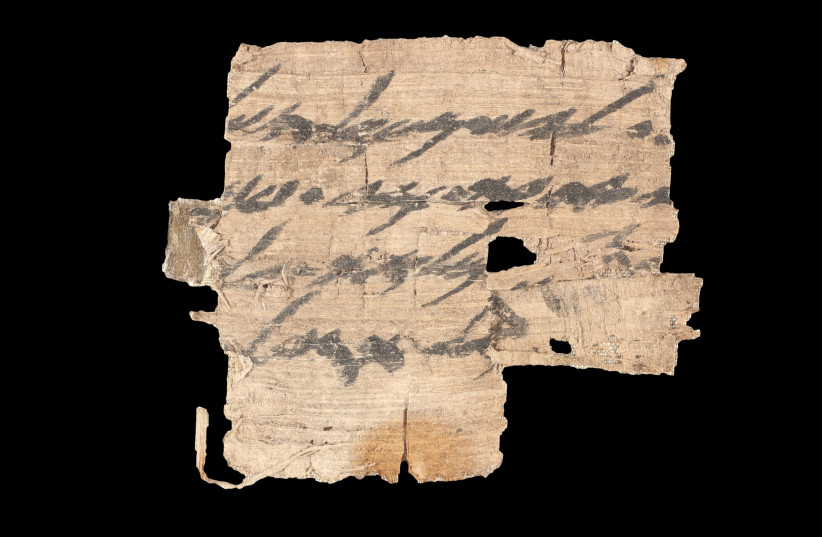
Ishmael Papyrus, a rare document from the First Temple period. / (photo credit: SHAI HALEVI / ISRAEL ANTIQUITIES AUTHORITY)

A letter written in ancient Hebrew dating back to the First Temple period, around the sixth or seventh century BCE, was returned to Israel on Wednesday. It was probably found in the Judean Desert caves.

Archaeologists estimated that it dates back to the sixth century BCE which joins two other documents in this time period in the Israel Antiquities Authority Dead Sea Scrolls collection. The script on the extremely rare ripped document starts with “To Ishmael send…”, hinting that it is a fragment of a letter. 

According to a Wednesday press release, the letter was returned thanks to a joint operation by the Antiquities Theft Prevention Unit of the Israel Antiquities Authority, the Culture and Sport Ministry and the Jerusalem Affairs and Heritage Ministry.

Who are the archaeologists behind the research?

Dr. Ada Yardeni, an Ancient Hebrew Script scholar, passed away back in June 2018 and Prof. Shmuel Ahituv was asked to take over and complete the publication of a document that she was working on before she passed.

According to the announcement, he was surprised to find a photograph of a rare and, until then unknown, document from the First Temple period with Yardeni’s decipherment. This all led to the joint Intelligence operation finding the rest of the original documents.

The Israel Antiquities Authority is carrying out archaeological surveys to locate important finds in the Judean Desert. (credit: EITAN KLEIN / ISRAEL ANTIQUITIES AUTHORITY)

They found a person who lives in Montana, USA, who owned the parchment.

He explained that it was given to his mother, who had hung it on her wall. She got it on a visit to Jerusalem in 1965 from Joseph Sa’ad, a well-known antiquities dealer from Bethlehem. Sa’ad was known to have sold thousands of Dead Sea scroll fragments over the years.

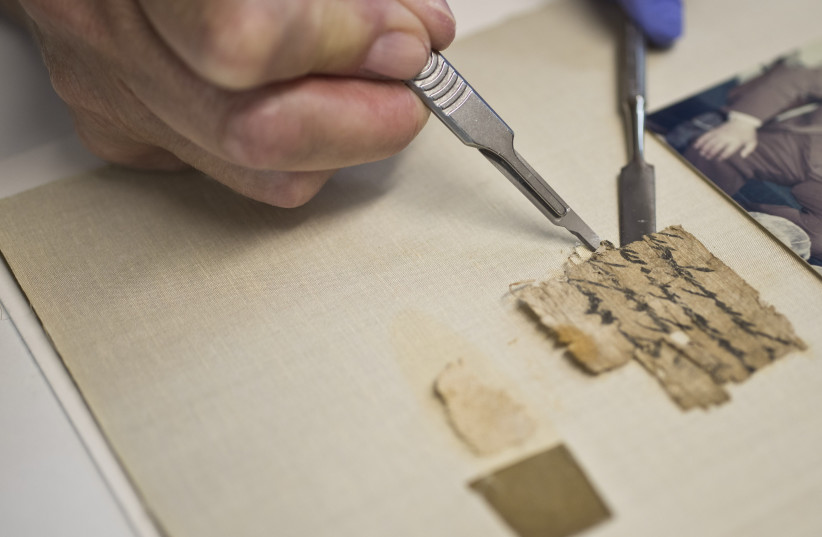
The man was convinced to give the fragment over to Israel after he was invited to visit the Israel Antiquities Authority Judean Desert Scroll Department’s Conservation Laboratory in Jerusalem.

What’s in a name? 

“The name Ishmael mentioned in the document, was a common name in the Biblical period, meaning ‘God will hear,'” Ahituv said.

“It first appears in the Bible as the name of the son of Abraham and Hagar, and it is subsequently the personal name of several individuals in the Bible, including Yishmael ben Netanyahu, who murdered the governor Gedaliah ben Ahikam.

“It also appears as the name of officials on paleographic finds such as bullae (clay stamp seals) used for sealing royal documents in the administration of the Kingdom of Judea, for example, the bulla reading, ‘To Yishmael, song of the king,'” he added. 

Director of the Israel Antiquities Authority Judean Desert Scrolls Unit, Dr. Joe Uziel said: “Towards the end of the First Temple period, writing was widespread. This is evident from many finds, including groups of ostraca (documents written on pottery shards) and stamp seals with writing, that have been discovered in many ancient urban settlements.

“Each new document sheds further light on the literacy and the administration of the First Temple period,” he added. 

The story about the document will be presented at the First Judean Desert Conference taking place at the Bible Lands Museum in Jerusalem next week. The conference is open to the public, free of charge. 

In a joint intelligence operation, the Antiquities theft Prevention Unit of the Israel Antiquities Authority, and Professor Shmuel Ahituv, recipient of the Israel Prize for Biblical Studies, with the help of the Ministry of Culture and Sport and the Ministry of Jerusalem and Heritage, succeeded in repatriating a First Temple-period document, dated to the late seventh or early sixth century BCE. The document is written in ancient Hebrew script on papyrus, and it was probably found in the Judean Desert caves.

The extremely rare document is composed of four torn lines that begin with the words “To Ishmael send….”, the text hinting that it is a fragment of a letter containing instructions to the recipient. Based on the writing, it is proposed to date the ‘Ishmael Papyrus’ to the seventh to sixth centuries BCE, joining only two other documents from this period in the Israel Antiquities Authority Dead Sea Scrolls collection. All three papyri come from the Judean Desert, where the dry climate enables the preservation of the papyri.

The story began when Dr. Ada Yardeni, scholar of Ancient Hebrew Script, passed away in June 2018, and Prof. Shmuel Ahituv was asked to complete the publication of a document she was working on. Ahituv was surprised to encounter the photograph of a rare and, until then unknown, document from the First Temple period, together with Yardeni’s preliminary decipherment. This led to a joint campaign by Ahituv and the Antiquities theft Prevention Unit of the Israel Antiquities Authority to locate the whereabouts of the original document.

The intelligence mission succeeded, and the person who owned the papyrus, a resident of Montana, USA, was located. He explained that the papyrus was given to his mother when she visited Jerusalem in 1965, by Joseph Sa‘ad, Curator of the Rockefeller Museum, and Halil Iskander Kandu, a well-known antiquities dealer from Bethlehem, who many years ago sold thousands of Dead Sea scroll fragments. Back home, his mother hung the framed scroll fragment on the wall.

In order to persuade the owner to transfer the fragile document to Israel, where it would be conserved in climate-controlled conditions, he was invited to visit the Israel Antiquities Authority Judean Desert Scroll Department’s Conservation Laboratory in Jerusalem. After the visit, the owner was convinced that here were the best conditions to conserve and research the rare document, and he generously gave it to the Israel Antiquities Authority.

The Dead Sea Scrolls Unit conserved the papyrus and documented it with the modern multispectral system used to monitor the state of the scrolls.
In order to confirm that the document was genuine, a small sample was radiometrically dated in the Weizmann Institute in Rehovot. The sample provided a date similar to that determined by the paleographic evaluation (based on the letter forms), thus consolidating the dating towards the end of the First Temple period.

The document was researched by Prof. Ahituv, and his findings will be presented next Thursday at the Israel Antiquities Authority’s First Judean Desert Conference at the Bible Lands Museum in Jerusalem.

According to Professor Shmuel Ahituv, “The name Ishmael mentioned in the document, was a common name in the Biblical period, meaning ‘God will hear’. It first appears in the Bible as the name of the son of Abraham and Hagar, and it is subsequently the personal name of several individuals in the Bible, including Yishmael ben Netanyahu, who murdered the governor Gedaliah ben Ahikam. It also appears as the name of officials on paleographic finds such as bullae (clay stamp seals) used for sealing royal documents in the administration of the Kingdom of Judah, for example the bulla reading, ‘To Yishmael, son of the king’. The present document probably certified a dispatchment either to, or from, Yishmael.”

“Towards the end of the First Temple period, writing was widespread,” says Dr. Joe Uziel, Director of the Israel Antiquities Authority Judean Desert Scrolls Unit. “This is evident from many finds, including groups of ostraca (documents written on pottery sherds) and stamp seals with writing, that have been discovered in many ancient urban settlements, including in the royal capital of Jerusalem. However, First Temple-period documents written on organic materials—such as this papyrus—have scarcely survived. Whilst we have thousands of scroll fragments dating from the Second Temple period, we have only three documents, including this newly found one, from the First Temple period. Each new document sheds further light on the literacy and the administration of the First Temple period.”


Zawartość publikowanych artykułów i materiałów nie reprezentuje poglądów ani opinii Reunion’68,
ani też webmastera Blogu Reunion’68, chyba ze jest to wyraźnie zaznaczone.
Twoje uwagi, linki, własne artykuły lub wiadomości prześlij na adres:
webmaster@reunion68.com


News From Israel- September 04, 2022

News From Israel- September 04, 2022

ILTV Israel News


A shooting terror attack on a public bus this morning, leaving 7 Israelis injured in the Jordan Valley

The 50th anniversary of the Munich Olympics Massacre coming up. The victims’ families again speaking out against hate.

And for the first time in years… Druze from the Northern Golan Heights increasingly applying for Israeli citizenship. But why now?


Zawartość publikowanych artykułów i materiałów nie reprezentuje poglądów ani opinii Reunion’68,
ani też webmastera Blogu Reunion’68, chyba ze jest to wyraźnie zaznaczone.
Twoje uwagi, linki, własne artykuły lub wiadomości prześlij na adres:
webmaster@reunion68.com