AARON REICH
In breaching the walls of Jerusalem in 70 CE, the Roman legions stormed the city and destroyed the Second Temple, of the many infamous moments mourned on Tisha Be’av.
.
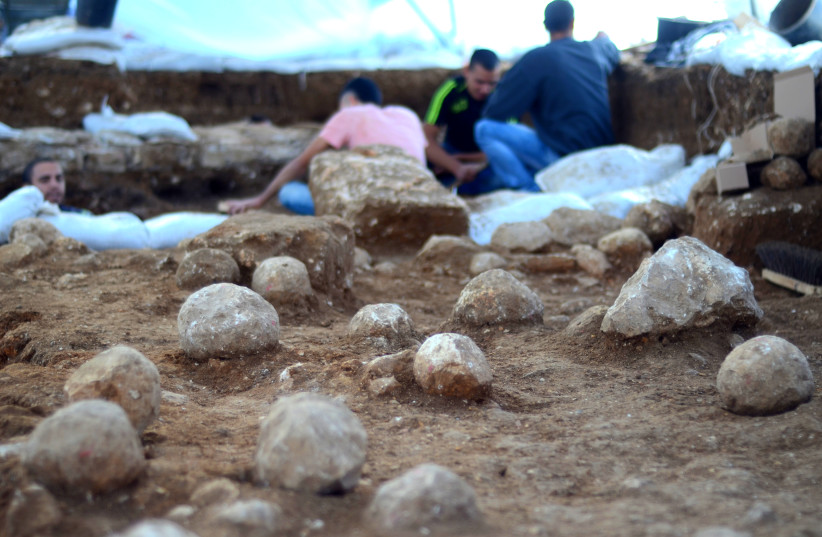 The Russian Compound excavation site. The ballista stones, the physical evidence of the battle that took place 2000 years ago, are visible on the floor. / (photo credit: YOLI SCHWARTZ/ISRAEL ANTIQUITIES AUTHORITY)
The positions of the Roman army’s ballistae used in their attack on Jerusalem may have been found thanks to archaeological evidence and calculations made by the Israel Antiquities Authority.
The findings come on Tisha Be’av, the Jewish fast day that mourns, among other things, the destruction of the Temple in Jerusalem by the Romans during this invasion.
Background: When Romans took Jerusalem
The Roman Empire was the pinnacle superpower of the ancient world and firmly dominated the entirety of the Mediterranean Sea.
Its army, too, was the powerhouse of the era, enforcing the empire’s will on its conquered and subjugated lands.
The imperial legions were vast, strong in number with a vast number of flexible tactics and formations at their disposal, along with their signature innovations and weaponry, such as the ballista.
It was with this might that the Romans, in an army led by Pompey the Great, would ultimately conquer Judea, ruled at the time by the Hasmonean Kingdom, in 63 BCE — which was technically before the birth of the empire and was actually in the tail-end of the Roman Republic.
However, not all of the Jews accepted Roman rule, as while Judea was allowed to be autonomous, they were still heavily beholden to Rome.
Ultimately, in 66 CE, a Jewish revolt erupted against Rome, at the time ruled by Emperor Nero. The Roman legions, led by General Vespasian, were dispatched to quell this uprising.
The revolt was widespread and would last for several years, ultimately ending with the fall of Masada in 73-74 CE. But the most significant battle was the Siege of Jerusalem in 70 CE.
This began after a brief lull in the conflict, caused by Emperor Nero’s death. Vespasian went back to Rome, becoming the new emperor, while his son Titus was now left in command of the legions. He would lay siege to Jerusalem and after a siege of just under five months, would breach into the city and destroy the Second Temple.
This marked the end of a historic period for the Jews, the total destruction of the Second Temple, and is one of the many infamous moments contributing to the mourning day of Tisha Be’av.
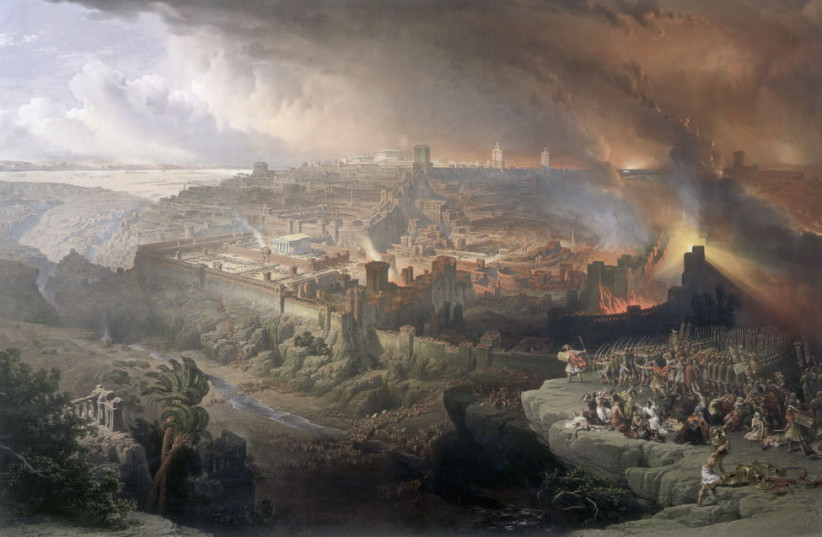 The Siege and Destruction of Jerusalem by the Romans Under the Command of Titus, A.D. 70 (credit: DAVID ROBERTS/WIKIMEDIA COMMONS)
How did the Roman army do it?
That question was answered by Israel Antiquities Authority researcher Kfir Arbiv.
Over the course of many years, archaeological excavations were able to uncover a significant number of Roman military equipment in the city. Many of these were found by Arbiv and fellow researcher Dr. Rina Avner in the Russian Compound near the Jerusalem Municipality.
So far, the excavated equipment consists of anything from ballista stones, sling stones, spears, arrowheads, swords and catapults.
In particular, Arbiv focused on the ballista stones.
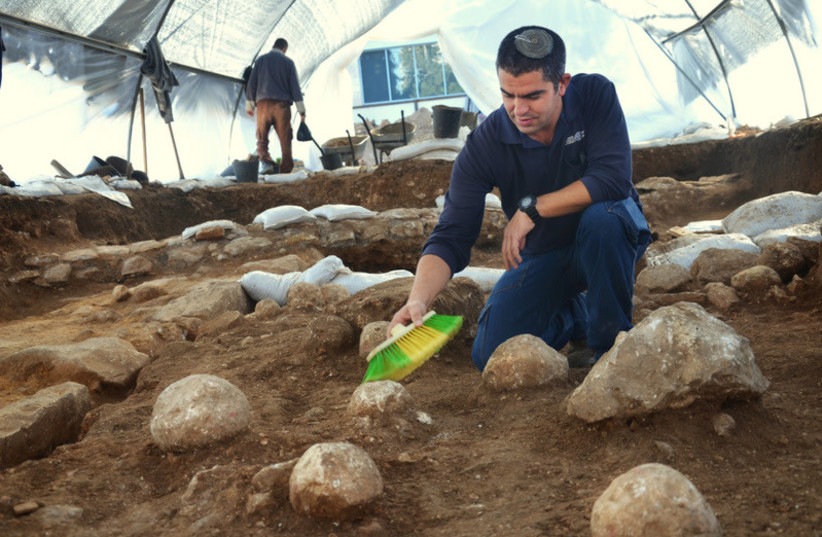 Kfir Arbiv, Israel Antiquities Authority excavation director, cleans a ballista stone at the Russian Compound excavation site. (credit: YOLI SCHWARTZ/ISRAEL ANTIQUITIES AUTHORITY)
Ballistae themselves were large weapons of the ancient world that could be described as a sort of gigantic crossbow — though the crossbow itself was a later weapon.
These contraptions used springs for torsion in order to launch either heavy darts or large stones in siege warfare.
They were first utilized by the ancient Greeks as siege weapons and were later incorporated by the Romans as they continued to expand their presence and adapt their military capabilities.
Smaller forms of ballista, called scorpio, were also used with more precision.
Overall, though they were used as siege weaponry, ballistae could also be described as an early form of artillery, used to take out fortifications and target soldiers.
This lines up with the Siege of Jerusalem, with the ballista stones found being of varying weight and size, able to be launched in an effort to break through the walls or to hit people and prevent the defenders from trying to come out from cover to strike back.
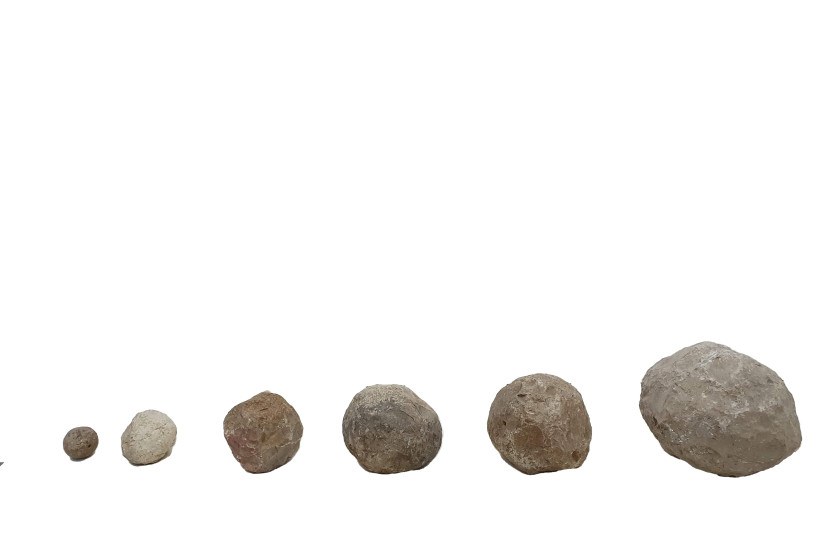 Ballista stone balls of different dimensions (credit: Kfir Arbiv/Israel Antiquities Authority)
With this in mind, Arbiv hit the books – and the keyboard.
Much of the battle itself was described by the famed Jewish historian Josephus in his landmark work The History of the Jewish War against the Romans.
With this information, Arbiv was able to match it up with his own findings. These were gained through the locations of where the ballistae stones were found and, from there, he calculated where they must have been fired from.
This complex series of calculations had to factor in everything from the location of the city walls, the angles used to launch each stone and what their ranges were and the local topography.
From here, Arbiv helped discover two things: Where much of the Roman artillery was located, and where the Romans probably managed to breach the city.
“Whoever controls this spot, dominates the whole area and the fate of the city.”
Kfir Arbiv
Where did the Romans breach Jerusalem’s walls?
Regarding the location of artillery, a significant amount of ballistae seem to have been placed in Cat’s Square, located around the center of modern Jerusalem.
As for where the Romans likely breached into the city, that would seemingly be the Russian Compound.
Excavations in the area were able to find remnants of the Third Wall, the outermost line of defense of the city. However, this area also had the largest amount of ballistae stones, with hundreds if not thousands found in the area, seemingly directed at this specific spot.
Josephus himself seemed to have indicated s much, with his writings stating that the Romans breached the walls in the northwest.
For Arbiv, the fact that they chose this spot is not at all a surprise.
“Whoever controls this spot, dominates the whole area and the fate of the city,” he explained.
For Israel Antiquities Authority director Eli Eskosido, the findings are significant in helping further validate the records of the Siege of Jerusalem.
“The physical evidence of the huge resources employed by the Roman army in Jerusalem reflects the extremely harsh battles that eventually led to the destruction of the Second Temple,” he explained.
“Notwithstanding the internal factions and the impossible odds, a small group of Jewish defenders withheld the Romans for a few months until the tragic destruction of the city. The use of up-to-date research methods reveals more and more about the fascinating history of Jerusalem.”
But there may be a lot more to discover in the area, with many weapons and machines used by the Roman legions still unaccounted for.
“We know from the historical sources that the Roman army employed massive siege rams to batter the fortification walls and siege towers that reached the height of the walls,” explained Israel Antiquities Authority Jerusalem region director Amit Reem, “but these have not yet been found in Jerusalem.”
 News From Israel- August 14, 2022

 The Spielberg Jewish Film Archive
