Archives

1,877-year-old bronze Roman coin discovered on Israeli beach

1,877-year-old bronze Roman coin discovered on Israeli beach

AARON REICH


The coin was minted in Alexandria, Egypt, in the reign of Emperor Antoninus Pius and contains the image of the Cancer zodiac sign and the moon goddess Luna.

.
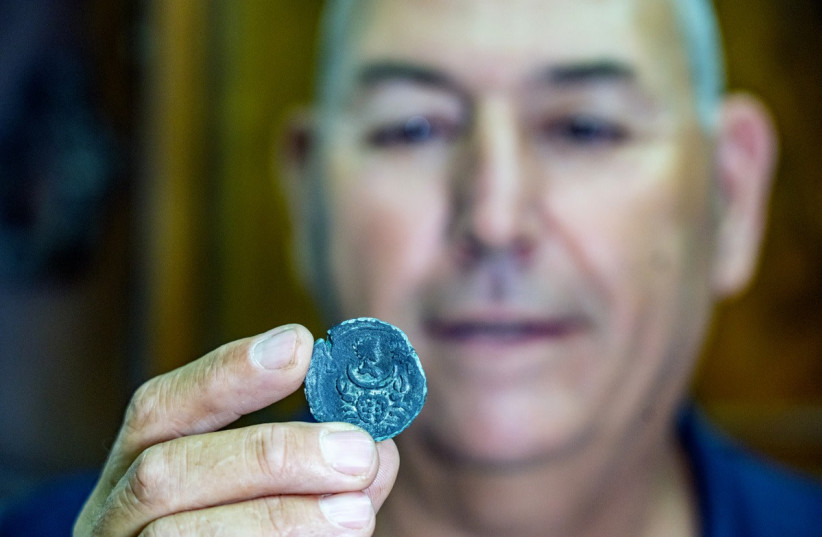
The 1,850-year-old bronze Roman coin found in Israel’s waters is seen being held. It depicts the Cancer zodiac sign and the moon goddess Luna. / (photo credit: DAFNA GAZIT/ISRAEL ANTIQUITIES AUTHORITY, YANIV BERMAN/ISRAELI ANTIQUITIES AUTHORITY)

A bronze Roman coin dating back 1,877 years with the symbol of the Cancer zodiac sign and a Moon goddess was discovered at Carmel Beach in Haifa by archaeologists from the Antiquities Authority.

The coin was discovered during a survey of the area designed to find antiques and save them from degradation.

This isn’t the oldest Roman-era coin discovered. In fact, coins from the earlier Bar Kokhba revolt were found in Jerusalem two years ago. However, this coin was found in the water, is in remarkably good condition and its engravings shed considerable light on its origins and what it is meant to depict.

Israel in the Roman era

The coins used as money by the Romans were minted from gold, silver, bronze, copper and orichalcum, although historians are unclear as to what exactly is orichalcum metal.

Over time, especially in the closing days of the Roman Republic and throughout the Roman Empire, these coins also contained a number of icons and writings.
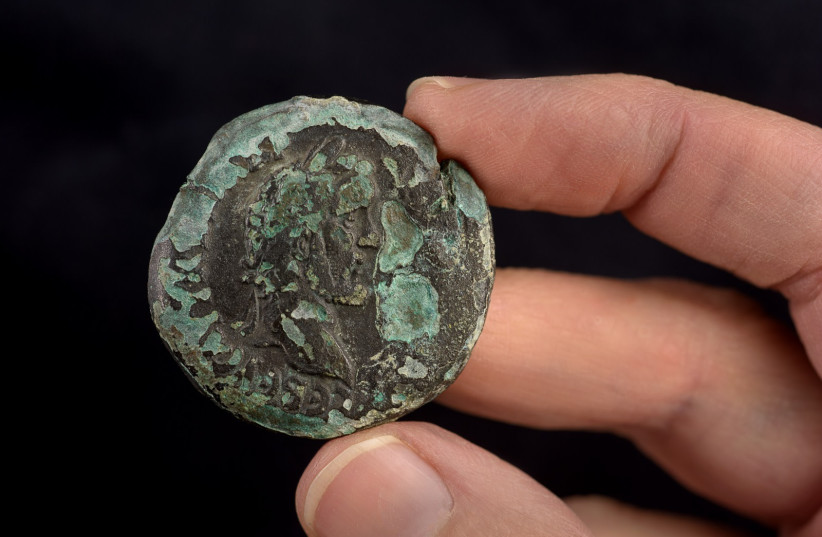
 The reverse side of the 1,850-year-old bronze Roman coin. It depicts Roman Emperor Antoninus Pius. (credit: DAFNA GAZIT/ISRAEL ANTIQUITIES AUTHORITY, YANIV BERMAN/ISRAELI ANTIQUITIES AUTHORITY)The reverse side of the 1,850-year-old bronze Roman coin. It depicts Roman Emperor Antoninus Pius. (credit: DAFNA GAZIT/ISRAEL ANTIQUITIES AUTHORITY, YANIV BERMAN/ISRAELI ANTIQUITIES AUTHORITY)

This coin in particular is no exception, with the writing telling us exactly when and where the coin was minted: in year eight of the reign of Antoninus Pius, and where it was minted, Alexandria in Egypt.

Antoninus Pius was Roman emperor from 138 CE to 161 CE, so this would have been minted in 145 CE, 75 years after the destruction of the Second Temple.

Pius’s reign was well remembered and historians note him as one of the “Five Good Emperors” – alongside Nerva, Trajan, Hadrian and Marcus Aurelius – who presided over Rome’s great golden age of Pax Romana.

This is despite the fact that Pius wasn’t a military man like many other notable Roman emperors and that his long reign was largely peaceful. Rather, his great strengths were in his skilled administration of the large empire, a profitable economy with a massive surplus in the empire’s coffers, and his work as a progressive legal reformer.

Further, the administrative role Pius held was of such paramount importance to his reign that many historians believe he never actually left the city of Rome.

Pius’s reign also saw him rule over what is now the State of Israel, with the Bar Kokhba revolt having ended just two years prior to the beginning of his reign.

This was important, as it was now up to Pius to improve relations between the empire and the Jews following the revolt and the many decrees of his predecessor, Hadrian, which had been extremely unpopular among the Jews, such as the ban on circumcision.

Pius was able to do this, however, and ties between Rome and the Jews improved. The Talmud even notes the close friendship between Antoninus Pius and the leader of the Jews in the Levant, Rabbi Yehuda Hanasi.

This is something some historians debate, as the Talmud just refers to an emperor known as Antoninus which could refer to either Pius’s successor Marcus Aurelius, whose full name was Marcus Aurelius Antoninus, or Caracalla, whose full name was also Marcus Aurelius Antoninus, though his birth name was Luciuus Septimius Bassianus.

Antoninus’s image has been found on coins in Israel before. One such coin was found in 2021 that also contains the image of Antoninus Pius, with the other side containing the image of the Syrian moon god Mên and the inscription “of the people of Geva Phillipi” and the date of the civic year 217, which would be 158 CE or 159 CE.

What was on the coin?

In addition to showing when and where it was minted, the coin now found also included symbols.

On one side was the image of Antoninus Pius along with the inscription, while the other side contained two symbols: a crab, the zodiac sign of Cancer, and the Moon goddess Luna.

The other side was the Moon goddess Luna.

The inclusion of Cancer seemed to have been due to the coin being part of a series of coins with zodiac symbols.Luna, however, is another story but far from unprecedented.

Iconography in Roman coins tended to depict emperors and images of gods. This served to both spread the image and name of the emperor to the wider empire and associate him with being a divine figure.

Luna was also important to the Roman Empire for another reason, as it was this goddess, alsong with the sun god Sol, who was used by the empire to represent Roman rule over the world as well as a guarantee of peace.

Its presence in the Carmel Beach

As Israel has been a pillar of the ancient world and has been ruled by numerous kingdoms and empires throughout history, it is no surprise that it has been host to a wide range of archaeological finds, some of which are incredibly ancient.

However, as noted by IAA maritime archaeology unit director Yaakov Shavit, this is the first time something like this was found in Israeli waters.

“Along the shores of the Mediterranean Sea in the State of Israel and its maritime area, there are many archaeological sites and finds that tell of connections that existed here in ancient times between the ports of the Mediterranean and the many countries along its shores,” Shavit said in a statement.

“Along the shores of the Mediterranean Sea in the State of Israel and its maritime area, there are many archaeological sites and finds that tell of connections that existed here in ancient times between the ports of the Mediterranean and the many countries along its shores.”

Yaakov Shavit

“These findings, which sunk into the abyss and disappeared from sight for hundreds and thousands of years, were preserved in an amazing way… and their discovery completes pieces of the historical puzzle of Israel’s history.”

Indeed, the discovery of this coin also reflects an ever-changing perception of the sea in Israel and the vast importance it serves.

“In the last decade, Israel has been changing its perception of the sea,” said IAA director Eli Escozido. “Now it is already clear that the sea is not the border of Israel, but is a significant part of it, in security, strategy and economics – and also in its heritage. It’s home to natural treasures and cultural assets that must be explored and protected.”The finding of this coin, Escozido said, is a “spectacular reminder” of the maritime archaeological survey.


Zawartość publikowanych artykułów i materiałów nie reprezentuje poglądów ani opinii Reunion’68,
ani też webmastera Blogu Reunion’68, chyba ze jest to wyraźnie zaznaczone.
Twoje uwagi, linki, własne artykuły lub wiadomości prześlij na adres:
webmaster@reunion68.com

Arab-Israeli Soccer Player Quits Israeli National Team, Year After Jerusalem Criticism

Arab-Israeli Soccer Player Quits Israeli National Team, Year After Jerusalem Criticism

i24 News


Israeli forward Munas Dabbur playing for Germany’s Bundesliga team Hoffenheim. Photo: Imago Images Sports via Reuters Connect

Arab-Israeli soccer player Munas Dabbur announced Tuesday that he was leaving the Israeli national team, over a year after he was condemned by teammates and fans for his criticism of Israel regarding Jerusalem.

The 30-year-old forward, who plays for Germany’s Bundesliga team Hoffenheim, shared a post on Instagram announcing his retirement from the Israeli team.

“I would like to inform you of my decision that my part of the Israeli national team has come to an end. I would like to thank my family and everyone who has ever supported me,” he wrote in the caption of a photo of him in the national soccer team’s uniform.

He did not elaborate on why he made the decision.

In May 2021 — amid a wave of unrest surrounding Jerusalem’s holy sites that spilled into Israeli-Arab violence across the country as well as cross-border fighting between Israel and Gaza’s Hamas — Dabbur posted to the same social media platform: “God will deal with the perpetrators of injustice.”

He subsequently explained that the post was directed toward Israel and as a way to protest excessive force by Israeli security forces, according to Haaretz.

After that, he became the target of constant booing by Israeli soccer fans and was not selected to play in the two following matches of the national team.


Zawartość publikowanych artykułów i materiałów nie reprezentuje poglądów ani opinii Reunion’68,
ani też webmastera Blogu Reunion’68, chyba ze jest to wyraźnie zaznaczone.
Twoje uwagi, linki, własne artykuły lub wiadomości prześlij na adres:
webmaster@reunion68.com

Al Qaeda Leader Zawahiri Killed in CIA Drone Strike in Afghanistan: US Officials

Al Qaeda Leader Zawahiri Killed in CIA Drone Strike in Afghanistan: US Officials

Reuters and Algemeiner Staff


A photo of Al Qaeda’s leader, Egyptian Ayman al-Zawahiri, is seen in this still image taken from a video released on September 12, 2011. / REUTERS/SITE Monitoring Service via Reuters

Al Qaeda leader Ayman al-Zawahiri has been killed in a CIA drone strike in Afghanistan, US officials told Reuters on Monday, the biggest blow to the militant group since its founder Osama bin Laden was killed in 2011.

Zawahiri, an Egyptian doctor and surgeon, helped coordinate the Sept. 11, 2001, attacks in which four civilian aircraft were hijacked and slammed into the World Trade Center’s twin towers in New York, the Pentagon near Washington and a Pennsylvania field, killing nearly 3,000 people.

One of the US officials, speaking on the condition of anonymity, said a drone strike was carried out by the CIA in the Afghan capital Kabul on Sunday.

“Over the weekend, the United States conducted a counterterrorism operation against a significant Al Qaeda target in Afghanistan,” a senior administration official said.

“The operation was successful and there were no civilian casualties,” the official added.

If confirmed, his death in a CIA drone strike raises questions about whether he was being given sanctuary by the Taliban following their takeover of Kabul in August 2021 as the last US-led troops were leaving Afghanistan after 20 years of war.

In a statement, Taliban spokesman Zabihullah Mujahid confirmed that a strike took place and strongly condemned it, calling it a violation of “international principles.”

US President Joe Biden will deliver remarks on Monday at 7:30 p.m. on what the White House described as a “successful counter-terrorism operation.”

A loud explosion echoed through Kabul early Sunday morning.

“A house was hit by a rocket in Sherpoor. There were no casualties as the house was empty,” Abdul Nafi Takor, spokesman of the interior ministry, said earlier.

One Taliban source, requesting anonymity, said there had been reports of at least one drone flying over Kabul that morning.

With other senior al Qaeda members, Zawahiri is believed to have plotted the October 12, 2000 attack on the USS Cole naval vessel in Yemen which killed 17 U.S. sailors and injured more than 30 others, the Rewards for Justice website said.

He was indicted in the United States for his role in the August 7, 1998 bombings of the US embassies in Kenya and Tanzania that killed 224 people and wounded more than 5,000 others.

Both bin laden and Zawahiri had eluded capture when US-led forces toppled Afghanistan’s Taliban government in late 2001 following the Sept. 11 attacks on the United States.

Bin Laden was killed in 2011 by US forces in Pakistan.


Zawartość publikowanych artykułów i materiałów nie reprezentuje poglądów ani opinii Reunion’68,
ani też webmastera Blogu Reunion’68, chyba ze jest to wyraźnie zaznaczone.
Twoje uwagi, linki, własne artykuły lub wiadomości prześlij na adres:
webmaster@reunion68.com



News From Israel- July 31, 2022

News From Israel- July 31, 2022

ILTV Israel News


The public angry as an Israeli court orders an at-risk woman into protective custody, against her will…

The Gilboa prison pimping scandal getting worse and worse. Another woman now corroborating horrific experiences from her time as a guard at the jail.

Miriam Haart – one of the stars from “my unorthodox life” Joining us in studio following the success of the show’s first season on Netflix.


Zawartość publikowanych artykułów i materiałów nie reprezentuje poglądów ani opinii Reunion’68,
ani też webmastera Blogu Reunion’68, chyba ze jest to wyraźnie zaznaczone.
Twoje uwagi, linki, własne artykuły lub wiadomości prześlij na adres:
webmaster@reunion68.com


Researchers determine that fortress may be remains of lost city – study

Researchers determine that fortress may be remains of lost city – study

JERUSALEM POST STAFF


Archaeologists identified structures that indicate that the site may have been used for military purposes, as well as a complex that may have been dedicated to the Zoroastrian goddess Anahita.

.
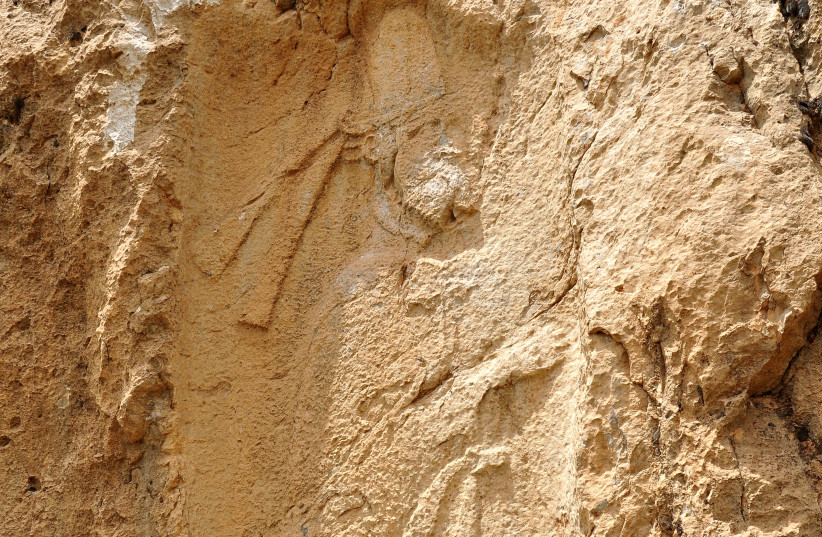
A rock relief at Rabana-Merquly / (photo credit: Osama Shukir Muhammed Amin/CC BY-SA 4.0 (https://creativecommons.org/licenses/by-sa/4.0)/WIKIMEDIA)

The mountain fortress of Rabana-Merquly in Iraqi Kurdistan was a major center of the Parthian Empire, which existed in parts of Iran and Mesopotamia 2,000 years ago, a new study found.

The study, published in Antiquity journal on Wednesday, was led by Dr. Michael Brown from the Institute of Prehistory, Protohistory and Near-Eastern Archaeology at Heidelberg University.

According to the university, an international team studied archeological remains at the site during excavations conducted in 2009 and from 2019 to 2022.

The team identified structures that indicate that the site may have been used for military purposes, as well as a complex that may have been dedicated to the Zoroastrian goddess Anahita.

Furthermore, rock reliefs at the entrance to the fortress and the location of the fortress near the Lower Zab River were found to be significant.

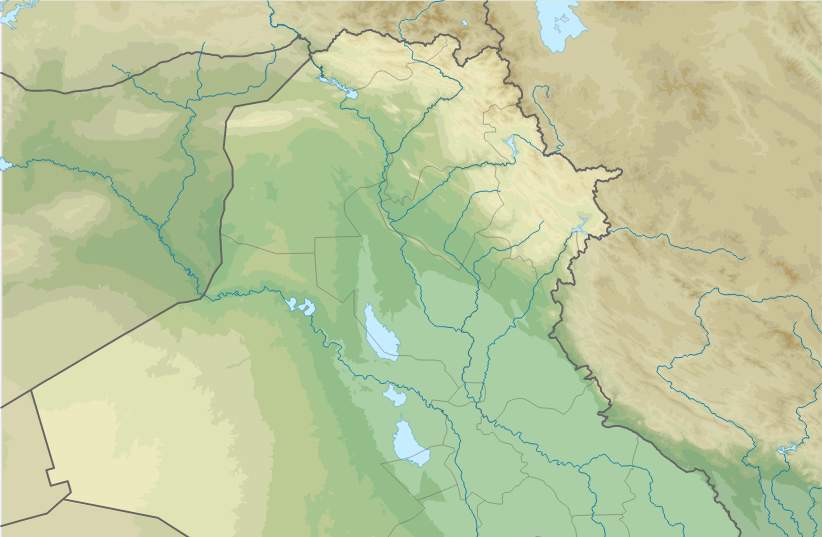
Physical map of Iraq (credit: Urutseg/CC0/VIA WIKIMEDIA COMMONS)

“The considerable effort that must have gone into planning, building, and maintaining a fortress of this size points to governmental activities.”

Dr. Michael Brown, Institute of Prehistory, Protohistory and Near-Eastern Archaeology, Heidelberg University

Brown said that the reliefs may depict the city’s founder Natounissar.

Lost city

The researchers speculate that Rabana-Merquly could be the lost city of Natounia, which has only been documented on several coins from the first century B.C.E.

“The considerable effort that must have gone into planning, building, and maintaining a fortress of this size points to governmental activities,” Brown said, according to the university.


Zawartość publikowanych artykułów i materiałów nie reprezentuje poglądów ani opinii Reunion’68,
ani też webmastera Blogu Reunion’68, chyba ze jest to wyraźnie zaznaczone.
Twoje uwagi, linki, własne artykuły lub wiadomości prześlij na adres:
webmaster@reunion68.com