Archives

The Spielberg Jewish Film Archive – The Land of Promise

The Spielberg Jewish Film Archive – The Land of Promise

Hebrew University of Jerusalem   Hebrew University of Jerusalem


Name: The Land of Promise
Year: 1935
Duration: 00:58:26
Language: English

Abstract: The definitive pre-state portrayal of the developing Jewish national home.

The Spielberg Jewish Film Archive –
The 500 films, selected for the virtual cinema, reflect the vast scope of documentary material collected in the Spielberg Archive. The films range from 1911 to the present and include home movies, short films and full length features.

שם: לחיים חדשים
שנה: 1935
אורך: 00:58:26
שפה: אנגלית

תקציר: אחד הסרטים רבי ההשפעה ביותר מהתקופה שלפני קום המדינה, הסוקר את התפתחותו של הבית הלאומי היהודי בארץ.

ארכיון הסרטים היהודיים על שם סטיבן שפילברג –
חמש מאות הסרטים שנבחרו עבור הקולנוע הווירטואלי משקפים את ההיקף הנרחב של החומר התיעודי בארכיון שפילברג. באתר ישנם סרטים משנת 1911 ועד ימינו אלה ביתיים, קצרים ובאורך מלא.

כל הזכויות שמורות לארכיון הסרטים היהודיים על שם סטיבן שפילברג ולאוניברסיטה העברית בירושלים 2010; דף הבית; www.spielbergfilmarchive.org.il
http://multimedia.huji.ac.il/


Zawartość publikowanych artykułów i materiałów nie reprezentuje poglądów ani opinii Reunion’68,
ani też webmastera Blogu Reunion’68, chyba ze jest to wyraźnie zaznaczone.
Twoje uwagi, linki, własne artykuły lub wiadomości prześlij na adres:
webmaster@reunion68.com


U.S. seeks Mideast architecture vs Iran; Israel-Saudi ties expected to improve TV7 Israel News 16.06

U.S. seeks Mideast architecture vs Iran; Israel-Saudi ties expected to improve TV7 Israel News 16.06

TV7 Israel News


1) Foreign Minister Yair Lapid vaguely acknowledges Israel’s warming of ties with the Kingdom of Saudi Arabia.
2) The United States highlights its efforts to broaden regional cooperation to confront the Islamic Republic of Iran.
3) The European Union pledges support for Egypt to tackle growing concerns over food security.


Zawartość publikowanych artykułów i materiałów nie reprezentuje poglądów ani opinii Reunion’68,
ani też webmastera Blogu Reunion’68, chyba ze jest to wyraźnie zaznaczone.
Twoje uwagi, linki, własne artykuły lub wiadomości prześlij na adres:
webmaster@reunion68.com


Menorah graffiti: Carving on Ephesus Celsus Library stairs an enigma

Menorah graffiti: Carving on Ephesus Celsus Library stairs an enigma

JUDITH SUDILOVSKY


The menorah became employed as a Jewish symbol sometime in the 3rd century, so far three have been found in ancient Ephesus which had a flourishing Jewish community.
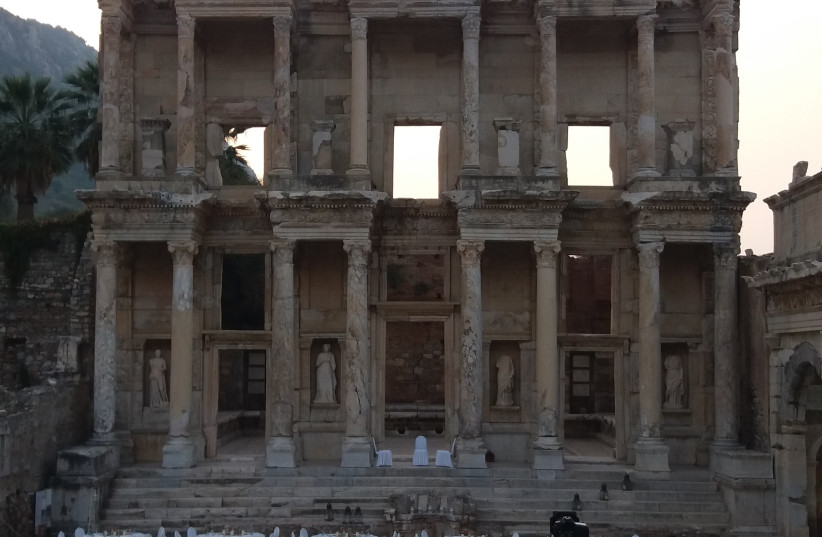
The restored Celsus Library of Ephesus, one of the ancient world’s most impressive libraries. / (photo credit: JUDITH SUDILOVSKY)

Once considered the official cultural and economic capital of the Roman Empire in Asia Minor, the southern Aegean Sea port city of Ephesus, located today in Turkey, was also home to one of the ancient world’s largest and most impressive libraries that housed over 12,000 scrolls and manuscripts, some tucked away in niches along the inner wall.

Julius Aquilas, son of Roman senator and Roman Legion Commander Celsus Polemeanus, began construction of the Celsus Library – the third-largest library in the Roman world – in honor of his father around 110 CE, completing it in 135. Celsus is buried in a sarcophagus beneath the main entrance of the library.

Somewhere along the ancient history of the library, someone carved a graffiti image of a menorah into one of the steps of the library’s marble staircase. The history of the menorah can be nothing more than conjecture, noted Dr. Avner Ecker of the Martin (Szusz) Department of Land of Israel Studies and Archaeology at Bar-Ilan University.

Still, he said, since it is located in a very central spot – adjacent to the Agora of Ephesus – the image of the menorah is not meaningless.

In a 1980 companion article to his book Fishers of Men: The Way of The Apostle tracing the path of Paul the Apostle – coauthored by photographer Gordon Converse and archaeologist Robert J. Bull – American Near East scholar and lecturer B. Cobbey Crisler describes their discovery of the menorah based on his memory of having seen the menorah seven years earlier during excavations being conducted by Austrian archaeologists.
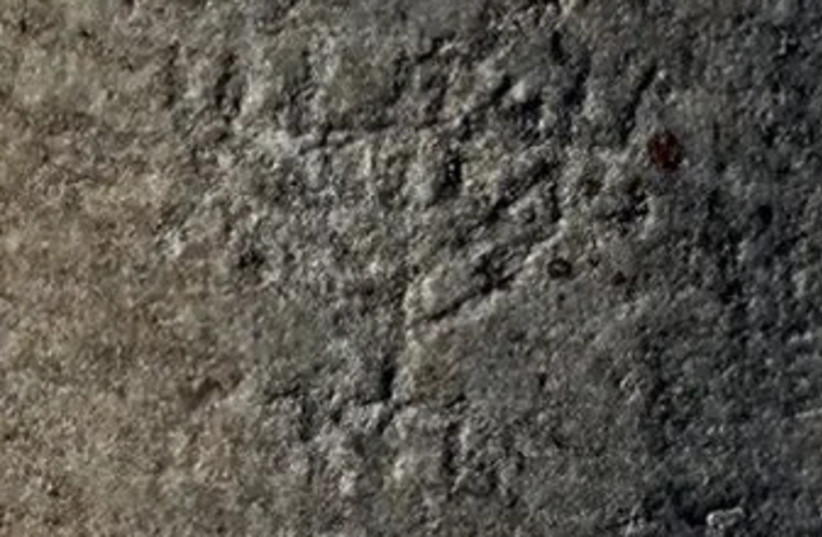
An image of menorah graffiti carved near a so-called brothel building in ancient Ephesus. (credit: HASAN GULDAY)

A plaque has been put up next to the menorah, but it can be easily missed if one is not walking up the stairs in just the right place.

No written sources mention the Celsus Library, said Ecker, and all information about the library is from a dedication inscription uncovered at the site. The first level of the library had statues of the virtues of Celsus in niches, and on the second level, there were statues of Celsus and his family.
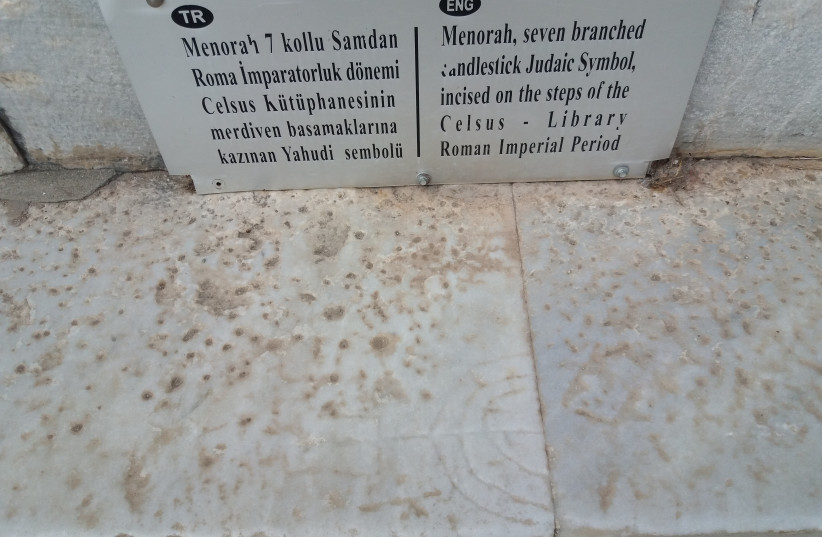
Ephesus was home to a large and flourishing Jewish community. A menorah graffiti prominently carved into the stairs of the important Celsus Library remains a mystery. (credit: JUDITH SUDILOVSKY)

The library and its contents were destroyed in a fire in 262 CE either by an earthquake or an invasion by the Goths, and an earthquake in the 10th or 11th century destroyed what remained of the façade. German and Austrian archaeologists began excavating the site in 1895 under the direction of Otto Benndorf and Carl Humann. Excavations at the site have continued since then through the Austrian Archaeological Institute, which Benndorf established. The institute reconstructed the Celsus Library in the 1970s.

Many of the finds from the Ephesus excavations have been taken to museums around the world, including the  British Museum in London and the Ephesus Museum in Vienna, where the original statues of virtue are now located.

“Celsus’s family was very important,” Ecker said. “He was a senator in Rome, and as commander of a Roman legion may have had some involvement in Syria and even in the Jewish Revolt. So one theory holds that the menorah graffiti may have been some sort of response to that. But then the person who did that would have needed to have some specific knowledge about his career.”

Another theory holds that because of the vast numbers of manuscripts kept at the library, it is very likely that some of those included Jewish manuscripts, and the carving of the menorah was someone’s way of indicating that the library also had some Jewish content, he said.

Yet another possibility is the stone with the menorah carving had simply been repurposed from another site during renovations on the library stairs.

“But then that would take away from the romance surrounding the story of the menorah,” he admitted.

And maybe someone just wanted to make his mark similar to modern-day graffiti, said Eckert, noting that graffiti was more tolerated in ancient times.

“It would have taken a matter of minutes to make if you have the skill and right tools,” said Ecker. “You would have had to have a hammer and chisel to do that, a nail would not have been enough.”

The menorah became employed as a Jewish symbol sometime in the third century, he said, probably at the same time the cross became a common symbol for Christianity, as a reaction to Jews wanting to express their separate identity. There are few examples of menorahs being used as random graffiti, he said, and Ephesus is one of them. Another example can be found carved on the Roman road outside of Cyrenaica in modern-day Libya, from the second century, thought to be a symbol of the Diaspora Revolt by Jewish rebels in 115-117 CE, which had its hub in Cyrenaica.

In excavations in Ephesus by Austrian archaeologists at the beginning of the 20th century, the Celsus Library menorah was discovered under a fountain from around 400 CE, so though the exact date for the menorah graffiti is not known, it was carved likely at the end of the second century or early third century CE, Ecker said.

LOCAL TURKISH tour guide Hasan Gulday, who has worked with Israeli and Jewish tourists and writes on his website about the menorahs in Ephesus, also points out that another menorah graffiti was etched next to the so-called brothel building in Ephesus. The most important carving of a menorah in Ephesus, however, is under the Mezeus and Mithradates Gate, built by two Persian Jewish freed slaves, and dedicated to the Roman emperor who had been their former master, Gulday said.

After the destruction of the First Temple, a large number of Jews moved to Western Turkey, he said, in a large wave of Roman and Hellenistic colonization.

“Jews were considered important for business and trade due to their high literacy rate at a time when only 3% of the general population was literate,” said Gulday. 

According to the Roman census, 10% of the population of Ephesus was Jewish, and they later had the right to collect taxes for the rebuilt Temple in Jerusalem, which was very unusual, he said. Large Jewish populations also existed in nearby Hierapolis and Sardis, where there are impressive remains of the largest Western synagogue. Today, many of the Jewish residents of the city of Izmir, ancient Smyrna, are descendants of the original Jewish inhabitants of Ephesus, Gulday said.

A cosmopolitan city, ancient Ephesus had an established and flourishing Jewish community whose presence was documented from the first century BCE by Josephus, among others, noted Ecker. The Jews of Ephesus, who were Roman citizens, were exempt from military service, and had the right to have someone take care of their dietary needs in the market assuring them which products were kosher, said Ecker.

“That was a huge privilege,” he said.

Ephesus was also an important place for Christians, where two of Jesus’s apostles, Paul and John, spent time preaching to the local Jewish and gentile community. John mentions Ephesus in the Book of Revelation as one of the Seven Churches of Asia Minor. The apostle John held the position of bishop of Ephesus.

The second-century Christian text “Dialogue with Trypho” between early Christian writer Justin Martyr, originally from Shechem (Nablus), and Trypho, thought to be a Jewish refugee from the Bar-Kochba revolt, also took place in Ephesus, noted Ecker.

There was a large synagogue in Ephesus near the Celsus Library, but it has not yet been found.

This month marks both US National Library Week and National Librarian Day.


Zawartość publikowanych artykułów i materiałów nie reprezentuje poglądów ani opinii Reunion’68,
ani też webmastera Blogu Reunion’68, chyba ze jest to wyraźnie zaznaczone.
Twoje uwagi, linki, własne artykuły lub wiadomości prześlij na adres:
webmaster@reunion68.com


News From Israel- June 15, 2022

News From Israel- June 15, 2022

ILTV Israel News


Iran said to be increasingly on edge as the regime ramping up its nuclear and space programs…

Europe looking to Israel as a new source of fuel – as well as a way to escape Russia’s ‘energy-based blackmail…’

A novel way to look into the past. Israeli archaeologists partnering with A.I technology to discover clues about the earliest uses of fire.


Zawartość publikowanych artykułów i materiałów nie reprezentuje poglądów ani opinii Reunion’68,
ani też webmastera Blogu Reunion’68, chyba ze jest to wyraźnie zaznaczone.
Twoje uwagi, linki, własne artykuły lub wiadomości prześlij na adres:
webmaster@reunion68.com


First Roman military amphitheater in Southern Levant revealed at excavations near Megiddo

First Roman military amphitheater in Southern Levant revealed at excavations near Megiddo

JUDITH SUDILOVSKY


Less lavish than amphitheaters for the civilian population, the military amphitheaters were used for training and entertainment by the troops.

.
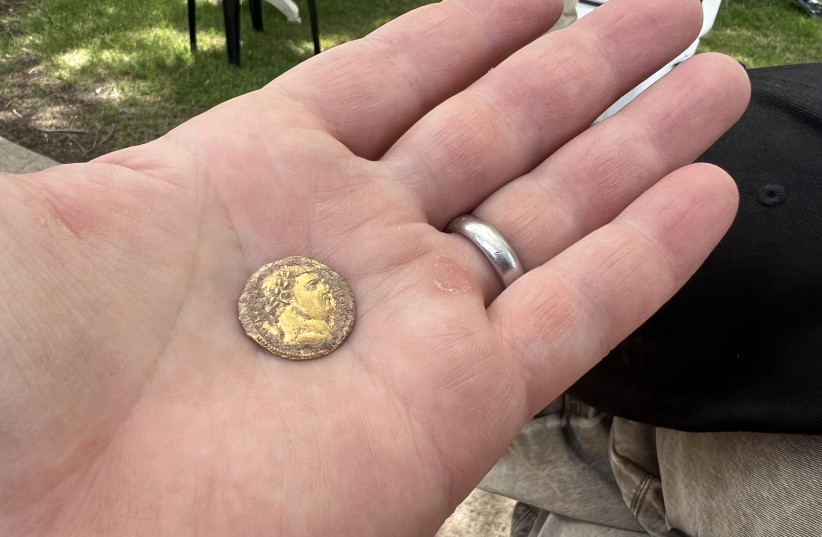
A gold coin of Roman Emperor Diocletian from the Legion excavations. / (photo credit: JEZEREEL VALLEY REGIONAL PROJECT)

Archaeologists excavating at the base of the Legio VI Ferrata Roman Legion near Megiddo (known as Legio) believe they have found evidence of the first military amphitheater to be identified in the Southern Levant.

While remains of over 230 Roman civilian amphitheaters have been found throughout what was the territory of the Roman Empire, fewer military amphitheaters have been excavated, and most of those are in the western regions of the empire.

“Military amphitheaters are connected to the military and not to a city. We know of examples of military amphitheaters in the western regions of the Roman Empire such is in Germany, France and Spain, but they are not known in the eastern half of the Empire. This structure is a few hundred meters from the military base.”

Dr. Yotam Tepper, Israel Antiquities Authority consultant

“We know of examples of military amphitheaters in the western regions of the Roman Empire such is in Germany, France and Spain,” he continued, “but they are not known in the eastern half of the Empire. This structure is a few hundred meters from the military base.” 

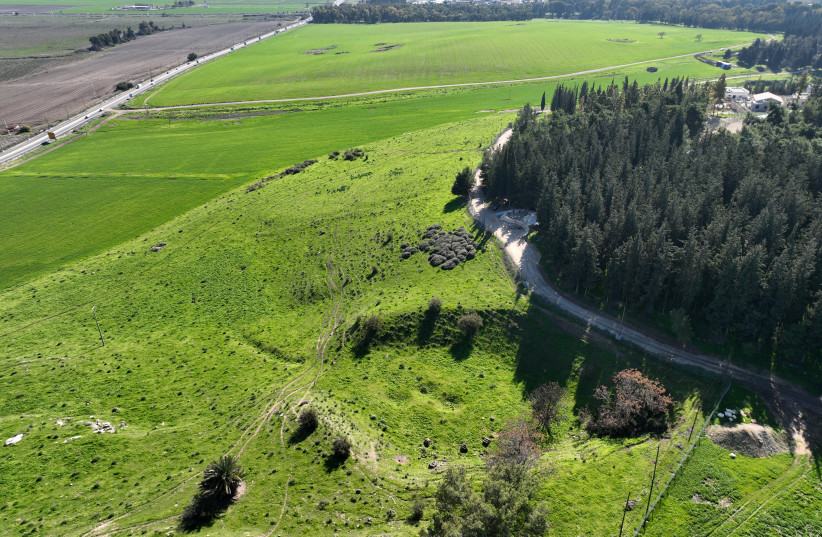
The bowl-like depression of the amphitheater at Legio. (credit: JEZREEL VALLEY REGIONAL PROJECT)

Tepper co-directs the excavations at Legio excavations with Matthew J. Adams, director of the W.F. Albright Institute of Archaeological Research in Jerusalem, and Susan Cohen, archaeologist at Montana State University.

The archaeological project at Legio is conducted under the auspices of the Jezreel Valley Regional Project. The amphitheater is one of several parts of the excavation of the base of the Roman Sixth Legion that was stationed here from the second to third centuries CE. The excavation of the amphitheater there is being supervised by Mark Letteney from the University of Southern California. The nearby Kibbutz Megiddo has also been providing strategic assistance.

History of Meggido / Legio

The area had a vibrant community, and the Roman Legion’s military camp shared the area with a Jewish village as well as with a Roman-Byzantine city.

Several excavations teams have worked at the site over the years, starting in 1902 by Gottlieb Schumacher on behalf of the German Society for Oriental Research. Schumacher – after discovering two stone stairs, one stone seat and several other architectural elements – decided that a bowl-like depression in the wadi near Megiddo had been the site of an eastern-facing theater.

However, because of the more elliptical shape of the crater, the current excavating team believed what lay underneath was actually a military amphitheater where spectators sat all around a flat-surfaced arena in a seating area called the cavea.

IN THE FIRST excavation of this area of Legio since Schumacher’s initial foray, the team excavated an area of almost 250 square meters in archaeological sections revealing parts of the flattened arena, remains of ramps made from layers of dirt and rock that would have supported the cavea, and two sections of the outside supporting wall. They have just begun to uncover the stone wall of the entrance gate to the amphitheater. In addition, they found remains of what appears to have been stone seats, said Tepper, who also uncovered parts of stone seats during excavations for his master’s degree in 2003.

They also found a gold coin from the reign of Roman Emperor Diocletian from 294 CE.

The architecture of the ancient amphitheater

The arena of the amphitheater would have been 50-70 meters (164-230 feet) long and the seating area some eight to nine meters high, said Tepper.

Their work has been made more difficult, noted Tepper, because the stones from the structure were used as building material by the subsequent inhabitants of the area, including residents of a nearby Ottoman-era village on to personnel of a British military camp.

“The main question we were looking to answer was if the bowl shape we were seeing on the ground was actually an amphitheater, and basically we have proved it,” said Adams. “We have determined the shape is artificially made… it looks like they flattened the entire area down to a natural clay source that was already there. Just today we are starting to see monumental stones from the entrance into the amphitheater gate, which is nice and promising because it is clear that at least the foundation of the wall is there.”

“Just today we are starting to see monumental stones from the entrance into the amphitheater gate, which is nice and promising because it is clear that at least the foundation of the wall is there.”

Matthew J. Adams

Compared to the elaborate amphitheaters used for the civilian population, military amphitheaters were a more rustic affair, he said, with wooden seating and a less lavish setting.

How was the amphitheater built?

Located near the Roman military camp, the amphitheater would have been built by the manual labor of the soldiers with picks and hoes, said Adams. It was used as both a training ground for soldiers as well as for “entertainment” for the troops such as gladiator battles and animal fights.

“We tend to think of an army in the modern sense but soldiers of the Roman Legion played a lot of roles including local police, builders and engineers,” he said, noting the Sixth Roman Legion from Megiddo helped build part of the Caesarea aqueduct.

Israel’s archeological richness

Israel boasts three Roman amphitheaters, in Caesarea, Bet She’an and Beit Guvrin. While some scholars maintain that the amphitheater in Beit Guvrin was also used for military purposes, Tepper and Adams believe that its location within the city indicates that it was more than likely mainly used for the population of the city.

“[Located just outside the military camp], our amphitheater is very much connected to the legion,” said Adams. “It gives us another dimension to the experience of the soldier outside the formality of the base itself. With every new find, we see different parts of their lives. In the excavation of the headquarters, we can imagine the generals planning and the troops gathering. In the barracks, we see their cooking pots where they prepared their meals. And now the amphitheater is the place where we know they were spending a lot of time as a legion training and also doing leisure activities.”


Zawartość publikowanych artykułów i materiałów nie reprezentuje poglądów ani opinii Reunion’68,
ani też webmastera Blogu Reunion’68, chyba ze jest to wyraźnie zaznaczone.
Twoje uwagi, linki, własne artykuły lub wiadomości prześlij na adres:
webmaster@reunion68.com