Archives

Media should have been more responsible in covering Tel Aviv terror attack – editorial

Media should have been more responsible in covering Tel Aviv terror attack – editorial

JPOST EDITORIAL


This was about ratings and drama and there was nothing like it before on Israeli TV.
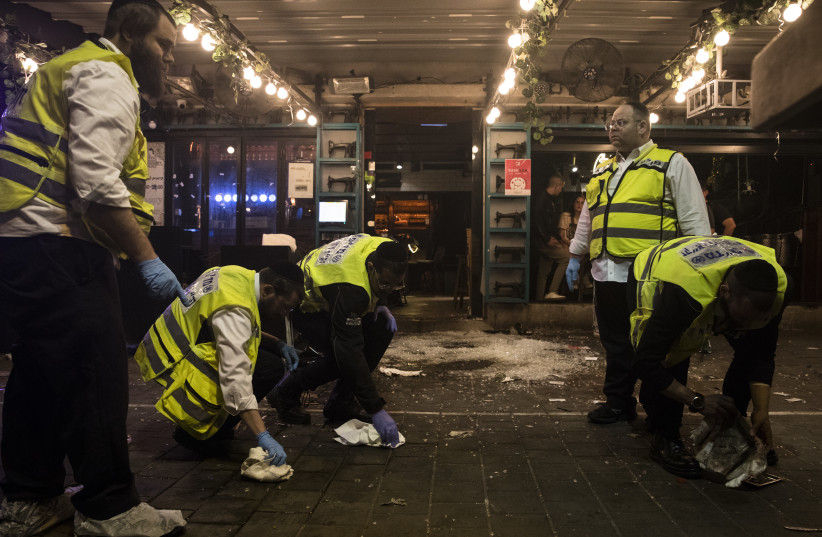
Members of Israeli ZAKA team clean blood from the site after a shooting terror attack on Dizengoff street on April 8, 2022 in Tel Aviv / (photo credit: Amir Levy/Getty Images)

Many people who watched the live TV news broadcasts from Dizengoff Street in Tel Aviv on Thursday night came away with an uneasy feeling. 

First was the suspense and drama playing out live on television, reminiscent of shows like “24” or Miami Heat. Here was a live chase for a terrorist on the streets of the State of Israel’s main commercial and entertainment hub. 

There were the initial images from the scene of the attack, at the Ilka Bar where three people were murdered and half a dozen more were wounded and then the live feed from Dizengoff 176 where dozens of policemen and IDF soldiers stood with their guns and assault rifles pointed upwards due to a suspicion that the gunman – later found near a mosque in Jaffa – was holed up inside. 

What they were thinking exactly, was unclear. Had the terrorist been inside the building and opened a window and started spraying the street below he would have hit many of those same security officers. Should the street have not been cleared and then only a select group sent to the building?

And this is only one of the many questions that came out of that evening. In general, what was obvious from the scene was that chaos reigned in Tel Aviv on Thursday night and no one was able to control what was happening.

Security forces take aim at a building where the gunman who opened fire on Dizengoff Street was suspected of hiding last night. At least two people were killed and another eight were wounded in the terrorist attack in the heart of Tel Aviv. (credit: JACK GUEZ/AFP VIA GETTY IMAGES)

The reason was that the terrorist was still on the run and was not neutralized right after the attack as mostly happens. As a result, with a terrorist on the run, the city went wild – and with it the country. 

Approximately 1,000 policemen and soldiers – including elite units like Sayeret Matkal and Shaldag – descended on the city and began going door-to-door searching for the terrorist. What also happened was that the media – there in larger numbers than usual since it was after all Tel Aviv – decided to follow the security forces on their house-to-house hunt. 

Reporters were running – mostly out of breath – after the soldiers and policemen as they went into apartment buildings, backyards and narrow alleyways in search of the shooter. That they were broadcasting police and army tactics on live TV meant nothing. That they were showing the soldier’s and policemen’s faces – some banned from being publicized- also meant very little. 

This was about ratings and drama and there was nothing like it before on Israeli TV. 

This does not mean that just the media is to blame. Reporters cannot necessarily be criticized for being caught up in the moment and doing their job even if that means chasing policemen and soldiers as they try to do their job. 

On the other hand, it can be expected of news directors and editors to understand that some situations are not meant to be covered in that way. A gunman on the loose, still armed and dangerous is a job for the security forces. 

For this to happen there needs to be someone who takes responsibility. During the evening pursuit on Thursday night, Communications Minister Yoaz Hendel (New Hope) tried to appeal to the media to follow the event from the main command post set up near the Ilka Bar, where the attack took place. No one really listened. 

What also needs to happen is for someone in the government to set rules of engagement with the media and not simply expect a situation to evolve a certain way. 

The Prime Minister’s Office has a National Information Directorate and the IDF has one of the biggest spokesperson’s offices in the country. The police PR apparatus has also grown tremendously over the years. Where were all these people? Why wasn’t there a clear flow of information? Why were Tel Aviv residents being asked to lock their doors and stay home but given very little additional information? 

Both sides need to learn lessons from what happened on Thursday night. The chaos that the entire country and world watched is not a long-term strategy. Israel needs to get its act together. 


Zawartość publikowanych artykułów i materiałów nie reprezentuje poglądów ani opinii Reunion’68,
ani też webmastera Blogu Reunion’68, chyba ze jest to wyraźnie zaznaczone.
Twoje uwagi, linki, własne artykuły lub wiadomości prześlij na adres:
webmaster@reunion68.com

Matza maneuvers and Israel’s crumbling coalition – opinion

Matza maneuvers and Israel’s crumbling coalition – opinion

RUTHIE BLUM


MK Idit Silman resigned from the government, leaving four different scenarios for how it may turn out.

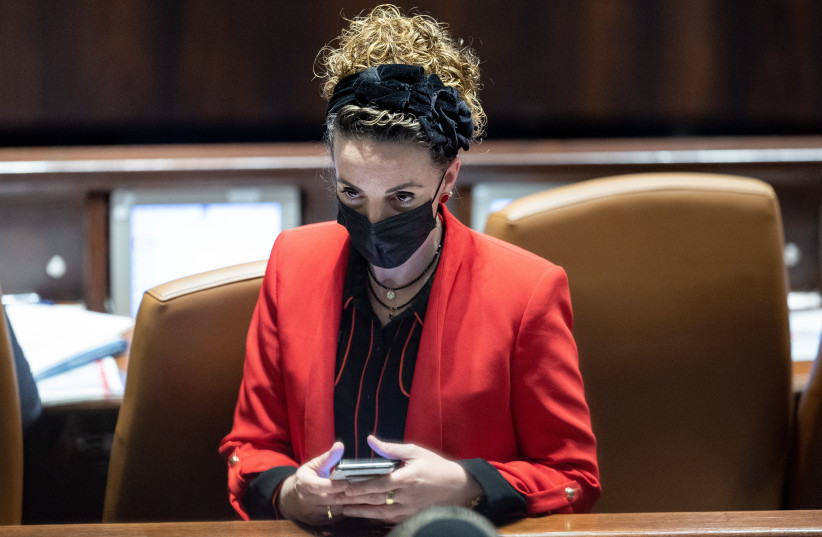
MK Idit Silman attends a plenum session for the 73rd establishment of the Knesset, in the assembly hall of the Israeli parliament in Jerusalem, January 17, 2022. / (photo credit: YONATAN SINDEL/FLASH90)

Israel’s national camp celebrated the resignation of Coalition Chair (majority whip) Idit Silman on Wednesday, and with good reason. The Yamina Party MK’s move not only robbed the government of its razor-thin majority in the Knesset. It also paved the way for additional defectors to follow suit.

The immediate upshot of what is being dubbed as a political earthquake is not yet clear. There are four possible scenarios, among them a reshuffling of the existing parliamentary constellation and another election.

But one thing is certain. The depiction of the impetus behind the move by Silman, who also serves as chairwoman of the Knesset Health Committee, is purposely misleading.

Ostensibly, she couldn’t take it anymore due to a debate with Health Minister Nitzan Horowitz over the entry of leavened goods into hospitals during the week of Passover. In fact, the current untenable union of contradictory ideologies goes far beyond points of religious ritual – at least where the public is concerned.

Silman’s particular case is different matter. She has been under serious and unpleasant pressure from her base ever since she allowed Bennett to woo her, with a cushy post, into joining him in the maneuver that required handing the mandates he received from his voters to the Left. Even her own husband came to regret backing her decision to accept the fantasy of a tenable partnership with post – and anti-Zionists – all in order to abet Prime Minister Naftali Bennett in his con.

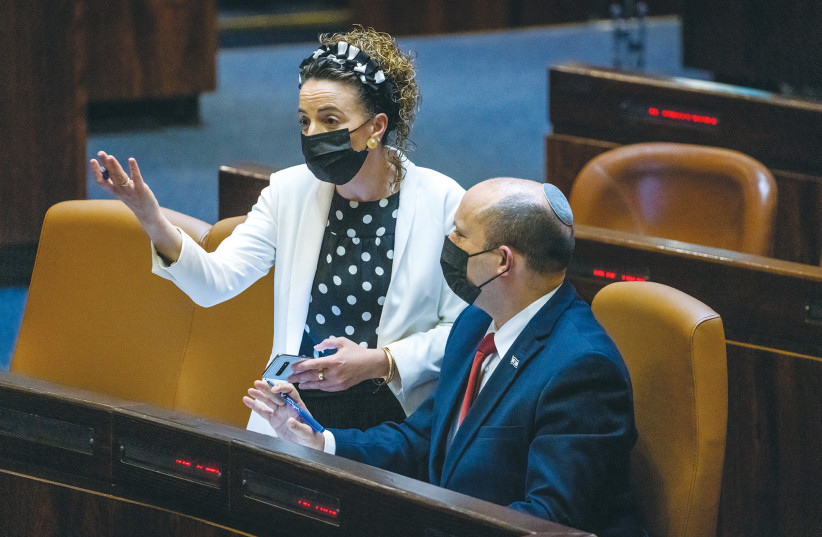
Prime Minister Naftali Bennett and MK Idit Silman seen in better days for them at a Knesset plenum session last July. (credit: OLIVIER FITOUSSI/FLASH90)

To get back at former supporters hurling epithets at her everywhere she went, she claimed to have been physically assaulted at a gas station by angry right-wingers. Her tale of woe backfired, however, as she kept altering the details of the alleged attack, which lacked both eyewitnesses and CCTV evidence.

Nor would she have jumped ship if Opposition leader Benjamin Netanyahu hadn’t promised her both the number 10 slot on the Likud list, guaranteeing her a seat in the next Knesset and the health portfolio, in place of her nemesis Horowitz.

In other words, the opportunism on her part that enabled the forming of the government a year ago is now catalyzing its demise. Upholding the ban on patients and their visitors bringing bread into medical facilities during Passover really has nothing to do with it. And she would have done well not to have argued that “people in the Holocaust fasted on Passover so as not to eat hametz [unleavened products], and a minister in the state of Israel within a coalition like ours unfortunately intends to introduce [it].” Jews starved by the Nazis didn’t have that luxury.

This is not to say that Silman was wrong for bolting, or that upholding Jewish tradition in the public sphere is unimportant to Israelis. Yet, with the uptick in deadly terrorism and out-of-control cost of living – alongside mass concern for atrocities committed in Ukraine – the hametz status quo wasn’t on anybody’s mind until Horowitz made a big issue of it.

UNWITTINGLY, HIS doing so gave Silman, an Orthodox Jew, a virtuous cause on which to pin her exit. Her resignation letter, reportedly formulated by Religious Zionism Party leader MK Bezalel Smotrich, thankfully doesn’t mention hametz-gate. On the other hand, it doesn’t refer to any other specific policy either.

“Some of our partners, who hold central positions in the coalition… are not willing to compromise on issues that are at the core of the worldview of the voters who put us in the Knesset,” she wrote. “Key values of my own do not jibe with the current reality. I am attuned to the protestations of those whose support we won… and to the pain of those who didn’t vote for us but who belong to the national camp. I can no longer bear the injury to [these] values… I call on you and the rest of my colleagues to admit the truth… The time has come to recalculate our route. To try to forge a nationalist, Jewish, Zionist government [and implement] the values on the basis of which we were elected and that represent most of the nation.”

The omission of the word religious in the list adjectives defining the kind of coalition she wants to see is not accidental. Contrary to what the local Left constantly contends and critics abroad believe, Israel is simultaneously proud of its Judaism and pluralistic. It is both the nation-state of the Jewish people and a vibrant mosaic made up of an ethnically diverse population.

Those who accuse it of apartheid and a slew of additional crimes might want to ask themselves why it’s such a magnet for tourists, refugees and foreign workers, including Palestinians. The same advice applies to the likes of Deputy Economy Minister Yair Golan, who bemoaned Silman’s “disastrous choice to strengthen the camp of the corrupt, extremist and ultra-Orthodox nationalists.”

This is the guy who in January called Jews demonstrating against plans to demolish the Homesh Yeshiva in northern Samaria and pleading with the government to rebuild the settlement destroyed there after the 2005 Gaza withdrawal “sub-humans.”

He then sneered about settlers “shouting [that plans to evacuate them are] a ‘shame’ and a ‘disgrace,’ yet failing to mention that they’ve been carrying out a pogrom [against Palestinians]. We, the Jewish people, who have suffered from pogroms throughout history, are now conducting pogroms against others.”

Such imagery wasn’t new for Golan. During his tenure as deputy chief of IDF staff, he used the occasion of Holocaust Remembrance Day to express fear that signs of the “revolting processes that occurred in Europe [during World War II]… are here among us [Israelis] today in 2016.”

Examples of this attitude abound in the current government. Such a dim view of the majority of the public has no place in the coalition ruling it.

It should be unnecessary to add a caveat about Israel’s flaws, as though anywhere else on earth is perfect or even necessarily preferable. Still, it’s worth noting in the context of the disintegrating coalition that the worst thing about the Jewish state – other than its dangerously liberal, interventionist Supreme Court – is its electoral system.

After all, it is the latter that furnished Bennett and the rest of the “anybody but Bibi” crowd with the legal means to prevent Likud – the largest single party whose leader consistently polls above his rivals – from taking its rightful place at the helm. In addition, according to the latest surveys, if elections were held today, the impasse that forced four consecutive rounds would remain pretty much intact.

Netanyahu, thus, is working tirelessly to reassemble the puzzle pieces. His efforts, naturally, are bringing to the fore a common mantra recited by his detractors: that if only he would bow out and step down, a nationalist government could be established with no difficulty. These paragons of principle need to be reminded that Netanyahu won the Likud primary by a landslide, and the party with him at its head garnered the most votes.

It is hard to conceive of any politician quitting under such circumstances. Indeed, it’s the less popular ones who should be practicing what they preach and break the stalemate. Despite her matza machinations, Silman deserves credit for providing the possibility.


Zawartość publikowanych artykułów i materiałów nie reprezentuje poglądów ani opinii Reunion’68,
ani też webmastera Blogu Reunion’68, chyba ze jest to wyraźnie zaznaczone.
Twoje uwagi, linki, własne artykuły lub wiadomości prześlij na adres:
webmaster@reunion68.com

Intact early Bronze Age jug found by American tourist in Judean Desert

Intact early Bronze Age jug found by American tourist in Judean Desert

JUDITH SUDILOVSKY


Caves have been excavated for decades in the area where Dead Sea Scrolls were found.

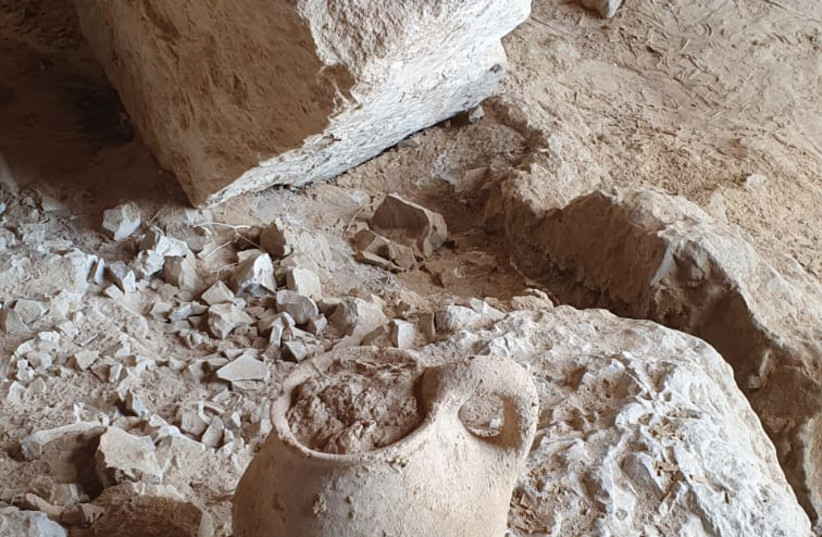
An intact 5000-year-old jug which was discovered by an American tourist in the Judean Desert after a section of a cave wall collapsed.
(photo credit: Amir Ganor/Israel Antiquities Authority)

Sometimes it just takes the right person in the right place at the right time.

Recently, American tourist Robbie Brown was that person.

Having returned for a visit to Israel with friends following the lifting of COVID-19 travel restrictions, Brown asked for special permission to visit the site of an archaeological dig in the Qumran region near the Dead Sea where five years ago he had volunteered with Dr. Oren Gutfeld of the Hebrew University of Jerusalem and Dr. Randall Price of the University of Liberty in Virginia.

The excavation of cave 53, as the site is called, was theoretically completed in 2017, said the Antiquities Authority (IAA). At the time, archaeologists uncovered shards of jars and bowls that served as lids for jars, dates and olive seeds, and even a blank piece of ancient parchment scroll – even though the cave had been excavated 30 years earlier by the IAA led by Dr. Yigal Israel and the late Dr. Rudolf Cohen, who had found antiquities from the Neolithic and Roman periods.

However, when Brown and his friends climbed into the cave located 100 meters above the road line, they were stunned to find the remains of a fallen wall, and right next to it an entire, 5,000-year-old pottery jug.

An intact 5000-year-old jug which was discovered by an American tourist in the Judean Desert after a section of a cave wall collapsed. (credit: Amir Ganor/Israel Antiquities Authority)

Having taken part in the excavations of the cave, Brown knew to photograph the jug without moving it or touching it, and contacted the IAA. Amir Ganor, the IAA’S director of the robbery prevention unit, came right out to the site with Gutfeld and Aviam Atar, the Nature and Parks Authority district director.

“It’s amazing,” said Ganor, noting that the cave was part of a survey of Judean Desert caves conducted two years ago by IAA archaeologists, intended to document and locate all ancient finds in the desert caves in an attempt to thwart antiquity thefts.

“It seems that the jar was revealed as a result of the natural collapse of a part of the cave wall at the cave entrance, which can happen over time. This is perhaps the first complete vessel we have found from this period in the caves in the Judean Desert.”

During their cave survey, pottery shard remains were found from the Early Bronze Age, he added.

“It is good that the person who entered the cave was Robbie, who participated in the excavation and is aware of the importance of the finds and their role in completing the archaeological puzzle of the Land of Israel,” said Ganor. “We call on citizens who discover artifacts to leave them in place and call us immediately so that we can maximize the archaeological information from the find.”

Ganor added that climbing without authorization in the cliff areas of the Judean Desert is dangerous and forbidden by law.

The clay jug was removed from the cave and will be scientifically analyzed.

SOME 972 TEXTS dating to the first and second centuries BCE, including the oldest known existing copy of the Old Testament, were discovered in the Qumran caves in this same area in the early years of Israel’s statehood. Since then, thousands of fragments have been found. The majority are written in ancient Hebrew while others are written in Aramaic and Greek.
The first seven scrolls were discovered in clay jars in 1947, according to the traditional story, by a young Bedouin shepherd chasing after one of his goats. What ensued was a thriller-worthy race to purchase the scrolls, and later excavate the area, after an antique dealer who had bought the scrolls from the Bedouin showed part of a scroll to Hebrew University Professor Elazar Sukenik on the eve of Israeli independence. Sukenik managed to buy three of the scrolls before war broke out, and Israel later bought others following the war.

Due to the dry climate of the Dead Sea area, the scrolls were well preserved. They are thought to have been written by members of the Essene Jewish sect living in a community at the bottom of the mountains where the caves are located. Remains from the community were also uncovered in excavations. In addition to shedding light on Jewish life during that period, the scrolls have also provided scholars with information on the emergence of early Christianity.

The first seven scrolls discovered are on display at the specially-constructed Shrine of the Book at the Israel Museum in Jerusalem.

Ownership of the scrolls has been contested by Jordan, which had sovereignty over the Qumran area until 1967, and in 2010 when the scrolls were on exhibit in Canada, Jordan demanded that Israel hand over some that had previously been housed in the Rockefeller Museum in east Jerusalem. Following the Six-Day War, Israel relocated the scrolls to the Shrine of the Book.

Canada and other countries rejected Jordan’s requests that they seize the scrolls when they have been on exhibit in museums abroad.

Israel’s Foreign Ministry told The Jerusalem Post at the time of Jordan’s demand, “Jordan’s occupation of the West Bank was never recognized by the international community, and the kingdom relinquished all claims on the territories. The scrolls have no relation to Jordan or the Jordanian people.”

Other scroll fragments including a complete scroll known as the Copper Scroll – which was found in early excavations but believed to be from a different period than the other scrolls – are on exhibit in a climate-controlled display in the Jordan Museum. The Copper Scroll is made of metal and contains a list of places where gold and silver items are hidden, and has been used as a map by treasure hunters.


Zawartość publikowanych artykułów i materiałów nie reprezentuje poglądów ani opinii Reunion’68,
ani też webmastera Blogu Reunion’68, chyba ze jest to wyraźnie zaznaczone.
Twoje uwagi, linki, własne artykuły lub wiadomości prześlij na adres:
webmaster@reunion68.com


Jared Leto Hired Team of Five Israelis to Rehearse Lines for Series on WeWork Co-Founder Adam Neumann

Jared Leto Hired Team of Five Israelis to Rehearse Lines for Series on WeWork Co-Founder Adam Neumann

Shiryn Ghermezian


Jared Leto in the limited series “WeCrashed,” premiering globally March 18, 2022 on Apple TV+. Photo: AppleTV+

Actor Jared Leto recently shared details with Variety magazine about how he prepared for the lead role of Israeli WeWork co-founder Adam Neumann in the new limited television series “WeCrashed.”

In the show — his first starring role in a TV series since “My So-Called Life” — Leto, 50, plays the Israeli businessman who co-created the shared office space company, while actress Anne Hathaway stars as Neumann’s wife and muse, Rebekah. The eight-episode series will debut on Apple TV+ on Friday.

Leto, who is not Jewish, told Variety that he had a surprisingly hard time playing Neumann. The 30 Seconds to Mars frontman said that in order to get ready for the role, he took part in Shabbat dinners and hired a team of five Israelis to rehearse lines with so he could “hear that voice all the time.”

“A couple of times, strangely towards the end of shooting ‘WeCrashed,’ Paolo’s [accent] started to come out a little bit,” Leto added, referring to his recent role in Ridley Scott’s “House of Gucci.” He said, “It was very bizarre. I don’t know if it’s because I got tired or if Paolo was just demanding my attention, but that can happen.”

Still, Leto stayed in character in between takes for “WeCrashed,” according to Hathaway. She told the magazine, “I didn’t really work with Jared. He was only ever Adam. It was fun. Wild and focused. Inspiring.”

Leto also told Variety that he met Neumann in-person as part of his prep for the role, and recalled being captivated by the Israeli entrepreneur. He also advised Neumann not to watch the show. “I don’t even watch it,” said Leto, who famously does not like to watch his own projects. “So why would I tell him to watch it?”


Zawartość publikowanych artykułów i materiałów nie reprezentuje poglądów ani opinii Reunion’68,
ani też webmastera Blogu Reunion’68, chyba ze jest to wyraźnie zaznaczone.
Twoje uwagi, linki, własne artykuły lub wiadomości prześlij na adres:
webmaster@reunion68.com


News From Israel- April 04, 2022

News From Israel- April 04, 2022

ILTV Israel News


On the second night of Ramadan Palestinians clash with police, as tensions remain high and security forces placed on highest alert

Ukraine condemning Russia’s aggressive actions in Bucha as war crimes…What are Israeli officials saying?

And a new poll during diaspora week…Only a small majority of Israelis feel a kinship with Jews around the world


Zawartość publikowanych artykułów i materiałów nie reprezentuje poglądów ani opinii Reunion’68,
ani też webmastera Blogu Reunion’68, chyba ze jest to wyraźnie zaznaczone.
Twoje uwagi, linki, własne artykuły lub wiadomości prześlij na adres:
webmaster@reunion68.com