Archives

News From Israel- March 03, 2022

News From Israel- March 03, 2022

ILTV Israel News


As the Russian invasion enters its 8th day, is Israel looking to take on a more active mediation role?

What lessons can Israel draw over Iran from the world’s reaction to the Russia-Ukraine war? Likud Knesset member and former mayor of Jerusalem Nir Barkat weighs in

We’ll hear from Rabbi Mendi Wolf, who is on a mission to evacuate over 100 orphans from Ukraine


Zawartość publikowanych artykułów i materiałów nie reprezentuje poglądów ani opinii Reunion’68,
ani też webmastera Blogu Reunion’68, chyba ze jest to wyraźnie zaznaczone.
Twoje uwagi, linki, własne artykuły lub wiadomości prześlij na adres:
webmaster@reunion68.com


It’s All About Us

It’s All About Us

Shmuel Sackett


People love looking forward to something; a vacation, the Super Bowl, or the day their kids (finally) leave for sleepaway camp. Everyone has their own list… but what about the world. Yes, the world. What should the world be looking forward to?

The Midrash teaches (Midrash Rabbah, Ba’Midbar 1) that “if the nations of the world realized the value of the Bet Ha’Mikdash to all of humanity, they would surround it with their armies and guard it for the Jews!”

In the book of Yeshayahu, there is an incredible prophecy; (Chapter 56, verse 7) “My House will be called a house of prayer for all nations.” We say this passuk many times a year, before the beautiful prayer of “Shema Kolenu”. We are stating, in very clear words, that the awesome place we want rebuilt – the holy Bet Ha’Mikdash – is not only for the Jewish nation… but for the entire world as well!

This is (or should be) the #1 item on “The world’s wish list” … for the Jews to return home and build the 3rd and final Temple in Jerusalem. There’s only one problem. Not only is this not item #1, the world is doing everything they can to make sure it does not happen at all.

Let me tell you about something that happened just 2 months ago. If not for Covid, this would have been the biggest story in the news. Unfortunately, it was not reported in any major media outlet – on both sides of the political spectrum. Sorry, but we can’t just blame this on CNN or Whoopi Goldberg. (However, it was reported in JewishPress.com)

The United Nations held a special vote on December 1, 2021, and here are the results: 129 countries voted that Israel does not have any ties to the Temple Mount. Those same 129 countries affirmed that the Temple Mount is to be recognized only by its Muslim name, al-Haram al-Sharif.  Obviously, those 129 countries failed history class because Islam was founded in the 7th Century – and the first Bet Ha’Mikdash was built 1,400 years before that – but, as they say, don’t confuse me with the facts.

In case you are interested; who voted against this resolution that rewrites history? 11 countries including USA, Hungary and the Czech Republic… and who abstained? 31 countries including the United Kingdom, Kenya and Ukraine. (By the way, everyone’s new best friend – and the one with the most exciting glatt kosher, mehadrin, kitniyot free Pesach program – the United Arab Emirates – voted in support of this bill. But I thought they loved us?? I’m so confused…)

Now comes the important part of this article: Who do we blame? Whose fault is it that 129 countries voted this way? Allow me to be very clear with my answer; I don’t blame any of the 129 countries. How can Bangladesh and South Africa feel that the Temple Mount is an integral part of the Jewish Nation… if most of the Jewish Nation doesn’t feel that way? 70% of American Jews have never been to Israel even once in their life and have no desire to do so… so what do we expect from Cuba and Japan?

But let’s talk about the 30% who do come to Israel. Ask them what is the #1 holiest site in Israel today and I guarantee you that 98% will say “the Kotel”. Why is that? Why won’t we admit that the “Makom Ha’Mikdash” – the place of the Temple – is the holiest, most special place for Jews… and all of mankind? Don’t misunderstand me. I am not getting into the discussion of going up to Har Ha’Bayit or not. I’m simply trying to understand why this awesome place, described in our holy books as “where Heaven kisses earth” is not on most Jew’s radar.

What happens within 24 hours of landing in Israel? You rush to the Kotel, then Café Rimon in Mamilla. After that it’s Machane Yehuda and Mea Shearim for some shopping, Aroma for coffee, back to the Kotel and then Papagaio for dinner. How many times have you stopped, looked at the desecration on the Temple Mount, and shed a tear? Do you think mourning over the destruction of the Bet Ha’Mikdash is limited just to Tisha b’Av? I have no problem with davening at the Kotel but at least feel bad that you are in the garden and not in the palace.

The 129 countries of the world want you to remain in the garden. They want to disconnect you from your most cherished and special place. They want you to forget about it and simply sing it as a song; “Next Year in Jerusalem…” Unfortunately, many of us have already done this and while we wouldn’t actively vote with Iran or Indonesia, our actions tell a different story.

Dearest friends: stop blaming the world and start realizing that it’s all about us. How do we feel about Har Ha’Bayit? How connected are we to the Makom Ha’Mikdash? How many of us can look at a drawing of the Bet Ha’Mikdash and correctly identify many of the areas? We are now reading the Torah portions that deal with the Mishkan – which is a miniature Bet Ha’Mikdash – and its vital we make those Torah portions real.

Don’t let the 129 countries of the world win. Focus on the Bet Ha’Mikdash and make sure you understand the connection between our Nation, our future, our destiny, and this great and awesome place. And most importantly of all, don’t just sing about it… make sure you live it as well!

Am Yisrael Chai!


Zawartość publikowanych artykułów i materiałów nie reprezentuje poglądów ani opinii Reunion’68,
ani też webmastera Blogu Reunion’68, chyba ze jest to wyraźnie zaznaczone.
Twoje uwagi, linki, własne artykuły lub wiadomości prześlij na adres:
webmaster@reunion68.com


Amid Ukraine crisis, Israel should be a safe haven for refugees – editorial

Amid Ukraine crisis, Israel should be a safe haven for refugees – editorial

JPOST EDITORIAL


It is high time that Israel stop being so stringent in its opposition to absorbing refugees from distressed situations.

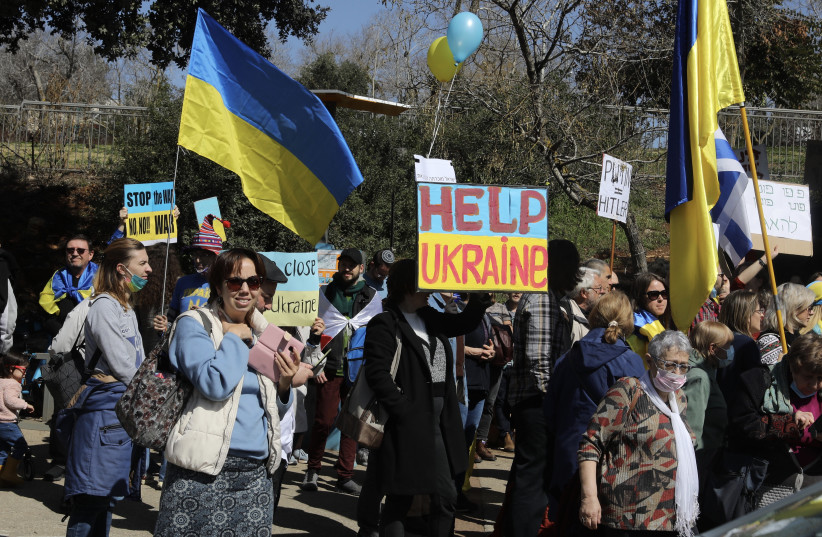
Israelis protest on behalf of Ukraine outside the Knesset, February 28, 2022. / (photo credit: MARC ISRAEL SELLEM/THE JERUSALEM POST)

As The Jerusalem Post’s correspondent Zvika Klein – who is in Poland reporting on some of the thousands of refugees crossing the border from war-torn Ukraine – eloquently stated on Tuesday, we should all be proud of Israel’s humanitarian efforts over the last week.

Israel was established as a state and a haven for all Jews, and the brutal Russian invasion of Ukraine has proven, like countless examples in the past throughout the world, that when Jews are in danger, Israel is there to help.

Along with global Jewish organizations, the government has sprung into action in an attempt to rescue the Israelis still in Ukraine and to aid the Jewish Ukrainians who are fleeing the country. On the ground, Foreign Ministry personnel have been working 24/7 at Ukraine’s borders, helping Israelis and Jews get to safety.

As Klein pointed out, well before Russian President Vladimir Putin invaded Russia in an unprovoked war, Israel had already invested unparalleled man hours and effort to prepare for the evacuation and life-saving decisions for tens of thousands of Israelis and Jews.

Back in Jerusalem, Israel hasn’t sat idle. An Israeli shipment of about 100 tons of humanitarian aid to Ukraine arrived this week, including 17 tons of medical equipment and medicine, water purification systems intended to supply 200,000 people, emergency water supply kits to supply 100,000 people, winter tents to house 3,000, 15,000 blankets, 3,000 sleeping bags and 2,700 winter coats.

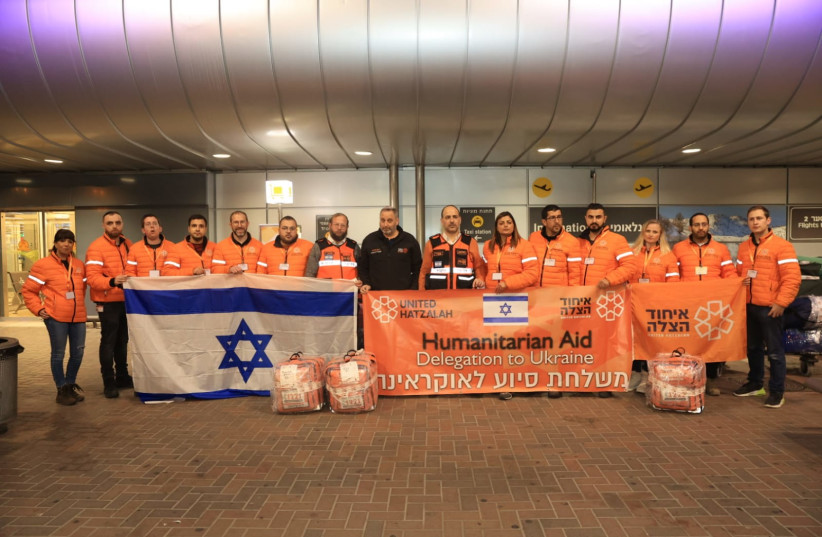
The United Hatzalah delegation ahead of departure to Moldovia (credit: United Hatzalah Spokesperson)

Ukrainian Jews are also taking advantage of Israel’s open doors to make aliyah. A family that Klein wrote about on Tuesday – Natalia and Andre Forys and their children, Arina, 12, and Max, six, from outside Kyiv – are on their way to their new home in the Jewish state. An estimated 10,000 Ukrainian Jews have registered to immigrate to Israel, out of 200,000 who are eligible.

It’s admirable, and as Klein wrote, makes one proud to be an Israeli.

However, another aspect of Israel’s efforts regarding the war is somewhat less admirable. On Tuesday, Ukrainian Ambassador to Israel Yevgen Korniychuk told reporters that dozens of Ukrainian nationals had arrived at Ben-Gurion Airport and were sent back despite the ongoing humanitarian crisis caused by the Russian invasion.

The ambassador said that officials in Jerusalem were asking for bonds of up to NIS 20,000 to allow someone to remain in the country, money that none of these refugees have.

“We believe that you remember the times of the Second World War, when Ukrainians were saving the lives of Jews during the Holocaust. Ukraine is in fourth place, with almost 4,000 people who have been called Righteous Among the Nations… we are asking you to help the Ukrainians to overcome this tragedy now,” he said, calling the situation “humanitarian.”

Israel is admittedly hesitant to open the borders to non-Jewish refugees because there have been many instances in the past of tourists from former FSU countries who remained in the country illegally and began to work.

A spokesperson for Interior Minister Ayelet Shaked denied that Ukrainian refugees were not allowed into the country. 

“We are not deporting Ukrainians. Whoever wants to enter with a tourist visa is welcome. Whoever reaches Israel and, in accordance with the Population, Immigration and Border Authority’s questioning, is found to be someone who wants to be here for a month, as a tourist, can enter. Europe is absorbing all Ukrainian citizens for three years.”

In a speech Wednesday, Diaspora Affairs Minister Nachman Shai criticized that policy, saying that the formal criteria for entry must be put aside during a time of emergency. 

“At this moment, we need to open the gates of the state of Israel to Ukrainian refugees,” he said.

Prime Minister Naftali Bennett spoke with Shaked about adopting a “broader approach of Beit Hillel” in allowing Ukrainians into the country.

Those are encouraging signs. It is high time that Israel stop being so stringent in its opposition to absorbing refugees from distressed situations.

Israel is a strong country, its Jewish character and essence unthreatened by hundreds – or even thousands – of people who desperately need a haven. Just like we welcome in Jews from around the world with open arms, in times of war, we should do the same with whoever needs our refuge.


Zawartość publikowanych artykułów i materiałów nie reprezentuje poglądów ani opinii Reunion’68,
ani też webmastera Blogu Reunion’68, chyba ze jest to wyraźnie zaznaczone.
Twoje uwagi, linki, własne artykuły lub wiadomości prześlij na adres:
webmaster@reunion68.com


BDS and the Apartheid Libel Are on the March

BDS and the Apartheid Libel Are on the March

Alexander Joffe


Illustration with the logo of Amnesty International on the vest of an observer of a demonstration in Paris, France, Paris, on Dec. 11, 2021. Photo: Xose Bouzas / Hans Lucas via Reuters Connect

A key development in BDS activity in February was a report by Amnesty International entitled “Israel’s Apartheid Against the Palestinians.” The BDS movement and its various supporters, immediately lauded the report. BDS advocates also complained about what they deemed as inadequate coverage by mainstream media — despite the fact that the report’s lies and distortions received prominent coverage.

Observers immediately noted that the report, based almost entirely on its own and other NGO “analyses” (sometimes quoting nearly verbatim) was filled with egregious errors of fact and overt fabrications, and was undermined by Amnesty leaders’ farcical ignorance and obsession regarding Israel. By advocating for a Palestinian “right of return,” the report also effectively argued for the destruction of Israel. Palestinian terrorism and rejection of negotiations were completely omitted.

The Amnesty report was widely condemned by US and European governments, Jewish and Israeli organizations, and by both an Islamist Israeli Arab politician and the head of Amnesty’s Israel branch. But it follows similar reports by Human Rights Watch and B’Tselem, and anticipates additional reports from the Commission of Inquiry that was recently created by the United Nations Rights Committee.

Despite a hostile reception from governments, BDS supporters are already referencing the Amnesty report, including those promoting a BDS resolution at Concordia University. In Britain, the Labour Party’s former shadow chancellor, John McDonnell, spoke in opposition to a government plan to prohibit local councils from adopting BDS measures, saying that he was “against investments going into Israel, as I do believe according to the Amnesty Report, the Human Rights report and many Jewish institutions as well, that actually it is an apartheid state the way they treat the Palestinians.”

There were also a number of significant BDS-related developments in academia. Among the most noteworthy were campus protests aimed at Israelis. At the Harvard Kennedy School of Government, BDS supporters protested outside a classroom where retired IDF Major General Amos Yadlin was speaking. Calling Yadlin a “war criminal,” the protestors accused the university of “lack of regard for Palestinian narratives.” The same BDS group also protested the presence of Sabra brand hummus on campus. Additional protests again the brand were held at Northwestern University.

Similarly, at Cambridge University, Israeli official and former cabinet minister Tzipi Livni was met by anti-Israeli protests that included flares and whistles, chants of “from the river to the sea, Palestine will be free,” and posters calling her “Zionist scum.” Jewish students and the British Universities Secretary condemned the tone of the protests.

At the University of Manchester, the head of StandWithUs in Britain was confronted and abused by pro-Palestinian protestors, who called her “worse than Hitler.” At the University Chicago, the local Students for Justice in Palestine (SJP) chapter urged the boycott of “sh**y Zionist classes,” specifically naming several taught by Israelis, warning that they “serve as vehicles to spread Zionist propaganda.” In response to a media inquiry, a university spokesperson stated that the institution’s “values compel our steadfast opposition to discrimination, including rejection of antisemitism, anti-Palestinian bias, and other forms of bias that are incompatible with our commitment to diversity and inclusion.”

Similarly, at the University of Illinois, the SJP chapter condemned the School of Public Health’s hosting of Israeli speakers, while the chapter at UCLA called on students to boycott a scholarship at the School of Public Affairs founded by former Rep. Lynn Schenk (D-NY) because she is a “Zionist.” At the University of Connecticut, the SJP chapter protested the university president’s plan to travel to Israel.

Efforts to ostracize Israelis are also underway in the Middle East Studies Association (MESA), where the membership is voting on a BDS resolution. In response, at least a half dozen universities have dropped or declined to renew their institutional memberships. The bases of these decisions have not been publicized, but they are likely in response to potential threats to funding should educational institutions endorse MESA’s desired policy of discrimination on the basis of national origin.

In the Netherlands, a number of universities have issued a statement suspending compliance with a freedom of information request filed by an anti-Israel NGO, that demanded they disclose ties with Israeli and Jewish entities. The group making the request — the Rights Forum — was founded by a notoriously antisemitic former Dutch prime minister, who has accused Israel of being a “Nazi state” that “poisons Palestinians.”

There were also a number of BDS developments in the student realm. Reports indicate that an unofficial sexual assault awareness group at SUNY New Paltz excluded Jewish students on the basis of their support for Israel. The group responded that any defense of Israel as a “a non-colonial state and justifying its occupation of the area, is being indifferent [and] condoning the oppression of Palestinians,” and that “Allowing these beliefs to permeate into our organization would exclude Palestinian students and survivors.”

Pushback against the IHRA working definition of antisemitism also occurred in February. At the University of Texas, the student government took up a resolution to withdrawn and condemn its previous endorsement of the IHRA definition. The local SJP chapter later withdrew the resolution after university officials expressed concern about the student government taking up “non-university issues.” At Queen Mary University of London Jewish students protested an event on “resisting and refusing IHRA.” In contrast, the student government at Duke University approved a resolution condemning antisemitism and endorsing the IHRA definition.

The student union at the University of Toronto voted to approve a BDS resolution that calls on the union to “wholly divest funds and further on forbid investment to firms complicit in the occupation of Palestinian Territory.” The concepts of “firms” and “Palestinian Territory” were not defined. The new resolution comes in the wake of a late 2021 decision by the student union at the Scarborough campus to boycott all such “firms” active on campus, and to “refrain from engaging with organizations, services, or take part in events that further normalize Israeli apartheid.”

The impact of the wave of BDS protests and efforts to ostracize Jews and Israelis on campus was highlighted by a call from members of Congress for the Department of Education to do more to prevent campus antisemitism. The Department of Education has delayed issuing rules regarding antisemitism until the end of 2022. Jewish leaders similarly called on Congress to provide more support for Department of Homeland Security programs aimed at protecting Jewish institutions. The impact of BDS rhetoric and protests has also been documented in reports showing the rise of antisemitic incidents in both the US and in the UK.

In the political sphere, support for BDS and animosity towards Israel are now clear litmus tests on the “progressive” left, in both districts with and without Jewish constituencies. The split within the party is demonstrated by the selection of ‘Squad’ member and BDS supporter Rep. Rashida Tlaib (D-MI) to give a response to President Biden’s State of the Union Address on behalf of the Working Families Party.

Another important BDS-related development is a statement by a number of progressive groups opposing the Abraham Accords. Led by “Jewish Voice for Peace Action,” the 29 groups included all major BDS organizations, such as the American Friends Service Committee, CAIR, the Center for Constitutional Rights, IfNotNow, and the Presbyterian Church (USA). The statement makes the accusation that

While masquerading as ‘peace’ and ‘diplomacy’, the Abraham Accords and this legislation are in fact an endorsement of arms sales and political favors between the U.S. and authoritarian regimes — including weapons sales to the United Arab Emirates and the recognition of Morocco’s illegal annexation of Western Sahara — in exchange for the sidelining of Palestinian rights.

Legislators are thus increasingly caught between the positions of their constituents and the far-left anti-Israel consensus. One example of this is Rep. Jamaal Bowman (D) of New York, who withdrew his support for bipartisan legislation aimed at strengthening the Abraham Accords. Bowman, whose district includes heavily Jewish southern Westchester, stated that after a J Street-sponsored trip to Israel, he “became aware that the deals that this bill supports and seeks to pursue, have included deals at odds with human rights and safety for everyday people in the region.” In reality, the legislation specifically calls for the US to “support a negotiated solution to the Israeli-Palestinian conflict resulting in two states — a democratic Jewish state of Israel and a viable democratic Palestinian state — living side by side in peace, security, and mutual recognition.” Bowman had been previously criticized for his trip by the Democratic Socialists of America.

The impact of antisemitism in politics is likely reflected in the continuing upswing in antisemitic acts across the US, including vandalism of property in New YorkChicagoWashington, DC, and elsewhere.


A version of this article was published at SPME, where the author is a contributor.


Zawartość publikowanych artykułów i materiałów nie reprezentuje poglądów ani opinii Reunion’68,
ani też webmastera Blogu Reunion’68, chyba ze jest to wyraźnie zaznaczone.
Twoje uwagi, linki, własne artykuły lub wiadomości prześlij na adres:
webmaster@reunion68.com


Russian missiles hit city administration, residential areas

Russian missiles hit city administration, residential areas

AARON REICH, REUTERS, JERUSALEM POST STAFF


Ukraine’s ambassador to US accused Moscow of using a vacuum bomb. * Ukrainian President Volodymyr Zelensky: States that commit war crimes shouldn’t get a permanent UNSC seat.
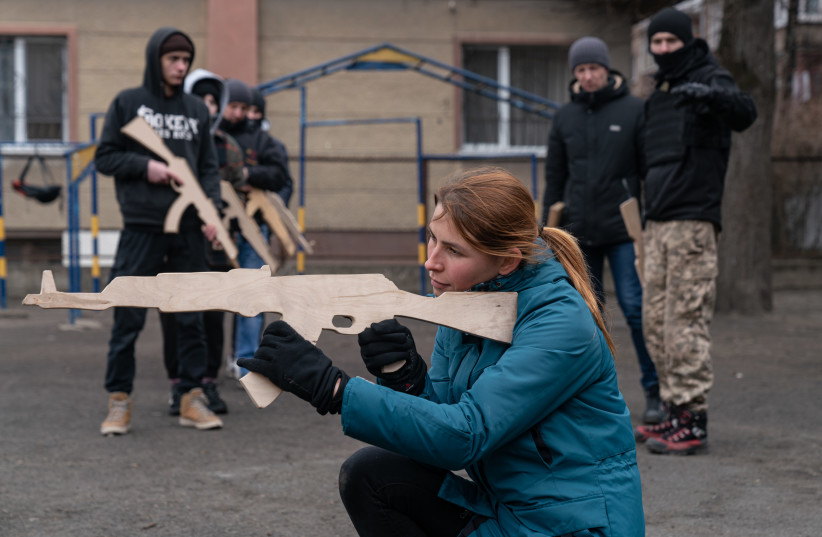
A woman takes part in a basic military training session on February 28, 2022 in Ivano-Frankivsk, Ukraine. / (photo credit: Alexey Furman/Getty Images)

Kharkiv region head Oleg Synegubov said on Tuesday that Russian missile attacks hit the center of Ukraine’s second-largest city, including residential areas and the city administration building, as Moscow started day six of its invasion.

Synegubov said Russia launched GRAD and cruise missiles on Kharkiv and was guilty of war crimes. He said the city defenses were holding.

The recent shelling of the city of Kharkiv in Ukraine by Russian forces is a war crime, Ukrainian President Volodymyr Zelensky said as the conflict stretched into its sixth day on Tuesday.

The Ukrainian president called for a no-fly zone for Russian missiles, planes and helicopters, though he did not specify how this would be enforced. Washington has firmly declined a Ukrainian request for the West to impose a no-fly zone to shield Ukraine from Russian airstrikes – a step that would bring Western forces into direct conflict with the Russian military.

Zelensky argued that Russia has committed war crimes in Ukraine, specifying that the artillery shelling of the city of Kharkiv constituted as the targeting of civilians.
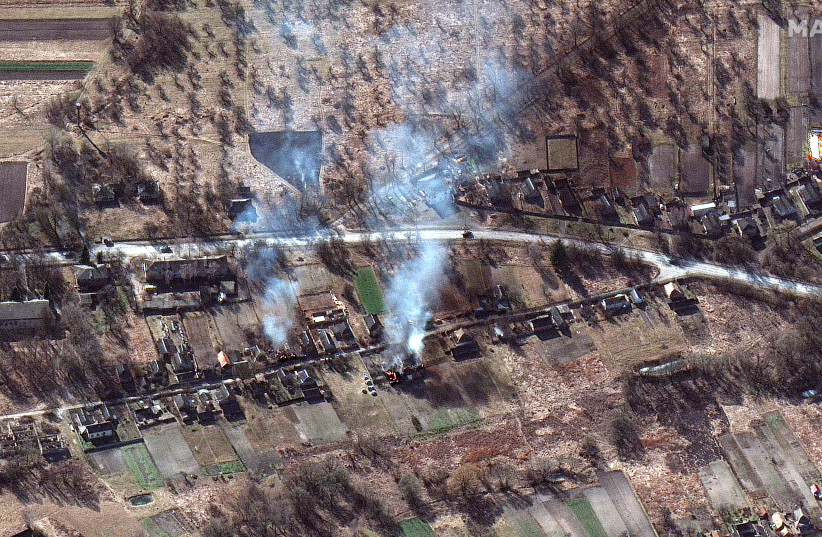
A satellite image shows part of a military convoy and burning homes, near Invankiv, Ukraine February 28, 2022. (credit: Satellite image 2022 Maxar Technologies/Handout via REUTERS)

According to Ukrainian Ambassador to the US Oksana Markarova, Russian forces used an illegal weapon known as a vacuum bomb against Ukraine.

“They used the vacuum bomb today, which is actually prohibited by the Geneva convention,” Markarova said after briefing members of the US Congress. “The devastation that Russia is trying to inflict on Ukraine is large.”

A vacuum bomb uses oxygen from the surrounding air to generate a high-temperature explosion, typically producing a blast wave of a significantly longer duration than that of a conventional explosive.

https://twitter.com/i/status/1498550505211113474

.

In addition, Amnesty International and Human Rights Watch both said that Russian forces appeared to have used widely banned cluster munitions, with Amnesty accusing them of attacking a preschool in northeastern Ukraine while civilians took shelter inside.

Amnesty International said international humanitarian law prohibits the use of inherently indiscriminate weapons such as cluster munitions. Launching indiscriminate attacks that kill or injure civilians constitutes a war crime.
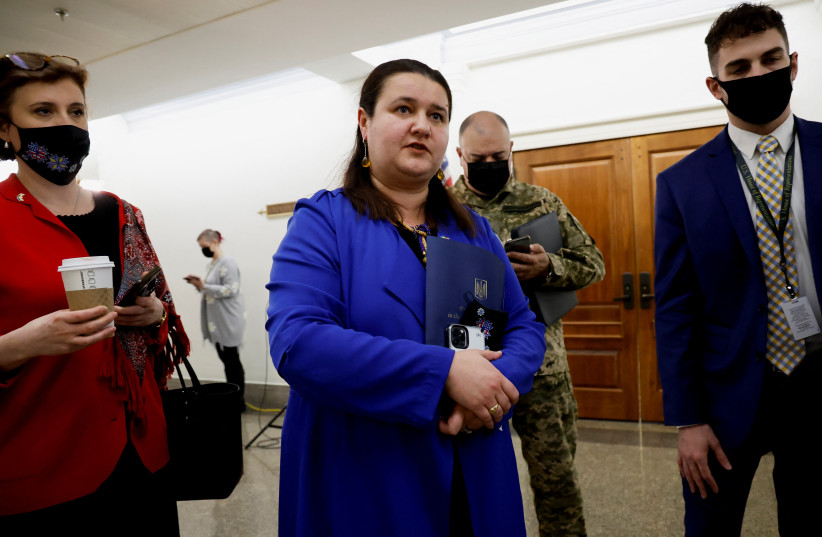
Ukraine’s ambassador to the United States Oksana Markarova walks between meetings with members of the U.S. Congress on Capitol Hill in Washington, US. February 28, 2022. (credit: REUTERS/JONATHAN ERNST)

White House Press Secretary Jen Psaki said she had seen reports but did not have confirmation that Russia had used such weapons. “If that were true, it would potentially be a war crime,” she told a press briefing, noting that there are international organizations that would assess that and President Joe Biden’s administration “would look to be a part of that conversation.”

The Russian embassy in Washington did not respond to requests for comment.

Any state that has committed war crimes should not be allowed to be a permanent member of the United Nations Security Council, Zelensky said.

“Dozens of eyewitness accounts” indicated that this was a targeted attack of a residential area without military facilities, Zelensky said, according to the New Voice of Ukraine news outlet. “The Russians knew where they were shooting,” he said, adding that “No one in the world will forgive you for killing peaceful Ukrainian people.”

This comes after the International Criminal Court said they might investigate any war crime committed in Ukraine. 

As the war enters its sixth day, around 350,000 people have entered Poland from Ukraine since Russia invaded the country, a Polish deputy interior minister said on Tuesday.

“Over the last 24 hours 100,000 people crossed the Polish-Ukrainian border,” Maciej Wasik told public broadcaster Polskie Radio 1. “In total, since Thursday, there have already been 350,000 refugees.”

Military developments

Russia’s advance on Kyiv has made little progress in the past 24 hours due to logistical difficulties and the army has increased its use of artillery north of the capital, a British military intelligence update said.

“The Russian advance on Kyiv has made little progress over the past 24 hours probably as a result of continuing logistical difficulties,” the British defense ministry said in a military intelligence update.

“Russian forces have increased their use of artillery north of Kyiv and in vicinities of Kharkiv and Chernihiv. The use of heavy artillery in densely populated urban areas greatly increases the risk of civilian casualties.”

“Russia has failed to gain control of the airspace over Ukraine prompting a shift to night operations in an attempt to reduce their losses,” it said.

.

More than 70 Ukrainian servicemen were killed when Russian troops shelled a military base in the town of Okhtyrka in Ukraine’s northeastern Sumy region on Monday, regional governor Dmytro Zhyvytskyy said on Facebook.

Satellite images taken on Monday show a Russian military convoy north of the Ukrainian capital of Kyiv that stretches for about 40 miles (64 km), substantially longer than the 17 miles (27 km) reported earlier in the day, according to Maxar Technologies.

Further, Ukraine cut communications for Russian cellphone numbers in the country, according to the Derzhspetszviazok (The State Service of Special Communications and Information Protection of Ukraine), the country’s intelligence and technical security service.

In addition, Ukraine will allow foreigners traveling to the country to help fight against Russia to do so without a visa, according to a new decree signed by the president that went into effect Tuesday.

The decree, signed by President Volodymyr Zelensky, allows for all foreigners hoping to join the new unit for foreign volunteers, known as the International Legion of the Territorial Defense Force, with the exception of those coming from Russia.

The new unit for foreign volunteers was announced on Sunday, with Ukrainian authorities having said the next day that thousands have already applied to join.

Some young volunteers are traveling straight to Ukraine to enlist.

Others are applying at Ukrainian embassies and consulates before quitting jobs or dropping out of university. Full story here.

Negotiations

Turkish President Tayyip Erdogan’s office said early on Tuesday that he held a phone call with his Belarusian counterpart Alexander Lukashenko to discuss developments in Russia’s invasion of Ukraine.

The two premiers discussed ceasefire talks between Russia and Ukraine, according to Erdogan’s office. The talks failed to reach a breakthrough on Monday, and negotiators have not said when a new round would take place. 

Erdogan’s office said he told Lukashenko that Turkey will continue to make efforts to stop the war and restore peace. Russia calls its actions in Ukraine a “special operation.”

Zelensky said the negotiations between Russia and Ukraine were conducted against the background of Russian bombardments into Ukrainian territory. 

The fact that these two events took place at the same time, Zelensky said, was no coincidence, accusing Moscow of doing it intentionally, according to NV.

“Don’t waste your time, we don’t accept this tactic,” Zelensky said, according to NV. “Fair negotiations can only happen when one side doesn’t hit the other with artillery during negotiations.”

Regarding the points brought up in the talks themselves, Zelensky said that he would go over what was discussed with the Ukrainian delegation when they return to Kyiv so they can decide how to move forward when the second round of negotiations begins, according to Ukrainian media.

Diplomacy

Ukraine has made an effort to reach out to the West repeatedly during the conflict, including Europe. 

Zelensky officially applied on Monday to join the European Union, with the application being on its way to Brussels for processing, Ukrainian President’s Office deputy head Andrij Sybiha wrote on Facebook.

In response, the heads of state for eight different EU member states – Bulgaria, Estonia, Lithuania, Latvia, Poland, Slovakia, Slovenia and the Czech Republic – pushed for immediately admitting Ukraine into the bloc. 

This follows Slovakian Prime Minister Eduard Heger telling Politico that Ukraine should have a “special track” towards EU membership.

Energy ministers from European Union countries on Monday agreed to urgently link a European power system to Ukraine’s grid, a move that would increase its independence from Russia.

Ukraine disconnected its grid from a Russian system last week and has asked for emergency synchronization with a European system. That would mean Russia would no longer control technical aspects of Ukraine’s network such as grid frequency. EU officials said the link could be completed within weeks. Full story here.

Sanctions, economy and corporate reactions

The financial impact of the conflict, international reaction to it from businesses and Western sanctions has been noted in analyses of the Russian economy.

The Council of the European Union sanctioned 26 individuals over Russia’s aggressive actions in Ukraine, including noted Russian-Israeli billionaire Mikhail Fridman.

The rouble stabilized somewhat on Tuesday after its crash to an all-time low, while the safe-haven yen and Swiss franc were steady after their biggest rallies in almost seven weeks with traders focused squarely on the developing crisis in Ukraine.

This impact was also felt by Russian companies, with many of its key companies taking hits.

Ukrainian Foreign Minister Dmytro Kuleba said on Tuesday morning that US Secretary of State Antony Blinken had offered his country, which is under attack from its neighbor Russia, more support in the form of sanctions and weapons.

A stream of Western companies pulling out of Russia is expected to grow on Tuesday, as corporations and investors across industries follow the lead of energy firms BP and Shell, which abandoned multi-billion-dollar positions after the invasion of Ukraine.

Three major Hollywood studios, Disney, Sony and Warner Bros., said they would pause theatrical releases of upcoming films in Russia in response to its invasion of Ukraine and the unfolding humanitarian crisis.

The impact has also been felt in sports, too. 

International football governing body FIFA has expelled Russia from competing in the World Cup, with Russia’s business partnerships with the US hockey league the NHL ending and Russia and Belarus being sanctioned by the International Ice Hockey Federation sanctioned Russia and Belarus, which is supportive of the invasion, banning both nations from upcoming world championship tournaments. Full story here.


Zawartość publikowanych artykułów i materiałów nie reprezentuje poglądów ani opinii Reunion’68,
ani też webmastera Blogu Reunion’68, chyba ze jest to wyraźnie zaznaczone.
Twoje uwagi, linki, własne artykuły lub wiadomości prześlij na adres:
webmaster@reunion68.com